COPI NG I N AGED PEOPLE W I TH ALZHEI MER´ S DI SEASE
Juliana Ner y de Souza1 Elian e Cor r êa Ch av es2 Pau lo Car am elli3
JN Souza, EC Chaves, P Caram elli. Coping in aged people wit h alzheim er´ s disease. Rev Lat ino- am Enferm agem 2 0 0 7 j an eir o- fev er eir o; 1 5 ( 1 ) : 9 3 - 9 .
The int ensit y of st ress experiences and elaborat ion of coping essent ially depend on individuals’ cognit ive assessm ent . Consider ing t he cognit ive im pair m ent of elder ly per sons w it h Alzheim er ’s disease ( DA) , t his st udy aim ed t o ident ify t heir coping st yle. The Jalowiec Coping I nvent ory was applied t o 60 elderly, 30 in t he cont rol group and 30 in t he DA group. The result s dem onst rat ed a predom inance of em ot ion- focused coping in t he DA gr ou p an d pr oblem - f ocu sed copin g in t h e con t r ol gr ou p, bu t t h e dif f er en ce w as n ot st at ist ically sign if ican t ( p= 0 . 1 2 4 ) . I n addit ion, it w as obser v ed t hat indiv iduals w it h bet t er cognit iv e dev elopm ent in t he DA gr oup select ed pr oblem - focused coping st r at egies ( p= 0. 0074) . Thus, it seem s t her e is a t endency t o select ev asiv e and em ot ional cont rol st rat egies in dem ent ed elderly wit h worsened cognit ive perform ance, rat her t han at t em pt ing t o solv e t he pr oblem or m inim ize it s consequences.
DESCRI PTORS: nur sing; aged; adapt at ion psy chological; st r ess; cognit ion; Alzheim er disease
COPI NG EN ANCI ANOS CON LA ENFERMEDAD DE ALZHEI MER
La elaboración de est rat egias de at aque a las sit uaciones est resant es depende de la evaluación cognit iva hecha por el individuo. Considerando el déficit cognit ivo de los ancianos con la enferm edad de Alzheim er ( DA) , est e est udio t uv o por obj et iv o v er ificar el est ilo de coping pr edom inant em ent e ut ilizado por ellos. Par a est o, fue aplicado el invent ario de Coping de Jalowiec en 60 ancianos, de los cuales 30 individuos eran cognit ivam ent e salu d ab les ( g r u p o con t r ol) y 3 0 in d iv id u os con DA. Se ob ser v ó u n p r ed om in io d el cop in g en f ocad o en la em oción en el g r u p o DA y en f ocad o en el p r ob lem a en el g r u p o con t r ol, au n q u e n o h u b o u n a d if er en cia significat iv a. Así, par ece haber una t endencia, en los ancianos con dem encia, a elegir est r at egias ev asiv as y de cont r ol em ocional, en det r im ent o de la t ent at iva de solucionar el pr oblem a o m inim izar sus consecuencias.
DESCRI PTORES: enfer m er ía; anciano; adapt ación psicológica; est r és; cognición; enfer m edad de Alzheim er
COPI NG EM I DOSOS COM DOENÇA DE ALZHEI MER
A int ensidade da ex per iência do est r esse e a elabor ação do coping dependem , fundam ent alm ent e, da av aliação cognit iv a feit a pelo indiv íduo. Consider ando o déficit cognit iv o de idosos com doença de Alzheim er ( DA) , est e est udo t ev e por obj et iv o ident ificar o est ilo de coping ut ilizado por eles. Par a isso, foi aplicado o I n v en t ár io de Copin g de Jalow iec em 6 0 idosos, sen do 3 0 do gr u po con t r ole e 3 0 com DA. Os r esu lt ados evidenciaram o predom ínio do coping focado na em oção no grupo DA e focado no problem a no grupo cont role, porém , não houve diferença significat iva ( p= 0,124) . Além disso, observou- se que, quant o m elhor o desem penho cognit ivo dos idosos com DA, m aior a t endência em ut ilizar est rat égias de coping focadas no problem a ( p= 0,0074) . Assim , parece haver t endência à seleção de est rat égias evasivas e de cont role em ocional nos idosos dem ent es com p ior d esem p en h o cogn it iv o, em d et r im en t o d a t en t at iv a d e solu cion ar o p r ob lem a ou m in im izar su as con seq ü ên cias.
DESCRI TORES: enfer m agem ; idoso; adapt ação psicológica; est r esse; cognição; doença de Alzheim er
1
RN, Mast er’s St udent , e- m ail: j [email protected] .br; 2 RN, PhD, Professor, e- m ail: [email protected] , Universit y of São Paulo College of Nursing; 3 Neurologist , Assist ant Professor, Universit y of São Paulo Medical School, e- m ail: caram [email protected]
I NTRODUCTI ON
T
h e cou n t less ch an ges elder ly people w it h Alzh eim er ’s Disease ( AD) ex p er ien ce in t h eir d aily lives as a result of physical, m ent al or social cognit ive a l t e r a t i o n s c a n r e p r e s e n t a t h r e a t t o t h e i r b i o p sy ch o so ci a l m a i n t en a n ce, t h u s co n st i t u t i n g a st r e ssi n g f a ct o r t o t h e e x t e n t t h a t t h e y d e m a n d adj ust m ent st rat egies( 1) and exert a st rong em ot ional im pact( 2).Psy chological st r ess consist s in “ a par t icular r elat ion bet w een people and t he env ir onm ent , w hich t h ese p eop le assess as g oin g b ey on d t h eir cop in g r esou r ces an d t h r eat en in g t h eir w ell- b ein g ”( 2 ). Th is d e f i n i t i o n g i v e s r i se t o t h e co n ce p t o f “ co g n i t i v e assessm en t ”( 2 ) as a n on - b iolog ical m ed iat or t h at is capable of in t er v en in g in t h e st r ess r espon se. Th is assessm ent com pr ises t w o ( pr im ar y and secondar y ) int er dependent st eps and consist s in a pr ocess t hat d ef in es w h y an d t o w h at ex t en t a cer t ain r elat ion b e t w e e n i n d i v i d u a l s a n d t h e e n v i r o n m e n t t h a t sur r ounds t hem is st r essful( 2 ) .. I n t his r elat ion, it is not t he qualit y of t he event but t he way we perceive it t hat will classify it as st ressing. Aft er t he assessm ent st eps, a j udgm ent phase st ar t s, in w hich t he per son an al y zes w h et h er en v i r o n m en t al o r i n t er n al ( f ear, anxiet y) dem ands are great er t han t he personal effort s t o m o d u l a t e t h e st r e ss e x p e r i e n ce . Th i s co n f l i ct bet ween dem ands and effort s m ade t o act upon t hem is called coping( 2).
Acco r d i n g t o t h e Co g n i t i v e I n t e r a ct i o n i st Model( 2), coping consist s in “ const ant cognit ive change
and behavioral effort s t o handle specific ext ernal and/ or int er nal dem ands t hat ar e assessed as som et hing t hat goes beyond t he person’s resources” and can be classified in t w o dist inct div isions: pr oblem - cent er ed an d em ot i on - cen t er ed( 2 ). Pr ob l em - cen t er ed cop i n g r efer s t o any of t he indiv idual’s at t em pt s t o m anage or m odify t he pr oblem . Em ot ion- cent er ed coping, on t he ot her hand, descr ibes t he at t em pt t o r eplace or r e g u l a t e t h e e m o t i o n a l i m p a c t o f s t r e s s i n t h e indiv idual, m ainly der iv ing fr om defensiv e pr ocesses t h at m ak e t h e per son r ealist ically av oid con fr on t in g t he t hreat( 2).
Con sid er in g t h e p r og r essiv e cog n it iv e an d funct ional im pairm ent caused by AD, deriving from a n eu r od eg en er at iv e p h y siop at h olog ical p r ocess, t h e elabor at ion of copin g st r at egies an d t h e per cept ion o f co n f l i ct i n g ev en t s can o ccu r d i f f er en t l y, as t h e
cognit iv e funct ion and, t her efor e, planning, abst r act t hink ing and j udgm ent ar e pr ogr essiv ely im pair ed.
Hence, according t o t he present ed t heoret ical pr em ise( 2), indiv iduals suffer ing fr om AD w ill possibly f ace d if f icu lt ies or im p ossib ilit y, d ep en d in g on t h e d i s e a s e ’ s e v o l u t i o n s t a g e , t o a s s e s s t h e t h r e a t pot en t ial of a cer t ain st r essf u l ev en t , as w ell as t o j udge if personal resources t o cope wit h environm ent al or in t er n al dem an ds ar e su f f icien t t o m odu lat e t h e st r ess ex per ience. This r equir es access t o r egions in t h e l i m b i c sy st e m a n d co r t i ca l a r e a s r e l a t e d t o cognit ion, em ot ion and behavior, w hose funct ions are im pair ed in elder ly people w it h AD.
Thus, it is not known whet her assessm ent of per for m an ce capacit y it self is accessible in or der t o ident ify t he available int ernal and ext ernal resources, a l l o w i n g f o r t h e e l a b o r a t i o n o f e f f i c i e n t c o p i n g st r at egies t o deal w it h t he conflict ing sit uat ion, or if cop in g b ecom es p r ed om in an t ly d ef en siv e, in w h ich t he individual avoids any conscious confront at ion wit h t he t hr eat ening r ealit y.
The influence cognit ive im pairm ent can exert o n h o w d e m e n t e d p e r so n s a sse ss, r e a ct t o a n d m anage adverse sit uat ions gives rise t o t he hypot hesis t hat coping in persons wit h m ild AD is predom inant ly em ot ion - cen t er ed , w h ose cop in g st r at eg ies m ain ly d e r i v e f r o m d e f e n si v e p r o ce sse s, d e cr e a si n g t h e pot ent ial t o act on t he problem .
The significant lack of r esear ch focusing on t h e r e so u r ce s e l d e r l y p e r so n s w h o e x p e r i e n ce a degener at iv e pr ocess hav e at t heir disposal t o cope wit h or handle st ressful sit uat ions, as well as how t hey react t o t hem , is a relevant fact or t o explore t his t hem e. Th u s , t h i s s t u d y a i m s t o i d e n t i f y t h e p r ed om in an t cop in g st y le of in d iv id u als w it h AD in com par ison w it h cognit iv ely healt hy elder ly per sons, indir ect ly at t em pt ing t o explor e AD pat ient s’ capacit y t o access t he arsenal of coping possibilit ies t hat were const r uct ed t hr oughout t heir ex ist ence.
POPULATI ON AND METHOD
Th e st u d y w as d ev elop ed at t h e Cog n it iv e Ne u r o l o g y a n d Be h a v i o r Ou t p a t i e n t Cl i n i c o f t h e Univ er sit y of São Paulo Medical School Hospit al das Clín icas ( HC- FMUSP) . Dat a w er e collect ed af t er t h e
Th is r esear ch in clu d ed 6 0 in d iv id u als, w h o w er e su b d i v i d ed i n t w o d i f f er en t g r o u p s: Co n t r o l gr oup: including 3 0 elder ly w it h cognit iv e- funct ional aut onom y, random ly chosen fr om a gr oup of elder ly w h o w er e r egist er ed at t h e Un iv er sit y of São Pau lo School of Nur sing Secr et ar y of Cult ur e and Univ er sit y Ex t e n s i o n ( S CEU - EEU S P) b e c a u s e t h e y h a d pr ev iously par t icipat ed in at least one cult ur al act iv it y at t his inst it ut ion; AD Gr oup: com pr ising 3 0 elder ly m edically diagnosed as m ild AD, w ho w er e r andom ly ch o sen f r o m a p op u l at i on of el d er l y w i t h AD w h o r eceiv ed clinical follow - up by t he Cognit iv e Neur ology an d Beh av ior Gr ou p at t h e FMUSP ( GNCC- HC-FMUSP) . Th e st u d y o n l y i n cl u d e d t h o se p a t i e n t s classified as m ild AD, t hus const it ut ing a conv enience sa m p l e .
Th e diagn osis of AD an d t h e det er m in at ion of sym pt om int ensit y w ere perform ed by t he m edical t eam at t he GNCC- HCFMUSP, based, r espect iv ely, on cr it er ia by t he Nat ional I nst it ut e of Neur ological and Com m u n icat iv e Disor d er s an d St r ok e - Alzh eim er ’s Disease and Relat ed Disor der s Associat ion ( NI NCDS-ADRDA)( 3) and by t he DSM- I I I - R( 4).
Elderly diagnosed wit h any ot her neurological or n eu r od eg en er at iv e d isease w er e ex clu d ed f r om t he st udy, as well as t hose wit h a hist ory of alcohol or drugs abuse during t he previous year or during a long period before t hat , illit erat e persons, elderly from t he con t r ol g r ou p t ak in g p sy ch oact iv e d r u g s, m ed ically diagnosed as depr essiv e or anx iet y disor der or w it h evidence of cognit ive alt erat ions t hat were incom pat ible w it h nor m alit y for t heir age.
I nit ially, aft er sur vey ing t he files of pat ient s w it h m ild AD f r om t h e abov e m en t ion ed ou t pat ien t clinic and from elderly regist ered at t he SCEU- EEUSP, du r in g an in div idu al in t er v iew , a qu est ion n air e w as a p p l i e d i n b o t h g r o u p s t o c o l l e c t p e r s o n a l char act er ist ics, as w ell as one cognit iv e assessm ent ( MMSE)( 5- 6) and one coping inst rum ent ( Jalowiec Coping Scale)( 7 ). A f u n ct ion al assessm en t scale ( I QCODE -I nfor m ant Quest ionnair e on Cognit iv e Decline in t he Elderly)( 8)w as also applied t o elderly from t he cont rol g r o u p , i n o r d e r t o e x cl u d e ca se s w i t h co g n i t i v e a l t e r a t i o n s a n d / o r d e m e n t i a , a s t h e a sso ci a t i o n b et w een a co g n i t i v e an d a f u n ct i o n al assessm en t i n st r u m e n t , t h e l a t t e r a p p l i e d t o a ca r e g i v e r o r r esponsible, pr esent s good sensit iv it y and specificit y lev els t o det ect dem ent ia feat ur es( 9).
The MMSE( 5- 6) consist s of different quest ions, t ypically gr ouped in seven cat egor ies, w it h a view t o
a global cognit ive funct ion assessm ent . I t s scor e can r ange fr om a m inim um of zer o t o a m ax im um of 30 point s. Cut - off scores for individuals wit hout cognit ive com plaint s are: > 28 for subj ect s wit h m ore t han seven y ear s of educat ion, > 24 for t hose w it h bet w een four an d sev en y ear s of edu cat ion , > 2 3 f or people w it h bet ween one and t hree years of st udy( 10). I n our st udy, t his inst rum ent was used t o assess t he norm al elderly persons‘ cognit ive perform ance, as well as t o confirm a n d su p p o r t t h a t o n l y el d er l y w i t h m i l d AD w er e in clu d ed .
The Coping Scale( 7) aim s t o ident ify individual charact erist ics of st rat egies t o cope w it h st ressors. I t con sist s of 6 0 posit iv e st at em en t s, div ided in eigh t c o p i n g s t y l e s t h a t a r e b a s e d o n c o g n i t i v e a n d b e h a v i o r a l e l a b o r a t i o n , w h i c h a r e : c o n f r o n t i v e , ev a si v e, o p t i m i st i c, f a t a l i st i c, em o t i v e, p a l l i a t i v e, suppor t iv e and self- r eliant .
Th e I QCODE( 8 ) assesses cog n it iv e d eclin e, b ased on an in t er v iew w it h a car eg iv er or an ot h er person close t o t he pat ient . I t consist s of 26 quest ions, t h r ou gh w h ich t h e in f or m an t an aly zes t h e pat ien t ’s c u r r e n t p e r f o r m a n c e i n d i f f e r e n t d a i l y a c t i v i t y s i t u a t i o n s i n c o m p a r i s o n w i t h t h e p e r f o r m a n c e obser v ed t en y ear s ear lier.
Answ er s t o all assessm ent inst r um ent s w er e obt ained on t he basis of an individual int erview, always h eld b y t h e sam e r esear ch er, w it h q u est ion s b ein g ask ed t o each indiv idual fr om t he cont r ol gr oup and fr om t he AD gr oup.
I n v iew of t he im por t ance of et hical aspect s inv olv ed in any r esear ch, all indiv iduals and/ or t heir r esp ect iv e leg al r esp on sib les r eceiv ed t h e con sen t t erm , so t hat part icipant s could choose t o be included or not in t he st udy and w er e infor m ed t hat r efusing w ould not ent ail any onus w hat soev er.
RESULTS
Table 1 - Dist r ibut ion of elder ly gr oups accor ding t o age. São Paulo, 2005
st r essful sit uat ion. How ev er, t his differ ence w as not st at ist ically significant ( Table 3) .
Table 3 - Dist r ibut ion of elder ly gr oups accor ding t o coping st y les. São Paulo, 2005
e g A p u o r G e s a e s i d s ' r e m i e h z l
A Control
N % N %
9 6 – | 2
6 2 6.7 8 26.7
6 7 – | 9
6 9 30.0 12 40.0
3 8 – | 6
7 9 30.0 9 30.0
0 9 | – | 3
8 10 33.3 1 3.3
l a t o
T 30 100 30 100
n o i t a c u d E p u o r G e s a e s i d s ' r e m i e h z l
A Control
N % N %
6 – |
1 20 66.7 16 53.4
2 1 – |
6 8 26.7 10 33.3
8 1 – | 2
1 1 3.3 3 10.0
2 2 | – | 8
1 1 3.3 1 3.3
l a t o
T 30 100 30 100
Table 2 - Dist r ibut ion of elder ly gr oups accor ding t o educat ion. São Paulo, 2005
Al t h o u g h e l d e r l y f r o m b o t h g r o u p s w e r e dist ribut ed in different age and educat ion ranges, w e decided t o analy ze dat a using m ean v alues of t hese v ar iables, as som e r an ges in clu ded f ew in div idu als, w hich m ade it difficult or im possible t o per for m dat a com par isons and st at ist ical cor r elat ions.
Th u s , w h e n c o m p a r i n g m e a n v a l u e s f o r gender, age and educat ion, w e found no st at ist ically sign if ican t dif f er en ces bet w een bot h gr ou ps, ex cept f o r ag e ( p < 0 . 0 0 1 ) . Th er ef o r e, w e co n si d er ed t h e g r o u p s a s p r a c t i c a l l y h o m o g e n e o u s i n t e r m s o f s o c i o d e m o g r a p h i c c h a r a c t e r i s t i c s , r e p r e s e n t i n g g r e a t e r r e l i a b i l i t y i n m u t u a l c o m p a r i s o n s a n d cor r elat ion s.
As t o cognit ive perform ance, t he m ean score was 20.6 in t he AD group, wit h 14 as t he m inim um and 28 as t he m axim um scor e. I n t he cont r ol gr oup, t he m ean score was 27.4, wit h 23 as t he m inim um and 30 as t he m axim um . As expect ed, t he difference bet ween bot h groups was st at ist ically significant ( p< 0.001) , as different cognit ive perform ance was exact ly t he reason for dist ribut ing t he elderly in t wo cat egories.
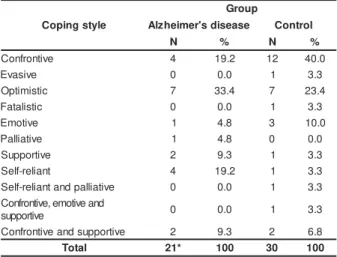
Wit h respect t o coping st yle, in t he AD group, t h e opt im ist ic st y le pr edom in at ed in t h e 2 1 elder ly w h o w e r e c a p a b l e o f a n s w e r i n g t h e i n s t r u m e n t q u est ion s, w h ich m ean s t h at t h ese in d iv id u als u se opt im ist ic t hought s, m ent al elabor at ion and posit iv e com parisons about t he problem . I n t he cont rol group, t he confr ont iv e st y le w as obser v ed, ev idencing t hat elderly wit hout pat hological cognit ive alt erat ions solve t he sit uat ion in a com bat ive w ay, by confr ont ing t he
e l y t s g n i p o C p u o r G e s a e s i d s ' r e m i e h z l
A Control
N % N %
e v i t n o r f n o
C 4 19.2 12 40.0
e v i s a v
E 0 0.0 1 3.3
c i t s i m i t p
O 7 33.4 7 23.4
c i t s il a t a
F 0 0.0 1 3.3
e v i t o m
E 1 4.8 3 10.0
e v i t a il l a
P 1 4.8 0 0.0
e v i t r o p p u
S 2 9.3 1 3.3
t n a il e r -fl e
S 4 19.2 1 3.3
e v i t a il l a p d n a t n a il e r -fl e
S 0 0.0 1 3.3
d n a e v it o m e , e v it n o r f n o C e v it r o p p u
s 0 0.0 1 3.3
e v i t r o p p u s d n a e v i t n o r f n o
C 2 9.3 2 6.8
l a t o
T 21* 100 30 100
p = 0.341. * Nine out of 30 individuals in t his group present ed difficult ies t o underst and t he quest ions t hey were asked, which m ade it im possible t o cont inue applying t he invent ory during t he int erview.
As t he fr equency of m any coping st y les w as low in bot h gr oups, w e decided t o r egr oup t he eight different coping t ypes and classify t hem on t he basis of t h e ch ar act er i zat i on of t h e cop i n g act i on f ocu s ( em ot ion and problem ) . This new division allowed for a p p r o p r i a t e st a t i st i ca l t r e a t m e n t f o r co m p a r a t i v e analy sis w it h t he ot her v ar iables.
Hence, aft er t his r egr ouping, w e found t hat em ot ion- focused coping predom inat ed in t he AD group ( 6 1 . 9 % ) an d pr oblem - focu sed copin g in t h e con t r ol group ( 40% ) , alt hough st at ist ical significance was not ach iev ed ( p= 0 . 1 2 4 ) .
A com parison of individuals’ coping st yles wit h t heir respect ive educat ion shows t hat , in bot h groups, eld er ly w it h h ig h er m ean v alu es f or ed u cat ion u se t h e pr oblem as a st r at egic f ocu s in t h e at t em pt t o adm inist er or m odify t he st r essful sit uat ion, alt hough t h is dif f er en ce w as n ot sign if ican t f or eit h er of t h e gr oups ( Table 4) .
Tab le 4 - Dist r ib u t ion of g r ou p s’ m ed ian ed u cat ion accor ding t o coping st y le. São Paulo, 2005
e l y t s g n i p o C ) p u o r g D A ( e l y t s g n i p o C ) p u o r g l o r t n o c ( n o i t a c u d
E Emotion Problem Emotion Problem
y c n e u q e r
F 13.0 8.0 12.0 18.0
n a e
M 4.2 7.3 5.3 7.7
n o it a i v e d d r a d n a t
S 2.2 6.9 3.1 4.7
n a i d e
M 4.0 4.0 4.0 7.5
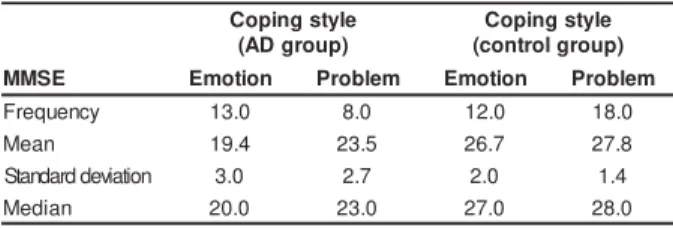
Con sider in g t h e in v olv em en t of cogn it ion in t he elaborat ion of coping st rat egies and t he definit ion of t he coping st y le, w e decided t o analy ze how t his v a r i a b l e b e h a v e d i n i n d i v i d u a l s w i t h AD , w h o se cog n it iv e p er f or m an ce is p at h olog ically im p air ed in com par ison w it h t he cont r ol gr oup.
Th u s, w e f ou n d a si g n if ican t d i f f er en ce i n cog n it iv e p er f or m an ce an d cop in g st y le in t h e AD gr oup on ly.
Table 5 - Dist ribut ion of groups’ m edian MMSE scores accor ding t o coping st y le. São Paulo, 2005
Moreover, in bot h groups, m ore t han one st yle of coping st rat egy predom inat ed. This result is in line w i t h a n o t h e r st u d y o f a n e l d e r l y g r o u p w i t h o u t cognit iv e alt er at ions, w hose dat a r ev ealed a net w or k of r elat ions bet w een differ ent st y les, in w hich som e st yles predom inat ed, but no single st yle was used( 11). I n t his st udy, we found t hat t he opt im ist ic st yle ( em ot ion- focused) predom inat ed in t he AD group and t he confront ive st yle ( problem - focused) in t he cont rol g r ou p .
Al t h o u g h n o t st a t i st i ca l l y si g n i f i ca n t , t h i s difference in t he select ion of coping st rat egies m akes u s r ef lect ab ou t t h is g r ou p ’s b eh av ior al ef f or t s t o handle specific dem ands t hey analy ze as som et hing t h a t t h r e a t e n s t h e i r p e r so n a l i n t e g r i t y. Th u s, b y prim arily choosing em ot ion- focused coping, AD group m em ber s ex pr ess t heir difficult y t o r ecr uit r esour ces t hat allow t hem t o change t he sit uat ion, in t he at t em pt t o rem ove t he problem or decrease it s im pact capacit y as a sour ce of st r ess.
I n v iew of t he neur opsy chological lim it at ion t o elabor at e cognit iv e st r at egies, t hese elder ly select d e f e n s i v e a n d d i s t a n c i n g p r o c e s s e s a s c o p i n g st rat egies, focusing t heir act ions on t he regulat ion or subst it ut ion of t he em ot ional im pact of st ress. I n t he co n t r o l g r o u p , o n t h e o t h e r h a n d , t h e o p p o si t e happened. I n view of t he possibilit y t o select adapt ive st r at egies t o con f r on t t h e st r essin g sit u at ion , t h ese elder ly pr edom in an t ly u se pr oblem - focu sed copin g.
When a specific coping st yle is adopt ed, t his is not inherent ly good or bad. On t he opposit e, when assessing t he efficacy of t he coping st yle an individual adopt s, t he cont ext in which t he st ressing event occurs needs t o be analy zed, as a cer t ain coping st y le can be effect ive in on sit uat ion but not in anot her. When preparing for a t est , for exam ple, focusing t he act ion on coping wit h t he problem is adapt ive. When await ing t he result , on t he ot her hand, it is int erest ing t o direct coping act ions at t he cont rol of t he em ot ional im pact deriving from t he wait ing t im e. I n t he sam e way, when dealing w it h inex or able sit uat ions, such as t he deat h of a p ar t n er f or ex am p le, in it ially, it m ay b e m or e adapt iv e t o inv olv e in palliat iv e coping t o handle t he em ot ion- focused sit uat ion and t hen, aft erw ards, aft er e m o t i o n a l b a l a n ce i s r e st o r e d , t o se l e ct a m o r e i n st r u m e n t a l co p i n g i n o r d e r t o e l a b o r a t e f u t u r e plans( 12- 13).
Moreover, when assessing coping efficacy, not only t he possibilit y of solv ing, but also of cont r olling t h e pr oblem sh ou ld be v er if ied( 1 3 - 1 4 ). Th is appr oach
e l y t s g n i p o C
) p u o r g D A (
e l y t s g n i p o C
) p u o r g l o r t n o c ( E
S M
M Emotion Problem Emotion Problem
y c n e u q e r
F 13.0 8.0 12.0 18.0
n a e
M 19.4 23.5 26.7 27.8
n o it a i v e d d r a d n a t
S 3.0 2.7 2.0 1.4
n a i d e
M 20.0 23.0 27.0 28.0
Mann- Whit ney’s non- param et rical t est , p = 0.0074 AD group; p = 0.1602 cont rol group.
Ta b l e 5 e v i d e n ce s t h a t , i n t h e d e m e n t e d e l d e r l y g r o u p , p a r t i ci p a n t s w i t h b e t t e r co g n i t i v e perform ance t end t o select t he st ressful sit uat ion it self as t he focus of act ion for coping st r at egies.
DI SCUSSI ON
“ Co g n i t i v e assessm en t ” i s asso ci at ed w i t h liv ed, v icar iou s ex per ien ces an d lear n in g. Mor eov er, coping efficacy and qualit y also est ablish t heoret ically dir ect r elat ions w it h indiv iduals’ lear ning and m ent al elabor at ion capacit y. Hen ce, ch oosin g t h e pr oblem -focused or em ot ion- -focused coping st yle will not only depend on how individuals int erpret a t hreat , but also o n t h e r e s o u r c e s a t t h e i r d i s p o s a l t o e l a b o r a t e st r a t eg i es t h a t a r e co h er en t w i t h t h ei r i n d i v i d u a l capacit y t o react and face a cert ain adverse sit uat ion. I n v i e w o f t h e s e t h e o r e t i c a l p r e m i s e s , h y p o t h et i ca l l y, el d er l y w i t h AD t en d t o el a b o r a t e pr edom in an t ly def en siv e an d r esign at ion st r at egies, a s t h e co g n i t i v e i m p a i r m e n t d e r i v i n g f r o m t h e i r d i sea se ca n a f f ect t h e el a b o r a t i o n o f co n f r o n t i v e coping w it h t he st r essful sit uat ion.
m ainly refers t o unsolvable and perm anent ly st ressing sit u at ion s, lik e in t h e case of ch r on ic d iseases f or ex am ple, in w hich t he absence of cur e per spect iv es requires m any m ore em ot ional and sit uat ional cont rol st r at egies t han confr ont iv e act ions( 13- 15).
Fu r t h e r m o r e , l i t e r a t u r e d a t a a p p o i n t em ot ional cont r ol, achieved on t he basis of em ot ion-focused coping, as a favor able and effect ive st r at egy t o cope w it h st r essin g sit u at ion s, in w h ich t h er e is lit t le cont r ol capacit y( 13).
Th u s, b a sed o n t h e p r esen t ed t h eo r et i ca l pr em ises an d t h e ch r on ic cont ex t of t h eir sit uat ion, t he pr edom inance of em ot ion- focused coping am ong AD gr oup m em ber s m ay hav e been an adapt iv e and d ef en siv e st r at eg y t h ese in d iv id u als elab or at ed t o m in im ize t h e em ot ion al im p act d er iv in g f r om t h eir per cept ion of t heir lim it at ions and losses. I n v iew of t his per cept ion, confr ont ing t he sit uat ion could r esult in m or e t h r eat en in g em ot ion s t h an t h e ev en t t h at or iginat ed t he st r ess it self.
However, som e aut hors suggest t hat , alt hough t h e em ot ion - focu sed st r at egy seem s t o be adapt iv e in t he short t erm , if individuals cont inue using it for a lon g t im e, t h ey m ay t en d t ow ar ds passiv en ess an d r epeat edly f ocu s t h eir act ion on n egat iv e em ot ion s and on t he possible consequences of t hese feelings( 13). As t o educat ion, we observed in bot h groups t h at in div idu als w it h h igh er edu cat ion lev els t en ded t o select t he pr oblem as t he st r at egic focus t o cope wit h adverse sit uat ions, alt hough t his difference is not st at ist ically significant .
Hence, educat ion m ay have exert ed a posit ive influence on problem coping, as individuals t ended t o sel ect ed co m b a t i v e st r a t eg i es, w h o se el a b o r a t i o n r e q u i r e s t h e u s e o f a c q u i r e d k n o w l e d g e a n d ex p er i en ces.
Wit h r esp ect t o cog n it iv e p er f or m an ce, w e f o u n d t h a t , i n t h e AD g r o u p , e l d e r l y w i t h b e t t e r
per for m ance on t he MMSE pr im ar ily chose pr oblem -focused coping st rat egies, t o t he det rim ent of em ot ion. This difference was st at ist ically significant . Again, t his inform at ion seem s t o indicat e t hat , depending on t he ev olut ion st age of t he disease, t hese indiv iduals use t he k now ledge acquir ed and st or ed in t heir sem ant ic m em ory in t he at t em pt t o fight t he problem . Alt hough predom inant coping in t his group focused on em ot ion, t h e se d a t a sh o w t h a t , i n i n d i v i d u a l s w i t h b e t t e r co g n i t i v e p er f o r m a n ce, so m e n eu r o p sy ch o l o g i ca l , an at om ic- f u n ct ion al an d n eu r oph y siologic r esou r ces ar e st ill av ailable t o h andle st r essfu l sit uat ions in a m ore com bat ive way. The sam e fact was found in t he cont r ol gr oup, but w it hout st at ist ical significance.
CONCLUSI ON
I n t his st udy, elder ly people w it h AD t ended t o use em ot ion as an adapt ive st r at egy t o cope w it h adverse sit uat ions, at t em pt ing t o act on t he em ot ional im pact daily difficult ies pr ov ok e in t heir daily life, as t h eir cog n it iv e im p air m en t af f ect ed t h e elab or at ion of confr ont ive and pr oblem - solv ing act ions. How ever, am ong t he elderly wit h AD, t hose wit h a less int ense cognit ive im pairm ent t ended t o cope wit h t he st ressing sit uat ion by select ing confront ive coping st rat egies in t h e at t em p t t o sol v e t h e p r ob l em or m i n i m i ze i t s con seq u en ces.
A l t h o u g h t h e s e d a t a p e r m i t t h e a b o v e m e n t i o n e d c o n c l u s i o n s , w e s u g g e s t t h a t f u t u r e r esear ch st u d ies lar g er g r ou p s, u ses m or e r ef in ed cog n it iv e assessm en t an d cop in g in st r u m en t s an d includes st r ess assessm ent indicat or s w hen analyzing t he correlat ions am ong t hese fact ors, so t hat w e can adv ance in t he const r uct ion of k now ledge about t his com plex net w or k of int er act ions w hich is t he hum an m in d .
REFERENCES
1. Holm es TH, Rahe RH. The social readj ust m ent rat ing scale. J Psy ch osom Res 1 9 6 7 ; 1 1 : 2 1 3 - 8 .
2. Lazarus RS, Folkm an S. St ress, appraisal and coping. New Yor k : Spr inger ; 1 9 8 4 .
3. McKhann G, Drachm an D, Folst ein M, Kat zm an R, Price D, St a d l a n EM. Cl i n i c a l d i a g n o s i s o f Al z h e i m e r ’ s d i s e a s e . Neu r ol og y 1 9 8 4 ; 3 4 ( 7 ) : 9 3 9 - 4 4 .
4 . A m e r i c a n Ps y c h i a t r i c A s s o c i a t i o n . D i a g n o s t i c a n d St at ist ical Man u al of Men t al Disor d er s ( DSM- I I I R) . 3r d ed . Wash in gt on ( WS) : DC; 1 9 8 7 .
5. Folst ein MF, Folst ein SE, Mchugh PR. Minim ent al st at e: a pr act ical m et hod for gr ading t he cognit iv e st at e of pat ient s f or t h e clin ician . J Psy ch iat r ic Res 1 9 7 5 ; 1 2 : 1 8 9 - 9 8 . 6. Brucki SMD, Nit rini R, Caram elli P, Bert olucci PHF, Okam ot o I H. Sugest ões para o uso do m ini- exam e do est ado m ent al no Br asil. Ar q Neu r opsiqu iat r 2 0 0 3 Set em br o; 6 1 ( 3 B) : 7 7 7 - 8 1 . 7. Jalow iec A. Jalow iec Coping Scale. Chicago ( I L) : I llinois; 1 9 8 7 .
9 . Bu st am an t e SEZ , Bot t in o CMC, Lop es MA, Azev ed o D, Hot ot ian SR, Lit v oc J e cols. I n st r u m en t os com bin ados n a av aliação de dem ência em idosos. Ar q Neur opsiquiat r 2003 Set em b r o; 6 1 ( 3 - A) : 6 0 1 - 6 .
1 0 . H e r r e r a Jr E, Ca r a m e l l i P, S i l v e i r a AS , N i t r i n i R. Epidem iologic su r v ey of dem en t ia in a com m u n it y - dw ellin g Br a zi l i a n p o p u l a t i o n . Al zh e i m e r D i s Asso c D i so r d 2 0 0 2 ; 1 6 ( 2 ) : 1 0 3 - 8 .
1 1 . Galdino JMS. Ansiedade, depr essão e coping em idosos. [ d isser t ação] SãoPau lo ( SP) : Escola d e En f er m ag em / USP; 2 0 0 0 .
1 2 . Pe n i c h e CG, Jo u c l a s W, Ch a v e s EC. A l g u m a s consider ações sobr e o pacient e cir úr gico e a ansiedade. Rev Lat in o- am En f er m agem 2 0 0 0 j an eir o; 8 ( 1 ) : 4 5 - 5 0 .
13.Zeidner M, Endler NS apud Folk m an S, Mosk ow it z JT. I n: Co p i n g : Pi t f a l l s a n d p r o m i se . An n u Re v Psy ch o l 2 0 0 4 ; 5 5 : 7 4 5 - 7 4 .
14. Chaves EC, Cade NV. Anx iet y effect s on blood pr essur e of w om en w it h hy per t ension. Rev Lat - am Enfer m agem 2004 Ab r i l ; 1 2 ( 2 ) : 1 6 2 - 7 .
15.Terry DJ. Hynes GJ. Adj ust m ent t o a low - cont rol sit uat ion: r eex am in in g t h e r ole of cop in g r esp on ses. J Per son al Soc Psy ch o l 1 9 9 8 ; 7 4 ( 4 ) : 1 0 7 8 - 9 2 .