AR
TICLE
1 Programa de Pós-Graduação em Promoção da Saúde, Centro Universitário de Maringá. Av. Guedner 1610, Aclimação. 87050-900 Maringá PR Brasil. mirian.yamaguchi@ unicesumar.edu.br
Scientific research about the National Policy
for Health Promotion
Abstract The objective of this study was to as-sess the level of knowledge and systematization of scientific research linked to the National Health Promotion Policy (PNPS) ten years after its im-plementation. A scientometric study was con-ducted of the national and international scientific literature about the PNPS using the PubMed and SciELO databases. The study was carried out in the month of December 2015, using the phrase “national health promotion policy” which result-ed in the identification of 88 publications relatresult-ed to the PNPS. The years 2012 and 2013 had the greatest number of articles published, identifying the National Policy on Diet and Nutrition and the theme of Oral Health as the most studied subjects. The states of São Paulo, Rio de Janeiro, and the Federal District stood out for the quantity and quality of scientific production, which was mostly published in international journals classified in the Qualis A2 stratum. The policies of Emergen-cy Care, Maternal-Infant Health, and Adolescent Health were the themes least explored. Although scientific research has contributed to the applica-tion of technical and scientific knowledge in the promotion of health, the underexplored sectors may hinder the design and reformulation of stra-tegic actions for addressing health inequities in subsequent decades.
Key words Public policy, Quality of life, Publica-tions, Public sector
Yamaguc
hi MU
Introduction
The institutionalization of health promotion (HP) in Brazil occurred more than 27 years ago, after the promulgation of the Federal Constitu-tion of 1988. Since then, inter-sectorial acConstitu-tions have been implemented, as much in the realm of public policy as in scientific production, in order to confront inequities in health1-3. The
in-volvement of teaching and research institutions with the strengthening of HP as a strategy for the improvement of quality of life and health can be perceived, expressed in the growing increase of graduate programs involved with this theme4,5.
On the other hand, HP programs were only ef-fectively implemented in the Primary Health-care Units in observance of the introduction of the National Health Promotion Policy (PNPS)6,7.
This process formalized the inclusion of actions directed to the improvement of quality of life and the reduction of vulnerabilities and risk factors related to health factors in the country’s health agenda8.
Programs involved with the promotion of physical activity; healthy diet; non-consumption of tobacco; and the implementation of healthy environments are the most prevalent in the UBS of the country. At least one of these is offered in the majority of units, and three or more in half of them9. Although strategic actions such as those
aimed at the control of tobacco use had already promoted a significant reduction in the preva-lence of smoking in the adult population9-11, an
increase in the abusive consumption of alcohol and illicit drugs in young persons and adults in the country12-14 are examples of targets yet to be
attained, and constitute a challenge to be over-come.
In any event, the results obtained after es-tablishment of the PNPS signal an early break-through in the constitutional challenge to conso-lidate the implementation of the programs, and encourage the development of new approaches for facing the inequities in health. The success of health actions does not depend only on invest-ments in infrastructure and training of person-nel, but also in the integration between different sectors and sciences, particularly those with an interdisciplinary focus. The articulation of scien-tific knowledge with the formulation of new stra-tegies facilitates decision making and guarantees the greater success of the actions aimed at the resolution of the problems15,16.
Knowing and systematizing the scientific production linked to HP can aid in the
evalua-tion of the achieved results and in envisioning the institutional formulation, review, and impro-vement of the PNPS, and guarantee the streng-thening and solidifying of HP strategies in the country. Scientometric studies have frequently been carried out for the quantitative and quali-tative analysis of scientific production in a spe-cific field, especially in health17,18. In the present
study, we present a scientometric analysis of the scientific contributions oriented to the process of planning, analysis, and evaluation of the PNPS. This illustrates the importance of HP as an area of research and reinforces the initiatives of inte-gration between science and health services.
Materials and methods
A scientometric study was conducted of the national and international scientific literatu-re about the National Health Promotion Policy (PNPS)19, approved by the Ministry of Health by
Decree No. 687 on March 30, 2006. The research was carried out using the databases indexed in the United States National Library of Medicine (PubMed), accessed through the website http://
www.ncbi.nlm.nhi.gov/pubmed, as well as the
Scientific Electronic Library Online (SciELO), available through the Virtual Health Library (BVS) on the site http://bireme.br.
The research was done in the month of De-cember 2015 using the Portuguese terms “polí-tica nacional de promoção da saúde” and their corresponding English equivalents, “national health promotion policy.” For the English search, the word Brazil was added. For the PubMed da-tabase, the data filter Publication dates – 10 years was used, and for the SciELO database, the years 2006 to 2016 were selected.
e C
ole
tiv
a,
21(6):1727-1736,
2016
Higher Education Personnel (CAPES) to evalua-te the periodicals in the different research areas in Brazil.
The publications included in this study were also classified according to the relevant stages in the implementation process of the PNPS19 and
by the corresponding themes of organization, planning, execution, analysis, and evaluation20.
Following this, the articles were analyzed and ca-tegorized according to the following public policy sectors: National Policy of Primary Care (Pnab); National Policy of Diet and Nutrition (Pnan); National Policy of Popular Health Education (Pnep-SUS); National Policy of Humanization (HumanizaSUS); National Policy of Strategic and Participatory Management (ParticipaSUS); National Policy of Integrative and Complemen-tary Practices (PNPIC); National Policy for the Reduction of Morbidity by Accidents and Vio-lence; National Policy of Emergency Care; and the National Policy of Integrated Health for Spe-cific Populations (black population and LGBT). The analysis of titles and abstracts also made it possible to elaborate specific and complementary thematic axes, due to the fact that some of the articles consider more than one theme simulta-neously, for example, nutrition and health of the elderly, popular education on health and
obesi-ty, and men’s primary care and health, among others. Finally, the data was tabulated and orga-nized in spreadsheets in the program Microsoft Excel 2010.
Results
In the initial phase of the search process, 150 scientific publications were found: 85 of these were in the PubMed database, and the other 65 in SciELO. After the evaluation of titles and abs-tracts, duplicate articles and those that did not meet the criteria of inclusion were excluded, re-sulting in 88 articles.
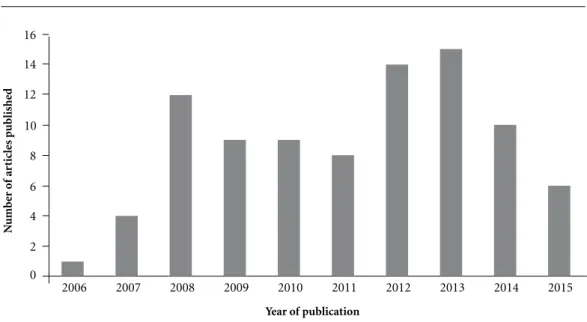
Figure 1 presents the articles published in the PubMed and SciELO databases. The first analysis of the articles identified an increase in scientific production beginning in 2008, with an emphasis on the years 2012 and 2013, in which there were a greater number of publications related to the PNPS.
In light of the implementation process of the PNPS, it was possible to identify that of the 88 total publications, 38% (33) were related to the stages of organization, planning, analysis, and evaluation of the PNPS. Among these, a majority of 58% (19) refer to the analysis of health sectors, and in contrast, none of the publications descri-bed the stages pertaining to the realization of ac-tions related to the PNPS (data not shown).
Figure 1. Number of articles about the NHPP published in the PubMed and SciELO databases in the period of
2006 to 2015.
Year of publication
N
umb
er o
f ar
tic
les pub
lishe
d
2006 2007 2008 2009 2010 2011 2012 2013 2014 2015
Yamaguc
hi MU
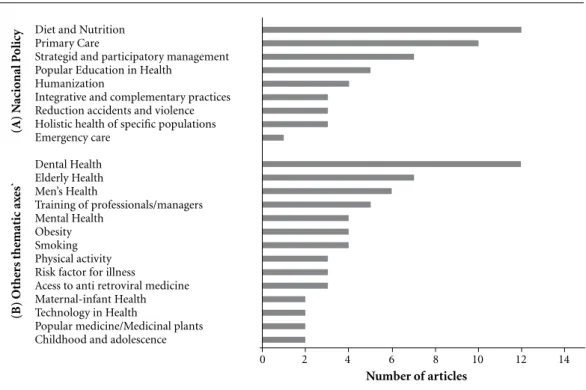
The analysis of the themes according to he-alth sectors described in the PNPS identified that the greatest amount of research was about Diet and Nutrition, followed by research related to Primary Care and the policy of Strategic and Participatory Management (Figure 2A). Among other categories of the thematic axes, Dental Health, Health of the Elderly, Men’s Health, and Training of Professionals and Managers figured as the most discussed themes in the scientific li-terature (Figure 2B).
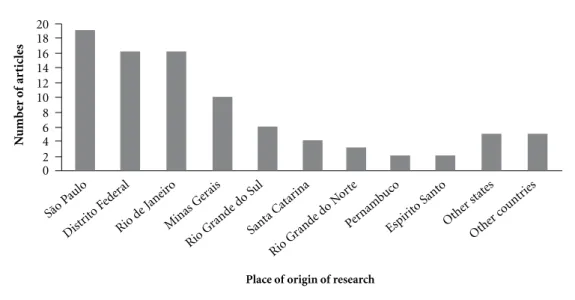
The classification of the articles according to locale of origin of the research is shown in Figure 3. It should be noted that the states of São Paulo (19), Rio de Janeiro (16), and the Federal District (16) account for 58% of the 88 articles related to the PNPS. Among the other states, Paraná, Bahia, Goiânia, Paraíba, and Ceará were represented. In terms of publications originating from other countries, researchers from the United States, Canada, Italy, France, and England are included.
The findings of the classification regarding scientific quality in the articles analyzed in this study showed that the majority of the research is published in international periodicals, classified
in the Qualis strata A1 and A2 (Interdisciplinary area), totaling 51% (45). This is followed by ano-ther 30% (26) publications in periodicals classi-fied in stratum B1 (Figure 4).
The percentage of periodicals with a grea-ter concentration of publications related to the PNPS is represented in Figure 5. It should be noted that the Revista Ciência & Saúde Coletiva accounts for 24% of the publications, followed by the journals Saúde & Sociedade (11%), and
Cadernos de Saúde Pública (10%). The journals
presented in Figure 5 possess scientific quality in the Qualis/Capes strata A1, A2, B1, and B2 in the Interdisciplinary area.
Discussion
A decade after the publication of the National Health Promotion Policy (PNPS), it becomes relevant to measure the scientific production related to the implementation of health policies in Brazil, beginning with the publication of the PNPS by Decree MS/GM No.687 on the 30th of
March, 2006. Its evolution can be appreciated in
Figure 2. Number of articles published in the period 2006 to 2015 related to the PNPS. Classifications based on:
public policies of the health sectors cited in the PNPS (A); in complementary thematic axes (B), and sampled in December 2015.
* Some analyzed articles span more than one thematic axis simultaneously.
(A) N
acio
nal P
olicy
(B) Othe
rs the
mat
ic ax
es
*
Diet and Nutrition Primary Care
Strategid and participatory management Popular Education in Health
Humanization
Integrative and complementary practices Reduction accidents and violence Holistic health of specific populations Emergency care
Dental Health Elderly Health Men’s Health
Training of professionals/managers Mental Health
Obesity Smoking Physical activity Risk factor for illness
Acess to anti retroviral medicine Maternal-infant Health Technology in Health
Popular medicine/Medicinal plants Childhood and adolescence
0 2 4 6 8 10 12 14
e C
ole
tiv
a,
21(6):1727-1736,
2016
the revision of the PNPS issued by the Decree No. 2,446 of the 11th of November, 201420. The
pre-sent research, for its part, using a scientometric analysis, identified peculiarities in the behavior of Brazilian scientific research in the themes re-ferring to the PNPS.
Different from what has been presented by the Ministry of Science, Technology, and Inno-vation for the Brazilian scientific publications, whose scientific production showed continuous and constant growth21, the volume of research in
respect to the PNPS during the last decade suffe-red fluctuations, with an increase in the years of 2008, 2012, and 2013. It was clear that in the first years after the PNPS was instituted, the authors restricted themselves to debating and reflecting on the guidelines of the health programs22 and on
health promotion itself, in Brazil23,24 and in Latin
Figure 3. Number of articles published in the period of 2006 to 2015 about the PNPS, classified according to
geographic origin of the publications.
Figure 4. Survey of the Qualis/Capes strata of the
scientific journals published in the period of 2006 to 2015 about the PNPS.
* N/C refers to scientific journals not classified in the WebQualis system.
Figure 5. Scientific journals with the greatest percentage of articles
published about the National Health Promotion Policy (PNPS) after its implementation in 2006 until 2015.
Place of origin of research
N
umb
er o
f ar
tic
les
São P aulo
Distrit o Fed
eral
0 2 4 6 8 10 12 14 16 18 20
Rio d e Jane
iro
Minas Ge rais
Rio G rand
e do S ul
Santa C atarina
Rio G rand
e do N orte
Pernamb
uco
Espir ito S
anto
Othe r stat
es
Othe r count
ries
P
er
ce
ntag
e (%)
0 5 10 15 20 25 30 35 40 45
A1 A2 B1 B2 B4 N/C*
Qualis/Capes classification
N
ame o
f the jour
nals
Ciência & Saúde Coletiva Saúde & Sociedade Cadernos de Saúde Pública Brazilian Oral Research Trabalho, Educação e Saúde Interface Botucatu Escola Anna Nery Other journals
0 5 10 15 20 25 30 35
Percentage (%)
Yamaguc
hi MU
America25. Since 2008, after a cycle of one year
of implementation of the PNPS was completed, there was a prevalence of research oriented to themes related to diet and nutrition26-28, dental
health29-30, anti-retroviral therapy31, and the
trai-ning of professionals, interdisciplinarity, and the elderly32.
In subsequent years, a great diversity in pu-blished themes can be perceived. The representa-tive volume of articles (38%) related to the stages of the process of implementation of the PNPS are in their majority related to the analysis of the PNPS in its essence1,33-35, while other articles
analyzed more specific policies related to mental health36,37, smoking38, accidents and violence39,
dealing with HIV/AIDS40-41, among other
analy-ses.
The PHPP bases its relation with the other public policies directly or indirectly related to the health sector that were obtained by the popula-tion20. The categorization of the scientific
publi-cations according to the different specific policies allowed us to identify the greater occurrence of research about national policies of Diet & Nutri-tion, Primary Care, and Strategic and Participa-tory Management.
The themes of interest of the researchers about diet and nutrition permeate different as-pects of study, spanning reflections about the policy itself24 and its dialogue with the National
Policy of Dietary and Nutritional Security42, its
inclusion in school programs28,43,44 in relation to
obesity45,47 and dental health48, the
encourage-ment of research26, and even comparisons with
other countries49 are some examples. The great
demand for studies about diet and nutrition are justified, because in recent decades Brazilians ex-periences social transformations that triggered a diminishing of poverty and a consequent change in dietary standards, resulting in a new scenario related to excess weight in the population and its consequences for health50.
In Brazil the Primary Healthcare Units (UBS) were planned to be installed close to the people, and are effectively the point of access for the po-pulation’s healthcare. Research that targets access to primary health services51,52, worker’s health53,
health of the elderly54,55, men’s health56, and
men-tal health55 appear as the subject of the second
greatest interest identified in the corresponding scientific production.
Next, themes related to the National Policy on Strategic and Participatory Management56
were the third most important among the dif-ferent scientific publications. The Secretary of
Strategic and Participatory Management coordi-nates the participatory model of SUS and activi-ties of monitoring, auditing, and evaluations of SUS management56. These publications
contai-ned themes about the balance of the implemen-tation of the PNPS35, and research about
mana-gement at the municipal and state level57-60. From
the perspective of popular participation, work dealing with ombudsmen services61,62 and aspects
of the contribution of the religious community63
were published, as well as research pertaining to traditional medicine based on medicinal plants64.
A complementary categorization of the scien-tific articles, which was denominated as “other thematic axes,” is relevant to the present research. An analysis of the articles within this sub-classi-fication allows us to determine that publications about dental health, health of the elderly, and men’s health were included as the three themes of greatest interest for the researchers.
The emphasis on the great number of pu-blished scientific research on dental health can be understood as related to historical circums-tances. Two decades before the implementation of the PNPS, the first epidemiological survey of oral health was carried out, which signaled the precariousness of dental health in the Brazilian population. This initial study from 1986 provi-ded a basis for the 1996 effort to measure if there had been alterations in the dental health profile of the population, which culminated in the large epidemiological survey Project SB Brazil, begin-ning in 2000 and ending in 200365. The findings
of this project stimulated actions that resulted in bold investments in the implementation of the Smiling Brazil Program8, which generated
inte-rest in the scientific community for research rela-ted to the investments and results for oral health in the Brazilian population29,39,66-68. Another issue
of great global relevance drew researchers to in-quire about the research. We refer to the fact that in less than a decade Brazil would be the sixth country in the world in the number of elderly persons69, and this issue has reinforced studies
regarding this theme drawing from a broad pers-pective of inter-sectorial and transdisciplinary work32,54,55,58,70,71. This issue placed the health of
the elderly in second place among the themes of scientific production on the PNPS.
e C
ole
tiv
a,
21(6):1727-1736,
2016
Health72, which triggered interest of researchers
and consequently demanded recent publications about the promotion of men’s health56,73-76.
Regarding the place of origin of the publi-cations related to the PNPS, the present resear-ch identified the state of São Paulo in particu-lar with the greatest number of contributions, followed by the Federal District and Rio de Janei-ro. This data partially corresponds to the ranking published by the Research Support Foundation of the State of São Paulo77, in which the state of
São Paulo occupies first place with 51% of the scientific production of the country, followed by the contributions of Rio de Janeiro (18%), Minas Gerais (10.6%), Rio Grande do Sul (10.2%), Pa-raná (6.3%), Pernambuco (4%), Santa Catarina (3.5%), and the Federal District (3.3%)77. The
present study identified that for research related to the PNPS, the Federal District climbs from ei-ghth place in the general ranking to second place, a scenario that may be based on the proximity of researchers to the government ministries that are established in the Federal District itself.
The analysis of quality of publications based on the Qualis strata identified that the majority of publications appear in high quality journals
(Qualis A2 in the Interdisciplinary area), and that the journal Ciência & Saúde Coletiva concentra-ted the greatest number of publications relaconcentra-ted to the PNPS.
With the present study, we conclude that in the ten years since the implementation of the PNPS, researchers have undertaken relevant and creative work. Scientometric analysis identified the National Policy of Diet and Nutrition and the theme Dental Health as the most studied subjects in the research, and clearly determined that less priority is given to the Policy of Emergency At-tention, to Maternal-Infant Health, and to Ado-lescence. This research was restricted to the term “National Policy on Health Promotion,” and trefore other studies directed toward specific he-alth policies might add further knowledge. These themes suggest future, more detailed investiga-tions that allow us to clarify the causes of this disparity. We hope the findings of the scientific production related to the PNPS contribute to the generation, diffusion, and application of techni-cal and scientific knowledge in the promotion of health in a way that facilitates the designing and reformulation of strategic actions for addressing health inequities in the coming decades.
Collaborations
MU Yamaguchi participated in the conceptua-lization and execution of the research, drafting, editing, and approval of the final version of the manuscript. MP Bernuci participated in the execution of the research, drafting, editing, and approval of the final version of the manuscript. GC Pavanelli carried out critical revision and approval of the final article submitted for publi-cation.
Acknowledgements
Yamaguc
hi MU
Betsch C, Böhm R, Airhienbuwa CO, Butler R, Chap-man GB, Haase N, HerrChap-mann B, Igarashi T, Kitayama S, Korn L, Murm UK, Rohrmann B, Rothmann AJ, Shavitt S, Updegraff JA, Uskul AK. Improving Medi-cal Decision Making and Health Promotion through Culture-Sensitive Health Communication: An Agenda for Science and Practice. Med Decis Making 2015; pii: 0272989X15600434.
Yao Q, Chen K, Yao L, Lyu PH, Yang TA, Luo F, Chen SQ, He LY, Liu ZY. Scientometric trends and knowledge maps of global health systems research. Health Res
Pol-icy Syst 2014; 12:26.
Zhang Y, Diao T, Wang L. Quantative evalution of translational medicine based on scientometric anal-ysis and information extraction. Clin Transl Sci 2014; 7(6):465-469.
Brasil. Ministério da Saúde (MS). Portaria nº 687 MS/ GM, de 30 de março de 2006. Aprova a Política de Pro-moção da Saúde. Diário Oficial da União 2006; 31 mar. Brasil. Ministério da Saúde (MS). Portaria nº 2.446 MS/GM, de 11 de novembro de 2014. Redefine a Políti-ca Nacional de Promoção da Saúde. Diário Oficial da
União 2014; 12 nov.
Brasil. Ministério da Saúde (MS). Portal do Ministério da Ciência, Tecnologia e Inovação [Internet]. [acessado 2016 jan 25]. Disponível em: http://www.mct.gov.br/ upd_blob/0238/238139.pdf
Hartz ZMA. Princípios e padrões em metaavaliação: diretrizes para os programas de saúde. Cien Saude Colet
2006; 11(3):733-738.
Buss PM, Carvalho AI. Health promotion in Brazil.
Promot Educ 2007; (Supl. 1):7-12.
Traverso-Yepez MA. Dilemas na promoção da saúde no Brasil: reflexões em torno da política nacional. Interface
(Botucatu) 2007; 11(22):223-238
Carvalho AI, Westphal MF, Pereira Lima VL. Health promotion in Brazil. PromotEduc 2007; 1:7-12. Serruya S, Vasconcelos AB.A Secretaria de Ciência e Tecnologia e Insumos Estratégicos do Ministério da Saúde e a pesquisa em alimentação e nutrição. Cad
Saude Publica 2008; 24(2):361-364.
Pinheiro ARO, Carvalho DBB. Estado e mercado: ad-versários ou aliados no processo de implementação da Política Nacional de Alimentação e Nutrição? Elemen-tos para um debate sobre medidas de regulamentação.
Saude Soc 2008;17(2):170-183.
Domene SMA. A escola como ambiente de promoção da saúde e educação nutricional. Psicol. USP 2008; 19(4):505-517.
Kramer PF, RAMER, Ardenghi TM, Ferreira S, Fischer LA, Cardoso L, Feldens A.Utilização de serviços odon-tológicos por crianças de 0 a 5 anos de idade no Muni-cípio de Canela, Rio Grande do Sul, Brasil. Cad Saude
Publica 2008; 24(1):150-156.
Pedrazzi V, Dias KRHC, Rode SM. Oral health in Brazil - Part II: Dental Specialty Centers (CEOs). Braz. Oral Res 2008; 22(1):18-23.
Meiners CMMA. Patentes farmacêuticas e saúde públi-ca: desafios à política brasileira de acesso ao tratamento anti-retroviral. Cad Saude Publica 2008; 24(7):1467-1478. 16. 17. 18. 19. 20. 21. 22. 23. 24. 25. 26. 27. 28. 29. 30. 31. References
Buss PM, Carvalho AL. Development of health promo-tion in Brazil in the last twenty years (1988-2008). Cien
Saude Colet 2009; 14(06):2305-2316.
da Silva LS, Cotta RM, Rosa CO. Health promotion and primary prevention strategies to fight chronic disease: a systematic review. Rev Panam Salud Publica 2013; 34(5):343-350.
de Andrade LO, Pellegrini Filho A, Solar O, Rígoli F, de Salazar LM, Serrate PC, Ribeiro KG, Koller TS, Cruz FN, Atun R. Social determinants of health, universal health coverage,and sustainable development: case studies from Latin American countries. Lancet 2015; 385(9975):1343-1351.
Lira SVG, Bezerra MP, Frota MA, Valdés MTM, Vieira LJES, Silva RM. Scientific production on Health Pro-motion in the Brazilian Postgraduate Courses. Saude Soc 2009; 18(3):437-445.
Heidemann ITSB, Bochs AE, Fernandes GC, Wosny AM, Marchi JG. Promoção da Saúde e qualidade de vida: concepções da carta de Ottawa em produção científica. Cienc Cuid Saude 2012; 11(3):613-619. Rocha DG, Alexandre VP, Marcelo VC, Rezende R, Nogueira JD, Franco de Sá R. The review process of the National Health Promotion Policy: simultaneous mul-tiple movements. CienSaudeColet 2014; 19(11):4313-4322.
Ramos LR, Malta DC, Gomes GA, Bracco MM, Flo-rindo AA, Mielke GI, Parra DC, Lobelo F, Simoes EJ, Hallal PC. Prevelence of health promotion programs in primary helath care units in Brazil. Rev Saude Publica
2014; 48(5):837-844.
Pucca GA, Gabriel M, de Araújo ME, de Alemida FC. Ten years of National Oral Health Policy in Brazil: in-novation, boldness, and numerous challenges. J Dent Res 2015; 94(10):1333-1337.
Silva ST, Martins MC, Faria FR, Cotta RM. Combating smoking in Brazil: the strategic importance of govern-ment actions. Cien Saude Colet 2014; 19(2):539-552. Malta DC, Iser BP, Sa NN, Yokota RT, Moura LD, Claro RM, Luz MG, Bernal RI. Trends in tobacco consump-tion from 2006 to 2011 in Brazilian capitals accord-ing to the VIGITEL survey. CadSaudePublica 2013; 29(4):812-822.
Malta DC, Bernal RT, Oliveira M. Trends in risk factors chronic diseases, according of health insurance Brazil, 2008-2013. CienSaudeColet 2015; 20(4):1005-1016. Malta DC, Machado IE, Porto DL, da SILVA MM, de Freitas PC, da Costa AW, Oliveira-Campos M. Alcohol consumption among Brazilian Adolescents according to the National Adolescent School-based Health Survey (PeNSE 2012). RevBrasEpidemiol 2014; 17(1):203-214. Macinko J, Mullachery P, Silver D, Jimenez G, Liba-nio MNO. Patterns of Alcohol Consumption and Related Behaviors in Brazil: Evidence from the 2013 National HealthSurvey (PNS 2013). PLoSOne 2015; 10(7):e0134153.
Abdalla RR, Madruga CS, Ribeiro M, Pinsky I, Caetano R, Laranjeira R. Prevalence of cocaine use in Brazil: data from the II Brazilian national alcohol and drugs sur-vey (BNADS). AddictBehay 2014; 39(1):297-301. Holmes S, Scarrow G, Schellenber M. Translating evi-dence into practice: the role of health research funders.
Implement Sci 2012; 7:39.
e C ole tiv a, 21(6):1727-1736, 2016
Motta LB, Caldas CP, Assis M. A formação de profis-sionais para a atenção integral à saúde do idoso: a ex-periência interdisciplinar do NAI - UNATI/UERJ. Cien
Saude Colet 2008; 13(4):1143-1151.
Silva PFA, Baptista TWF. Os sentidos e disputas na construção da Política Nacional de Promoção da
Saú-de. Physis 2014; 24(2):441-465.
Rocha DG, Alexandre VP, Marcelo VC, Rezende R, No-gueira JD, Sá RF. Processo de revisão da Política Na-cional de Promoção da Saúde: múltiplos movimentos simultâneos. Cien Saude Colet 2014; 19(11):4313-4322. Malta CM, Silva MMA, Albuquerque GM, Lima CM, Cavalcante T, Jaime PC, Silva Junior JB.A implementa-ção das prioridades da Política Nacional de Promoimplementa-ção da Saúde, um balanço, 2006 a 2014. Cien Saude Colet
2014; 19(11):4301-4312.
Escudeiro CC, Souza MLAS. Saúde mental no Sistema Único de Saúde: mudança do modelo de atenção na região de Lins-SP. Saude soc. 2009; 18(1):44-47. Simon AG, Baptisra TWF. O papel dos estados na polí-tica de saúde mental no Brasil. Cad Saude Publica 2011; 27(11):2227-2241
Costa e Silva VL, PAntani D, Andreis M, Sparks R, Pinsky I. Bridging the gap between science and pub-lic health: taking advantage of tabacco control experi-ence in Brazil to inform policies to counter risk fac-tros for non-communicable diseases. Addiction 2013; 108(8):1360-1366.
Minayo MCS, Deslandes SF. Análise da implantação da rede de atenção às vítimas de acidentes e violências segundo diretrizes da Política Nacional de Redução da Morbimortalidade sobre Violência e Saúde. Cien Saude
Colet 2009: 14(5):1641-1649.
Grangeiro A, Escuder MML, Castilho EA. Evaluation of strategies by the Brazilian Ministry of Health to stimu-late the municipal response to AIDS. Cad Saude Publica
2011; 27(1):128.
Lopez LC. Uma Análise das Políticas de Enfrentamento ao HIV/Aids na Perspectiva da Interseccionalidade de Raça e Gênero. Saude Soc 2011; 20(3):590-603. Alves KPS, Jaime PC. A Política Nacional de alimenta-ção e Nutrialimenta-ção e seu diálogo com a Política Nacional de Segurança alimentar e Nutricional. Cien Saude Colet
2014; 19(11):4331-4340.
Yokota RTC, Vasconcelos TF, Pinheiro ARO, Schmitz BAS, Coitinho DC, Rodrigues MLCF. Projeto “a escola promovendo hábitos alimentares saudáveis”: compa-ração de duas estratégias de educação nutricional no Distrito Federal, Brasil. Rev Nutr 2010; 23(1):37-47. Sidaner E, Balaban D, Burlandy L. The Brazilian school feeding programme: an example of an integrated progamme in support of food and nutrition security.
Public Health Nutr 2013; 16(6):989-994.
Coutinho JG, Gentil PC, Toral N. A desnutrição e obe-sidade no Brasil: o enfrentamento com base na agenda única da nutrição. Cad Saude Publica 2008; 24(2):332-340.
Reis CE, Vasconcelo IAL, Barros JF. Políticas públicas de nutrição para o controle da obesidade infantil. Rev.
paul. pediatr. 2011; 29(4):625-633.
Jaime PC, da Silva AC, Gentil PC, Claro MR, Monteiro CABrazilian obesity prevention and control initiatives. Brazilian obesity prevention and control initiatives.
Obes Rev 2013; 14(2):88-95.
Freire MCM, Balbo PL, Amador MA, Sardinha LMV. Guias alimentares para a população brasileira: impli-cações para a Política Nacional de Saúde Bucal. Cad
Saude Publica 2012; 28(Supl. 0):20-29.
Vieira VL, Gregório MJ, Cervato-Mancuso AM, Graça APSR. Ações de alimentação e nutrição e sua interface com segurança alimentar e nutricional: uma compara-ção entre Brasil e Portugal. Saude Soc 2013; 22(2):603-607.
Brasil. Ministério da Saúde (MS). Secretaria de Aten-ção à Saúde. Departamento de AtenAten-ção Básica. Política
nacional de alimentação e nutrição. 2a ed. Brasília: MS;
2008.
Rocha PM, Ucho a AC, Rocha NSPD, Souza ECFS, Rocha ML, Pinheiro TXA. Avaliação do Programa Saúde da Família em municípios do Nordeste brasi-leiro: velhos e novos desafios. Cad Saude Publica 2008; 24(1):s69-s78.
Tesser CD, Norman AH. Repensando o acesso ao cui-dado na Estratégia Saúde da Família. Saude Soc 2014; 23(3):869-883.
Dias EC, Silva TL. Contribuições da Atenção Primária em Saúde para a implementação da Política Nacional de Saúde e Segurança no Trabalho (PNSST). Rev Bras
Saúde Ocup 2013; 38(127):31-43.
Thume E, Facchini LA, Tomasi E, Vieira LAS. Assistên-cia domiciliar a idosos: fatores assoAssistên-ciados, caracterís-ticas do acesso e do cuidado. Rev Saude Publica 2010; 44(6):1102-1111.
Andrade FB, Ferreira Filha MO, Dias MD, Silva AO, Costa ICC, Lima EARL, Mendes CKTT. Promoção da saúde mental do idoso na atenção básica: as contribui-ções da terapia comunitária. Texto Contexto – Enferm
2010; 19(1):129-136.
Brasil. Ministério da Saúde (MS). Secretaria de Gestão Estratégica e Participativa. Política Nacional de Gestão
Estratégica e Participativa no SUS - ParticipaSUS. 2a ed.
Brasília: Editora do Ministério da Saúde; 2009. Silva KS, Bezerra AF. The conception of administrators regarding the formation of a healthcare consortium in Pernambuco, Brazil: a case study. Nt J Health Palnn
Manage 2011; 26(2):158-172.
Oliveira DC, Silva EM. Cuidado ao idoso em Campinas -SP: estudo qualitativo com gestores e representantes políticos. Rev Bras Enferm 2012; 65(6):942-949. Fracolli LA, Gomes MFP, Gryschek ALFPL. Percep-ções de gestores municipais sobre aPercep-ções de promoção da saúde: em foco os agentes comunitários de saúde.
Saude Soc 2014; 23(3):919-927.
Cardoso SLC, Vasconcellos Sobrinho M, Vasconcelos AMA. Gestão ambiental de parques urbanos: o caso do Parque Ecológico do Município de Belém Gunnar Vin-gren. Rev Bras Gest Urbana 2015; 7(1):74-90. Peixoto SF, Marsiglia RMG, Morrone LC. Atribuições de uma ouvidoria: opinião de usuários e funcionários.
Saude Soc 2013; 22(3):785-794.
Melo MPP. Governo da população: relação médico-pa-ciente na perícia médica da previdência social. Interface
(Botucatu) 2014; 18(48):23-36.
Yamaguc
hi MU
Gomes MCPA. Projeto: Ylê ayié yaya ilera (Saúde plena na casa desta existência):equidade e integralidade em saúde para a comunidade religiosa afro-brasileira.
In-terface (Botucatu) 2010; 14(34):663-672.
Sorte Junior WF. Traditional knowledge for promotion of socioeconomic inclusion of local communities. Rev
Saude Publica 2012; 46(3):583-586.
Costa JFR, Chagas LD, Silvestre RM, organizadores.
A política nacional de saúde bucal do Brasil: registro de
uma conquista histórica. Brasília: OPAS; 2006.
Junqueira SR, Pannuti CM, Rode SM.Oral Health in Brazil - Part I: public oral health policies. Braz Oral Res
2008; 22(1):8-17.
Pucca Juniro GA; Costa JFR, Chagas LD, Silvestre RM. Oral health policies in Brazil. Braz Oral Res 2009; 23(1):9-16.
Pires FS, Botazzo C. Organização tecnológica do traba-lho em saúde bucal no SUS: uma arqueologia da políti-ca nacional de saúde bupolíti-cal. Saude Soc 2015; 24(1):273-284.
Organização Mundial da Saúde (OMS).
Envelhecimen-to ativo: uma política de saúde. Brasília: Organização
Pan-Americana de Saúde; 2005. [Internet]. [acessado 2015 dez 20]. Disponível em: http://bvsms.saude.gov. br/bvs/publicacoes/envelhecimento_ativo.pdf Combinato DS, Vecchia MD, Lopes EG, Manoel RA, Marino HD, Oliveira ACS, Silva KF.“Grupos de Con-versa”: saúde da pessoa idosa na estratégia saúde da família. Psicol Soc 2010; 22(3):558-568.
Aveiro MC, Aciole GG, Driusso P, Oishi J. Perspectivas da participação do fisioterapeuta no Programa Saúde da Família na atenção à saúde do idoso. Cien Saude Co-let 2011; 16(1):1467-1478.
Brasil. Ministério da Saúde (MS). Secretaria de Atenção à Saúde. Departamento de Ações Programáticas e es-tratégicas. Política Nacional de Atenção Integral à Saúde
do Homem: princípios e diretrizes. Brasília: MS; 2009.
Moura EC, Santos W, Neves ACM, Gomes R, Schwarz E. Atenção à saúde dos homens no âmbito da estratégia saúde da família. Cien Saude Colet 2014; 19(2):429-438. Araújo MG, Lima GAF, Holanda CSM, Carvalho JBL, Sales LKO.Opinião de profissionais sobre a efetivação da política nacional de atenção integral à saúde do
ho-mem. Esc Anna Nery 2014; 18(4):682-689.
Souza LPS, Almeida ER, Queiroz MA, Silva JR, Sou-za AAM, Figueiredo MFS. Conhecimento de uma equipe da estratégia saúde da família sobre a política de atenção à saúde masculina. Trab educ saude 2014; 12(2):291-304.
Trilico MLC, Oliveira GR, Kijimura MY, Pirolo SM. Discursos masculinos sobre prevenção e promoção da saúde do homem. Trab educ saude 2015; 13(2):381-395. Indicadores de Ciência, Tecnologia e Inovação em São Paulo 2010, Capítulo 4, Publicações indexadas nas ba-ses SCIE e SSCI, segundo regiões e unidades da Federa-ção – Brasil – 1998-2006. FAPESP [Internet]; [acessado 2016 jan 20]. Disponível: http://www.fapesp.br/indica-dores/2010/volume1/cap4.pdf
Article submitted 27/01/2016 Approved 03/03/2016
Final version submitted 05/03/2016 63.
64.
65.
66.
67.
68.
69.
70.
71.
72.
73.
74.
75.
76.