w w w . r b h h . o r g
Hematology, Transfusion and Cell Therapy
Original article
Late chimerical status after bone marrow
transplantation in severe aplastic anemia
according to two different preparatory regimens
Marcia Quiroga
∗, Noemi Farah Pereira, Marco Antonio Bitencourt, Carmem Bonfim,
Marianna Gendre de Mesquita Monteiro, Ricardo Pasquini
Hospital de Clínicas da Universidade Federal do Paraná (HC/UFPR), Curitiba, PR, Brazil
a r t i c l e
i n f o
Article history:
Received 24 January 2017 Accepted 29 November 2017 Available online 17 February 2018
Keywords:
Severe aplastic anemia Bone marrow transplantation Conditioning regimen Chimerism
a b s t r a c t
Background:This study investigated the influence of two conditioning regimens on the chimerical status of 104 patients with acquired severe aplastic anemia.
Methods:Patients were monitored for at least 18 months after related bone marrow transplantation and reaching partial or complete hematologic recovery. Group I patients (n= 55) received 200 mg/kg cyclophosphamide alone and Group II (n= 49) received 120 mg/kg cyclophosphamide associated with 12 mg/kg busulfan. Patients were classified in three chimerism levels according to the percentage of donor cells in the peripheral blood. Results:Chimerism≤50% occurred in 36.4% of Group I and none of Group II; chimerism 51–90% was found in 20.0% of Group I and 10.2% of Group II; and chimerism >90% was found in 43.6% of Group I versus 89.8% of Group II. A significant association (p-value < 0.001) was found between conditioning type and chimerism levels. A higher number of infused cells was associated with higher levels of chimerism only in Group I (p-value = 0.013). Multivari-ate analysis showed that chimerism >90% is associMultivari-ated with the cyclophosphamide plus busulfan conditioning (p-value < 0.001) and higher number of infused cells (p-value = 0.009), suggesting that these factors are predictive of graft outcome. Regarding hematological recov-ery, higher chimerism levels were associated with higher neutrophil (p-value = 0.003) and platelet counts (p-value < 0.001) in Group I only. These results show that myeloablative con-ditioning favors full donor chimerism and non-myeloablative concon-ditioning predisposes to mixed chimerism or autologous recovery of hematopoiesis.
Conclusion:These data show that autologous recovery depends on the intensity of immuno-suppression and that the immunosuppressive function of cyclophosphamide alone can induce this type of hematopoietic recovery.
© 2018 Associac¸ ˜ao Brasileira de Hematologia, Hemoterapia e Terapia Celular. Published by Elsevier Editora Ltda. This is an open access article under the CC BY-NC-ND license (http://creativecommons.org/licenses/by-nc-nd/4.0/).
∗ Corresponding author at: Rua: Emilio Cornelsen, 570 ap. 102, Bloco 6, Ahu, Curitiba, PR, Brazil.
E-mail address:[email protected](M. Quiroga). https://doi.org/10.1016/j.htct.2017.11.011
Introduction
Hematopoietic stem cell transplantation (HSCT) is the treat-ment of choice for young patients with severe aplastic anemia (SAA).1 An intensity of conditioning regimen that achieves immunosuppressive effects to avoid graft rejection is a crucial factor in the allogeneic bone marrow trans-plantation (BMT) setting for SAA patients. The standard conditioning for patients who have an human leukocyte anti-gen (HLA)-matched sibling donor comprises high doses of cyclophosphamide (CY – 200 mg/kg) with or without anti-thymocyte globulin (ATG).2
Until the early 90s, SAA patients transplanted at Hospital de Clínicas (HC) of the Universidade Federal do Paraná (UFPR) received non-myeloablative conditioning such as 200 mg/kg of body weight of CY. Subsequently, it was observed that patients who received more than 15 transfusions prior to transplant had higher rejection rates and lower survival compared to those receiving fewer transfusions (unpublished data). Piccin et al.3also found a significant difference in the survival rates of patients with SAA or Fanconi Anemia who received more than 20 units of red blood cells and/or platelets. For this reason and because of the irregular supply of ATG, from 1993 all poly-transfused SAA patients received CY (120 mg/kg) associated with busulfan (BUS – 12 mg/kg of body weight). The CY + BUS combination showed a marked reduction in rejection rates.4
Transplant outcome is assessed by hematologic recov-ery and chimerism analysis that provide information on the hematopoietic reconstitution of patients, which can be autologous, allogeneic or chimerical. The determination of chimerism status has been based on the amplification of markers with a variable number of tandem repeats (VNTRs) or short tandem repeats (STRs) scattered throughout the genome.5–7
This retrospective study analyzed the levels of chimerism in two groups of patients with acquired SAA who received different conditioning regimens before undergoing BMT with HLA-identical sibling donors. The goal was to investigate the association between chimerism levels with different condi-tioning as well as with other variables in order to identify factors that could predict the outcome of the allogeneic hematopoietic stem cell graft. Among the study variables were pre-transplant characteristics such as patient’s age and gender, time between diagnosis and BMT, and transplant characteristics such as donor’s age and gender and num-ber of infused cells. The chimerism status of patients with normal or near normal hematological levels was also ana-lyzed. Peripheral blood hematimetric levels, such as the neutrophil and platelet counts, and hemoglobin concen-tration were evaluated in the period equal to or greater than 18 months after transplantation. Patients with time equal to or greater than 18 months post-transplant were included because they had already reached stable chimerism and because hematological changes rarely occur after this time.
Methods
Patients
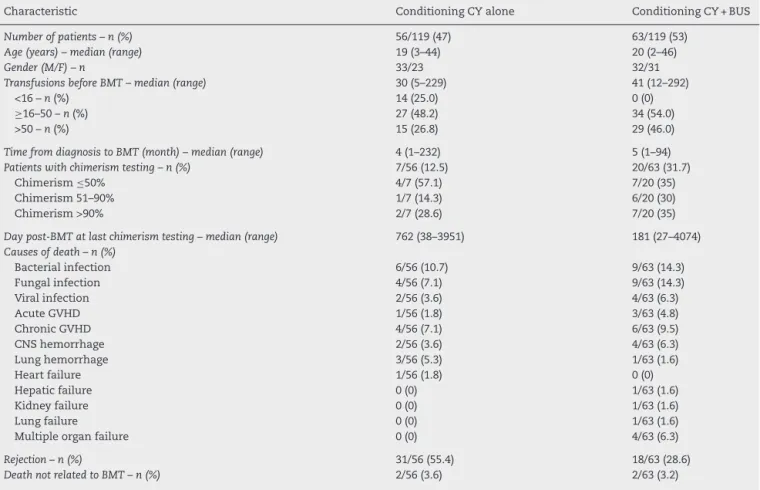
The Bone Marrow Transplantation Service at HC-UFPR started its activities in 1979, and from that time up to October 2011, this center has performed 516 transplants in SAA patients. This study involved 104 SAA patients who underwent the first transplant at HC-UFPR between August 1987 and July 2009. Data on chimerism levels were collected up to April 2011. The inclusion criteria for the patients analyzed in this cohort were a diagnosis of SAA, first BMT with a related donor, alive at the time of this study, chimerism analysis performed at a time≥18 months after the transplant, partial or complete hematologic recovery, and conditioned with CY alone or with CY + BUS (Figure 1). Pre-transplant characteristics of these patients are shown inTable 1. The characteristics of patients who passed away (not included in this study) are described in Table 2.
Transplant characteristics
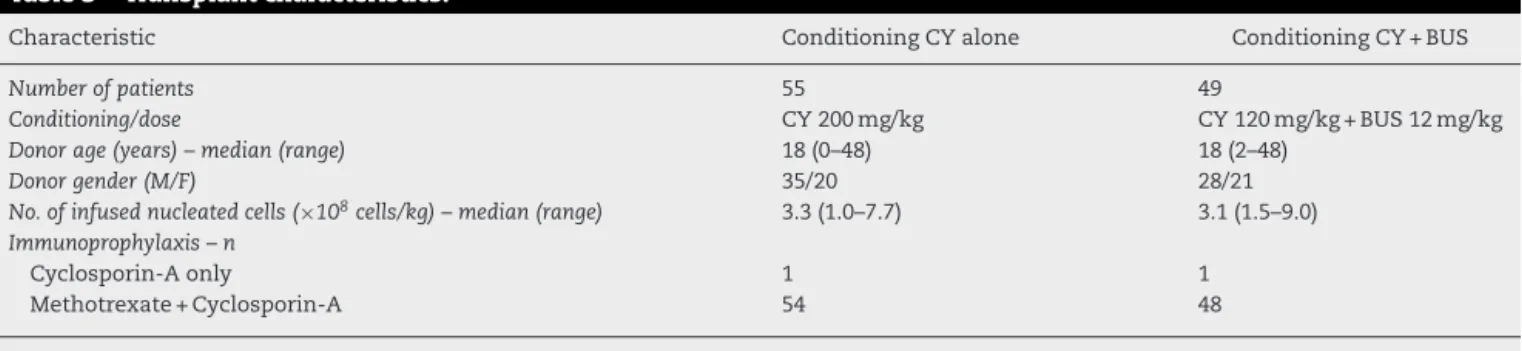
All patients who received bone marrow from HLA-identical siblings were divided into two groups according to the con-ditioning regimen. The choice of the concon-ditioning protocol was based on the number of previous transfusions with this information being obtained from medical records as well as from reports from the patient or family members. Forty-four patients with less than 16 transfusions were treated with CY alone at 200 mg/kg body weight in four doses and those with ≥16 transfusions (n= 49), in general, received CY at 120 mg/kg
body weight divided in two doses associated with BUS at 12 mg/kg of body weight in 16 oral doses.4 However, eleven patients who received≥16 transfusions and were included in the CY alone group (n= 44 + 11) because they were transplanted before the implementation of the CY + BUS protocol. The deci-sion to combine CY + BUS was based on the experience of Lucarelli et al.8 who used this regimen to treat thalassemia patients, but the doses utilized in our center were modified. The transplant characteristics of this cohort are shown in Table 3.
Late hematological status
516 SAA *HSCT from 1979 to 2011
465 post-CSA introduction (1986)
432 related donors
191 patients CY alone
110 patients < 16 transfusions 81 patients ≥ 16 transfusions
193 patients CY+BUS (1993) 0 patients < 16 transfusions 193 patients ≥ 16 transfusions
48 patients received other
conditioning regimens
384 patients (CY alone/CY+BUS)
265 patients alive 119 patients passed away
171 patients had chimerism testing
performed
**94 patients without chimerism testing
120 patients with chimerism testing performed at ≥ 18
months post-HSCT and partial or full hematologic recovery
16 patients: 2nd HSCT 104 patients: 1st HSCT
55 patients CY alone 44 patients < 16 transfusions 11 patients ≥ 16 transfusions
treated with CY alone prior to introduction of CY+BUS
49 patients CY+BUS 0 patients < 16 transfusions 49 patients ≥ 16 transfusions
33 unrelated donors
Figure 1 – Patients who underwent hematopoietic stem cell transplantation at Hospital de Clinicas, Universidade Federal do Parana, Curitiba, Brazil from 1979 to 2011. *HSCT: hematopoietic stem cell transplantation. **Ninety-four patients did not have variable number of tandem repeat (VNTR)/short tandem repeat (STR) chimerism results either because this test was not performed in our center at the time they were transplanted or due to no show to their follow up medical appointment.
Chimerism analysis
Post-BMT chimerism analysis between August 1995 and July 2009 was performed by PCR amplification of VNTR/STR loci, and detection of amplified fragments was visualized by verti-cal discontinuous polyacrylamide gel electrophoresis stained with silver salts (n= 84).9However, from August 2009 onward, chimerism was evaluated by PCR amplification of STR loci using fluorescent labeled primers (Applied Biosystems Inc., USA) with the amplified fragments being identified by cap-illary electrophoresis in an ABI 3130 Genetic Analyzer (n= 20).
In order to minimize possible variations between these two methods, besides proposing an alternative approach, the results were stratified in chimerism levels of≤50%, between 51% and 90% and >90% of donor cells for both conditioning groups.
DNA isolation
Table 1 – Pre-transplant characteristics.
Characteristic Conditioning CY alone Conditioning CY + BUS
Number of patients 55 49
Age (years) – median (range) 17 (1–35) 18 (6–45)
Gender (M/F) 40/15 34/15
Transfusions before BMT – median (range) 10 (1–60) 30 (16–238)
<16 –n(%) 44 (80.0) 0 (0)
≥16–50 –n(%) 10 (18.2) 43 (87.8)
>50 –n(%) 1 (1.8) 6 (12.2)
Previous treatment – n (%)
None 42 (76.4) 29 (59.2)
PDR 8 (14.5) 5 (10.2)
Cyclosporin-A + PDR 3 (5.5) 8 (16.3)
Androgens + PDR 1 (1.8) 2 (4.1)
Others 1 (1.8) 5 (10.2)
Time diagnosis-BMT (months) – median (range) 2 (0–36) 3 (0–127)
CY: cyclophosphamide; BUS: busulfan; M: male; F: female; BMT: bone marrow transplant; PDR: prednisone.
Table 2 – Characteristics of patients not included due to death at the time of data collection for this study.
Characteristic Conditioning CY alone Conditioning CY + BUS
Number of patients – n (%) 56/119 (47) 63/119 (53)
Age (years) – median (range) 19 (3–44) 20 (2–46)
Gender (M/F) – n 33/23 32/31
Transfusions before BMT – median (range) 30 (5–229) 41 (12–292)
<16 –n(%) 14 (25.0) 0 (0)
≥16–50 –n(%) 27 (48.2) 34 (54.0)
>50 –n(%) 15 (26.8) 29 (46.0)
Time from diagnosis to BMT (month) – median (range) 4 (1–232) 5 (1–94)
Patients with chimerism testing – n (%) 7/56 (12.5) 20/63 (31.7)
Chimerism≤50% 4/7 (57.1) 7/20 (35)
Chimerism 51–90% 1/7 (14.3) 6/20 (30)
Chimerism >90% 2/7 (28.6) 7/20 (35)
Day post-BMT at last chimerism testing – median (range) 762 (38–3951) 181 (27–4074)
Causes of death – n (%)
Bacterial infection 6/56 (10.7) 9/63 (14.3)
Fungal infection 4/56 (7.1) 9/63 (14.3)
Viral infection 2/56 (3.6) 4/63 (6.3)
Acute GVHD 1/56 (1.8) 3/63 (4.8)
Chronic GVHD 4/56 (7.1) 6/63 (9.5)
CNS hemorrhage 2/56 (3.6) 4/63 (6.3)
Lung hemorrhage 3/56 (5.3) 1/63 (1.6)
Heart failure 1/56 (1.8) 0 (0)
Hepatic failure 0 (0) 1/63 (1.6)
Kidney failure 0 (0) 1/63 (1.6)
Lung failure 0 (0) 1/63 (1.6)
Multiple organ failure 0 (0) 4/63 (6.3)
Rejection – n (%) 31/56 (55.4) 18/63 (28.6)
Death not related to BMT – n (%) 2/56 (3.6) 2/63 (3.2)
CY: cyclophosphamide; BUS: busulfan; M: male; F: female; BMT: bone marrow transplant; GVHD: graft-versus-host disease; CNS: central nervous system.
performed with DNA from peripheral blood or buccal cells to obtain the constitutional pattern of patients from sam-ples considered pre-transplant. Buccal cells were collected after transplant only when the patient’s pre-transplant DNA samples were no longer available for chimerism testing. Post-transplant samples of patients and their donors were isolated from peripheral blood.
Polymerase chain reaction amplification of VNTR/STR loci and fragment detection in polyacrylamide gels stained with silver salts
Table 3 – Transplant characteristics.
Characteristic Conditioning CY alone Conditioning CY + BUS
Number of patients 55 49
Conditioning/dose CY 200 mg/kg CY 120 mg/kg + BUS 12 mg/kg
Donor age (years) – median (range) 18 (0–48) 18 (2–48)
Donor gender (M/F) 35/20 28/21
No. of infused nucleated cells (×108cells/kg) – median (range) 3.3 (1.0–7.7) 3.1 (1.5–9.0)
Immunoprophylaxis – n
Cyclosporin-A only 1 1
Methotrexate + Cyclosporin-A 54 48
CY: cyclophosphamide; BUS: busulfan.
Specific primers for these loci were divided into two multi-plex systems named trimulti-plex I and II.11 Amplifications were performed in ABI 9600 or 9700 thermal cyclers, using 28 cycles at 94◦C for 30 s, 62◦C for 30 s, followed by one cycle at 62◦C for 20 min and 4◦C forever. Amplified samples were loaded into vertical discontinuous polyacrylamide gel and electrophoresed at 105 V for 18 h at room temperature.12 Frag-ments were detected by silver staining with the percentage of donor derived cells being inferred by visual observation of intensity of the electrophoretic bands for the informative loci.9
Polymerase chain reaction amplification of single tandem repeat loci using fluorescent-tagged primers and
fragments detection by capillary electrophoresis
Pre- and post-transplant samples from patient as well as from donors were amplified by a multiplex system including 15 STR loci (D8S1179, D21S11, D7S820, CSF1PO, D3S1358, TH01, D13S317, D16S539, D2S1338, D19S433, VWA, TPOX, D18S51, D5S818 and FGA) and the amelogenin gene (Kit AmpFℓSTR
Identifiler, ABI, USA). Amplifications were done in an ABI 9700 thermal cycler and fragments separated by capillary elec-trophoresis in an ABI 3130 Genetic Analyzer according to manufacturer’s instructions. Data were analyzed using Gen-eMapper v. 4.0 software (ABI, USA). Calculation of percentage of donor derived cells in the post-transplant sample was based on the presence of homozygous or heterozygous peaks corre-sponding to alleles not shared by patient and donor.13,14
Statistical analysis
The results of the quantitative variables were described as medians, and minimum and maximum values, and qualitative variables by their frequencies and percentages. Comparisons of two groups of patients (chimerism 51–90% and >90% donor cells) in regard to age, interval between diag-nosis and BMT, number of infused cells, neutrophil count, platelet count and hemoglobin level were performed using Student’st-test for independent samples or the nonparamet-ric Mann–Whitney test. While comparisons of three groups of patients (chimerism levels≤50%, 51–90% and >90%) were by the variance analysis model (ANOVA) with a factor or the non-parametric test of Kruskal–Wallis. The condition of normality of variables was evaluated using the Kolmogorov–Smirnov test. Association analysis between chimerism levels and gen-der was achieved by Fisher’s exact test for two chimerism
levels and the chi-square test for three levels; associations between recipient/donor sex matching and three chimerism levels were investigated by the chi-square test. Multivariate analysis included variables with p-values <0.25 in the uni-variate analysis, and employed an adjusted logistic regression model. The significance of variables was assessed by the Wald test.p-Values <0.05 were considered statistically significant. Data were analyzed using Statistica v.10.0 software (Stat Soft, Oklahoma, USA).
Results
Univariate analysis
Conditioning regimen and chimerism
The percentage of donor derived cells was >90% in 24 (43.6%), 51–90% in 11 (20.0%) and≤50% in 20 (36.4%) patients in the group treated with CY alone. While in the group that received CY plus BUS, 44 (89.8%) achieved chimerism >90% and five (10.2%) from 51–90% donor cells. These results showed a sig-nificant association between the conditioning regimen and chimerism level (p-value < 0.001). The follow up of chimerism status showed that patients with≤50% donor cells had pro-gressive reductions of donor derived cells with predominance of their own cells, and they were considered as having autol-ogous recovery (AR) in this study.
Pre-transplant characteristics and chimerism
There was no significant association between chimerism lev-els and patients’ age (p-value = 0.241), gender (p-value = 0.953) or interval between diagnosis and transplant (p-value = 0.448) in the group conditioned with CY alone and none of these pre-transplant variables had any effect on chimerism levels in the CY + BUS Group (p-value = 0.394,p-value = 0.306 andp -value = 0.211, respectively).
Transplant characteristics and chimerism
Table 4 – Associations between chimerism levels and post-transplant variables in patients conditioned with CY alone.
Variable Chimerism p-Value
≤50% (n= 20) 51–90% (n= 11) >90% (n= 24)
Neutrophil count (×103/L) – median (range) 2.2 (1.0–5.9) 2.3 (1.5–6.4) 3.3 (2.3–8.2) 0.003b
Hemoglobin (g/dL) – median (range) 15.1 (9.2–17.3) 15.2 (11.7–17.0) 15.1 (13.3–19.2) 0.597a
Platelet count (×103/
L) – median (range) 143 (12–249) 163 (131–315) 218 (131–315) <0.001b
a ANOVA com um factor.
b Kruskal–Wallis non-parametric test.
Table 5 – Influence of pre-transplant and transplant variables on the chimerism levels by multivariate analysis.
Variable Chimerism p-Valuea(univariate)p-Valueb(multivariate) ORbCI (95%)
≤90% (n= 36) >90% (n= 68)
Patient age (years) – median (range) 16.5 (1–35) 18.5 (5–45) 0.039 0.056 1.11 (1–1.23)
Donor age (years) – median (range) 17 (1–48) 19.5 (0–48) 0.105 0.471 0.97 (0.90–1.05)
Time from diagnosis to BMT (months) – median (range) 2 (1–36) 3 (0–127) 0.125 0.861 1.01 (0.93–1.08)
Conditioning regimen – n (%)
CY 31 (56.4) 24 (43.6)
CY + BUS 5 (10.2) 44 (89.8) <0.001 <0.001 16.68 (4.75–58.63)
Number of infused cells (×108cells/kg) 3.17 (1.01–7.75) 3.37 (1.86–8.96) 0.107 0.009 1.9 (1.17–3.1)
CI: confidence interval; OR: odds ratio; BMT: bone marrow transplant; CY: cyclophosphamide; BUS: busulfan. a Studentt-test or Mann–Whitney non-parametric test.
b Logistic regression model and Wald test.
number of infused cells (p-value = 0.357). Patient and donor sex matching did not have an impact on chimerism levels when both conditioning groups were analyzed together (p -value = 0.740;n= 104) or on the CY alone group (p-value = 0.938; n= 55). The CY + BUS group was not analyzed separately due to small numbers of patients at the≤50% and 51–90% chimerism levels in the four sex matching categories.
Post-transplant characteristics and chimerism
Patients conditioned with CY alone who had higher chimerism levels showed higher neutrophil (p-value = 0.003) and platelet counts (p-value < 0.001) (Table 4). In the CY + BUS group, patients with chimerism >90% of donor cells had neutrophil (p-value = 0.051) and platelet counts (p-value = 0.051) slightly higher than those with chimerism between 51% and 90%. Hemoglobin was not associated with levels of chimerism in either of the conditioning groups.
Multivariate analysis
Pre-transplant and transplant variables included in the mul-tivariate analysis were those previously associated with chimerism level >90% of donor cells in the univariate analysis (Table 5). Results revealed associations of the CY + BUS condi-tioning (p-value < 0.001) as well as higher number of infused cells (p-value = 0.009) with levels of chimerism >90%.
Acute and chronic graft-versus-host disease
In this study, 5.4% (3/55) of patients in the CY alone group and 14.3% (7/49) in the CY + BUS Group developed acute graft-versus-host disease (GVHD). Chronic GVHD was present in
6.1% (3/49) of patients conditioned with CY + BUS and in none of the patients who received CY alone (Table 6).
Discussion
This retrospective study investigated the influence of two dif-ferent conditioning regimens on the chimeric status of SAA patients who received bone marrow grafts from HLA-identical siblings. Chimerism tests were performed on samples col-lected at≥18 months post-transplant. Results showed that the type of conditioning influenced the level of chimerism since nearly 90% of patients treated with CY + BUS reached levels >90% of donor cells, while only 44% of those who received CY alone reached this level of chimerism. Despite the obser-vation by Lawler et al.15of a higher frequency of full donor chimerism in patients conditioned with CY alone compared to other regimens, this association was very weak.
Variations in chimerism levels after HSCT may reflect dif-ferences related to the sensitivity of the methods and the type of conditioning. Results of this study are similar to others that also reported presence of higher percentages of donor cells in myeloablative regimens.16,17 Frequencies of chimerism between 51% and 90% donor cells were twice as high in patients who received CY alone (20%) compared to those treated with CY + BUS (10%). Our result is similar to Gomez et al.,18Jillella et al.19and Shamshad20who also found higher frequencies of mixed chimerism in patients with non-myeloablative conditioning.
Table 6 – GVHD in patients conditioned with CY alone and CY + BUS.
GVHD Chimerism (CY alone)n= 55 n(%) Chimerism (CY + BUS)n= 49 n(%)
≤50%(n= 20) 51–90%(n= 11) >90%(n= 24) 51–90%(n= 5) >90% (n= 44)
Acute GVHD grade I 0 1 (9.1) 0 0 1 (2.3)
Acute GVHD grade II 0 0 1 (4.2) 0 3 (6.8)
Acute GVHD grade III 0 0 1 (4.2) 0 2 (4.5)
Acute GVHD grade IV 0 0 0 0 1 (2.3)
Chronic GVHD 0 0 0 0 3 (6.8)
GVHD: graft-versus-host disease; CY: cyclophosphamide; BUS: busulfan.
These lower frequencies could be due to different condi-tioning regimens and/or different methods used to analyze chimerism levels. Piccin et al.21also showed that AR patients have a better prognosis than those with successful engraft-ment and significantly better than patients with graft failure. The major concern with AR is related to the susceptibility of autologous cells to clonal evolution that may result in difficult-to-manage hematological malignancies. The absence of AR in the CY + BUS group is consistent with results of previous studies18,19and emphasizes that myeloablative conditioning commonly eradicates the patient’s cells providing full donor chimerism. Piccin et al.21found that the time interval between diagnosis and transplant was longer in the AR group com-pared to patients with stable engraftment but this was not observed in the present study. It is important to point out that all patients evaluated for chimerism status were alive at the time of investigation and the occurrence of late rejection or death related to transplantation were extremely rare events 18 months after transplant.
Pre-transplant characteristics such as patient age and sex did not influence chimerism levels in either of the condition-ing groups. This result is similar to those found by Lawler et al.15and Piccin et al.,21although their analyses were not done separately according to the conditioning regimen.
Gorin et al.23 showed that infusions of greater number of cells remains an important factor in graft outcome and they point out that every effort must be made to achieve cell numbers >2.5×10⁸kg−1. In the current study, the num-ber of infused cells was associated with chimerism levels only in the CY alone group, where those who received fewer cells had chimerism≤50%. Multivariate analysis revealed an association between higher numbers of infused cells and chimerism >90%, independently of the conditioning regimen. Other transplant features such as donor age and sex did not influence chimerism levels, with similar results being reported by Lawler et al.15
Post-transplant outcome was assessed by hematological recovery, based on the latest available blood count after 18 months of HSCT. Positive associations between higher neu-trophil and platelet counts with greater chimerism levels were observed only in the CY alone group. Hematological recovery data in the literature refer mostly to the period immediately following transplantation; studies investigating associations of hematological parameters with long-term chimerism were not found.
Data from this study showed a higher frequency of acute (7/44 = 15.9%) and chronic (3/44 = 6.8%) GVHD in patients con-ditioned with CY + BUS who had chimerism >90% compared
to those conditioned with CY alone whose frequencies of acute and chronic GVHD were 8.4% (2/24) and 0%, respec-tively. At HC-UFPR, it was observed that the rejection rate was close to 50% in patients who received≥16 transfusions and were conditioned with CY alone. In order to reduce rejec-tion the institurejec-tion started to use condirejec-tioning with CY plus BUS. The association of these drugs reduced the rejection rate to approximately 15%. From 1993 onward, polytransfused patients (≥16 transfusions) who transplanted with a related donor received the CY plus BUS and no longer CY alone. The overall survival at ten years for patients with ≥16 transfu-sions who received CY alone was around 50%; this increased to approximately 70% with the CY + BUS combination (unpub-lished data).
Early referral of individuals diagnosed with SAA to special-ized centers is crucial to reduce the number of transfusions as this is a risk factor for rejection and requires more aggressive conditioning regimens. On comparing polytransfused patients with those who received few transfusions, the rejection rate remains high for the latter group despite the use of less immunogenic blood products in recent years. This could be because new therapeutic approaches that are supposed to reduce rejection are not always available in small centers. Patients who are referred to reference centers have better chances of receiving this kind of treatment.
We acknowledge some limitations of this study. In addi-tion to being retrospective, there is a lack of informaaddi-tion about chimerism status on leukocyte subpopulations since the VNTR/STR assays were performed on whole blood. It is well known that post-transplant engraftment monitoring of cell subsets increases the sensitivity of the assay to detect donor cells.
Conclusion
to prevent graft rejection and to improve the hematopoietic function.
Conflicts of interest
The authors declare no conflicts of interest.
Acknowledgements
We wish to thank Roseli Rocio Silva for her technical assis-tance and the data manager Heliz Regina Neves.
r e f e r e n c e s
1. Bacigalupo A. Bone marrow transplantation for acquired severe aplastic anemia. Hematol Oncol Clin North Am. 2014;28(6):1145–55.
2. Mori T, Koh H, Onishi Y, Kako S, Onizuka M, Kanamori H, et al. Impact of cyclophosphamide dose of conditioning on the outcome of allogeneic hematopoietic stem cell
transplantation for aplastic anemia from human leukocyte antigen-identical sibling. Int J Hematol. 2016;103(4):461–8. 3. Piccin A, O’Marcaigh A, Gardiner N. Outcome of bone marrow
transplantation in acquired and inherited aplastic anaemia in the Republic of Ireland. Ir J Med Sci. 2005;174(3):13–9.
4. Silva LC, Pasquini R. Análise da rejeic¸ão nos pacientes transplantados por anemia aplástica severa condicionados com ciclofosfamida ou a associac¸ão desta ao bussulfano. Rev Bras Hematol Hemoter. 2005;27(1):5–11.
5. Bader P, Niethammer D, Willasch A, Kreyenberg H, Klingebiel T. How and when should we monitor chimerism after allogeneic stem cell transplantation? Bone Marrow Transplant. 2005;35(2):107–19.
6. Gill P, Jeffreys AJ, Werrett DJ. Forensic application of DNA “fingerprints”. Nature. 1985;318(6046):577–9.
7. Weber JL, May PE. Abundant class of human DNA polymorphisms which can be typed using the polymerase chain reaction. Am J Hum Genet. 1989;44(3):388–96. 8. Lucarelli G, Angelucci E, Giardini C, Baronciani D, Galimberti
M, Polchi P, et al. Bone marrow transplantation for thalassemia. Indian J Pediatr. 1993;60(4):517–23.
9. Smith AG, Martin PJ. Analysis of amplified variable number tandem repeat loci for evaluation of engraftment after hematopoietic stem cell transplantation. Rev Immunogenet. 1999;1(2):255–64.
10. Miller SA, Dykes DD, Polesky HF. A simple salting out procedure for extracting DNA from human nucleated cells. Nucleic Acids Res. 1988;16(3):1215–8.
11. Alonso CA, Malaghini M, Pereira NF, Ribeiro EM, Pasquini R. Avaliac¸ão do quimerismo após o transplante de medula óssea (TMO) através da utilizac¸ão de sistemas “triplex” de
marcadores VNTR. In: 43◦Congresso Nacional de Genética,
1997. 1997.
12. Sajantila A, Lukka M. Improved separation of PCR amplified VNTR alleles by a vertical polyacrylamide gel electrophoresis. Int J Legal Med. 1993;105(6):355–9.
13. Thiede C, Florek M, Bornhäuser M, Ritter M, Mohr B, Brendel C, et al. Rapid quantification of mixed chimerism using multiplex amplification of short tandem repeat markers and fluorescence detection. Bone Marrow Transplant.
1999;23(10):1055–60.
14. Thiede C, Lion T. Quantitative analysis of chimerism after allogeneic stem cell transplantation using multiplex PCR amplification of short tandem repeat markers and fluorescence detection. Leukemia. 2001;15:303–6. 15. Lawler M, Mccann SR, Marsh CW, Ljungman P, Hows J,
Vandenberghe E, et al. Serial chimerism analyses indicate that mixed haemopoietic chimerism influences the probability of graft rejection and disease recurrence following allogeneic stem cell transplantation (SCT) for severe aplastic anaemia (SAA): indication for routine assessment of chimerism post SCT for SAA. Br J Haematol. 2009;144(6):933–45.
16. Hoelle W, Beck JF, Dueckers G, Kreyenberg H, Lang P, Gruhn B, et al. Clinical relevance of serial quantitative analysis of hematopoietic chimerism after allogeneic stem cell transplantation in children for severe aplastic anemia. Bone Marrow Transplant. 2004;33(2):219–23.
17. Ommati LV, Rodrigues CA, Silva AR, Silva LP, Chaufaille ML, Oliveira JS. A retrospective comparison of cyclophosphamide plus antithymocyte globulin with cyclophosphamide plus busulfan as the conditioning regimen for severe aplastic anemia. Braz J Med Biol Res. 2009;42(3):244–50.
18. Gomez JR, Garcia MJ, Serrano J, Sanchez J, Falcon M, Castillejo JA, et al. Chimerism analysis in long-term survivor patients after bone marrow transplantation for severe aplastic anemia. Haematologica. 1997;82(5):588–91.
19. Jillella AP, Shafer D, Klumpp TR, Emmons RV, Mangan KF. Mixed chimerism and graft failure following conditioning with the fludarabine and cyclophosphamide nonablative regimen; conversion to full donor chimerism. Am J Hematol. 2007;82(6):419–26.
20. Shamshad GU, Ahmed S, Bhatti FA, Ali N. Mixed donor chimerism in non-malignant haematological diseases after allogeneic bone marrow transplantation. J Coll Physicians Surg Pak. 2012;22(12):765–8.
21. Piccin A, McCann S, Socié G, Oneto R, Bacigalupo A, Locasciulli A, et al. Survival of patients with documented autologous recovery after SCT for severe aplastic anemia: a study by the WPSAA of the EBMT. Bone Marrow Transplant. 2010;45(6):1008–13.
22. Pieroni F, Dias JB, Barros GM, Stracieri AB, Moraes DA, Oliveira MB, et al. The incidence of autologous recovery and late graft failure in a Brazilian cohort of SAA transplanted patients. In: 38◦
Annu Meet Eur Gr Blood Marrow Transplant Geneva, 2012. 2012.