Bolm Inst. oceanogr., S Paulo, 36(1/2) :17-35, 1988
AGE AND GROWTH OF THE SOUTHEASTERN BRAZILIAN
SARDINE~ Sa~d~nettab~a:6i..ti.. en:6~:6 , 1 981 - 1 983
Suzana Anita SACCARD01 ; Carmen L. D. B. ROSSI-WONGTSCHOWSKI2 ; Maria Cristina CERGOLE1 &Maria Mercedes BITTENCOURT3
1 Superintendência do Desenvolvimento da Pesca (SUDEPE)
(Av. Indianôpolis, 1123 - Indianópolis, 04063, são Paulo, SP) 2 Instituto Oceanográfico da Universidade de são Paulo
(Caixa Postal 9075, 01051 são Paulo, SP)
3 Instituto Nacional de Pesquisas da Amazônia (INPA)
(Estrada do A1eixo, 1756 - Caixa Postal 1478, 69.000, Manaus, AM)
Ab.tract
BmaiUan sardine data wel"e aoneoted be tween Septembel"
1981and August
1983fl"om
the southeastel"n Bl"aailian watel"a. Otolitha wel"e l"ead using l"efleated ligth on the
sUl"face of the whole struatUl"e. ThPee methods were used to determine the time of
l"ing formation, being the mean length
per
ring the best one. There are two annuaZ
rings clearly visible, one laid down in November/Deaember, and the other one laid
down in Marah/April. A method of age determination is desaribed, being the maximum
age
3years.
Descriptors: Age determination, Otolith reading, Growth curves, Spawning seasons, Methodology, S~di..netta b~~enó~, SW Atlantic, Brazi I:
southeastern coast.
Descritores: Determinação da idade, Leitura de otõlitos, Curvas de crescimento, PerTodos de desova, Metodologia, S~di..netta b~i..tien6~, Atlântico Sul Ocidental, Rio de Janeiro, são Paulo, Paraná, Santa Catarina, Brasil: costa sudeste.
Introdudion
previous studies on the age and growth of the Brazi1ian sardine, S~di..netta
b~~en:6i..:6 (Steindachner, 1879) have
been carried out by Richardson
et
ato
(1960). Santos & Frantzen (1965), Rijavecet
ato
(1977; 1983), Vazz01eret
ato
(1982; 1987) and Rossi-Wongtschowskidat. (1982). The present study is
part of a more extensive investigation named the "Integrated program of
Biological Studies on Sardine",which has been deve10ped in the southeastern coast of Brazi1 since 1981 to investigate changes in the biologica1 parameters of the species, and to provide data for stock assessment.
In this paper we present the results obtained from the examination of
oto1iths from fish caught in four regions in the area between 22° (Cabo Frio, Rio de Janeiro) and 28°S (Cabo de Santa Marta Grande, Santa Catarina) during the period 1981-1983.
Age was determined using an
ContJt. no. 690
do
Inó:t.
oc.eanog~.da U.6p.
interpretation of rings that differs from that found in the literature, thus resu1ting in a new definition of the age classes. On the basis of these studies, growth parameters were estimated for the who1e area for app1ication in ana1ytica1
stock assessment mode1s. Material and methods
Samp1ing was carried out during the period September 1981 to August 1983 at 13 collection points aloog the southeast coast of Brazil between latitudes 22° and 28°S, inc1uding four coastal states: Rio de Janeiro, são Paulo, Paraná and Santa Catarina (Fig. 1).
In order to samp1e the range of sizes caught, month1y samp1es were co1lected, both from commercial 1andings and from the artisana1 fishery and consisted of 20 kg boxes of fish obtained from different fishing boats and various fixed nets.
After measuring all specimens
18 Bolm Inst. oceanogr., S Paulo, 36(1/2), 1988
BRAZIL
Fi g. 1.
4o-W JO"W
Fishing ground of Brazilian sardine,
SMcUYle.Ua
b.I"r.Mi-ue.n6 ÁÃ •
2,-s
total length to the nearest millimeter, weighed to the nearest 0.1 gram (g) and sexed; otoliths ("sagitta") were removed and stored dried for later analysis. AlI AlI lengths given in this paper refer to total length (Lt ).
A total of 287 samples containing 10,880 otoliths were obtained from the whole area in the period mentioned above.
Data on fish length and weight were analysed by region, male and female data were pooled.
The age of fish was obtained by examining whole otoliths in 70% alcohol under reflected light against a black background using a binocular
stereoscopic microscope at 25 times magnification. Translucent hyaline rings were counted and measurements of various otoliths dimensions were obtained using a measuring scale in one ocular, one division corresponding to · 40 llm.
Observations on the nature of the otolith edge, i.e., whether it was hyaline or opaque, were also made.
Two independent otoliths readings were realized, and only matcheo results considered.
The timing and periodicity of ring formation was verified for each region using the following methods:
a) by plotting the monthly mean length of alI fish with the same number of rings on graphs and linking the points in sequence (Vazzoler, 1982); b) monthly mean marginal growth index,
as given by Matsuura (1961,
cito
iYl:Cadwallader, 1978), for otoliths with 4 rings represented by: G1=R-r /
R-r _ , where G1 is the
margin~l
groUt~
index, R is the total otolith radius, and r n and rn-l are the radii of the ultimate and penultimateannulus respectively;
c) monthly frequency of hyaline and opaque edges.
Age has been interpreted according to the timing of ring formation and using the arbitrary birthday of 1st January, considering the period of the spawning peak (Matsuura, 1977;
Rossi--Wongtschowski, 1977~ Isaac-Nahum
e.t
al.,
1988).Growth parameters (K, L 00' to) were
estimated from age data for . the entire area.
Growth curves were fitted by plotting Lt against Lt+l using the von
Bertalanffy growth equation.
AlI biological data were processed in FORTRAN, using a BURROUGHS 7900 System at the Electronical Computation Center of
of University of são Paulo.
Results
Ag
e.
de.teJl.1niYllLÜo nRing counts
Numbers of sardine otoliths analysed by period, by region, are shown in Table 1.
Tab1e 1. Number of oto1iths of
Safr1:Ü.Yle.Ua bJta..6 ilie.n6ÁÃ ana1ysed during 1981-1983 from Rio de Janeiro, são Paulo, Paraná and Santa Catarina regions
81/82 82/83
~·9Ion Tot.1 ''''t ched Tota' S.lected for
re I ui ti Ift.lys'l
"'o de Janeiro HI~ 16 .. H26 1862
Sio ,.,,10 1035 715 111 ~ I O~)
Par.ná 670 539 563 ~ 78
Sinta Cat.rlna 1539 1019 1119 1072
5658 3917 5222 ~~55
SACCARDO e.t
aL
SaJtdüle.1..fubJta6 .LU.e.n6"w:
age: g rowth 19Surrounding the central nuc1eous two hya1ine rings were often observed which were not inc1uded in the counts, because
they were considered non-periodic annu1i corre1ated with changes occurring during the 1arva1 and pre-juveni1e stages, in
accordance with Rossi-Wongtschowski e.t
alo
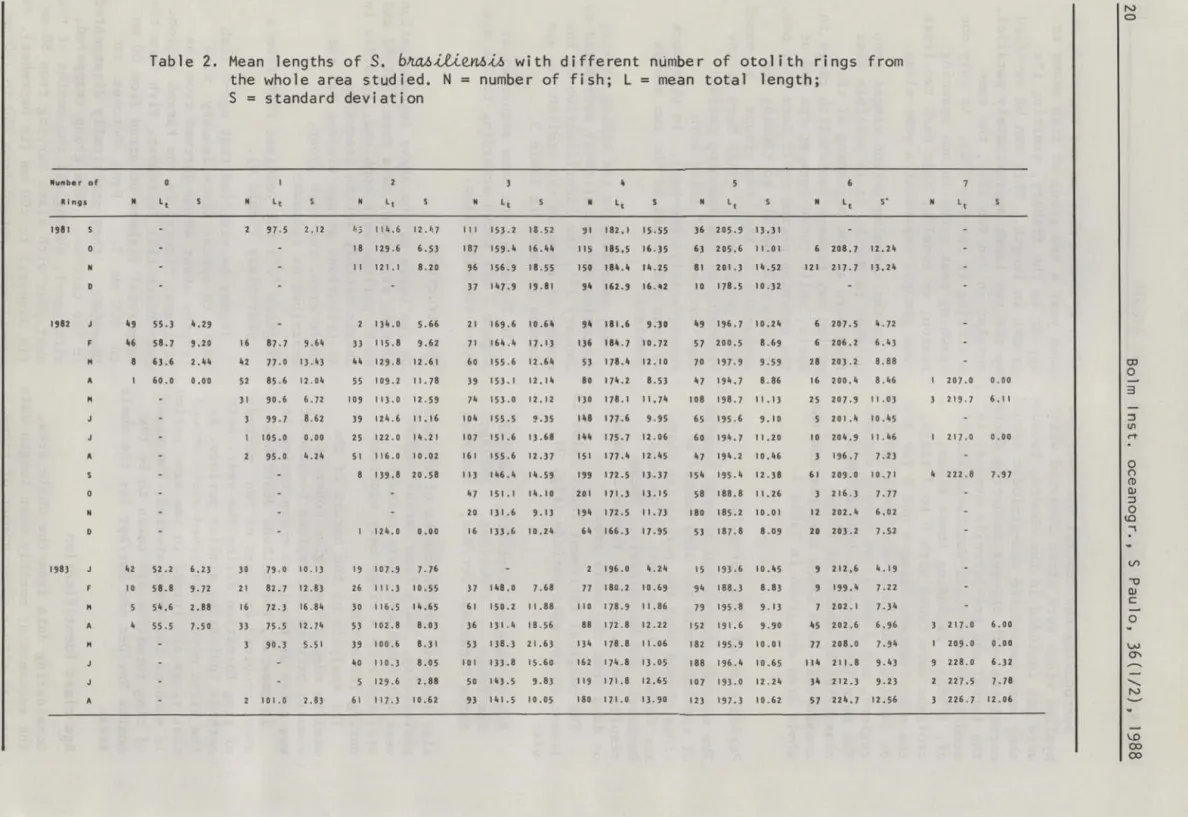
(1982). Exc1uding these rings,oto1iths were found with O to 7 rings, the most frequent being 4 and 5 for Rio de Janeiro, são Paulo and Santa Catarina regions, and 2 and 3 for Paraná region.
The mean lengths of
S.
bJta6~e.n6"w,classified by number of rings
considering both sexes together and the whole area are given in Table 2.
Periodicity of ring formation
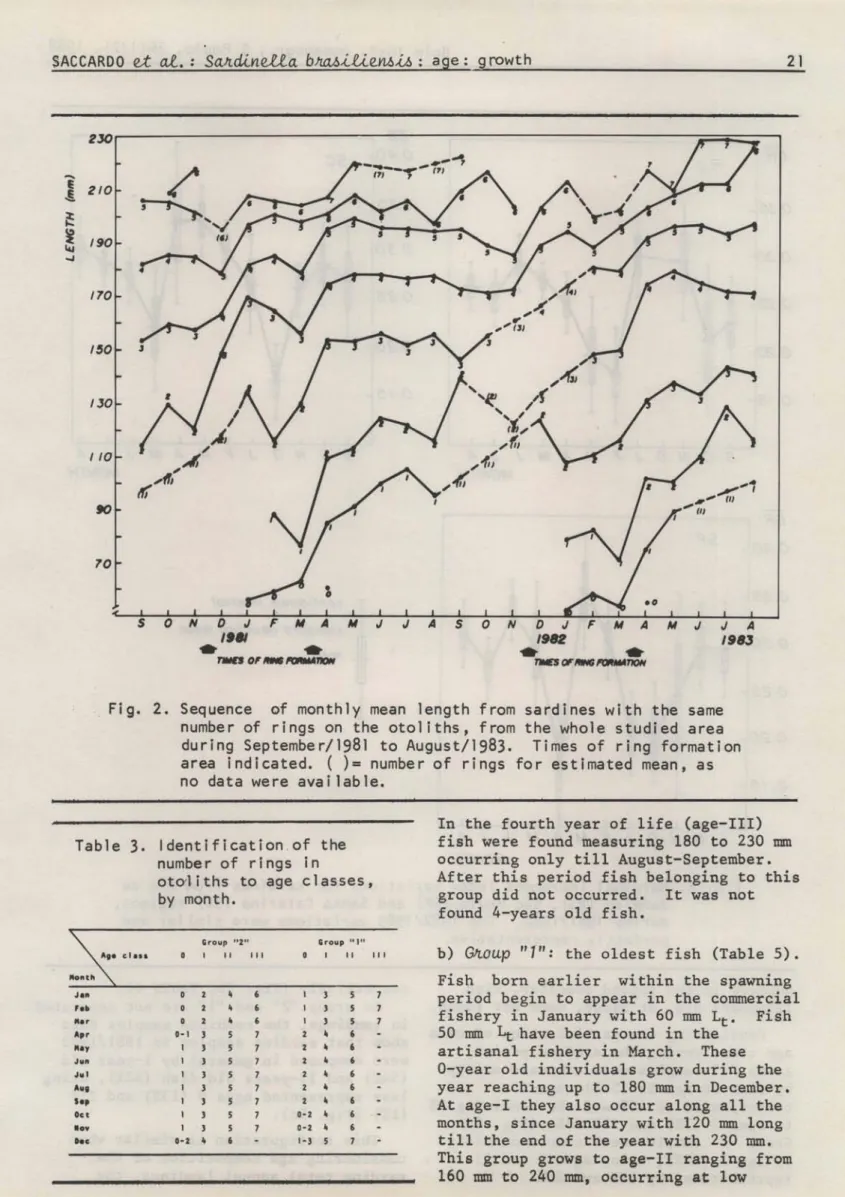
The month1y progression of mean 1engths of specimens with the same number of rings showed that the periodica1 rings are formed twice a year: in November/ December, and March/Apri1. These resu1ts can be seen in Figure 2, based on data from the who1e area.
The marginal increment index va1ue 1S
10west in two main periods (Fig. 3), viz:
Rio de Janeiro: são Paulo
Santa Catarina:
Sept/Oct, Oct/Dec, Oct/Dec,
Jan/Feb Mar/Apr Mar/May,
a1so indicate growth checks of the same periodicity. Data from Paraná region were not considered here because oto1iths with 4 rings on1y occurred during few months.
The ana1ysis of the nature of the oto1ith edge did not give coherent resu1ts between a11 regions because it was often difficu1t to characterize it.
In general, the methods described above provided evidence of two periods of ring formation during the year, both methods indicating similar periods. As
the first method described above showed that rings are formed in the same period in each of the areas studied, the times of ring formation are taken to be the months Nov/Dec and Mar/Apr for the who1e area.
Age class ldentification
Considering data from the whole area, the sequence of month1y mean length data for fish with a given number of rings
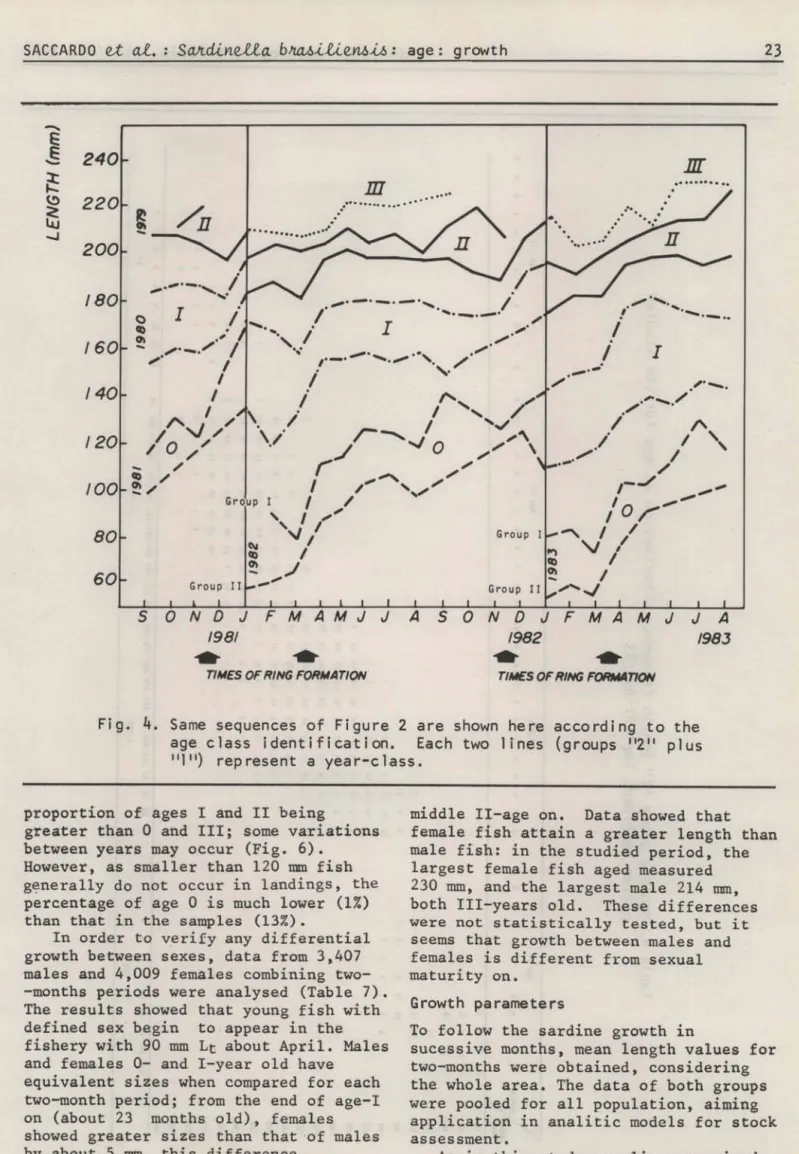
(Fig. 2) showed that at the beginning of each year a new group of fish seems to appear in the fishery, starting its growth in 1ength. This can be verified by the two 1ines approximate1y para11e1, surging in Jan-Feb 1982, the same
occurring in Jan-Feb 1983. As on1y one spawning peak occur in one spawning season, we consider that each two 1ines
(two groups) represent a year-c1ass. As the spawning period ranges from October to March, it is possib1e that fish born at the beginning of this period may present two otolith rings in April, whi1e those born at the end of the spawning period cou1d form on1y one, or none till Apri 1, so causing the
appearance of the two groups. We named these groups as "1" (fish born at the beginning of the spawning period: Sept-Nov) and "2" (fish born.
subsequente1y: Dec-Mar). In this work we mean year-c1ass as the two groups combined.
So, according to the timing of ring formation and the birthday attributed to January 1st , the identification of the number of rings in the otoliths to age classes is shown in Tab1e 3.
In Figure 4, the same sequences of Figure 2 are shown according to the age class identification.
Age structure
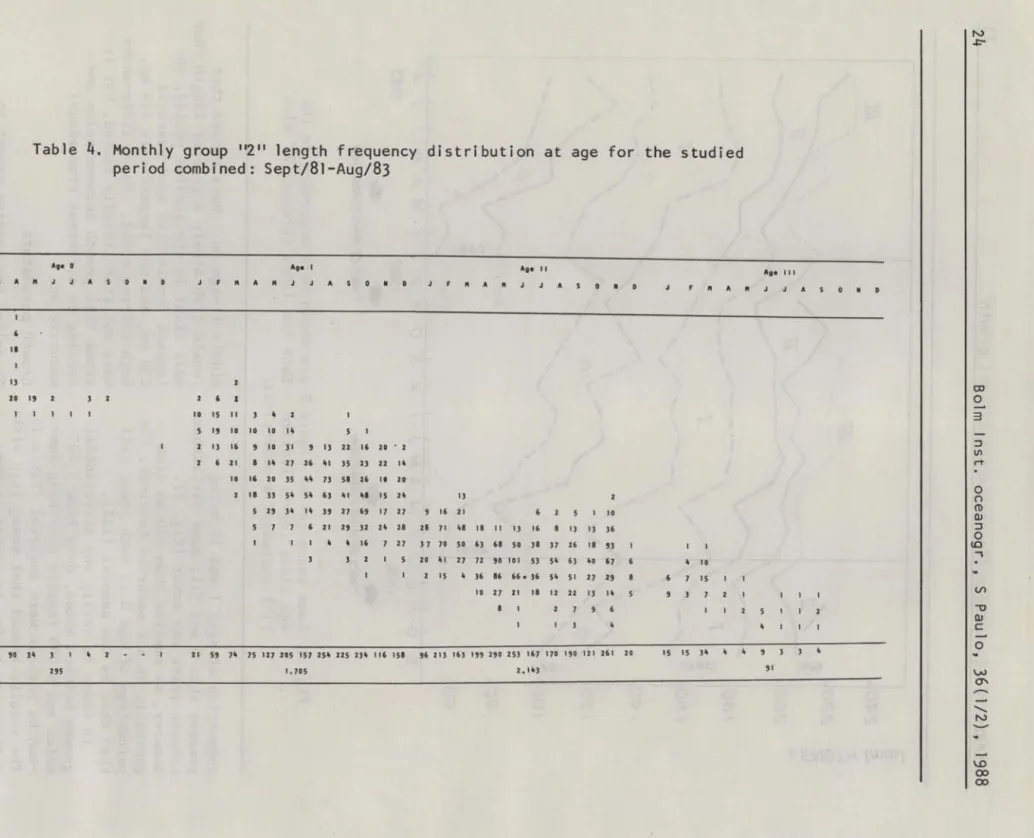
On the basis of the above interpretation of ring structure, data from 1981-82 and 82-83 periods were combined, in order to obtain month1y 1ength frequency
distributions at age classes for the whole area, for each group,
described as fo110ws:
a)
gJtoup
"2": the youngest fish from a year-class (Tab1e 4).It may be verified that age-O fish begin to appear since January with 1engths about 40 mm derived from the artisanal fishery in the Paraná region. From March ti11 September, fish from the cornrnercial fishery occurred from 60 mrn
to 100 rnrn Lt. From October to
December they practically disappeared
in the catches. This group reappered, with age-I, during a11 the months of the next year with sizes varying from 80 rnrn
Table 2. Mean lengths of
S.
b~~en6ih with different númber of otolith rings from the whole area studied. N = number of fish; L = mean total length;S = standard deviation
Mu l'tl be r of 6
R i "gs Lt 1981
1982 ~9 55.3 ~ . 29
~6 58 . 7 9.20
H 63.6 2.~~
A 60.0 0.00
H
A
o
1983 ~2 52 . 2 6 .2 3
lO 58.8 9 . 72
H 54.6 2.88
A 55 . 5 7 . 50
H
A
Lt 97 . 5 2. 12
16 87 . 7 9.6~
U 77.0 13.~3
52 85.6 12 . 0~
31 90 . 6 6. 72 99 . 7 8 . 62 105.0 0.00
95 . 0 ~.H
30 79 . 0 10 . 13
21 82.7 12 . 83
16 72 . 3 16.8~
33 75.5 12.7~
90 . 3 5 . 51
101 . 0 2 . 83
Lt " 3 11 ~ .6 12 . 1' 7 18 129.6 6.53 I I 121. I 8.20
13~ . 0 5 . 66 33 115 . 8 9.62
~~ 129 . 8 12.61 55 109 . 2 11.78 109 113.0 12.59 39 124 . 6 11.16 25 122.0 1~.21
51 116.0 10 . 02 139.8 20 . 58
12~ . 0 0.00
19 107.9 7.76 26 11 1. 3 10.55 30 116.5 1~.65
53 102.8 8.03
39 100 . 6 8 . 31
~o 110 . 3 8.05 129.6 2 . 88 61 117.3 10.62
Lt
111 153.2 18 . 52
187 159.~ 16 . H 96 156 . 9 18 . 55 37 1~7.9 19.81
21 169.6 10 . 6~
71 164 . ~ 17 . 13 60 155 . 6 12.6~
H 153.1 12 . 1~ 7~ 153 . 0 12 . 12
10~ 155.5 ~.35
107 151.6 13 . 68
16 1 155.6 12.37 I 13 146 . ~ 14 . 59
~7 151 . 114.10
20 131.6 9.13
16 133.6 10 . 2~
37 1~8 . 0 7 . 68 6 1 150 . 2 11 . 88
36 131 . ~ 18 . 56 53 138 . 3 2 1. 63 101 133 . 8 15 . 60 50 1~3 . 5 9 . 83
93 141.5 10 . 05
L t
91 182.1 15 . S5 115 185.5 16 . 35 150 18~ . ~ r~.25
9~ 162.9 16._2
H 181.6 9 . 30 136 18~ . 7 10.72 53 178.~ 12.10
80 lH.2 8.53
130 178 . 1 11.74
H8 177.6 9 . 95
1~~ 175.7 12 . 06 151 177.~ 12.~5
199 172.5 13.37 201 171.3 13.15
194172.51\ . 73 6~ 166 . 3 17.95
196.0 ~.2~
77 180.2 10 . 69 110 178 . 9 1\ .86 88 172.8 12 . 22
13~ 178 . 8 11.06 162 17~.8 13 . 05
119 171.8 12.65
180 171.0 13 . 90
L t
36 205 . 9 13.31 63 205 . 6 11.01 81 201 . 3 1~ . 52
10 178.5 10 . 32
~9 196.7 10.H
57 200.5 8.69 70 197 . 9 9.59 47 19~ . 7 8 . 86
108 198.7 11.13
65 195.6 9 . 10
60 19~.7 11.20
~7 194.2 10.~6 15~ 195.~ 12.38
58 188.8 11.26
180 185.2 10.01
53 187.8 8 . 09
15 193.6 10.~5 9~ 188 . 3 8 . 83 79 19 5. 8 9 . 13 152 191 . 6 9 . 90
182 195.9 10 . 01
188 196.~ 10.65 107 193 . 0 12 . 2~
123 197 . 3 10 . 62
Lt S"
208.7 12.24
121 217 . 7 13.2~
6 207.5 ~.72
6 206.2 6 . ~3
28 203.2 8 . 88 16 200 . 4 8.46 25 207 . 9 1\ . 03
201.~ 10 . 45
lO 20~.9 11 . 46
196.7 7.23
61 209 . 0 10.71 216 · 3 7 . 77
12 202.~ 6.02
20 203.2 7 . 52
9 212,6 ~ . 19
9 199.4 7 . 22
202 . 1 7 . H 1,5 202 . 6 6.96 77 208 . 0 7.9~
114 211.8 9 . 43
H 212.3 9 . 23
57 22~ . 7 12.56
L t
20 7. 0 0 . 00 219 . 7 6 . 11
217 .0 0.00
222.8 7 . 97
217 . 0 6 . 00
209.0 0 . 00
9 228 . 0 6.32
227.5 7.78
226.7 12.06
SACCARDO
et
al. : Sa.Jtdble..U.a.bfl.a.,6.LUe.YL6i6:
age: 9 rowth 21230
-..
e
~ 2/0
~
i
/90""
..,j/70
"O
/JO
/10
to
70
:,
;~
'~
,
,
,
,.,(,1,,, "(,,
'"
,,111
,,-tt:
...., ... '1, ' " //I
"//1
00
J A S O N O J M A M J J A
/983
/9.
..
71WS CF lfING f'OMIAnoN..
Fig. 2. Sequence of monthly mean length from sardines with the same number of rings on the otoliths, from the whole studied area during September/1981 to August/1983. Times of ring formation area i nd i cated. ( ) = numbe r of r i ngs fo r es ti mated mean, as no data were avai lable.
Table 3. Identificationof the number of rings in
oto1iths to age classes, by month.
Jo.
,.~
....
A,.
...
,
J ••
J.I
Aog
Se,
OCl
•••
Do.
Group "2"
o
O-I
0-2 ~
11 111
Group "111
0-2 ~
0-2 ~
1-' 5
11 111
5
6 6
In the fourth year of life (age-III) fish were found measuring 180 to 230 mm occurring only till August-September. After this period fish belonging to this group did not occurred. It was not found 4-years old fish.
b) GJtoup
"1":
the oldest fish (TabIe 5).Fish born earlier within the spawning period begin to appear in the commerciaI fishery in January with 60 mm Lt. Fish 50 mm
4
have been found in the22 Bolm Inst. oceanogr., S Paulo, 36( 1/2), 1988
GR
0.35
O.
0 .25
O.
0.15
GR
0.40
0.35
0 .30
0 .25
0 .20
0.15
RJ
sp
SONDJ FMA MJ JA MONTH
GR
0.40
0.35
0 .30
0.25
0.20
0.15
se
S
o
No
J F M A M J J AMONTH
confidence infervol
sfondord deviotion mtIOn meon
Fig. 3. Marginal increment index variations for sardines from Rio de Janei ro (RJ), São ' Paul0 (SP) and Santa Catarina (SC) regions, during 1981/1982. The 1982/1983 variations were simi lar and perfectly representative.
numbers in the seeond semester. Fish III-years old, or older, were not found.
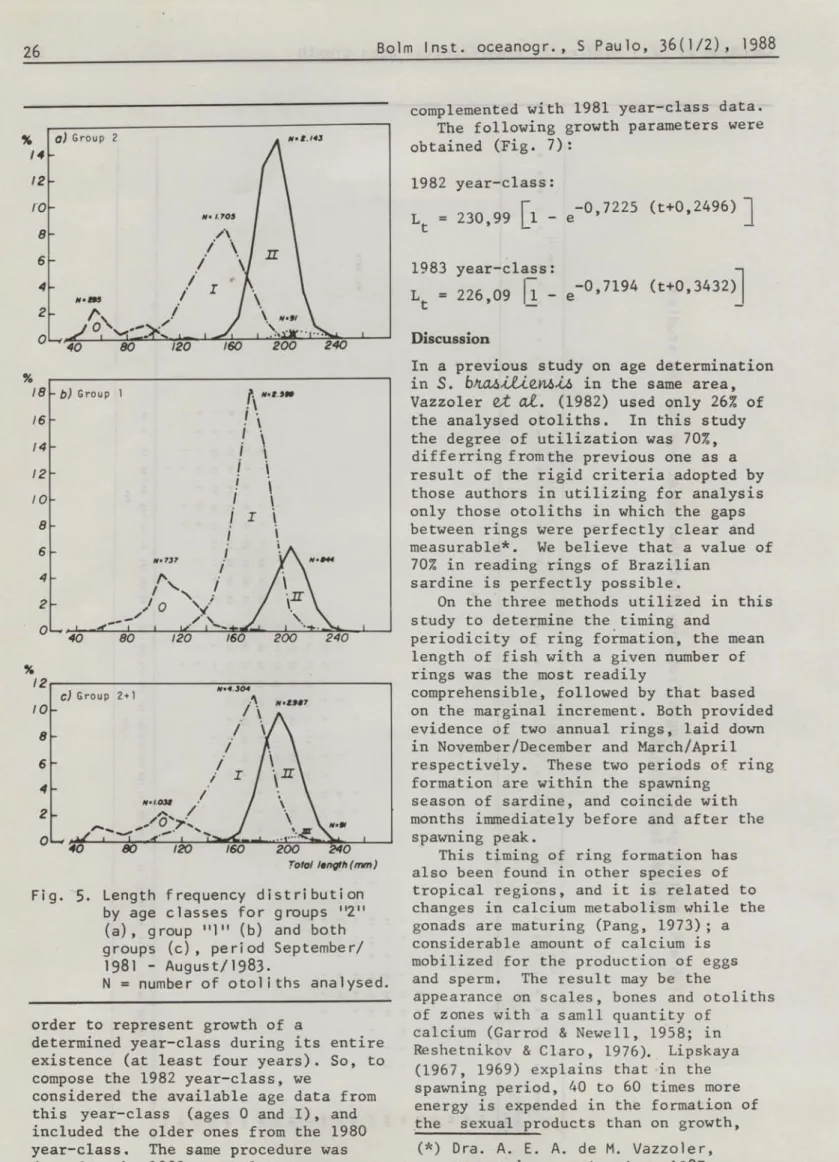
Considering the partieipation of eaeh age elass during the studied period, group "2" samp1es were eomposed main1y by fish at age-lI (51%); age-I
eorresponded to 40% and the remaining 9% to ages O (7%) and 111 (2%) (Fig. 5a). Group "1" samp1es were eomposed main1y by age I (62%), being ages O and 11 representated by 18% and 20%
respeetive1y (Fig. 5b, Tab1e 6).
As group "2" and "1" are not separated in landings, the eombined samp1es data show that sardine samples in 1981/1983 were eomposed in general by I-year old
(54%) and II-years old fish (32%), being less represented ages O (13%) and Irr (1%) (Fig. 5e).
SACCARDO e;t ai. : SalLMn.e.Ua. bJta"ú,lie.n6,{,6: age: growth 23
-
E.§
240
lI[.-
... .
~
t!)
220
~
~
DI
....
....
...
-J
200
/80
/60
/40
/20
/00
80
60
()
I
CIi) •
0\ . '
-
;,'",.-.""
/
I
,
II' I /
I
, , /
/ O '"
/-
/CIi) /
~/
Group
...
Group
"
...
.
".'
... .
I
I
I
"'-...
_ /. .
"
.
I
"',
. I
./.1 I '
....
/,--I'
--
.,..
/01"-"
'V /
I / II
""".J
5 ONDJ FMAMJJ A 50
/98/
...
/982... ...
TIMES DF RING FORMAT/ON T/lrfES OF RING FORMATION...
Fig.
4.
Same sequences of Figure 2 are shown here according to theage class identification. Each two lines (groups "2" plus
11111) represent a year-class.
proportion of ages I and 11 being
greater than O and 111; some variations between years may occur (Fig. 6).
However, as sma11er than 120 mm fish
g~nera11y do not occur in 1andings, the
percentage of age O is much lower (1%) than that in the samp1es (13%).
In order to verify any differentia1 growth between sexes, data from 3,407 males and 4,009 fema1es combining two--months periods were ana1ysed (Tab1e 7). The resu1ts showed that young fish with defined sex begin to appear in the fishery with 90 mm Lt about Apri1. Males and fema1es 0- and I-year old have
equiva1ent sizes when compared for each two-month period; from the end of age-I on (about 23 months old), fema1es showed greater sizes than that 'of males by about 5 mm, this difference
increasing to about 10 to 20 mm from
midd1e lI-age on. Data showed that female fish attain a greater length than male fish: in the studied period, the
largest female fish aged measured 230 mm, and the largest male 214 mm, both III-years old. These differences were not statistica11y tested, but it
seems that growth between males and fema1es is different from sexual maturity on.
Growth parameters
To fol1ow the sardine growth in
sucessive months, mean length values for two-months were obtained, considering the whole area. The data of both groups were poo1ed for alI popu1ation, aiming application in analitic mode1s for stock assessment.
::'\.
..
11 ].SI 51
"
51
..
16 1i11 I)
l i I 14 I '
"
20111 111
lU
1)1 " I
151 161 111 111
"1
UI
111
UI
1)1
141
"
56 I) ,O"
Table 4. Monthly group "2" length frequency distribution at age for the studied period combined: Sept/81-Aug/83
A,. O A,. I Ag. II
A
11 15 11
"
" 10 10"
1 I ' 16 l i , I
I ' 11
"
10 • 211 14 17 16
"
)5"
11 14l i
"
10 )5 44 1) 51 16 11 10-18 JJ 54 54"
41 41 15 H I)U )4 14 H 17
"
17 17 16 11 1011 1, J1 H 28 18 71 41 18 11 IJ 16 1) I) J6
16 17 l i 7' 50 6)
"
5' JI l i"
18"
2. 41 17 71 'O la I 5) 54 6) 4. 67 10
2 15 4 J6 16 66. 16 54 51 17 2' 15
l i 27 21 18 12 22 I) 14
)4 21 5' 74 75 127 105 157 254 115 2)4 116 151 " 21) 16) '" 2" 25) 167 170 ' " 121 261 2. 15 15 )4
2'5 1.705 2. ,,)
At. III
"
N
..e-to
O
3
::J U>
rt
O
()
ro
QJ ::J
O
\O
...,
Vl
"'O
QJ C
O
\AI
O'
...
N
SACCARDO
e.t
al.. age g rowth25
.
c~ ~
c , c
..
..
..
.
"U
ill
"U
~
....
I/)
ill
.I:
....
L-o
..
4- H
ill
C'I
..
H ;;lU H H
~ ::: ~ o
....
..
lU
~ ::: :
..
c
.
~ ,..
..
..
o c ::: ~ ~ !:'
....
"-
..
~ :; o~ c
..
~.o H H ~ ;;
L- ~
..
~ ;:-
~H ~
..
..
....
I/)
-
H :...
o~
H
..
..
"'C
-
~ ~..
H..
..
>-U
=
~c
ill
-
~ ~-
..
..
~..
~
..
..
~..
~
C'" ~
.. ..
~ ~ :::=
:!ill H ~
..
~
L-:::
..
~..
~
..
4- ~
..
~-
~H
~ ~ ::
..
~.I:
..
~..
~ :::....
..
.. ..
..
..
C'I :.
-
..
~ ~ H..
..
C M c , ::; ;;; H ":
=
..
..
~..
ill 00 ~ ~
...
..
..
~..
..
C'I ;: M
..
~ ~..
~
-
H:!
.. ..
..
c:r
..
~ :;..
I H
..
:! ~ ~ :::
~
0.00
~ ...
=
;; ;:..
~..
H H
=
o o.
L- ill ;:;
C'I V')
>-"'C
-
:: ::..
~ ~ ~ ~ ~.I: o ~
....
C
L-o ill ;:
=
x: o.
-
o-
:: :;;H
LI'\ ::: :; H
=
~~
ill :.
~
.
~..Q ~ ~
C H ~ ;;
~
..
lU H
-
~~ H H ~ ;;;
~ ::
..
H
..
..
c
..
..
H..
H
..
H..
o
=
~..
..
~: :! :::;
=
~.. .. .. .. ..
:...
=
.
..
.
.
.. ..
..
;.. ..
..
.
o..
'"..
~..
..
H ~..
'" :! ~
..
.
H ~..
26 Bolm Inst. oceanogr., S Paulo, 36(1/2), 1988
"
14 1210
8
6
4
2
O
%
18
/6
/4
/2
/0
8
6
4
"
2O
o) Group 2
/1'_
i
,,I"
1tI.'.70~
/\
i
\
/
\
/
i
Ib) Group 1
f:
".6.5., \
40
""
/I '" '
/ O ' .. /
I I
- - , I ' / ' ,
-
' - . , .80 /20
! "
I ',
\
I \
i \
! \
I \
i
I \I i
12~---~~~---~
10
8
6
4 2
O
c) Group 2+1
"'e 1.0»
i
/
'/0 ... '/ '
,...
"...",.. .,'...
".....
' ...80 /20
Totol lenglh (mm)
Fig. ~. Length frequency distribution
by age classes for groups 112" (a), group 111 11 (b) and both groups (c), period September/ 1981 - August/1983.
N = number of oto1iths ana1ysed.
order to represent growth of a
determined year-c1ass during its entire existence (at 1east four years). So, to compose the 1982 year-c1ass, we
considered the avai1ab1e age data from
this year-class (ages
°
and 1), andinc1uded the older ones from the 1980 year-c1ass. The same procedure was done for the 1983 year-c1ass,
comp1emented with 1981 year-c1ass data. The fo110wing growth parameters were obtained (Fig. 7):
1982 year-c1ass:
Lt
=
230,99 [1 e-O,7225 (t+O,2496) ]1983 year-c1ass:
l
'
-I e-O,7194 (t+O,3432)_
L
=
226,09t
Discussion
In a previous study on age determination
in
S.
b~~e~~ in the same area,Vazzo1er et
ai.
(1982) used on1y 26% ofthe ana1ysed otoliths. In this study the degree of uti1ization was 70%, differring from the previous one as a result of the rigid cri teria adopted by those authors in utilizing for analysis only those oto1iths in which the gaps between rings were perfectly c1ear and measurable*. We believe that a va1ue of 70% in reading rings of Brazilian
sardine is perfectly possible.
On the three methods uti1ized ~n this
study to determine the timing and
periodicity of ring formation, the mean length of fish with a given number of rings was the most readi1y
comprehensib1e, fol1owed by that based on the marginal incremento Both provided evidence of two annua1 rings, 1aid down in November/December and March/Apri1 respective1y. These two periods of ring formation are within the spawning
season of sardine, and coincide with months irmnediate1y before and after the
spawning peak.
This timing of ring formation has also been found in other species of tropical regions, and it is related to changes in calcium metabolism whi1e the gonads are maturing (Pang, 1973); a considerable amount of calcium is mobilized for the production of eggs
and sperm. The result may be the
appearance on scales, bones and otoliths of zones with a samll quantity of
ca1cium (Garrod
&
Newell, 1958; inReshetnikov & Claro, 1976) . . Lipskaya
(1967, 1969) explains that in the spawning period, 40 to 60 times more energy is expended in the formation of the sexual products than on growth,
(*) Dra. A. E. A. de M. Vazzoler,
SACCARDO e~ alo Sa~~efla b~i li en6~: age: growth
27
Table
6.
Annual ]ength frequency distribution at age, ror groups 112 11and 11]11, for the studied per i od Sept/8]-Aug/83.
Age O Age I
Conort 11211 111 11 "2" 11111
% % % %
40 25 0.59
50 103 2 . 44 O • 1 2 60 52 1 . 23 26 0 . 62 70 17 O . 40 33 0 . 79
80 40 0.94 42 1 . O O O . 05
90 46 1 . 09 74 1 . 71 10 0 . 24 100 11 O .26 185 4.43 46 1 . 09
110 143 3 . 42 74 1 . 75
12 O 0.02 116 2.78 163 3.85 8 O . 19
130 70 1.67 239 5 . 64 41 0 . 98
140 21 O .50 312 7.37 108 2.58
150 O. 17 352 8.31 234 5 . 60
160 8 O. 19 261 6 . 16 500 11 . 96
17.0 4 O. 10 169 3.99 770 18 . 42
180 0.07 61 1 .44 588 14 . 07
190 14 0 . 33 261
200 O • 05 64
210 15
220 8
230 2
240
295 737 1]05 2599
this being ref1ected in the r1ng formation . in bony structures of these fish.
For S~di~etta a~, in the Lybian
coasta1 waters, it is apparent that the hya1ine zone in oto1iths is 1aid down during the period of gonad maturation
and spawning in adu1t fish (Pawson &
Giama, 1985). On the other hand, the rings in sca1es of the oi1-sardine,
S.
lo~gieep6, in Indian waters may beformed due to poor feeding in summer
months (Bensan, 1968). In S~di~op~
~eopite~dU6 in Austra1ia it may be
regarded as a sudden check in growth due to assumption of shoa1ing habit of
the species (i~ Ba1an, 1968). In our
study it is difficu1t to state the cause of ring formation; according to Skorniakov (1964), under certain conditions two rings are regularly formed a year in tropical -fish with
6.24 1 .53 O .36 0 . 19 0 . 05
Age 11 Age 111
"2" 11 111 " 211 "111
% H
,
15 O . 35
70 1 . 65 0.02
275 6 . 50 30 O . 72
551 13 . O 1 95 2 . 27 O . 05 634 14.97 187 4.47 14 0.33 414 9 . 78 265 6 . 34 30 0.71 142 3 . 35 187 4 . 47 25 0.59 33 0 . 78 68 1. 63 13 O . 31
9 O .21 10 0 . 24 0.17
O . 02
2143 844 91
partia1 spawning and Nekrasov (1979) cites severa1 examp1es from 1iterature for tropical fish where two rings a year are formed.
For the same genus, Baptista (1977;
~. i~ Thomas, 1983) found that the
Ango1an sardine11as (S~di~efla a~
and
S.
eba)
form two hyaline rings annua11y. A1so in the otoliths of theSouthwest African pilchard S~di~op~
oeefl~a, it was observed that more than
one ring is 1aid down each year (Thomas, 1984), and in this case, the broad
hya1ine zone formed between September and December was referred to as the annual ring and considered in the countings.
Rings on
S.
b~~en6~'oto1iths formedin November/December and March/Apri1 cou1d be re1ated to some other factor, not directly associated with
28
("y.) 18
16
I~
12
10
8~
6~
..
2
-O O
1 8 1 6 I 4
I 2 ~
10
8
6
4
I/N/I
,a,.,
100
Bolm Inst. oceanogr., S Paulo, 36(1/2), 1988
.~
/ .
.
\
N (~.)"',
/ ,...
o 14.' " (I)/
'~
\"lT
1-1 1 1 . 173.' " I"~)
I '
\
XL I .O ... . R7 (47)I
I \
I
\\
m 17.0J7 11),
I
\ ,.,., , ... 11 ' " • . J19_,
I
\\
,
\I
I
\\
I \
,
i
\ \/
\ \,
i
\,
,
\
I
/
\I
\
\
,,'/
I
DI ____
\
'.
-'
",..
,_
...
,
".\,...
_-
...
b.~' , <-,
150
,"
,
\,
1-1 \
I \
I \
I
\
,
\
"
\,
\
200
I \ 1' ...
/
\
i
.,
I
Y
\-lT
/
i
\
\
" I \ \
,
I
\
\
,
\ \.,-
oI
Jl
m
250
N 1' .'57 133' . 111'3
741.351 15 .34'
I / \ \
2~ ~
i ' .
O
=s-/~
' " .... (.,.~\....!!.?b:.::J'>,-+._
O 100 150 200
14
12
10 ~
8~
6
4
2
O
-'
='O 100
"
1
í--\
/ \.
JI
'/
,,/,
"
'(
\
, ! \ \
/
I
\
"
I
i
\
\
"
I
\
\
/
1 \ \
....
o
1
m
"
/
\\
/ / III \ ".
b c / '
C\,
c'-
, ...
0r ...
\""";,;,;!!I,,,':',
150 200
N
li.'"
250
1.57 ...
I. I5J . 5I 7 (41)
J<f.O" (11
250
Lt (mm)
Fig.
6.
Length composition of sardines at age as determined by otoliths, from the total landings in 1981, 1982 and 1983.N= number of fish
!
!
I
I
SACCARDO e;t ai.. SMcüne.lla bJtM-tüe.n6.ú..: age: 9 rowth
Table 7. Mean length at age by two-month periods, considering males and females separated. Asterisk indicate for each tow
months the greatest value between sexes, without statistical compa ri son
Yee r.-c I .. s 1982 Yeu.-CI ... 1983
"ales "ales Females
Age Number of Sempllng perlod
r I ngl
N N Sempllng perlod
o Ii 1I1 O-I 0-1-2 1-2 1-2 1- 2
1- 2- 3
2-3 2-3-~ 3-~ 3-~ 3-~ 3-~-5 ~-5 ~-5-6 ·5-6 5-6 5-6 5-6-7 6-7 6-7 7 7 Jen-Feb/82 "er-Apr Mey-Jun Jul-Aug Sep-Oct Nov-Oec "er-Apr "ay-Jun Jul-Aug Sep-Oet/81 Jen-Fev/82 Mer-Apr "ey-Jun Jul-Aug
Se p-Oe t
Nov-Oee Jan-Fev/83 "ar-Apr Mey-Jun Jul-Aug Sep-Oet
2 IH.OO 3 126.00 34 126.12 29 119.07 7 128.00 12 131.83
136.00 8 136.75
3 148.00 133. 00
25 1~3.96 19 1~4.37
63 161.16 105 158.52
226 16~.93 209 162.41
193 160.5~ 240 163.64
222 170.03 268 168.48
15~ 169.77 192 172.72
162 183.26 173 192.89 88 188.50 95 195.94 82 195.90 118 201.39 55 192.36 65 197.95 112 194.40 163 199.24 85 184.46 127 190.24
8 202.62 lO 208.70* 212.33
209 . 00 214.00
204 . 14 9 228.00 4 230.25
Jen-Feb/83 Mer-Apr "ey-Jun Jul-Aug Sep-Oct/81 Nov-Oee Jen-Feb/82 Mer-Apr "ey-Jun Jul-Aug Sep-Oet Nov-Oec Jan-Fev/83 "er-Apr Mey-Jun JIII-Aug Sep-Oet/81 Nov-Oee Jen-Fev/82 "er-Apr "ay-Jun Jul-Aug Sep-Oet
in this species.
110.00 lO 101 . 10 26 106.35 36 106.53
31 118.8~ 30 117.73
16 111.19 21 122.38
25 1~0.56 20 1~5.80
49 171.26 31 168.81 61 166 . 18 94 163.55 201 168.03 248 169.~1
2~8 167.16 298 165.97 270 ·165.63 27~ 165 . 76 183 170.16 1~5 173.3~
84 181.64 104 188.58 183 187.81 202 192.31 241 196.52 320 204.28 139 196.89 182 202.81 59 203.34 46 209.09 33 202.76 60 203.73
204.00 10 207.40 13 202.69 16 203.81
213.00
21~.00
2 223 . 00 217.00 225.67
29
in immature individuaIs. It is assumed that in adu1ts the same factor can trigger ring formation in the periods considered here. In the 1iterature there are instances where the formation of hyaline zones in the ot01iths of
~exua11y immature animaIs is caused by
an inherent rhythm linked with the rep·roduc ti ve cyc 1e - e. g. the European hake (Hick1ing, 1935), pi1chard (Davies, 1956; Baird, 1970) and the Cape hakes
(Botha, 1971). Whatever may be the cause
for the checks in S. b~~~e.n6.ú..
ot01iths, they seem to be periodic and so they can be used to indicate the age
wbi1e ageing the otoliths in the present work, alI we11-formed rings were counted without any attempt to
discriminate between those referring to growth or other causes. This procedure was adopted taking into account the possibility that any person might be involved in performing the counts. Considering the resu1ts, this method
proved to be efficient: Vazz01er
e.t
ato
30
Bolm I nst. oceanogr., S Pau lo, 36( 1/2), 1988230
E
.
.
.§
..
~ \.:) 2/0
<:
lu
....J
/90 /70 /50 130 110
90
70
50
30
10
'"
..
JF JFFi g.
7.
Growth curves for 1982 and MONTH1983 year-classes. Groups "1 11 and "211 comb i ned.
( ) Estimated values.
given number of rings are similar, which indicates that the readings were
comparable. The present interpretation
differs from that of Vazzoler
et
alo
(1982) in relation to the attribution of age, since they considered that only one ring is formed annually, finding that age ranges from O to 7-years old whereas we consider the age to range from O to
3-years old in
S.
b~~~en6~. However,the authors cited above analysing the monthly variation of otoliths with hyaline and opaque edges, found a peak in hyaline zone formation also in April
(fig. 6 from page 80), which they attributed to spawning, without taking it into account for age determination.
Richardson
et
alo
(1960) also found upto 7 rings in scales of
S.
b~~~en6~from Santos and Rio de Janeiro, and
suggested the Brazilian summer as the period of ring formation. It is
interesting to note that they supposed an annual rings formation on scales, but mentioned that certain anomalies could not be explained. The period when length at age is at a minimum,
according to Richardson
et
al., lop.
cLt.)
corresponds to that ofNovember/December, when we also verified a rniniurnurn length per ring in summer. After an increase in rnean
length values per ~ing, we find a
second low value, verified in summer (March/April) .
The wide range of lengths found for each age class, rnainly for ages O and I, is easily explained by the length of the spawning period of
SACCARDO
e.t ai.
:
SalZ.dúle.lia
bJta6.,{) '~e.Vl/.).-i..J.J : age: g rawth"2" are graphically separ·ated, there 1S
a small averlap of length within age classes (Fig. 5a, b). It should also be noted that both ages 11 and 111 show a wide overlap, suggesting that at these ages the species is approaching its maximum size. In fact, according to pauly's equation (Pauly, 1980) in which maximum longevity of fish can be expressed by tmax=3/K+to, we found a maximum age of 3,9 and 3,8 for
S.
b~~e.n6~ in 1982 and 1983,respectively. These values are
approximate to that found by Matsuura (1983), who found 4,3 and it should be noted that in that work only fish from the northern part of the
distributional area - therefore ~arger
fish-were considered for study. The occurrence of few individuaIs of age 111 and older in the catches provides evidence of the short 1ife span of the Brazilian sardine.
The data obtained during this study through ageing of otoliths showed that sardine fishery is practically based upon ages I (54%) and 11 (32%)
individuaIs, and it is interesting to note that the same resu1ts were obtained through the analysis of length composition of catches f:rom 1974 to 1980 in the same area
(PDP/SUDEPE, 1985).
We find in literature severa1 examp1es in which the average size of sardine fema1es is greater than
that of males by a few mi11imeters Phi11ips, 1948; Ben-Tuvia, 1960; Pawson-Giama, 1985. As occurs with
S.
b~~en6~ the difference isre1ative1y sma11 in young fish, but it increase as the fish become older.
According to Matsuura (1983), Brazilian sardine reaches sexual maturity at the end of age O at a total length of 160 mm. Our samp1es
showedthat no fi$h from group
"2" was ripe or spent at the end of age O; we presume that these fish do not spawn in the summer of the year after the fish are born, first
spawning occurring on1y in the summer of their second year of life (at the endof age-I or starting age-lI). In relation to group "1" fish, ripe and spent individuaIs from the year-class
1981 (spawning season 80/81) w~re
found in December/81 (age-O) and February/82 (age-I); those from the
year-class 1982 (spawning season 81/82) were found spawning only in March/83 (age-I) (Table 6). These results show clear1y that fish may spawn for the first time in the summer of the year after they are born, when they are the oldest
(largest) from a given year-class and able to attain length at first maturity in this period, that is 160-170 mm total length (Rossi--Wongtschowski, 1977). Considering
that Matsuura's work (1983) was based upoo fish samp1ed from the Rio de Janeiro region - where spawning genera1ly occurs earlier than in
southern regions of its distributional
area (Saccardo & Isaac-Nahum, 1983),
it is possib1e to find sexually
mature fish at age-O, but our resu1ts suggest that this does not occur for the whole population.
For the close1y related species
SaI!.di~etta a~chovia, Prosvirov
&
Varea (1965) believed that this sardine in the northeastern Gulf of Mexico reached sexual maturity during its second year at a 1ength of
140-150 mm standard length. In
Venezuela,
S.
anchovia
was found tobe sexually mature between the ages of 11 and 111 years at a total length
of 195 mm (Simpson
&
Gonzalez, 1967).For the Indian oi1-sardine,
SaI!.dinetta longice.p6,
those born in July-August have a faster growth rate than later recruits (AnthonyRaja, 1970). Similar observation
is possib1e to be made for
S.
b~~e.n6~ in this study, if growth
parameters for group "2" and "1" are separate1y obtained: group "I"
present higher growth rate than group "2". This may be related to the warm period to which they are submitted, as group "1" fish are born at the beginning of the summer season, growing faster than group "2" fish.
Growth parameters values of
S.
bJta6~e.n6~, considering togetherdata from both group, are coherent with data found in literature for the genus in other areas (Pau1y, 1978). Values for K are about 0.7,
Loo about 230 mm and to ranges from
-0,23 to -0,34. For the most relative
species
S. anchovia
from Venezuela,values of K and L are 0,7 and 240 mm, 00
32 Bolm Inst. oceanogr., S Paulo, 36(1/2), 1988
respective1y (Heald
&
Griffiths, 1967;Simpson, 1971).
Other authors have obtained similar va1ues to ours for Brazi1ian sardine:
Santos & Fratzen (1965)
[Lt 24.3 1 - e -0.50 t ]
Matsuura (1977)
[Lt = 24.4 1 - e -0.44 t
]
Matsuura (1983)
'[Lt = 26.0 1 - e-0 •62 (t+O.588) ]
PDP/SUDEPE (1985)
[Lt = 24.0 1 - e -O.62(t+0.588) ]
However, those studies did not inc1ude fish from the who1e area of abundanee of this speeies, and/or presuposed that tO=O ••
In cone1usion, this work shows a different way of interpreting age
of S. b~~en6~ through otoliths
rings. Having found two rings formed a year, the age varies from O to 111 years along the oceurrenee area of the speeies.
The cause of ring formation may be linked to the reproduetive eycle. As cited above, there are evidenees that the pre-spawning stages are attained in fish from the Rio de Janeiro samp1es in November, and later in those from são Paulo and Santa Catarina regions. This indicates that the spawning process begins ear1ier in the northern region
(Saccardo
&
Isaac-Nahum, 1983).The marginal increment index va1ues shown in this work a1so suggest a progressive north-south shift in time
(Fig. 3~. This fact may be re1ated to
the previous observation, inforcing the argument of the cause of ring formation.
Resumo
A idade da sardinha SMcün.e:Ua.
bfUUli-lienói6
foi determinada pelo examede otó1itos de exemplares
provenien-tes de desembarques da pesca comercial e artesanal, na área compreendida
en-tre 22°S (Cabo Frio, RJ) e 28°S
(Cabo de Santa Marta, Grande, SC), du-rante o período 1981-83. Este estudo
ê
parte de um programa mais amplode-nominado "Programa Integrado de Estu-dos Biológicos sobre Sardinha", desen-volvido na região sudeste do Brasil desde 1981, objetivando conhecer as variações dos parâmetros biológicos
da espécie, e fornecer subsídios
ã
avaliação pesqueira do recurso.
Foram contados os aneis translú-cidos dos otó1itos, colocados intei-ros em recipientes de fundo preto, imersos em álcool 70% e iluminados com luz incidente sob estereomicros-cópio binocu1ar. Alem das contagens, foram efetuadas medidas das distâncias do núcleo do otó1ito ao bordo, e do núcleo a cada anel translúcido, bem como observações da natureza do bordo. Foram utilizados três métodos para determinar a epoca e periodicidade de formação dos aneis. Os parâmetros de crescimento Loo' K e to foram estima-dos, e as curvas ajustadas usando-se a equação de von Berta1anffy. Os resul-tados mostraram que os otó1itos possuem de O a 7 aneis, sendo formados dois anéis por ano: um entre novembro-dezemr bro, e outro entre março-abri1. Estas épocas estão intimamente ligadas ao período de reprodução. Descreveu-se um metodo para a determinação da idade de
sardinha, tendo sido identificadas clas-ses etárias de O a 3 anos. Verificou-se tambem a ocorrência de dois grupos de peixes dentro de um dado período de de-sova (outubro e março), que representa-riam individuos que nascem no início da estação ' de desova, e aqueles que nas-cem posteriormente; ambos grupos formam uma classe anual. Os parâmetros de crescimento obtidos foram:
classe anual 1982:
Lt
=
230,990_
e- 0 ,7225(t+0,2496)]classe anual 1983:
SACCARDO e;t
ai.. SaJtdiYle.Ua blliUJilie.VL6,w:
age: grONth33
Acknow ledgements
We thank alI scientists from the Integrated Programme of Bio10gica1 Studies on Sardine (PIEBS), name1y: Dr. H. Va1entini; G. S. Melo; S. Jab1onski; M. Teixeira-Wenze1; L. G. Domit; R. de D. Cardoso; J. sá ReVoredo; L. Frosch and M. Munhoz.
We also thank Dr. Roger Bai1ey and Dr. Richard Parrish for reviewing the manuscript and giving their with many valious suggestions.
References
ANTONY RAJA, B. T. 1970. Estimation of age and growth of the Indian
oil-sardine,
SaJLdl.J1e1la. UYlgic.e.p6
VaI. Indian J. Fish., 17(1/2):26-42. BAIRD, D. 1970. Age and growth of theSouth African pi1chard,
SaJLdiYlop6
oc.e.tiatd.
InvestI Rep., Div. Sea Fish. S. Afr., (91):1-16.BALAN, V. 1968. Studies on age and growth of the oi1-sardine
SaJLdiYle1la.
lOYlgic.e.p6
VaI. by mean of scales.Indian J. Fish., 11(2-A):663-686. BENSAN, P. 1968. Growth variations
in the Indian oil-sardine,
SaJtdiYle.lla
lOYlgic.e.p6
Va1enciennes. Indian J.Fish., 11(2-A):699-708.
BEN-TUVIA, A • . 1960. Synopsis of
bio1ogica1 data on
SaJLdiYle.lla
a.uJT.1.,taof the Mediterranean Sea and other waters. FAO Fish. Biol. Synopses,
(14):287-312.
BOTBA, L. 1971. Growth and oto1ith morpho1ogy of the Cape hakes
MeJr1.u.c.úu& c.ape.n.6.(.&
(Cas t .) and M.panado~ (Franca). Investi Rep.,
Div. Sea Fish. S. Afr., (97) :1-32. CADWALLADER, P. L. 1978. Age, growth
and condition of the common river ga1axias, Gala.u.~
vutgcvvi..6
Stokell, in the G1entui River, Canterbury, New Zealand. Fish. Res. BulI., N.Z.,(17) :9-35.
DAVIES, D. H. 1956. The South African pi1chard (S~YlOp6
oc.e.tiatd).
Sexual maturity and reproduction, 1950-1954. Investl Rep., Div. Sea Fish. S.Afr.,(22):1-55.
HEALD, E. J. & GRIFFITHS, R. C. 1967. La determinaciôn, por medio de la 1ectura de escamas, de la edad de la sardina,
SaJLdiYle.lla aYlc.hovia,
deI Golfo de Cariaco, Venezuela Oriental. Ser. Rec. Explot. pesq., 1(10):375-421.HICKLING, C. F. 1935. Seasona1 changes in the ovary of the immature hake
(Mruuc.úu& mruUc.úM).
J. mar. bio1. Ass. U.K.,20(2):443-461.
ILES, T. D.
&
JOHNSON, P. O. 1962. The correlation table ana1ysis of a sprat(C.e.upe.a .6p!ta.ftu&
L.) year class to separate two groups differing in growth characteristics. J. Cons. int. Exp1or. Mer., 27(3):287-303.ISAAC-NAHUM, V. J.; CARDOSO, R. de D.; SERVO,
G.;
ROSSI-WONGTSCHOWSKI, C. L. D. B.&
TEIXEIRA, M. S. M. 1988. Aspects of the spawning bio1ogy ofthe Brazi1ian sardine,
SaJtdiYle.lla
bna.6-<..e.-<.e.n.6.(.&
(Steindachner, 1879),(C1upeidae). J. Fish Bio1., 32(3): 383-396.
LIPSKAYA, N. Ya. 1967. Assessment of energy expenditure on the manufacture of sexual products in fishes.
Cit.
~n: Nekrasov, V. V., 1979. Hydrobiol.J., 15(2):35-39.
1969. Some data on the growth and feeding on the round scad (Ve.c.apt~u&
plLnctatu.6
Agassiz) in the Gu1f of Guinea.CLt.
~n:Nekrasov, V. V., 1979. Hydrobio1. J., 15(2):35-39.
MATSUURA, Y. 1977. O ciclo de vida da sardinha-verdadeira (Introdução
ã
Oceaqografia pesqueira). Pub1
ç
ão esp. Inst. oceanogr., S Paulo, (4):1-146.1983. Estudo comparativo das fases iniciais do ciclo de vida da sardinha-verdadeira,
SaJLdine.lla
bna.6-<..e.-<.e.n.6~, e da sardinha-cascuda,
HaJte.ngu.ta jaguana,
(pisces: Clupei-dae) e nota sobre a dinâmica dapopu-1a~ão da sardinha-verdadeira na
re-giao sudeste ~o Brasil. Tese de
34
Bo1m Inst. oceanogr., S Paulo, 36(1/2), 1988NEKRASOV, B. V. 1979. The causes of annulus formation in tropical fishes. Hydrobiol. J. ', 15(2):35-39.
PANG, P. K. T. 1973. Endocrine control of calcium metabolism in teleosts.
Am.
Zool., 13(3):775-792. PAULY, D. 1978. A pre1iminarycompi1ation of fish 1ength growth parameters. Ber. Inst. Meeresk.
Christian-Albrechts-Univ., (55)'1-200. 1980.. A se1ection of simp1e methods for the assessment of
tropical fish stocks. FAO Fish. Circ., (729):1-54.
PAWSON, M. · G.
&
GIAMA, M. S. 1985. A biological sampling prob1emillustrated by the population structure and . growth patterns of
S~dlnetta ~ at Tripoli, Lybia.
Environ. Bio1. Fishes, 12(2):143-154. PDP/SUDEPE. 1985. Relatório da Segunda Reunião do Grupo de Trabalho e Trei-namento (GTT) sobre Avaliação de Es-toques, realizada em Tamandaré/PE, 29 de junho a 24 de julho, 1981. Grupo de Trabalho sobre sardinha. PDP/Ser. Doc. tec., (34);63-108.
PHILLIPS, J. B. 1948. Growth of the sardine, S~dlno~
c.a.eJr.ulea., 1941-42
through 1946-47. Fish BulI., Calif.,
(71):1~33.
PROSVIROV, E. S.
&
VAREA, . A. 1965.S~dlnetla.
a.nehovia
Valenciennes ofthe Gu1f of Mexico.
In:
Bogdanov, A.s.,
ed. Soviet-Cuban fishery research. Trans1ated from Russian. Jerusa1em, Israel Program for Scientific Translations, 1969. p.247-28l.RESHETNIKOV, Y. S.
&
CLARO, R. M. 1976. Time of formation of the annual ring . in the Lutjanidae. Hydrobiol.J.,
12(3):30-~5.
RICHÃRDSON, I. D.; VAZZOLER, G.; FARIA, A. de & MORAES, M. N. de. 1960. Report on sardine investigations in Brazil.
In:
Rosa Jr., H.&
Murphy, G., eds proceedings of the Wor1d Scientific Meeting on the Biology of Sardines and Re1ated Species. Roma, FAO Proc. Sardine Meeting, 3(13): 1051-1079.RI JAVE C , L.
&
AMARAL, J. C. 1977. Distribuição e abundância de pei-xes pe1ágicos na costa sul e su-deste do Brasil (resultados da pesquisa com ecointegrador). PDPIT,(24) :55p.
- - - ; JABLONSKI, S.; SIMON, A. S. C. B.; RODRIGUES, L. F.
&
PIRES, M. R.Q.
1977. Contribuição aoconhecimento da biologia e dinâmica da sardinha
(Sa.Jtcüne..t.ta.
bJta.,6-<.lie.n.~~~J em águas brasileiras (resul-tados preliminares. PDP/SUDEPE, Ser. Doc. Oc., (24) :36 p.
ROSSI-WONGTSCHOWSKI, C. L. D. B. 1977. Estudo das variações da relaçã~ peso total/comprimento total em funçao do ciclo reprodutivo e comportamento de
S~cünetla. b~~e.~~ (Steindachner,
1879) da costa do Brasil entre 23°S e 28°S. Bolm Inst. oceanogr., S Paulo, 26:131-180.
---; VAZZO-LER, A. E. A. de M. & BRAGA, F. M. de S. 1982. Estudos sobre estrutura, ciclo de vida e comportamento de S~
cünetta
b~~e~~ (Steindachner, 1879), na área entre 22°s e 28°S, Brasil. 1. Morfologia dos otó1itos. Bolm Inst. oceanogr., S Paulo,31(2):57-76.
SACCARDO, S. A.
&
I SAAC-NAHUM , V. J. 1983. Biologia e disponibilidade de sardinha (S~cünetla. b~~e.~~,Steindachner, 1879) na costa sudeste do Brasil. PDP/Doc. tec., (33):265-294.
SANTOS, E. P.
&
FRANTZEN, F. M. 1965 • Growth of sardines: quantitative aspects. Anais Acad. bras. ciênc. 37(supl.) :360-262.SACCARDO
e.:t
M.Sa!t.CÜn.e.Ua
bll.a6-tue.YL6-L6: age: growth35
SIMPSON, J. G. & GONZALEZ G., G. 1967. Some aspects of the early life history and environment of the sardine, S~~n.etta
anchov-ta,
in eastern Venezuela. Ser. Recur. Explot. pesq., Minist. Agric. Cria lnvest. Pesq., Caracas, 1(2):38-93.SKORNYAKOV, V. l. 1964. Determination of the age of some tropical fish. Trudy atlant. nauchno-issled. Inst. ryb. khoz. okeanogr., 11.
TROMAS, R. M. 1983. Back-calculation and time of hyaline ring formation in the otoliths of the pi1chard off southwest Africa. S. Afr. J. mar. ScL, 1:3-18.
1984. A method of age determination for the southwest African pilchard S~~nop6
oce.Uata.
S. Afr. J. mar. Sei., 2:63-70.
VAZZOLER, A. E. A. de M. 1982. Manual de métodos para estudos biológicos de populações de peixes: reprodução e crescimento. Brasília, CNPq. Programa Nacional de Zoologia. 106p.
VAZZOLER, A. E. A. de M. ; ROSSI-WONGTS-CHOWSKI, C. L. D. B.
&
BRAGA, F. M. de S. 1982. Estudos sobre estrutu-ra, ciclo de vida e comportamento de S~~n.e..U.a.bltMilie.YL6-L6
(Steindachner,1879), na área entre 22°S e 28°S, Brasil. 2. Determinação da idade in-dividual e crescimento dos otó1itos. Bolm Inst. oceanogr., S Paulo, 31 (2) : 77-84.
---;
ROSSI-WONGTS-CHOWSKI, C. L. D. B. & BRAGA, F. M. de S. 1987. Estudos sobre estrutu-ra, ciclo de vida e comportamento de
Sa~din.e.lta b~ilie.YL6-L6 (Steindachner,
1879), na área entre 22°S e 28°S, Brasil. 4. Crescimento: aspectos quantitativos. Bolm Inst. oceanogr., S Paulo,
35(1)
:53-63.WILLIAMS, T.
&
BEDFORD, B. C. 1974. The use of otoliths for agedetermination.
In.:
Bagena1, T. B., ed. The proceedings of anInternationa1 Symposium on the Ageing of Fish, held at the University of Reading, on 19 and 20 July, 1973. Surrey, Unwin Brothers. p.114-123.

![Table 6. Annual ]ength frequency distribution at age, ror groups 112 11](https://thumb-eu.123doks.com/thumbv2/123dok_br/15577896.605789/11.871.22.859.15.1179/table-annual-ength-frequency-distribution-age-ror-groups.webp)