Arq Neuropsiquiatr 2011;69(5):790-798
Article
A topographic study on the
evaluation of speech and language
in the acute phase of a irst stroke
Fabricio Ferreira de Oliveira1, Benito Pereira Damasceno2
ABSTRACT
Evaluation of speech and language may help in localization of site and extension of brain lesions, particularly in the absence of other neurological signs or radiologically defined injuries. Objective: To verify what language tasks are best correlated to which brain regions, in order to develop a test for neurologists in emergency settings. Method: Thirty-seven adult first-stroke patients were submitted to cognitive and language tests, and then paired with thirty-seven healthy controls. Patients underwent CT and/or MRI for topographic correlation with test results (p<0.05). Results: All tests were able to distinguish patients from controls, but only word/sentence repetition, naming, ideomotor praxis and, non-significantly, comprehension and counting 1-20 predicted left hemisphere lesions. Repetition was related to perisylvian structures, comprehension to the posterior portion of the middle cerebral artery territory, and fluency to frontal lesions, while naming was accurate only for lesion side. Conclusion: Language and cognitive tasks can help in the localization of acute stroke lesions.
Key words: linguistics, aphasia, apraxias, stroke, brain infarction, language, speech, disability evaluation.
Um estudo topográfico da avaliação de fala e linguagem na fase aguda de um primeiro infarto cerebral
RESUMO
Avaliação de fala e linguagem pode ajudar na localização do sítio e da extensão de lesões cerebrais, especialmente quando ausentes outros sinais neurológicos ou radiológicos. Objetivo: Verificar quais tarefas linguísticas se correlacionam melhor com quais regiões cerebrais, a fim de desenvolver um teste para uso pelos neurologistas em emergências. Método: 37 pacientes e 37 controles pareados passaram por avaliação linguístico-cognitiva. Pacientes foram submetidos a TC e/ou RM para correlação topográfica com os resultados da avaliação (p<0,05). Resultados: Todos os testes diferenciaram pacientes de controles, mas apenas os de repetição de palavras/sentenças, nomeação, praxia ideomotora e, de forma não-significativa, compreensão e contagem 1-20 puderam predizer lesões no hemisfério esquerdo. Os testes de repetição estavam relacionados com estruturas perisylvianas, compreensão com a porção posterior do território da artéria cerebral média, e fluência com regiões frontais, enquanto os de nomeação localizavam apenas o lado das lesões. Conclusão: Testes linguístico-cognitivos podem ajudar a localizar infartos cerebrais agudos.
Palavras-Chave: linguística, afasia, apraxias, acidente cerebral vascular, infarto encefálico, linguagem, fala, avaliação da deficiência.
Correspondence Benito Pereira Damasceno
Departamento de Neurologia UNICAMP Caixa Postal 6111
Cidade Universitária “Zeferino Vaz” Distrito de Barão Geraldo 13083-970 Campinas SP - Brasil E-mail: [email protected]
Support
This study was supported by CAPES (Coordenação de Aperfeiçoamento de Pessoal de Nível Superior)
Conflict of interest
The authors report no conflict of interest
Received 27 December 2010 Received in final form 23 May 2011 Accepted 30 May 2011
Department of Neurology, Faculty of Medical Sciences, University of Campinas (UNICAMP), Campinas SP, Brazil: 1MD, MSc; 2MD, MSc, PhD, Full Professor of the Department of Neurology.
Stroke is the leading cause of hand-icap in developed countries, and the most common neurological reason for inpatient
of speech and language may help neurologists to localize brain injury site and extension even in the absence of other neurological signs, and still in the absence of ra-diologically deined lesions1,2.
Classic aphasias have been correlated to specific brain regions and regarded as vascular syndromes3.
Several tests are available for evaluation of speech and language, but they are more suitable for psychological assessments, taking around 30 minutes or more for com-pletion4. herefore, they are not useful for emergency
neurological examinations. Other complicating factors for assessment of speech and language in the acute stroke phase are, for instance, patient cooperation, the required length for a complete evaluation, and time of stroke evo-lution. Increasing experience and speciic training for ex-amination of speech and language may lead to a more precise diagnosis in time5.
The aim of this study was to verify what language tasks are more consistently correlated to which brain re-gions, in order to contribute to the development of a quick and accurate instrument for evaluation of speech and language to be used by neurologists in emergency settings, particularly when stroke localization by neuro-imaging is incomplete or not possible.
METHOD
his is a blind, prospective, non-randomized study, in which patients were evaluated for speech and language within 72 hours from a single irst-ever ischemic brain injury. Recruitment was carried out from May 2007 to April 2008 at the Hospital das Clínicas/UNICAMP, with the enrolment of all consecutive patients admitted to the Emergency Unit who presented the following additional characteristics: adults over 18 years-old, any educational level, not comatose, no evidence of previous strokes or other brain diseases, no other incapacitating or medi-cally unstable conditions, no history of alcoholism or chronic occupational exposure to neurotoxic substances. Subjects were paired with healthy controls according to age (±5 years) and educational level (±2 years). Cere-bral computed tomography (CT) and/or 2.0 tesla mag-netic resonance imaging (MRI) were performed for topographic correlation between speech and language assessment results and the brain injury site, both in the acute and the chronic phases (surviving patients would be submitted to MRI or CT at an average of 3 months post-stroke). Preference was given to the MRI, except in cases of patients who were claustrophobic or had me-tallic devices in their bodies; in such situations, a CT had to be repeated in the chronic phase. All radiolog-ical exams were evaluated by two neurologists and by at least one radiologist. Subjects would be excluded from the study in case more than one deined brain lesion
hap-pened to be found, or if the injury was restricted to areas of the central nervous system other than the brain itself. All survivors were followed for a period of 3-18 months after the acute stroke.
Deinition of stroke followed the WHO MONICA criteria6: rapidly developing signs of focal or global
dis-turbance of cerebral function, lasting more than 24 hours or leading to death, with no apparent cause other than vascular.
A neurologist who was trained on the assessment items (FFO) conducted the neurological evaluation. he crucial aspects of the language testing were recorded in colour with a digital camera. In case of uncertainties regarding the diagnosis of aphasic syndromes, the au-thors would agree on a consensus when reviewing the evaluation.
he examiner was blind to the neuroimaging localiza-tion diagnosis during the assessment7, which consisted
on a short medical interview with a complete neurolog-ical exam including visual acuity and hearing evaluation (listening to inger-scratching with closed eyes, in each ear at once), and also the following cognitive and lin-guistic tasks:
[1] Attention was examined by means of the “A” Random Letter Test8, in which patients had to tap the
unimpaired hand on the desk immediately after hearing the letter “A” (scoring was in accordance with the number of errors, which could be omission, perseveration, or tap-ping for another letter);
[2] Hand dominance was assessed according to a 5-point scale of the Edinburgh Inventory9;
[3] Visual perception was tested by showing 10 ab-stract figures (modified from Jones-Gotman et al.10,
1997), each of them displayed for 10 seconds, soon after which the patients would have to point to each among 4 other igures (scored as hit-or-miss, maximum score=10);
[4] Evaluation of ideomotor praxis - subjects were asked to perform ive separate tasks: to put the tongue between the upper lip and the teeth, to whistle, to wave goodbye, and to pretend to light and blow out the ire of a match with and without a real match (scoring 1 point for each correct action);
[5] Evaluation of constructional praxis - to copy with matches two match-made igures, each task scoring 1 (correct) or 0 (wrong): the igure of an equilateral tri-angle having an adjacent line going 60 degrees from one of the vertices (4 matches were given to the subject); and the igure of two pentagons joined by one of their sides (9 matches were given);
[6] Evaluation of language and speech functions comprised:
in-Arq Neuropsiquiatr 2011;69(5) Stroke: speech and language
Oliveira and Damasceno
quiries “How are you?”, “Tell me about your work!”, “Tell me about your everyday activities!”, recording the pres-ence of mutism, poverty of speech, latency for response, coherence of response, impaired comprehension, pho-nemic or semantic paraphasias, neologisms, persevera-tion or echolalia, and grammatical errors (score was 1 if any of these symptoms present, or 0 if absent);
– Evaluation of luency by recording the presence (score 1) or absence (0) of non-luent speech manifested as increased latency or efort to respond, phono-articu-latory diiculties, phonetic mistakes and word-inding diiculty;
– Auditory perception of phonemes was tested by repetition of 11 diferent letters or phonemes (scoring 1 point for each correct repetition up to a maximum of 11 points)11: O, A, M, P, B, D, T, L, N, G (guê), Q11;
– Study of comprehension with three simple yes-or-no questions (“Is this place your home?”, “Is the ant bigger than the elephant?”, “Is your father’s brother your uncle?”) and three commands (“Show me your tongue!”, “Raise your arms!”, “Put your hand on my nose!”), with a maximum score of 6;
– Repetition of four words: house, banana, forest, metalworker, and three sentences: it is not raining today, the moon glitters in the sky, little and often the hen ills its crop, scoring 1 point for each word or sentence cor-rectly repeated;
– Naming six objects (button, coin, clock, pen, match, nail), scoring 1 point for each;
– Study of automatic speech by asking the subject to count from 1 to 20, to mention the 7 days of the week, and to fully sing the song “Happy birthday…”, scoring 1 for each correct task.
Results of language tests were inserted into a clas-siication table (Table 1)3,12. Aphasia is deined as loss
of linguistic or communicative ability, characterized by difficulty to understand and/or produce words; pho-nemic distortion or exchange of words (phopho-nemic or se-mantic paraphasias, respectively); diiculty to name ob-jects (anomia) or to recall words during conversation13.
Reading and writing are usually afected, while phono-articulatory function and consciousness are relatively preserved. In this study, dysarthria was clinically dis-tinguished from apraxia of speech in that it is often ac-companied by slowing or paresis of tongue movements, dysphagia, and production of consistent phono-articu-latory errors, while apraxia of speech may occur without signiicant weakness, with preservation of the involun-tary and automatic movements of chewing and swal-lowing, and production of inconsistent articulatory er-rors, sometimes with well articulated and luent parts of sentences3,14.
Size of infarct was classiied as large (more than 1.5
cm in diameter on CT or MRI at any plane) or small (less than 1.5 cm in diameter on CT or MRI at all planes), in accordance with the TOAST classiication15. Parietal
le-sions were not accounted for in the category of injured lobes because they consisted on a small group of non-aphasics - only 3 patients. We considered as subcortical lesions those radiologically conirmed injuries that cluded the periventricular white matter, thalamus, in-ternal capsule, globus pallidus, caudate nucleus or len-ticular nucleus16.
Chi-square or Fisher’s exact test were used for com-parisons of categorical variables. For continuous mea-sures, we applied the Mann-Whitney test and ANOVA, followed by Tukey’s test. Multiple logistic regression analysis was used to identify variables that could dis-criminate between lesion sides (left or right). Signiicance was set at p<0.05.
his study was approved by the Ethics Committee of the Faculty of Medical Sciences, University of Campinas / UNICAMP (CAAE 2081.0.000.146-06), on March 2007. All patients or their representatives signed the informed consent form before the evaluation (we secured the as-sent of the next-of-kin if the patient was unable to write or had severe comprehension impairment). All the ap-proached subjects agreed to participate.
RESULTS
We included 37 patients (22 male, 15 female) and 37 matched controls (23 male, 14 female), p=0.818. Mean age was 63.96±11.3 years for patients and 62.29±11.4 years for controls (p=0.6379). Mean educational level was 4.8±4.1 years for patients and 5.1±4.0 years for controls (p=0.4162). Among all patients, 3 (8.1%) were illiterate, and other 25 (67.6%) had at most 4 years of schooling.
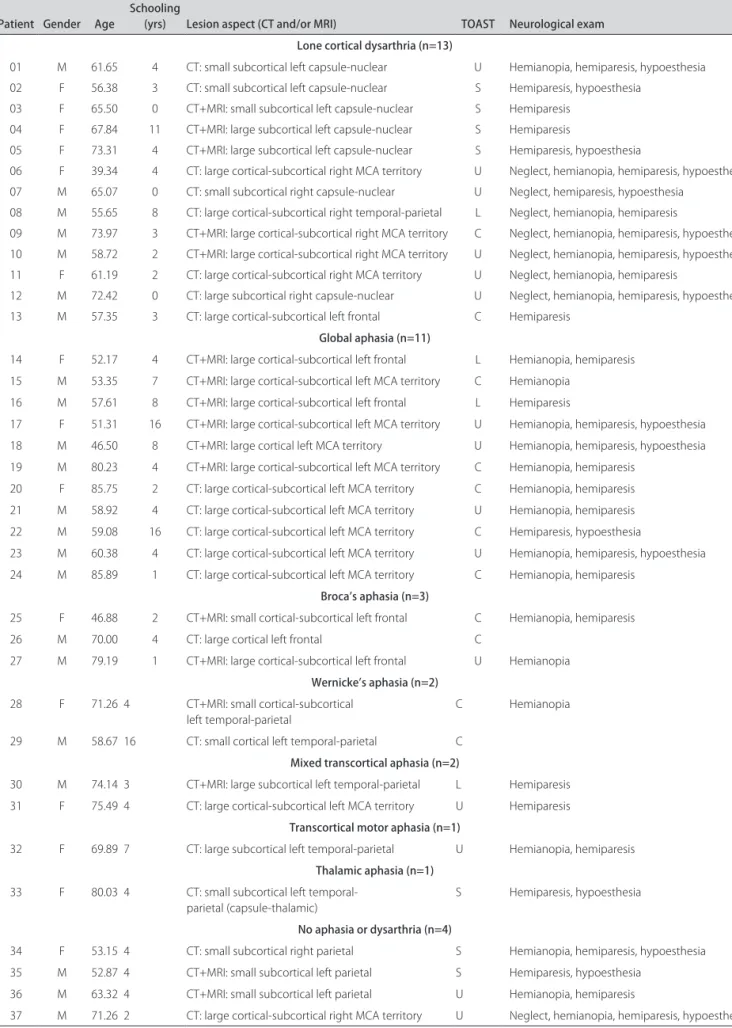
he classiications of language and speech disorders according to the results of the test battery are showed in Table 1. Ranging scores from 10 to 50 in the Edin-burgh Inventory9, patients numbered as 1 (score of 42)
and 35 (score of 46) in Table 2 were considered left-handed; among controls, only the control of patient number 35 was left-handed (score of 46). All other pa-tients had scores between 10 and 18, while other con-trols had scores between 10 and 23, and were consid-ered right-handed.
uro
ps
iqu
ia
tr 2011;69(5)
793
St
ro
ke:
sp
eec
h
and
la
ngua
g
e
Ol
ivei
ra
a
nd
D
amasc
en
o
Syndrome Spontaneous speech Fluency Comprehension Repetition Naming Other signs Lesion localization
Broca’s aphasia Poor, efortful, with paraphasias and agrammatism
Impaired Normal Impaired Impaired Hemiparesis, mouth and hand apraxia
Posterior-inferior frontal (areas 44, 45, sometimes 46)
Wernicke’s aphasia Logorrheic, with paraphasias
and neologisms Normal Impaired Impaired Impaired Homonymous hemianopia, apraxia, anosognosia Posterior-superior temporal (area 22)
Conduction aphasia Normal (phonetic mistakes) Normal Normal Impaired Normal Hemi-hypoesthesia, apraxia, hemianopia
Arcuate fasciculus - supramarginal gyrus
Global aphasia Poor (mutism), with verbal stereotypes
Impaired Impaired Impaired Impaired Hemiparesis, hemianopia, hemi-hypoesthesia, apraxia
Perisylvian region (middle cerebral artery territory)
Anomic aphasia or
amnestic aphasia Normal (diiculty inding words) Normal Normal Normal Impaired Homonymous hemianopia Inferior parietal (angular gyrus)
Transcortical motor aphasia
Poor (mutism), with great latency to respond, echolalia, perseveration
Impaired Normal Normal Impaired Eventually hemiparesis (crural involvement) and grasp relex
Anterior and superior to broca’s area (supplementary motor area)
Transcortical sensory aphasia
Normal (semantic jargon) Normal Impaired Normal Impaired Eventually hemianopia and visual agnosia
Watershed areas of middle cerebral artery and posterior cerebral artery
Mixed transcortical aphasia
Mutism Impaired Impaired Normal Impaired Eventually hemianopia, visual agnosia and hemiparesis
Watershed areas of middle cerebral, anterior cerebral and posterior cerebral arteries
Cortical dysarthria or apraxia of speech
Articulatory diiculties, phonetic mistakes
Impaired Normal Impaired Impaired Eventually apraxia or face and tongue paresis
Inferior part of pre-central gyrus and nearby areas
Verbal deafness Normal Normal Impaired Impaired Normal Absent Middle third of superior temporal gyrus
Thalamic aphasia Normal or with paraphasias Normal Normal or discretely
impaired Normal Impaired Dysarthria, initially with mutism Thalamus in the dominant hemisphere
Subcortical aphasia (non-thalamic)
Poor, with great latency to respond, echolalia, perseveration
Arq Neuropsiquiatr 2011;69(5) Stroke: speech and language
Oliveira and Damasceno
Table 2. Demographic and clinical characteristics of the 37 stroke patients.
Patient Gender Age Schooling (yrs) Lesion aspect (CT and/or MRI) TOAST Neurological exam Lone cortical dysarthria (n=13)
01 02 03 04 05 06 07 08 09 10 11 12 13
M F F F F F M M M M F M M
61.65 56.38 65.50 67.84 73.31 39.34 65.07 55.65 73.97 58.72 61.19 72.42 57.35
4 3 0 11 4 4 0 8 3 2 2 0 3
CT: small subcortical left capsule-nuclear CT: small subcortical left capsule-nuclear CT+MRI: small subcortical left capsule-nuclear CT+MRI: large subcortical left capsule-nuclear CT+MRI: large subcortical left capsule-nuclear CT: large cortical-subcortical right MCA territory CT: small subcortical right capsule-nuclear CT: large cortical-subcortical right temporal-parietal CT+MRI: large cortical-subcortical right MCA territory CT+MRI: large cortical-subcortical right MCA territory CT: large cortical-subcortical right MCA territory CT: large subcortical right capsule-nuclear CT: large cortical-subcortical left frontal
U S S S S U U L C U U U C
Hemianopia, hemiparesis, hypoesthesia Hemiparesis, hypoesthesia
Hemiparesis Hemiparesis
Hemiparesis, hypoesthesia
Neglect, hemianopia, hemiparesis, hypoesthesia Neglect, hemiparesis, hypoesthesia
Neglect, hemianopia, hemiparesis
Neglect, hemianopia, hemiparesis, hypoesthesia Neglect, hemianopia, hemiparesis, hypoesthesia Neglect, hemianopia, hemiparesis
Neglect, hemianopia, hemiparesis, hypoesthesia Hemiparesis
Global aphasia (n=11)
14 F 52.17 4 CT+MRI: large cortical-subcortical left frontal L Hemianopia, hemiparesis
15 M 53.35 7 CT+MRI: large cortical-subcortical left MCA territory C Hemianopia
16 M 57.61 8 CT+MRI: large cortical-subcortical left frontal L Hemiparesis
17 F 51.31 16 CT+MRI: large cortical-subcortical left MCA territory U Hemianopia, hemiparesis, hypoesthesia
18 M 46.50 8 CT+MRI: large cortical left MCA territory U Hemianopia, hemiparesis, hypoesthesia
19 M 80.23 4 CT+MRI: large cortical-subcortical left MCA territory C Hemianopia, hemiparesis
20 F 85.75 2 CT: large cortical-subcortical left MCA territory C Hemianopia, hemiparesis
21 M 58.92 4 CT: large cortical-subcortical left MCA territory U Hemianopia, hemiparesis
22 M 59.08 16 CT: large cortical-subcortical left MCA territory C Hemiparesis, hypoesthesia
23 M 60.38 4 CT: large cortical-subcortical left MCA territory U Hemianopia, hemiparesis, hypoesthesia
24 M 85.89 1 CT: large cortical-subcortical left MCA territory C Hemianopia, hemiparesis
Broca’s aphasia (n=3)
25 F 46.88 2 CT+MRI: small cortical-subcortical left frontal C Hemianopia, hemiparesis
26 M 70.00 4 CT: large cortical left frontal C
27 M 79.19 1 CT+MRI: large cortical-subcortical left frontal U Hemianopia
Wernicke’s aphasia (n=2)
28 F 71.26 4 CT+MRI: small cortical-subcortical
left temporal-parietal
C Hemianopia
29 M 58.67 16 CT: small cortical left temporal-parietal C
Mixed transcortical aphasia (n=2)
30 M 74.14 3 CT+MRI: large subcortical left temporal-parietal L Hemiparesis
31 F 75.49 4 CT: large cortical-subcortical left MCA territory U Hemiparesis
Transcortical motor aphasia (n=1)
32 F 69.89 7 CT: large subcortical left temporal-parietal U Hemianopia, hemiparesis
Thalamic aphasia (n=1)
33 F 80.03 4 CT: small subcortical left
temporal-parietal (capsule-thalamic)
S Hemiparesis, hypoesthesia
No aphasia or dysarthria (n=4)
34 F 53.15 4 CT: small subcortical right parietal S Hemianopia, hemiparesis, hypoesthesia
35 M 52.87 4 CT+MRI: small subcortical left parietal S Hemiparesis, hypoesthesia
36 M 63.32 4 CT+MRI: small subcortical left parietal U Hemianopia, hemiparesis
37 M 71.26 2 CT: large cortical-subcortical right MCA territory U Neglect, hemianopia, hemiparesis, hypoesthesia
language impairment, 7 (21.2%) had right hemisphere lesions (presenting dysarthria without aphasia) and 26 (78.8%) had left hemisphere lesions.
Among the 33 patients with aphasia or dysarthria (Table 2), there were 5 (15.2%) with aphasic syndromes whose lesions deviated from the classic clinical-ana-tomic correlations shown in Table 1 (patients numbered as 14, 16, 30, 31, 32). Patients performed inferior to con-trols on all cognitive and language tests (p<0.001), ac-cording to Table 3. Only four tests were able to discrim-inate between brain injury sides: word repetition tests (p=0.0062), sentence repetition tests (p=0.0039), naming tests (p=0.0453), and ideomotor praxis tests (p=0.0293). Marginally signiicant results for discrimination between lesions to either hemisphere were found in regard to the comprehension tests (p=0.0556) and to counting from 1 to 20 (11 of 28 left hemisphere injured patients scored no mistakes, against 8 of 9 right hemisphere injured ones; p=0.0625). All other evaluated parameters were non-signiicant for discrimination between injured cerebral hemispheres.
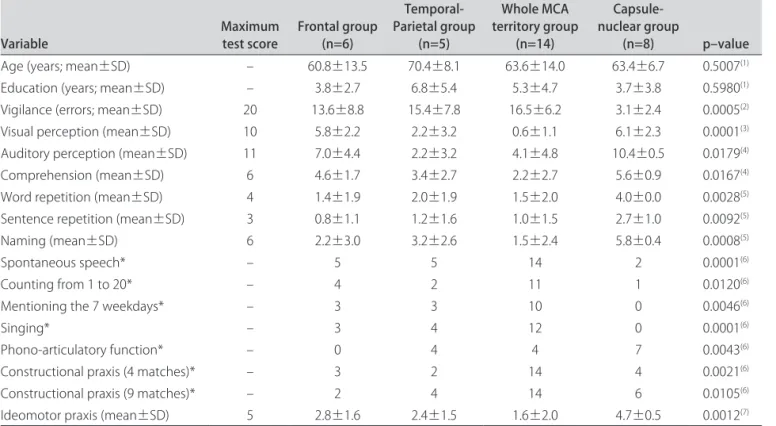
Table 4 establishes the statistical value of compar-isons between test scores, age and education, and the brain injury topography for stroke patients (the 4 patients without aphasia or dysarthria were excluded,
there-fore we only considered 33 patients for this analysis). Stepwise multiple logistic regression analysis showed that the sentence repetition tests were able to discrimi-nate between lesion sides in favor of the right hemisphere when scores were high, both when the data of all variables were included (OR=14.093, 95% CI 2.59-76.43, p=0.0022, accuracy 93.3%) and when vigilance tests, handedness, visual and phoneme perception tests were excluded (OR=3.647, 95% CI 1.51-8.81, p=0.004, accuracy 86.7%).
he 33 patients with aphasia or dysarthria were clas-siied in four lesion groups, which were similar in regard to age and education: frontal, temporal-parietal, cap-sule-nuclear, and whole middle cerebral artery (MCA) territory. Statistical analysis with ANOVA followed by Tukey’s test showed that repetition of words and sen-tences was afected mainly by frontal and whole MCA territory lesions, and also by temporal-parietal lesions in lesser degree. Whole MCA territory was the lesion site most frequently associated to disturbances of spon-taneous speech, comprehension, naming, sentence rep-etition, ideomotor and constructional praxis. These linguistic-cognitive functions were less afected by cap-sule-nuclear lesions which, along with temporal-parietal lesions, constituted the main cause of phono-articulatory diiculties and errors.
Table 3. Comparisons between patients and controls in cognitive and language tests.
Variable Maximum test score Patients Controls p–value
n – 37 (100%) 37 (100%) –
Attention: no scored mistakes – 25 (67.57%) 37 (100%) 0.0002* Vigilance test: mean errors±SD 20 11.5±8.4 0.5±1.1 <0.0001** Right-Handedness (n): the Edinburgh Inventory – 35 (94.59%) 36 (97.30%) 1,0000*** Visual perception of abstract designs: mean±SD 10 3.4±3.3 9.3±0.7 <0.0001** Auditory perception of phonemes: mean±SD 11 6.6±4.4 10.6±0.8 <0.0001** Spontaneous speech (n)† – 9 (24.32%) 37 (100%) <0.0001*
Disturbances in luency (n) – 33 (89.19%) 0 (0%) 0.0002* Comprehension tests: mean±SD 6 3.8±2.5 5.8±0.4 <0.0001** Word repetition tests: mean±SD 4 2.4±1.9 4.0±0.0 <0.0001** Sentence repetition tests: mean±SD 3 1.6±1.5 3.0±0.2 <0.0001** Naming tests: mean±SD 6 3.2±2.7 5.9±0.3 <0.0001** Counting from 1 to 20† – 19 (51.35%) 37 (100%) <0.0001*
Mentioning the 7 weekdays† – 20 (54.05%) 35 (94.59%) <0.0001*
Singing† – 18 (48.65%) 35 (94.59%) <0.0001*
Phono-articulatory function† – 21 (56.76%) 37 (100%) <0.0001*
Ideomotor praxis tests: mean±SD 5 2.8±2.0 4.8±0.4 <0.0001** Constructional praxis test - 4 matches† – 13 (35.14%) 29 (78.38%) 0.0002*
Constructional praxis test - 9 matches† – 9 (24.32%) 31 (83.78%) <0.0001*
Arq Neuropsiquiatr 2011;69(5) Stroke: speech and language
Oliveira and Damasceno
DISCUSSION
All tests could differentiate between patients and controls, as much as discriminate which patients showed predominant luency impairment from those whose in-juries mostly weakened comprehension. All test items were of signiicance for comparisons between the lin-guistic evaluation and the brain injury topography for stroke patients, except for age and education, as we ex-pected, since these two parameters are not topograph-ical predictors for brain injuries.
he time-window used for subject evaluation was ap-propriate, since 100% of the approached subjects could be tested within the irst 72 hours post-stroke, and con-sidering that comatose patients were not assessed. Age, schooling and handedness were similar for groups of pa-tients and controls, with no statistically signiicant difer-ence. Despite the sample size, it is likely that this pairing helped minimize the efect that schooling might have had on some tests (“A” Random Letter Test8, visual
per-ception of abstract forms10, auditory perception of
pho-nemes11, constructional praxis). he size of the sample
was an important limitation, though, for the inclusion of more patients might have conirmed the power of more tests with signiicant results for stroke localization.
Only four tests were able to predict the presence of left hemisphere lesions: word and sentence repetition, naming, and ideomotor praxis. Although not statistically signiicant, counting from 1 to 20 and comprehension tasks also were more impaired in patients with left hemi-sphere injuries. Diiculties for counting were probably due to language impairment and not to the low educa-tional levels of our patients17, since the left hemisphere
group had a lower proportion of subjects with four years or less of elementary schooling, besides having higher educational levels. Studies with larger samples might likely be able to diferentiate brain injury sides from the analysis of the other items.
Proportions of aphasic syndromes were similar to those from other studies18-20, except that none of our
pa-tients met the established criteria for conduction aphasia, anomic aphasia, subcortical (non-thalamic) aphasia or isolated apraxia of speech. his could be due to the size of the sample, but also to the strict inclusion cri-teria leading only to irst-stroke patients being recruited. Severity of aphasia is usually associated to stroke se-verity19,20. Four of the eight patients who did not
sur-vive had a cardioembolic stroke, while cardioembolism was the most frequent etiology for patients with global
Table 4. Comparisons between evaluated parameters of patients and brain injury topography.
Variable Maximum test score Frontal group(n=6)
Temporal-Parietal group
(n=5)
Whole MCA territory group
(n=14)
Capsule-nuclear group
(n=8) p–value
Age (years; mean±SD) – 60.8±13.5 70.4±8.1 63.6±14.0 63.4±6.7 0.5007(1)
Education (years; mean±SD) – 3.8±2.7 6.8±5.4 5.3±4.7 3.7±3.8 0.5980(1)
Vigilance (errors; mean±SD) 20 13.6±8.8 15.4±7.8 16.5±6.2 3.1±2.4 0.0005(2)
Visual perception (mean±SD) 10 5.8±2.2 2.2±3.2 0.6±1.1 6.1±2.3 0.0001(3)
Auditory perception (mean±SD) 11 7.0±4.4 2.2±3.2 4.1±4.8 10.4±0.5 0.0179(4)
Comprehension (mean±SD) 6 4.6±1.7 3.4±2.7 2.2±2.7 5.6±0.9 0.0167(4)
Word repetition (mean±SD) 4 1.4±1.9 2.0±1.9 1.5±2.0 4.0±0.0 0.0028(5)
Sentence repetition (mean±SD) 3 0.8±1.1 1.2±1.6 1.0±1.5 2.7±1.0 0.0092(5)
Naming (mean±SD) 6 2.2±3.0 3.2±2.6 1.5±2.4 5.8±0.4 0.0008(5)
Spontaneous speech* – 5 5 14 2 0.0001(6)
Counting from 1 to 20* – 4 2 11 1 0.0120(6)
Mentioning the 7 weekdays* – 3 3 10 0 0.0046(6)
Singing* – 3 4 12 0 0.0001(6)
Phono-articulatory function* – 0 4 4 7 0.0043(6)
Constructional praxis (4 matches)* – 3 2 14 4 0.0021(6)
Constructional praxis (9 matches)* – 2 4 14 6 0.0105(6)
Ideomotor praxis (mean±SD) 5 2.8±1.6 2.4±1.5 1.6±2.0 4.7±0.5 0.0012(7)
SD: standard deviation; MCA: middle cerebral artery. *Number of subjects with diiculties and/or errors; (1)ANOVA; (2)ANOVA followed by Tukey’s test
(diferences between the following groups: nuclear and whole middle cerebral artery territory; nuclear and temporal-parietal;
capsule-nuclear and frontal); (3)ANOVA followed by Tukey’s test (diferences between the following groups: frontal and temporal-parietal; frontal and whole middle
cerebral artery territory; capsule-nuclear and temporal-parietal; capsule-nuclear and whole middle cerebral artery territory); (4)ANOVA followed by Tukey’s test
(diferences between the capsule-nuclear group and the whole middle cerebral artery territory group); (5)ANOVA followed by Tukey’s test (diferences between
the following groups: capsule-nuclear and whole middle cerebral artery territory; capsule-nuclear and frontal); (6)Fisher’s exact test; (7)ANOVA followed by
aphasia (ive out of eleven patients). Most patients with aphasia changed to a less disabling form of language im-pairment during follow-up. A non-luent aphasia could evolve into a luent form of aphasia, whereas expectedly the opposite never occurred7,19,20.
All but two patients with global aphasia had large le-sions in the left MCA territory, for this was the lesion site that afected most language functions. On the other hand, all cases of lone cortical dysarthria were associated to lesions in the left capsule-nuclear or right MCA ter-ritory, leaving unafected the performance on language tests. he presence of mutism in 9 of the 11 patients with global aphasia may be explained by lesions in the frontal-putaminal part of the MCA territory1.
Constructional and ideomotor apraxias were mostly associated to whole MCA territory or to focal temporal-parietal lesions. he left inferior temporal-parietal component of these lesions is the main responsible for these types of apraxia, though they can also be found in premotor and callosal lesions21.
Five (15.2%) of our language-impaired cases deviated from the classic anatomy of aphasic syndromes. One ex-planation could be that their CT imaging underestimated the lesion extension, even though CT and/or MRI were also performed in the chronic stroke phase, when the syndrome is usually stabilized. Other authors have found even larger proportions of aphasic syndromes deviating from their classic clinical-anatomic correlations, with cases of lesions in language areas without aphasia, non-luent aphasia with posterior lesions, or global aphasia in small and circumscribed lesions1,22,23. Besides,
“localiza-tion” of aphasic syndromes to particular brain areas is a challenging task that can only be approximate, due to in-terindividual variability in the boundaries of cytoarchitec-tural ields, as well as in the patterns of sulci and gyri3,24.
Moreover, the resulting syndrome should be explained not only by functional loss of the damaged area, but also by disturbances of excitation-inhibition balance along with functional reorganization in other brain regions25.
he concept of aphasias as vascular syndromes could be clinically useful2,3, since they lead to strong
predic-tions about what parts of the brain are ischemic, even in cases when DWI does not reveal all dysfunctional areas. However, as there are cases which deviate from the classic anatomy of aphasic syndromes, a simpler, quicker and more reliable approach to lesion localization would be to evaluate tasks such as repetition of words and sen-tences, comprehension and naming.
In this study, impairment of repetition was found in frontal, temporal-parietal, and whole MCA territory le-sions. his was expected, since misrepresented repetition usually corresponds to lesions located deeply or in the margins of the left lateral sulcus, comprising structures
from the frontal-opercular to the supramarginal and su-perior temporal gyri, arcuate fasciculus, external cap-sule, posterior arm of the internal capcap-sule, and even the thalamus1. Comprehension disorders associated to MCA
and temporal-parietal strokes also attest to lesions in the posterior portions of the temporal gyri extending to the external capsule, and less frequently to frontal and infe-rior parietal lesions (in these two latter locations when sentences with complex logical-grammatical structures like “bigger than”, or “father’s brother”, are used). he ob-ject naming task could predict lesions in the dominant (left) hemisphere, but this task is considered to have low power for hemispheric localization, since object or pic-ture naming require many diferent cognitive represen-tations and processes, which engage distinct and partly overlapping brain regions from the anterior to the pos-terior cortex, or subcortical regions including the thal-amus3. In regard to impairments in spontaneous speech
and fluency, particularly the presence of mutism, our findings also concur with those of the medical litera-ture24, indicating more anterior extensions of the lesions.
Besides sample size and variety, another limitation of this study was that 20 (of 37 patients) underwent ce-rebral CT but not MRI. Further studies should use DWI and T2-MRI in the hyperacute stroke phase (within the irst hours from onset) to determine infarct size, as well as during follow-up, in order to verify the dynamics of penumbra regions in function-speciic brain areas for more precise brain-language-behavioral correlations and stroke management.
Despite these limitations, we can conclude that tasks of word and sentence repetition, comprehension, naming, analysis of spontaneous speech and luency, and ideomotor praxis used in this study can help neurologists to determine side and location of lesions in the acute stroke phase, while impairments in all these tasks may indicate larger lesions in the MCA territory.
ACKNOWLEDGMENTS – We acknowledge the help of the Statistics section of the Research Chamber, Faculty of Medical Sciences, Univer-sity of Campinas / UNICAMP. We are also indebted to our patients and their families for kindly agreeing to participate on the study.
REFERENCES
1. Kreisler A, Godefroy O, Delmaire C, et al. The anatomy of aphasia revis-ited. Neurology 2000;54:1117-1123.
2. Oliveira FF, Avelar WM, Bichuetti DB, et al. Semantic aphasia as a sole man-ifestation of acute stroke. Arq Neuropsiquiatr 2010;68:965-967. 3. Hillis AE. Aphasia: Progress in the last quarter of a century. Neurology
2007;69:200-213.
4. Lezak MD, Howieson DB, Loring DW. Neuropsychological Assessment. 4th
edition. New York: Oxford University Press, 2004.
5. Hand PJ, Haisma JA, Kwan J, et al. Interobserver agreement for the bed-side clinical assessment of suspected stroke. Stroke 2006;37:776-780. 6. WHO MONICA Project Principle Investigators. The World Health
cardio-Arq Neuropsiquiatr 2011;69(5) Stroke: speech and language
Oliveira and Damasceno
vascular disease): a major international collaboration. J Clin Epidemiol 1988;41:105-114.
7. Oliveira FF, Damasceno BP. Short-term prognosis for speech and language in first stroke patients. Arq Neuropsiquiatr 2009;67:849-855.
8. Strub RL, Black FW. The mental status examination in neurology. 4th
edi-tion. Philadelphia: Davis, 2000.
9. Oldfield RC. The assessment and analysis of handedness. The Edinburgh Inventory. Neuropsychologia 1971;9:97-113.
10. Jones-Gotman M, Zatorre RJ, Olivier A, et al. Learning and retention of words and designs following excision from medial or lateral temporal-lobe structures. Neuropsychologia 1997;35:963-973.
11. Christensen AL. Luria’s neuropsychological investigation. 2nd edition.
Co-penhagen: Munksgaard, 1979.
12. Kertesz A, Ferro JM, Shewan CM. Apraxia and aphasia: the functional-ana-tomical basis for their dissociation. Neurology 1984;34:40-47. 13. Benson DF. Aphasia. In: Heilman KM, Valenstein E (Org). Clinical
neuropsy-chology. 3rd edition. New York: Oxford University Press, 1993.
14. Ogar J, Willock S, Baldo J, Wilkins D, Ludy C, Dronkers N. Clinical and anatomical correlates of apraxia of speech. Brain Lang 2006;97:343-350. 15. Adams HP, Bendixen BH, Kappelle LJ, et al. Classification of subtype of
acute ischemic stroke: definitions for use in a multicenter clinical trial. Stroke 1993;24:35-41.
16. Radanovic M, Scaff M. Speech and language disturbances due to subcor-tical lesions. Brain Lang 2003;84:337-352.
17. Soares ECS, Ortiz KZ. Influence of schooling on language abilities of adults without linguistic disorders. Sao Paulo Med J 2009;127:134-139. 18. Godefroy O, Dubois C, Debachy B, Leclerc M, Kreisler A. Vascular
apha-sias: main characteristics of patients hospitalized in acute stroke units. Stroke 2002;33:702-705.
19. Laska AC, Hellblom A, Murray V, Kahan T, von Arbin M. Aphasia in acute stroke and relation to outcome. J Intern Med 2001;249:413-422. 20. Pedersen PM, Vinter K, Olsen TS. Aphasia after stroke: type, severity
and prognosis. The Copenhagen aphasia study. Cerebrovasc Dis 2004; 17:35-43.
21. Wheaton LA, Hallett M. Ideomotor apraxia: a review. J Neurol Sci 2007; 260:1-10.
22. Basso A, Lecours AR, Moraschini S, Vanier M. Anatomoclinical correlations of the aphasias as defined through computerized tomography: excep-tions. Brain Lang 1985;26:201-229.
23. Willmes K, Poeck K. To what extent can aphasic syndromes be localized? Brain 1993;116:1527-1540.