DOI: 10.1590/0004-282X20150218
ARTICLE
Myotonic dystrophy type 1: frequency of
ophthalmologic findings
Distrofia miotônica tipo 1: frequência dos achados oftalmológicos
Karin Suzete Ikeda1, Cristina Iwabe-Marchese2, Marcondes Cavalcante França Jr.2, Anamarli Nucci2, Keila Monteiro de Carvalho1
Myotonic dystrophy type 1 (DM1) is a cytosine-thymine-guanine [CTG]n triplet disorder inherited as autosomal dominant mode with multisystem variable expression. CTGn repeat oc-curs in the 3’ untranslated region of the myotonin protein ki-nase gene (MDPK) on chromosome 19q1,2,3. Toxic RNA
tran-scripts accumulate in the nucleus due to aberrant splicing and lead to abnormal expression of several proteins due to seques-tration of nuclear transcription factors4.
A variety of ocular signs is described in DM1 patients, like cataract, retinal degeneration, low intraocular pressure (IOP), eyelid ptosis, epiphora, corneal lesions, extraocular myotonia,
extraocular muscle weakness, abnormal central control of eye movement5. Cataract is one of the most important and
distinctive feature of the disease5 and it may alert about the
underlying disease5. herefore, ophthalmologists can help to
detect DM1 patients6,7,8, to refer patients for an appropriate
diagnosis, for monitoring and genetic counseling8. Also, they
can help to provide the best assistance to DM1 patients, for instance, restoring their visual acuity.
Our aim was to analyze the frequency of
ophthalmologi-cal indings in a cohort of DM1 patients followed up in a uni -versity hospital and to identify possible correlations of these
1Universidade Estadual de Campinas, Faculdade de Ciências Médicas, Departamento de Oftalmologia, Campinas SP, Brazil; 2Universidade Estadual de Campinas, Faculdade de Ciências Médicas, Departamento de Neurologia, Campinas SP, Brazil.
Correspondence: Keila Monteiro de Carvalho; Departamento de Oftalmologia da UNICAMP; Rua Tessália Vieira de Camargo, 126; 13083-887 Campinas SP, Brasil; E-mail: [email protected]
Conflict of interest: There is no conlict of interest to declare.
Received 06 July 2015; Received in inal form 05 October 2015; Accepted 17 November 2015.
ABSTRACT
The purpose of the study was to evaluate the frequency of ophthalmologic abnormalities in a cohort of myotonic dystrophy type 1 (DM1) patients and to correlate them with motor function. We reviewed the pathophysiology of cataract and low intraocular pressure (IOP). Method: Patients were included after clinical and laboratory diagnosis and after signed informed consent. They were evaluated by Motor Function Measure scale, Portuguese version (MFM-P) and ophthalmic protocol. Results: We evaluated 42 patients aged 17 to 64 years (mean 40.7 ± 12.5), 22 of which were men. IOP (n = 41) was reduced in all but one. We found cataract or positivity for surgery in 38 (90.48%) and ptosis in 23 (54.76%). These signs but not IOP were signiicantly correlated with severity of motor dysfunction. Abnormalities in ocular motility and stereopsis were observed. Conclusion: Cataract and ptosis are frequent in DM1 and associated to motor dysfunction. Reduced IOP is also common, but appears not to be related with motor impairment.
Keywords: myotonic dystrophy type 1, cataract, eyelid ptosis, intraocular pressure, Motor Function Measure scale, Portuguese version.
RESUMO
O objetivo do estudo foi avaliar a frequência das anormalidades oftalmológicas em uma coorte de pacientes com distrofia miotônica tipo 1 (DM1) correlacionando-as à função motora. Revisamos a fisiopatogenia da catarata e baixa pressão intraocular (PIO). Método: Os pacientes foram incluídos após diagnóstico clínico-laboratorial de DM1. Aqueles que assinaram o termo de participação foram avaliados pela escala medida da função motora, versão em português (MFM-P) e protocolo oftalmológico. Resultados: Avaliamos 42 pacientes de 17 a 64 anos (média 40,7 ± 12,5), 22 do sexo masculino. Encontramos catarata ou positividade de cirurgia em 38 (90,48%) e blefaroptose em 23 (54,76%) e esses sinais foram correlacionados significativamente à maior gravidade da disfunção motora. Baixa PIO também foi comum e não correlacionada à gravidade motora. Alterações da motilidade ocular e de estereopsia ocorreram. Conclusão: Catarata e ptose palpebral são frequentes na DM1 e associadas à gravidade motora. Baixa PIO é comum e parece ser independente da evolução motora.
184 Arq Neuropsiquiatr 2016;74(3):183-188
abnormalities with motor dysfunction. We also reviewed the pathogenesis of cataract and low IOP.
METHOD
A descriptive study was carried out from February 2013 to January 2014. Consecutive patients diagnosed with DM1, from the Neuromuscular outpatient Clinic at UNICAMP University Hospital were invited to partici-pate in the study. This study was approved by the Ethics Committee in Research of the Faculty of Medical Sciences, UNICAMP, under the protocol no. 143.693/2012. Each pa-tient signed a written informed consent before any study-related procedure.
Diagnosis of DM1 was based on clinical phenotype, including distinct facial findings, facial, cervical and pre-dominant distal weakness and atrophy, associated with action and percussion miotonia. Patients were also sub-mitted to the motor function measure scale, Portuguese version (MFM-P)9 and ancillary exams including
cre-atinekinase, electroneuromyography and routine labo-ratory tests. MFM-P scale includes 32 items, rated on
a 4-point scale (0 to 3; 3 = completes the exercise in the standard normal pattern) and 3 dimensions (D1 = stand
-ing position and transfers; D2 = axial and proximal function; D3 = distal function). The total and sub scores
are expressed as percentage of the highest possible score.
DNA analysis was available in n = 25 patients. In most of
these patients, screening for DMPK expansions was per-formed using the TP-PCR technique, which is a sensitive method but does not enable precise quantification of the CTG repeat length. The remaining patients did not have molecular testing, but for all of them there was at least one family member with a positive test and a clear autosomal dominant pattern of inheritance.
They were submitted to an ophthalmologic protocol that included: visual acuity, refraction, visual field con-frontation, clinical color vision evaluation using Ishihara test, lid position, pupillary reflex, measurement of IOP, slit lamp biomicroscopy, fundus examination, motil-ity measurements, stereopsis test, nystagmus evalua-tion. Visual acuity was considered with the best correc-tion and Snellen visual acuity was converted to LogMAR acuity10. Refraction in patients under 18 years-old was
performed 30 minutes after the instillation of 1% cyclo-pentolate. Color vision was assessed by Ishihara’s test for color deficiency, 24 plates; 2007 edition, Kanehara Trading Inc., Tokyo, Japan. Slit lamp biomicroscopy used Haag-Streit aparatus (Koeniz, Suiss). Dilated fundus examination was performed after instillation of tropi-camide 1% and phenylephrine 10%, using a 78 diopter lens in a Volk Optical, Mentor (Ohio, USA). IOP was re-corded with Goldmann applanation tonometry (model
R900, Haag-Streit, Koeniz, Suiss) after topical anesthesia with one drop of tetracaine 1% and phenylephrine 0.1% and instillation of one drop of fluorescein 1%. Ocular mo-tility evaluation: the angles of deviation were measured with the best optical correction in place for the distance and the near and cardinal gaze positions. The measure-ments were made using the simultaneous and alternate-cover tests. The Krimsky test was employed when the cover tests were not applicable. Ductions, versions and diplopia were also evaluated. Stereopsis was assessed us-ing Titmus Stereo Fly, Circles and Animals Test (Stereo Optical Co., Inc., Chicago). Occasional patients were not able to complete some parts of the examination proto-col, but the remaining tests performed were all consid-ered for further analyses.
Statistical analysis was performed using MS-Excel
(MS-Oice 2010) for data organization and IBM SPSS
(Statistical Package, version 22.0) for Spearman
correla-tion test and Mann-Whitney test. Signiicance level was considered < 0.05.
RESULTS
Forty-two patients were enrolled in the study, with ages
ranging from 17 to 64 years (mean = 40.7 ± 12.5), median 43.5. here were 20 men and 22 women.
Cataract or prior phacoemulsification in at least one eye was detected in 38 patients (90.48%). Mean age at
cat-aract diagnosis was 40.2 ± 10.9 years. Among 28 (73.65%)
patients that had the diagnosis of cataract made in our institution, two had visual acuity worse than 0.3 and were submitted to surgery and the others are still in visual mon-itoring. Ten patients with cataracts were followed up out-side the institution and four (40%) were operated. Four patients (9.52%) in the cohort had no signs of cataract in either eye. These were one woman and three men aged 17, 20, 23 and 30 years, respectively.
A detailed frequency of ophthalmological indings in the
cohort is displayed in Table 1. Ishihara’s vision color test was normal in all fourteen patients examined. Nystagmus was absent in 34 patients (80.95%); the remaining 8 (19.05%) had physiological nystagmus. None of the subjects presented pathological nystagmus.
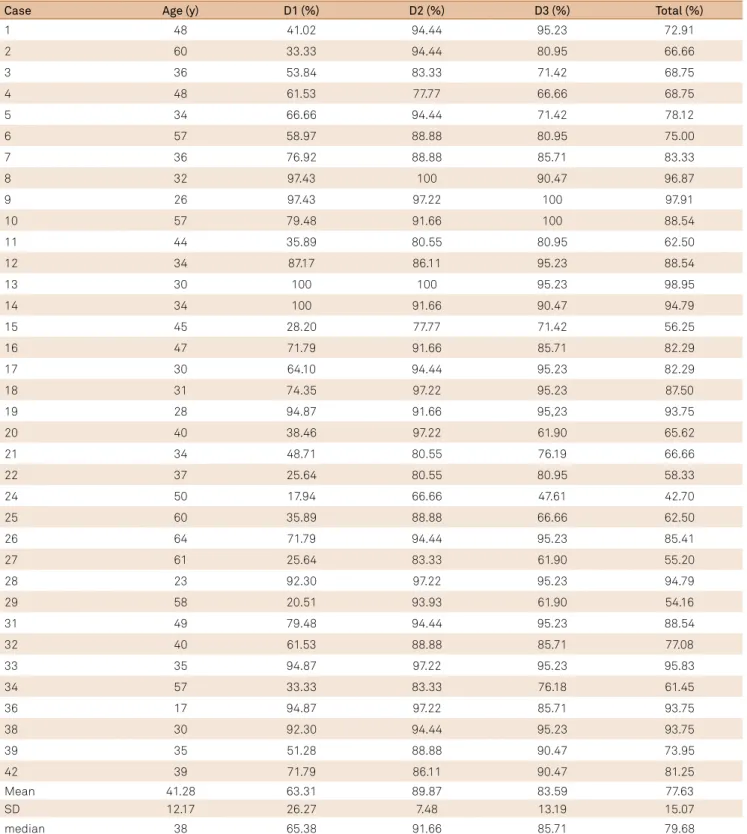
he results of MFM-P scale are shown in Table 2 and Figure. Statistical analysis revealed a signiicant correla
-tion between MFM-P and age (r = -0.668; p < 0.001), but
no correlation between IOP and MFM-P considering each
eye. MFM-P also had a signiicant correlation with Titmus test (r = -0.467, p = 0.007). Patients with cataracts had low -er MFM-P scores in comparison to those patients without
cataracts (75.9 ± 14.5 vs 95.8 ± 2.7, p = 0.019). In addition,
ptosis was also associated with lower total MFM-P scores
K
arin Suz
e
te Ik
eda e
t al
. My
o
tonic dy
s
tr
oph
y type 1 and oph
thalmol
og
y
Table 1. Results of the ophthalmologic examination.
Cataract IOP mean (mmHg)
Eyelid ptosis
Visual acuity OD in LogMar
Visual acuity
OS in LogMar Refraction OD Refraction OS Cornea Optic nerve Retina Strabismus
Stereopsis in seconds
of arc
N = 42 N = 41 N = 42 N = 42 N = 42 N = 42 N = 42 N = 42 N = 42 N = 42 N = 42 N = 36
38 1 23 20 22 3 1 39 38 37 34 7
90.48% 2.44% 54.76% 47.61% 52.38% 7.14% 2.38% 92.86% 90.47% 88.09% 80.95% 19.44%
yes normal yes 0 0 emmetropia emmetropia normal normal normal normal 40
4 OD 19 7 5 3 5 2 2 5 4 9
9.45% 8.7 45.24% 16.67% 11.90% 7.14% 11.90% 4.76% 4.76% 11.90% 9.52% 25%
no (±2.00) no 0.1 0.1 myopia myopia supericial
punctata keratitis cup-to-disc ratio > 0,6 altered exophoria 50
OS 7 6 6 2 1 1 2 2 2
8.7 16.67% 14.29% 14.29% 4.76% 2.38% 2.38% 4.76% 4.76% 5.55%
(±1.99) 0.2 0.2 hyperopia hyperopia senile corneal arcus
cup-to-disc asymmetry between eyes> 0,2
pigmentary epithelium retina atrophy
intermittent exotropia 60
2 1 8 7 1 2 1 2
4.76% 2.38% 19.05% 16.67% 2.38% 4.76% 2.38% 5.55%
0.3 0.3 astigmatism astigmatism peripapillary atrophy pigmentary alteration
of the macula exotropia 80
3 1 15 16 1 1 2
7.14% 2.38% 35.71% 38.09% 2.38% 2.38% 5.55%
0.4 0.4 myopia and astigmatism
myopia and
astigmatism chorioretinal scar
intermittent esotropia 100
1 3 7 11 1
2.38% 7.14% 16.67% 26.19% 2.78%
0.5 0.5 hyperopia and astigmatism
hyperopia and
astigmatism 140
1 2 7
2.38% 4.76% 19.44%
0.8 0.7 200
1 2 2
2.38% 4.76% 5.55%
1 1.3 400
1 2.78%
800
186 Arq Neuropsiquiatr 2016;74(3):183-188 DISCUSSION
In the DM1 cohort we observed a high frequency of
cat-aract and low IOP, the irst sign with signiicant correlation with MFM-P. In contrast, MFM-P versus IOP was not signii -cantly correlated. Although cataract is a cardinal sign of DM1, it generally develops with disease progression, expressed in
our patients with lower scores of MFM-P. he typical DM1
lens opacity is named “christman’s tree” cataract, the expres-sion of iridescent multicolored posterior capsular lens opac-ity11, at least in earlier stages of its development. his pattern
is diicult to see in cases with mature cataract5,11,12.
Four patients with genetically proved DM1, aged up to 30 years, had transparent lenses and were under the mean and
Table 2. MFM-P results in n = 36 Myotonic Dystrophy type 1 patients.
Case Age (y) D1 (%) D2 (%) D3 (%) Total (%)
1 48 41.02 94.44 95.23 72.91
2 60 33.33 94.44 80.95 66.66
3 36 53.84 83.33 71.42 68.75
4 48 61.53 77.77 66.66 68.75
5 34 66.66 94.44 71.42 78.12
6 57 58.97 88.88 80.95 75.00
7 36 76.92 88.88 85.71 83.33
8 32 97.43 100 90.47 96.87
9 26 97.43 97.22 100 97.91
10 57 79.48 91.66 100 88.54
11 44 35.89 80.55 80.95 62.50
12 34 87.17 86.11 95.23 88.54
13 30 100 100 95.23 98.95
14 34 100 91.66 90.47 94.79
15 45 28.20 77.77 71.42 56.25
16 47 71.79 91.66 85.71 82.29
17 30 64.10 94.44 95.23 82.29
18 31 74.35 97.22 95.23 87.50
19 28 94.87 91.66 95,23 93.75
20 40 38.46 97.22 61.90 65.62
21 34 48.71 80.55 76.19 66.66
22 37 25.64 80.55 80.95 58.33
24 50 17.94 66.66 47.61 42.70
25 60 35.89 88.88 66.66 62.50
26 64 71.79 94.44 95.23 85.41
27 61 25.64 83.33 61.90 55.20
28 23 92.30 97.22 95.23 94.79
29 58 20.51 93.93 61.90 54.16
31 49 79.48 94.44 95.23 88.54
32 40 61.53 88.88 85.71 77.08
33 35 94.87 97.22 95.23 95.83
34 57 33.33 83.33 76.18 61.45
36 17 94.87 97.22 85.71 93.75
38 30 92.30 94.44 95.23 93.75
39 35 51.28 88.88 90.47 73.95
42 39 71.79 86.11 90.47 81.25
Mean 41.28 63.31 89.87 83.59 77.63
SD 12.17 26.27 7.48 13.19 15.07
median 38 65.38 91.66 85.71 79.68
median age in relation to those with lens opacity. his fact rein -forces that cataract develops during disease evolution. It is in-teresting to note that MFM-P scale performed in three of them were 93.75% to 98.95%, scores close to normal. Cataract is rare in congenital and infantile clinical types of DM1, at least earlier in the disease course and in patients under 10 years5.
here are several hypotheses to explain how cataracts de
-velop in patients with DM1: haploinsuiciency of SIX5 gene
expression13,14, toxicity of DMPK gene products15, instability
of DMPK gene with repercussion in the expression proile of
the epithelial cell of lens12. It is important to realize that even
patients with small CTG expansions may present cataracts, and this may be the unique clinical sign in these subjects16. In
this study, we were not able to correlate the frequency of cat-aracts with the genotypes because we employed a qualitative method (TP-PCR) for most patients and also because some patients were not tested directly.
References
1. Mahadevan M, Tsilidis C, Sabourin L, Shutler G, Amemiya C, Jansen G et al. Myotonic dystrophy mutation: an unstable CTG repeat in the 3’ untranslated region of the gene. Science. 1992;255(5049):1253-5. doi:10.1126/science.1546325
2. Fu YH, Pizzuti A, Fenwick RG Jr, King J, Rajnarayan S, Dunne PW et al. An unstable triplet repeat in a gene related to myotonic muscular dystrophy. Science. 1992;255(5049):1256-8. doi:10.1126/science.1546326
3. Brook JD, McCurrach ME, Harley HG, et al. Molecular basis of myotonic dystrophy: expansion of a trinucleotide (CTG) repeat at the 3’ end of transcript encoding a protein kinase family member. Cell. 1992;68(4):799-808. doi:10.1016/0092-8674(92)90154-5
4. Sicot G, Gourdon G, Gomes-Pereira M. Myotonic dystrophy, when simple repeats reveal complex pathogenic entities: new indings and future challenges. Hum Mol Genet. 2011;20 (R2):R116-23. doi:10.1093/hmg/ddr343
5. Harper PS. The eye in myotonic dystrophy. In: Harper PS editor, Myotonic dystrophy. London: WB Saunders; 2001. Chapter 8, p. 199-221.
6. Burian HM, Burns CA. Ocular changes in myotonic dystrophy. Am J Ophthalmol. 1967;63(1):22-34. doi:10.1016/0002-9394(67)90577-6
7. Kidd A, Turnpenny P, Kelly K Clark C, Church W, Hutchinson C et al. Ascertainment of myotonic dystrophy through cataract by selective screening. J Med Genet. 1995;32(7):519-23. doi:10.1136/jmg.32.7.519
8. Rojas MVM, Chimelli LMC, Simões AL. [Myotonic dystrophy type 1 in cataract patients: Molecular diagnosis for screening and genetic counseling]. Arq Bras Oftalmol. 2005;68(1):15-20. Portuguese. doi:10.1590/S0004-27492005000100004
9. Iwabe C, Miranda-Pfeilsticker BH, Nucci A. Motor function measure scale: Portuguese version and reliability analysis. Rev Bras Fisioter. 2008;12(5):417-24. doi:10.1590/S1413-35552008000500012
10. Messias A, Jorge R, Cruz AAV. [Logarithmic visual acuity charts: reasons to use and how to design it]. Arq Bras Oftalmol. 2010;73(1):96-100. Portuguese. doi:10.1590/S0004-27492010000100019
11. Reiter C, Gramer E. [Anticipation in patients with iridescent multicoloured posterior capsular lens opacities (“Christmas tree cataract”): the role in the diagnosis of myotonic dystrophy]. Ophthalmologe. 2009;106(12):1116-20. German. doi:10.1007/s00347-009-1924-2
12. Abe T, Sato M, Kuboki J, Kano T, Tamai M. Lens epithelial changes and mutated gene expression in patients with myotonic dystrophy. Br J Opthalmol. 1999;83(4):452-7. doi:10.1136/bjo.83.4.452
MFM-P: motor function measure scale, Portuguese version.
Figure. Distribution MFM-P total score by age.
Total %
Age (years) MFM-P total score 120
100
60
20 40 80
0
0 10 20 30 40 50 60 70
Eyelid ptosis, not associated with external
ophthalmo-plegia, was the second most frequent inding in the cohort. It was signiicantly correlated with poor motor performance ex -pressed by MFM-P scores, which suggests it is a manifestation
that evolves along disease course. Aring et al.17 documented
swollen eyelids ‘pseudoptosis’ in their patients younger than 18 years, while blepharoptosis was reported to be rare.
Previous reports highlighted low IOP in some patients with DM16,18. In these studies, authors hypothesized that
low IOP could be related either to increased aqueous
hu-mor outlow or decreased aqueous secretion. However, a
complete pathophysiologic model to explain reduced IOP is still not available6,18.
In our mostly adult cohort, the most common refractive
error was myopia. his is in contrast to Bollinger et al.19 who
described 86% of eyes with hypermetropia, +6.0 Dioptrias for
children (n = 27) and +2.10 Dioptrias for adults (n = 5).
Stereopsis of 40 seconds of arc is seen in normal popula-tion20. We found stereopsis worse than 40 in 80% of our
pa-tients. his might be explained by strabismus20,
anisometro-pia21, prolonged interoperative period after bilateral cataract
extractions22 or the presence of bilateral cataracts23.
We found a predominance of exodeviations in our
pa-tients, which is in line with Burian and Burns6.
188 Arq Neuropsiquiatr 2016;74(3):183-188
13. Klesert TR, Cho DH, Clark JI, Maylie J, Adelman J, Snider L et al. Mice deicient in Six5 develops cataracts: implications for myotonic dystrophy. Nat Genet. 2000;25(1):105-9. doi:10.1038/75490
14. Sarkar PS, Appukuttan B, Han J, Ito Y, Ai C, Tsai W et al. Heterozygous loss of Six5 in mice is suficient to cause ocular cataracts. Nat Genet. 2000:25(1):110-4. doi:10.1038/75500
15. Rhodes JD, Monckton DG, McAbney JP, Prescott AR, Duncan G. Increased SK3 expression in DM1 lens cells leads to impaired growth through a greater calcium-induced fragility. Hum Mol Genet. 2006;15(24):3559-68. doi:10.1093/hmg/ddl432
16. Medica I, Teran N, Volk M, Pfeifer V, Ladavac E, Peterlin B. Patients with primary cataract as a genetic pool of DMPK protomutation. J Hum Genet. 2007;52(2):123-8. doi:10.1007/s10038-006-0091-4
17. Aring E, Ekström AB, Tulinius M, Sjöström A. Ocular motor function in relation to gross motor function in congenital and childhood myotonic dystrophy type 1. Acta Ophthalmol. 2012;90(4):369-74. doi:10.1111/j.1755-3768.2010.01956.x
18. Rosa N, Lanza M, Borrelli M, Palladino A, Di Gregorio MG, Politano L. Intraocular pressure and corneal biomechanical
properties in patients with myotonic dystrophy. Ophthalmology 2009;116(2):231-34. doi:10.1016/j.ophtha.2008.09.001
19. Bollinger KE, Kattouf V, Arthur B, Weiss AH, Kivlin J, Kerr N et al. Hypermetropia and esotropia in myotonic dystrophy. J AAPOS. 2008;12(1):69-71. doi:10.1016/j.jaapos.2007.08.005
20. Bicas HEA, Almeida HC. Funções visuais binoculares. In: Bicas HEA, Souza-Dias CR, Almeida HC, editors. Estrabismo. Rio de Janeiro: Guanabara Koogan; 2008. p. 97. (Série Oftalmologia Brasileira).
21. Dadeya S, Kamlesh, Shibal F. The effect of anisometropia on binocular visual function. Indian J Ophthalmol. 2001;49(4):261-3.
22. Loba P, Rajska K, Simiera J, Wilczynski M, Omulecki W, Broniarczyk-Loba A. The inluence of a prolonged interoperative period on binocular vision after bilateral cataract extractions. Eur J Ophthalmol. 2015;25(4):315-9. doi:10.5301/ejo.5000569