A Case-Control study of the prevalence of
neurological diseases in inflammatory bowel
disease (IBD)
Um estudo de caso-controle da prevalência de doenças neurológicas na doença
inflamatória intestinal (DII)
Francisco de Assis Aquino Gondim1, Gisele Ramos de Oliveira2, Benedito Cadorno V. Teles2, Marcellus H.L.P. Souza2, Lucia L.B.C. Braga1, Erick L. Messias3
ABSTRACT
Neurological diseases are common in inflammatory bowel disease (IBD) patients, but their exact prevalence is unknown.Method:We prospectively evaluated the presence of neurological disorders in 121 patients with IBD [51 with Crohn’s disease (CD) and 70 with ulcerative colitis (UC)] and 50 controls (gastritis and dyspepsia) over 3 years. Results: Our standard neurological evaluation (that included electrodiagnostic testing) revealed that CD patients were 7.4 times more likely to develop large-fiber neuropathy than controls (p = 0.045), 7.1 times more likely to develop any type of neuromuscular condition (p = 0.001) and 5.1 times more likely to develop autonomic complaints (p = 0.027). UC patients were 5 times more likely to develop large-fiber neuropathy (p = 0.027) and 3.1 times more likely to develop any type of neuromuscular condition (p = 0.015).Conclusion:In summary, this is the first study to prospectively establish that both CD and UC patients are more prone to neuromuscular diseases than patients with gastritis and dyspepsia.
Keywords:Chron’s disease, inflammatory bowel disease, peripheral neuropathy, small fiber neuropathy, ulcerative colitis.
RESUMO
Doenças neurológicas são comuns em pacientes com doença inflamatória intestinal (DII), mas sua prevalência exata é desconhecida. Métodos:Nós estudamos prospectivamente a presença de distúrbios neurológicos em 121 pacientes com DII [51 com doença de Crohn (DC) e 70 com colite ulcerativa (RCU)] e 50 controles (gastrite e dispepsia) ao longo de 3 anos.Resultados: A avaliação neurológica padronizada (que incluiu testes eletrodiagnósticos) demonstrou que pacientes com DC foram 7,4 vezes mais propensos a desenvolver neuropatias de fibras grossas do que os controles (p = 0,045), 7,1 vezes mais propensos a desenvolver qualquer tipo de condição neuromuscular (p = 0,001) e 5,1 vezes mais propensos a desenvolver queixas autonômicas (p = 0,027). Pacientes com RCU foram 5 vezes mais propensos de desenvolver neuropatia de fibras grossas (p = 0,027) e 3,1 vezes mais propensos a desenvolver qualquer tipo de condição neuromuscular (p = 0,015).Conclusão:Em resumo, este é o primeiro estudo prospectivo a estabelecer que os pacientes tanto com DC quanto de RCU são mais propensos a doenças neuromusculares do que os pacientes com gastrite e dispepsia.
Palavras-chave:doença de Crohn, doença inflamatória intestinal, neuropatia periférica, neuropatia de fibras grossas, colite ulcerativa.
A wide variety of neurological diseases has been reported in patients with inflammatory bowel disease (IBD). They may be part of the spectrum of extraintestinal mani-festations of Chron’s disease (CD) and ulcerative colitis
(UC) or secondary to nutritional or treatment/iatrogenic complications1.
The list of the most common neurological diseases in IBD patients include migraine, peripheral neuropathy, restless leg
1Universidade Federal do Ceará, Departamento de Medicina Clínica, Fortaleza CE, Brazil; 2Universidade Federal do Ceará, Departamento de Fisiologia e Farmacologia, Fortaleza CE, Brazil; 3University of Arkansas, Psychiatry Research Institute, Little Rock AR, USA.
Correspondence: Francisco de Assis Aquino Gondim; Departamento de Medicina Clínica, Universidade Federal do Ceará; Rua Professor Costa Mendes, 1608; 60430-140 Fortaleza CE, Brasil; E-mail:[email protected]
Disclosures:The authors have no relevant financial, intellectual or other competing interests about the current manuscript. Dr. FAA Gondim has received several research grants and research scholarship from the Brazilian Research Council (CNPq).
Conflict of interest:There is no conflict of interest to declare.
Support:This study was sponsored by the Brazilian Research Council (CNPq), CAPES; FUNCAP (Fundação Cearense de Pesquisa) e Universidade Federal do Ceará.
Received 19 July 2014; Received in final form 18 October 2014; Accepted 06 November 2014.
*This manuscript was part of the requirements for a Habilitation thesis in Neurology presented by Dr. FAA Gondim at the Faculdade de Medicina de Ribeirão Preto, Universidade de São Paulo.
DOI:10.1590/0004-282X20140223
syndrome, demyelinating central nervous system disease and cerebrovascular disease2,3,4,5. However, there are
conflict-ing reports about the exact prevalence of those neurological conditions due to variable inclusion and disease-definition criteria employed by different retrospective series5,6,7,8,9,10,11,12.
On 2004, we started a prospective cohort study to evalu-ate the exact prevalence of the neurological complications in IBD patients and subsequently published the initial results about the peripheral nervous system involvement13. Here,
we will report the results of the initial 3 years following the establishment of the cohort (2004-2008), comparing the prevalence of neurological diseases among patients with CD and UC to that of disease-controls (gastritis and dyspep-sia). Part of this work has been published in abstract form elsewhere14.
METHODS
We prospectively studied the prevalence of common neurological disorders in consecutive patients with CD and UC seen at the outpatient IBD Clinic from the Universidade Federal do Ceará. For this paper, we employed the meth-odology of a nested case-control study, a relatively new obser-vational design whereby a case-control approach is employed within an established cohort. The nested case-control design has the advantage of allowing for statistically efficient analysis of data from an existing ongoing cohort with substantial sav-ings in cost and time. The diagnosis of CD and UC was made by experienced gastroenterologists and was based on widely accepted diagnostic criteria, combining clinical, endoscopic, radiological and pathological criteria13.
Standard protocol approvals, registrations, and patient consents
After approval by the Institutional Review Board from the Universidade Federal do Ceará, all patients with IBD who attended this outpatient clinic from 12/2004 to 7/2008 were invited to participate. Four patients (1 with CD and 3 with UC) either refused to participate or discontinued subsequent follow-up. A total of 121 patients were enrolled and accepted to be part of the study after signing a written informed con-sent and subsequently completed the neurological evalu-ation and follow-up. We have also evaluated the presence of the same neurological conditions in a group of 50 patients with gastritis/dyspepsia (disease-control group) to quantify and compare the risk of developping neurological diseases in CD and UC patients (including autonomic complaints), although this group did not have systematic checking of sev-eral blood tests conducted since conditions such as vitamin B12 deficiency are not common in this group.
Our protocol of neurological evaluation has been previously published13. Briefly, it consisted in a standard
neurological interview conducted by 2 board certified neurologists (both certified by the American Board of Psychiatry and Neurology as well as the Brazilian Neurology Board) with the help from medical students trained to conduct medical records review and simple tests such as drawing of Archimedes spirals15. This was followed
by neurological exam, that included vibration assessment by Rydel-Seiffer tuning fork, manual testing of major muscle groups (including intrinsic hand muscles) and functional assessment (e.g. ability to arise from a seated position with-out using the arms).
Headache assessment was a separate part of the protocol and will not be discussed in the present publication. Their medical charts were reviewed and a standard electrodiag-nostic testing was performed based on their clinical com-plaints13. Patients with normal electrodiagnostic testing but
with sensory complaints not consistent with myelopathy or ganglionopathy were considered to be affected by small fiber neuropathy13. Additional neurological work-up,
includ-ing neuroimaginclud-ing, electroencephalogram, visual and somato-sensory evoked potentials was performed based on the findings of our initial neurological evaluation13.
Statistical analysis
Descriptive statistics, Chi-square test, Mann-Whitney (if failed normality test), ANOVA followed by Student-Newman Keuls test ( for comparison of multiple groups) and t-test were used to compare the differences among the different groups. To compare and quantify the risk of the presence of the different neurological manifestations among CD and UC patients, we calculated the odds ratio (OR) for developing the most common neurological manifes-tations, with their respective confidence intervals and levels of significance (p was considered to be significant if less than 0.05).
RESULTS
A total number of 121 IBD patients, 70 with UC and 51 with CD were enrolled and completed the neurological evaluation. In addition, 50 control patients (gastritis/dyspep-sia) underwent complete neurological evaluation. Three patients died during the observational period (1 with CD and 2 with UC), one due to a car accident and 2 due to unknown reasons.
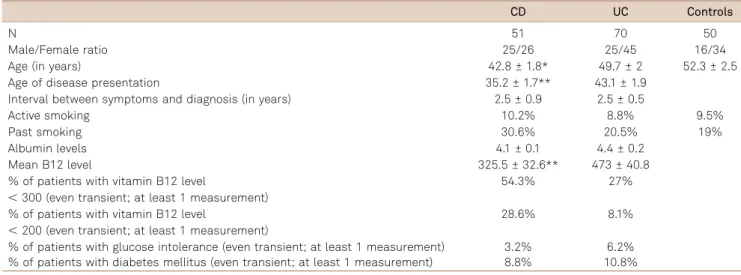
thyroid disease, but rates of DM and glucose intolerance (considering even transient abnormalities due to prednisone administration) were similar in both groups.
Table 2 details the OR analysis of the different neuro-logical conditions in CD versus control patients, based on the results of our standardized neurological evaluation. As can be seen on Table 2, patients with CD were 7.4 times more likely to develop large-fiber neuropathy than controls (p = 0.05), about 7 times more likely than controls to develop any type of neuromuscular condition (p = 0.001) and about 5 times more likely to develop autonomic complaints (p = 0.03). Despite the clear trend for the presence of higher prevalence of other conditions, there was no significant difference, most likely due to small sample (type II error).
Table 3 details the OR analysis of the different neurological conditions in UC versus control patients, based on the results of our standardized neurological evaluation. As can be seen on Table 3, patients with UC were 5 times more likely to develop large-fiber neuropathy than controls (p = 0.03) and about 3 times more likely than controls to develop any type of neuromuscular condition (p = 0.02). Despite the clear trend for the presence of higher prevalence of other conditions, there was no significant difference (most likely due to small sample, type II error) for strokes, hypoacusis and facial para-lysis, even when one plots CD and UC together against control patients.
DISCUSSION
A recent Editorial Review has shown that the extra-intest-inal manifestations of IBD extend to every corner of the body16. However, the magnitude of neurological involvement
(both central and peripheral) is still a matter of controversy,
due to major differences in the inclusion criteria and meth-odologies employed by the different studies.
Here, we present the initial results of the prospective study started in 2004 (acronym NEURODII), that was designed to evaluate the neurological complications in IBD patients. Among the initial 121 IBD patients enrolled (51 with CD and 70 with UC), neuromuscular manifestations were 3-7 times more prevalent in IBD patients than controls, especially large-fiber peripheral neuropathies, that were 5-7 times more prevalent in IBD patients than controls. A trend for higher prevalence of several other neurological condi-tions can be clearly seen on Tables 2 and 3, but no statistical significance for the other conditions was reached (even when one combines CD and UC patients versus controls), most likely due to the small sample, and the rarity of the events, leading to low power to detect diferences (type II error). Longer follow-up periods and larger sample may address this limitation over the next decade. In addition, as can be seen in Table 1, patients with CD and UC also had high rates of abnormal metabolic changes, such as tran-sient or isolated high TSH levels (of unclear significance), borderline or high glucose levels during prednisone treat-ment or B12 changes. This is consistent with the findings from several other studies but also highlights the fact that most of the time the impact of metabolic abnormalities is important for the development of neurological conditions. Unfortunately, control patients did not undergo intense metabolic screening since they did not have neuropathic symptoms and we also do not have accurate rates of the pre-valence of metabolic disorders at the state of Ceará, Brazil. However, it seems very clear that the IBD had far more metabolic complications than controls.
Our present results prospectively confirm the fact that peripheral neuropathy is the most consistently reported
Table 1. Demographic findings in patients with Crohn’s disease (CD), ulcerative colitis (UC) and controls (gastritis and dyspepsia).
CD UC Controls
N 51 70 50
Male/Female ratio 25/26 25/45 16/34
Age (in years) 42.8 ± 1.8* 49.7 ± 2 52.3 ± 2.5
Age of disease presentation 35.2 ± 1.7** 43.1 ± 1.9
Interval between symptoms and diagnosis (in years) 2.5 ± 0.9 2.5 ± 0.5
Active smoking 10.2% 8.8% 9.5%
Past smoking 30.6% 20.5% 19%
Albumin levels 4.1 ± 0.1 4.4 ± 0.2
Mean B12 level 325.5 ± 32.6** 473 ± 40.8
% of patients with vitamin B12 level 54.3% 27%
,300 (even transient; at least 1 measurement)
% of patients with vitamin B12 level 28.6% 8.1%
,200 (even transient; at least 1 measurement)
neurological condition in IBD patients1,4,8,9,12,13,14. However,
even the subject of peripheral neuropathy in IBD patients has been challenged by a recent retrospective study with important methodological limitations11. They have evaluated
the medical charts from local residents of the Olmsted county (seen at Mayo Clinic) from 1940 to 2004 to establish the prevalence of peripheral neuropathy. The authors have concluded that neuropathy was uncommon in IBD patients11. There are multiple explanations for this
discrep-ancy. Our first conclusion is that the ascertainment of the diagnosis of peripheral neuropathy from charts managed mostly by nonneurologists (gastroenterologists) is not valid, since it is very unlikely that this specific diagnosis will be registered in the chart (except for more obvious and dra-matic cases). This is true for several other conditions, e.g. if one conducts chart reviews in patients admitted for the treatment of cirrhosis due to alcoholism, it is very likely that they would find low percentages of the written chart dia-gnosis of “neuropathy”, especially prior to 1990. In fact, in the seventies, despite the widespread use of prolonged doses of metronidazole (known classic cause of neuropathy), gas-troenterologists considered that “Neuropathy is not com-mon in IBD and I have only seen a dubious case”17. In this
paper, the authors also do not report the disease severity
or the prevalence of other important conditions such as dia-betes mellitus (associated with rates of peripheral neuro-pathy up to 50%) or nutritional deficiencies. It is still possible that an unrecognized bias, such as outstanding management of nutritional deficiencies and immune status (referral bias) or genetic background could explain those dis-crepancies. The latter is unlikely since in a prospective study to evaluate neuropathic symptoms in IBD patients, very high percentages of neuropathic symptoms were found even inside the United States18.
Regarding the central nervous system manifestations, despite a trend for higher prevalence of ischemic strokes, we have not found a higher percentage of strokes or central demyelinating diseases in our CD or UC patients (even when both were plotted against controls). This may be due to our small sample, since previous studies from larger databases have found significantly higher rates of strokes and central demyelinating diseases4,5,7,16. However, when we grouped
together CD and UC patients, there are 5/121 IBD patients with strokes (0/51 in the control group) and 7/121 with hypoacusis (versus 2/51 in the control group). Also, we have not found cases of multiple sclerosis, although at least 1 of the patients labeled as“ischemic strokes”could have been affected by demyelinating disease, since her disease course
Table 2. Prevalence of different neurological disorders in patients with Crohn’s disease (CD, N = 51) and controls (Cont, for gastritis and dyspepsia, N = 50).
Neurological complication CD (N) Cont (N) OR CI p
Ischemic stroke 2 1
Epilepsy 2 0 2.0 [0.1 - 20.4] 0.5695
Autonomic complaints 9 2 5.1 [1.1 - 25.2] 0.0277
Large-fiber neuropathy 12 2 7.4 [1.5 - 70.6] 0.045
Small fiber neuropathy 7 3 2.5 [0.5 - 15.7] 0.1937
Carpal tunnel syndrome 1 2 0.5 [0.01 - 9.6] 0.55
Hypoacusis 4 1 4.2 [0.4 - 209.5] 0.1759
Facial paralysis 2 1 2.0 [0.1 - 120.4] 0.5695
Myasthenia gravis 1 0
Any neuromuscular disorder 25 6 7.1 [2.4 - 23.4] 0.0001
CI: Confidence interval; N: number of affected patients; OR: odds ratio.
Table 3. Prevalence of different neurological conditions in patients with ulcerative colitis (UC, N = 70) and controls (Cont, for gastritis and dyspepsia, N = 50).
Neurological complication UC Cont OR CI p
Ischemic stroke 2 0
Transient chorea 1 0
Epilepsy 2 1 1.6 [0.08 - 93.6] 0.7195
Autonomic complaints 5 2 1.8 [0.3 - 20.1] 0.4689
Large-fiber neuropathy 12 2 5.0 [1.3 - 63.2] 0.027
Small fiber neuropathy 8 3 2.0 [0.5 - 12.4] 0.3096
Carpal tunnel syndrome 6 2 2.3 [0.4 - 23.6] 0.32
Hypoacusis 3 1 2.2 [0.2 - 1147.5] 0.4917
Facial paralysis 3 1 2.2 [0.2 - 1147.5] 0.4917
Any neuromuscular disorder 30 6 3.1 [1.2 - 9.9] 0.015
was not consistent with abrupt onset of stroke symptoms and MRI findings were equivocal. Unfortunately she did not complete a full work-up for demyelinating diseases. These findings may reflect the lower percentage of demyeli-nating disease in our region and contrast with other studies that have suggested that neurological screening for central demyelinating disease may be warranted in IBD patients7,19
. Other authors have found high percentages of abnormal neurological examination and MRI abnormalities on 37% of the IBD patients20. On the other hand, peripheral nervous
system involvement (either small and large-fiber neuro-pathy) was very common in our patients, suggesting that early evaluation of subclinical or mild symptoms may be important, especially in populations more prone to nutri-tional deficiencies due to lower socio-economic status (like ours). Although, some authors have not recommended screening for peripheral neuropathy in IBD patients19, they
have found significant changes on neurophysiological para-meters even in patients with subclinical disease, similar to the findings from our present series and other older stud-ies13,21,22,23,24,25. Knowledge about the extent of neurological
involvement in IBD patients may become even more import-ant with the advent of new different therapeutic strategies to
control the IBD course and its different extraintestinal manifestations26. There were important therapeutic
changes during this cohort study. In this study, few patients were managed with inflixamab or alemtuzumab, and most were treated with azathioprine and prednisone (especially for disease relapses). However, over the last 5 years, those 2 medications were used far more frequently. The final report from our cohort study will also attempt to establish whether the neuropathy course was affected by those therapeutic changes. In a nested case-control within a Brazilian cohort, we have found that patients with IBD are significantly more affected by several neurological con-ditions (especially peripheral neuropathy and other neuro-muscular diseases) than controls. Those conditions are commonly mild, but frequently misdiagnosed27. Further
studies are necessary to understand the exact nature of sev-eral sensory symptoms experienced by IBD patients, that may include the involvement of complex changes on cent-ral neuroplasticity and function of small fibers and sensory and autonomic ganglia23,28. Long-term follow-up at the
end of the cohort study will also establish whether other conditions (especially central) are also more prevalent in IBD patients.
References
1. Gondim FAA, Brannagan TH 3rd, Sander HW, Chin RL, Latov N. Peripheral neuropathy in patients with inflammatory bowel disease. Brain. 2005;128(4):867-79. http://dx.doi.org/10.1093/brain/awh429 2. Dimitrova AK, Ungaro RC, Lebwohl B, Lewis SK, Tennyson CA, Green
MW et al. Prevalence of migraine in patients with celiac disease and inflammatory bowel disease. Headache. 2013;53(2):344-55. http://dx. doi.org/10.1111/j.1526-4610.2012.02260.x
3. Weinstock LB, Bosworth BP, Scherl EJ, Li E, Iroku U, Munsell MA et al. Crohn’s disease is associated with restless legs syndrome. Inflamm Bowel Dis. 2010;16(2):275-9. http://dx.doi.org/10.1002/ibd.20992 4. Morís G. Inflammatory bowel disease: an increased risk factor for
neurologic complications. World J Gastroenterol. 2014;20(5):1228-37. http://dx.doi.org/10.3748/wjg.v20.i5.1228
5. Katsanos AH, Kosmidou M, Giannopoulos S, Katsanos KH, Tsivgoulis G, Kyritsis AP et al. Cerebral arterial infarction in inflammatory bowel diseases. Eur J Intern Med. 2014;25(1):37-44. http://dx.doi. org/10.1016/j.ejim.2013.08.702
6. Greenstein AJ, Janowitz HD, Sachar DB. The extra-intestinal complications of Crohn’s disease and ulcerative colitis: a study of 700 patients. Medicine (Baltimore). 1976;55(5):401-12. http://dx.doi. org/10.1097/00005792-197609000-00004
7. Gupta G, Gelfand JM, Lewis JD. Increased risk for demyelinating diseases in patients with inflammatory bowel disease. Gastroenterology. 2005;129(3):819–26. http://dx.doi.org/10.1053/j.gastro.2005.06.022 8. Lossos A, River Y, Eliakim A, Steiner I. Neurologic aspects of
inflammatory bowel disease. Neurology. 1995;45(3):416-21. http:// dx.doi.org/10.1212/WNL.45.3.416
9. Elsehety A, Bertorini TE. Neurologic and neuropsychiatric complica-tions of Crohn’s disease. South Med J. 1997;90(6):606-10. http://dx. doi.org/10.1097/00007611-199706000-00005
10. Gendelman S, Present D, Janowitz HD. Neurological complications of inflammatory bowel disease. Gastroenterology. 1982;82:1065.
11. Figueroa JJ, Loftus Jr EV, Harmsen WS, Dyck PJ, Klein CJ. Peripheral neuropathy incidence in inflammatory bowel disease: a population-based study. Neurology. 2013;80(18):1693-7. http://dx.doi.org/ 10.1212/WNL.0b013e3182904d16
12. Crespi V, Boglium G, Marzorati L, Zincone A, D’Angelo L, Liberani A et al. Inflammatory bowel disease and periphera neuropathy [abstract]. In: Proceedings of 4th Meeting of the European Neurological Society; 1994 June 25-29; Barcelona, Spain. (J Neurol. 1994;241(Suppl 1):63). 13. Oliveira GR, Teles BC, Brasil EF, Souza MH, Furtado LE, Castro-Costa
CM et al. Peripheral neuropathy and neurological disorders in an unselected Brazilian population-based cohort of IBD patients. Inflamm Bowel Dis. 2008;14(3):389-95. http://dx.doi.org/10.1002/ibd.20304 14. Gondim FAA, Teles BCV, Oliveira GR, Brasil EF, Aquino OS, Costa AMC
et al. High prevalence of neurological disorders in patients with inflammatory bowel disease. Neurology. 2007;68:A105.
15. Oliveira GR, Aquino PS, Costa AM, Louis ED, Braga LL, Souza MH et al. Tremor in patients with inflammatory bowel disease. Tremor Other Hyperkinetic Mov (NY). 2013;3:tre-03-149-3042-1.
16. Loftus EV. Inflammatory bowel disease extending its reach. Gastroenterology. 2005;129(3):1117-20. http://dx.doi.org/10.1053/j. gastro.2005.07.042
17. Coxon A, Pallis CA. Metronidazole neuropathy. J Neurol Neurosurg Psychiatry. 1976;39(4):403-5. http://dx.doi.org/10.1136/jnnp.39.4.403 18. Shen TC, Lebwohl B, Verma H, Kumta N, Tennyson C, Lewis S et al. Peripheral neuropathic symptoms in celiac disease and inflammatory bowel disease. J Clin Neuromuscul Dis. 2012;13(3):137-45. http://dx. doi.org/10.1097/CND.0b013e31821c55a1
19. Stovicek J, Liskova P, Lisy J, Hlava S, Keil R.Crohn’s disease: is there a place for neurological screening? Scand J Gastroenterol. 2014;49(2):173-6. http://dx.doi.org/10.3109/00365521.2013.867358 20. Babali A, Terzoudi A, Vadikolias K, Souftas V, Kleitsas K, Pitiakoudis
inflammatory bowel disease. Eur J Gastroenterol Hepatol. 2013;25(5):539-42. http://dx.doi.org/10.1097/MEG.0b013e32835ceca6 21. Ståhlberg D, Bárány F, Einarsson K, Ursing B, Elmqvist D, Persson A.
Neurophysiologic studies of patients with Crohn’s disease on long-term treatment with metronidazole. Scand J Gastroenterol.1991;26(2):219–24. http://dx.doi.org/10.3109/00365529109025034
22. Gondim FAA. Neuropatias periféricas e manifestações Neurológicas em duas populações de pacientes com doença inflamatória intestinal de diferentes nacionalidades [thesis]. São Paulo: Faculdade de Medicina de Ribeirão Preto; 2008.
23. Coelho LSM, Oliveira GR, Costa AMC, Aquino PS, Braga LLBC, Souza MHLP et al. Prevalence of somatic and autonomic small fiber neuropathy in a cohort of patients with inflammatory bowel disease. Neurology. 2010;74:A345.
24. Sassi SB, Kallel L, Ben Romdhane S, Boubaker J, Filali A, Hentati F. Peripheral neuropathy in inflammatory bowel disease patients: a
prospective cohort study. Scand J Gastroenterol. 2009;44(10):1268-9. http://dx.doi.org/10.1080/00365520903199871
25. Cetinkaya ZA, Cetinkaya Y, Gencer M, Sezikli M, Tireli H, Kurdas OÖ et al. The relationship between quiescent inflammatory bowel disease and peripheral polyneuropathy. Gut Liver. 2011;5(1):57-60. http://dx.doi.org/10.5009/gnl.2011.5.1.57
26. Singh S, Kumar N, Loftus Jr EV, Kane SV. Neurologic complications in patients with inflammatory bowel disease: Increasing relevance in the era of biologics. Inflamm Bowel Dis. 2013;19(4):864-72. http://dx. doi.org/10.1002/ibd.23011
27. Buskila D, Odes LR, Neumann L, Odes HS. Fibromyalgia in inflammatory bowel disease. J Rheumatol. 1999;26(5):1167-71. 28. Lei Q, Malykhina AP. Colonic inflammation up-regulates voltage-gated