Abst ract
Submitted: July 7, 2016 0RGL¿FDWLRQ1RYHPEHU Accepted: December 15, 2016
Effect of different com posit e core
m at erials on fract ure resist ance of
endodont ically t reat ed t eet h rest ored
wit h FRC post s
Obj ect ive: This st udy evaluat ed t he fract ure resist ance of endodont ically WUHDWHG WHHWK UHVWRUHG ZLWK ¿EHU UHLQIRUFHG FRPSRVLWH SRVWV XVLQJ WKUHH UHVLQFRPSRVLWHFRUHEXLOGXSPDWHULDOV&OHDU¿O3KRWR&RUH&3&0XOWL&RUH Flow ( MCF) , and LuxaCor e Z- Dual ( LCZ) ) , and a nanohybr id com posit e, ( Tet ric N- Ceram ( TNC) ) . Mat erial and Met hods: Fort y endodont ically t reat ed ORZHU¿UVWSUHPRODUVZHUHUHVWRUHGZLWKTXDUW]¿EHUSRVWV'7/LJKW3RVW cem ent ed wit h resin cem ent ( Panavia F2.0) . Sam ples were random ly divided int o four groups ( n= 10) . Each group was built - up w it h one of t he four core m at erials following it s m anufact urers’ inst ruct ions. The t eet h were em bedded LQDFU\OLFUHVLQEORFNV1LFNHO&KURPLXPFURZQVZHUH¿[HGRQWKHVSHFLPHQV w it h resin cem ent . The fract ure resist ance was det erm ined using a universal t est ing m achine wit h a crosshead speed of 1 m m / m in at 1350 t o t he t oot h axis unt il failure occurred. All core m at erials used in t he st udy w ere subj ect ed t o WHVWIRUWKHÀH[XUDOPRGXOXVDFFRUGLQJWR,625HVXOWV2QHZD\ ANOVA and Bonferroni m ult iple com parisons t est indicat ed t hat t he fract ure resist ance was higher in t he groups w it h CPC and MCF, w hich present ed QRVWDWLVWLFDOO\VLJQL¿FDQWGLIIHUHQFHS!EXWZDVVLJQL¿FDQWO\KLJKHU WKDQLQWKRVHZLWK/&=DQG71&S,QWHUPVRIWKHÀH[XUDOPRGXOXV t he ranking from t he highest values of t he m at erials was aligned w it h t he sam e t endency of fract ure loads. Conclusion: Am ong t he cores used in t his VWXG\WKHFRPSRVLWHFRUHZLWKKLJK¿OOHUFRQWHQWWHQGHGWRHQKDQFHIUDFWXUH WKUHVKROGVRIWHHWKUHVWRUHGZLWK¿EHUSRVWVPRUHWKDQRWKHUV
Ke yw or ds: Com posit e core m at erial. Endodont ically t reat ed t eet h. FRC post . Flexural m odulus. Fract ure resist ance.
Prapaporn PANITIWAT1 Prarom SALIMEE1
http://dx.doi.org/10.1590/1678-77572016-0306
1Department of Prosthodontics, Faculty of Dentistry, Chulalongkorn University, Bangkok, Thailand Corresponding address:
Prarom Salimee, DDS, PhD Assistant Professor, Department of Prosthodontics, Faculty of Dentistry, Chulalongkorn University
I nt roduct ion
Th e u se o f f i b e r r e i n f o r ce d co m p o si t e ( FRC)
post s has t rem endously increased t he rest orat ion of
endodont ically t r eat ed t eet h due t o t heir fav orable
p h y sical p r op er t ies, su ch as h ig h t en sile st r en g t h
and good fat igue r esist ance. Also, t heir m odulus of
elast icit y is sim ilar t o t hat of dent in. I n com binat ion
wit h FRC post , t he com posit e core build- up m at erial is
oft en used t o rest ore t he coronal port ion of t he t eet h
and t o achieve ret ent ion and resist ance form for t he
crown4,7.The clinical evaluat ion of t he FRC post and core rest orat ion has report ed high success rat e wit h reduct ion
in failure of root fract ure. The com m on failures of t hese
rest orat ions relat ed t o m at erials are post debonding,
crown debonding, or post fract ure, which are usually
com bined w it h cor e failur e, especially in t eet h w it h
few coronal walls21,27 6LQFH WKH )5& SRVW LV ÀH[LEOH
t he core build- up m at erial m ust be st rong enough and
resist m ult idirect ional m ast icat ory force. Furt herm ore,
it has t o wit hst and a process of crown preparat ion by
rot ary cut t ing inst rum ent . Therefore, t he core m at erial
is also a crit ical com ponent for t he overall success in t he
rest orat ion of endodont ically t reat ed t eet h, especially
when using it wit h FRC post .
Resin com posit e is a popular core build- up m at erial
t o be used w it h FRC post due t o sim ilarit y t o t oot h
st ruct ure in hardness and fract ure t oughness, giving
t he abilit y t o per for m t he pr eparat ion aft er cur ing.
Rest orat ive com posit es can be regularly em ployed for
core build- up m at erial4,7,21,27.Nowadays, t here are m any
UHVLQFRPSRVLWHVWKDWDUHVSHFL¿FDOO\GHVLJQHGIRUFRUH EXLOGXS ZLWK LQFUHDVH LQ ¿OOHUV IRU KLJKHU VWUHQJWK
and enhance for easy m anipulat ion. These m at erials
DUH GLIIHUHQW LQ DPRXQW DQG W\SHV RI ¿OOHU YLVFRVLW\
cu r i n g m o d e, b u i l d - u p t ech n i q u e, am o n g o t h er s,
while t heir physical propert ies have been invest igat ed
in m an y asp ect s1 1 , 2 0 , 2 2 , 2 8. Reg ar d in g v iscosit y, h ig h
v iscosit y com posit e cor e m at er ials ar e h an dled by
u si n g i n cr em en t al t ech n i q u e t o en su r e co m p l et e
poly m er izat ion and opt im al st r engt h. Low v iscosit y
core build- up com posit es are generally prepared in an
aut om ix syringe t hat can avoid air cont am inat ion. These
m at erials can also be used for cem ent ing t he FRC post
and core m at erial at t he sam e t im e. I n order t o allow
polym erizat ion in t he root canal, t hey are dual- curing
FRPSRVLWHVZKLFKDUHSUHIHUDEOHWRXVHZLWK¿EHUSRVWV
where light curing m ight not be perfect ly com plet ed.
I t can be not iced by clinicians t hat low viscosit y core
m at erials are m ore easily prepared by diam ond cut t ing inst rum ent t han high viscosit y m at erials. Thus, t he low viscosit y com posit e core m ight be easy t o handle, but
t he st rengt h m ight be reduced. 5WWHUPDQQ HW DO22
( 2011) invest igat ed t he physical propert ies of direct core
PDWHULDOVDQGIRXQGWKDWWKHÀH[XUDOVWUHQJWKRIKLJK YLVFRVLW\FRPSRVLWHV&OHDU¿ODQG0XOWL&RUH+%LVKLJKHU
WKDQWKDWRIÀRZDEOHFRPSRVLWHV5DELOGD6& However,
som e st udies have shown t hat low viscosit y com posit e
core m at erials had higher bond st rengt hs t o FRC post
t han hybrid com posit es23,25. The st udy of Naum ann, et
al.17 VKRZHGQRVLJQL¿FDQWO\KLJKHUULVNRIIDLOXUH
EHWZHHQKLJKYLVFRVLW\FRPSRVLWH&OHDU¿O&RUHORZ
viscosit y com posit e ( LuxaCore Dual) , and self- adhesive
cem ent ( RelyX Unicem ) for core build- up aft er long t erm
st orage, t herm ocycled and m echanically loaded. This
m ay indicat e t hat t he st rengt h of core m at erial alone
PLJKWQRWLQÀXHQWWKHVWUHQJWKRIHQGRGRQWLFDOO\WUHDWHG
t eet h rest ored wit h FRC post . The st udy of Kim and Lee12 ( 2012) invest igat ed t he use of various post s and
cem ent at ion procedures and showed t hat t he change of
SRVWRUFRUHGLGQRWLQÀXHQFHWKHIUDFWXUHVWUHQJWKDQG
failure pat t erns. However, various fact ors t ook part in t he result s of t he st udy, since som e core m at erials were used bot h as cem ent and core m at erial.
This st udy aim ed t o evaluat e t he fract ure resist ance
of endodont ically t reat ed t eet h rest ored wit h FRC post ,
using four different core build- up com posit e m at erials:
one rest orat ive nanohybrid com posit e ( Tet ric N- Ceram ( TNC)DQGWKUHHVSHFL¿HGFRPSRVLWHVIRUFRUHEXLOG XS PDWHULDOV &OHDU¿O 3KRWR &RUH &3& 0XOWL&RUH
Flow ( MCF) , and LuxaCore Z- Dual Aut om ix ( LCZ) .
The
null hypot hesis was t hat t here would be no differencein t he fract ure load of t he rest orat ions am ong t hese
com posit es.
Mat erial and m et hods
Fract ure resist ance t est
Specim en pre- t reat m ent
)RUW\ H[WUDFWHG KXPDQ ORZHU ¿UVW SUHPRODUV GXH
t o ort hodont ics t reat m ent prot ocol, wit h sim ilar form
an d size of r oot s, w er e select ed . Each t oot h w as
visually inspect ed t o be free of cracks, dent al caries,
rest orat ions, or ot her defect s. The dim ensions of t he
t eet h were m easured m esiodist ally, labiolingually, and
in root lengt h, using a digit al vernier caliper ( Mit ut oyo,
Ka w a sa k i , Ja p a n ) . Te e t h si ze w i t h 5 . 5 + 0 . 5 m m
m m in root lengt h were chosen. All t eet h were cleaned
and debrided of soft t issues and st ored in 0.9% norm al
saline unt il used.
Root canal preparat ion
The clinical crowns were decoronat ed perpendicularly
t o t he root axis 1 m m above t he cem ent oenam el j unct ion
( CEJ) by a low speed cut t ing m achine ( I SOMET 1000;
Buehler Lt d, I L, USA) . The pulpal t issue was rem oved
ZLWKDEDUEHGEURDFKDQGDVWDLQOHVVVWHHO.¿OHVL]H
15 ( Dent sply Maillefer, Ballaigues, Sw it zer land) was
insert ed int o t he canal t hrough t he apex t o est ablish
t he w or k ing lengt h by subt ract ing 1 m m fr om t his
m easur em ent . All t eet h w er e endodont ically t r eat ed
XVLQJDVWHSEDFNWHFKQLTXHZLWKPDVWHUDSLFDO¿OHVL]H DQGFRURQDOÀDULQJVL]H'XULQJLQVWUXPHQWDWLRQV
t h e r oot can als w er e ir r ig at ed w it h 2 . 5 % NaOCl,
al t er n at i n g i r r i g at i on w i t h 2 . 5 % NaOCl an d 1 7 %
et hy len ediam in et et r aacet ic acid solu t ion , an d f in al
irrigat ion wit h norm al saline. The canals were dried and
t hen obt urat ed using a lat eral condensat ion t echnique
wit h gut t a- percha cones and eugenol- cont ained root
canal cem ent ( CU dent al Product , Bangkok, Thailand)5.
The excess of gut t a- percha was rem oved wit h a hot
LQVWUXPHQWDQGVHDOHGZLWKSURYLVLRQDO¿OOLQJPDWHULDO
( Cavit ; 3M ESPE, Seefeld, Germ any) t o a dept h of 3
m m . All specim ens were st ored at 370C during 24 h for
com plet e set t ing of cem ent14.
Specim en’s block preparat ion
Aft er endodont ic t r eat m ent , a D.T. univer sal dr ill
was used t o prepare a post space t o a dept h of 10 m m ,
leaving 4 m m of int act gut t a- percha as t he apical seal.
7KH FDQDOV ZHUH WKHQ VKDSHG ZLWK '7 ¿QLVKLQJ GULOO
corresponding t o t he post ( D.T. Light- PostI llusion size
1; RTD, Saint- Egreve, France) wit h a coronal diam et er of
1.5 m m and 0.9 m m at it s apical t ip. A vinyl polysiloxane ( Reprosil light body consist ency; Dent sply Caulk, USA)
was used t o sim ulat e t he periodont al ligam ent . Each root
was dipped int o m elt ed m odeling wax at 2 m m below
t he CEJ, which allowed t he t hickness of approxim at ely
0.2 m m . The t oot h was t hen at t ached t o a surveyor
( Dent alfarm , Torino, I t aly) wit h t he D.T. Light drill in t he
canal and placed in a plast ic m old ( 22 m m in diam et er
and 20 m m in height ) 2 m m coronally above t he upper
edge. The aut opolym erizing acrylic resin ( Form at ray;
Ker r Cor porat ion, Orange, CA, USA) w as pour ed in
t he m old, result ing in root em bedded in acrylic resin
base. A silicone m old index was m ade as an aid for t he
specim en reposit ioning when replacing t he wax wit h
vinyl polysiloxane.
Post and core build- up procedure
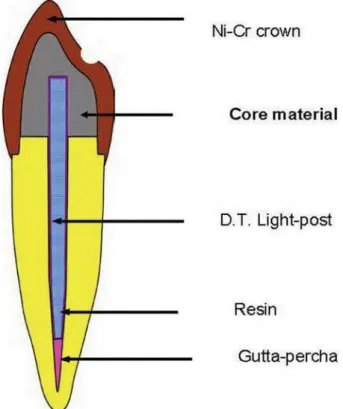
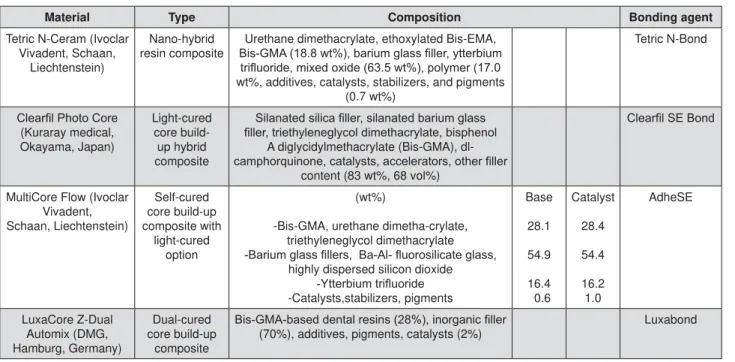
All specim en s w er e t h en r an dom ly div ided in t o f ou r g r ou p s of t en sam p les accor d in g t o d if f er en t com posit e core m at erials t o build- up ( Figure 1) . The core m at erials used and t heir com posit ions are shown
LQ)LJXUH(DFK¿EHUSRVWZDVFXWDWPPOHQJWK
wit h a high- speed diam ond rot ary cut t ing inst rum ent ( I SO 314197; I nt ensiv SA, Grancia, Swit zerland) . At t his lengt h, 10 m m of t he post would be in t he root , leav ing 4 m m pr oj ect ing above t he pr epar ed t oot h. Surface t reat m ent of post was perform ed wit h silane
FRXSOLQJ DJHQW PL[WXUH RI &OHDU¿O 6( ERQG SULPHU
and porcelain bond act ivat or; Kuraray Medical) . The root canal was irrigat ed wit h norm al saline, dried wit h paper point s, and condit ioned wit h self- et ching prim er ( ED prim er I I A&B; Kuraray Medical) for 30 seconds, followed by gent ly air dried. The post was cem ent ed wit h dual- polym erizing resin cem ent ( Panavia F2.0; Kuraray Medical) according t o t he m anufact urer ’s inst ruct ion. The excess cem ent was r em oved and t he post was cured wit h a light- polym erized unit ( Elipar Trilight ; 3M ESPE, St . Paul, MN, USA) for 20 seconds per surface. Before core build- up procedure, a dent in bonding agent was applied t o dent in according t o t he m anufact urers’ r ecom m endat ions ( Table 1) . The cor e build- up w as t hen cont inued using a t ransparent m at rix band. For TCN and CPC, t he increm ent al t echnique of 2- m m layer
was perform ed per 40 seconds of light curing. For MCF and LCZ, t he m at erial was inj ect ed around t he post and
OLJKWFXUHGIRUVHFRQGV$IWHU¿QLVKHGWKHFRUHZDV
prepared for full m et al crown wit h a circum ferent ial 0.5
PPFKDPIHU¿QLVKLQJOLQHDW&(-OHYHO7KHKHLJKWRI
t he core was 6 m m facially and 3 m m lingually above t he CEJ. This result ed in t he abut m ent height at 5 m m of core m at erial and 1 m m ferrule. The coronal end of t he post was com plet ely covered wit h t he resin core 1 m m6. All m easurem ent s were done by digit al caliper.
Crown rest orat ion
An im pression of t he rest orat ion was m ade wit h vinyl polysiloxane im pression m at erial and poured wit h t ype I V dent al st one ( Vel- Mix ; Ker r Cor porat ion, Orange, CA, USA) . The full m et al crown of each specim en was m ade by creat ing t he wax pat t ern wit h blue inlay cast ing wax ( Kerr Corporat ion) on t he dies wit h t he sam e out er cont our. A not ch was prepared for t est ing on t he cent er of t he occlusal surface.Each pat t ern was invest ed and cast ed u sin g Nick el- Ch r om iu m alloy ( 4 all William s
,YRFODU 9LYDGHQW 7KH FURZQ ZDV ¿QLVKHG SROLVKHG DQG WKH ¿W WR WKH VSHFLPHQ ZDV HYDOXDWHG
by visual inspect ion and checked wit h vinyl polyet her
silicone ( Fit checker; GC Corporat ion, Tokyo, Japan) .
The crown was t hen cem ent ed wit h Panavia F 2.0. The
procedure was perform ed by condit ioning dent in wit h
ED prim er for 30 seconds and cem ent ing t he crown t o
t he core. Each surface was light polym erized for 20
seconds. An oxygen barrier ( Oxyguard I I gel; Kuraray
Medical) was applied t o t he m argin of t he crown for 3
m inut es, and t hen t he excess cem ent was rem oved. The
specim ens were st ored at 370C 24 h prior t o t est ing.
The fract ur e r esist ance t est was per for m ed by a
universal t est ing m achine ( m odel 8872; I nst ron Lt d,
High Wycom be, UK) at 1350 t o t he long axis of t he t oot h.
The load t ip was placed on t he prepared occlusal not ch. A
cont inuous com pressive force was applied at a crosshead
speed of 1 m m / m in unt il failure. The highest fract ure
load of each specim en was m easured by a sudden drop
in load m agnit ude, recorded in Newt on. All specim ens
w er e v isu ally ex am in ed u n der a st er eom icr oscope
( ML9300; Meij i, Tokyo, Japan) for t he m ode of failure.
Flexural m odulus t est
All r esin com p osit e cor e b u ild - u p u sed in t h is
VWXG\ ZDV WHVWHG IRU ÀH[XUDO VWUHQJWK DFFRUGLQJ WR
I SO 4049: 2009 ( E)10. Preparat ions of a beam - shaped
specim ens ( n= 5 ) w er e per for m ed accor ding t o t he m an u f act u r er ’s r ecom m en dat ion , u sin g a st ain less st eel m old ( 25× 2× 2 m m3). Each specim en was light
cur ed for 60 seconds per side. All specim ens w er e st ored at 37± 1° C for 24 hours in dist illed wat er prior
WR WHVWLQJ 7KH ÀH[XUDO VWUHQJWK ZDV GHWHUPLQHG E\
using a universal t est ing m achine at a crosshead speed 0.75± 0.25 m m / m in unt il t he fract ur e occur r ed. The
KLJKHVWORDGRIHDFKVSHFLPHQZDVUHFRUGHG7KHÀH[XUDO VWUHQJWKDQGÀH[XUDOPRGXOXVZHUHFDOFXODWHGIURPWKH
following equat ions:
( 1)
Material Type Composition Bonding agent
Tetric N-Ceram (Ivoclar Vivadent, Schaan,
Liechtenstein)
Nano-hybrid resin composite
Urethane dimethacrylate, ethoxylated Bis-EMA,
%LV*0$ZWEDULXPJODVV¿OOHU\WWHUELXP WULÀXRULGHPL[HGR[LGHZWSRO\PHU
wt%, additives, catalysts, stabilizers, and pigments (0.7 wt%)
Tetric N-Bond
&OHDU¿O3KRWR&RUH
(Kuraray medical, Okayama, Japan)
Light-cured core
build-up hybrid composite
6LODQDWHGVLOLFD¿OOHUVLODQDWHGEDULXPJODVV ¿OOHUWULHWK\OHQHJO\FROGLPHWKDFU\ODWHELVSKHQRO
A diglycidylmethacrylate (Bis-GMA), dl-
FDPSKRUTXLQRQHFDWDO\VWVDFFHOHUDWRUVRWKHU¿OOHU
content (83 wt%, 68 vol%)
&OHDU¿O6(%RQG
MultiCore Flow (Ivoclar Vivadent, Schaan, Liechtenstein)
Self-cured core build-up composite with
light-cured option
(wt%)
-Bis-GMA, urethane dimetha-crylate, triethyleneglycol dimethacrylate
%DULXPJODVV¿OOHUV%D$OÀXRURVLOLFDWHJODVV
highly dispersed silicon dioxide
<WWHUELXPWULÀXRULGH
-Catalysts,stabilizers, pigments
Base 28.1 54.9 16.4 0.6
Catalyst 28.4 54.4 16.2 1.0
AdheSE
LuxaCore Z-Dual Automix (DMG, Hamburg, Germany)
Dual-cured core build-up
composite
%LV*0$EDVHGGHQWDOUHVLQVLQRUJDQLF¿OOHU
(70%), additives, pigments, catalysts (2%)
Luxabond
Figure 2- Core build-up materials used in this study, their compositions and recommended bonding agent
( 2)
:KHUHıZDVWKHÀH[XUDOVWUHQJWK03D(ZDVWKH ÀH[XUDOPRGXOXV03D3ZDVWKHPD[LPXPORDG1
L was t he lengt h of span bet ween t he support s ( m m ) , b
was t he widt h of t he specim ens ( m m ) , h was t he height
RIWKHVSHFLPHQVPPDQGįZDVWKHGHÀHFWLRQPP
Dat a collect ion and analysis
The dat a were analyzed using st at ist ical soft ware
( SPSS St at ist ics 17.0; SPSS I nc, I L, USA) . The norm al
dist ribut ion was t est ed wit h Kolm ogorov- Sm irnov and
Sh ap ir o- Wilk t est s. On e- w ay an aly sis of v ar ian ce
( ANOVA) and Bonfer r oni m ult iple com par isons t est
were used t o analyze t he differences bet ween groups
(D= 0.05) , respect ively.
Result s
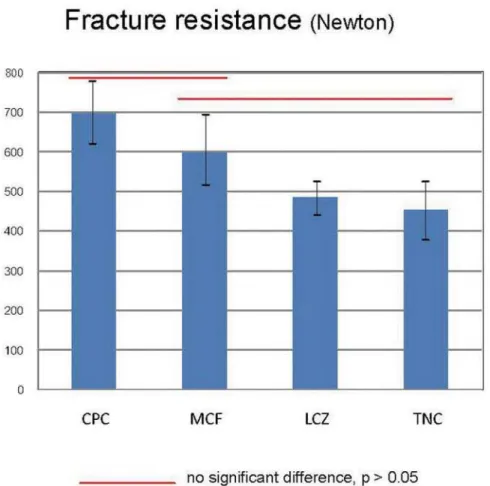
The fract ur e load w as higher in t he gr oup w it h
CPC ( 699.1± 173.4 N) , follow ed by t he gr oups w it h
MCF ( 587.1± 182.3 N) , LCZ ( 483.1± 80.5 N) , and TNC
( 451.4± 154.5 N) , respect ively. ANOVA and Bonferroni m ult iple com par isons t est show ed t hat t he fract ur e
UHVLVWDQFHIRU&3&ZDVQRWVLJQL¿FDQWO\GLIIHUHQWIURP
MCF ( p> 0.05)EXWVLJQL¿FDQWO\KLJKHUWKDQWKDWRI/&=
and TNC ( p< 0.05) ( Figure 3) .When t he specim ens were exam ined under t he st ereom icroscope, t he pat t ern of failure for all groups originat ed at t he lingual m argin of t he crown and cont inued obliquely in an apical- facial direct ion, as shown in Figure 4.
7KHUHVXOWVRIÀH[XUDOPRGXOXVRIWKHFRUHPDWHULDOV
are shown in Table 1. The ranking of t hese values align wit h t he sam e t rend of t he fract ure resist ance, in which t he highest m odulus experienced t he highest value of fract ure resist ance.
Discussion
I n m at er ial aspect , t h e failu r e of r est or at ion of endodont ically t reat ed t eet h using FRC post and core concerns m any fact ors, such as t ypes of FRC post , shape of post , sur face t r eat m ent s, cem ent at ion, and cor e m at erial used. I n t his st udy, we aim ed t o invest igat e t he effect of t he core m at erial used by using fract ure r esist an ce t est . Th er ef or e, t h e ot h er f act or s w er e cont rolled for t he sam e condit ion, except t he t ypes of core m at erial.
Due t o t he st at ist ical analysis, t he null hypot hesis
Figure 3- Results of fracture resistance load in the four study groups PL3
E =
ZDVUHMHFWHGVLQFHWKHUHZHUHVLJQL¿FDQWGLIIHUHQFHV
am ong fract ure resist ances in t he group using different co m p o si t e co r e b u i l d - u p m a t er i a l s. Th e f r a ct u r e
UHVLVWDQFHORDGRI&3&DQG0&)JURXSVZDVVLJQL¿FDQWO\
higher t han t hat of LCZ and TNC groups. The result s of
WKLVVWXG\FRQ¿UPHGWKHSUHYLRXVVWXGLHVRI%LWWHUHWDO3
( 2016) , Naum ann, et al.18 DQG5WWHUPDQQHW
al.22 LQZKLFK&OHDU¿O&RUHVKRZHGDPHFKDQLFDO
load resist ance higher t han ot her m at erials. Alt hough core m at erial was t he only variable fact or, t he differences in fract ure loads could be t he propert ies of core m at erial concer ning st r engt h, r igidit y, bonding abilit y t o post and dent in, polym erizat ion m odes, et c. The st rengt h of core m at erials is one of t he im port ant propert ies in
obt aining a long t erm success of rest orat ion, especially
when t he rem aining t oot h st ruct ure is lim it ed1. I n t his
sit uat ion, st ress was placed on t he core m at erial t hat
dem ands a higher st rengt h m at erial t o resist a fract ure
load. Com posit e m at er ials ar e gen er ally com posed of or ganic poly m er m at r ix , a com pound of Bis- GMA
DQG¿OOHUSDUWLFOHVTNC is a convent ional nanohybrid
FRPSRVLWHDQGWKHQDQRVL]HG¿OOHULPSURYHVLWVJRRG
physical propert ies and est het ics9. The ot her m at erials
DUH UHVLQ FRPSRVLWHV VSHFL¿FDOO\ XVHG IRU FRUH EXLOG
up. CPC is a light- curing hybrid com posit e wit h high
t ranslucency t hat show high dept h of cure t o 7 m m . MCF
DQG/&=DUHGXDOFXULQJFRPSRVLWHVZLWKÀXRULGH¿OOHU
DQG]LUFRQLXPGLR[LGH¿OOHUUHVSHFWLYHO\t hat have low
consist ency, which allows t he m ixing and applicat ion in root canal. According t o t he m anufact urers’ inform at ion,
&3&KDVWKHKLJKHVW¿OOHUFRQWHQWZWIROORZHG
by MCF ( base 71.3 wt % , cat alyst 70.6 wt % ) , LCZ ( 70 w t % ) , and TNC ( 63.5 w t % ) , r espect ively. I t can be not iced t hat t he result s of fract ure resist ance load had
WKHVDPHWUHQGZLWKWKH¿OOHUFRQWHQWLQFRUHPDWHULDOV ,Q WKLV VWXG\ ZH DOVR LQYHVWLJDWHG WKH ÀH[XUDO
m odulus of t he core m at erial used. The result s showed t he sam e t rend t o t he fract ure resist ance. This m ay
FRQ¿UPWKDWLQFUHDVHG¿OOHUFRQWHQWUHVXOWVLQDKLJKHU ÀH[XUDOPRGXOXVDQGWKHKLJKHUPRGXOXVWKHFRPSRVLWH
co r e m a t er i a l h a d , t h e m o r e f r a ct u r e r esi st a n ce increased. These result s agree wit h t he previous st udies of Ahn and Sorensen1 ( 2003) , which not ed t hat CPC VKRZHGVLJQL¿FDQWO\KLJKHUYDOXHLQÀH[XUDOVWUHQJWK
shear bond st rengt h, and fract ure t oughness com pared t o ot her core m at erials. 7KHÀH[XUDOPRGXOXVLQGLFDWHV
t he relat ive st iffness of t he m at erial wit hin an elast ic
UDQJH WKDW UHÀHFWV WKH VWUHQJWK DQG ORQJHYLW\ RI WKH
r est orat ion. The desir ed m odulus of cor e m at er ials
should be sim ilar t o t hat of dent in t o uniform ly dist ribut e
t he m ast icat ory forces t o t he post and root . Sim ilar
m oduli m inim ize t he int er facial st r ess bet w een t w o
different m at erials29.
The bonding abilit y of t he cor e m at er ial is also t he fact ors concerning t he result s. Two m ain bonding surfaces have cooperat ed: core/ dent in int erface at t he cross sect ion 1 m m above t he CEJ of t he t oot h and cor e/ post int er face along t he cor e height cor onally. Alt hough t he area of core/ dent in bonding surface was sm all, t he posit ion was near t o t he fulcrum , which was in a cr it ically ar ea. This st udy used dent in bonding agent recom m ended by each m anufact urer before core build- up pr ocedur e t o avoid incom pat ibilit y bet w een m at erials. The st udy of O’Keefe and Powers20 ( 2001)
show ed incom pat ibilit ies bet w een a self- cur ed cor e m at erial and a dual- cured adhesive. Their st udy also
VKRZHGWKDW&OHDU¿O6(%RQGKDGKLJKHUERQGVWUHQJWKV
Group (n=5) Mean ± SD (GPa)
&OHDU¿O3KRWR&RUH&3& 17.00 ± 2.33
MultiCore Flow(MCF) 7.20 ± 0.36 LuxaCore Z-Dual Automix(LCZ) 6.67 ± 0. 54 Tetric N-Ceram(TNC) 5.90 ± 1.04
Table 1-0HDQDQGVWDQGDUGGHYLDWLRQVRIWKHÀH[XUDOPRGXOXVRIWKHIRXUJURXSV Figure 4- Fracture pattern observed under stereomicroscope
t han Prim e & Bond NT when bonded t o t he sam e core m at erial. This m ight help increasing t he high fract ure
UHVLVWDQFHLQ&3&JURXSVDSDUWIURPWKHHIIHFWRI¿OOHUV
cont ent . CPC, which is a light- curing com posit e core m at erial, also showed higher bond st rengt h t o dent in
DQG KLJKHU ÀH[XUDO VWUHQJWKt han chem ical and
dual-curing com posit es1.
At t he post / cor e m at er ial int er face, t he sur face t r eat m en t of t h e post s w as per f or m ed w it h silan e coupling agent from t he sam e m anufact urer of CPC. A previous st udy showed t hat low viscosit y core m at erials have higher m icrot ensile bond st rengt h t o FRC post t han convent ional com posit es using increm ent al t echnique25.
Flowable com posit es achieved bet t er int egrat ion wit h
¿EHU SRVW VLQFH EXEEOHV DQG YRLGV ZLWKLQ WKH FRUH
or t he cor e/ post int er face ar e m inim ized15. The low
consist ency of t he core m at erial such as MCF and LCZ m ight be easier t o lut e t he surface of t he post , wit h less air cont am inat ion, providing higher bond st rengt h. For TNC and CPC, which use increm ent al t echnique, it can be not iced t hat CPC, which is less consist ent , was m ore t ranslucent and m ay have allowed less void, prom ot ing m ore com plet e polym erizat ion13. I t seem ed
t hat t he curing m ode did not affect t he result s, since CPC showed t he highest and TNC showed t he lowest values of fract ure resist ance. The effect ive bond bet ween t he post and t he core m at erial should be furt her invest igat ed
t o enhance higher st rengt h in endodont ically t eet h wit h
m ore coronal st ruct ure loss.
Surface t reat m ent of t he FRC post in t his st udy was
DOVR SHUIRUPHG E\ XVLQJ PL[WXUH RI &OHDU¿O 6( ERQG
prim er and porcelain bond act ivat or, which com e from t he sam e m anufact urer of CPC. This was t o im prove t he adhesion of t he post and cem ent int erface chem ically. The m echanical t reat m ent of airborne- part icle- abrasion can im prove bond st rengt hs, but it s t echnical sensit ivit y
OHDGHGWRDULVNRIPRGLI\LQJWKHVKDSHVDQG¿WRIWKH
post24. The com pat ibilit y of t he m at erials used m ay have
affect ed t he result s. I n t he CPC group, core m at erial,
ERQGLQJ DJHQW &OHDU¿O 6( %RQG DQG UHVLQ FHPHQW
( Panavia F2.0) are from t he sam e m anufact urer, which
m ight be m ore com pat ible t han t he ot her groups.
Regarding m ode of failures, t he fract ure pat t ern of all groups was sim ilar. The direct ion of t he force applied obliquely on t he occlusal surface of t he sim ulat ed crown
PD\FDXVHWKHSRVWWRÀH[ODELDOO\8.This generat es a
com pressive st ress in t he labial dent in while t he lingual dent in is under t ension. The fulcrum was locat ed at t he upper border of t he acrylic block, sim ulat ing t he
labial alveolar bone crest . Tension forces m ight cause an adhesiv e failur e of t he post - cem ent - r oot dent in int er face. Then, t he post m ight be loose w it hin t he root canal and consequent ly act like a wedge. Loads ex ceedin g t h e t en sile st r en gt h of den t in leaded t o cervical root fract ure, oblique from t he cervico- lingual t o labio- apical direct ion16 7KLV ¿QGLQJ DJUHHV ZLWK D WKUHHGLPHQVLRQDO ¿QLWH HOHPHQW DQDO\VLV LQ ZKLFK
st ress concent rat ion in t he post region was observed at
WKHLQWHUIDFHEHWZHHQOLQJXDOVLGHRI¿EHUSRVWDQGUHVLQ
core, and m axim um st ress in t he rem aining radicular dent in was on t he inner side of t he proxim al wall at cervical level19. The fract ure pat t ern observed indicat ed
higher st ress concent rat ions developed in t he coronal t hird of t he dent in t han at t he apex. Furt herm ore, high st ress concent rat ions increased bet ween a rigid and less rigid part in t he cervical area of t he m et al crown m argin and t he brit t le dent in. I n cont rast , t he placem ent of all-ceram ic or porcelain fused t o m et al crowns m ight have different result s from t he full m et al crown used in t his st udy, due t o different m ode of failure26.
Ferrule lengt h and rem aining coronal dent in play
im port ant roles in t he success of endodont ically t reat ed
t eet h. The absence of coronal wall m ight increase t he
r isk of r est orat ion failur e3 0. The st udy of Ak k ayan2
VKRZHG QR VLJQL¿FDQW GLIIHUHQFH EHWZHHQ
and 1.5 m m ferrules lengt h in specim ens rest ored wit h
TXDUW] ¿EHUV SRVW DQG UHVLQ FRPSRVLWH FRUH 7KXV
a 1- m m ferrule height was prepared in t his st udy t o
sim ulat e t he condit ion t hat can be ret ained wit h FRC
post , while t he effect of t he core m at erial used can be
clearly invest igat ed.
Various m at erial propert ies concern t he success of endodont ically t reat ed rest orat ions. The previous st udy concluded t hat t he perform ance of t he core m at erials depended on t heir form ulat ion, as well as on t heir proper
cu r in g pr ocess2 2. Sin ce t h er e ar e m any r est or at iv e
pr oduct s in t he m ar ket now aday s, clinicians should consider select ing a rest orat ive m at erial not only by t he easiness of use, but also by it s suit able propert ies t o gain m ore successful rest orat ions. Thus, it is im port ant t o select t he suit able com posit e core m at ereial t o use wit h t he FRC post , especially when t he t oot h has m oderat e or severe coronal st ruct ure loss.
Conclusions
Wit hin t he lim it at ions of t his st udy, it was shown t hat
UHVLQFRPSRVLWHFRUHEXLOGXSPDWHULDOZLWKKLJKHU¿OOHU
cont ent t ended t o enhance m ore fract ure resist ance for
endodont ically t reat ed t eet h rest ored wit h FRC post .
Acknow ledgem ent s
This r esear ch w as suppor t ed by Chulalongkor n
Universit y, Facult y of Dent ist ry Research Fund. The
aut hors are grat eful t o Dr. Kevin Tom pkins and Mr.
Barry Arnold for t heir edit orial assist ance and Mrs.
Paipun Phit ayanon for her adv ice in t he st at ist ical
analysis.
References
1- Ahn SG, Sorensen JA. Com parison of m echanical propert ies of various
post and core m at erials. J Korean Acad Prost hodont . 2003; 41( 3) : 288- 99.
2- Akkayan B. An in vit ro st udy evaluat ing t he effect of ferrule lengt h on IUDFWXUHUHVLVWDQFHRIHQGRGRQWLFDOO\WUHDWHGWHHWKUHVWRUHGZLWK¿EHU reinforced and zirconia dowel syst em s. J Prost het Dent . 2004; 92( 2) :
155-62.
3 - Bit t er K, Sch u b er t A, Neu m an n K, Blu n ck U, St er zen b ach G, 5WWHUPDQQ6$UHVHOIDGKHVLYHUHVLQFHPHQWVVXLWDEOHDVFRUHEXLOGXS m at erials? Analyses of m axim um load capabilit y, m argin int egrit y, and
physical propert ies. Clin Oral I nvest ig. 2016; 20( 6) : 1337- 45.
4- Cagidiaco MC, Radov ic I , Sim onet t i M, Tay F, Fer rar i M. Clinical SHUIRUPDQFHRI¿EHUSRVWUHVWRUDWLRQVLQHQGRGRQWLFDOO\WUHDWHGWHHWK 2- year result s. I nt J Prost hodont . 2007; 20( 3) : 293- 8.
5- Dav is ST, O'Connell BC. The effect of t w o r oot canal sealer s on WKHUHWHQWLYHVWUHQJWKRIJODVV¿EUHHQGRGRQWLFSRVWV-2UDO5HKDELO 2007; 34( 6) : 468- 73.
6 - Gr an din i S, Baller i P, Fer r ar i M. Scan n in g elect r on m icr oscopic
inv est igat ion of t h e su r f ace of f iber post s af t er cu t t in g. J En dod.
2002; 28( 8) : 610- 2.
7- Grandini S, Goracci C, Tay FR, Grandini R, Ferrari M. Clinical evaluat ion RIWKHXVHRI¿EHUSRVWVDQGGLUHFWUHVLQUHVWRUDWLRQVIRUHQGRGRQWLFDOO\ t reat ed t eet h. I nt J Prost hodont . 2005; 18( 5) : 399- 404.
,FKLP,.X]PDQRYLF'9/RYH50$¿QLWHHOHPHQWDQDO\VLVRIIHUUXOH design on rest orat ion resist ance and dist ribut ion of st ress wit hin a root .
I nt Endod J. 2006; 39( 6) : 443- 52.
9- I lie N, Hickel R. Resin com posit e rest orat ive m at erials. Aust Dent J.
2011; 56 ( Suppl 1) : 59- 66.
10- I nt ernat ional Organizat ion for St andart izat ion. I SO 4049: Dent ist
ry-Polym er- based r est orat ive m at er ials. 4t h. Geneva: The Or ganizat ion;
2009.
11- Kaj ihara H, Suzuki S, Minesaki Y, Kurashige H, Tanaka T. Effect of ¿OOHUORDGLQJRQUHVLQFHPHQWERQGLQJWRVLODQL]HGEXLOGXSFRPSRVLWHV Am J Dent . 2005; 18( 2) : 109- 12.
.LP<+/HH-+,QÀXHQFHRIPRGL¿FDWLRQLQFRUHEXLOGLQJSURFHGXUH RQIUDFWXUHVWUHQJWKDQGIDLOXUHSDWWHUQVRISUHPRODUVUHVWRUHGZLWK¿EHU post and com posit e core. J Adv Prost hodont . 2012; 4( 1) : 37- 42.
13- Kournet as N, Tzout zas I , Eliades G. Monom er conversion in dual- cured
core buildup m at erials. Oper Dent . 2011; 36( 1) : 92- 7.
14- Mendonça SC, Carvalho JR Júnior, Guerisoli DM, Pécora JD, Sousa-1HWR 0' ,Q YLWUR VWXG\ RI WKH HIIHFW RI DJHG HXJHQRO RQ WKH ÀRZ set t ing t im e and adhesion of Grossm an root canal sealer. Braz Dent J.
2000; 11( 2) : 71- 8.
15- Mont icelli F, Goracci C, Grandini S, García- Godoy F, Ferrari M. Scanning HOHFWURQPLFURVFRSLFHYDOXDWLRQRI¿EHUSRVWUHVLQFRUHXQLWVEXLOWXSZLWK different resin com posit es. Am J Dent . 2005; 18( 1) : 61- 5.
16- Naum ann M, Preuss A, Frankenberger R. Reinforcem ent effect of DGKHVLYHO\OXWHG¿EHUUHLQIRUFHGFRPSRVLWHYHUVXVWLWDQLXPSRVWV'HQW Mat er. 2007; 23( 2) : 138- 44.
17- Naum ann M, St erzenbach G, Rosent rit t M, Beuer F, Frankenberger
R. I n vit ro perform ance of self- adhesive resin cem ent s for post- and- core EXLOGXSVLQÀXHQFHRIFKHZLQJVLPXODWLRQRU\HDUVWRUDJHLQ chloram ine solut ion. Act a Biom at er. 2010; 6( 11) : 4389- 95.
1DXPDQQ06WHU]HQEDFK*5RVHQWULWW0%HXHU)0H\HU/FNHO H, Frankenberger R. Self- adhesive cem ent s as core build- ups for
one-st age poone-st- endodont ic reone-st orat ions? I nt Endod J. 2011; 44( 3) : 195- 202.
19- Ok am ot o K, I no T, I wase N, Shim izu E, Suzuk i M, Sat oh G, et DO 7KUHHGLPHQVLRQDO ¿QLWH HOHPHQW DQDO\VLV RI VWUHVV GLVWULEXWLRQ LQ FRPSRVLWHUHVLQFRUHVZLWK¿EHUSRVWVRIYDU\LQJGLDPHWHUV'HQW0DWHU J. 2008; 27( 1) : 49- 55.
20- O'Keefe KL, Powers JM. Adhesion of resin com posit e core m at erials
t o dent in. I nt J Prost hodont . 2001; 14( 5) : 451- 6.
21- Rasim ick BJ, Wan J, Musikant BL, Deut sch AS. A review of failure
m odes in t eet h r est or ed w it h adhesively lut ed endodont ic dow els. J
Prost hodont . 2010; 19( 8) : 639- 46.
5WWHUPDQQ6$OEHUWV,5DDE:+-DQGD553K\VLFDOSURSHUWLHV of self- , dual- , and light- cured direct core m at erials. Clin Oral I nvest ig.
2011; 15( 4) : 597- 603.
23- Sadek FT, Mont icelli F, Goracci C, Tay FR, Cardoso PE, Ferrari M.
Bond st rengt h perform ance of different resin com posit es used as core PDWHULDOVDURXQG¿EHUSRVWV'HQW0DWHU
6DKD¿ $ 3HXW]IHOGW $ $VPXVVHQ ( *RWIUHGVHQ . 5HWHQWLRQ an d f ailu r e m or ph ology of pr ef abr icat ed post s. I n t J Pr ost h odon t .
2004; 17( 3) : 307- 12.
25- Salam eh Z, Papacchini F, Ounsi HF, Goracci C, Tashkandi E, Ferrari 0$GKHVLRQEHWZHHQSUHIDEULFDWHG¿EHUUHLQIRUFHGSRVWVDQGGLIIHUHQW com posit e resin cores: a m icrot ensile bond st rengt h evauluat ion. J Adhes
Dent . 2006; 8( 2) : 113- 7.
26- Salam eh Z, Sorrent ino R, Ounsi HF, Goracci C, Tashkandi E, Tay FR,
et al . Effect of different all- ceram ic crown syst em on fract ure resist ance
and failure pat t ern of endodont ically t reat ed m axillary prem olars rest ored ZLWKDQGZLWKRXWJODVV¿EHUSRVWV-2UDO5HKDELO 27- Signore A, Benedicent i S, Kait sas V, Barone M, Angiero F, Ravera G.
Long- t erm survival of endodont ically t reat ed, m axillary ant erior t eet h UHVWRUHGZLWKHLWKHUWDSHUHGRUSDUDOOHOVLGHGJODVV¿EHUSRVWVDQGIXOO ceram ic crown coverage. J Dent . 2009; 37( 2) : 115- 21.
7DXE|FN 77 %RUWRORWWR 7 %XFKDOOD : $WWLQ 7 .UHMFL , ,QÀXHQFH of light - cur ing pr ot ocols on poly m er izat ion shr ink age and shr ink age
for ce of a dual- cur ed cor e build- up r esin com posit e. Eur J Oral Sci.
2010; 118( 4) : 423- 9.
2 9 - Wat t s DC. Elast ic m odu li an d v isco- elast ic r elax at ion . J Den t .
1994; 22( 3) : 154- 8.