Application of PCR-SSP method for
HLA-B
*
27
identiication as an auxiliary tool for diagnosis of
ankylosing spondylitis
Aplicação da metodologia de PCR-SSP na identificação de
HLA-B
*
27
como auxílio ao diagnóstico de espondilite anquilosante
Gisele Cristina A. Oliveira; Eliane P. Ambrosio-Albuquerque; Jeane Eliete L. Visentainer
Universidade Estadual de Maringá (UEM), Paraná, Brazil.
First submission on 19/05/16; last submission on 19/05/16; accepted for publication on 28/06/16; published on 20/08/16
ABSTRACT
Introduction: Human leukocyte antigens (HLA) are molecules that present antigen to the immune system; their presence or absence have been described as an inluential factor in some diseases. HLA-B*27 is an HLA polymorphism that has been associated with increased
susceptibility to ankylosing spondylitis (AS) and other spondyloarthropaty. The detection of HLA-B*27 has been used as diagnostic and prognostic tool in these cases, as well as in the differential diagnosis of other diseases. Objective: Standardize the single speciic primer-polymerase chain reaction (PCR-SSP) methodology for use in the Immunogenetics Laboratory of the Universidade Estadual de Maringá (UEM), considering its speciicity and cost-effectiveness. Material and methods: A total of 30 individuals without AS positive for HLA-B*27 allele and 10 AS negative individuals, were previously tested by PCR-sequence speciic oligonucleotide (PCR-SSO) and, in this study, by PCR-SSP. Results: One hundred percent of the patients tested conirmed their results, even with different subtypes. Conclusion: Considering
the high reproducibility and the broad spectrum of subtypes covering, it was concluded that the PCR-SSP identifying method for HLA-B*27 can be used as a routine diagnostic tool for spondyloarthropathies.
Key words:HLA-B*27 antigen; ankylosing spondylitis; molecular biology.
INTRODUCTION
The major histocompatibility complex is a set of mapped genes on the short arm of chromosome 6, which encodes molecules presenting antigens to the immune system, called
human leukocyte antigen (HLA)(1). HLA molecules are divided
into classes: in class I region are loci A, B and C(2), that generates
products with high degree of allelic variation at each locus,
resulting in a large variability in individuals(3). The presence
or absence of some of these antigens has been related to some
diseases(1). By August 2015, 3,977 HLA-B alleles were identiied
in different populations(4).
The HLA-B*27 is a polymorphism of the HLA-B, described in 1969(5). The presence of this allele was associated with ankylosing
spondylitis (AS) and other spondyloarthropathies(6-8), a group
of chronic inlammatory diseases with clinical and radiological manifestations in common(9). About 184 subtypes of this HLA(10)
are known, and HLA-B*27:05 is the most widely distributed and
probably is the allele from which others have developed(11-14).
The HLA-B*27 connection to the AS is well established; 90%-95% of patients with the disease have this allele(15-18),
suggesting a tendency to family association(19-21). The prevalence
of AS accompanies the frequency of HLA-B*27 allele in the
population(22), however studies indicate that only 2% of the
individuals HLA-B*27 positive develop the disease(23), indicating
the involvement of other genetic and/or environmental factors in
the onset of it(24, 25). The exact trigger mechanism has not been
identiied(26).
Moreover, some studies indicate that certain subtypes have a greater association with AS than others, suggesting clinical
speciicity(27-32). The HLA-B*27:05 and the HLA-B*27:02 are
the most common subtypes, 90% and 5%-10%, respectively, in
Caucasians(33); the HLA-B*27:04 is the predominant subtype
among Chinese and Japanese(34) and the HLA-B*27:04,
the HLA-B*27:06 and the HLA-B*27:07 are found only in Asia(35, 36). This allele is rare in black African populations, as well
as the frequency of AS in this ethnic group. In Brazil, the disease is found in mulattos, since they have the Caucasian genetic inluence(37).
The HLA-B*27 has been used as a diagnostic marker for AS and other spondyloarthropathies(38, 39). The presence of the allele is
not linked to the development of AS, but its presence may be useful
in the diagnosis and also to auxiliate in the differential diagnosis of other diseases(2). Furthermore, it can be used as indicator of
patient prognosis; individuals with AS and HLA-B*27 tend to have
more prolonged and severe symptoms(40).
The identiication of HLA-B*27 and its subtypes is
commonly performed by polymerase chain reaction-sequence speciic oligonucleotide (PCR-SSO) and polymerase chain reaction-sequence speciic primer (PCR-SSP) methodologies. This is a method considered fast, eficient and relatively low cost(41). The advantage is the differentiation of several alleles(42),
this method allows to detect a single different base in the the deoxyribonucleic acid (DNA) sequence between two alleles, though it can not detect a new undeined allele, unless the change happen in the location detected by the primer(43).
The PCR-SSO, when compared to the PCR-SSP, may present more ambiguities because the probes used are able to bind to the DNA of the sample in a single region per test; the PCR-SSP can bind to the DNA of the sample in two regions per test(44).
Due to the beneits of PCR-SSP methodology and clinical applicability of HLA-B*27, the standardization of this method for use in routine and research in the Immunogenetics Laboratory of the Universidade Estadual de Maringá (UEM) is justiied.
MATERIAL AND METHODS
Case series
We included 30 patients without AS previously tested by PCR-SSO (One-Lambda, low-medium resolution) and proven positive for HLA-B*27 allele from the National Register of Bone Marrow Donor (Registro Nacional de Doadores de Medula Óssea [REDOME]) of the city of Maringá and surrounding region. The control-group consisted of 10 individuals from the same
database, but negative for HLA-B*27 allele, evidenced by the
same methodology.
The selection of individuals in the database considered the
heterogeneity of the HLA-B*27 alleles to identify the greatest
number of subtypes. These have been identiied, including cross-reactions, by the National Marrow Donor Program (NMDP)
code (http://www.marrow-donor.org/cgi-bin/DNA/dnatyp.pl).
Table 1 describes the HLA-B*27 subtypes tested and conirmed
in this study.
TABLE 1 − Positive results for HLA-B*27 by PCR-SSO and PCR-SSP methods
Patients
NMDP code of subtypes identiied by PCR-SSO
and PCR-SSP
Possible alleles that the subtypes represent
H1 B*27:AETG 27:03/27:05/27:13/27:14/27:17
H2 B*27:ADDM 27:03/27:05/27:13/27:17/27:19
H3 B*27:09
-H4 B*27:BWHH 27:03/27:05/27:07/27:11/27:13/27:17/ 27:32
H5 B*27:TGG 27:02/27:30
H6 B*27:02
-H7 B*27:BXPE 27:03/27:05/27:13/27:17/27:32
H8 B*27:CXME 27:03/27:05/27:13/27:17/27:38
H9 B*27:CWNS 27:03/27:05/27:13/27:17/27:32/27:37
H10 B*27:08
-H11 B*27:BRRD 27:03/27:05/27:13/27:17/27:19/27:28
H12 B*27:AS 27:07/27:11
H13 B*27:CFBR 27:03/27:04/27:05/27:10/27:13/27:14/2 7:15/27:17
H14 B*27:CNCS 27:07/27:11/27:34
H15 B*27:XME 40:01/40:10/40:22N/40:43
H16 B*27:ADDM 27:03/27:05/27:13/27:17/27:19
H17 B*27:BWHH **
H18 B*27:BXPE **
H19 B*27:AETG **
H20 B*27:CXME **
H21 B*27:TGG **
H22 B*27:BRRD **
H23 B*27:CWNS **
H24 B*27:CXME **
H25 B*27:BXPE **
H26 B*27:ADDM **
H27 B*27:BWHH **
H28 B*27:BRRD **
H29 B*27:CWXB 27:03/27:05/27:13/27:17/27:19/27:38
H30 B*27:PEN 27:03/27:05/27:13/27:17
TABLE 3 − Positive and negative results for PCR-SSO and PCR-SSP
HLA-B*27 (PCR-SSO)
PCR-SSP testing
Present Absent
Positive 30 0
Negative 0 10
PCR-SSO: polymerase chain reaction-sequence specific oligonucleotide; PCR-SSP: polymerase chain reaction-single specific primer; HLA: human leukocyte antigens. TABLE 2 − Speciic primers for HLA-B*27
Sense Sequence
Sense 1-5’ -GCTACGTGGACGACACGCT-3’
Antisense 1-5’ -CTCGGTCAGTCTGTGCCTT-3’
Antisense 2-5’ -TCTCGGTAAGTCTGT GCCTT-3’ HgH sense -5’-TGCCTTCCCCAACCATTCCCCTTA-3’ HgH antisense 5’-CCACTCACGGATTTC TGTTGTGTTTG-3’ HLA: human leukocyte antigens.
DNA extraction
The DNA extraction was performed with the BIOPUR extraction kit (Kit de Extração Mini Spin Plus 250, Biometrix), using from 200 μl of whole blood collected with ethylenediaminetetraacetic acid (EDTA). After extraction, the DNA was quantiied in Nanodrop (NanoDrop 2000 Spectrophotometer, Thermo Scientiic-Uniscience).
PCR-SSP
The primers speciic for HLA-B*27 were selected from
sequences of the International ImMunoGeneTics Database
(IMGT)/HLA (http://www.ebi.ac.uk/ipd/imgt/hla/probe.html)
and described by Kulkarni et al.(45); the sequences are shown in
Table 2. The Amplicon lanked by these primers was designed to
identify the HLA-B*27 subtypes from 27:01 to 27:73 and expand the identiication, an additional primer was included(46). The HgH
gene was used as an internal control of the reaction.
RESULTS
To standardize the PCR-SSP, tests were performed with several amounts of each compound to improve the visibility of the bands in the gel testes. In the irst mix tested, the reaction was not satisfactory, the control bands were visible, but the bands of
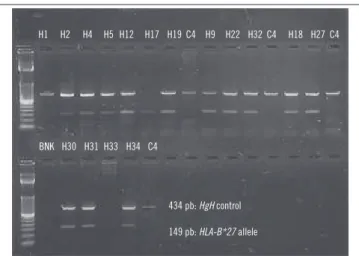
the HLA-B*27 were poorly visible. Modiications and sequential test were conducted by modifying a test variable to reach the best reaction condition, which is composed of: 12.5 μl buffer, 4 μl MgCl2, 2.5 μl dNTP, 1.5 μl primers, 1 μl primers of HgH gene and 1.25 μl Taq. Moreover, cycling conditions were also changed to improve the visibility of the bands in the agarose gel, reaching the optimum ile of: initial denaturation at 94ºC for 5 minutes, 30 cycles at 94ºC for 40 seconds, 64ºC for 1 minute, 72ºC for 1 minute and inal extension at 72ºC for 10 minutes. The Figure shows the pattern of bands obtained using the inal mix, standardized.
From the standardization, the HLA-B*27 alleles were tested
and all subtypes were ampliied by PCR-SSP. Table 3 shows the
results. One hundred percent of sensitivity and speciicity were obtained, there was no false positive or negative result.
The conditions of the reaction used were described by
Parasannanavar et al. (2013)(47) with modiications. The tests were
initiated at the following conditions: 1 μl buffer, 0.5 μl magnesium chloride (MgCl2), 0.5 μl deoxyribonucleotide phosphates (dNTP), 2.5 μl primers and 0,5 μl Taq, this volume was used for ive samples. The ampliications were performed in a thermocycler (Veriti 96 Well Thermal Cycler, Applied Biosystems) at settings: initial denaturation at 94ºC for 5 minutes, 30 cycles at 94ºC for 1 minute, at 65ºC for 2 minutes, at 72ºC for 1 minute and inal extension at 72ºC for 10 minutes. The ampliication products were subjected to electrophoresis (Electrophoresis Power Supply LPS – 300 V, Loccus Biotecnologia) in 2% agarose gel with 0.5 µg/ml Syber safe and bromophenol blue in 0.5× buffer of tris-borate-EDTA (TBE) at 80 V for 30 minutes. The identiication of bands was performed using a transilluminator (Transiluminador UVB LTB 20 × 20 STV, Loccus Biotecnologia); the band corresponding
to the HgH gene has 434 pb and the positive band for HLA B*27,
149 pb.
BNK H30 H31 H33 H34 C4
FIGURE − Band pattern of positive and negative samples for HLA-B*27 by PCR-SSP in agarose gel with standardized mix
PCR-SSP: polymerase chain reaction-single specific primer; HLA: human leukocyte antigens; H: HLA-B*27 positive; C: HLA-B*27 negative; BNK: blank.
Step ladder: 50 pb.
434 pb: HgH control 149 pb: HLA-B*27 allele
RESUMO
Introdução: Os antígenos leucocitários humanos (HLA) são moléculas que apresentam antígenos ao sistema imune; a presença
ou a ausência deles é descrita como fator influente em algumas doenças. O HLA-B*27 é um polimorfismo do HLA que tem sido associado à maior predisposição à espondilite anquilosante (EA) e a outras espondiloartropatias. A detecção do HLA-B*27 é utilizada como ferramenta diagnóstica e prognóstica nesses casos, assim como no diagnóstico diferencial de outras doenças. Objetivo:
Padronizar a metodologia de reação em cadeia da polimerase-iniciador específico (PCR-SSP) para utilização no Laboratório de Imunogenética da Universidade Estadual de Maringá (UEM), considerando sua especificidade e seu custo-benefício. Material e
métodos: Foram utilizados 30 indivíduos comprovadamente sem EA positivos para o alelo HLA-B*27 e 10 indivíduos negativos,
testados previamente por PCR-oligonucleotídeo específico (PCR-SSO) e, neste estudo, por PCR-SSP. Resultados: Cem por cento dos pacientes testados tiveram seus resultados confirmados, mesmo com diferentes subtipos. Conclusão: Tendo em vista a alta reprodutibilidade e o amplo espectro de subtipos que abrange, concluiu-se que a técnica de identificação de PCR-SSP para o HLA-B*27 pode ser utilizada como auxílio diagnóstico de rotina para espondiloartropatias.
Unitermos: antígeno HLA-B*27; espondilite anquilosante; biologia molecular.
REFERENCES
1. Martinez-Borra J, Gonzalez S, Lopez-Larrea C. Genetic factors predisposing to spondylarthropathies. Arthritis Rheum. 2000; 43(3): 485-92.
2. Rudwaleit M. New approaches to diagnosis and classiication of axial and peripheral spondyloarthritis. Curr Opin Rheumatol. 2010; 22(4): 375-80.
DISCUSSION
Due to the association of the presence of the HLA-B*27 allele
with spondyloarthropathies, the molecular detection requires this allele, which is of utmost importance for both the study and the diagnosis of these diseases. Furthermore, this detection in asymptomatic patients and the research on the risk of patients relatives developing the disease is also essential, that’s because epidemiological studies have shown that 10%-20% of irst-degree relatives of patients with AS have higher risk of developing the
disease(48).
According to Parasannanavar et al. (2013)(47), the methods
used for identiication of HLA-B*27 (microlymphocytotoxicity and low cytometry) are dificult because of the lack of a speciic antiserum and the possibility of false results due to the change on epitopes. Molecular techniques are more sensitive and speciic. The authors tested 90 samples from healthy controls by PCR-SSP and PCR-SSO and found no discrepancy in results between them, data compatible with this study, in which the eficiency of PCR-SSP and
the applicability of the primers used was proven, since all results were consistent with those obtained by PCR-SSO, reaching 100% of speciicity and sensitivity.
The dificulty encountered was the standardization of the DNA concentration to be used, Parasannanavar et al. (2013)(47)
suggest the use of 80-100 ng, and this value is not always obtained. Alternative for DNA extraction methods may be used, such as
salting out method(49), which expects a higher performance, but
requires more time and the use of larger amounts of blood or buffy-coat.
Other authors, such as Frankenberger et al. (1997)(50), also
found that identiication of HLA-B*27 by PCR is reliable and
reproducible, and therefore recommended for the routine, since it overcomes the weaknesses of serology, such as cross-reactivity and
ambiguous results.
It was concluded that the PCR-SSP identiication method can be used as a routine diagnostic aid for spondyloarthropathies. It is a relatively simple, quick, low costly, high sensitivity and speciicity technique.
3. Castro-Santos P, Gutierrez MA, Diaz-Pena R. Genetics of ankylosing spondylitis. Rev Med Chil. 2014; 142(9): 1165-73.
4. International Immunogenetics databases [Internet]. Available at: http://www.ebi.ac.uk/ipd/imgt/hla/stats.html.
5. Thorsby E. HL-A antigens and genes. I. A study of unrelated Norwegians. Vox Sang. 1969; 17(2): 81-92.
7. Brewerton DA. Discovery: HLA and disease. Curr Opin Rheumatol. 2003; 15(4): 369-73.
8. Schlosstein L, Terasaki PI, Bluestone R, Pearson CM. High association of an HL-A antigen, W27, with ankylosing spondylitis. N Engl J Med. 1973; 288(14): 704-6.
9. Zeidler H, Mau W, Khan MA. Undifferentiated spondyloarthropathies. Rheum Dis Clin North Am. 1992; 18(1): 187-202.
10. Allele Search Tool. IMGT/HLA-IPD-EMBL-EBI. [Internet]. Available at: http://www.ebi.ac.uk/ipd/imgt/hla/allele.html.
11. Khan MA, Ball EJ. Genetic aspects of ankylosing spondylitis. Best Pract Res Clin Rheumatol. 2002; 16(4): 675-90.
12. Khan MA. HLA in spondyloarthropathies. In: Mehra NK, editor. The HLA complex in biology and medicine. A resource book. New Delhi: India Jaypee Brother Med Publ Ltd. 2010; p. 259-75.
13. Ankylosing spondylitis. Ankylosing spondylitis. [Internet]. Available at: http://www.hlab27.com/.
14. Van Gaalen FA. Does HLA-B*2706 protect against ankylosing spondylitis? A meta-analysis. Int J Rheum Dis. 2012; 15(1): 8-12. 15. Oostveen J, Prevo R, den Boer J, van de Laar M. Early detection of sacroiliitis on magnetic resonance imaging and subsequent development of sacroiliitis on plain radiography. A prospective, longitudinal study. J Rheumatol. 1999; 26(9): 1953-8.
16. Svejgaard A. PP and LPR. HLA and disease suceptibility: clinical implications. Clin Immunol Allergy 4. 1984; 567-80.
17. Breur-Vriesendorp BS, Dekker-Saeys AJ, Ivanyi P. Distribution of HLA-B27 subtypes in patients with ankylosing spondylitis: the disease is associated with a common determinant of the various B27 molecules. Ann Rheum Dis. 1987; 46(5): 353-6.
18. Khan MA, Kellner H. Immunogenetics of spondyloarthropathies. Rheum Dis Clin North Am. 1992; 18(4): 837-64.
19. Khan MA. Ankylosing spondylitis: introductory comments on its diagnosis and treatment. Ann Rheum Dis. 2002; 61 Suppl 3: iii3-7. 20. Sieper J, Braun J, Rudwaleit M, Boonen A, Zink A. Ankylosing spondylitis: an overview. Ann Rheum Dis. England. 2002; 61 Suppl 3: iii8-18.
21. Zochling J, van der Heijde D, Burgos-Vargas R, et al. ASAS/EULAR recommendations for the management of ankylosing spondylitis. Ann Rheum Dis. 2006; 65(4): 442-52.
22. Van Gaalen FA. Does HLA-B*2706 protect against ankylosing spondylitis? A meta-analysis. Int J Rheum Dis. 2012; 15(1): 8-12. 23. Braun J, Bollow M, Remlinger G, et al. Prevalence of spondylarthropathies in HLA-B27 positive and negative blood donors. Arthritis Rheum. 1998; 41(1): 58-67.
24. Brown MA, Kennedy LG, MacGregor AJ, et al. Susceptibility to ankylosing spondylitis in twins: the role of genes, HLA, and the environment. Arthritis Rheum. 1997; 40(10): 1823-8.
25. Laval SH, Timms A, Edwards S, et al. Whole-genome screening in ankylosing spondylitis: evidence of non-MHC genetic-susceptibility loci. Am J Hum Genet. 2001; 68(4): 918-26.
26. Allen RL, Bowness P, McMichael A. The role of HLA-B27 in spondyloarthritis. Immunogenetics. 1999; 50(3-4): 220-7.
27. Liu X, Hu LH, Li YR, Chen FH, Ning Y, Yao QF. The association of HLA-B*27 subtypes with ankylosing spondylitis in Wuhan population of China. Rheumatol Int. 2010; 30(5): 587-90.
28. Liu Y, Jiang L, Cai Q, et al. Predominant association of HLA-B*2704 with ankylosing spondylitis in Chinese Han patients. Tissue Antigens. 2010; 75(1): 61-4.
29. Garcia-Fernandez S, Gonzalez S, Mina Blanco A, et al. New insights regarding HLA-B27 diversity in the Asian population. Tissue Antigens. 2001; 58(4): 259-62.
30. Gonzalez S, Garcia-Fernandez S, Martinez-Borra J, et al. High variability of HLA-B27 alleles in ankylosing spondylitis and related spondyloarthropathies in the population of northern Spain. Hum Immunol. 2002; 63(8): 673-6.
31. Mou Y, Wu Z, Gu J, et al. HLA-B27 polymorphism in patients with juvenile and adult-onset ankylosing spondylitis in Southern China. Tissue Antigens. 2010; 75(1): 56-60.
32. Meryem A, Noureddine B, Ouafaa MS, et al. HLA-B27 subtypes distribution among moroccan patients with ankylosing spondylitis. Am J Med Biol Res. 2013; 1(1): 28-32.
33. Ball EJ, Khan MA. HLA-B27 polymorphism. Joint Bone Spine. 2001; 68(5): 378-82.
34. Lopez-Larrea C, Sujirachato K, Mehra NK, et al. HLA-B27 subtypes in Asian patients with ankylosing spondylitis. Evidence for new associations. Tissue Antigens. 1995; 45(3): 169-76.
35. Choo SY, Antonelli P, Nisperos B, Nepom GT, Hansen JA. Six variants of HLA-B27 identiied by isoelectric focusing. Immunogenetics. 1986; 23(1): 24-9.
36. Choo SY, Fan LA, Hansen JA. A novel HLA-B27 allele maps B27 allospeciicity to the region around position 70 in the alpha 1 domain. J Immunol. 1991; 147(1): 174-80.
37. Sampaio-Barros PD, Bertolo MB, Kraemer MH, Neto JF, Samara AM. Primary ankylosing spondylitis: patterns of disease in a Brazilian population of 147 patients. J Rheumatol (Canada). 2001; 28(3): 560-5. 38. Reveille JD, Ball EJ, Khan MA. HLA-B27 and genetic predisposing factors in spondyloarthropathies. Curr Opin Rheumatol. 2001; 13(4): 265-72.
39. Koh WH, Boey ML. Ankylosing spondylitis in Singapore: a study of 150 patients and a local update. Ann Acad Med Singapore. 1998; 27(1): 3-6.
40. Londono J, Romero-Sanchez MC, Torres VG, et al. Associação entre os níveis séricos de potenciais biomarcadores com a presença de fatores relacionados à atividade clínica e ao mau prognóstico em espondiloartrites. Rev Bras Reumatol. [Internet]. 2012; 52(4): 529-44. Available at: http://www.scielo.br/pdf/rbr/v52n4/v52n4a06.pdf. 41. Allen RL, Bowness P, McMichael A. The role of HLA-B27 in spondyloarthritis. Immunogenetics. 1999; 50(3-4): 220-7.
42. Conjunto de baixa resolução AllSet+TM Gold B27. Instruções de
43. McGinnis MD, Conrad MP, Bouwens AG, Tilanus MG, Kronick MN. Automated, solid-phase sequencing of DRB region genes using T7 sequencing chemistry and dye-labeled primers. Tissue Antigens. 1995; 46(3): 173-9.
44. Testes de tipagem LABType® SSO. [Internet]. Available at: http:// www.onelambda.com/content/dam/onelambda/en/TDX/Documents/ securedocs/docs/Product_Insert/RSSO-LTYP-PI-PT-00.pdf.
45. Kulkarni B, Mohanty D, Ghosh K. Frequency distribution of human platelet antigens in the Indian population. Transfus Med. England; 2005 Apr; 15(2): 119-24.
46. Nathalang O, Tantimavanich S, Nillakupt K, Arnutti P, Jaruchaimontree C. HLA-B27 testing in Thai patients using the PCR-SSP technique. Tissue Antigens. 2006; 67(3): 233-6.
47. Parasannanavar DJ, Rajadhyaksha A, Ghosh K. Application of a simple in-house PCR-SSP technique for HLA-B* 27 typing in spondyloarthritis patients. Arthritis. [Internet]. 2013. Available at: http://www.ncbi.nlm. nih.gov/pubmed/24490069. PubMed PMID: 24490069.
48. Sérgio Fraco. Bioinforme. HLA-B27. [Internet]. Available at: http://www. sergiofranco.com.br/bioinforme/index.asp?cs=Hematologia&ps=hlab27. 49. John SW, Weitzner G, Rozen R, Scriver CR. A rapid procedure for extracting genomic DNA from leukocytes. Nucleic Acids Res. 1991; 19(2): 408.
50. Frankenberger BL, Breitkopf S, Albert E, et al. Routine molecular genotyping of HLA-B27 in spondyloarthropathies overcomes the obstacles of serological typing and reveals an increased B *2702 frequency in ankylosing spondylitis. J Rheumatol. 1997; 24(5): 899-903.
CORRESPONDING AUTHOR
Jeane Eliete Laguila Visentainer