OR
IGI
N
A
L
R
E
S
E
A
R
C
H
Mailing address: Rodrigo Franco de Oliveira – UNOPAR – Centro de Pesquisa em Ciências da Saúde. Laboratório de Cultura Celular (LACCEL) – Av. Paris, 675 – Jd. Piza CEP: 86041-140 – Londrina (PR), Brasil – E-mail: [email protected] – Presentation: Dec. 2013 – Accepted for publication: Mar. 2015 – Funding Source: Funadesp, Capes Conlict of interest: nothing to declare – Approval by the Ethics Committee on behalf of Universidade Norte do Paraná (UNOPAR), under protocol no. 462.478/2013.
112
ABSTRACT | Within the physiotherapy practice there is a wide use of therapeutic ultrasound for the treatment of various musculoskeletal disorders. The aim of this study was to evaluate the efect of Low Intensity Ultrasonic irradiation with diferents forms of pulse and intensity in cell culture of L929 ibroblasts (ATCC CCL-1 NCTC), in order to check cell viability and deine parameters of dosimetry. For this purpose, it was used the application of pulsed ultrasound with a frequency of 1MHz in cultured ibroblast cells divided into ive groups (control and instantaneous intensity of 0.3W/cm2 - 10%, 0.3W/cm2 - 20%, 0.5W/cm2 - 10% and US
0.5W/cm2 - 20% - 100Hz). Irradiation occurred at intervals
of 24, 48 and 72 hours for two minutes and 24 hours after each irradiation test MTT [3 (4,5-dimethylthiazol) -2,5-diphenyltetrazolium bromide] was performed. Results showed that when comparing the values of viable cells by MTT method in the ive groups, we could not ind statistically signiicant diference in any of them, in these three conditions (24, 48 and 72 hours); while. Whereas, when performing the analysis of repeated measures in the diferent groups, it was found a statistically signiicant diference only in the group irradiated with ultrasound at 0.5W/cm2 with pulse regime of
10% (p = 0.003). Based on these results, it is concluded that the Low Intensity Ultrasonic irradiation in L929 ibroblast cell culture, only in the group with an intensity of 0.5W/cm2
-10% obtained numerical growth, with statistical signiicance in all periods evaluation.
A study developed in the Cell Compartment Dynamics Laboratory of The Health Sciences Research Center of Universidade do Norte do Paraná (UNOPAR) – Londrina (PR), Brazil.
1Physical therapist, graduate degree student in Rehabilitation Sciences from Universidade Estadual de Londrina (UEL)/Universidade
do Norte do Paraná (UNOPAR) – Londrina (PR), Brazil.
2Physical therapist, PhD, and Prof. in the Master’s and Doctorate Program in Rehabilitation Sciences UEL/UNOPAR – Londrina (PR),
Brazil.
3Biologist, PhD, and Prof. in the Master’s and Doctorate Program in Rehabilitation Sciences UEL/UNOPAR – Londrina (PR), Brazil. 4Biologist, PhD, and Full Prof. in Universidade do Vale do Paraíba (UNIVAP) in the Cell and Tissue Biology Department, São José dos
Campos (SP), Brazil.
5Biologist, doctor and full professor of the Vale do Paraíba University (UNIVAP) at the Department of Cell and Tissue Biology – São
José dos Campos (SP), Brazil
6Physiotherapist, doctor and full professor of the Master’s and Doctoral Program of Rehabilitation Sciences – UEL/UNOPAR – Londrina
(PR), Brazil.
Efect of low-intensity pulsed ultrasound
therapy on a ibroblasts cell culture
Efeito da terapia ultrassônica de baixa intensidade em cultura celular de ibroblastos
Efecto del ultrasonido de baja intensidad en cultivo celular de ibroblastos
Priscila Daniele de Oliveira1, Deise A. A. Pires Oliveira2, Cintia Cristina Martinago3,
Regina Célia Poli Frederico4, Cristina Pacheco Soares5, Rodrigo Franco de Oliveira6
Keywords | Dosimetry; Connective Tissue; Cell Culture Techniques; Ultrasonic Therapy
RESUMO | Dentro da prática isioterápica veriica-se a ampla utilização do ultrassom terapêutico para tratamento das diversas afecções musculoesqueléticas. O objetivo deste estudo foi avaliar o efeito da irradiação Ultrassônica de Baixa Intensidade, com diferentes regimes de pulsos e intensidade, em cultura celular de ibroblastos L929 (ATCC CCL-1 NCTC), de modo a veriicar a viabilidade celular e deinir parâmetros de dosimetria. Para isso, utilizou-se a aplicação de ultrassom pulsado, com frequência de 1Mhz, em cultura de células ibroblásticas, divididas em cinco grupos (controle e com intensidade instantâneas de 0,3W/ cm2-10%; 0,3W/cm2 -20 %; 0,5W/cm2 -10% e US 0,5W/cm2
de 10% (p=0,003). Com base nesses resultados, conclui-se que a irradiação Ultrassônica de Baixa Intensidade em cultura celular de ibroblastos L929, somente no grupo com intensidade de 0,5W/cm2-10% obteve o crescimento numérico, com signiicância
estatística em todos os períodos de avaliação.
Descritores | Dosimetria; Tecido Conjuntivo; Técnicas de Cultivo de Célula; Terapia por Ultrassom.
RESUMEN | En la práctica isioterápica se utiliza bastante el ultrasonido como terapia para el tratamiento de diversos trastornos muscoloesqueléticos. Este artículo tiene por objetivo evaluar el efecto de la irradiación ultrasónica de baja intensidad, con diferentes regímenes de pulsos y de intensidades, en cultivo celular de ibroblastos L929 (ATCC CCL-1 NCTC), para veriicar la viabilidad celular y establecer los parámetros de dosimetría. Se utilizó el ultrasonido pulsado, con frecuencia de 1Mhz, en un cultivo de células ibroblásticas, divididas en cinco grupos (con control y con la intensidad instantánea del 0,3W/cm2-10%; 0,3W/
cm2 -20%; 0,5W/cm2 -10% y US 0,5W/cm2 -20 % - 100Hz). La
irradiación se llevó a cabo en intervalos de 24, 48 y 72 horas, durante dos minutos y después de las 24 horas de cada irradiación se realizó la prueba de MTT {Bromuro de [3-(4,5-dimetiltiazol)-2,5-difeniltetrazólio]}. Los resultados mostraron que en la comparación entre los valores de células viables por el método MTT en los cinco grupos evaluados no ha sido posible encontrar ninguna diferencia estadísticamente signiicativa en los tres momentos evaluados (24, 48 y 72 horas). En cambio, al llevar a cabo el análisis de medida repetida en los diferentes grupos, se obtuvo una diferencia estadísticamente signiicativa solamente en el grupo irradiado con ultrasonido a 0,5W/cm2 con el régimen
de pulso del 10% (p=0,003). Basándose en estos resultados se concluyó que la irradiación ultrasónica de baja intensidad en cultivo celular de ibroblastos L929 obtuvo el aumento sólo en el grupo con intensidad de 0,5W/cm2-10%, con signiicancia en
todos los periodos de evaluación.
Palabras clave | Dosimetría; Tejido Conectivo; Técnicas de Cultivo de Células; Terapia por Ultrasonido.
INTRODUCTION
herapeutic ultrasound (TUS) is veriied to be widely used for the treatment of several acute and chronic musculoskeletal illnesses1,2 in the physical
therapy practice, when one oversees the resources which are used in clinical rehabilitation. hat is mainly due to the fact it is a safe method which prevents patients from being exposed to risks from invasive procedures3.
hat method has been present in the clinical practice for more than six decades4. However, Wardejn and
McMeeken5 highlight the lack of scientiic evidence in
regards to its therapeutic efects and to the normalization of its application, and the available articles conirm the contradiction above, concerning standardization and the very tissue healing, as they are short of evidence on the actual biologic efects, action mechanisms, or concrete determination of criteria that are indicated for that kind of treatment4,6,7.
hat shows the importance of constantly investigating its clinical results and studying the relationship between dosages and biological responses, in order to achieve dosimetric consensus for the related physical agent1,8.
After all, as Ishikawa et al.9, point out, the correct
application of 10 TUS is essential, not only to support
the exposure levels which induce signiicant biological repercussion, but also to protect patients. From that
perspective, an array of thermal and non-thermal physiological efects which TUS induces in biological tissues through vibration is found on several studies10.
Considering those efects, one can mention ibroblast activation, increased collagen extensibility and scarring, diminished inlammatory cells (leukocytes and macrophages) through cell metabolism acceleration, protein synthesis, osteogenesis, calcium cycle activation, angiogenesis (with a consequent increase in blood circulation and perfusion), growth factor production, reduced muscular spasms, articular rigidity, and, inally analgesia11-18.
In this context, based on the studies from Zhou et al.19,
TUS efects are highlighted to have a close connection with cell types when applied in vitro, which favors DNA synthesis in periosteum, osteoblasts, and ibroblasts.
Finally, based on the considerations by Johns20, the
relevance of culture cell studies is highlighted when they are correlated with ultrasound action, once they allow complementing in vivo investigations, strictly controlling the countless variables, and also potentializing knowledge in regards to that therapeutic tool.
METHODOLOGY
his study is characterized as experimental, and, in order that it be conducted, ibroblast cells from the connective tissue of mice of L929 lineage (ATCC CCL-1 NCTC) were used. hey were provided by Instituto Adolfo Lutz (SP), Brazil. he study was approved by the Ethics Committee of Universidade Norte do Paraná (UNOPAR), under protocol no. 462,478/2013.
Cell Culture
L929 ibroblast cells were routinely cultivated in 25cm2 dishes (TPP, Switzerland, Europe) with MEM
(Minimum Essential Medium, Gibco® – Invitrogen Corporation, GradIsland, USA) that was supplemented with 10% fetal bovine serum (Cultilab, Brazil) and 1% antibiotic (Gibco®, by Life Technologies). Cells were kept in a CO2 incubator, in a 5% atmosphere at 37°C (hermo Forma Scientiic, Waltham, MA). he cells used in this experiment followed the usage recommendations for in vitro toxicity tests iguring in ISO 10993-5.
Ultrasound
Ultrasound irradiation was conducted with a device of brand KLD® – (Biossistemas Equipamentos Eletrônicos Ltda.), model Avatar III, with a 1MHz transducer, BNR (beam nonuniformity ratio) ≤6, and with a 1cm2 efective radiation area (ERA). he
equipment was properly calibrated by the manufacturer.
Irradiation
After the culture became conluent, trypsinization was conducted in the 12-well TPP dishes with 24 cm in diameter and 18 mm in depth, in a 1x10⁶ cells/mL
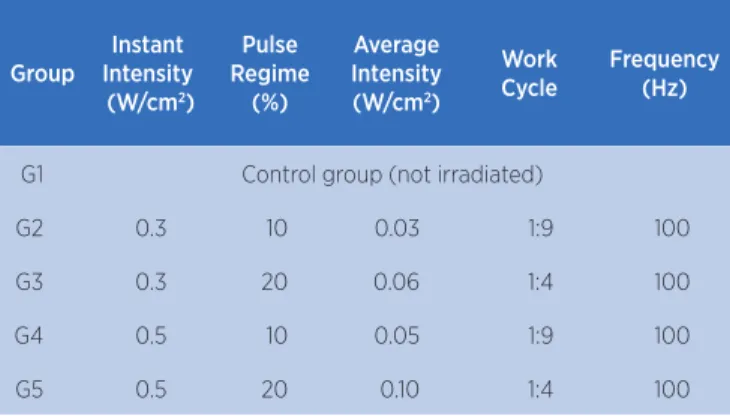
density. Following that, cells were left sedimenting for 24 hours (overnight). After that, the intervention in 24, 48, and 72-hour intervals was started, by observing the following separation among groups (Table 1):
In order to get good coupling of the ultrasound interface (cell layer away from the 18 mm transducer) and mechanical wave propagation, the well volumes were filled up with MEM medium up to their rims, and each well was irradiated and always kept in the same position in regards to the ultrasound transducer face.
Table 1. Description of experiment groups and respective dosimetries
Group
Instant Intensity (W/cm2)
Pulse Regime
(%)
Average Intensity (W/cm2)
Work Cycle
Frequency (Hz)
G1 Control group (not irradiated)
G2 0.3 10 0.03 1:9 100
G3 0.3 20 0.06 1:4 100
G4 0.5 10 0.05 1:9 100
G5 0.5 20 0.10 1:4 100
In regards to the application time, the irradiation for conducted at room temperature for 2 minutes in each well, in the 24, 48, and 72-hour intervals, without the dish being heated. All experiments were conducted in triplicate, and, after each period, cultures had their cell viability evaluated through MTT toxicity test.
Cytotoxicity test through MTT
he cytotoxicity was tested for through MTT 3-(4,5-dimethylthiazol-2-yl)-2,5-diphenyltetrazolium bromide assay. L929 cell cultures received ultrasound irradiation in the 24, 48, and 72-hour intervals. MTT assays were conducted 24 hours after each irradiation, according to the following procedure: after the MEM medium was removed, each well received 80 μL MTT, in a inal 0.5mg/mL concentration, and was incubated for 1 hour at 37°C, in a 5% CO2 atmosphere; then, 400μL dimethyl sulfoxide (DMSO) was added to each well. Dishes were kept under agitation for 30 minutes, for formazan crystals to be solubilized. heir concentrations were spectroscopically quantiied through a microplate reader (ELISA Reader – Spectra Count – Packards Instrument, Ofeburg – Germany), in a 570nm wavelength.
STATISTICAL ANALYSIS
in between evaluations. SPSS, version 20.0 software was used in the statistical analysis, whose conidence interval was 95%, and values of p<0.05 were considered to be statistically signiicant.
RESULTS
No statistical signiicance was found among the viable cell values and the groups (G1=control, G2=0.3−10%, G3=0.3−20%, G4=0.5−10%, and G5=0.5−20%) through MTT method, in the three evaluated times (24, 48, and 72-hours) (Figure1).
When the repeated measure analysis was conducted in the diferent groups, statistic signiicance was only found in the group that was irradiated with 0,5W/ cm2 ultrasound with a 10% pulse regime (p=0.003).
In that group, cell viability speed was increased from 24 to 48 hours, from 48 to 72 hours, and from 24 to 72 hours.
However, despite the low number of evaluated samples, it is important to mention certain diferences in absolute values, concerning cell viability, especially in group G3, which was irradiated with 20% pulsed ultrasound in a 0.3W/cm² intensity, which may suggest that, even though no statistically signiicant diferences had been found in all experimental groups, a considerable growth took place in the number of irradiated cells. Such fact allows understanding that ultrasound has not operated in a harmful way to cells, and the numbers in no groups were decreased, as the ibroblasts remained inert to the ultrasound action, because all groups experienced growth in their total values (Figure 1).
◊ statistically signiicant diferences between the irst and second evaluations (24/48 hours) * statistically signiicant diferences between the second and the third evaluations (48/72 hours)
●statistically signiicant diferences between the irst and the third evaluations (24/72 hours)
Figure 1. Cell viability comparison among groups at the diferent evaluated times.G1-not irradiated; G2- received US 0.3 W/cm2
irradiation (10%); G3- irradiated with US 0.3 W/cm2 (20%);
G4- group irradiated with US 0.5 W/cm2 (10%), and G5- US 0.5 W/cm2 (20%) 24 Hours
Time
P
er
cen
tage of c
ell pr
olif
er
a
tion
Viability X Time
0 100 200 300 400
G1-Control
48 Hours 72 Hours
G1 G2 G3 G4 G5 G1 G2 G3 G4 G5 G1 G2 G3 G4 G5
G1-0.3 W/cm2-10%
G3-0.3 W/cm2-20%
G4-0.5 W/cm2-10%
DISCUSSION
According to Silva et al.16, the therapeutic efects of
ultrasound do not depend exclusively on the intensity, mode of emission, and frequency, but they are also directly subject to the intervention duration. In this study, the therapeutic application time was standardized in two minutes, based on the conclusion from Oliveira et al.21, who conirmed increase cell viability with this
same application protocol.
In regards to the pulsed emission mode that was used, it corroborates indings from Cunha et al.,22,
who regard the related modality to be more eicient than the one of continuous pulse. hat fact, within the process of tissue repair in rats, signaled optimization in the organization and aggregation of collagen iber bundles, as the continuous work cycle was found to show disorganization in the material, as an example of a harmful efect in the healing.
Lirani-Galvão et al.23 and Hsieh24 report that pulsed
ultrasound has a relevant behavior, which related to therapeutic efects such as: increased permeability, membrane and intracellular calcium difusion.
In turn, the beneits of 0.5W/cm2 dosage (pulsed at
10 and 20%, and instant intensity) that were also found in our results may also be linked to the association of athermal efects, which could be responsible for the related stimulation in the transportation of substances and modiied cell membrane permeability25.
he indings in this experiment also reinforce the studies by Demir et al.26, in which the therapeutic
ultrasound has been shown to be eicient in the stimulation of ibroblast cultures, with intensities between 0.1 and 0.5W/cm², making the inlammatory phase of healing quicker. Likewise, Lowe et al.27 and
Oliveira et al.28 also conirmed their efectiveness in the
healing phase, using ultrasound dosages with intensities of approximately 0.5W/cm2in pulsed modes (10 and
20%−100Hz) and 1MHz frequency.
On the other hand, when using the 0.3 W/cm2
intensity (pulsed at 10% and 20%, 100Hz frequency, and instant intensity) in order to highlight the non-thermal action TUS, the employed dosage may not have been enough to cause signiicant biophysical implications, as they are intensity-dependent29.
Also, one may mention that Lim et al.30, in an
odontoblast culture, veriied increased cell viability when it is associated to low-intensity pulsed ultrasound therapy (1MHz, 0.5W/cm2, pulsed at 20% and 50%)
in 10 minutes of intervention. hus, the ultrasound application time (two minutes) in groups 0.3W/cm2
(pulsed at 10% and 20$, with 1MHz frequency, and instant intensity) may not have been enough to promote biomodulatory responses.
his way, other studies on those subjects differ in some aspects from our results, and they discuss the increased bone metabolism in rats (with a 0.3W dosage and 1MHz frequency)14,17, or the increased
number of fibroblasts and collagen alignment through the use of pulsed ultrasound (20%) at a 0.5W/cm²13 intensity.
However, it is important to point out authors who have not obtained stimulatory results - such as Artifon et al.25, with the 0.5W/cm² group in the soleus
muscles of rats, and Frasson et al.31, who have not
veriied increased numbers of ibroblast cells or blood capillaries in calcaneus tenectomies, when pulsed TUS is applied (20% with intensities of 0.3W/cm2 and
1.5W/cm2).
In that context, cell culture also contributes to their indings, by pointing out that ultrasound efects are correlated to the parameters used and to the cell type, and it is capable of ensuring the proliferation of ibroblasts21, osteoblasts32, and chondrocytes33.
Corroborating such statements, other in vitro
studies say that, after diferent incubation periods (24, 48, and 72 hours), cell viability, as analyzed by MTT method, was not found to have signiicant diferences15.
Likewise, Bohari et al.34 found the same results in
regards to a ibroblast culture.
his way, we point out that in our study it was possible to verify that, the same way as Artilheiro et al.15,
cell numbers were increased as expected. Even though that increase has not been signiicant in all groups, TUS has not caused cell viability to be inhibited.
Finally, through the therapeutic advances that are based on technological developments taking place in the last few years, ultrasound became a resource with promising results in scar healing; that is related to the fact that increased release of growth factors takes place through the granulation of platelets, mast cells, and macrophages during the initial inlammatory phase of healing.
CONCLUSION
Based on the results from this study, 0.3 W/cm2
(10%−20%) and 0.5W/cm2 (20%) low-intensity pulsed
ultrasound irradiation can be concluded to percentually increase cell viability in an L929 ibroblast culture. In turn, only the group with 0.5W/cm2 (10%) treatment
obtained numerical growth with statistic signiicance in all evaluation periods (24, 48, and 72 hours).
REFERENCES
1. Robertson VJ, Baker KG. A review of therapeutic ultrasound: efectiveness studies. Phys Ther. 2001;81(7):1339-50.
2. Lopes LG, Bertolini SMG, Martins EER, Gewehr PM, Lopes MS. Análise morfométrica de tecido muscular de coelhos submetido a ultra-som pulsado e contínuo de 1 MHz I. Fisioter Pesq. 2005;12(3):15-21.
3. Rutten S, Nolte PA, Guit GL, Bouman DE, Albers GH. Use of low-intensity pulsed ultrasound for posttraumatic nonunions of the tibia. J Trauma. 2007;62:902-8.
4. Farcic, TS, Lima RMB, Machado AFP, Baldan CS, Vilicev CM, Esteves JI, et al. Aplicação do ultrassom terapêutico no reparo tecidual do sistema musculoesquelético. Arq Bras Cienc Saúde. 2012;37(3):149-53.
5. Warden SJ, Mcmeeken JM. Ultrasound usage and dosage in sports physiotherapy. Ultrasound Med Biol. 2002;28(8):1075-80.
6. Demir H, Menku P, Kirnap M, Calis M, Ikizceli I. Comparison of the efects of laser, ultrasound, and combined laser ultrasound treatments in experimental tendon healing. Lasers Surg Med. 2004;35(1):84-9.
7. Lirani-Galvão AP, Jorgetti V, Silva OL. Comparative study of how low-level laser therapy and low-intensity pulsed ultrasound afect bone repair in rats. Photomed Laser Surg. 2006;24(6):735-40.
8. Olsson DC, Martins VMV, Pippi NL, Mazzanti A, Tognoli GK. Ultra-som terapêutico na cicatrização tecidual. Cienc Rural. 2008;38(4):1199-207.
9. Ishikawa NM, Alvarenga AV, Paes LFC, Pereira WCA, Machado JC. Análise do desempenho de equipamentos de ultra-som para isioterapia. Rev Bras Fisioter. 2002;6(2):63-9.
10. Itakura DA, Magas V, Neves EB, Nohama P. Alteração da temperatura nos tecidos biológicos com a aplicação do ultrassom. Fisioter Mov. 2012;25(4):857-68.
11. Carvalho DCL, Cliquet JRA. A ação do ultra-som terapêutico de baixa intensidade em ossos de ratas osteopênicas. Acta Ortop Bras. 2003;11(1):17-24.
12. Olsson DC, artins VMV, Martins E, Mazzanti A. Pulsed and continuous ultrasound stimulation in rats healing celiotomy. Cienc Rural. 2006;36(3):865-72.
13. Yeung CK, Guo X, Ng YF. Pulsed ultrasound treatment accelerates the repair of Achilles tendon rupture in rats. J Orthop Res. 2006;24(2):193-20.
14. Freeman TA, Patel P, Parvizi J, Antoci Jr V , Shapiro IM. Micro-CT analysis with multiple thresholds allows detection of bone formation and resorption during ultrasound-treated fracture healing. J Orthop Res. 2009;27(5):673-9.
15. Artilheiro PP, Oliveira EN, Viscardi CP, Martins MD, Busadori SK, Fernandes KPC, et al. Efeitos do ultra-som terapêutico contínuo sobre a proliferação e viabilidade de células musculares C2C12. Fisioter Pesq. 2010;17(2):167-72.
16. Silva JMN, Carvalho JP, Moura Júnior MJ, Arisawa ELS, Martin AA, Sá HP, et al. Estudo da ação do ultrassom terapêutico em modelo experimental de tendinite em ratos Wistar. Conscientiae Saúde. 2010;9(4):625-32.
17. Oliveira P, Sperandio E, Fernandes KR, Pastor FAC, Nonaka KO, Renno ACM. Comparison of the efects of low-level laser therapy and low-intensity pulsed ultrasound on the process of bone repair in the rat tíbia. Rev Bras Fisioter. 2011;15(3):200-5.
18. Bertolini GRF, Silva TS, Ciena AP, Artifon EL. Comparação do ultrassom pulsado e contínuo no reparo tendíneo de ratos. Fisioter Pesq. 2012;19(3):242-7.
19. Zhou S, Schmelz A, Seuferlein T, Li Y, Zhao J, Bachem MG. Molecular mechanisms of low- intensity pulsed ultrasound in human skin ibroblasts. J Biol Chem. 2004;279(52):54463-9. 20. Johns LD. Nonthermal efects of therapeutic ultrasound:
the frequency resonance hypothesis. J Athl Train. 2002;37(3):293-9.
21. Oliveira AAP, Oliveira RF, Soares CP. Comparação do efeito da terapia laser de baixa potencia e irradiação ultra-sônica pulsada de baixa intensidade in vitro. Conscientiae Saúde. 2008;7(4):457-62.
22. Cunha A, Parizotto NA, Vidal BC. The efect of therapeutic ultrasound on repair of the Achilles tendon (Tendo Calcaneus) of the rat. Ultrasound Med Biol. 2001;27(12):1691-6.
23. Lirani-Galvão APR; Jorgetti V, Silva OL. Comparative study of how low-level laser therapy and low-intensity pulsed ultrasound afect bone repair in rats. Photom Laser Surg. 2006;24:735-40.
24. Hsieh YL. Efects of ultrasound and diclofenac phonophoresis on inlammatory painrelief: suppression of inducible nitric oxide synthase in arthritic rats. Phys Ther. 2006;86(1):39-49. 25. Artifon EL, Ferrari D, Cunha DM, Nascimento CM, Ribeiro LFC,
Bertolini GRF. Efeitos do ultrassom terapêutico associados ao alongamento estático sobre parâmetros morfométricos longitudinais de sóleo imobilizado de rato. Rev Bras Med Esporte. 2012;18(5):341-4.
26. Demir H, Yaray S, Kirnap M, Yaray K. Comparison of the effects of laser and ultrasound treatments on experimental wound healing in rats. J Rehabil Res Dev. 2004;41(5):721-8.
27. Lowe AS, Walker MD, Cowan R, Baxter D. Therapeutic ultrasound and wound closure: lack of healing efect on x-ray irradiated wound in murine skin. Arch Phys Med Rehabil. 2001;82(11):1507-11.
28. Oliveira RF, Oliveira DA, Monteiro W, Zangaro RA, Magini M, Soares CP. Comparison betweenth efect of low level laser therapy and low intensity pulsed ultrasonic irradiation in vitro. Photomed Laser Surg. 2008;26(1):6-9.
29. Franco AD, Pereira LE, Groschitz M, Aimbire F, Martins RABL, Carvalho RA. Análise do efeito do ultra-som no edema inlamatório agudo. Fisioter Mov. 2005;18(2):19-24.
31. Frasson NFV, Taciro C, Parizotto NA. Análise nanoestrutural da ação do ultra-som terapêutico sobre o processo de regeneração do tendão de ratos. Fisioter Pesq. 2009;16(3):198-204.
32. Wu S, Kawahara Y, Manabe T, Ogawa K, Sasaki A, Yuge L. Low-intensity pulsed ultrasound accelerates osteoblast diferentiation and promotes bone formation in an osteoporosis rat model. Pathobiology. 2009;76(3):99-107. 33. Miyamoto K, An HS, Sah RL, Akeda K, Okuma M, Otten L,
et al. Exposure to pulsed low-intensity ultrasound stimulates
extracellular of bovine intervertebral disc cells cultured in alginate beads. Spine. 2005;30(21):2398-405.
34. Bohari SPM, Grover LM, Hukins DWL. Pulsed-low intensity ultrasound enhances extracellular matrix production by ibroblasts encapsulated in alginate. J Tissue Eng. 2012;3(1):1-7.