BOLETÍN
de la
(REVISTA MENSUAL) *
AVISO-Aunque por de contado despliégase el mayor cuidado en la selección de los trabajos publicados in toto o compendiados. sólo los autores son solidiwios de las
ophiones
vertidas. a menos que conste espl&itamente lo contrario
Año 28 Enero de 1949 No. 1
EVALUATION OF NEW DRUGS IN THE TREATMENT OF RICKIXTTSIAL DISEASES*
By J. E. i%ADEL, M.D.
Department of Virus and Rickettsial Diseases, Army Medical Department, Research und Graduate Xchool, Army Medical Center,
Washington, D. C.
The treatment of the rickettsial diseases of man was thoroughly reviewed by Dr. J. C. Snyder at the Symposium on Rickettsial Diseases held under the auspices of the Ameritan Association for the Advance- ment of Science in Boston in December 1946 (1). The present discus- sion will be limited essentially to developments in this field since 1946; Snyder’s article should be consulted for referentes to the earlier work. Only those observations made prior to 1946 which bear directly on recent investigations and current usages will be mentioned in any detail. A brief unannotated summary of the earlier literature follows.
There is considerable uniformity of opinion that some beneficial effect is obtained by treatment of early cases of epidemic typhus, murine typhus and spotted fever with adequate amounts of potent speciiic antiserum. On the whole, however, the employment of this method of therapy has not provided results which are especially en- couraging. Indeed, in the last few years relatively little has been added to this segment of the field. _
* The articles appearing on pages 1 to 60 are a continuation of the scientific papers submitted to the VI Pan Ameritan Conference of National Directors of Health, held in Mexico City, from Oct. 4 to 7, 1948. See BULLETIN for Dec. 1948, pp. 1105-1164; and Nov. 1948, pp. 998-1056.
2 PAN AMERICAN SANITARY BUREAU [Januar g
I
As the antibiotics became available they have been employed in experimental and clinical rickettsial infections. Penicillin showed some promise in experimental infections with murine typhus but clinical trials with this antibiotic showed it to be of no value in epidemic typhus, scrub typhus, Q fever, and of little orno value in spotted fever. Pinker- ton and his co-workers, who in 1944 reported the efficacy of this anti- biotic in infected eggs and mice, have recently stated that they were unable to repeat their results with the commercial penicillin subse- quently available. They (2) now find penicillin X the most active rickettsiastatic substance of the crystalline penicillin fractions tested and believe that their earlier irregular results were due to variations in the amounts of this and other fractions in the materials available in 1944. In view of these current findings they suggest that the use of penicillin in the treatment of rickettsial diseases deserves further con- sideration. It may well be, however, that the recent advances in the antibiotic field have swept beyond the point where a reconsideration of the penicillins in the treatment of typhus is warranted. Streptomycin possesses some beneficial effect in experimental infections with severa1 of the rickettsial agents but its activity is so slight that it is not likely to be of much value in the treatment of rickettsial diseases of man. Both penicillin and streptomycin are clearly indicated for treating certain bacteria1 complications which develop in rickettsial infections. We shall return later in the talk to a discussion of the newer antibiotics.
A large number of drugs were tested for their activity in the ricket- tsioses during and immediately prior to the war years. These fe11 into severa1 broad groups including the sulfonamides, the acridines and thiazine compounds, and para-aminobenzoic acid. Certain of these, such as the sulfonamides, were of no value. Others, including two with the para-sulfamidobenzamide structure, were sufficiently promising in experimentally infected animals to be tested in patients with epidemic typhus before being discarded. Similarly, certain of the quinolines and acridines, notably sontoquin and nitroacridine, showed some prom- ise but conclusive evidente of their usefulness in patients has not been forthcoming. Severa1 of the thiazine compounds, especially methylene blue, were effective under experimental conditions but were unsatis- factory in treating patients with scrub typhus. As a result of these various trials, the physician in 1946 and 1947 was left with only one useful drug for the treatment of rickettsial diseases, namely, para- aminobenzoic acid.
t
l-WI RICKETTSIAL DISEASES 3
b
-i
Figure 1 illustrates the results obtained in one of the early experi- me& of Hamilton and his colleagues (4) in which embryonated eggs infected with R. prowazeti were treated with para-aminobenzoic acid. It is evident from this figure that the lives of embryos inoculated with 4 mg. of para-aminobenzoic acid immediately prior to infection were
FIGURE 1
p-AUISOBENZOIC ACID AND.TYPIWS RICKEIISIAE
IU0
r
(Reproduced from Proc. Soc. Exp. Biol. & Med., Hamilton et aI, referente (4))
prolonged. Between 1942 and 1946 a number of Iaboratories studied the rickettsiostatic effect of para-aminobenzoic acid under varying experimental conditions and found the drug to have an inhibitory effect on ehe growth of most of the rickettsial agenes (see literature cited by r Snyder (1)).
4 PAN AMERICAN SANITARY BUREAU [January
but observed no benefit when treatment was begun later than the eighth day.
‘,
FIGURE 2.-Comparison of the Clinical Severity of Forty-Four “Untreated” Cases and Seventeen Cases Treated with Para-Aminobenzoic Acid in Groups
1 and B Combined
Number and Percentage of Patients in Each Classification -
B C D E F
~-- _____ 4.
44 “untreated” caBes . . .
(2;) (2& (4k (l& (188%) :
17 cases treated with para-amino- benzoic acid. . . . ll
(65%) (23;) (1&
0 0 .-
(Reproduced from Jour. Am. Med. Assn., Yoemans et al, referente (5))
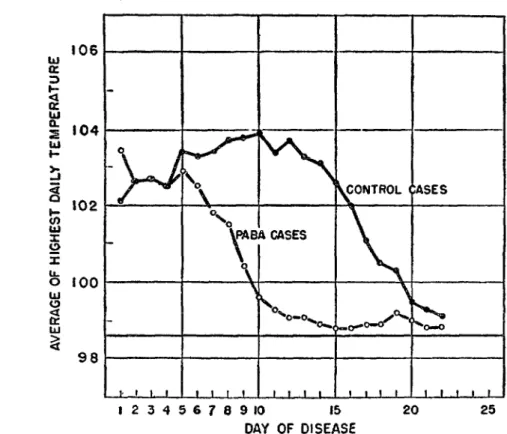
The efficacy of para-aminobenzoic acid in the treatment of patients with scrub typhus was reported by Tierney (6) in 1946. A summary of the average daily temperatures of 16 untreated and 18 treated patients of his is given in Figure S. It is evident that the temperature curves were favorably influenced by the drug.
Results which may be expected with the use of para-aminobenzoic acid in a given patient with scrub typhus are illustrated in Figure 4. This individual, a 52 year old Chinese woman, was treated this spring by the U. S. Army team in Malaya. Treatment was begun late on the seventh day when the temperature was between 103” and 104” F. Dur- ing the subsequent four days she received daily amounts of 25 to 30 grams of para-aminobenzoic acid and maintained a blood leve1 of 25- 50 mg.%. Her temperature returned to normal on the tenth day but did not remain at a permanently normal leve1 until after the 12th day. This individual had circulating rickettsiae at the time treatment was begun and still had rickettsemia two days later.
Para-aminobenzoic acid has continued to be used with favorable results in the treatment of murine typhus (7) and spotted fever (8).
It is not the purpose to discuss here the indications and contra-in- dications for the clinical use of para-aminobenzoic acid or to spend time on the methods of administration. Suffice it to say that if the drug is employed, it should be used boldly and blood levels of 20-50 mg.% should be maintained until the temperature approaches normal.
WOI RICKETTSIAL DISEASES 5 r.
of the compounds closely related to para-aminobenzoic acid have an appreciable therapeutic effect.
1 wish to discuss in some detail the very recent developments in the rickettsial field which have resulted from the introduction of the new antibiotic Chloromycetin. Dr. Paul R. BurkhoIder of Yale University, while working with a mold recovered from a soil specimen from Vene-
FIGURE 3.-Comparz’son of the average of the highest Fahrenheit temperature each
day in 16 control cases of scrub typhus and 18 cases treated with para-amino- benzoic acid (PABA).
12345678910 15 20 25
DAY OF DISEASE
(Reproduced from Jour. Am. Med. Assn., Tierney, N. A., referente (6))
6 PAN AMERICAN SANITARY BUREAU [January
Parke, Davis and Company indicated that the new antibiotic possessed rickettsiostatic properties when tested in embryonated eggs infected with R. prozouzelc2 (9, 10). Crystalline material was supplied to the Department of Virus and Rickettsial Diseases at the Army Medical
104 -
1 E U 102 - P D E G IOO - F
98 -
BLOOD LEVEL MG “fo
P A e A
DOSE 50 40 30 20 10 0 1
FIGURE 4
PATIENT P2, FENIALE. AGE %?
130 LB. A
t
4 ---
CM /DAY
DAY OF DISEASE
++ t+ +c+ ++ + + + + +
wac <THou~A~WS) 06 9.7 1.0
WJI RICKETTSIAL DISEASES
FIGURE 5
Rickettsiostatic Effect of Drug in &bqonated
ERRE! Infected with R. orientalis
I-
- Control /’
---- 0.125 mg. uf’
--- 0.25 mg.
f
-- 0.50 mg. ;
-h-- 1.00 mg. / , : /'
-laY ln Treatment vith 0.25 uqi@/e&
- Control - 6 hour pre -- 24 hours post ---- 48 hours post
Day of I?eath
FIGURE 6
RICKETTSPOSTATIC EFFECT QF CHLOROMYCETIH
ì
IN EMBRYONATED EGGS INFEcTED WITH R.EiluRMETl
66
7Q
: 60
Pi 50
N 40
T
30
c
il 20
U
60
VARIQU8 DOSES
- CONTROL
--- 0.25 MG --- 0.56 MG -VS---- 1.00 MG
WI-W 6.8 MG FTW EGG
4 5 6 7 6 9 60
IIJanuarg lO.@] RICKETTSIAL DISEASES 9 +
Figure 5 summarizes a series of experiments in which embryonated eggs were infected with the agent of scrub typhus and were treated with r varying amounts of drug. It is apparent from the figure at the top of
the illustration that as little as 0.125 mg. of Chloromycetin per egg was sufficient to prolong the life of the infected embryos. When the dose ;+ was increased to 1.0 mg. per egg, the lives of the infected embryos were greatly extended, indeed, two-thirds of them survived to hatching time. In this experiment the drug mas given one-half hour before the eggs ‘. were inoculated with infectious material. In the experiment sum-
maized in the graph at the bottom of illustration al1 four groups of eggs were treated with 0.25 mg. per egg but the drug was given at vary- ing times. The data clearly indicate that under these conditions the .$
prolongation of life of the embryos was essentially the same whether the drug was given immediately before infection or 48 hours after.
Figure 6 illustrates the results obtained in embryos infected with the agent of Q fever. R. burneti appear to be less susceptible to the drug *
than any of the other rickettsiae tested. Thus, in order to obtain an appreciable prolongation of life of the embryos, it was necessary to increase the dose of drug to one mg. per egg. With this agent as with the others, however, delays up to 48 hours in administering adequate amounts of the drug elicited the same effect as obtained when the drug was given immediately prior to infection.
Data on the activity of the new antibiotic against four additional c rickettsiae are summarized in Figure 7. Here the information is pre-
sented in a slightly different manner. The dose of drug is indicated along the ordinate and the average number of days which life was prolonged in each treated group over the average life of the control group is indicated along the abscissa. It is apparent that in the range of doses employed in experiments carried out with the agents of murine typhus, epidemic typhus, spotted fever and rickettsialpox the prolonga- tion of life of embryos is related directly to the dose of the drug.
10 PAN AMERICAN SANITARY BUREAU [January
of infected mice were given the drug by the oral route, here too either al1 of the mice or the majority of them survived. The experiment sum- marized at the bottom of the illustration is of particular interest since treatment was begun in various groups of animals from one to ten days after infection. Al1 mice which received 2.5 mg. per day beginning five
FIGURO 7
l . s * I
0 I 2 3 4 5 6 7 6
- ROCKY MOUNTAIN
SPOTTED FEVEW ---- RICKETTSIALPOX
I I I I I I 8
0 1 2 3 4 5 6 7 8
W.91 RICKETTSIAL DISEASES ll
to save the majority of the animals even when treatment was delayed until five days after infection but not when the drug was withheld until the eighth day. During the course of the above work it was found that the drug in the doses used elicited no toxic signs or obvious pathological ‘. lesions in normal mice.
FIGURE S.-Chemotherapeutic Effect Obtained in Mice Infected with R. orientalis
1
2
Ig./day/mouse Route
Controls 2.5 1.5 0.75 0.5 0.25 0.10
Injected intra- peritoneally
5.0 5.0 3.0 1.5
Fed in water
Controls 2.5 2.5 2.5 2.5 0.75 0.75 0.75 0.75
Injected intra- peritoneally
Treatment
Day begun in relation to
infection
1 post 1 post 1 post 1 -post 1 post 1 post 1 pre 2 post 1 pre 1 pre
1 post 5 post 8 post 10 post 1 post 5 post 8 post 10 post
ll
_- - - -- -- -Xution of infectious inoculum
10-s G3 018 ‘VS 2/8 5/8 5/8 3/8 W Uf3 W7 1/8 7/8 Oh3 Oh3 l/8 3/8 W8 2/8 w 7/8 10-s
7/8 318
(Reproduced from Science, Smadel and Jackson, referente (13 a.)) 101
2/7
12 PAN AMERICAN SANITARY BUREAU [January
et al (10). At this stage in the work our colleagues at the Instituto de Salubridad y Enfermedades Tropicales in Mexico City invited a group from the Army Medical Department Research and Graduate School to study the usefulness of Chloromycetin in the treatment of patients with typhus fever in Mexico. We were most happy to accept this invitation.
7 E 40 Y p. 39 E G. =' c 37
120 P :: ‘Oo g 80 60
I.‘..‘.‘I*~ll~ll~ll~J
12345678 9 10 II 12 13 14 15 16 II 18 19 20
DAY OF DISEASE
RASH ++ ++++ + 0 0 0
LEONS TEST ,I “>
wac (X 1000) 124 10.4 7.6 7.3 10.7
(Reproduced from Proc. Soc. Exp. Biol. and Med., Smadel et al, referente 15)
1Wl RICIZETTSIAL DISEASES 13
the serological data presented at the bottom of the illustration that this person suffered from epidemic typhus. The temperature curve at the top of the chart shows a prompt drop following the administration of Chloromycetin. Your attention is called to the fact that the amount of drug given here was considerably less than the dosage employed in subsequent studies on scrub typhus in Malaya. Furthermore, the maximal blood leve1 was only 10 gamma per CC. and this was maintained for a relatively short period.
The studies in Mexico provided encouraging results and the data ob- tained enabled us to progress rapidly in subsequent work. Neverthe- less, the conclusive demonstration of the efficacy of Chloromycetin in the treatment of typhus fevers had to await the results of careful tests on a larger number of patients than were available during January in Mexico City. During the time the studies were being carried on at the Instituto de Salubridad y Enfermedades Tropicales, Dr. Payne and his collabora- tors were employing the drug on a group of cases of epidemic typhus in Bolivia (16). Although their dosages were somewhat smaller and the patients were followed less closely than in Mexico, they treated a larger number of patients. Their general conclusions were that the drug was an effective chemotherapeutic agent.
Arrangements for a clinical trial of the new drug in the treatment of patients with scrub typhus were completed late in 1947 and a group of investigators under the auspices of the U. S. Army visited Malaya during the spring and summer of 1948 and worked with the members of the Institute for Medical Research at Kuala Lumpur. The following illus- trations summarize certain phases of this work (17).
Figure 10 presents the íindings in the first patient with scrub typhus who was treated with Chloromycetin. The drug was begun on the fifth day with an initial oral dose of 40 grams and continued at 0.25 grams every two hours. The temperature returned to normal within 24 hours and the pulse rate which had been elevated during the fever likewise promptly dropped to normal. In this individual the blood leve1 of Chloromycetin was approximately 25 gamma per CC. shortly after ther- apy was begun and on the three succeeding days ranged between 10 and 20. As the daily dose of drug was diminished, the blood leve1 dropped until none was detectable on the tenth day immediately before the drug was stopped. This patient had a rash and an eschar. R. tsutsugamushi were isolated from his blood at the time treatment was begun and on the following day shortly after the temperature became normal. During convalescence the Weil-Felix reaction with the OX-K organism rose from 80 to 5,000. The f?ndings in this case are typical of those encountered in other treated patients.
14 PAN AMERICAN SANITARY BUREAU [January
P u L S E
FINRE 10
PATIENT 1, MALE, AGE 26 120 LB.
C H k
BLOOD LEVEL R T/CC 0 M Y c
30
30
10
0 Ib-l
E T i
N DOSE
GM~DAY
DAY OF DISEASE
I
RASH +++ ++ + 0 0 ISR ‘04,,. ‘oo,,o ‘a,,l ‘Q4& ‘V,o ‘O’/,a “%O “‘17.
WBC CTHOUSANDS) 6.0 7.2
1 RSC &%LIONS) 4.0 4.2 1
WF OX-K 80 320 1250 5120 5120
1w-91
RICKETTSIAL DISEASES 15of drug over a period of 6 to 24 hours. The data summarized in Figure ll indicate that this short period of therapy is as efficacious in scrub typhus as is the longer course of treatment. Indeed, in the patient whose record is illustrated in figure ll therapy was discontinued before the patient became afebrile. It is of interest that none of these individuals with the short course of therapy developed relapses.
FIGURE 11
104 -
PATIENT 29, MALE, AGE 23 i2et.s.
T E M 102 - P
C 60
H
k EL000 LEVEL 40
; TlCC
M 20
Y
C 0
T I
N 4.0
DOSE GM.iDAY 2.0
‘1’2’3’4’5
DAY OF DISEASE
RASH f-k + 0
ESCHAR + + f + + 0
WF OX-K 80 320
RICKETTSEMIA + + + 0
16 PAN AMERICAN SANITARY BUREAU [January
individuals developed complications or evidente of toxic reaction from the drug and no deaths occurred. Among the 12 controls, one developed parotitis and another developed pneumonia and died on the 17th day. Data on an additional50 cases of scrub typhus treated with Chloromyce- tin are in agreement with those from the first 25.
FIGURE 12.~Xcrub Typhus Patients, Kuala Lumpur, 1948
No. of patients . . . . . . Dey after onset R begun.. . . Last febrile day of illness.. . Duration of fever (hrs) after
Rbegun...
Day after onset disch’d from hosp...
Complications. . . . . , . . . Deaths
Month of onset.. . . . . . .
- --
-
Treated
25 18 males { 7 females
3 to ll, av. 6.2
4 to 12, av. 7.5 10 to 96, av. 31.0 9 to 28, av. 19.2
0 0 Mar.-Apr. - - - Untreated
12-al1 males
13 to 29, av. 18.1
17 to 53, av. 30.7 c 1, parotitis; 1, pneu- *
monia 1, 17th day
Feb.-Mar.
(Reproduced from Science, Smadel et al, referente (17))
It is evident from these data that Chloromycetin is highly efficacious in the treatment of scrub typhus.
During the course of the work in Mexico (15) and in Malaya (18), four patients with murine typhus were treated with Chloromycetin. The results in these individuals indicated that the antibiotic is as effective in the treatment of murine typhus as it is in scrub typhus and epidemic typhus.
19491 RICKETTSIAL DISEASES 17
agents. F’urthermore, severa1 patients with spotted fever responded favorably, and, encouraging results were obtained with the drug in a number of patients suffering from Q fever. F’urther information on this new antibiotic and published data will be awaited with interest.
SUMMARY
The unremitting search for an effective specific therapeutic agent for the treatment of rickettsial diseases has yielded a number of promising leads. Until this year, however, only one drug, namely, para-aminoben-
zoic acid, has proved of value in the treatment of this group of diseases. While para-aminobenzoic acid was useful, it left much to be desired.
Recent work has demonstrated that the new antibiotic Chloromycetin is a specific chemotherapeutic agent for a number of the rickettsial dis- eases of man. In the first 25 patients with scrub typhus who were treated the average duration of fever after therapy was begun was 31 hours. There were no complications and no deaths among the 70 odd cases of scrub typhus who have been given Chloromycetin. Chloromy- cetin has also proved effective in the treatment of patients with epidemic typhus, murine typhus and spotted fever. Current practice is tc ad- minister an initial oral dose of about 4 grams of drug and to follow this with approximateIy 0.25 grams by mouth every two hours for four or more doses. No toxic manifestations of the drug have been observed in man.
REFERENCES
(1) Snyder, J. C. : The Treatment of the Rickettsial Diseases of Man, Chapter in “Riokettsial Diseases of Man,” Ameritan Association for the Ad- vancement of Science, Washington, D. C., 1948.
(2) Greiff, D., and Pinkerton, H.: The Rickettsiostatic Action of Crystalline Penicillin Fractions in Embryonated Eggs. Proo. Soc. Exp. Biol. & Med., 1948, 68, 228-232.
(3) Snyder, J. C., Maier, J., and Andersen, C. R.: Report to the Division of Medical Sciences of the National Research Council, Washington, D. C., December 26, 1942.
(4) Hamilton, H. L., Plotz, H., and Smadel, J. E. : Effect of Para-aminobenzoic Acid on the Growth of Typhus Rickettsiae in the Yolk Sac of theIn- fected Chick Embryo. Report to the Director, USA Typhus Com- mission, December 16, 1943. Subsequently published Proo. Soc. Exp. Biol. & Med., 1945, 68, 255-262.
(5) Yeomans, A., Snyder, J. C., Murray, E. S., Zarafonetis, C. J. D., and Ecke, ’ R. S.: The Therapeutic Effect of Para-Aminobenzoic Acid in Louse-
borne Typhus Fever. Jour. Am. Med. Assn., 1944, 126, 349-356.
(6) Tierney, N. A. : Effect of Para-aminobenzoic Acid in Tsutsugamushi Disease. Jour. Am. Med. Assn., 1946, ídl, 289-285.
(7) Levy, M. D., and Arnold, W. T. : Para-aminobenzoic Acid in Treatment of Endemio Typhus Fever. Tex. State Jour. Med., 1946,42, 314-316. (8) Woodward, T. E., and Baby, W. T. : Further Concepts of the Treatment of
18 OFICINA SANITARIA PANAMERICANA [Enero
(9) Ehrlich,J.,Bartz,Q.R.,Smith,R.M.,Joslyn,D.A.,andBurkholder,P.R.:
Chloromycetin, A New Antibiotic from a Soil Actinomycete. Science, 1947, 106, 417.
(10) Smith, R. M., Joslyn, D. A., Gruhzit, 0. M., McLean, 1. W., Jr., Penner, M. A., and Ehrlich, J.: Chloromycetin: Biological Studies. Jour. Bact., 1948, 65, 425448.
(ll) Bartz, Q. R.: Isolation and Characterization of Chloromycetin. Jour. Biol. Chem., 1948, 178, 445450.
(12) Woodward, T. E., Smadel, J. E., Ley, H. L., Jr., Green, R., and Mankikar, D. S.: Preliminary Report on the Beneficial Effect of Chloromycetin in the Treatment of Typhoid Fever. Ann. Int. Med., 1948,19,131-134. (13) (a) Smadel, J. E., and Jackson, E. B.: Chloromycetin, an Antibiotic with
Chemotherapeutic Activity in Experimental Rickettsial and Vira1 Infections. Science, 1947, 106, 418419.
(b) Smadel, J. E., and Jackson, E. B. : Unpublished data.
(14) Ley, H. L., Jr., Smadel, J. E., and Crocker, T. T. : Administration of Chloro- mycetin to Normal Human Subjects. Proc. Soc. Exp. Biol. and Med., 1948,68,9-l%
(15) Smadel, J. E., León, 8. P., Ley, H. L., Jr., and Varela, G. : Chloromycetin in the Treatment of Patients with Typhus Fever. Proc. Soc. Exp. Biol. & Med., 1948, 68, 12-19.
c
(16) Payne, E. H., Knaudt, J. A., and Palacios, S. : Treatment of Epidemic Typhus with Chloromycetin. Jour. Trop. Med. and Hyg., 1948, 61, 6&71. (17) Smadel, J. E., Woodward, T. E., Ley, H. L., Jr., Philip, C. B., Traub, R.,
Lewthwaite, R., and Savoor, S. R. : Chloromycetin in the Treatment of Scrub Typhus. Science, 1948, 108, 169-161.
(18) Ley, H. L., Jr., Woodward, T. E., and Smadel, J. E. : To be published. (19) Pincoffs, M. C., Guy, E. G., Lister, L. M., Woodward, T. E., and Smadel,
J. E.: Treatment of Rocky Mountain Spotted Fever with Chloro- mycetin. Ann. Int. Med., 1948, in press.
EVALUACI6N DE LAS NUEVAS DROGAS EN EL TRATAMIENTO DE LAS RICKETTSIOSIS (Sumario)
c 19491 RICKETTSIOSIS 19