online | memorias.ioc.fiocruz.br Leprosy has remained an important public health
care problem, despite the adoption of specific goals and strategies from the World Health Organization (WHO) to eliminate this disease across the globe. The annual num-ber of cases detected has been declining worldwide; in 2003, more than 514,000 cases were detected, while only 228,474 cases were reported in 2010. In Brazil, 34,894 new cases were detected in 2010. The global prevalence of leprosy was 192,246 cases in early 2011 (WHO 2011). In addition to multi-drug therapy, the Brazilian lep-rosy control programme includes the early diagnosis of new cases, together with clinical examination and intra-dermal BCG vaccination of contacts considered most at risk for developing the disease (MS 2002). Studies have shown that once contacts have received the BCG vac-cine (either the 1st or 2nd dose) and the primary patient has begun treatment, the risk of contracting the disease declines (Düppre et al. 2008).
When leprosy is either untreated or diagnosed late, there is a high probability that disabilities will occur. However, once leprosy is diagnosed, early treatment re-duces the potential for developing disabilities, which are responsible for the stigma and discrimination that have been experienced by many leprosy patients throughout history (Mankar et al. 2011).
Epidemiological surveillance of contacts is a highly efficient component of leprosy control. Actively searching for new cases is pivotal for early detection while simulta-neously interrupting the chain of transmission and helping to prevent the disabilities that arise from untreated disease. The importance of contact surveillance in controlling the incidence of leprosy has been consistently highlighted by the Brazilian Ministry of Health (MS 2006).
The aim of this study was to compare the epidemio-logical characteristics of the cases diagnosed through contact surveillance with the characteristics of the pas-sively detected cases. This comparison could yield in-formation to improve leprosy prevention and control strategies in endemic areas of Brazil and help acquire subsidies to implement these strategies.
PATIENTS, MATERIALS AND METHODS
Selection of participants - The patients at the Souza Araújo Ambulatory (SAA) clinic are primarily from the metropolitan region of Rio de Janeiro, but also come from other cities in the state. Because the clinic is a national referral centre, coverage is not limited to any particular location. Most of the patients in the study (70%) were referred from other health care institutions (both public and private); the remaining patients either arrived spon-taneously (approximately 6%) or were identified by con-tact surveillance (approximately 16%). After the clinical, histopathological and bacteriological confirmations of leprosy were obtained, the patients began treatment and were monitored. The services of the clinic include out-patient dermatology, neurology, physiotherapy and health care education. Patient and contact information, including socio-economic, clinical and laboratory data, is recorded + Corresponding author: [email protected]
Received 15 March 2012 Accepted 18 July 2012
Characteristics of leprosy diagnosed through the surveillance
of contacts: a comparison with index cases
in Rio de Janeiro, 1987-2010
Mariana de Andrea Hacker/+, Nadia Cristina Duppre, José Augusto Costa Nery, Anna Maria Sales, Euzenir Nunes Sarno
Laboratório de Hanseníase, Instituto Oswaldo Cruz-Fiocruz, Rio de Janeiro, RJ, Brasil
Contact surveillance is an important strategy to ensure effective early diagnosis and control of leprosy; pas-sive detection may not be as efficient because it is directly tied to the ready availability of heath care services and health education campaigns. The aim of this study was to reinforce that contact surveillance is the most effective strategy for the control of leprosy. The analysed data were obtained from a cohort of contacts and cases diagnosed through a national referral service for leprosy. We analysed data from patients diagnosed between 1987-2010 at the Souza Araújo Ambulatory in Rio de Janeiro. Epidemiological characteristics of leprosy cases diagnosed through contact surveillance and characteristics of passively detected index cases were compared using a conditional logis-tic regression model. Cases diagnosed by contact surveillance were found earlier in the progression of the disease, resulting in less severe clinical presentations, lower levels of initial and final disability grades, lower initial and final bacterial indices and a lower prevalence of disease reaction. In this respect, contact surveillance proved to be an effective tertiary prevention strategy, indicating that active surveillance is especially important in areas of high endemicity, such as Brazil.
in the SAA clinical database. The database has been regu-larly and systematically maintained since 1987.
All of the outpatients were classified by clinical ex-amination and histopathology tests according to the Rid-ley and Jopling (1966) criteria. The spectral classification of leprosy is divided into two polar groups, namely tuber-culoid (TT) and lepromatous (LL) and three intermediate types, namely borderline tuberculoid (BT), borderline borderline (BB) and borderline lepromatous (BL).
The collection of material for bacteriological exami-nation and the determiexami-nation of the bacterial index (BI) were performed by specialised professionals using the standard procedures recommended by the WHO (MS 2009). The slit skin smear test determined the BIs at di-agnosis and at the end of treatment. Leprosy treatment followed WHO guidelines throughout the study.
The patients were classified as paucibacillary (PB), when the smear was negative, and as multibacillary (MB) when the smear was positive. The operational classifica-tion used in the routine treatment at the SAA is different from that used at other health care centres in Brazil, in which BIs are not considered and disease classification is based on the number of detected skin lesions.
For contact surveillance, the SAA maintains a cohort consisting of all the contacts of diagnosed patients, who are asked to attend the clinic for dermatological exami-nation. Those with signs or symptoms of leprosy at this examination were evaluated via bacteriological and his-topathological tests to confirm the diagnosis. The healthy contacts were instructed to return to the clinic if they lat-er explat-erienced any signs or symptoms of the disease.
The index leprosy patient was responsible for bring-ing his/her contacts to the clinic. If an MB patient was detected among the contacts after diagnosing a PB in-dex case, the MB case was considered the inin-dex case. The contacts consisted of those who inhabited the same household as the patient or had close contact in other ways (such as neighbours and relatives) during the five-year period preceding diagnosis (MS 2010). Contacts were considered co-prevalent cases when leprosy was detected at initial examination. Incident cases did not have any signs or symptoms of the disease at the initial examination after an index case was diagnosed, but they were diagnosed during contact follow-up surveillance.
We selected 414 patients detected by contact surveil-lance at the SAA from 1987 through September 2010 among the cohort of contacts; 286 of the patients were co-prevalent cases and 128 were incident cases. Their respective index cases (n = 310), who were passively de-tected at the SAA during the same period, were selected for comparison.
Statistical analysis - The variables considered in this study were gender, age, clinical presentation, disability grade, BI at both diagnosis and the end of treatment and the presence of a reaction at diagnosis.
A conditional logistic regression model was used to estimate the odds ratios (ORs), taking into account the relationship between the contacts and their respective index cases (Hosmer & Lemeshow 2000). Because of the close relationship between the contacts and their re-spective index cases, a similar approach was undertaken
in a previous study conducted by our group (Sales et al. 2011), which examined the index-case factors associ-ated with disease among contacts. The index cases were compared with both the co-prevalent and incident cases detected via contact surveillance. A significance level of 5% was established.
The variables that showed statistical significance in the bivariate analysis were considered for inclusion in the multivariate models. The final models consisted of the variables that remained significant in the multivari-ate models. Analyses were performed in Stata version 9.2 (StataCorp LP, College Station, Texas, USA).
Ethics - The Ethicals Committee of the Oswaldo Cruz Foundation approved the use of these data for research and publication in accordance with the Helsinki Declaration.
RESULTS
We analysed 286 co-prevalent and 128 incident cases detected via contact surveillance. These cases were re-lated to 310 index cases of leprosy; 218 of the index cases (70.3%) had one secondary case, 52 (16.8%) had two sec-ondary cases, 22 (7.1%) had three secsec-ondary cases, 11 (3.5%) had four secondary cases, four (1.3%) had five secondary cases, one had six secondary cases and one had eight secondary cases.
All of the variables showed statistically significant differences (p < 0.001) in the bivariate analyses (Table I). While the majority of index cases were male (71.3%), there were more females among the co-prevalent and in-cident cases detected by contact surveillance (55.6% and 59.6%, respectively). Among the index cases, 7.7% were under 15 years of age. Among the co-prevalent and inci-dent cases, this proportion was much higher (29.4% and 28.9%, respectively). The predominant clinical presenta-tions among the index cases were LL (46.5%) and BL (31%). In the cases detected by contact surveillance, the predominant clinical presentation was BT (51.4% of the co-prevalent cases and 50% of the incident cases). The majority of index cases had MB leprosy (83.5%), while most of the cases found through contact surveillance had the PB form (74.5% of the co-prevalent cases and 82.8% of the incident cases).
The percentages of index cases without disabilities at the beginning and end of treatment were 56.1% and 57%, respectively. This percentage was much higher among the secondary cases (82.7% and 86.4%, respec-tively, of the co-prevalent cases and 87.4% and 86.5%, respectively, of the incident cases). Reaction at diagnosis was present in 42.9% of the index cases, in 13.6% of the co-prevalent cases and in 7.8% of the incident cases.
The index cases had a higher initial bacterial index; namely, 34.7% of the index cases had a BI between 0-3 and 46.8% had a BI above 3, while 73.7% of the co-prev-alent and 83% of the incident cases had a BI of 0.
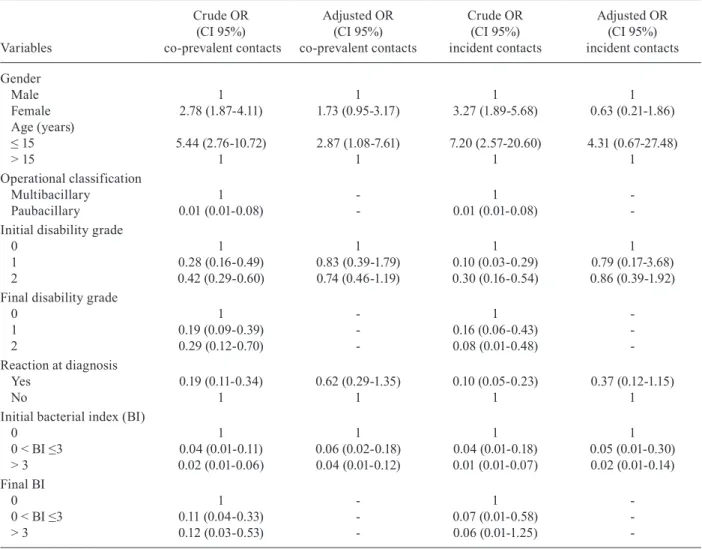
1.81% less likely to have a final disability grade of 1, 58% less likely to have an initial disability grade of 2 and 71% less likely to have a final disability grade of 2.
The odds of reaction at diagnosis were 81% lower for co-prevalent cases detected by contact surveillance than for the passively detected cases. Compared with passive-ly detected cases, co-prevalent cases also presented lower odds of having an initial and final BI of between 0 and 3 and they had even lower odds of having a BI above 3.
Compared with the index cases, the incident cases were more likely to be female (OR = 3.27) and 15 years
of age or younger (OR = 7.20), but they were less likely to have the MB form of the disease (OR = 0.01).
Regarding disability at baseline, the incident cases detected by contact surveillance were 90% less likely to reach a disease grade of 1 and 70% less likely to reach grade 2 than the passively detected cases. Lower odds were also observed in the cases detected by contact sur-veillance with regard to reaching a final disability grade of 1 (OR = 0.16) or 2 (OR = 0.08). The odds of reaction at diagnosis were 90% lower for incident cases than for index cases. Incident cases also presented lower odds of
TABLE I
The clinical and epidemiological characteristics of the index cases, co-prevalent contacts and incident contacts, Souza Araújo Ambulatory patients, Rio de Janeiro, 1987-2010
Variablesa
Index cases n = 310
n (%)
Co-prevalent contacts n = 286
n (%)
Incident contacts n = 128
n (%)
Gender
Male 221 (71.3) 127 (44.4) 52 (40.6)
Female 89 (28.7) 159 (55.6) 76 (59.4)
Age (years)
≤ 15 24 (7.7) 84 (29.4) 37 (28.9)
> 15 289 (92.3) 202 (70.6) 91 (71.1)
Clinical form
Tuberculoid leprosy 0 (0) 4 (1.4) 6 (4.7)
Boderline tuberculoid 37 (11.9) 147 (51.4) 64 (50)
Borderline boderline 19 (6.1) 19 (6.6) 10 (7.8)
Borderline lepromatous 96 (31) 31 (10.8) 8 (6.2)
Lepromatous leprosy 144 (46.5) 24 (8.4) 3 (2.3)
I 7 (2.3) 43 (15.1) 27 (21.1)
NI 2 (0.6) 17 (5.9) 8 (6.2)
NP 5 (1.6) 1 (0.3) 2 (1.5)
Operational classification
Multibacillary 259 (83.5) 73 (25.5) 22 (17.2)
Paucibacillary 51 (16.6) 213 (74.5) 106 (82.8)
Initial disability grade
0 170 (56.1) 229 (82.7) 104 (87.4)
1 17 (24.4) 31 (11.2) 8 (6.7)
2 59 (19.5) 17 (6.1) 7 (5.9)
Final disability grade
0 150 (57) 178 (86.4) 83 (86.5)
1 77 (29.3) 16 (7.8) 9 (9.4)
2 36 (13.7) 12 (5.8) 4 (7.1)
Reaction at diagnosis
Yes 133 (42.9) 39 (13.6) 10 (7.8)
No 177 (57.1) 247 (86.6) 118 (92.2)
Initial bacterial index (BI)
0 56 (18.4) 196 (73.7) 98 (83)
0 < BI ≤ 3 106 (34.7) 42 (15.8) 12 (10.2)
> 3 143 (46.8) 28 (10.5) 8 (6.8)
Final BI
0 45 (19.5) 65 (62.5) 23 (69.7)
0 < BI ≤3 134 (58.3) 29 (27.9) 7 (21.2)
> 3 51 (22.2) 10 (9.6) 3 (9.1)
having an initial or final BI of 0-3, while the odds were even lower of their BI being above 3. The clinical disease form, final BI and disability grade were not included in the final multivariate models due to the reduced number of observations in some of these categories and the lack of complete information for all of the cases. The operational classification was not included in the multivariate analy-sis because of co-linearity with the bacterial index. In the multivariate analysis of the incident cases, the BI remained statistically significant. For the co-prevalent cases among contacts, both age and BI were found to be statistically significant in the multivariate analysis (Table II).
DISCUSSION
For both the co-prevalent and incident cases diag-nosed by contact surveillance, diagnosis occurred ear-lier in the progression of the disease and the disease had a less severe clinical presentation. These cases also ex-hibited lower levels of initial and final disability grades, a lower initial and final BI and a lower incidence of
reac-tions. These differences were more significant between the prevalence and index cases than between the co-prevalent and index cases.
For the most part, the sample group analysed in this study consists of individuals with difficult diagnoses, severe illnesses and other atypical features because the participants were from a national leprosy referral ser-vice. Because of this selection bias, this sample group does not constitute a representative sample of leprosy patients within the general population. However, the SAA is less prone to having operational problems, rig-orously follows standard procedures and employs quali-fied professional staff. Another strength of this study is that these findings highlight the most recent trends in the leprosy epidemic and may be relevant in guiding subsequent interventions in the effort to control and pre-vent the spread of the disease.
Possibly due to inter-relationships among the vari-ables, however, only the initial BI remained significant for the incident cases and only age and the initial BI remained
TABLE II
Odds ratios (ORs) (crude and adjusted) of the co-prevalent and incident contacts, Souza Araújo Ambulatory patients, Rio de Janeiro, 1987-2010
Variables
Crude OR (CI 95%) co-prevalent contacts
Adjusted OR (CI 95%) co-prevalent contacts
Crude OR (CI 95%) incident contacts
Adjusted OR (CI 95%) incident contacts
Gender
Male 1 1 1 1
Female 2.78 (1.87-4.11) 1.73 (0.95-3.17) 3.27 (1.89-5.68) 0.63 (0.21-1.86) Age (years)
≤ 15 5.44 (2.76-10.72) 2.87 (1.08-7.61) 7.20 (2.57-20.60) 4.31 (0.67-27.48)
> 15 1 1 1 1
Operational classification
Multibacillary 1 - 1
-Paubacillary 0.01 (0.01-0.08) - 0.01 (0.01-0.08)
-Initial disability grade
0 1 1 1 1
1 0.28 (0.16-0.49) 0.83 (0.39-1.79) 0.10 (0.03-0.29) 0.79 (0.17-3.68) 2 0.42 (0.29-0.60) 0.74 (0.46-1.19) 0.30 (0.16-0.54) 0.86 (0.39-1.92) Final disability grade
0 1 - 1
-1 0.19 (0.09-0.39) - 0.16 (0.06-0.43)
-2 0.29 (0.12-0.70) - 0.08 (0.01-0.48)
-Reaction at diagnosis
Yes 0.19 (0.11-0.34) 0.62 (0.29-1.35) 0.10 (0.05-0.23) 0.37 (0.12-1.15)
No 1 1 1 1
Initial bacterial index (BI)
0 1 1 1 1
0 < BI ≤3 0.04 (0.01-0.11) 0.06 (0.02-0.18) 0.04 (0.01-0.18) 0.05 (0.01-0.30) > 3 0.02 (0.01-0.06) 0.04 (0.01-0.12) 0.01 (0.01-0.07) 0.02 (0.01-0.14) Final BI
0 1 - 1
-0 < BI ≤3 0.11 (0.04-0.33) - 0.07 (0.01-0.58)
-> 3 0.12 (0.03-0.53) - 0.06 (0.01-1.25)
significant among the co-prevalent cases. Again, taking into account the relationships among the clinical vari-ables, the patients diagnosed through contact surveillance were diagnosed significantly earlier and had significantly lower bacterial loads compared with the index cases.
Recently published work by our group (Sales et al. 2011) using multilevel analyses measured the effect of in-dex case characteristics on the risk of developing leprosy among contacts; this work showed that the bacillary load of the index case was the principle factor leading to dis-ease among his/her contacts. The present study demon-strated that for the contacts and especially incident cases who became sick after the index case began treatment, there were reduced odds of disability and a severe clinical presentation, as well as increased odds of early diagnosis, in those who were detected through contact surveillance compared with passively detected cases. Reduced odds of final disability among the co-prevalent and incident cases detected among contacts were observed. However, importantly, this effect was not statistically significant in the final models. The disability grade has commonly been used as an indicator of diagnostic timeliness based on the assumption that the presentation of grades 1 and 2 constitutes evidence of late diagnosis.
Physical disability is considered the most severe com-plication of leprosy and the presence of reaction at diag-nosis is a risk factor for developing disability (Saunderson 2000). In the present study, cases detected by contact sur-veillance presented lower odds of reaction at diagnosis.
Another study investigated the characteristics of the cases detected among the contacts between 1998-2002 and compared them with index cases. The results showed that the contact group had a higher proportion of female patients, children, skin lesions and nerve damage, but a greater proportion of negative smears, than the primary cases. In our results, however, there were no differences in the degrees of disability between the contact group and index cases (Ignotti et al. 2007).
The prevalence of the MB form of the disease may in-dicate delayed diagnosis. Our study showed higher odds of the paucibacillary form occurring among cases diagnosed by contact surveillance than among the passively detected index cases, thus confirming once again the importance of early diagnosis. Similarly, a study of 107 families con-ducted between 1998-2002 showed that the most frequent operational classification among contacts was PB, but no age or gender differences between the co-prevalent and index cases were found (Duraes et al. 2010).
With respect to clinical form, the present study also found that the cases diagnosed by contact surveillance presented a less severe form of the disease. Likewise, Goulart et al. (2008) showed that in patients diagnosed between 2002-2007, the TT and BT clinical forms were predominant among contacts, but that LL was the most common among the index cases.
Different types of studies have confirmed contact surveillance as an important strategy in leprosy control. A microsimulation model developed to predict future leprosy trends showed that leprosy incidence would be substantially reduced by effective BCG vaccine cover-age in concert with the combined strategies of contact
tracing, early diagnosis and the treatment of infection and/or chemoprophylaxis in household contacts (Fis-cher et al. 2011).
On the other hand, Moet et al. (2004) noted that, de-spite epidemiological contact surveillance, transmission often occurs before index case detection. The results of the present study, however, reinforce the importance of contact surveillance in the prevention of leprosy.
A recent study demonstrated that, in endemic ar-eas, neighbourhood contacts also appear to be important sources of transmission. Therefore, control measures in endemic areas should not be limited to households, but rather should include high-risk groups in the neighbouring areas of patient households as well (Feenstra et al. 2012).
Contact surveillance facilitates early diagnosis, which, in turn, helps control the spread of the disease, thus reducing the incidence of disability and disease-related stigma. Early detection immediately provides an opportunity for treatment, consequently leading to a reduction in contagiousness (Rodrigues & Lockwood 2011). The introduction of multidrug therapy has led to a drastic decline in the prevalence of leprosy (Khub-chandani 2011). Health education is also an important coadjuvant of prevention in contact surveillance strate-gies. Clearly, leprosy elimination activities, as detailed in the National Plan for Leprosy Elimination, should be expanded (MS 2006).
Leprosy in passively detected cases tends to be much more severe, thereby leading to the highest levels of dis-ability and requiring larger investments in financial and human resources. Disabling injuries have a profound im-pact on the socio-economic sector of society and often lead to the exclusion of these patients from the labour force and even from social contact. A study delineating the impact of leprosy on quality of life found that leprosy causes high percentages of secondary injuries that com-promise the capacity of the individual to engage in gain-ful employment and satisfactory life experiences and that perpetuate the stigma associated with the disease (Lustosa et al. 2011).
Government action for leprosy control should prior-itise contact surveillance, as it has proven to be an indis-pensable tool in early leprosy detection and in prevent-ing the more serious disease-related complications while also contributing to the control of disease spread.
In summary, the data in this study convincingly show that contact surveillance is a highly effective strategy in leprosy control efforts and that active surveillance is es-pecially needed in highly endemic areas, such as Brazil.
REFERENCES
Düppre NC, Camacho LA, da Cunha SS, Struchiner CJ, Sales AM, Nery JA, Sarno EN 2008. Effectiveness of BCG vaccination among leprosy contacts: a cohort study. Trans R Soc Trop Med Hyg102: 631-638.
Duraes SMB, Guedes LS, Cunha MD, Magnanini MMF, Wand Del Rey de Oliveira ML 2010. Epidemiologic study of 107 cases of families with leprosy in Duque de Caxias, Rio de Janeiro, Brazil. An bras Dermatol85: 339-345.
Fischer EA, de Vlas SJ, Habbema JD, Richardus JH 2011. The long-term effect of current and new interventions on the new case detec-tion of leprosy: a modeling study. PLoS Negl Trop Dis 5: e1330.
Goulart IMB, Souza DOB, Marques CR, Pimenta VL, Gonçalves MA, Goulart LR 2008. Risk and protective factors for leprosy development determined by epidemiological surveillance of household contacts. Clin Vaccine Immunol15: 101-105.
Hosmer DW, Lemeshow S 2000. Applied logistic regression, 2nd ed., John Wiley & Sons, New York, 373 pp.
Ignotti E, Bayona M, Alvarez-Garriga C, Andrade VL, Valente JG 2007. Transmission of Hansen’s disease and unscreened house-hold contacts. Indian J Lepr 79: 11-25.
Khubchandani J 2011. State of the globe: many challenges of the mul-tifaceted leprosy. J Glob Infect Dis3: 315-316.
Lustosa AA, Nogueira LT, Pedrosa JI, Teles JB, Campelo V 2011.The impact of leprosy on health-related quality of life. Rev Soc Bras Med Trop44: 621-626.
Mankar MJ, Joshi SM, Velankar DH, Mhatre RK, Nalgundwar AN 2011. A comparative study of the quality of life, knowledge, atti-tude and belief about leprosy disease among leprosy patients and community members in Shantivan leprosy rehabilitation centre, Nere, Maharashtra, India. J Glob Infect Dis 3: 378-382.
Moet FJ, Meima A, Oskan L, Richardus JH 2004. Risk factors for the development of clinical leprosy among contacts and their rel-evance for targeted interventions. Lepr Rev75: 310-326.
MS - Ministério da Saúde 2002. Guia para o controle da hanseníase. [cited 2012 Nov 24]. Available from: bvsms.saude.gov.br/bvs/ publicacoes/guia_de_hanseniase.pdf.
MS - Ministério da Saúde 2006. Plano nacional de eliminação da hanseníase em nível municipal 2006-2010. [cited 2012 Jan 21]. Available from: portal.saude.gov.br/portal/arquivos/pdf/hanse-niase_plano.pdf.
MS - Ministério da Saúde 2009. Guia de procedimentos técnicos para baciloscopia em hanseníase. [cited 2011 Apr 24]. Available from: portal.saude.gov.br/portal/arquivos/pdf/guia_tecnico_ para_ baciloscopia_13_11_2009.pdf.
MS - Ministério da Saúde 2010. Portaria 3.125 de 7 de outubro de 2010. [cited 2011 Nov 24]. Available from: saude.es.gov.br/down-load/portaria_3125_hanseniase_2010.pdf.
Ridley DS, Jopling WH 1966. Classification of leprosy according to immunity. A five-group system. Int J Lepr34: 255-273.
Rodrigues LC, Lockwood DN 2011. Leprosy now: epidemiology, prog-ress, challenges and research gaps. Lancet Infect Dis 11: 464-470.
Sales AM, Ponce de Leon A, Düppre NC, Hacker MA, Nery JA, Sarno EN, Penna ML 2011. Leprosy among patient contacts: a multilevel study of risk factors. PLoS Negl Trop Dis 5: 1013.
Saunderson P 2000. The epidemiology of reactions and nerve dam-age. Lepr Rev71 (Suppl.): S106-S110.