Genotypic and phenotypic detection of efflux pump in
Rhodococcus equi
Letícia Trevisan Gressler
1, Agueda Castagna de Vargas
1, Mateus Matiuzzi da Costa
2,
Luciana Pötter
3, Bibiana Petri da Silveira
1, Luis Antônio Sangioni
1,
Sônia de Avila Botton
1 1Departamento de Medicina Veterinária Preventiva, Universidade Federal de Santa Maria, Santa Maria, RS, Brazil.
2
Laboratório de Imunologia e Microbiologia, Universidade Federal do Vale do São Francisco, Petrolina, PE, Brazil.
3
Departamento de Zootecnia, Universidade Federal de Santa Maria, Santa Maria, RS, Brazil.
Submitted: April 29, 2013; Approved: March 14, 2014.
Abstract
Thereq_39680gene, associated to a putative efflux system, was detected in 60% (54/90) ofR. equi isolates by PCR. The phenotypic expression of efflux mechanism was verified in 20% of the isolates using ethidium bromide. For the first time, the expression of efflux mechanism was demonstrated in R. equi.
Key words:ethidium bromide, efflux pump, multidrug resistance,Rhodococcus equi,vapA.
Efflux systems or efflux pumps are transporter pro-teins of toxic compounds classified into five families ac-cording to their primary structure and energy-coupling mechanism: i. Major Facilitator Superfamily - MFS, ii. Adenosine Triphosphate-Binding Cassette - ABC, iii. Small Multidrug Resistance Family - SMR, iv. Resis-tance-Nodulation-Cell Division Superfamily - RND, and v. Multidrug and Toxic Compound Extrusion Family -MATE (Kumar and Schweizer, 2005). These proteins were firstly described inEscherichia coliassociated with tetra-cycline resistance profile (Mcmurrayet al., 1980).
Although several genes encoding efflux pumps can be found on plasmids, there are other efflux pump genes lo-cated on the chromosome, which provide for the bacterium an intrinsic mechanism that allows survival in a hostile en-vironment (e.g. the presence of antimicrobials) (Webber and Piddock, 2003). Then, the efflux pumps are related to acquired and intrinsic resistance to several antimicrobials in different bacterial species (Li and Nikaido, 2004). Cross-resistance was already described in efflux systems, i.e.the exposure to any one agent that belongs to the sub-strate profile of an efflux pump can allows its over-expression and consequent cross-resistance to different substrates (Webber and Piddock, 2003). These systems are
also considered as a major mechanism of resistance among multidrug-resistant pathogenic microorganisms in veteri-nary medicine (Paulsen, 2003).
Rhodococcus equiis a facultative intracellular patho-gen that infects animals and immunocompromised human patients (Takaiet al., 1991; Takaiet al., 2000). This bacte-rium is the etiological agent of rhodococcosis, an important disease that typically affects foals less than six months of age, causing severe lesions including pyogranulomatous pneumonia and mesenteric lymphadenitis (Prescott, 1991). InR. equi, the most important virulence factor is associated with the presence of virulence proteins (Vap) encode by large plasmids (Takaiet al., 1995), which have been used to classify isolates as virulent (VapA); intermediately virulent (VapB) and avirulent (without virulence plasmid) (Ribeiro et al., 2005).
Currently, the treatment of rhodococcosis usually consists of a combined application of macrolides, such as erythromycin, azithromycin or clarithromycin, associated with rifampicin (Muscatello, 2012). However, the increas-ing resistance inR. equiisolates to various antimicrobials, including the macrolides group, has been reported (Takaiet al., 1997; Asohet al., 2003; Buckley and Stanbridge, 2007; Venner et al., 2012). The microorganisms’ resistance to
Send correspondence to S.A. Botton. Departamento de Medicina Veterinária Preventiva, Universidade Federal de Santa Maria, Avenida Roraima 1000, Prédio 44, Sala 5007, 97105-900, Santa Maria, RS, Brazil. E-mail: [email protected].
macrolides has been associated to basically three events: presence of methylases, efflux pump activity and enzy-matic inactivation (Sutcliffeet al., 1996).
In R. equi, the presence of four putative multidrug efflux proteins was mentioned in the reference strainR. equi103S (Leteket al., 2010). This study reported the se-quence of a chromosomal gene known as req_39680, which encodes a protein with 308 amino acids, related to putative cation efflux system. Similar efflux mechanism was described in mycobacteria being related to the devel-opment of high level drug-resistance (Schmalstieget al., 2012); however, studies about efflux systems activity have not been described inR. equi. Herein, we identified the presence of the req_39680 gene, as well as verified the phenotypic expression of efflux mechanism in soil, feces of healthy animals and clinicalR. equiisolates.
R. equi isolates were obtained from ten horse-breeding farms, located in the Brazilian states of Rio Grande do Sul (RS) and Paraná (PR). The isolates were ob-tained from soil (n= 30), feces of healthy animals (n= 30) and foals clinical (n= 30) samples from 1991 to 2012. The clinical samples were recovered from post-mortem pulmo-nary lesions subsequent to antimicrobial treatment. The ref-erence strainsR. equiATCC 33701P + (vapApositive),R. equiATCC 33701P - (vapAnegative) andStaphylococcus aureus ATCC 25923 were used as control in both phenotypic and genotypic assays.Mycobacterium goodii SB314/96 andNocardiasp. SB57/2008 were used as nega-tive control in the genotypic assays.
Among 90 bacterial isolates analyzed, 70 were identi-fied phenotypic and genotypically previously by Monego et al. (2009), being classified as vapA positive R. equi (n= 26) andvapAnegativeR. equi(n= 44). These isolates were lyophilized and stored at -20 °C until the tests were performed. Additionally, 20 soil samples (»10 g) were
col-lected, especially for this study, in January of 2012 in three different horse-breeding farms in RS. These samples were collected from mare-foal paddocks (n= 20) and stored in sterile plastic bags until the bacteriology culturing. The soil samples were growing in nalidixic acid-novobiocin-acti-dione (cycloheximide)-potassium tellurite (NANAT) se-lective medium described by Woolcock et al. (1980). Colonies withR. equiprofile were submitted to phenotypic identification (Quinnet al., 1994) and genotypic analysis for genus, species andvapAgene (Takaiet al., 1995). All theR. equisoil isolates were classified asvapA negative and also were lyophilized and stored at -20 °C until testing.
In order to evaluate the characteristics of the protein encoded byreq_39680gene prior to the genotypic tests, it was performed a bioinformatics analysis. The sequence of the protein was recovered fromR. equi103S (GenBank ac-cess YP_004008630.1) and submitted to analysis by the Phyre V 2.0 (Protein Homology/Analogy Recognition
En-gine) program
(http://www.sbg.bio.ic.ac.uk/phyre2/html/page.cgi?id=in-dex).
Following, the polymerase chain reaction (PCR) method was used to detect thereq_39680gene in the R. equiisolates. Primarily, each strain was grown on Müeller Hinton agar (Himedia® Laboratories) and incubated at 37 °C for 24 h. Three to five colonies were suspended in 500mL of Milli-Q water and submitted to DNA extraction
by cethyltrimethylammonium bromide (CTAB) protocol (Sambrook and Russell, 2001). The extracted DNA was measured using the Picopet 01 DNA Calculator (Cam-bridge, England). The PCR primers employed were: for-ward - RE1 (5’-CCGCGATCCCTCGACACACG-3’) and reverse - RE2 (5’-CCCACCCGCATCCGCAAGAT-3’). Both primers were designed using Primer-BLAST program (http://www.ncbi. nlm.nih.gov/tools/primer-blast/) based on DNA sequence of the reference strain R. equi 103S
(GenBank access: NC_014659.1)
(http://www.ncbi.nlm.nih.gov) in order to amplify the com-plete gene. The PCR was carried out in a total volume of 25mL containing: 10mmoles of each primer, 200mM of
deoxynucleotides (dNTPs, Invitrogen®), 1 U of DNA poly-merase (GoTaq, Invitrogen®), 1X of the 5X enzyme buffer, and 60 ng of DNA sample. The amplifications were per-formed using PTC-100 Programmable Thermal Controller (MJ Research) with the following cycling profile: initial denaturation at 94°C/1min, 35 cycles of 94 °C/30 s, 63 °C/30 s and 72 °C/1 min 30 s, and a final extension at 72 °C/5 min. PCR products (10mL) were run in 1% agarose
gel, stained with ethidium bromide, visualized under UV light and photo documented by L-PIX ST (Loccus®Brazil). All PCR products were purified, in quadruplicate, with the PureLink PCR Purification Kit (Invitrogen®) and sent for DNA sequencing with the same primers for req_39680 gene. DNA sequencing was performed in an automated se-quencer ABI-PRISM 3100 Genetic Analyzer (ACT Gene Molecular Analysis Ltd., Biotechnology Center/UFRGS, Porto Alegre, RS). DNA consensus sequences were gener-ated by Gap program of the Staden package 4 software (Stadenet al., 2000) and analyzed by Basic Local Align-ment Search Tool (BLAST) (NCBI/DNASIS software ver-sion 2.5, Software Engineering Co. Ltd., SanBruno, California, US).
The phenotypic expression of efflux mechanism was performed in agar containing ethidium bromide (EtBr). This assay was based on the use of a fluorescent cationic dye (EtBr) to visualize the efflux mechanism in bacterial cells (adapted from Martinset al., 2006). SixR. equi iso-lates from clinical (n= 2), feces (n= 2) and soil (n= 2) sam-ples were tested with different concentrations of EtBr (0.2, 0.4, 0.8, 1.0, 1.2, 1.4, 1.6, 1.8 and 2.0mg/mL) in order to
cultivated in tryptic soy agar (TSA) medium (Himedia® Laboratories) for 24 h at 37 °C. A single colony of each bacterium was transferred to tryptic soy broth (TSB) me-dium (Himedia® Laboratories) and maintained at 37 °C overnight. For each microorganism, an inoculum suspen-sion was prepared in 0.9% saline, adjusted to the turbidly of 0.5 on the McFarland’ scale, and absorbance readings were performed in a spectrophotometer at 600 nm-wavelength. Subsequently, dilutions in TSB were carried out to obtain an inoculum containing approximately 1,000 CFU/mL. This inoculum was applied with swab on plates containing EtBr incorporated into the TSA and incubated at 37 °C for 48 h under aerobic conditions. Afterward, these plates were visualized on UV light. Both viability of cells and capacity of detection of efflux systems at the different concentra-tions were observed. The 0.2mg/mL EtBr concentration
was selected to be used in all isolates (90), since provided the adequate physiological conditions to development of theR. equi. All tests were performed in duplicate. After the visualization of the results on UV light the plates were photo documented by PIX-L ST (Loccus®Brazil). Bacteria were considered positive to efflux system expression when the fluorescent colonies were not observed under UV light and negative when the colonies showed fluorescence.
The data were analyzed by SAS statistical software (SAS, 2001). The nonparametric Chi-square test was used to calculate the difference in thereq_39680gene frequency amongR. equiisolates from different sources. Likewise, it was used the Spearman correlation analysis in order to evaluate the correlation between the presence of this gene with the phenotypic expression of efflux mechanism, as well as the occurrence ofvapAgene. The minimum signifi-cance level considered was p < 0.05.
The protein encoded by req_39680 gene demon-strated 100% confidence and 96% coverage with MATE family transporter protein; it was classified as multi antimicrobial extrusion protein and characterized as cat-ion-bound multidrug and toxin compound extrusion protein when analyzed by Phyre V 2.0. This finding is very relevant
since MATE family transporter proteins are categorized among the multidrug efflux transporter families present in various pathogenic microorganisms (Kuroda and Tsuchiya, 2009). Based on these results we selected thereq_39680 gene to perform this study usingR. equiisolates.
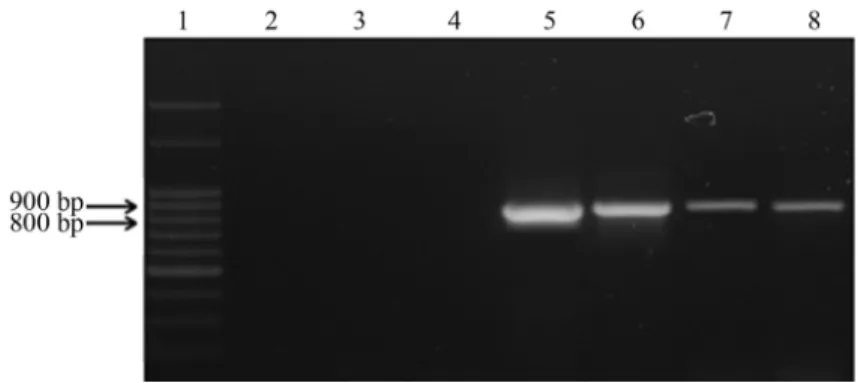
Thereq_39680gene was detected in 60% (54/90) of R. equiisolates tested (Table 1), as well as inR. equiATCC 33701. This result corroborates with the described by Rahman et al. (2003), which demonstrated that R. equi ATCC 33701 has 12 putative genes encoding efflux pro-teins, as well as 25 proteins of the ABC family, some of which are related to drug resistance. All PCR- products am-plified a specific DNA fragment of approximately 840 bp (Figure 1). The identity ofR. equiPCR products was con-firmed by DNA sequence consensus analyses, which showed 100% of identity with the reference strainR. equi 103S (GenBank access NC_014659.1). A DNA sequence from a BrazilianR. equiisolate (SB 54/97) was deposited in GenBank (access JX_512957).
Thereq_39680gene was detected inR. equiisolates from clinical (66.7%), soil (66.7%) and feces (46.7%) sam-ples. No difference was observed in the frequency of the gene amongR. equiisolates from different sources, thus it
Figure 1- PCR amplification patterns ofreq_39680gene inR. equiisolates. Amplicons were generated from a single PCR assay withR. equi req_39680
gene-specific primers (approx. 840 bp). Line 1: Molecular weight marker, 100 bp-DNA ladder (Ludwig Biotech®, Brazil); Lines 2-4: Negative controls (Ultra-pure water,Mycobacterium goodiiSB314/962,Nocardiasp., respectively); Line 5: reference strainR. equiATCC 33701 (positive control); Lines 6-8: Samples from clinical (SB54/97), feces (SB490/95) and soil (SB20/12) isolatesR. equi.
Table 1- Molecular detection of the genereq_39680and phenotypic ex-pression of efflux mechanism in agar containing EtBr in clinical, feces and soilR. equiisolates (n= 90).
Positive/total ofR. equiisolates
Source req_39680gene1 Phenotypic expression of efflux mechanism
Clinical 20/30* 11/30*
Feces 14/30 03/30
Soil 20/30 04/30
Total 54/90 18/90
1
Presence ofreq_39680gene detected by PCR assay.
is present in a comparable proportion of isolates recovered from all three sources. We suppose that the presence of the req_39680gene is not an adaptation to the host but may be just as relevant to its saprophytic status, given that aerosols from soil or fecal derived strains are the most likely source of rhodoccocal pneumonia (Muscatelloet al., 2006). Like-wise, according Leteket al.(2010) some antimicrobial re-sistance genes may be associated to efflux systems in clinical isolates as well as other environmental rhodococci. Other members of the genus Rhodococcus, such as Rhodococcus erythropolisandRhodococcus fascians, as-sure their survival in the environment through the efflux pumps (Desomeret al., 1992; Nagyet al., 1997). Accord-ing Martinez (2009) drug resistance determinants present in soil organisms typically may have an important impact on the clinical management of microbial infections
The assessment of phenotypic expression of efflux mechanism by methodologies using EtBr as substrate is widely employed in phenotypic studies to verify efflux pumps (Li and Nikaido, 2004); however, it is based on qualitative results and have also show limitation due to physiological characteristics of each microorganism (Mar-tinset al., 2006). In this sense, we firstly standardized the phenotypic expression of efflux mechanism assay with dif-ferent EtBr concentrations, in order to know the concentra-tion that did not affect the best growth of the bacterial cells. We suggest that this methodological approach could be a useful to further screening assays of efflux systems inR. equi, furthermore, this is an instrument-free method for the demonstration of efflux pump activity of bacteria (Martins et al., 2006).
The efflux mechanism by extruding of EtBr was de-tected in 20% (18/90) ofR. equiisolates tested, including: 61.1% (11/18) clinical, 22.2% (4/18) soil and 16.7% (3/18) feces isolates (Table 1). Although thereq_39680gene has been detected in all positive samples for efflux mechanism by extruding of EtBr, we cannot establish a relationship be-tween efflux and presence or absence ofreq_39680gene. On the other hand, 66.6% (36/54) ofreq_39680gene posi-tiveR. equiisolates did not show phenotypic expression of efflux mechanism. We suppose that this mechanism may be expressed by these isolates in other circumstances to be evaluated. In this respect, Viveiroset al. (2005) demon-strated that anE. colistrain sensitive to tetracycline became resistant due to the efflux mechanism induced after slow and gradual exposure to the antibiotic and this expression was reverted by serial transfer to drug-free medium or by exposure to inhibitors of efflux pumps.
A high correlation index (0.66; p < 0.0001) was veri-fied between the presence of the req_39680 gene and phenotypic expression of efflux mechanism in clinical iso-lates. However, no correlation was observed inR. equi iso-lates from feces and soil. We believe that the fact of these clinical samples have been recovered from foals post-mortem pulmonary lesions, subsequent to antimicrobial
treatment againstR. equi, may be driving an expression of the efflux mechanism in the host. The treatment failures ob-served in infections byR. equimay be associated to the ex-trusion of chemical compounds (e.g.antimicrobials) once resistance mechanisms to macrolides also include two fam-ilies of efflux pumps (Robertset al., 1999), increasing the chances of failure in infection control.
According to Leteket al.(2010) the correlation be-tween the presence of virulence and antimicrobial resis-tance genes inR. equiis not well documented. As stated by these same authors, it is possible the occurrence of a direct regulatory interaction or only a random effect between these genes. In this study, no correlation was observed be-tween the presence of bothvapAandreq_39680genes inR. equiisolates. This finding may be better explained by the location ofreq_39680gene, since it has a chromosomal lo-cusand thevapAis a plasmidial gene.
In conclusion, thereq_39680gene is equally distrib-uted amongR. equiisolates from different sources and a high correlation index between phenotypic expression of efflux mechanism and presence ofreq_39680gene was ob-served in clinical samples. Thus, there is a potential possi-bility of efflux systems to be an emerging form of adaptation to pathogenic and saprophytic life byR. equi isolates; however, additional studies are required to con-firm this hypothesis.
References
Asoh N, Watanabe H, Fines-Guyon M, Watanabe K, Oishi K, Kositsakulchai W, Sanchai T, Kunsuikmengrai K, Kahin-tapong S, Khantawa B, Tharavichitkul P, Sirisanthana T, Nagatake T (2003) Emergence of rifampin-resistant Rhodococcus equi with several types of mutations in the rpoBgene among AIDS patients in northern Thailand. J Clin Microbiol 41:2337-2340.
Buckley TE, Stanbridge S (2007) Resistance studies of erythro-mycin and rifampin forRhodococcus equiover a 10-year pe-riod. Irish Vet J 60:728-731.
Couto I, Costa SS, Viveiros M, Martins M, Amaral L (2008) Efflux-mediated response of Staphylococcus aureus ex-posed to ethidium bromide. J Antimicrob Chemoth 62:504-513.
Desomer J, Vereecke D, Crespi M, Van Montagu M (1992) The plasmid-encoded chloramphenicol-resistance protein of Rhodococcus fasciansis homologuos to the transmembrane tetracycline efflux proteins. Mol Microbiol 6:2377-2385. Kumar A, Schweizer HP (2005) Bacterial resistance to
antibiot-ics: Active efflux and reduced uptake. Adv Drug Deliver Rev 57:1486-1513.
Kuroda T, Tsuchiya T (2009) Multidrug efflux transporters in the MATE family. Biochim Biophys Acta 1794:763-768. Letek M, González P, MacArthur I, Rodríguez H, Freeman TC,
virulence underpinned by key gene acquisitions. Plos Genet 6:e1001145.
Li XZ, Nikaido H (2004) Efflux-mediated drug resistance in bac-teria. Drugs 64:159-204.
Martinez JL (2009) The role of natural environments in the evolu-tion of resistance traits in pathogenic bacteria. P Roy Soc B-Biol Sci 276:2521-2530.
Martins M, Santos B, Martins A, Viveiros M, Couto I, Cruz A, Pagés J, Molnar J, Fanning S, Amaral L (2006) An instru-ment-free method for the demonstration of efflux pump ac-tivity of bacteria. In vivo 20:657-664.
Mcmurray LM, Petrucci RE, Levy SB (1980) Active efflux of tet-racycline encoded by four genetically different tettet-racycline resistance determinants inEscherichia coli. Proc Nat Acad Sci USA 77:3974-3977.
Monego F, Maboni F, Krewer C, Vargas A, Costa M, Loreto E (2009) Molecular characterization of Rhodococcus equi from horse-breeding farms by means of multiplex PCR for thevapgene family. Curr Microbiol 58:399-403.
Muscatello G, Gerbaud S, Kennedy C, Gilkerson JR, Buckley T, Klay M, Leadon DP, Browning GF (2006) Comparison of concentrations ofRhodococcus equiand virulentR. equiin air of stables and paddocks on horse breeding farms in a tem-perate climate. Equine Vet J 38(3):263-265
Muscatello G (2012)Rhodococcus equipneumonia in the foal-Part 2: Diagnostics, treatment and disease management. Vet J 192:27-33.
Nagy I, Schoofs G, Vanderleyden J, Mot R (1997) Transposition of the IS21-related element IS1415 in Rhodococcus erythropolis. J Bacteriol 179:4635-4638.
Paulsen IT (2003) Multidrug efflux pumps and resistance: Regu-lation and evolution. Curr Opin Microbiol 6:446-451. Prescott JF (1991) Rhodococcus equi: An animal and human
pathogen. Clin Microbiol Rev 4:20-34.
Quinn, P.J.; Carter, M.E.; Markey, B.; Carter, G.R. (1994). Corynebacteriumspecies andRhodococcus equi. In: Quinn, P.J., Carter, M.E., Markey, B., Carter, G.R. (eds) Clinical Veterinary Microbiology. Wolfe, London, pp 137-143. Rahman MT, Herron LL, Kapur V, Meijer WG, Byrne BA, Ren J,
Nicholson VM, Prescott JF (2003) Partial genome sequenc-ing of Rhodococcus equi ATCC 33701. Vet Microbiol 94:143-158.
Ribeiro MG, Seki I, Yasuoka K, Kaduda T, Sasaki Y, Tsubaki S, Takai S (2005) Molecular epidemiology of virulent Rhodococcus equifrom foals in Brazil: Virulence plasmids of 85-kb type I, and a new variant, 87-kb Type III. Comp Immunol Microb 28:53-61.
Roberts MC, Sutcliffe J, Courvalin P, Jensen LB, Rood J, Seppala H (1999) Nomenclature for macrolide and macrolide-lin-cosamide streptogramin B antibiotic resistance determi-nants. Antimicrob Agents Chemother 43:2823-2830.
Sambrook J, Russell DW (2001) Molecular Cloning: A Labora-tory Manual, Cold Spring Harbor LaboraLabora-tory Press, New York, 2344 pp.
SAS (2001) Statistical analysis system user’s guide: Statistics. Version 8.2, Cary: Statistical Analysis System Institute, 1686 pp.
Schmalstieg AM, Srivastava S, Belkaya S, Deshpande D, Meek C, Leff R, Oers NSC, Gumbo T (2012) The antibiotic-resistance arrow of time: Efflux pump induction is a general first step in the evolution ofMycobacterialdrug-resistance. Antimicrob Agents Chemother 56:4806-4815.
Staden R, Beal KF, Bonfield JK (2000) The Staden Package, 1998. Met Mol Biol 132:115-130.
Sutcliffe J, Grebe T, Tait-Kamradt A, Wondrack L (1996) Detec-tion of erythromycin-resistant determinants by PCR. Anti-microb Agents Ch 40(11):2562-2566.
Takai S, Ohbushi S, Koike K, Tsubaki S, Oishi H, Kamada M (1991) Prevalence of virulentRhodococcus equiin isolates from soil and feces of horses from horse-breeding farms with and without endemic infections. J Clinical Microbiol 29:2887-2889.
Takai S, Ikeda T, Sasaki Y, Watanabe Y, Ozawa T, Tsubaki S, Sekizaki T (1995) Identification of virulentRhodococcus equiby amplification of gene coding 15 to 17 kilodalton an-tigens. J Clinical Microbiol 33:1624-1627.
Takai S, Takeda K, Nakano Y, Karasawa T, Furugoori J, Sasaki Y, Tsubaki S, Higuchi T, Anzai T, Wada R, Kamada M (1997) Emergence of rifampicin-resistantRhodococcus equi in an infected foal. J Clinical Microbiol 35:1904-1908. Takai S, Hines SA, Sekizaki T, Nicholson VM, Alperin DA,
Osaki M, Takamatsu D, Nakamura M, Suzuki K, Ogino N, Kakuda T, Dan H, Prescott J (2000) DNA sequence and comparison of virulence plasmids fromRhodococcus equi ATCC 33701 and 103. Infect Immun 68:6840-6847. Venner M, Rödiger A, Laemmer M, Giguère S (2012) Failure of
antimicrobial therapy to accelerate spontaneous healing of subclinical pulmonary abscesses on a farm with endemic in-fections caused byRhodococcus equi. Vet J. 192(3):293-298.
Viveiros M, Jesus A, Brito M, Leandro C, Martins M, Ordway D, Molnar AM, Molnar J, Amaral L (2005) Inducement and re-versal of tetracycline resistance in Escherichia coli K-12 and expression of proton gradient-dependent multidrug efflux pump genes. Antimicrob Agent Chemother 49:3578-3582.
Webber MA, Piddock LJV (2003) The importance of efflux pumps in bacterial antibiotic resistance. J Antimicrob Che-mother 51:9-11.
Woolcock JB, Mutimer MD, Farmer AMT (1980) Epidemiology ofCorynebacterium equiin horses. Res Vet Sci 28:87-90.