Copyright © 2008 SBMAC ISSN 0101-8205
www.scielo.br/cam
Model reduction in large scale MIMO dynamical
systems via the block Lanczos method
M. HEYOUNI1, K. JBILOU1, A. MESSAOUDI2 and K. TABAA3 1L.M.P.A, Université du Littoral, 50 rue F. Buisson BP 699, F-62228 Calais Cedex, France
2École Normale Supérieure Rabat, Département de Mathématiques, Rabat, Maroc 3Faculté des Sciences Agdal, Département de Mathématiques, Rabat, Maroc
E-mails: [email protected] / [email protected] / [email protected] / [email protected]
Abstract. In the present paper, we propose a numerical method for solving the coupled Lyapunov matrix equations
A P+P AT +B BT =0 and AT Q+Q A+CTC=0
whereAis ann×nreal matrix andB,CTaren×sreal matrices with rank(B)=rank(C)=sand s≪n. Such equations appear in control problems. The proposed method is a Krylov subspace method based on the nonsymmetric block Lanczos process. We use this process to produce low rank approximate solutions to the coupled Lyapunov matrix equations. We give some theoretical results such as an upper bound for the residual norms and perturbation results. By approximating the matrix transfer functionF(z)=C(z In−A)−1Bof a Linear Time Invariant (LTI) system
of ordernby another oneFm(z)=Cm(z Im−Am)−1Bmof orderm, wheremis much smaller thann, we will construct a reduced order model of the original LTI system. We conclude this
work by reporting some numerical experiments to show the numerical behavior of the proposed method.
Mathematical subject classification: 65F10, 65F30.
Key words: coupled Lyapunov matrix equations; Krylov subspace methods; nonsymmetric block Lanczos process; reduced order model; transfer functions.
1 Introduction
Consider a stable linear multi-input multi-output (MIMO) state-space model of
the form: (
˙
x(t) = A x(t)+B u(t)
y(t) = C x(t), (1.1)
whereA∈Rn×n, B, CT ∈Rn×s,x(t)∈Rnis the state vector,u(t)∈Rs is the input vector andy(t)∈Rsis the output vector of the system (1.1). When dealing with high-order models, it is reasonable to look for an approximate stable model
(
˙
xm(t) = Amxm(t)+Bmu(t)
ym(t) = Cmxm(t), (1.2)
in which Am ∈ Rm×m, Bm, CT
m ∈ Rm×s andxm(t),ym(t) ∈ Rm, withm ≪n. Hence, the reduction problem consists in approximating the triplet{A,B,C}by another one{ ˆA,Bˆ,Cˆ}of small size. Several approaches in this area have been used as Padé approximation [15, 33, 34], balanced truncation [29, 37], optimal Hankel norm [16, 17] and Krylov subspace methods [3, 6, 11, 12, 21, 22]. These approaches require the solution of coupled Lyapunov matrix equations [1, 13, 25, 27] having the form
(
A P +P AT +B BT =0
AT Q+Q A+CT C =0, (1.3)
whereP,Qare the controllability and the observability Grammians of the sys-tem (1.1). For historical developments, applications and importance of Lya-punov equations and related problems, we refer to [10, 13] and the references therein. Throughout the paper, we will assume thatλi(A)+ ˉλj(A) 6= 0 for all i, j =1, . . . ,n whereλk(A)and it’s conjugateλˉk(A)are eigenvalues of A. In this case, the equations (1.3) have unique solutions [26].
For the single-input single-output (SISO) case, i.e., s = 1, two approaches based on Arnoldi and Lanczos processes were proposed in [21, 22] to solve large Lyapunov matrix equations. The Arnoldi and Lanczos processes were also applied in order to give an approximate reduced order model to (1.1) [2, 6, 11, 13].
Our purpose in this paper is to describe a method based on the nonsymmet-ric block Lanczos process [4, 15, 19, 36] for solving the coupled Lyapunov matrix equations (1.3). In this method, we project the initial equations onto block Krylov subspaces generated by the block Lanczos process to produce low-dimensional Lyapunov matrix equations that are solved by direct methods. By approximating the transfer function F(z) = C(z In− A)−1B by another one Fm(z) =Cm(z Im− Am)−1Bm where Am ∈Rm×m, Bm,CT
m ∈ Rm×s, andm is much smaller thann, we will construct an approximate reduced order model of the continuous time linear system (1.1).
The remainder of the paper is organized as follows. In the following section, we review the nonsymmetric block Lanczos process and give the exact solutions of the coupled Lyapunov matrix equations. In Section 3, we first show how to extract low rank approximate solutions to (1.3). Then, we give some theoretical results on the residual norms and demonstrate that the low rank approximate solutions are exact solutions to a pair of perturbed Lyapunov matrix equations. In Section 4, we consider the problem of obtaining reduced order models to LTI systems by approximating the associated transfer function. This approach is based on the nonsymmetric block Lanczos process. Finally, we will present some numerical experiments.
2 The block Lanczos method and coupled Lyapunov matrix equations
2.1 The nonsymmetric block Lanczos process
Let V ∈ Rn×s and consider the block matrix Krylov subspace Km(A,V) = span{V,A V, . . . ,Am−1V}. Notice thatZ ∈Km(A,V)means that
Z = m−1 X
i=0
We also recall that the minimal polynomial P of A with respect to V is the nonzero monic polynomial of lowest degreeqsuch that
P(A)◦V = q X
i=0
AiVi,
wherei ∈Rs×sandq =Is. The grade ofV denoted by grad(V)is the degree of the minimal polynomial, hence grad(V)=q.
In the sequel, we suppose that given two matrices V,W ∈ Rn×s of full rank, we compute initial block vectors V1 and W1 using the Q R decomposition of WT V. Hence, if WT V
= δ β whereδ ∈ Rs×s is an orthogonal matrix (i.e., δTδ=δ δT = Is) andβ∈Rs×s is an upper triangular matrix, then
V1=Vβ−1 and W1=Wδ. (2.1)
Given ann×n matrix Aand the initial n×s block vectors V, W, the block Lanczos process applied to the triplet(A,V,W)and described by Algorithm 1, generates sequences ofn×s right and left block Lanczos vectors{V1, . . . ,Vm} and{W1, . . . ,Wm}. These block vectors form biorthonormal bases of the block Krylov subspacesKm(A,V1)andKm(AT,W1).
Algorithm 1. The nonsymmetric block Lanczos process [4]
• Inputs : Aann×nmatrix,V,Wtwon×smatrices andman integer.
• Step 0 . Compute the QR decomposition ofWT V, i.e.,WTV
=δ β;
V1=Vβ−1;W1=Wδ;V2˜ = A V1;W2˜ = AT W1; • Step 1 . For j =1, . . . ,m
αj =WjT Vj˜ +1;Vj˜ +1= ˜Vj+1−Vjαj;W˜j+1= ˜Wj −WjαTj; Compute the QR decompositions ofV˜j+1andWj˜ +1, i.e.,
˜
Vj+1=Vj+1βj+1; ˜Wj+1=Wj+1δTj+1;
Compute the singular value decomposition ofWT
j+1Vj+1, i.e., WjT+1Vj+1=Uj6j ZTj;
δj+1=δj+1Uj61j/2;βj+1=61j/2VjTβj+1; Vj+1=Vj+1Zj6−
1/2
j ;Wj+1=Wj+1Uj6− 1/2 j ;
˜
Specifically, aftermsteps, the block Lanczos procedure determines two block matricesVm =(V1, . . . ,Vm)∈ Rn×ms,Wm =(W1, . . . ,Wm)∈ Rn×ms and an ms×msblock-tridiagonal matrix
Tm =
α1 δ2 β2 α2 . ..
. .. ... δm
βm αm
, (2.2)
that satisfy the following relations
AVm =VmTm+Vm+1βm+1EmT =VmTm+ ˜Vm+1EmT, (2.3) ATWm =WmTmT +Wm+1δ
T
m+1EmT =WmTmT + ˜Wm+1E T
m, (2.4) and
WT
m AVm =Tm, (2.5)
WT
m Vm = Ims, (2.6)
whereEmT =(0s, . . . ,0s,Is)∈Rs×ms.
Notice that, a breakdown may occur in Algorithm 1 ifW˜T
j V˜j is singular, or ifVj˜ orWj˜ is not full rank. In [4], several strategies are proposed to overcome breakdowns and near-breakdowns in order to preserve the numerical stability of the block Lanczos process for eigenvalue problems. In the sequel, we assume thatm ≤ min{q,r}whereq andr are the degrees of the minimal polynomials ofAwith respect toV and of AT with respect toW respectively.
2.2 Exact solutions of coupled Lyapunov matrix equations
Before deriving exact expressions for the solutions of the coupled Lyapunov matrix equations, let us give the following result which will be useful in the sequel.
Lemma 2.1. Let q = grad(B), r = grad(CT)and m
≤ min{q,r}. Assume that m steps of Algorithm1are applied to the triplet(A,B,CT), then we have
AjV1
=VmT
j
m E1, for j=0, . . . ,m−1, (2.7) (AT)jW1
where E1T =(Is,0s, . . . ,0s)∈Rs×ms.
Proof. SinceTmis a block tridiagonal matrix, then for 0≤ j≤m−2,T j m is a block band matrix with j upper-diagonals and j lower-diagonals. Therefore, lettingET
m =(0s, . . . ,0s,Is)we have EmTTj
m E1=E T m(T
T m)
jE1
=0, for j =0, . . . ,m−2.
Using this last relation and the fact thatEmT E1=0, we can proof (2.7) and (2.8) by induction.
Aj+1V1 = A(AjV1)= A(VmTmj E1)
= (VmTm+ ˜Vm+1EmT)T j
m E1=VmTmj+1E1.
Using the same arguments, we obtain (2.8).
Using the previous lemma, we next give the low rank approximate solutions to (1.3). LetQq be the minimal polynomial of Awith respect to B andq = grad(B), i.e.,
Qq(A)◦B = q X
i=0
Ai Bi =0, with i ∈Rs×s and q =Is,
and letRr be the minimal polynomial of AT forCT wherer =grad(CT), i.e.,
Rr AT
◦CT =
r X
i=0
ATiCT 9i =0, with 9i ∈Rs×s and 9r =Is.
Define
Kq=
0s 0s ∙ ∙ ∙ 0s −0
Is 0s . .. ... −1
0s . .. . .. 0s ...
..
. . .. . .. 0s ...
0s . . . 0s Is −q−1
andKr =
0s 0s ∙ ∙ ∙ 0s −90
Is 0s . .. ... −91
0s . .. . .. 0s ...
..
. . .. . .. 0s ...
0s . . . 0s Is −9r−1
,
as the block companion polynomials of Qq and Rr. Denote by Mq and Nr the following Krylov matrices
Then
A Mq = MqKq, and AT Nr = Nr Kr. (2.9)
We now give the following theorem
Theorem 2.2. The general solutions P and Q of the coupled Lyapunov matrix equation(1.3)are given by
P = Mq X MqT, (2.10)
Q = NrY NrT, (2.11)
where X ∈Rqs×qsand Y
∈Rr s×r s satisfy
KqX+X KqT +E1E1T = 0, (2.12) KrY +Y KrT + ˉE1Eˉ1T = 0, (2.13) with ET
1 = Is,0s, . . . ,0s
∈Rs×qs and EˉT
1 = Is,0s, . . . ,0s
∈Rs×r s.
Proof. Premultiplying (2.10) by A, postmultiplying (2.11) by AT, using (2.9) and the fact thatB= Mq E1, we have
A P +P AT +B BT = A MqX MqT +MqX MqT AT +B BT
= MqKqX MqT +MqX KqT MqT +MqE1E1T MqT
= Mq(KqX +X KqT +E1E1T)MqT
= 0.
By the same way, we prove (2.11).
Again using Lemma 2.1, we have the following result which states that the solutions of (1.3) could be obtained by using the block Lanczos process.
Theorem 2.3. Suppose that l =grad(B)=grad(CT)and assume that l steps of Algorithm 1 have been run. Then, the solutions P and Q of the coupled Lyapunov matrix equations(1.3)could be expressed as follows
P = VlŴVlT, (2.14)
where Ŵ and Ŵˆ are the solutions of the following reduced Lyapunov matrix equations
TlŴ+ŴTlT +E1β β T ET
1 = 0, (2.16)
TT
l Ŵˆ + ˆŴTl+E1E1T = 0, (2.17) and E1T = Is,0s, . . . ,0s
∈Rs×ls.
Proof. SinceB =V1β, the general solution Pof the first Lyapunov equation in (1.3) can be expressed as follows
P = Ml X MlT = B, A B, . . . ,Al−1BX BT BT AT
.. .
BT ATl−1 ,
= V1, A V1, . . . ,Al−1V1βXβT VT 1 V1T AT
.. .
V1T ATl−1 .
Using (2.7), we get
P =Vl E1,Tl E1, . . . ,Tll−1E1
βXβT ET 1 E1T TT
l .. .
E1T TT l
l−1 VT l ,
whereET
1 = Is,0s, . . . ,0s
is ans×lsmatrix. Setting
Ŵ= E1,TlE1, . . . ,Tll−1E1
βXβT
E1T ET
1TlT .. .
ET 1 TlT
thenP =VlŴVlT and we have
A P +P AT +B BT = AVlŴVlT +VlŴVlTA T
+B BT,
= AVlŴVlT +VlŴVlT A T
+V1β βT V1T,
= 0.
Multiplying the last equalities on the right byWl, on the left byWlT and using (2.5) and (2.6) withm =lwe obtain (2.16).
Note that (2.17) is obtained as above by using (2.8), (2.11) and the fact that CT =W1δT andδTδ=δ δT = Is.
Before ending this section, we have to say that in general grad(B)6=grad(CT). Hence, ifl = min{grad(B),grad(CT)}andlsteps of the nonsymmetric block Lanczos process have been run, then only (2.14) and (2.16) are satisfied ifl = grad(B). Similarly, only (2.15) and (2.17) are satisfied ifl =grad(CT).
3 Solving the coupled Lyapunov matrix equations by the block Lanczos process
Letq =grad(B),r =grad(CT)andm≤min{q,r}. Assuming thatmsteps of the nonsymmetric block Lanczos process have been run, we show how to extract low rank approximate solutions of the coupled Lyapunov matrix equations (1.3). The results given in the previous section show that the matrices given below could be considered as approximate solutions to (1.3).
Pm = Vm XmVmT, (3.1)
Qm = WmYmWmT, (3.2)
whereXm andYmare solutions of the following reduced Lyapunov equations
Tm Xm+XmTmT +E1β β T ET
1 = 0, (3.3)
TT
m Ym +YmTm+E1E1T = 0, (3.4) andE1= Is,0s, . . . ,0s
T
∈Rs×ms.
that the eigenvaluesλi(Tm)of the block tridiagonal matrix Tm constructed by the nonsymmetric block Lanczos process satisfy λi(Tm)+ ˉλj(Tm) 6= 0, for i, j=1, . . . ,m. This condition ensures the existence and uniqueness ofXmand Ymthe solutions of the reduced Lyapunov equations and that these solutions are symmetric and positive semidefinite.
Next, we show how to compute an upper-bound for the Frobenius residual norms in order to use it as a stopping criterion. Notice that the upper bound given below will allow us to stop the algorithm without having to compute the approximate solutionsPm andQm. Hence, letting
R(Pm) = A Pm+Pm AT +B BT, (3.5) R(Qm) = AT Qm+Qm A+CTC, (3.6)
be the residuals associated to Pm and Qm respectively, we have the following result
Theorem 3.1. Let Pm, Qmbe the approximate solutions defined by(3.1),(3.3) and(3.2),(3.4)respectively. Let R(Pm)and R(Qm)be the corresponding resid-uals defined by(3.5)and(3.6)respectively. Then
kR(Pm)kF ≤2k ˜Vm+1X˜mVmTkF and
kR(Qm)kF ≤2k ˜Wm+1Ym˜ WmTkF
(3.7)
whereXm˜ ,Ym˜ are the s×n matrices corresponding to the last s rows of Xmand Ymrespectively.
Proof. From (3.1) and (3.3), we have
R(Pm)= AVm XmVmT +Vm XmVmT A T
+B BT,
then using (2.3) and the fact thatB =V1β, we get
R(Pm) = VmTm+Vm+1βm+1EmT
XmVT m
+Vm Xm TmT V
T
m +Emβ T
m+1VmT+1
+V1β βT V1T
= Vm+1 TmXm
βm+1EmT Xm !
+Vm
XmTmT Xm EmβmT+1
VT
m+1+V1β βT V1T
= Vm+1 Tm Xm+XmT
T
m +E1β β T ET
1 Xm EmβmT+1
βm+1EmT Xm 0
! VT
m+1. Since Xm is the solution of the reduced Lyapunov equation (3.3) and Vm˜ +1 = Vm+1βm+1, then
R(Pm) = Vm+1 0 XmEm βmT+1
βm+1EmT Xm 0
! VT
m+1
= Vm+1βm+1EmT XmV T
m +VmXm EmβmT+1VmT+1
= Vm˜ +1EmT XmVmT +Vm Xm EmV˜mT+1. AsXm is a symmetric matrix, it follows that
kR(Pm)kF ≤2k ˜Vm+1EmT XmV T mkF ≤2
Vm˜ +1Xm˜ VmT
F,
whereXm˜ = EmT Xm represents theslast rows ofXm. Similarly, from (2.4) and asCT
= W1δT, Wm˜ +1 = Wm+1δmT+1and the fact thatYmis symmetric and is the solution of the reduced Lyapunov equation (3.4),
we obtain the second inequality of (3.7).
To reduce the cost in the coupled Lyapunov block Lanczos method, the solu-tion of the low-order Lyapunov equasolu-tions are computed everyk0iterations where k0is a chosen parameter. Note also that the approximate solutions are computed only when
rm :=2
Vm˜ +1Xm˜ VmT
F ≤ǫ and sm =2
Wm˜ +1Ym˜ WmT
F ≤ǫ, whereǫ is a chosen tolerance. Summarizing the previous results, we get the following algorithm
Algorithm 2. The coupled Lyapunov block Lanczos algorithm (CLBL)
• Inputs : Aann×nstable matrix,Bann×smatrix andCans×nmatrix.
• Step 1 . For j =k+1,k+2, . . . ,m;
construct the block tridiagonal matrixTm, the biorthonormal bases{Vk+1, . . . ,Vm},{Wk+1, . . . ,Wm},Vm˜ +1andWm˜ +1by Algorithm 1 applied to the triplet(A,B,CT);
end For
• Step 2 . Solve the low-dimensional Lyapunov equations:
TmXm +XmTmT +E1β β T ET
1 =0;
TT
m Ym+YmTm+E1E1T =0; • Step 3 . Compute the upper bounds for the residual norms:
rm =2
Vm˜ +1Xm˜ VmT
F and sm =2
Wm˜ +1Ym˜ WmT
F;
• Step 4 .Ifrm > ǫorsm > ǫ, setk =k+k0;m=k+k0and go to step 1.
• Step 5 .The approximate solutions are represented by the matrix product:
Pm =Vm XmVmT and Qm =WmYmWmT.
We end this section by the following result which shows that the approximate solutionsPm andQm are the exact solutions of two perturbed Lyapunov matrix equations.
Theorem 3.2. Suppose that m steps of Algorithm 2have been run. Let Pm, Qm be the approximate solutions defined by (3.1), (3.3) and(3.2), (3.4) re-spectively. Then Pm and Qm are the exact solutions of the perturbed Lyapunov matrix equations
(A−11)Pm +Pm(A−11)T +B BT = 0, (3.8) (A−12)T Qm+Qm(A−12)+CT C = 0, (3.9) where
11= ˜Vm+1WmT and 12=VmW˜ T
Proof. Multiplying (3.3) on the left byVm, on the right byVmT, we obtain
VmTm XmVmT +VmXmTmT V T
m +Vm E1β βT E1TVmT =0. Using (2.3), we have
AVm −Vm+1βm+1EmT
XmVT m
+Vm Xm
VT
m A T
−EmβmT+1VmT+1+B BT =0, and sinceWT
m Vm = Ims, then
A−Vm+1βm+1EmT W T m
Vm XmVmT
+Vm XmVmT
AT −WmEmβmT+1VmT+1
+B BT =0.
Hence,
A−11Pm+Pm A−11T +B BT =0, where
11=Vm+1βm+1EmTW T
m =Vm+1βm+1WmT = ˜Vm+1WmT.
We use the same arguments to show (3.9).
4 Reduced order models via the nonsymmetric block Lanczos process
In this section, we consider the following state formulation of a multi-input and multi-output linear time invariant system (LTI)
(
˙
x(t) = A x(t)+B u(t)
y(t) = C x(t), (4.1)
wherex(t)∈Rnis the state vector,u(t)∈Rs is the input,y(t)∈Rs is the out-put of interest and A ∈ Rn×n,B,CT
∈ Rn×s. Applying the Laplace transform to (4.1), we obtain
(
where X(z), Y(z) andU(z)are the Laplace transforms of x(t), y(t)andu(t) respectively.
The standard way of relating the input and output vectors of (4.1) is to use the associated transfer functionF(z)such thatY(z)= F(z)U(z). Hence, if we eliminateX(z)in the previous two equations, we get:
F(z)=C z In−A−1B. (4.2) We recall that most of model reduction techniques, like the moment-matching approaches, are based on this transfer function [2, 13, 15, 20, 22]. Moreover, if the number of state variables of the previous LTI system is very high, (i.e., if n the order of A is large), direct computations of F(z)becomes inefficient or even prohibitive. Hence, it is reasonable to look for a model of low order that approximates the behavior of the original model (4.1). This low-order model can be expressed as follows
(
˙
xm(t) = Amxm(t)+Bmu(t)
ym(t) = Cmxm(t), (4.3)
whereAm ∈Rm×m,Bm andCT
m ∈Rm×s withm≪n.
In [22] and for the single-input single-output case (i.e., s = 1), the authors proposed a method based on the classical Lanczos process to construct an ap-proximate reduced order model to (4.1). The aim of this section is to generalize some of the results given in [22] to the multi-input multi-output case.
More precisely, let us see how to obtain an efficient reduced model to (4.1) by using the nonsymmetric block Lanczos process. This is done by computing an approximate transfer function Fm(z)to the original one F(z). In fact, writing F(z) = C X where X = (z In − A)−1B ∈ Rn×s and considering the block linear system
z In−AX = B, (4.4)
we see that, approximatingF(z)can be achieved by computing an approximate solutionXmtoX by using the block Lanczos method for solving linear systems with multiple right-hand sides [19].
to the triplet(A,B,CT)and starting from an initial guessX0=0, we can show that
Xm =Vm z Ims−Tm −1
E1β. Since
C =δW1T and W1T Vm = Is,0, . . . ,0 T
= E1T ∈Rs×ms, the transfer functionF(z)can then be approximated by
Fm(z)=C Xm =δE1T z Ims −Tm −1
E1β. (4.5)
The above result allows us to suggest the following reduced order model to (4.1) (
˙
xm(t) = Tmxm(t)+E1βu(t)
ym(t) = δE1T xm(t), (4.6)
Next, we show that the reduced order model (4.5) proposed in the above ap-proach approximates the behavior of the original model (4.1). Moreover, we give an upper bound forkFm(z)−F(z)kwhich enable us to monitor the progress of the iterative process at each step. More precisely, we have the following results
Theorem 4.1. The matricesTm,β andδgenerated by the block Lanczos pro-cess applied to the triplet(A,B,CT) are such that the first 2m
−1 Markov parameters of the original and the reduced models are the same, that is,
C Aj B= δE1T
Tk m E1β
for j=0,1, . . . ,2(m−1).
Proof. For j ∈ {0,1, . . . ,2m−1}, let j1,j2 ∈ {0,1, . . . ,m−1}such that j = j1+ j2. Using the results of Lemma 2.1 and the fact that C = δW1T, WT
1 Vm =E1T, we have
C Aj B = δW1T Aj1+j2V1β =δ (AT
)j2W1T Aj1V1 β
= δ Wm(TmT)
j2 E1T V
mTmj1 E1
β
= δE1TTj2
m
WT m Vm
Tj1
m E1β =δE T
1Tmj1+j2 E1β
= (δE1T)Tj
m(E1β).
Definition 4.2. LetMbe a matrix partitioned into four blocks
M= A B
C D
! ,
where the submatrixD is assumed to be square and nonsingular. The Schur complement ofDinM, denoted by(M/D), is defined by
(M/D)=A−BD−1C.
IfDis not a square matrix then a pseudo-Schur complement ofDinMcan still be defined [7, 8]. Now, considering the matricesKandMˆ partitioned as follows
K=
A B E
C D F
G H L
Mˆ =
D F
H L
! ,
we have the following property
Proposition 4.3. If the matricesLandMˆ are square and nonsingular, then
K/Mˆ = (K/L)/(Mˆ/L)=
A E
G L
! /L
!
−
B E
H L
! /L
!
ˆ
M/L−1
C F
G L
! /L
! .
Theorem 4.4. Letαi,β, βi,δ, δi(1≤i ≤m),Vm˜ +1andWm˜ +1be the matrices obtained after m steps of the nonsymmetric block Lanczos process applied to the triplet(A,B,CT). If(z Ims−Tm),(z In−A)are nonsingular and z is such that|z|>kAk2, then
kF(z)−Fm(z)k2≤ kδk2kŴ1,m(z)k2k ˜Wm+1k2k ˜Vm+1k2kŴm,1(z)k2kβk2 |z| − kAk2 ,
(4.7)
where
Ŵm,1(z) = EmT(z Ims −Tm)−1E1
= DmβmDm−1βm−1 ∙ ∙ ∙ D2β2D1,
Ŵ1,m(z) = E1T (z Ims−Tm)−1Em
= D1δ2D2 ∙ ∙ ∙δm−1Dm−1δm Dm,
(4.9)
and
Dm =(z Is −αm)−1,Dj−1=(z Is −αj−1−δj Djβj)−1 for j =m, . . . ,2.
Proof. AsC =δW1T andB =V1β, we have
F(z)−Fm(z) = C(z In−A)−1B−δE1T(z Ims−Tm)−1E1β
= δW1T(z In−A)−1V1β−δE1T(z Ims −Tm)−1E1β
= δG(z) β,
whereG(z)= W1T(z In− A)−1V1−E1T(z Ims −Tm)−1E1. Now, from (2.3), we have
Vm(z Ims−Tm)−1=(z In−A)−1(z In−A)Vm(z Ims−Tm)−1
=(z In−A)−1(zVm−AVm) (z Ims−Tm)−1
=(z In−A)−1(zVm−VmTm − ˜Vm+1EmT) (z Ims−Tm)−1
=(z In−A)−1Vm−(z In−A)−1Vm˜ +1EmT (z Ims−Tm)−1. Multiplying the last relation on the left byW1T, on the right byE1we obtain
G(z)=W1T (z In−A)−1Vm˜ +1EmT(z Ims −Tm)−1E1. (4.10) Similarly, by using (2.4), we have
(z Ims−Tm)−1WmT =(z Ims −Tm)−1WmT(z In−A) (z In−A)− 1
=(z Ims−Tm)−1(zWmT −W T
m A)(z In−A)− 1
=(z Ims−Tm)−1(zWmT −TmWmT −EmW˜ T
m+1) (z In−A)−1
=(WT
m (z In−A)− 1
−(z Ims −Tm)−1EmW˜mT+1(z In−A)−1 and again, multiplying the last equality on the left byE1T, on the right byVm˜ +1, we have
Combining the formulas (4.10), (4.11) and letting
Ŵm,1(z)=EmT(z Ims −Tm)−1E1, Ŵ1,m(z)=E1T(z Ims −Tm)−1Em, we get
G(z)=Ŵ1,m(z)W˜mT+1(z In−A)−1Vm˜ +1Ŵm,1(z), and then
F(z)−Fm(z)=δ h
Ŵ1,m(z)W˜mT+1(z In−A)−1Vm˜ +1Ŵm,1(z) i
β.
Finally, using the inequalityk(z In−A)−1k2≤ |z|−k1Ak2 for|z|>kAk2, we have
kF(z)−Fm(z)k2
≤ kδk2kŴ1,m(z)k2k ˜Wm+1k2k(z In−A)−1k2k ˜Vm+1k2kŴm,1(z)k2kβk2
≤ kδk2kŴ1,m(z)k2 | ˜Wm+1k2k ˜Vm+1k2 |Ŵm,1(z)k2kβk2 |z| − kAk2
.
Next, set Dm =(z Is −αm)−1 and remark that Ŵm,1(z) is the Schur comple-ment of
(z Ims −Tm) in
0 −EmT E1 z Ims −Tm
! .
Hence, using the result of Proposition 4.3, we have
Ŵm,1(z) =
0 −EmT E1 z Ims−Tm
!
/(z Ims−Tm) ! =
0 0 −Is
E1 z I(m−1)s −Tm−1 −δmEm−1 0 −βm EmT−1 z Is−αm
/(z Ims −Tm)
=
0 −Is 0 Dm−1
! /Dm−1
!
−
0 −Is
−βmEmT−1 Dm−1 !
/Dm−1 !
×
z I(m−1)s −Tm−1 −δmEm−1
−βm EmT−1 Dm−1 !
/D−m1 !−1
×
E1 −δm Em−1 0 Dm−1
! /Dm−1
!
= DmβmEmT−1
z I(m−1)s−Tm−1−δm Em−1Dmβm EmT−1 −1
E1
where
E1T = Is,0s,∙ ∙ ∙,0s
∈Rs×(m−1)s,EmT−1= 0s,∙ ∙ ∙,0s,Is
∈Rs×(m−1)s
and Tˆm−1 is a block tridiagonal matrix having the same elements that Tm−1 except the(m−1,m−1)block which is equal to(αm−1+δm Dmβm).
Again, applying Proposition 4.3 to compute EmT−1(z I(m−1)s − ˆTm−1)−1E1, and so on, we finally obtain (4.8). Similarly, we remark that Ŵ1,m(z)T is the Schur complement of
z Ims −TT m
in 0 −E
T m E1 z Ims−TT
m !
.
Then, using the same arguments as forŴm,1(z)we get (4.9). Summarizing the previous results, we get the following algorithm
Algorithm 4. Model reduction via the block Lanczos process
• Inputs : Athe system matrix,Bthe input matrix,C the output matrix.
• Step 0 . Choose a toleranceǫ >0, an integer parameterk0and setk =0; m=k0.
• Step 1 . For j =k+1,k+2, . . . ,m
construct the block tridiagonal matrixTm,Vm˜ +1andWm˜ +1by Algorithm 1 applied to the triplet(A,B,CT).
compute the matricesŴ1,m(z)andŴm,1(z)using (4.8), (4.9). end For
• Step 2 . Compute the upper bound for the residual norm:
rm = kδk2kŴ1,m(z)k2k ˜Wm+1k2k ˜Vm+1k2kŴm,1(z)k2kβk2
|z| − kAk2
.
• Step 3 . Ifrm > ǫ, setk =k+k0;m =k+k0and go to step 1.
5 Numerical experiments
In this section, we present some numerical experiments to illustrate the behavior of the block Lanczos process when applied to solve coupled Lyapunov equations. We also applied the block Lanczos process for model reduction in large scale dynamical systems. All the experiments were performed on a computer of Intel Pentium-4 processor at 3.4GHz and 1024 MBytes of RAM. The experiments were done using Matlab 6.5.
Experiment 1. In this first experiment, we compared the performance of the coupled Lyapunov block Lanczos (CLBL) and the coupled Lyapunov block Arnoldi (CLBA) algorithms [21]. Notice that:
• In all the experiments, the parameterk0used to compute the solutions of the low-order Lyapunov equations isk0=5.
• For the coupled Lyapunov block Arnoldi algorithm, the tests were stopped when the residual given in [21] was less thanǫ =10−6.
• For the coupled Lyapunov block Lanczos algorithm, the iterations were stopped when
maxk ˜Vm+1Xm˜ kF,k ˜Wm+1Ym˜ kF ≤ǫ=10−6. (5.1) We note that Res1 =k A Pm + Pm AT +B BT k
F and Res2 =k AT Qm + QmA+CTC kF are the exact Frobenius residual norms for the first and the second Lyapunov equations (1.3) respectively. The number I ter of iterations required for CLBA corresponds to the total number of iterations needed for solving separately the two Lyapunov equations (1.3) by the Lyapunov block Arnoldi method.
The matrices A1and A2tested in this experiment comes from the five-point discretization of the operators [30]
L1(u) = 1u−(x−y) ∂u
∂x −sin(x+y) ∂u ∂y −10
3ex yu,
L2(u) = 1u−1 2
√
x+y ∂u
∂x −(cos(x)+cos(y)) ∂u
on the unit square[0,1] × [0,1]with homogeneous Dirichlet boundary condi-tions. The dimension of each matrix isn =n20wheren0is the number of inner grid points in each direction. The obtained stiffness matrices A1 and A2 are sparse and nonsymmetric with a band structure [30]. The entries of the matrices BandCwere random values uniformly distributed on[0,1].
(Ai,n0,s) Algorithm I ter Res1 Res2 flops (A1,60,3) CLBA 45 6.96 10−8 8.87 10−8 2.89 108 nnz(A1)=17760 CLBL 55 7.49 10−7 4.80 10−8 9.57 107 (A1,50,4) CLBA 35 3.73 10−7 3.94 10−7 2.29 108 nnz(A1)=12300 CLBL 45 7.49 10−7 4.80 10−8 9.51 107 (A1,50,3) CLBA 35 3.08 10−7 2.86 10−7 2.29 108 nnz(A1)=12300 CLBL 50 1.05 10−8 1.72 10−9 6.11 107 (A2,60,3) CLBA 60 1.34 10−7 1.21 10−7 5.25 108 nnz(A2)=17760 CLBL 75 1.14 10−6 2.65 10−7 1.97 108 (A2,60,2) CLBA 50 1.96 10−7 2.72 10−7 2.28 108 nnz(A2)=17760 CLBL 55 1.51 10−8 2.88 10−8 7.47 107 (A2,50,4) CLBA 50 5.84 10−8 9.74 10−8 4.65 108 nnz(A2)=12300 CLBL 55 4.03 10−8 3.01 10−9 1.51 108 Table 5.1 – Effectiveness of the coupled Lyapunov block Lanczos and coupled Lya-punov block Arnoldi methods.
Experiment 2. The dynamical system used in this experiment is a non trivial constructed model (FOM) from [9, 31]. Originally, the system obtained from the FOM model is SISO and is of ordern =1006. So, in order to get a MIMO system, we modified the inputs and outputs. The state matrices are given by
A=
˜
A1
˜
A2
˜
A3
˜
A4
where
˜
A1= −1 100
−100 −1
!
, A2˜ = −1 200
−200 −1
!
, A3˜ = −1 400
−400 −1
!
andA4˜ =diag(−1, . . . ,−1000). The columns ofBandC are such that
b1T =c1=(10, . . . ,10 | {z }
6
,1, . . . ,1 | {z }
1000
), and b2, . . . ,b6;c2, . . . ,c6
are random column vectors.
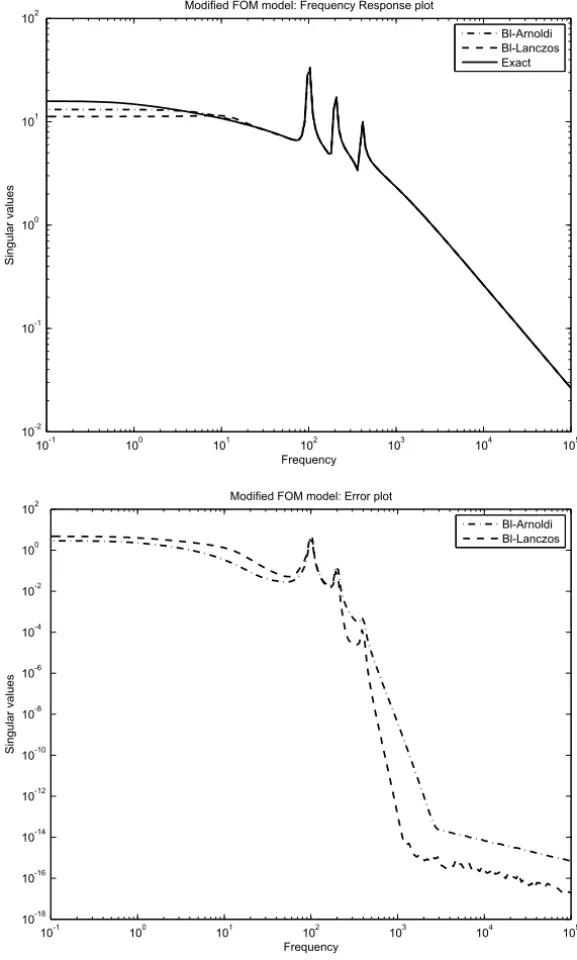
The response plot and error plot given below show the singular values σmax(F( ω))andσmax(Fm( ω)−F( ω))as a function of the frequencyω re-spectively, whereσmax(.)denotes the largest singular value andω∈ [10−1105]. As a stopping criterion, we used the upper bound (4.7). More precisely, we stopped the computation when
max w
kδk2kŴ1,m(z)k2k ˜Wm+1k2k ˜Vm+1k2kŴm,1(z)k2kβk2
|z| − kAk2
!
≤η=10−7. The frequency response (solid line) of the modified FOM model is given in the top of Figure 5.1 and is compared to the frequencies responses of orderm =12 when using the block Arnoldi process (dash-dotted line) and the block Lanczos process (dashed line). The exact errorskF(z)−F12(z)k2produced by the two processes are shown in the bottom of Figure 5.1.
6 Conclusion
In this paper, we applied the block Lanczos process for solving coupled Lya-punov matrix equations and also for model reduction. We gave some new theo-retical results and showed the effectiveness of this process with some numerical examples.
10-1 100 101 102 103 104 105 10-2
10-1 100 101 102
Frequency
S
in
g
u
la
r
va
lu
e
s
Modified FOM model: Frequency Response plot
Bl-Arnoldi Bl-Lanczos Exact
10-1 100 101 102 103 104 105
10-18 10-16 10-14 10-12 10-10 10-8 10-6 10-4 10-2 100 102
Frequency
S
in
g
u
la
r
va
lu
e
s
Modified FOM model: Error plot
Bl-Arnoldi Bl-Lanczos
Figure 5.1 – Top: kF( ω)k2 (solid line) and it’s approximations kF12B A( ω)k2 and
kF12B L( ω)k2. Bottom: Exact errorskF( ω)−F12B A( ω)k2(dashed-dotted line) and
REFERENCES
[1] A.C. Antoulas and D.C. Sorensen,Projection methods for balanced model reduction, Technical Report, Rice University, Houston, Tx, (2001).
[2] Z. Bai and Q. Ye,Error estimation of the Padé approximation of transfer functions via the Lanczos process. Elect. Trans. Numer. Anal.,7(1998), 1–17.
[3] Z. Bai,Krylov subspace techniques for reduced-order modeling of large-scale dynamical systems. App. Num. Math.,43(2002), 9–44.
[4] Z. Bai, D. Day and Q. Ye, ABLE: An adaptive block Lanczos method for non-Hermitian eigenvalue problems. SIAM J. Mat. Anal. Appl.,20(4) (1999), 1060–1082.
[5] R.H. Bartels and G.W. Stewart,Solution of the matrix equation A X+X B = C. Comm.
ACM,15(1972), 820–826.
[6] D.L. Boley and B.N. Datta,Numerical methods for linear control systems, in: C. Byrnes, B. Datta, D. Gilliam, C. Martin (Eds.) Systems and Control in the twenty-First Century, Birkhauser, pp. 51–74, (1996).
[7] C. Brezinski and M.R. Zaglia,A Schur complement approach to a general extrapolation algorithm. Linear Algebra Appl.,368(2003), 279–301.
[8] D. Carlson, What are Schur complements, anyway? Linear Algebra Appl., 74 (1986), 257–275.
[9] Y. Chahlaoui and P. Van Dooren,A collection on Benchmark examples for model reduction of linear time invariant dynamical systems. SILICOT Working Note 2002-2.
http://www.win.tue.nl/niconet/NIC2/benchmodred.html.
[10] B.N. Datta,Linear and numerical linear algebra in control theory: Some research problems.
Lin. Alg. Appl.,197-198(1994), 755–790.
[11] B.N. Datta,Large-Scale Matrix computations in Control. Applied Numerical Mathematics,
30(1999), 53–63.
[12] B.N. Datta,Krylov Subspace Methods for Large-Scale Matrix Problems in Control. Future
Gener. Comput. Syst.,19(7) (2003), 1253–1263.
[13] B.N. Datta,Numerical Methods for Linear Control Systems Design and Analysis. Elsevier
Academic Press, (2003).
[14] A. El Guennouni, K. Jbilou and A.J. Riquet,Block Krylov subspace methods for solving large Sylvester equations. Numer. Alg.,29(2002), 75–96.
[15] P. Feldmann and R.W. Freund,Efficient Linear Circuit Analysis by Padé Approximation via The Lanczos process. IEEE Trans. on CAD of Integrated Circuits and Systems,14(1995),
639–649.
[17] K. Glover, D.J.N. Limebeer, J.C. Doyle, E.M. Kasenally and M.G. Safonov,A characteri-sation of all solutions to the four block general distance problem. SIAM J. Control Optim.,
29(1991), 283–324.
[18] G.H. Golub, S. Nash and C. Van Loan,A Hessenberg-Schur method for the problem A X+ X B=C. IEEE Trans. Autom. Control,AC-24(1979), 909–913.
[19] G.H. Golub and R. Underwood,The block Lanczos method for computing eigenvalues.
Mathematical Software III, J.R. Rice, ed., Academic Press, New York, pp. 361–377, (1977). [20] E.J. Grimme, D.C. Sorensen and P. Van Dooren,Model reduction of state space systems via
an implicitly restarted Lanczos method. Numer. Alg.,12(1996), 1–32.
[21] I.M. Jaimoukha and E.M. Kasenally,Krylov subspace methods for solving large Lyapunov equations. SIAM J. Matrix Anal. Appl.,31(1) (1994), 227–251.
[22] I.M. Jaimoukha and E.M. Kasenally, Oblique projection methods for large scale model reduction. SIAM J. Matrix Anal. Appl.,16(2) (1995), 602–627.
[23] K. Jbilou and A.J. Riquet,Projection methods for large Lyapunov matrix equations. Linear Alg. Appl.,415(2-2) (2006), 344–358.
[24] S.J. Hammarling,Numerical solution of the stable, nonnegative definite Lyapunov equation.
IMA J. Numer. Anal.,2(1982), 303–323.
[25] A.S. Hodel,Recent applications of the Lyapunov equation in control theory, in Iterative Methods in Linear Algebra, R. Beauwens and P. de Groen, eds., Elsevier (North Holland), pp. 217–227, (1992).
[26] R.A. Horn and C.R. Johnson, Topics in Matrix Analysis. Cambridge University Press, Cambridge, (1991).
[27] J. Lasalle and S. Lefschetz,Stability of Lyapunov direct methods. Academic Press, New
York, (1961).
[28] A. Messaoudi,Recurssive interpolation algorithm: a formalism for solving systems of linear equations, I. direct methods. Comput. Appl.,76(1996), 31–53.
[29] B.C. Moore,Principal component analysis in linear systems: controllability, observability and model reduction. IEEE Trans. Automatic Contr.,AC-26(1981), 17–32.
[30] T. Penzl,LYAPACK A MATLAB toolbox for Large Lyapunov and Riccati Equations, Model Reduction Problem, and Linear-quadratic Optimal Control Problems.
http://www.tu-chemintz.de/sfb393/lyapack.
[31] T. Penzl,Algorithms for model reduction of large dynamical systems. Technical Report, SFB393/99-40. TU Chemintz, 1999. http://www.tu-chemintz.de/sfb393/sfb99pr.html. [32] Y. Saad,Numerical solution of large Lyapunov equations, in Signal Processing, Scattering,
[33] Y. Shamash,Stable reduced-order models using Padé type approximations. IEEE. Trans.
Automatic Control,AC-19(1974), 615–616.
[34] Y. Shamash,Model reduction using the Routh stability criterion and the Padé approximation technique. Internat. J. Control,21(1975), 475–484.
[35] I. Schur,Potenzreihn im Innern des Einheitskreises. J. reine Angew. Math,147(1917),
205–232.
[36] Q. Ye,An Adaptive Block Lanczos Algorithm. Num. Alg.,12(1996), 97–110.