Synthesis and Structural Characterization of
[Ir
4(µ-CO)(CO)
7{µ
4-η
3-Ph
2PC(H)C(Ph)PCBu
t}(µ-PPh
2)]:
Alkyne-Phosphaalkyne Coupling and Formation of a Novel
2-phosphabutadienylphosphine Ligand
Maria Helena Araujoa,b, Peter B. Hitchcockb, John F. Nixon*b,
and Maria D. Vargas*a
a
Instituto de Química, Universidade Estadual de Campinas, C.P. 6154,
13081-970 Campinas - SP, Brazil b
School of Chemistry, Physics and Environmental Science, University of Sussex,
Brighton, BN1 9QJ, UK
Received: August 26, 1998
A reação de [Ir4(µ-H)(CO)9(Ph2PC≡CPh)(µ-PPh2)] 1 com P≡CBut em CH2Cl2 a 35 °C por 4 h
leva à formação do composto inédito [Ir4(µ-CO)(CO)7{µ4-η3-Ph2PC(H)C(Ph)PCBut}(µ-PPh2)] 2,
que contem a cadeia 2-fosfabutadienilfosfina. O composto 2 forma-se também quando [Ir4(CO)10(Ph2PC≡CPh)(PPh2H)] 3 é aquecido na presença de P≡CBut, em thf, a 40 °C, por 48 h.
Essas duas reações também produzem pequenas quantidades de [Ir4(µ-CO)(CO)7(µ3-η2
-HCCPh)(µ-PPh2)2] 4, porque as velocidades das transformações de 1 e de 3 em 4 e das reações
desses compostos com P≡CBut são semelhantes. O composto 2 foi caracterizado por dados analíticos e espectroscópicos, espectrometria de massas usando fonte de FAB e experimentos de RMN de 1H,
31P, 13C, 2D 31P-1H HETCOR, diferença de nOe e DEPT que levaram à sua formulação e
estabeleceram que havia ocorrido o acoplamento entre o ligante Ph2PC≡CPh e o P≡CBut e a
migração do hidreto para o Cα do Ph2PC≡CPh. Entretanto, esses dados não permitiram decidir se
a clivagem da ligação P-Csp do Ph2PC≡CPh havia ocorrido e nem definir o modo de interação da
cadeia organofosforada. A estrutura molecular do composto 2, determinada por uma análise de difração de raios-X, mostrou que o cluster exibe um arranjo metálico na forma de uma borboleta e que a cadeia organofosforada, corretamente formulada por dados espectroscópicos, interage com o poliedro metálico através de quatro ligações σ.
Reaction of [Ir4(µ-H)(CO)9(Ph2PC≡CPh)(µ-PPh2)] 1 with P≡CBut in CH2Cl2, at 35 °C, for 4 h
yields the novel compound [Ir4(µ-CO)(CO)7{µ4-η3-Ph2PC(H)C(Ph)PCBut}(µ-PPh2)] 2, which
contains the 2-phosphabutadienylphosphine chain. Compound 2 is also formed upon thermolysis of [Ir4(CO)10(Ph2PC≡CPh)(PPh2H)] 3 in the presence of P≡CBut in thf, at 40 °C, for 48 h. Small
amounts of [Ir4(µ-CO)(CO)7(µ3-η2-HCCPh)(µ-PPh2)2] 4 are always obtained from both reactions,
because of the competing rates of the transformations of 1 and 3 into 4 and of their reactions with P≡CBut. Compound 2 was characterized by analytical and spectroscopic studies such as FAB ms,
1
H, 31P, 13C, 2D 31P-1H HETCOR, nOe difference and DEPT NMR experiments, which led to its formulation and established the coupling between the coordinated Ph2PC≡CPh and P≡CBut and the
migration of the hydride to the Cα of the Ph2PC≡CPh ligand. However, it was impossible to establish
unambiguously if cleavage of the P-Csp bond of the Ph2PC≡CPh ligand had occurred and the mode
of interaction of the organophosphorus chain. An X-ray diffraction study of compound 2 established
a butterfly arrangement of iridium atoms with the new ligand interacting with the metal framework
via four σ bonds and the PPh2 phosphorus lone pair.
Keywords: iridium cluster, phosphaalkyne, alkyne, coupling reaction
Introduction
There are relatively few examples of alkyne-alkyne coupling reactions at polynuclear carbonyl clusters1, one example being the reaction between [Ir4(µ-H)(CO)9
-(Ph2PC≡CPh)(µ-PPh2)] and HC≡CPh, which led to
[Ir4(CO)7(µ4-η3-PhCC(H)CCPh)(µ-PPh2)3]2. The
coordi-nation chemistry of phosphaalkynes, P≡CR, has been of great interest and its similarity to alkynes has been dis-cussed previously, and various publications and reviews have been written3. Published examples of codimerization between a phosphaalkyne and an alkyne are relatively few. For example, the reaction between [Co2(Cp2
)-(Me3SiCCSiMe3)] and P≡CBut resulted in the desired η4
-1-phosphacyclobutadiene complex [Co(Cp)(η4-PC(But)C (SiMe3)C((SiMe3)] and the reaction of [Zr(Cp2)(PMe3)(η2
-PCBut)] with alkynes led to the 1-phospha-3-zircona cyclopentadiene complexes4. The only published attempt to couple similar molecules on a cluster compound in-volved the reaction between [Fe3(CO)9
Se(PBut)-(ButC≡CH)] and P≡CBut with led to the unex-pected [Fe3(CO)7Se(PBut)(ButC=CH)(µ3-P-C(=C=O)
(But)] compound5. Although a number of 2-phosphabutadi-enes are known6, none have previously been obtained by the alkyne-phosphaalkyne coupling route. We recently re-ported that [Ir4(µ-H)(CO)9(Ph2PC≡CPh)(µ-PPh2)] 1
containing a terminally bound diphenylphosphino-acetylene undergoes a facile rearrangement into [Ir4(µ-CO)(CO)7(µ3-η2-HCCPh)(µ-PPh2)2] 4 which was
proposed to occur via CO loss, P-Csp bond cleavage and
hydride migration to the α-carbon of the acetylide frag-ment7. Cluster coordinated acetylides have been shown to undergo nucleophilic attack of alkynes at the α-carbon8,9 and, in an attempt to trap the proposed hydrido-acetylido intermediate in the transformation of 1 into 4, this reaction was carried out in the presence of P≡CBut. We report herein the first example of a phosphaalkyne-alkyne coupling reaction in the coordination sphere of a cluster compound, and describe the synthesis and characterization of [Ir4(µ
-CO)(CO)7{µ4-η3-Ph2PC(H) C(Ph)PCBut}(µ-PPh2)] 2,
which contains the 2-phosphabutadienylphosphine chain. A preliminary communication of this work has appeared elsewhere10.
Results and Discussion
The reaction of the orange compound [Ir4(µ
-H)(CO)9(Ph2PC≡CPh)(µ-PPh2)] 1 with P≡CBut in CH2Cl2,
at 35 °C, for 4 h resulted in a dark brown solution, from which the brown compound [Ir4(µ-CO)(CO)7{µ4-η3
-Ph2PC(H)C(Ph)PCBut}(µ-PPh2)] 2 was isolated in up to
48% yield, after purification by TLC, besides unreacted 1 and small amounts of [Ir4(µ-CO)(CO)7(µ3-η2-HCCPh)(µ
-PPh2)2] 4. Formation of 2 in 10% yield was also observed
when [Ir4(CO)10(Ph2PC≡CPh)(PPh2H)] 3 was heated with
P≡CBut in thf at 40 °C for 48 h. In both cases, heating for longer periods of time only resulted in additional formation of 4 and decomposition. Small amounts of compound 4 were unavoidably obtained, because of the competing rates of the two reactions illustrated in Scheme 1.
The reaction of 4 with P≡CBut was also investigated. All attempts led to an immediate color change from orange to dark brown, but in situ 31P{1H} NMR showed no phosphorus signals, which indicated that the reaction had occurred, but the product underwent decomposition. Simi-lar behavior was observed when the reaction of 4 with PR3
was investigated11.
Compound 2 was formulated on the basis of analytical and spectroscopic data discussed below. The coupling re-action between the Ph2PCCPh ligand and the PCBut
mole-cule, and the hydride migration to the resulting new phosphorus carbon chain were established by 1H, 31P and
Scheme 1.
13
C-NMR spectroscopy. In spite of the detailed spec-troscopic studies undertaken, it was impossible to establish unambiguously whether the diphenylphosphino-alkyne had undergone P-Csp bond cleavage and the geometry of
the metal polyhedron in 2, therefore an X-ray diffraction study had to be carried out.
Solution characterization of [Ir4(µ-CO)(CO)7{µ4-η3
-Ph2PC(H)C(Ph)PCBut}(µ-PPh2)] 2
The solution infrared spectrum of compound 2, be-tween 2200-1600 cm-1, only showed absorptions due to terminal and bridging carbonyl ligands. This result sug-gested that the triple bond of the Ph2PC≡CPh ligand was
interacting with the metal framework, because of the ab-sence of the νC≡C band at 2172 cm-1 which is observed in
both starting materials 1 and 3. In the FAB mass spectrum of 2, a molecular ion at m/z 1568 and sequential loss of eight CO ligands were observed. The mass difference between 1 and 2 clearly indicated the incorporation of one PCBut
molecule and loss of a CO group, resulting in a complex having the formula ‘‘Ir4H(CO)8(Ph2PCCPh)(PPh2)(PCBut)’’, with which the
elemental analysis agreed perfectly.
The 1H-NMR data for 2 were consistent with the pres-ence of both PPh2 and But groups. The absence of a hydride
signal and the presence of a doublet of doublets at δ 5.4 (JH-P = 55 and 13 Hz) suggested that the hydride ligand had
migrated to one of the carbon atoms of the Ph2PCCPh (Cα
or Cβ) or of the PCBut (Cγ) ligands, because migration of the hydride to one of the phosphorus atoms would have led to a much larger one-bond H-P coupling constant, typically between 300 and 500 Hz12. A nOe difference experiment established to which of the ligands Ph2PCCPh or PCBut the
hydride had migrated. This experiment consisted of con-tinuous irradiation of the resonance at δ 5.4 (CH), which resulted in a nOe of some of the phenyl proton resonances, but did not affect the But signal [Fig. 1a]. Likewise, when the But resonance at δ 1.1 was irradiated, only nOe of some of the phenyl proton resonances was observed [Fig. 1b]. Thus, the spacial proximity of the CH and the phenyl protons indicated that migration of the hydride had oc-curred either to Cα or Cβ of the Ph2PCCPh ligand.
The 31P{1H} NMR spectrum of 2 showed three sets of pseudo-triplets at δ 16.1, 28.0 and 116.5 with JP-P = 5 Hz.
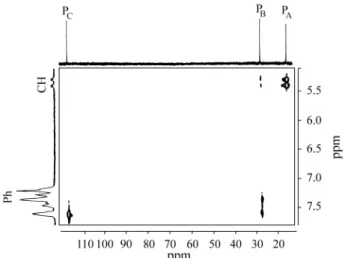
The 2D 1H-31P shift correlation spectrum established that the lowest frequency peak could be assigned to the phos-phorus atom of the PCBut (PA) group, and the other two
resonances at higher frequency were due to the PPh2 groups
(PB and PC) [Fig. 2]. This experiment also indicated that the
strong P-H coupling of 55 Hz was to the PA nucleus (δ
16.1), whilst the 13 Hz P-H coupling was to the PPh2
phosphorus PB (δ 28.0). The signal at δ 116.5 (PC), was
confidently attributed to the bridging phosphido nucleus, on the basis of previous work7. The second PPh2 (PB)
appeared at δ 28.0 and it is indicative of a phosphine12,
however the breaking of the P-Csp bond cannot be
ex-cluded, since the µ-PPh2 phosphorus nuclei have been
shown to span a wide chemical shift range, depending on the distance between the metal atoms they bridge12.
The coupling of the diphenylphosphinoalkyne with the phosphaalkyne was strongly suggested by the 13C{1H} and
13
C-NMR spectra and a DEPT experiment. These experi-ments made it possible to identify the Cβ (Cquat) resonance
as a doublet of doublets at δ 54.2, with JC-P = 37 and 28 Hz,
and the Cα (CH), also as a dd, at δ 126.0, JC-P = 57 and 35
Hz, and 1JC-H = 164 Hz. The chemical shifts of Cα and Cβ
and the P-C and C-H coupling constants are in agreement
Figure 2. 31P-1H heteronuclear correlation spectrum of compound 2 in CDCl3 at 25 °C.
with those normally observed for sp2 hybridized carbon atoms which are coordinated to organometallic com-pounds13. In the 13C{1H} NMR spectrum of 2 it was possi-ble to identify all eight CO groups and to assign the bridging CO resonance at δ 191.2, which is shifted to high frequency, in comparison with the terminal CO groups14. This result was in agreement with the IR and mass spectra data and the elemental analysis. It was also possible to identify five quaternary carbons and the CH carbon atom of the phenyl groups, in the aromatic carbon region be-tween δ 141.7 and 128.3. The two Cquat resonances at δ 38.5
and 29.6, were assigned to Cγ and C* or vice versa.
On the basis of these results two possible structures A and B were proposed for the new 2-phosphabutadienyl chain, as shown in Scheme 2. In A the coupling between Ph2PCCPh and PCBut would have occurred without
cleav-age of the Ph2P-C bond, and in B cleavage would have
occurred, leading to a µ-PPh2 coordinated fragment. The
trans-H to phospha-alkene PA arrangement would result in
the large 3JH-P = 55 Hz observed.
The mode of interaction of the proposed 2-phospha-butadienyl fragments A or B to the Ir4 metal frame could
only be speculated upon based on the above analytical and spectroscopic data. Because the 13C{1H} NMR data do not
suggest interaction of the C=C bond with the metal frame, fragment A would be a potential 7 electron donor to the 55 electron ‘‘Ir4(CO)8(PPh2)’’ fragment, whereas in B it could
donate 6 electrons to the 58 electron ‘‘Ir4(CO)8(PPh2)2’’
fragment. Compound 2 would therefore have 62 (A) or 64 (B) valence electrons and, therefore would exhibit a butter-fly or a spiked triangle arrangements of metal atoms according to Wade rules15. Similar metal arrangements were previously observed for [Ir4(CO)8(η1-COPh)(µ4-η3
-PhPC(H)CPh)(µ-PPh2)] (62 electrons)16 and [Ir4(µ
-H)-(CO)9(µ4-η3-Ph2PCCPh)(µ-PPh2)] (64 electrons) clusters.
Crystal Structure of 2
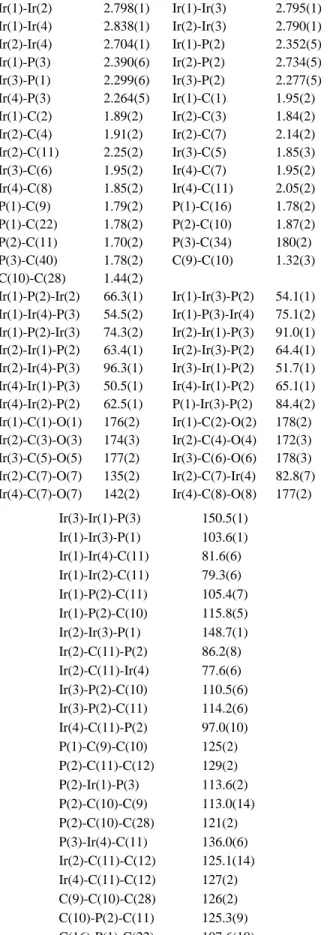
The molecular structure of 2 in the solid state is shown in Fig. 3, together with the atomic labeling scheme, and confirmed the geometry shown in A. Selected bond dis-tances (Å) and angles (°) are in Table 1. The structure consists of a butterfly arrangement of iridium atoms with metal-metal bond mean value of 2.785 Å. This arrangement of iridium atoms was previously observed for other 62-electron Ir4 clusters for which Ir-Ir bond mean values are
comparable e.g. [Ir4(CH3)(CO)8(µ4-η3-Ph2PCCPh) (µ-PPh2)]17,
[2.773 Å], [Ir4(CO)8(µ3-η3-Ph2PC(H)CPh)(µ-PPh2
)-(PCy3)]18, [2.749 Å] and [Ir4(CO)8(η1-COPh) (µ4-η3
-PhPC(H)CPh)(µ-PPh2)]16, [2.788 Å]. Complex 2 possesses
seven terminal CO ligands, distributed one on Ir(4) and two on each remaining Ir atoms, and one bridging carbonyl, which spans asymmetrically the shortest edge of the metal
Figure 3. Molecular Structure of [Ir4(µ-CO)(CO)7(µ4-η3 -Ph2PC(H)-C(Ph)PCBut)(µ-PPh2)] 2.
(CH3)3C
C
C C
H Ph
*
γ
β α
(CH3)3C
C
C C
H Ph
*
γ
β α
..
.. ..
A B
Ir Ir
Ph2PB
PA Ph2PB PA
Ir Ir
Ph2PC
Ir Ir
Ph2PC
framework Ir(2)-Ir(4) [2.704(1) Å, Ir(4)-C(7) 1.95(2) and Ir(2)-C(7) 2.14(2) Å]. The Ir(1)-Ir(4) is the longest edge [2.838(1) Å] and is spanned by an asymmetric phosphido group [Ir(1)-P(3) 2.390(6) and Ir(4)-P(3) 2.265(5) Å] which donates, formally, three electrons to the cluster. The new phosphabutadienyl Ph2PC(H)C (Ph)PCBut ligand
do-nates formally seven electrons to the cluster: two from the P(1)-C(9)=C(10) moiety which is interacting with the met-al framework via the phosphorus atom lone pair of the P(1)Ph2 group [Ir(3)-P(1) 2.299(6) Å], five from the
2-phosphaalkenyl P(2)=C(11) moiety, which is essentially sp2 [P(2)=C(11) 1.70(2) Å, C(10)-P(2)=C(11) 125.3(9)° and P(2)=C(11)-C(12) 129(2)°] and interacts with all four iridium atoms via four σ bonds [Ir(1)-P(2) 2.352(5), Ir(3)-P(2) 2.277(5), Ir(2)-C(11) 2.25(2) and Ir(4)-C(11) 2.05(2) Å]. The P=C and Ir-P bond distances are comparable with other complexes reported in the literature e.g. [W(CO)5
-{(SiMe3)2C=P-C(OEt)=C(H)Ph}]19, [P=C 1.65(10) Å],
[Ru(MeP=CHBut)Cl(I)(CO)(PPh3)2]20, [P=C 1.657(8) Å],
[TiCp2(Et2BH)(P=CBut)]21, [1.666(2) Å], [Ir4(CO)8(η1
-COCH3)(µ4-η3-Ph2P(1)CCPh)(µ-PPh2)]17, [Ir-P(1)
2.307(9) Å], [Ir4(µ-H)(CO)9(µ4-η3-Ph2P(1)CCPh) (µ
-PPh2)]7, [Ir-P(1) 2.373(9) Å],
[Ir4(CO)8(µ3-η3-Ph2P(1)C(H)CPh)(µ-PPh2)(PCy3)]18,
[Ir-P(1) 2.270 Å]. A formal electron count in 2 results in 19 and 17 electrons on Ir(2) and Ir(4), respectively, and 18 electrons on the other two metal atoms. This has been previously observed for other Ir4 clusters such as
[Ir4(CO)8(η1-COCH3)-(µ4-η3-Ph2PCCPh)(µ-PPh2)],
[Ir4(CO)8(η1-CH3)(µ4-η3-Ph2PCCPh)(µ-PPh2)] and
[Ir4(CO)8(µ3-η3-Ph2P C(H)CPh) (µ-PPh2)(PCy3)].
Although the X-ray diffraction study has confirmed structure A, proposed in Scheme 2 for the novel chain, it is impossible to be sure that P-C bond cleavage was not involved in the process, considering the analogous trans-formation of [Ru3(µ-H)(CO)8(µ3-η2-CCBut)(Ph2PC≡
CPh)] into [Ru3(CO)8{µ3-η4-Ph2PC(Ph)C(H)CC(But)}]22.
In this case, the alkyne-alkyne condensation and migration of the hydride ligand resulted in a new organic chain, Ph2PC(Ph)C(H)CC(But). It was suggested that a P-Cα
bond cleavage had initially occurred, with formation of a µ-PPh2 ligand, and after the condensation, insertion of the
new carbon chain, ‘‘C(Ph)C(H)CC(But)’’, into the Ru-PPh2
occurred leading to the observed P-Cβ(Ph); all these pro-posed steps had been previously observed.
No information regarding the detailed mechanism of the formation of compound 2 is available, but one can speculate the following steps: (i) CO loss and interaction of the acetylene moiety with an electron poor Ir center with a Ir-Ir bond cleavage, (ii) hydride migration to the Cα of the Ph2PCCPh ligand, and (iii) nucleophilic attack of the
Table 1. Selected bond distances (Å) and angles (deg) for 2.
Ir(1)-Ir(2) 2.798(1) Ir(1)-Ir(3) 2.795(1) Ir(1)-Ir(4) 2.838(1) Ir(2)-Ir(3) 2.790(1) Ir(2)-Ir(4) 2.704(1) Ir(1)-P(2) 2.352(5) Ir(1)-P(3) 2.390(6) Ir(2)-P(2) 2.734(5) Ir(3)-P(1) 2.299(6) Ir(3)-P(2) 2.277(5) Ir(4)-P(3) 2.264(5) Ir(1)-C(1) 1.95(2) Ir(1)-C(2) 1.89(2) Ir(2)-C(3) 1.84(2) Ir(2)-C(4) 1.91(2) Ir(2)-C(7) 2.14(2) Ir(2)-C(11) 2.25(2) Ir(3)-C(5) 1.85(3) Ir(3)-C(6) 1.95(2) Ir(4)-C(7) 1.95(2) Ir(4)-C(8) 1.85(2) Ir(4)-C(11) 2.05(2) P(1)-C(9) 1.79(2) P(1)-C(16) 1.78(2) P(1)-C(22) 1.78(2) P(2)-C(10) 1.87(2) P(2)-C(11) 1.70(2) P(3)-C(34) 180(2) P(3)-C(40) 1.78(2) C(9)-C(10) 1.32(3) C(10)-C(28) 1.44(2)
Ir(1)-P(2)-Ir(2) 66.3(1) Ir(1)-Ir(3)-P(2) 54.1(1) Ir(1)-Ir(4)-P(3) 54.5(2) Ir(1)-P(3)-Ir(4) 75.1(2) Ir(1)-P(2)-Ir(3) 74.3(2) Ir(2)-Ir(1)-P(3) 91.0(1) Ir(2)-Ir(1)-P(2) 63.4(1) Ir(2)-Ir(3)-P(2) 64.4(1) Ir(2)-Ir(4)-P(3) 96.3(1) Ir(3)-Ir(1)-P(2) 51.7(1) Ir(4)-Ir(1)-P(3) 50.5(1) Ir(4)-Ir(1)-P(2) 65.1(1) Ir(4)-Ir(2)-P(2) 62.5(1) P(1)-Ir(3)-P(2) 84.4(2) Ir(1)-C(1)-O(1) 176(2) Ir(1)-C(2)-O(2) 178(2) Ir(2)-C(3)-O(3) 174(3) Ir(2)-C(4)-O(4) 172(3) Ir(3)-C(5)-O(5) 177(2) Ir(3)-C(6)-O(6) 178(3) Ir(2)-C(7)-O(7) 135(2) Ir(2)-C(7)-Ir(4) 82.8(7) Ir(4)-C(7)-O(7) 142(2) Ir(4)-C(8)-O(8) 177(2)
Cβ at the δ+ P of the PCBut ligand with formation of the 2-phosphabutadienylphosphine observed experimentally.
Experimental
General procedures
All manipulations and reactions were performed under an atmosphere of argon, unless otherwise specified, using standard Schlenk techniques. CH2Cl2 was dried over CaH2,
hexane and thf over sodium wire. Solvents were freshly distilled under N2 from Na/K alloy (hexane and thf) or from
CaH2 (CH2Cl2) prior to use. P≡CBut, 3 [Ir4(µ-H)(CO)9
(Ph2PC≡CPh)(µ-PPh2)]7, 1 and [Ir4(CO)10(Ph2PC≡CPh)
(PPh2H)]7, 3 were prepared by literature methods.
Preparative TLC was carried out in air by using ca. 2 mm thickness glass-backed silica plates (20 x 20 cm) prepared from silica gel type GF254 (Fluka) and CH2Cl2
-hexane (3:7) as eluent and the compounds were extracted from silica with CH2Cl2.
IR spectra were obtained on a Bomen MB series IR instrument scanning between 2200 and 1600 cm-1, using CaF2 cells. Microanalyses were performed at the Instituto
de Química, Unicamp, Brazil. Fast atom bombardment mass spectra (FAB MS) were obtained on a Kratos MS50, operating at 8 keV. Xenon was used as the source of fast atoms. 3-Nitrobenzylalcohol, purchased from Aldrich, and distilled under vacuo, was used as a matrix. CH2Cl2 was
used as solvent. All m/z values are referred to 193Ir and were obtained at the University Chemical Laboratories, Univer-sity of Cambridge, UK. 1H, 13C and 13P-NMR studies were carried out using CDCl3 solutions and a Bruker AMX 500
spectrometer. Standard pulse sequences were used for the NMR experiments23. Chemical shifts are given in ppm using deuterated solvents as lock and reference (1H and 13C, SiMe4; 31P 85 % H3PO4, external) and coupling constants
(J) are given in Hz.
Preparation of [Ir4(CO)8{µ4-η3-Ph2PC(H)C(Ph)PCBut}
(µ-PPh2)] 2
Method 1
An orange solution of [Ir4(µ-H)(CO)9(Ph2PC≡CPh)(µ
-PPh2)] 1 (100 mg, 0.08 mmol) and P≡CBut (8 µL, 0.08
mmol) in CH2Cl2 (10 mL) was heated at 35 °C for 4 h, after
which time a color change from orange to dark brown was observed. The solution was concentrated under vacuo to about 1 mL and the mixture purified by TLC to afford
[Ir4(CO)8{µ4-η3-Ph2PC(H)C(Ph)PCBut}(µ-PPh2)] 2 (60
mg, 48%, Rf 0.30, brown), [Ir4(CO)8{µ3-η2-HCCPh)(µ
-PPh2)2] 4 (15 mg, 12%, Rf 0.55, orange) and starting
material 1 (15 mg, 15%, Rf 0.41, orange).
Method 2
To a yellow solution of [Ir4(CO)10(Ph2PC≡CPh)
(PPh2H)] 3 (53 mg, 0.035 mmol) in thf (10 mL) P≡CBut (7 µL, 0.07 mmol) was added and the reaction mixture was heated at 40 °C for 48 h. The resulting brown solution was concentrated under vacuo to about 1 mL. Separation of the mixture by TLC afforded [Ir4(CO)8{µ4-η3-Ph2PC(H)C(Ph)
PCBut}(µ-PPh2)] 2 (5 mg, 10%, Rf 0.58, brown), [Ir4(CO)8
{µ3-η2-HCCPh)(µ-PPh2)2] 4 (2 mg, 4%, Rf 0.67, orange),
and unreacted 3 (27 mg, 50%, Rf 0.62, yellow), along with
some decomposition products (base line on the TLC plates).
Reaction of [Ir4(CO)8{µ3-η2-HCCPh)(µ-PPh2)2] 4 with
P≡CBut
(a) To a solution of [Ir4(CO)8{µ3-η2
-HCCPh)-(µ-PPh2)2] 4 (27 mg, 0.018 mmol) in CH2Cl2 (10 mL) was
added P≡CBut (5.2 µL, 0.046 mmol) and the reaction mixture heated at 35 °C for 5 h. After ca. 10 min the color of the solution slowly began to change from orange to brown and after 5 h the solution was dark brown. Purifica-tion by preparative TLC afforded unreacted starting material 4 along with decomposition on the base line of the TLC plates.
(b) A solution of 4 (70 mg, 0.047 mmol) and P≡CBut (10 µL, 0.095 mmol) in benzene (20 mL) in a closed Schlenk fitted with Young tap, was heated under reflux for 4 h, a slowly color change from orange to dark brown was observed. The solvent was removed under reduced pressure and separation by preparative TLC afforded the starting material 4, along with decomposition products on the base line of the TLC plates.
Characterization of 2
Anal. Calcd. for C45H35O8P3Ir4: C, 34.5; H, 2.2. Found:
C, 34.7; H, 1.9%. IR (hexane, νCO): 2068 w, 2058 w,
2030vs, 2014w (sh), 2006s, 1985w, 1956s, 1836m cm-1.
FAB MS: m/z 1568 (M)+, 1540 (M- CO)+, 1512 (M- 2CO)+,
1484 (M- 3CO)+, 1456 (M- 4CO)+, 1428 (M- 5CO)+, 1400
(M- 6CO)+, 1372 (M- 7CO)+ and 1344 (M- 8CO)+. 1H NMR
(500 MHz, CDCl3, 25 °C): δ 1.1 (s, 9H, C(CH3)3), 5.4 (dd,
1H, JH-P 55 and 13 Hz), 6.9-7.5 (m, 25H, C6H5). 13C{1H}
NMR (125.721 MHz, CDCl3, 25 °C): δ 191.2 (d, JC-P 6 Hz,
CO), 183.3 (d, JC-P 73 Hz, CO), 175.5 (t, JC-P 35 Hz, CO),
173.8 (d, JC-P 49 Hz, CO), 170.4 (s, CO), 168.0 (d, JC-P 25
Hz, CO), 165.8 (d, JC-P 111 Hz, CO), 161.8 (br, CO), 141.7
(d, JC-P 33 Hz, Cquat., Ph), 138.4 (d, JC-P 30 Hz, Cquat., Ph),
Ph PPh2
Ir Ir
H
C C
C But
C C
H
PPh2
Ir Ir P
δ -δ+ δ
136.0 (d, JC-P 57 Hz, Cquat., Ph), 134.8 (dd, JC-P 21 and 8
Hz, Cquat., Ph), 133.7 (d, JC-P 13 Hz, CH, Ph), 132.6 (d, JC-P
11 Hz, CH, Ph), 132.1 (d, JC-P 13 Hz, CH, Ph), 131.7 (s,
CH, Ph), 130.5 (s, CH, Ph), 130.1 (s, Cquat., Ph), 130.0 (s,
CH, Ph), 129.6 (t, JC-P 8, CH, Ph), 129.1 (d, JC-P 11 Hz, CH,
Ph), 128.6 (d, JC-P 12 Hz, CH, Ph), 128.3 (t, JC-P 11 Hz, CH,
Ph), 126.0 (dd, JC-P 57 and 35 Hz, CH), 54.2 (dd, JC-P 37
and 28 Hz, Cquat.), 38.5 (s, Cquat.), 36.6 (d, JC-P 8 Hz, CCH3),
29.6 (s, Cquat.). 31P{1H} NMR (202.404 MHz, CDCl3,
25 °C): δ 16.1 (P1, t, JP-P 5 Hz), 28.0 (P2, t, JP-P 5 Hz), 116.5
(P3, t, JP-P 5 Hz).
X-ray structure determination of 2
X-ray quality crystals were grown by slow evaporation of a very concentrated CHCl3 solution of 2. Data were
collected at 293 K on an Enraf-Nonius CAD4
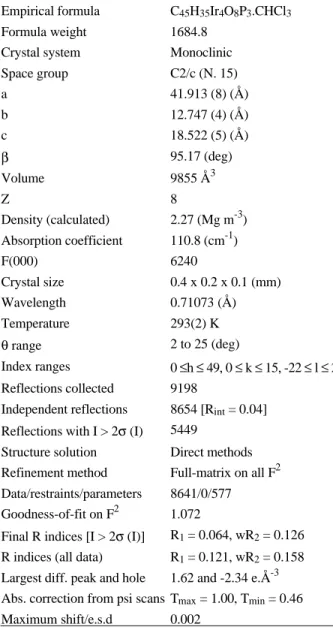
diffractome-ter. Crystal and refinement details are given in Table 2. Non-H atoms were located by heavy atom methods and the structure refined using SHELXS-8624 and refined on F2 with all reflections using SHELXS-9324. Hydrogen atoms were included in rigid mode.
Atomic coordinates, thermal parameters and a full list of bond lengths and angles have been deposited at the Cambridge Crystallographic Data Centre.
Acknowledgements
We acknowledge financial support from the Commis-sion of European Communities, Conselho Nacional de Desenvolvimento Científico e Tecnológico - CNPq (M.H.A, M.D.V) and Fundação de Amparo à Pesquisa do Estado de São Paulo - FAPESP (M.H.A). We thank Dr. Anthony G. Avent for all his help with the NMR experi-ments.
References
1. Sappa, E.; Tiripicchio, A.; Braunstein, P. Chem. Rev.
1983, 83, 203; Shapley, J.R.; McAteer, C.H.;
Chur-chill, M.R.; Biondi, L.V. Organometallics 1984, 3, 1595; Riaz, V.; Curtis, M.D.; Rheingold, A.; Hag-gerty, B.S. Organometallics 1990, 9, 2647; Mat-suzaka, H.; Mizobe, Y.; Nishio, M.; Hidai, M. J. Chem. Soc., Chem. Commun. 1991, 1011.
2. Pereira, R.M.S. Ph.D. Thesis, Universidade Estadual de Campinas, Brazil, 1996.
3. Nixon, J.F. Chem. Rev. 1988, 88, 1327; Chem. Ind.
1993, 404; Coord. Chem. Rev. 1995, 145, 201; Chem.
Soc. Rev. 1995, 319; Dillon, K.B.; Mathey, F.; Nixon, J.F. Phosphorus: The Carbon Copy 1998, Ed. John Wiley.
4. Imhof, W.; Huttner, G. J. Organomet. Chem. 1993, 447, 31.
5. Binger, P.; Milczarek, R.; Mynott, R.; Regitz, M. J. Organomet. Chem. 1987, 323, C35; Regitz, M. In Multiple Bond and Low Coordination in Phosphorus Chemistry, Ed. Regitz, M.; Scherer, O.J., Georg Thieme Verlag, Stuttgart, 1990, Chapter 2.
6. Appel, R. In Multiple Bonds and Low Coordination in Phosphorus Chemistry, Ed. Regitz, M.; Scherer, O.J., Georg Thieme Verlag, Stuttgart, 1990, Chapter 2. 7. Benvenutti. M.H.A.; Vargas, M.D.; Braga, D.;
Grepioni, F.; Mann, B.E.; Naylor, S. Organometallics
1993, 12, 2947 and references therein.
8. Sappa, E.; Pasquinelli, G.; Tiripicchio, A.; Tiripic-chio-Camellini, M. J. Chem. Soc., Soc., Dalton Trans.
1989, 601 and references therein.
9. Chi, Y.; Hwang, D.-K.; Chen, S.-F.; Liu, L.-K. J. Chem. Soc., Chem. Commun. 1989, 1540; Chi, Y.; Huttner, G.; Imhof, W. J. Organomet. Chem. 1990, 384, 93.
Table 2. Crystal data and details of measurements for compound 2.
Empirical formula C45H35Ir4O8P3.CHCl3
Formula weight 1684.8 Crystal system Monoclinic Space group C2/c (N. 15)
a 41.913 (8) (Å)
b 12.747 (4) (Å)
c 18.522 (5) (Å)
β 95.17 (deg)
Volume 9855 Å3
Z 8
Density (calculated) 2.27 (Mg m-3) Absorption coefficient 110.8 (cm-1)
F(000) 6240
Crystal size 0.4 x 0.2 x 0.1 (mm) Wavelength 0.71073 (Å) Temperature 293(2) K
θ range 2 to 25 (deg)
Index ranges 0 ≤h ≤ 49, 0 ≤ k ≤ 15, -22 ≤ l ≤ 21 Reflections collected 9198
Independent reflections 8654 [Rint = 0.04]
Reflections with I > 2σ (I) 5449
Structure solution Direct methods Refinement method Full-matrix on all F2 Data/restraints/parameters 8641/0/577 Goodness-of-fit on F2 1.072
Final R indices [I > 2σ (I)] R1 = 0.064, wR2 = 0.126
R indices (all data) R1 = 0.121, wR2 = 0.158
Largest diff. peak and hole 1.62 and -2.34 e.Å-3 Abs. correction from psi scans Tmax = 1.00, Tmin = 0.46
10. Benvenutti, M.H.A.; Hitchcock, P.B.; Nixon, J.F.; Vargas, M.D. J. Chem. Soc., Chem. Commun. 1994, 1869.
11. Araujo, M.H. Ph.D. Thesis, Universidade Estadual de Campinas, Brazil, 1995.
12. Verkade, J.G.; Mosbo, J.A. in Phosphorus-31 NMR Spectroscopy in Stereochemical Analysis, Ed. Verkade, J.G. and Quin, L.D., 1987, VHC, Chapter 13.
13. Doherty, S.; Corrigan, J.F.; Carty, A.J.; Sappa, E. Adv. Organomet. Chem. 37, 39.
14. Mann, B.E.; Pickup, B.T.; Smith, A.K. J. Chem. Soc., Dalton Trans. 1989, 889.
15. Mingos, D.M.P.; May, A.S. In Structural and Bonding Aspects of Metal Cluster Chemistry, Shriver, D.F.; Kaesz, H.D.; Adams, R.D., eds., VHC, 1990, 16, 4833.
16. Pereira, R.M.S.; Fijiwara, F.Y.; Vargas, M.D.; Braga, D.; Grepioni, F. Organometallics 1997, 16, 4833. 17. Vargas, M.D.; Pereira, R.M.S.; Braga, D.; Grepioni,
F. J. Chem. Soc., Chem. Commun. 1993, 1008. 18. Benvenutti. M.H.A.; Vargas, M.D.; Braga, D.;
Grepioni, F.; Parisini, E.; Mann, B.E. Organometal-lics 1993, 12, 2955, and references therein.
19. Hobbold, M.; Streubel, R.; Benvenutti, M.H.A.; Hitchcock, P.B.; Nixon, J.F. Organometallics 1997, 16, 3726.
20. Bedford, R.B.; Hill, A.F.; Jones, C.; White, A.J.P.; Wilton-Ely, J.D.E.T. J. Chem. Soc., Dalton Trans.
1997, 139.
21. Binger, P.; Sandmeyer, F.; Krüger, C.; Jörg, K.; God-dard, R.; Erker, G. Angew. Chem. Int. Ed. Engl. 1994, 33, 197.
22. Sappa, E.; Pasquinelli, G.; Tiripichio, A.; Camellini, M.T. J. Chem. Soc., Dalton Trans. 1989, 601 and references therein.
23. Mann, B.E. Adv. Organomet. Chem. 1988, 28, 397 and references therein.
24. Enraf-Nonius, CAD-4 Software. Version 5.0, 1989. Enraf-Nonius, The Netherlands. Sheldrick, G.M., 1985, SHELXS-86. Program for the Solution of Crys-tal Structures. University of Gottingen Germany. Sheldrick, G.M. (1993) SHELXL-93. Program for Crystal Structure Refinement. University of Gottin-gen, Germany. Watkin, D.J. and Pearce, L.J., 1993 CAMERON. An Interactive Graphics Editor. Univer-sity of Oxford, England.
![Figure 3. Molecular Structure of [Ir 4 (µ-CO)(CO) 7 (µ 4 -η 3 -Ph 2 PC(H)- PC(H)-C(Ph)PCBu t )(µ-PPh 2 )] 2](https://thumb-eu.123doks.com/thumbv2/123dok_br/18988047.459589/4.918.480.814.437.751/figure-molecular-structure-ir-co-co-pcbu-pph.webp)