Cross-cultural adaptation and analysis
of the psychometric properties of the
Balance Evaluation Systems Test and MiniBESTest in
the elderly and individuals with Parkinson’s disease:
application of the
Rasch
model
Angélica C. Maia1, Fátima Rodrigues-de-Paula2,
Lívia C. Magalhães3, Raquel L. L. Teixeira1
ABSTRACT | Background: Older adults and individuals with neurological problems such as Parkinson’s disease (PD) exhibit balance deicits that might impair their mobility and independence. The assessment of balance must be useful in identifying the presence of instability and orient interventions. Objective: To translate and perform a cross-cultural adaptation of the Balance Evaluation Systems Test (BESTest) and MiniBESTest to Brazilian Portuguese and analyze its
psychometric properties. Method: The tests were translated and adapted to Portuguese according to a standard method and then subjected to a test-retest reliability assessment (10 older adults; 10 individuals with PD). The psychometric properties were assessed by the Rasch model (35 older adults; 35 individuals with PD). Results: The reliability coeficient of the
tests relative to the items and subjects varied from 0.91 and 0.98, which is indicative of the stability and reproducibility of the measures. In the BESTest, the person (4.19) and item (5.36) separation index established six balance ability levels and seven levels of dificulty, respectively. In the MiniBESTest, the person (3.16) and item (6.41) separation index established four balance ability levels and nine levels of dificulty, respectively. Two items in the BESTest did not it with the model expectations, but the construct validity was not compromised. No item in the MiniBESTest was erratic. Conclusions: The results corroborate the diagnostic and screening functions of the BESTest and MiniBESTest, respectively, and indicate that the Brazilian versions exhibit adequate reliability, construct validity, response stability, and capacity to distinguish among various balance ability levels in older adults and individuals with PD.
Keywords: postural balance; physical therapy; Parkinson’s disease; older adults; cross-cultural adaptation; Rasch analysis.
HOW TO CITE THIS ARTICLE
Maia AC, Rodrigues-de-Paula F, Magalhães LC, Teixeira RLL. Cross-cultural adaptation and analysis of the psychometric properties of the Balance Evaluation Systems Test and MiniBESTest in the elderly and individuals with Parkinson’s disease: application of the Rasch model. Braz J Phys Ther. 2013 May-June; 17(3):195-217.http://dx.doi.org/10.1590/S1413-35552012005000085
1 Physical therapist, Belo Horizonte, MG, Brazil
2 Department of Physical Therapy, Universidade Federal de Minas Gerais (UFMG), Belo Horizonte, MG, Brazil 3 Department of Occupational Therapy, UFMG, Belo Horizonte, MG, Brazil
Received: 03/30/2012 Revised: 08/23/2012 Accepted: 01/20/2013
a r t i c l e
Introduction
Posture control (PC) is the ability to maintain
the projection of the body center-of-mass within
the limits of the base of support under static and
dynamic conditions and involves the control of the
body position in space for the purpose of ensuring
stability and orientation
1. PC depends on the visual,
vestibular, somatosensory, nervous, biomechanical,
and cognitive systems
1,2that are exposed to different
types of dysfunctions.
Older adults are liable to acquire balance disorders
as a function of multiple impairments, such as
multisensory loss, muscle weakness, and orthopedic
and cognitive limitations
3. Such impairments cause
functional losses, and the balance disorders must
be appropriately assessed and treated due to their
impact on the quality of life and their high inancial
onus relative to their health care costs
4,5. In addition,
several neurological conditions are associated with
postural instability, with Parkinson’s disease (PD)
being the most common movement disorder. The
estimated prevalence of PD is 100-200 cases/100,000
inhabitants
6. From the clinical point of view, PD
is characterized by motor dysfunctions such as
bradykinesia, tremor, and rigidity. Postural instability
tends to appear during the course of the disease
and is associated with falls, limited mobility and
Balance disorders are some of the most common
problems treated by physical therapists. These
health professionals need to identify the patients’
instability and select the most appropriate approach
to rehabilitation
8. The current clinical tests for
balance assessment focus on the detection of balance
disorders and the prediction of the risk of falls
9-13.
The Berg Balance Scale is one of the most widely
used tests. Its ceiling effect has been identiied in
the evaluation of more subtle balance disorders that
occur in older adults or at the initial stages of PD
12-14.
Horak et al.
8formulated the
Balance Evaluation
Systems Test
(BESTest) to help in the identiication
of the particular system that may be responsible
for poor balance and thus guide the treatment. The
BESTest is a versatile instrument that might be
applied to individuals at any age and with a broad
scope of diseases and severity levels
8. It comprises 27
items and a total of 36 tasks. The items are clustered
in sections corresponding to the six underlying
systems that may constrain balance: biomechanical,
stability limits, postural responses, anticipatory
postural adjustments, sensory orientation, and
dynamic balance during gait. Each item is scored
on an ordinal four-point scale varying from zero to
three (best performance). A shorter version known
as the MiniBESTest
14comprises 14 of the items from
the full version. As its application is faster than the
full version, it is useful to screen dynamic balance
disorders
14.
Both the BESTest and MiniBESTest were
originally elaborated in English. Thus, they must
be translated and cross-culturally adapted, and
their psychometric properties must be assessed
15.
Therefore, the aims of the present study were to
translate and conduct the cross-cultural adaptation
of the BESTest and MiniBESTest to Brazilian
Portuguese and to analyze their psychometric
properties in older adults and individuals with PD.
Method
Participants
The study comprised a convenience sample
including 35 older adults recruited in the community
and 35 individuals with idiopathic PD diagnosed
and recruited at the university outpatient clinic. The
two groups included individuals from both genders.
Nonetheless, volunteers with cognitive deicits on
the Mini Mental State Examination (MMSE)
16,17or
adverse clinical conditions, such as hemodynamic
and/or clinical instability, were excluded. The group
of older adults comprised individuals aged 65 years
old or older and volunteers previously diagnosed with
balance-affecting illnesses were excluded. The group
of PD patients comprised individuals aged 50 years
old or older, and those volunteers exhibiting other
neurological diseases were excluded. The patients
with PD were assessed within one hour from the
intake of antiparkinsonian medication.
The study was approved by the Research Ethics
Committee of the Universidade Federal de Minas
Gerais - UFMG, Belo Horizonte, MG, Brazil and the
participants signed informed consent forms.
Procedures and instruments of measures
Translation and cross-cultural adaptation
The process of translation and cross-cultural
adaptation followed the method suggested by
Beaton et al.
18, which consists of six stages.
In stage one, the instruments were translated into
Brazilian Portuguese by two independent bilingual
translators who were native Portuguese speakers.
In stage two, the two translations were synthesized
into one consensus version, which was used as
the basis for backward translation (stage three).
This backward translation was performed by two
independent translators who were native English
speakers. These translators were blinded to the study
aims and had no formal training in the health sciences.
In stage four, the inal version of the instruments was
revised by a panel of experts, who were charged with
consolidating the questionnaires and prepare the
pre-inal version
18.
In stage ive, the instruments were subjected to
pretesting, during which they were applied to 10 older
adults and 10 individuals with PD. The participants
expressed no doubts as to the meaning of the BESTest
items, and the responses showed no ambiguity;
therefore, no changes had to be made to the translated
version. In the case of the MiniBESTest, the examiner
expressed doubts with the scoring of items seven
and eight. The authors of the original version were
contacted and recommended modifying the wording
of the last sentence of the examiner’s instructions in
the corresponding items to “
Include inclination or hip
strategy as ‘instability’, and score one level below”.
Thus, the inal Brazilian versions of the BESTest
(Appendix 1) and MiniBESTest (Appendix 2) were
concluded. Communication with the authors of the
original instruments was maintained throughout the
entire process to improve the inal version (stage
First, clinical, demographic, and anthropometric
data were collected. Next, the volunteers were
evaluated with BESTest and MiniBESTest by
a trained examiner. The disease severity of the
individuals with PD was rated according to the
Hoehn and Yahr Scale (HY)
19,20. Patients in stage
0 (zero) do not exhibit any sign of disease, those in
stages 1 to 2.5 exhibit mild disability, those in stage
3 exhibit moderate disability, and those in stages 4
and 5 exhibit severe disability
21. The individuals with
PD were also assessed by the Motor Examination
of the
Unified Parkinson’s Disease Rating Scale
(UPDRS)
22, which serves to assess the progression
of PD and the effects of therapeutic interventions
22.
Test-retest reliability
To test their reliability, the BESTest and the
MiniBESTest were applied twice with a seven-day
interval to the irst 10 older adults and the irst 10
individuals with PD included in the study. The
reliability of the tests was assessed by the intraclass
correlation coeficient (ICC).
Statistical analysis
Descriptive statistics were used to characterize
the sample. The ICC was calculated using
software
SPSS for
Windows
version 17.0.
According to Portney and Watkins
23, the test-retest
reliability is appropriate when ICC >0.75, whereas
ICC<0.75 indicates poor to moderate reliability.
The inal versions of the instruments were assessed
using
Rasch
analysis, which is a probabilistic model
widely used in the ield of rehabilitation to evaluate
the psychometric properties of scales
24. This analysis
allows for the dificulty of the items and the abilities
of the individuals to be calibrated on the same linear
continuum. This linear continuum was divided into
equal intervals (logits) along which each item and
individual were aligned
24,25. The basic assumption of
the present study was that the better the individual’s
balance, the greater his or her odds to score high in
the investigated tests.
The analysis was performed using software
Winsteps,
version 3.72.3/2011
26, which calculates
values such as
MnSq
and
t
in two formats:
infit
and
outfit
. The init statistic is sensitive to the variation of
the scores representing the subjects’ abilities, and the
outit statistic relects the occurrence of unexpected
responses
25,27. These values are used to establish
whether the items it with the unidimensionality
concept, with values of
MnSq
=1±0.4 associated with
t
=±2 being acceptable
27. Erratic scores represent a
threat to the validity of a test and must be revised.
The condition in which more than 5% of the items
of a scale exhibit erratic scores indicate that the
corresponding combination of items is not able to
measure a unidimensional construct
27, and a lower
rate of erratic scores indicates that a particular set of
items is able to deine a dimension or construct
24,25,27.
As the BESTest comprises 36 items (taking into
consideration the tasks scored separately for the right
and left sides of the body), up to two (1.8 rounded)
items are allowed to not it with the model.
The
Rasch
model further includes the person and
item separation indices, which indicate the number of
ability levels among which the individuals might be
distributed and the number of dificulty levels among
which the items are distributed, respectively
24,25,27.
The number of levels among which the individuals
and items could be distributed was calculated using
the equation recommended by Bond and Fox
27. A
satisfactory test divides the subjects into at least
three ability levels: low, medium, and high
25. Ideally,
the estimated values of reliability to calibrate the
measures must be >0.80
27.
Results
Sample characterization
The average values of the parameters assessed
in the group of older adults were the following:
age=73.8±7.4 years old (65-97), body mass index
(BMI) =25.6±3.7 (19.1-33.6), and MMSE=24.5±4.3
(13-30). Four volunteers were illiterate. In addition,
most (18) of the volunteers had up to four years of
schooling, eight had ive to eight years, four had
inished secondary school, and one had inished
college. Of these 35 older adults, 26 were female, and
one used a Canadian cane. In this subsample, 45.7%
were married, 31.4% were widowers, 14.3% were
single, and 8.5% were separated/divorced. Fourteen
volunteers were sedentary, and 21 exercised using
at least one of the following modalities: walking,
dancing, yoga, and weight training.
secondary school, and four had inished college.
Of these 35 participants, 14 were women, two used
common canes, and one used a Canadian cane. In
this subsample, 62.9% were married, 17.1% were
widowers, 14.3% were separated/divorced, and 5.8%
were single. Sixteen volunteers were sedentary, and
nineteen exercised using at least one of the following
modalities: walking, water aerobics, weight training,
and
T’ai Chi Ch’uan
.
Test-retest reliability
The ICC values of both tests were adequate
(>.90)
23. The ICC value of the BESTest in the
population of older adults was 0.98 and was 0.92
in the individuals with PD. The ICC values of the
MiniBESTest were 0.99 and 0.95, respectively.
Rasch analysis
In the BESTest, the calibration stability of the
items and individuals was 0.97 and 0.95, respectively.
The results of the
Rasch
analysis relative to the
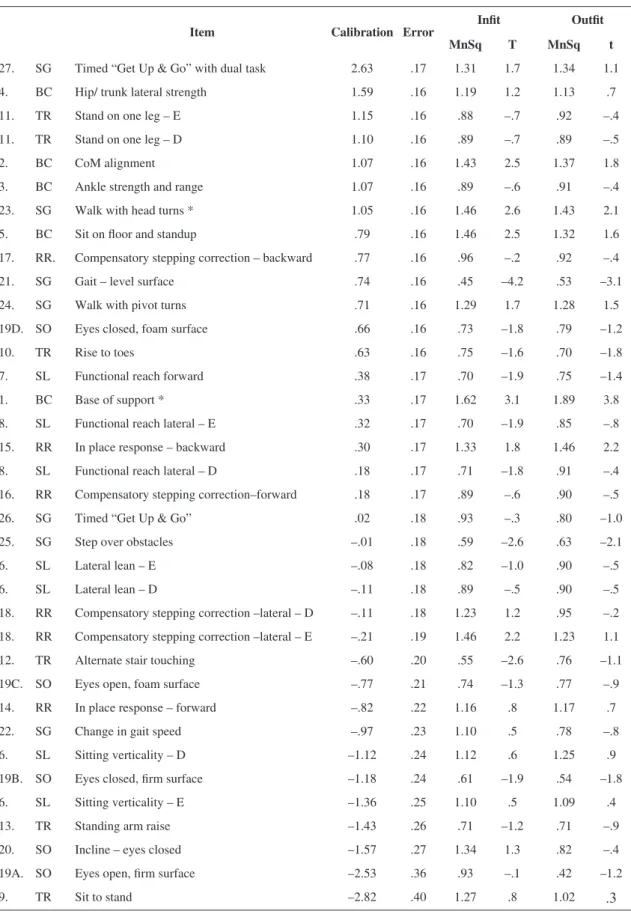
BESTest are described in Table 1, in which the
values of the calibration or dificulty of items, MnSq
and t (init and outit) are individually reported. The
individual separation index was 4.19, which indicates
that the items distributed the subjects among six
balance ability levels. The item separation index
was 5.36, which corresponds to approximately seven
levels of dificulty.
In Table 1, the items are listed in decreasing order
of dificulty. Item 27, “
Timed
Get Up & Go With
Dual Task
”, was the most dificult, and item 9, “
Sit to
Stand
”, was the easiest one. As a whole, the items were
well distributed as virtually all the sections included
items with low, medium, and high dificulty, except
for the section “Biomechanical constraints”, which
contains items that are concentrated at the upper area
of the continuum and that thus are primarily more
dificult. Among the 36 items included in the test,
two had erratic scores, i.e., did not it with the model
expectations, which were item 1, “
Base of support
”,
and item 23, “
Walk with head turns
”.
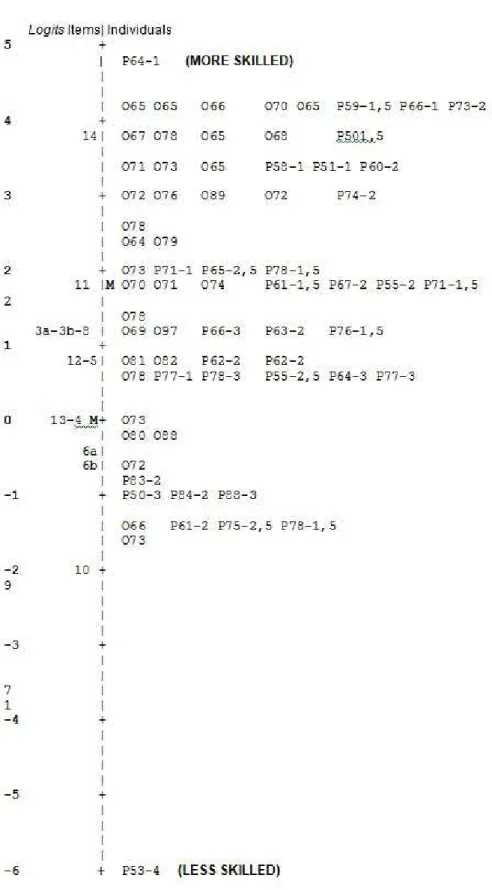
Figure 1 represents a map that depicts the levels of
dificulty of the items on the left and the continuum
of the ability of the sample balance on the right, as
measured by the BESTest. No items were aligned at
the level of the individuals at either endpoint. Most
items exhibited medium dificulty, whereas very easy
and very dificult items, which might distinguish the
individuals more accurately, were missing, although
a ceiling effect did not occur. Most of the older
adults exhibited medium to high abilities, and most
individuals with PD exhibited medium abilities.
Among the latter, those at the initial stages of the
disease (HY=1-2.5; UPDRS=17.2±7.1) were located
at the upper area of the continuum, which denotes
better balance than the individuals in the moderate
and severe stages (HY=3 and 4; UPDRS=30.4±5.7),
who clustered towards the middle and lower areas,
denoting worse balance.
In the
Rasch
analysis of the MiniBESTest,
the individual separation index was 3.16, which
indicates that the items distributed the subjects among
approximately four levels of balance ability. The
item separation index was 6.41, which corresponds
to approximately nine levels of difficulty. The
calibration stability of the items and individuals was
0.98 and 0.91, respectively. Similar to the full version,
in the MiniBESTest, “
Timed Get Up & Go With Dual
Task
” (item 14) was the most dificult, and “
Sit to
Stand”
(item 1) was the easiest one. All the items
it with the model expectations (average calibration
of 1.7 logits; average values of the subjects,
infit
[
MnSq
=0.98;
t
=0] and
outfit
[
MnSq
= 0.98 and
t
=0.2]);
average values of the items,
infit
: [
MnSq
= 1.0 and
t
=0] and
outfit
[
MnSq=
0.98 and
t
=0]).
Figure 2 shows a map that depicts the continuum
of the dificulty of the items on the left and the
sample balance ability continuum on the right,
as measured by the MiniBESTest. Similar to the
full version, in this case, most items had medium
dificulty, whereas items allowing the assessment
of the individuals with very high or very low ability
were lacking. Additionally, here, the individuals with
PD exhibited a tendency to poorer balance than the
older adults as the latter clustered in the upper area
and the former in the middle area of the graphic. The
individuals at the initial stages of PD (HY=1-2.5;
UPDRS=17.2±7.1) tended to exhibit better balance
and clustered in the upper area of the continuum,
whereas those at the moderate and severe stages
(HY=3 and 4; UPDRS=30.40±5.7) tended to exhibit
poorer balance and clustered in the middle and lower
areas of the graphic.
Discussion
Table 1. Calibration of BESTest items.
Item Calibration Error Infit Outfit
MnSq T MnSq t
27. SG Timed “Get Up & Go” with dual task 2.63 .17 1.31 1.7 1.34 1.1 4. BC Hip/ trunk lateral strength 1.59 .16 1.19 1.2 1.13 .7
11. TR Stand on one leg – E 1.15 .16 .88 –.7 .92 –.4
11. TR Stand on one leg – D 1.10 .16 .89 –.7 .89 –.5
2. BC CoM alignment 1.07 .16 1.43 2.5 1.37 1.8 3. BC Ankle strength and range 1.07 .16 .89 –.6 .91 –.4 23. SG Walk with head turns * 1.05 .16 1.46 2.6 1.43 2.1 5. BC Sit on loor and standup .79 .16 1.46 2.5 1.32 1.6 17. RR. Compensatory stepping correction – backward .77 .16 .96 –.2 .92 –.4 21. SG Gait – level surface .74 .16 .45 –4.2 .53 –3.1 24. SG Walk with pivot turns .71 .16 1.29 1.7 1.28 1.5 19D. SO Eyes closed, foam surface .66 .16 .73 –1.8 .79 –1.2 10. TR Rise to toes .63 .16 .75 –1.6 .70 –1.8 7. SL Functional reach forward .38 .17 .70 –1.9 .75 –1.4 1. BC Base of support * .33 .17 1.62 3.1 1.89 3.8 8. SL Functional reach lateral – E .32 .17 .70 –1.9 .85 –.8 15. RR In place response – backward .30 .17 1.33 1.8 1.46 2.2 8. SL Functional reach lateral – D .18 .17 .71 –1.8 .91 –.4 16. RR Compensatory stepping correction–forward .18 .17 .89 –.6 .90 –.5 26. SG Timed “Get Up & Go” .02 .18 .93 –.3 .80 –1.0
25. SG Step over obstacles –.01 .18 .59 –2.6 .63 –2.1
6. SL Lateral lean – E –.08 .18 .82 –1.0 .90 –.5 6. SL Lateral lean – D –.11 .18 .89 –.5 .90 –.5 18. RR Compensatory stepping correction –lateral – D –.11 .18 1.23 1.2 .95 –.2 18. RR Compensatory stepping correction –lateral – E –.21 .19 1.46 2.2 1.23 1.1 12. TR Alternate stair touching –.60 .20 .55 –2.6 .76 –1.1 19C. SO Eyes open, foam surface –.77 .21 .74 –1.3 .77 –.9 14. RR In place response – forward –.82 .22 1.16 .8 1.17 .7 22. SG Change in gait speed –.97 .23 1.10 .5 .78 –.8 6. SL Sitting verticality – D –1.12 .24 1.12 .6 1.25 .9 19B. SO Eyes closed, irm surface –1.18 .24 .61 –1.9 .54 –1.8 6. SL Sitting verticality – E –1.36 .25 1.10 .5 1.09 .4
13. TR Standing arm raise –1.43 .26 .71 –1.2 .71 –.9
20. SO Incline – eyes closed –1.57 .27 1.34 1.3 .82 –.4 19A. SO Eyes open, irm surface –2.53 .36 .93 –.1 .42 –1.2
9. TR Sit to stand –2.82 .40 1.27 .8 1.02
.3
The
Rasch
analysis performed in the present
study showed a calibration stability of the items
and individuals in both investigated tests, indicating
that the measures were stable and reproducible.
In the original versions, both instruments were
considered to be reliable and valid to assess balance
in individuals with PD
9,14.
Item 27, “
Timed Get Up & Go With Dual Task
”,
was considered to be the most dificult, which agrees
with the results of another study
29. The performance
of cognitive tasks (e.g., doing calculations and
spelling words backwards) while walking is known to
make the gait unstable
30, requiring a greater ability to
perform the latter task. Item 9, “
Sit to stand
”, was the
least dificult and did not pose a challenge to balance
in the present sample. The sample mostly comprised
individuals with medium to high abilities and patients
in the initial stages of PD, who were thus able to
perform this task easily. Most items in the BESTest
and MiniBESTest had medium dificulty (Figures 1
and 2, left side), and these tests lacked very easy and
very dificult items, which would allow for the better
assessment of the subjects, especially those with high
performance levels. For this reason, the BESTest and
MiniBESTest should be applied to populations other
than the one included in the present study, such as
youths and individuals with other diseases.
In the case of the BESTest, the
Rasch
analysis
found only two erratic items (1 and 23); therefore,
the combination of items was appropriate for the
assessment of a unidimensional construct
25,27. Item
1, “Base of support” is scored by the examiner
(presence or not of considerable deformities) and the
subject (presence or not of pain in the lower limbs)
together, which might account for the erratic scores.
Pain is an individual and subjective experience that
might be associated or not with actual or potential
tissue damage, and it can become increased by
negative emotional states
31. However, chronic pain
might also induce adaptive behaviors, leading the
affected individual to not have signs
32-34. Therefore,
examiners should pay special attention to individuals
with depressive and negative behavior with regards
to the pain. This observation should not be used to
calculate the item differentially but to collect relevant
information on the functional loss. In turn, item 23,
“
Walk with head turns
”, involved two simultaneous
activities: walking in a straight line and turning the
head. Therefore, it is a complex task that demands
quick responses from the vestibular system
1,
which might be affected by aging or disease
1,3.
Individuals with PD have dificulty in performing
simultaneous activities, and as a rule, they exhibit
poorer performance in one of the tasks
35. Four
volunteers in the present sample exhibited unexpected
low scores in this item, including three older adults
(O68, O69, and O78) and one individual with PD
(P67; HY=2; UPDRS=25). The individuals were
independent and had no dysfunctions; therefore,
high scores were expected in item #23, similarly to
what was seen in other items. These four volunteers,
however, exhibited the minimum score because they
stopped walking to turn the head to the side, which
might represent a differentiated safety strategy. In
addition, as Table 1 shows, item 23 is among the most
dificult tasks. Therefore, the examiners should take
the issues discussed here into account upon scoring
this item.
The
Rasch
analysis showed a tendency in both
the BESTest and MiniBESTest to distinguish
between the groups of older adults and individuals
with PD as a function of their distribution within the
continuum. The older adults exhibited medium to
high balance ability levels, whereas the individuals
with PD exhibited medium levels. Other studies that
compared the raw scores of the BESTest between the
controls and individuals with neurological diseases
8and ibromyalgia
29also found a poorer balance ability
(lower scores) among the ill individuals
8,29.
The decisive factor in the distribution of the
individuals with PD was the severity of disease. Most
of the sample (77.1%) was at the initial stages of PD
(HY=1-2.5) and clustered in the upper area of the
continuum, whereas the participants at the moderate
and severe stages, HY=3 and 4 (22.9%), clustered
in the middle and lower areas of the continuum.
Although the Berg Balance Scale is the instrument
most widely used for the clinical assessment of
balance, it exhibits a ceiling effect in milder cases
of PD because those individuals attain the maximum
scores
12,13. The results of the present study show that
the BESTest and MiniBESTest exhibit a satisfactory
ability to detect subtle balance deicits, thus making
the distinction among individuals easier
28,36. This
ability may be due to the fact that these tests assess
gait and postural responses in addition to mobility
(also assessed in the Berg Balance Scale), which
might be affected at the earliest stages of disease
13.
version, resulting in less precise measures. These
data correspond to the expected distinction between
instruments designed for diagnostic and screening
purposes, respectively. In the present study, the
application of the BESTest lasted 25 minutes on
average, varying from 21 to 31 minutes. In the study
by Jones et al.
29, the average length was 17 minutes.
The application of the MiniBESTest usually requires
12 to 15 minutes
14,36. The examiners should pay
attention to the instructions described in the tests,
especially for the items with a tendency towards
variability in the responses.
The lack of frail older adults and the small
number of individuals with advanced stages of PD
might represent limitations of the present study. In
addition, these tests must be applied to other types
of populations in further studies for their validity to
be more widely assessed.
The
Rasch
analysis showed that the set of items
that compose the Brazilian versions of the BESTest
and MiniBESTest exhibits appropriate construct
validity, response stability, and discriminatory
capacity among various balance ability levels in older
adults and individuals with PD.
Acknowledgments
To the Conselho Nacional de Desenvolvimento
Cientiico e Tecnológico – CNPq and Fundação
de Amparo à Pesquisa do Estado de Minas
Gerais - FAPEMIG, Brazil.
References
1. Horak FB, Macpherson JM. Postural orientation and equilibrium. In: Rowel LB, Shepherd JT, editors. Handbook of Phisiology. A critical, comprehensive presentation of physiological knowledge and concepts. New York: Oxford University Press; 1996. p. 255-92. 2. Horak FB. Postural orientation and equilibrium: what
do we need to know about neural control of balance to prevent falls? Age Ageing. 2006;35 Suppl 2:ii7-ii11. PMid:16926210. http://dx.doi.org/10.1093/ageing/al077 3. Matsumura BA, Ambrose AF. Balance in the Elderly. Clin
Geriatr Med. 2006;22:395-412. PMid:16627085. http://
dx.doi.org/10.1016/j.cger.2005.12.007
4. Gonçalves DFF, Ricci NA, Coimbra AMW. Functional balance among community-dwelling older adults: a comparison of their history of falls. Rev Bras Fisioter. 2009;13(4): 316-23. http://dx.doi.org/10.1590/ S1413-35552009005000044
5. Borges LL, Garcia PA, Ribeiro SOV. Características clínico-demográficas, quedas e equilíbrio funcional de idosos institucionalizados e comunitários. Fisioter Mov. 2009;22(1):53-60.
6. Tanner C, Hubble J, Chan P, editors. Epidemiology and genetics of Parkinson›s disease. In: Watts RL, Koller WC, editors. Neurologic principles and Practice. New York: McGraw-Hill; 1996. p.137-152.
7. Lau LML, Breteler MMB. Epidemiology of Parkinson›s disease. Lancet Neurol. 2006;5:525-535. http://dx.doi. org/10.1016/S1474-4422(06)70471-9
8. Horak FB, Wrisley DM, Frank J. The Balance Evaluation Systems Test (BESTest) to Differentiate Balance Deicits. Phys Ther. 2009;89(5):484-498. PMid:19329772 PMCid:2676433. http://dx.doi.org/10.2522/ptj.20080071 9. Podsiadlo D, Richardson S. The timed “Up & Go”: a test
of basic functional mobility for frail elderly persons. J Am Geriatr Soc. 1991;39:142-148. PMid:1991946.
10. Berg KO, Maki B, Williams JI, Holliday PJ, Wood-Dauphinée S. Clinical and laboratory measures of postural balance in an elderly population. Arch Phys Med Rehabil. 1992;70:1073-1080.
11. Tinetti ME, Inouye SK, Gill TM, Doucette JT. Shared risk factors for falls, incontinence and functional dependence: unifying the approach to geriatric syndromes. J Am Med Assoc. 1995;273:1348-1353. http://dx.doi.org/10.1001/ jama.1995.03520410042024
12. Karuka AH, Silva JAM, Navega MT. Analysis of agreement of assessment tools of body balance in the elderly. Rev Bras Fisioter. 2011;15(6):460-6. PMid:22218711. http://
dx.doi.org/10.1590/S1413-35552011000600006 13. King LA, Priest KC, Salarian A, Pierce D, Horak FB.
Comparing the MiniBESTest with the Berg Balance Scale to Evaluate Balance Disorders in Parkinson’s Disease. Park Dis. 2012;2012. Epub 2011 October 24. http://dx.doi. org/10.1155/2012/375419
14. Franchignoni F, Horak FB, Godi M, Nardone A, Giordano A. Using psychometric techniques to improve the balance evaluation systems test: The Mini-BESTest. J Rehabil Med. 2010;42:316-324.
15. Guillemin F, Bombardier C, Beaton DE. Cross-cultural adaptation of health-related quality of life measures: literature review and proposed guidelines. J Clin Epidemiol. 1993;46:1417-1432. http://dx.doi. org/10.1016/0895-4356(93)90142-N
16. Bertolucci PH, Brucki SM, Campacci SR, Juliano Y. O mini exame do estado mental em uma população geral: impacto da escolaridade. Arq Neuropsiquiatr. 1994;52:1-7. PMid:8002795. http://dx.doi.org/10.1590/ S0004-282X1994000100001
17. Brucki S, Nitrini R, Caramelli P, Bertolucci PHF, Okamoto IH. Sugestões para o uso do Miniexame do estado mental no Brasil. Arq Neuropsiquiatr. 2003;61(3-B):777-781. PMid:14595482. http://dx.doi.org/10.1590/ S0004-282X2003000500014
18. Beaton DE, Bombardier C, Guillemin F, Ferraz MB. Guidelines for the Process of Cross-Cultural Adaptation of Self-Report Measures. Spine (Phila Pa 1976). 2000;25(24):3186-3191. PMid:11124735. http://
dx.doi.org/10.1097/00007632-200012150-00014 19. Hoehn M, Yahr M. Parkinsonism: onset, progression and
20. Goetz CG, Poewe W, Rascol O, Sampaio C, Stebbins GT, Counsell C, et al. Movement Disorder Society Task Force Report on the Hoehn and Yahr Staging Scale: Status and Recommendations. Mov Disord. 2004;19(9):1020-1028. PMid:15372591. http://dx.doi.org/10.1002/mds.20213 21. Goulart F, Pereira LX. Uso de escalas para avaliação
da doença de Parkinson em fisioterapia. Fisioter Pesqui. 2005;11(1):49-56.
22. Goetz C, Poewe W, Rascol O, Sampaio C, Stebbins GT. The Unified Parkinson’s Disease Rating Scale (UPDRS): Status and Recommendations. Mov Disord. 2003;18(7):738-750. PMid:12815652. http://
dx.doi.org/10.1002/mds.10473
23. Portney LG, Watkins MP. Foundations of Clinical Research: Applications to Practice. 3rd ed. Upper Saddle River: Prentice-Hall; 2009. 892 p.
24. Kielhofner G. Research in Occuptional Therapy. Methods for Inquiry Practice. FA Davies; 2006. p.184-200. 25. Silverstein BF, Fisher WP, Kilgore KM, Harley JP,
Harvey RF. Applying psychometric criteria to functional assessment in medical rehabilitation: Deining interval measures. Arch Phys Med Rehabil. 1992;73:507-518. PMid:1622298.
26. Linacre JM. Winsteps Rasch Measurement Version 3.72.3 [Software]. Available from: http://www.winsteps.
com. 2011.
27. Bond TG, Fox CM. Applying the Rasch model: fundamental measurement in the human sciences. Mahwal: Lawrence Erlbaum Associates; 2001. 288 p. 28. Leddy AL, Crowner BE, Earhart GM. Functional Gait
Assessment and Balance Evaluation System Test: reliability, validity, sensitivity, and specificity for identifying individuals with Parkinson disease who fall. Phys Ther. 2011;91:102-113. PMid:21071506 PMCid:3017321. http://dx.doi.org/10.2522/ptj.20100113 29. Jones KD, Horak FB, Winters KS, Morea JM, Bennett
RM. Fibromyalgia is Associated with Impaired Balance and Falls. J Clin Rheumatol. 2009;15(1):16-21.
PMid:19125137 PMCid:2836495. http://dx.doi. org/10.1097/RHU.0b013e318190f991
30. Hollman JH, Kovash FM, Kubik JJ, Linbo RA. Age-related differences in spatiotemporal markers of gait stability
during dual task walking.Gait Postur. 2007;26(1):113-119. PMid:16959488. http://dx.doi.org/10.1016/j. gaitpost.2006.08.005
31. Da Silva JA, Ribeiro-Filho NP. Avaliação e Mensuração de Dor - Pesquisa, Teoria e Prática. São Paulo: FUNPEC; 2006. 467 p.
32. Philips HC, Grant L. The evolution of chronic back pain problems: a longitudinal study. Behav Res Ther. 1991;29(5):435-441. http://dx.doi. org/10.1016/0005-7967(91)90127-O
33. Hall AJ, Kalra L. Measuring quality of life: who should measure quality of life. BMJ. 2001;322(7299):1417-20. http://dx.doi.org/10.1136/bmj.322.7299.1417
34. Retinck ICM, Ketelaar M, Jongmans KJ, Gorter JW. Parents of children with cerebral palsy: a review of factors related to the process of adaptation. Child. 2006;33(2):161-169. 35. Berardelli A, Rothwell JC, Thompson PD, Hallett M.
Pathophysiology of bradykinesia in Parkinson’s disease. Brain. 2001; 124: 2131-46. PMid:11673316. http://dx.doi. org/10.1093/brain/124.11.2131
36. Leddy AL, Crowner BE, Earhart GM. Utility of MiniBESTest, BESTest and BEStest sections for
balance assessment in individuals with Parkinson’s
Disease. JNPT. 2011;35(2): 90-97. PMid:21934364 PMCid:3178037.
Correspondence
Fátima Rodrigues-de-Paula
Universidade Federal de Minas Gerais Departamento de Fisioterapia
Appendix 1. Translated version of BESTest to Brazilian Portuguese.
BESTest
Avaliação do Equilíbrio – Teste dos Sistemas
NÚMERO DO TESTE / CÓDIGO DO INDIVÍDUO _________________ DATA ____/____/______
NOME DO EXAMINADOR __________________________________
Instruções do BESTest para o EXAMINADOR
1. Os indivíduos devem ser testados com sapatos sem salto ou sem sapatos e meias.
2. Se o indivíduo precisar de um dispositivo de auxílio para um item, pontue aquele item em uma categoria
mais baixa.
Equipamentos necessários
• Cronômetro
• Fita métrica ixada na parede para o Teste de Alcance Funcional (
Functional Reach Test
)
• Um bloco da espuma Tempur
®(densidade média) de 10 cm de altura e com aproximadamente 60 × 60 cm
• Rampa de 10º de inclinação (pelo menos 60 × 60 cm) para icar de pé
• Degrau de escada, 15 cm de altura para tocar os pés alternadamente
• Duas caixas de sapato empilhadas para servir de obstáculo durante a marcha
• Peso livre de 2,5 kg para levantamento rápido do braço
• Cadeira irme com braços e marcação no chão com ita 3 metros à frente para o Teste “
Timed Get Up
and Go
”
• Fita crepe para marcar 3 metros e 6 metros no chão para o Teste “
Timed Get Up and Go
”
RESUMO DO DESEMPENHO: CALCULAR PORCENTAGEM DE PONTUAÇÃO
Seção I: ________/15 x 100 = _______ Restrições biomecânicas
Seção II: ________/ 21 x 100 = _______ Limites de estabilidade/ verticalidade
Seção III: ________/18 x 100 = _______Transições/ antecipatório
Seção IV ________/18 x 100 = _______ Reativo
Seção V: ________/15 x 100 = _______ Orientação sensorial
Seção VI: ________/21 x 100 = _______Estabilidade na marcha
TOTAL: ________/108 pontos = _____ Percentual total da pontuação
BESTest
Avaliação de Equilíbrio – Teste dos Sistemas
Os indivíduos devem ser testados com sapatos sem salto ou sem sapatos e meias. Se o indivíduo precisar de
dispositivo de auxílio para um item, pontue aquele item em uma categoria mais baixa. Se o indivíduo requerer
assistência física para executar um item, pontue na categoria mais baixa (0) para aquele item.
I. RESTRIÇÔES BIOMECÂNICAS ... (SEÇÃO I: _____/ 15 PONTOS)
1. BASE DE APOIO
(3) Normal: Ambos os pés têm base de apoio normal sem deformidades ou dor.
(2) Um pé tem deformidade e/ou dor.
(1) Ambos os pés têm deformidades
ou
dor.
(0) Ambos os pés têm deformidades
e
dor.
2. ALINHAMENTO DO CENTRO DE MASSA (CDM) (*AP: ÂNTERO-POSTERIOR; *ML:
MÉDIO-LATERAL)
3. FORÇA E AMPLITUDE DE TORNOZELO
(3) Normal: Capaz de icar na ponta dos pés com altura máxima e icar nos calcanhares com a ponta
dos pés para cima
(2) Comprometimento dos lexores ou extensores do tornozelo em um dos pés (i. e. menos que a
altura máxima)
(1) Comprometimento nos dois grupos do tornozelo (i. e. lexores bilaterais ou ambos lexores e
extensores de tornozelo de um pé)
(0) Ambos lexores e extensores nos tornozelos direito e esquerdo comprometidos (i.e. menos que
altura máxima)
4. FORÇA LATERAL DE QUADRIL/ TRONCO
(3) Normal: Abduz ambos os quadris para levantar o pé do chão durante 10 s enquanto mantém o
tronco na vertical
(2) Leve: Abduz ambos os quadris para levantar o pé do chão durante 10 s, mas não mantém tronco
na vertical
(1) Moderada: Abduz apenas um quadril para levantar o pé do chão durante 10 s com tronco na vertical
(0) Grave: Não abduz nenhum dos quadris para levantar o pé do chão durante 10 s com o tronco
na vertical ou não
5. SENTAR NO CHÃO E LEVANTAR (
Tempo______________ segundos).
(3) Normal: Senta e levanta do chão independentemente
(2) Leve: Usa uma cadeira para sentar no chão
ou para levantar
(1) Moderado: Usa uma cadeira para sentar no chão e para levantar
(0) Grave: Não senta no chão nem levanta, mesmo com uma cadeira, ou se recusa
II. LIMITES DE ESTABILIDADE ... (SEÇÃO II: _____/ 21 PONTOS)
6. VERTICALIDADE SENTADO E INCLINAÇÃO LATERAL
Inclinação
E D
(3) (3) Inclinação máxima, o indivíduo
move os ombros além da linha média
do corpo, muito estável
(2) (2) Inclinação moderada, o ombro do
indivíduo se aproxima da linha média
do corpo ou há alguma instabilidade
(1) (1) Inclinação muito pequena, ou
instabilidade signiicativa
(0) (0) Sem inclinação ou cai (excede os
limites)
Verticalidade
E D
(3) (3) Realinha para vertical com muito
pouco ou nenhum movimento em
excesso
(2) (2) Movimentos signiicativos a mais ou
a menos, mas eventualmente realinha
para a vertical
(1) (1) Falha ao realinhar para a vertical
(0) (0) Cai com os olhos fechados
7. ALCANCE FUNCIONAL PARA FRENTE (
Distância alcançada: ______ cm)
(3) Máximo para os limites: >32 cm
(2) Moderado: 16,5 cm –32 cm
(1) Pobre: <16,5 cm
(0) Inclinação não mensurável – ou deve ser pego
8. ALCANCE FUNCIONAL LATERAL (
Distância alcançada: Esquerdo ___cm; Direito ___cm)
Esquerdo Direito
(3) (3) Máximo para o limite: >25,5 cm
(2) (2) Moderado: 10 – 25,5cm
(1) (1) Pobre: <10 cm
III. TRANSIÇÕES – AJUSTES POSTURAIS ANTECIPATÓRIOS .. (SEÇÃO III: _____/ 18 PONTOS)
9. SENTADO PARA DE PÉ
(3) Normal: Passa para de pé sem a ajuda das mãos e se estabiliza independentemente
(2) Passa para de pé na primeira tentativa
com
o uso das mãos
(1) Passa para de pé após várias tentativas ou requer assistência mínima para icar de pé ou se
estabilizar ou requer tocar a parte de trás das pernas na cadeira
(0) Requer assistência moderada ou máxima para icar de pé
10. FICAR NA PONTA DOS PÉS
(3) Normal: Estável por 3 s com boa altura
(2) Calcanhares levantados, mas não na amplitude máxima (menor que quando segurando com as
mãos, então não requer equilíbrio) ou instabilidade leve e mantém por 3 s
(1) Mantém por menos que 3 s
(0) Incapaz
11. DE PÉ EM UMA PERNA
12. TOCAR DEGRAU ALTERNADAMENTE
Número de toques bem sucedidos: _______; Tempo em segundos: _______
(3) Normal: Fica de pé independentemente e com segurança e completa oito toques em <10 s
(2) Completa oito toques (10-20 s) E/OU mostra instabilidade como posicionamento inconsistente
do pé, movimento excessivo de tronco, hesitação ou sem ritmo
(1) Completa <oito toques
sem
assistência mínima (i.e. dispositivos auxiliares) OU >20 s para oito
toques
(0) Completa <oito toques, mesmo
com dispositivo auxiliar
13. DE PÉ, LEVANTAR O BRAÇO
(3) Normal: Permanece estável
(2) Oscilação visível
(1) Passos para recuperar equilíbrio/incapaz de mover-se rapidamente sem perder o equilíbrio
(0) Incapaz, ou necessita assistência para estabilidade
IV. RESPOSTAS POSTURAIS REATIVAS ... (SEÇÃO IV: _____/ 18 PONTOS)
14. RESPOSTA NO LUGAR – PARA FRENTE
(3) Recupera a estabilidade com os tornozelos, sem movimentação adicional de braços ou quadris
(2) Recupera estabilidade com algum movimento de braços ou quadris
(1) Dá um passo para recuperar a estabilidade
(0) Cairia se não fosse pego OU requer ajuda OU não tenta
15. RESPOSTA NO LUGAR – PARA TRÁS
(3) Recupera a estabilidade com os tornozelos, sem movimentação adicional de braços ou quadris
(2) Recupera estabilidade com algum movimento de braços ou quadris
(1) Dá um passo para recuperar a estabilidade
(0) Cairia se não fosse pego OU requer assistência OU não tenta
Esquerdo -
Tempo em segundos: _______.
(3) Normal: Estável por >20 s
(2) Movimentação do tronco OU 10-20 s
(1) De pé 2-10 s
(0) Incapaz
Direito -
Tempo em segundos: _______.
(3) Normal: Estável por >20 s
(2) Movimentação do tronco OU 10-20 s
(1) De pé 2-10 s
16. CORREÇÃO COM PASSO COMPENSATÓRIO – PARA FRENTE
(3) Recupera independentemente com passo único e amplo (segundo passo para realinhamento é
permitido)
(2) Mais de um passo usado para recuperar o equilíbrio, mas recupera a estabilidade independentemente
OU um passo com desequilíbrio
(1) Dá vários passos para recuperar o equilíbrio, ou necessita de assistência mínima para prevenir
uma queda
(0) Nenhum passo OU cairia se não fosse pego OU cai espontaneamente
17. CORREÇÃO COM PASSO COMPENSATÓRIO – PARA TRÁS
(3) Recupera independentemente com passo único e amplo
(2) Mais de um passo usado, mas estável e recupera independentemente OU um passo com
desequilíbrio
(1) Dá vários passos para recuperar o equilíbrio, ou necessita de assistência mínima
(0) Nenhum passo OU cairia se não fosse pego OU cai espontaneamente
18. CORREÇÃO COM PASSO COMPENSATÓRIO – LATERAL
Esquerdo
(3) Recupera independentemente com um
passo de comprimento/largura normais
(cruzado ou lateral permitido)
(2) Muitos passos usados, mas recupera
independentemente
(1) Dá passos, mas necessita de ser auxiliado
para prevenir uma queda
(0) Cai, ou não consegue dar passo
Direito
(3) Recupera independentemente com um
passo de comprimento/largura normais
(cruzado ou lateral permitido)
(2) Muitos passos usados, mas recupera
independentemente
(1) Dá passos, mas necessita de ser auxiliado
para prevenir uma queda
(0) Cai, ou não consegue dar passo
V. ORIENTAÇÃO SENSORIAL ... (SEÇÃO V: _____/ 15 PONTOS)
19. INTEGRAÇÃO SENSORIAL PARA O EQUILÍBRIO (CTSIB MODIFICADO)
A – OLHOS ABERTOS, B – OLHOS FECHADOS, C – OLHOS ABERTOS, D – OLHOS FECHADOS,
SUPERFÍCIE FIRME SUPERFÍCIE FIRME SUPERFÍCIE DE ESPUMASUPERFÍCIE DE ESPUMA
Tentativa 1 ______ s Tentativa 1______ s Tentativa 1 ______ s Tentativa 1______ s Tentativa 2 ______ s Tentativa 2 ______ s Tentativa 2 ______ s Tentativa 2 ______ s
(3) 30 s estável (3) 30 s estável (3) 30 s estável (3) 30 s estável
(2) 30 s instável (2) 30 s instável (2) 30 s instável (2) 30 s instável
(1) <30 s (1) <30 s (1) <30 s (1) <30 s
(0) Incapaz (0) Incapaz (0) Incapaz (0) Incapaz
20. INCLINAÇÃO – OLHOS FECHADOS
Dedos apontados para o topo
(3) Fica de pé independentemente, estável sem oscilação excessiva, mantém por 30 s, e alinha com
a gravidade
(2) Fica de pé independentemente 30 s com maior oscilação que no item 19-B OU alinha com a
superfície
VI. ESTABILIDADE NA MARCHA ... (SEÇÃO V: _____/ 21 PONTOS)
21. MARCHA – SUPERFÍCIE PLANA (
Tempo ________ s)
(3) Normal: Anda 6 m, com boa velocidade (≤5,5 s), sem evidência de desequilíbrio
(2) Leve: 6 m, com velocidade menor (>5,5 s), sem evidência de desequilíbrio
(1) Moderado: anda 6 m, com evidência de desequilíbrio (base larga, movimento lateral do tronco,
trajetória de passos inconsistente) – em qualquer velocidade preferida
(0) Grave: não consegue andar 6 m sem assistência OU desvios graves de marcha OU desequilíbrio
grave
22. MUDANÇA NA VELOCIDADE DA MARCHA
(3) Normal: Muda a
velocidade
da marcha signiicativamente sem desequilíbrio
(2) Leve: Incapaz de mudar velocidade da marcha sem desequilíbrio
(1) Moderado: Muda a velocidade da marcha, mas com sinais de desequilíbrio
(0) Grave: Incapaz de alcançar mudança signiicativa da velocidade E sinais de desequilíbrio
23. ANDAR COM VIRADAS DE CABEÇA – HORIZONTAL
(3) Normal: realiza viradas de cabeça sem mudar a velocidade da marcha e bom equilíbrio
(2) Leve: realiza viradas de cabeça suavemente com redução da
velocidade da marcha
(1) Moderado: realiza viradas de cabeça com desequilíbrio
(0) Grave: realiza viradas de cabeça com velocidade reduzida E desequilíbrio E/OU não movimenta
a cabeça na amplitude disponível enquanto anda
24. ANDAR E GIRAR SOBRE O EIXO
(3) Normal: Gira com pés próximos RÁPIDO (≤3 passos) com bom equilíbrio
(2) Leve: Gira com pés próximos DEVAGAR (≥4 passos) com bom equilíbrio
(1) Moderado: Gira com pés próximos em qualquer velocidade com sinais leves de desequilíbrio
(0) Grave: Não consegue girar com pés próximos em qualquer velocidade e desequilíbrio signiicativo
25. PASSAR SOBRE OBSTÁCULOS (
Tempo ________segundos)
(3) Normal: capaz de passar sobre as duas caixas de sapato empilhadas sem mudar a velocidade e
com bom equilíbrio
(2) Leve: passa sobre duas caixas de sapato empilhadas mas reduz a velocidade, com bom equilíbrio
(1) Moderado: passa sobre as duas caixas de sapato empilhadas com desequilíbrio
ou as toca
(0) Grave: não consegue passar sobre as caixas E reduz a velocidade com desequilíbrio ou não
consegue realizar com assistência
26. “GET UP & GO” CRONOMETRADO (
Tempo ________segundos)
(3) Normal: Rápido (<11 s) com bom equilíbrio
(2) Leve:
Devagar
(>11 s) com bom equilíbrio
(1) Moderado: Rápido (<11 s) com desequilíbrio
(0) Grave: Devagar (>11 s) E desequilíbrio
27. “GET UP & GO” CRONOMETRADO COM DUPLA TAREFA
(Tempo ________segundos)
(3) Normal: Nenhuma mudança notável entre sentado e de pé, no ritmo ou precisão da contagem
regressiva e nenhuma mudança na velocidade da marcha
(2) Leve: Desaceleração notável, hesitação ou erros na contagem regressiva OU marcha lenta (em
10%) na dupla tarefa
(1) Moderado: Afeta AMBAS: afeta a tarefa cognitiva E diminui a velocidade de marcha (em >10%)
na dupla tarefa
INSTRUÇÕES PARA O BESTEST
I. RESTRIÇÕES BIOMECÂNICAS
1. BASE DE APOIO
Instruções para o examinador: Examine detalhadamente
ambos os pés procurando por deformidades ou queixas de dor, assim como supinação/pronação anormais, ausência ou anormalidade nos dedos dos pés, dor de fasceíte plantar, bursite, etc.
Paciente: Fique de pé com pés descalços e me diga se atualmente tem alguma dor nos pés ou tornozelos ou pernas.
2. ALINHAMENTO DO CDM
Instruções pra o examinador: Olhe o paciente de lado e imagine uma linha vertical passando através do seu centro
de massa corporal (CDM) até os pés. (O CDM é um ponto imaginário dentro ou fora do corpo em torno do qual o corpo rodaria se lutuasse no espaço). Em um adulto, ereto de pé, uma linha vertical através do CDM até a superfície de apoio está alinhada à frente das vértebras na altura do umbigo e passa aproximadamente 2 cm à frente do maléolo lateral, centrada entre os dois pés. Alinhamentos posturais segmentares anormais, tais como escoliose ou cifose ou assimetrias, podem ou não afetar o alinhamento do CDM.
Paciente: Fique de pé, relaxado, olhando diretamente para frente.
3. FORÇA & AMPLITUDE DE TORNOZELO
Instruções para o examinador: Peça ao paciente para repousar a ponta dos dedos das mãos em suas mãos para apoio enquanto ele ica de pé sobre a ponta dos pés, o mais alto possível e depois, ica de pé sobre os calcanhares.
Observe a altura do calcanhar e o levantamento dos dedos
do pé.
Paciente: Repouse os dedos nas minhas mãos para apoio
enquanto ica de pé sobre a ponta dos pés.Agora ique sobre os calcanhares, levantando os dedos dos pés. Mantenha cada posição por 3 segundos.
4. FORÇA LATERAL DE QUADRIL/ TRONCO
Instruções para o examinador: Peça ao paciente para repousar a ponta dos dedos das mãos em suas mãos enquanto levanta a perna para o lado tirando-a do chão e mantém. Conte 10 segundos enquanto o pé está fora do chão com o joelho esticado. Se ele usar força moderada em suas mãos para manter o tronco verticalmente, pontue como se ele não
tivesse mantido o tronco na vertical.
Paciente: Repouse levemente seus dedos nas minhas mãos enquanto levanta sua perna para o lado no ar e mantenha a posição até eu falar para parar. Tente manter seu tronco vertical enquanto você sustenta sua perna no ar.
5. SENTAR NO CHÃO E LEVANTAR
Instruções para o examinador: Comece com o paciente de pé perto de uma cadeira irme. Considere que o paciente está sentado quando ambos os glúteos estiverem bem apoiados no chão. Se a tarefa levar mais de 2 minutos para ser completada, com ou sem a cadeira, pontue=0. Se o paciente necessitar de alguma assistência física, pontue=0.
Paciente: Você é capaz de sentar no chão e depois levantar em menos de 2 minutos? Se você precisar usar a cadeira para ajudar a ir ao chão ou para levantar-se, vá em frente, mas sua pontuação será afetada. Avise-me caso você não possa sentar no chão e se levantar sem a minha ajuda.
II. LIMITES DE ESTABILIDADE
6. VERTICALIDADE E INCLINAÇÃO LATERAL
Instruções pra o examinador: O paciente deve estar
sentado confortavelmente em uma superfície irme, nivelada, sem braços (banco ou cadeira), com os pés bem apoiados no chão. É permito levantar o ísquio ou pés quando inclinar. Observe se o paciente retorna à posição vertical suavemente sem movimentar a mais nem a menos. Pontue a pior execução de cada lado.
7. ALCANCE FUNCIONAL PARA FRENTE
Instruções para o examinador: O examinador deve colocar
uma régua no inal da ponta dos dedos do indivíduo, quando seus braços estiverem a 90º de lexão. O paciente não pode levantar os calcanhares, rodar o tronco ou protrair a escápula excessivamente. O paciente deve manter os braços paralelos à régua e pode usar o braço menos envolvido. A medida registrada é a máxima distância horizontal alcançada pelo paciente. Registre o melhor alcance.
Paciente: Fique de pé normalmente. Por favor, levante ambos os braços esticados a sua frente, com as pontas dos dedos mantidas alinhadas. Estique seus dedos e alcance para frente o máximo que conseguir. Não levante os calcanhares. Não toque a régua ou a parede. Uma vez tendo alcançado o mais longe que conseguir, por favor, retorne à posição de pé normal. Eu pedirei a você que faça isso duas vezes. Alcance o mais longe que conseguir.
8. ALCANCE FUNCIONAL LATERAL
Instruções para o examinador: Peça para o indivíduo alinhar bem os pés, para que as pontas dos dedos das mãos, com os braços abduzidos a 90º, estejam no começo da régua. A medida registrada é a distância máxima horizontal alcançada pelo paciente. Registre o melhor alcance. Certiique-se de que o indivíduo começou no neutro. É permitido ao paciente levantar um calcanhar do chão, mas não o pé inteiro.
Paciente: Fique de pé normalmente com os pés na largura dos ombros. Braços ao lado. Levante o braço para o lado. Seus dedos não devem tocar a régua. Alongue seus dedos e alcance o mais longe que conseguir. Não levante os dedos do pé do chão. Alcance o mais longe que conseguir. (REPITA
para o outro lado)
III. TRANSIÇÕES – AJUSTES POSTURAIS ANTECIPATÓRIOS
9. SENTADO PARA DE PÉ
Instruções para o examinador: Note o início do movimento e o apoio das mãos nos braços da cadeira ou nas coxas ou o movimento de jogar os braços para frente.
Paciente: Cruze os braços na frente do peito. Tente não usar as mãos a menos que você precise. Não deixe suas pernas encostarem na cadeira quando icar de pé. Por favor, levante agora.
10. FICAR NA PONTA DOS PÉS
Instruções para o examinador: Permita ao paciente tentar
duas vezes. Registre a melhor pontuação. (Se suspeitar que o indivíduo esteja usando menos que sua altura máxima, peça a ele que levante enquanto segura nas mãos do examinador.) Certiique-se de que o indivíduo olha para um alvo a 1,2 - 3,6 m de distância.
Paciente: Posicione seus pés na largura dos seus ombros. Coloque suas mãos nos quadris. Tente se elevar o mais alto possível sobre a ponta dos pés. Eu contarei em voz alta até 3 segundos. Tente manter essa posição por, no mínimo, 3 segundos. Olhe diretamente para frente. Levante agora.
11. DE PÉ EM UMA PERNA
Instruções para o examinador: Permita ao paciente duas
tentativas e registre a melhor. Registre em segundos o quanto ele mantém a posição, até um máximo de 30 segundos. Pare de contar quando o indivíduo tirar suas mãos dos quadris ou colocar o pé no chão.
Paciente: Olhe diretamente para frente. Mantenha suas mãos no quadril. Dobre uma perna para trás. Não toque a perna levantada na outra perna. Fique de pé sobre uma perna o máximo de tempo que conseguir. Olhe diretamente para frente. Levante agora. (REPITA DO OUTRO LADO) 12. TOCAR DEGRAU ALTERNADAMENTE
Instruções para o examinador: Use um degrau padrão com altura de 15 centímetros. Conte o número de toques bem sucedidos e o tempo total para completar oito toques. É permitido que o indivíduo olhe para seus pés.
Paciente: Coloque suas mãos nos quadris. Toque a ponta de cada pé alternadamente no degrau. Continue até que cada pé toque o degrau quatro vezes (total de oito toques). Eu cronometrarei o quão rápido você consegue fazer isso. Comece agora.
13. DE PÉ, LEVANTAR O BRAÇO
Instruções para o examinador: Use um peso de 2,5 kg. Faça o indivíduo icar de pé e levantar o peso com ambas as mãos até altura dos ombros. O indivíduo deve realizar isso o mais rápido que puder. Diminua a pontuação em uma categoria se o peso utilizado precisar ser menor que 2,5 kg ou se levantar <75º.
IV. RESPOSTAS POSTURAIS REATIVAS
14. RESPOSTA NO LUGAR – PARA FRENTE
Instruções para o examinador: Fique de frente para o paciente, coloque uma mão em cada ombro e empurre levemente o paciente para trás até que os músculos anteriores do tornozelo contraiam (e os dedos dos pés comecem a estender), então solte subitamente. Não permita nenhuma inclinação antecipada pelo paciente. Pontue a melhor de
duas tentativas se o paciente estiver despreparado ou caso
você tenha empurrado muito forte.
Paciente: Para os próximos testes, eu irei empurrá-lo para
testar suas reações de equilíbrio. Fique de pé em sua postura normal com os pés na largura dos ombros, braços ao lado do corpo. Não permita que minhas mãos o empurrem para trás. Quando eu soltar, mantenha seu equilíbrio sem dar um passo.
15. RESPOSTA NO LUGAR – PARA TRÁS
Instruções para o examinador: Fique de pé atrás do paciente, coloque uma mão em cada escápula e empurre isometricamente o paciente, até seus calcanhares estarem quase levantados, não permita movimento do tronco. Solte subitamente. Não permita nenhuma inclinação antecipada do paciente. Pontue a melhor de duas respostas se o paciente estiver despreparado ou se empurrar forte demais.
Paciente: Fique de pé com seus pés na distância dos ombros, braços ao lado do corpo. Não permita que minhas mãos o empurrem para frente. Quando eu soltar, mantenha o equilíbrio sem dar um passo.
16. CORREÇÃO COM PASSO COMPENSATÓRIO – PARA FRENTE
Instruções para o examinador: Fique de pé em frente e ao lado do paciente com uma mão em cada ombro e peça a ele que empurre para frente. (Certiique-se de que há espaço para que ele dê um passo à frente). Peça a ele que se incline até que seus ombros e quadris estejam à frente dos seus pés. Solte subitamente seu apoio quando o indivíduo estiver posicionado. Esse teste deve elicitar um passo. Esteja preparado para segurar o paciente.
Paciente: Fique de pé com seus pés na largura dos ombros, braços ao lado do corpo. Incline para frente contra minhas mãos além dos seus limites anteriores. Quando eu soltar, faça o que for necessário, incluindo dar um passo para prevenir uma queda.
17. CORREÇÃO COM PASSO COMPENSATÓRIO – PARA TRÁS
Instruções para o examinador: Fique de pé atrás e do lado do paciente com uma mão em cada escápula e peça para ele inclinar para trás. (Certiique-se de que há espaço para que ele dê um passo para trás). Peça a ele que incline até que seus ombros e quadris estejam atrás dos seus calcanhares. Solte o seu apoio quando o indivíduo estiver no lugar. O teste deve elicitar um passo.
Paciente: Fique de pé com seus pés na largura dos ombros, braços ao lado do corpo. Incline para trás contra minhas mãos além dos seus limites posteriores. Quando eu soltar, faça o que for necessário, incluindo dar um passo para prevenir uma queda.
NOTA: Esteja preparado para segurar o paciente.
18. CORREÇÃO COM PASSO COMPENSATÓRIO – LATERAL
Instruções para o examinador: Fique atrás do paciente, coloque uma mão no lado direito (ou esquerdo) da pelve, e peça a ele que incline seu corpo todo verticalmente na sua mão. Peça que ele incline até que a linha média da pelve esteja além do pé direito (ou esquerdo) e depois solte subitamente o apoio.
Paciente: Fique de pé com seus pés juntos, braços para baixo ao lado do corpo. Incline em direção à minha mão além do seu limite lateral. Quando eu soltar, dê um passo se precisar, para evitar uma queda.
NOTA: Esteja preparado para segurar o paciente.
V. ORIENTAÇÃO SENSORIAL
19. INTEGRAÇÃO SENSORIAL PARA EQUILÍBRIO (CTSIB MODIFICADO)
Instruções para o examinador: Faça os testes em ordem. Registre o tempo que o paciente foi capaz de icar em pé em cada condição até o máximo de 30 segundos. Repita a condição se ele não for capaz de icar de pé por 30 s e registre ambas as tentativas (média por categoria). Utilize a espuma de média densidade Tempur®, de 10 centímetros de
espessura. Auxilie o indivíduo a pisar sobre a espuma. Faça o indivíduo pisar fora da espuma entre as tentativas. Inclua inclinação ou estratégia do quadril durante uma tentativa como “instabilidade”.