ABSTRACT: This work presents the design and characteristics of a new compact ultraviolet (UV) irradiator used in a biological onboard space light experiment. The experiment, called DRM, took place in the International Space Station research facility (ISS-13 expedition), during the Centenary Mission (Russian-Brazil) in March-April 2006. The DRM main objective was to correlate the DNA repair mechanism and mutagenesis with microgravity. A compact irradiator apparatus was designed for DRM to allow in situ induced radiation in space. This apparatus, called CIM, uses UV-A Light-emitting diodes (LEDs) with 375 nm wavelength as molecular lesions inducers on four bacterial E. coli strains. The manned space mission restrictions were focused on during the CIM main parts design. The ultraviolet dosimetry is also described in this document as DRM experiment results and the CIM operational data are reported to certify the CIM design and DRM protocol compatibility in space application.
KEYWORDS: Ultraviolet radiation, Microgravity, ISS.
The Compact Irradiator Modulus Designed
for DNA Repair and Mutagenesis Studies
in ISS Microgravity Environment Using
UVA Emitted by Light-Emitting Diodes
Marcelo Sampaio1, Heitor Evangelista2, Roberto d’Amore3, Nasser RibeiroAsad2, Lídia Maria
Buarque de Oliveira Asad2, Adriano Caldeira de Araújo2, Ana Paula Hagge Brasil2, Nelson Veissid1,
Valeri Vlassov1, Alessandra Pacini4, Monique Thérèze Schulz Fontoura2
INTRODUCTION
During the last decades, experiments using different bacteria (e.g.: Bacillus subtilis HA 101, Echerichia coli B/r,
Echerichia coli PQ37, Echerichia coli 3 cp, Deinococcus radiodurans
type R, Deinococcus radiodurans type R+rec30) have been conducted and their preliminary conclusions point to no signiicant statistical diference existing in DNA repair mechanism responses to equivalent radiation doses under microgravity or terrestrial conditions. hese experiments have been developed under an approximately common basic protocol: essentially, they have used facilities of irradiation on Earth (e.g.: employing X-ray, gamma ray or UV-C radiation) to achieve a large spectrum of dose responses, followed by cooling and transportation to the microgravity environment, where the samples were incubated under controlled temperatures, ranging normally from + 20°C to + 37°C, depending on the experiment type and organism employed. In these conditions, the biological systems are available to repair damages in the DNA from naturally occurring and artiicially induced radiation. Ater a period of time in space, they were cooled again and sent back to the Earth’s surface, where their results were compared with ground controls. One exception was the in situ space irradiation experiment, conducted by Pross et al. (2000) during the Shuttle Atlantis light STS-84. he experiment employed a 63Ni beta source to
irradiate diploid mutant rad54-3 of the yeast Saccharomyces
1.Instituto Nacional de Pesquisas Espaciais – São José dos Campos/SP – Brazil 2.Universidade do Estado do Rio de Janeiro – Rio de Janeiro/RJ – Brazil 3.Instituto Tecnológico de Aeronáutica – São José dos Campos/SP – Brazil 4.Universidade do Vale do Paraíba – São José dos Campos/SP – Brazil.
Author for correspondence: Marcelo Sampaio | Instituto Nacional de Pesquisas Espaciais | Avenida dos Astronautas 1758, São José dos Campos/SP |
CEP: 12.227-010 – Brazil | Email: [email protected]
cerevisiae. hey also concluded that no signiicant diference was observed for either induction or repair but due to the type of radiation used in the experiment, their conclusion was restricted to double-strand breaks. Table 1 shows a brief compilation of space light experimental conditions employing studies of DNA repair and mutagenesis.
An alternative method to achieve higher dose levels over the biological material in space lights, without using artiicial sources aboard, is the external exposition of the biological experiment, as performed during the EXOBIOLOGIE experiment that belonged to the French PERSEUS mission (1999) onboard the MIR station (Rettberg et al., 2002). he authors investigated the ability of microorganisms (spores of the B. subtilis DNA repair, wild-type strain (HA 101X) and a DNA-repair deicient mutant strain (TKJ 6312, uvr.4Zf.Js pl-1)) to survive high doses of extraterrestrial solar UV alone or in combination with other space parameters (e.g. vacuum, microgravity, and cosmic radiation). hey reported the protective efects over microorganisms of inorganic substances like artiicial or real meteorites (in a powdered state).
Other microbiological experiment compilations which discuss ionized radiation conducted in Low Earth Orbit (LEO) can also be found at Olsson-Francis and Cockell (2010). If, on the one hand, there is acceptable evidence that weightlessness alters several cellular functions and efects signaling pathways associated to cell proliferation, differentiation and death (Manti, 2006), its efective inluence on DNA repair still raises controversies, despite an apparent trend to invariance between ground and space results. Kiefer and Pross (1999) concluded that the radiation repair is not impaired by the space environment and, based on the premise that the repair mechanism appears to be evolutionarily conserved, they further argued that it also holds true for mammalian cells. Nevertheless, direct comparison of onboard and terrestrial experimental results still presents important constraints: the interaction of the total spectra of cosmic ionizing radiation with an organism is not fully simulated on the ground, especially in the case of HZE particles, the ones with Z > 2. hey are ~ 1% of the total galactic cosmic radiation with energies high enough to penetrate at least 1 mm of the spacecrat walls. HZE particles may represent up to 50% of the efective dose in space (Ottolenghi et al., 2001). heir contribution of the radiation derived from the by-products originating from collisions of the cosmic rays primary beams with the nuclei of the materials which compose the spacecrat shielding.
In the history of radiobiological experiments in space, the use of onboard radiation sources occurred between the Gemini 3
Mission and the Spacelab D1 Mission, the results of which were reported between 1967 and 1986 (Kiefer and Pross, 1999). In this period, the onboard experiments used gamma ray radiation point sources that produced doses varying from 60 to 1,600 Gy, and beta radiation of 32P and 85S”. hese experiments focused on
alterations in the chromosomal or hematopoietic tissue, formed by ibers and cell types that support the blood tissue-forming cells (stem cells). Nevertheless, restrictions were imposed on the use of these manufactured ionizing radiation sources, which may generate high doses and high dose rates onboard during space missions, since their use could result in increased risks to the crew members. he use of ultraviolet lamps also created safety problems due to their toxic vapor contents. More recently, when there has been a surge of techniques that would signiicantly improve our knowledge of space biology responses to space radiation, through molecular level research, most radiobiological protocols have still been limited to pre-light irradiation conditions. A promising alternative to that is the use of unmanned, free-lying nanosatellites, like the SESLO experiment during the Space Environment Organism/Organic Exposure to Orbital Stresses (O/OREOS), mission (Nicholson
et al. 2011). he mission was launched to a 650 km Earth orbit, providing a total dose rate in the experiment 15 times higher than observed at the ISS (exposed to microgravity, ionizing radiation, and heavy-ion bombardment due to its high-inclination orbit), using living organisms (B. subtillis wild-type 168 and radiation-sensitive mutant WN1087 strains).
In view of the above limitations, we have developed the DRM (DNA Repair Under Microgravity) experiment to observe the biological response at the molecular level due to the combination of naturally occurring cosmic radiation and induced UV-A. We have developed a portable, hermetic UV-A irradiator, based on UV-A LED technology to conduct the DRM experiment, the Compact Irradiator Modulus (CIM). Here the UV-A irradiation was used in order to just enhance the biological response (not because it is signiicant for space missions) and observe if any synergistic response would occur in the presence of cosmic radiation. he equipment allowed for the study of the DNA repair and mutagenesis of E. coli K12 strains in conditions of irradiation in space (International Space Station-ISS/13th mission), during the Centenary Space Mission
A specific hardware was designed owing to attend the experiment, the speciications and light restrictions: weight, dimensions, biological barriers protocols and temperature safety limits. he bacterial samples were isolated in slots wile being
irradiated. Each slot is submitted to the environmental cosmic radiation and induced UV-A radiation generated by an array of 18 UV-A 375 nm LEDs. he use of UV-A LEDs in compact biological experiments presented several advantages: it promotes
Table 1. A brief summary of recent radiobiological studies involving DNA repair in bacteria, yeast and human lymphoblastoid during light missions.
Biological system Type of radiation Site of
irradiation Dose
Flight payload;
Mission Reference
Saccharomyces cerevisiae X-ray, 80 kV Ground > 140 Gy STS-42; IML-1 Pross et al., 1994
Bacillus subtilis UV-C, 254 nm Ground > 335 J m-2 STS-65; IML-2 Horneck et al., 1996
Escherichia coli B/r X-ray, 150 kV Ground 120 Gy STS-65; IML-2 Horneck et al., 1996
Escherichia coli PQ37 Gamma ray, 60Co Ground 300 Gy STS-65; IML-2 Horneck et al., 1996
Deinococcus radiodurans Gamma ray, 60Co Ground 2-12 kGy STS -65; IML-2 Kobayashi et al., 1996
Saccharomyces cerevisiae X-ray, 80 kV Ground 140 Gy STS-76; SMM-03 Pross and Kiefer, 1999
Deinococcus radiodurans Gamma ray, 60Co Ground 1-12 kGy STS 79 Kobayashi et al., 2000
Saccharomyces cerevisiae Beta ray, 63Ni Space Not mentioned STS 84 Pross et al., 2000
Escherichia coli KY396 X-ray, 150 kV and
UV-C, 254 nm Ground
150 Gy and
2 J m-2 STS-91 Takahashi et al., 2001
Saccharomyces cerevisiae UV-C, 254 nm Ground 30-300 J m-2 STS-91 Takahashi et al., 2001
Saccharomyces cerevisiae X-ray, 150 kV Ground 100-750 Gy STS-91 Takahashi et al., 2001
Saccharomyces cerevisiae X-ray, 150 kV Ground 100-750 Gy STS-91 Takahashi et al., 2001
Spores of the Bacillus
subtilis wildtype strain (HA
101X) and DNA-repair deicient mutant strain (TKJ 6312, uvrA10 spl-1)
Full extraterrestrial
UV spectrum Space 36.8-48.7 mGy
MIR; EXOBIOLOGIE/
Perseus
Rettberg et al., 2002
Deinococcus radiodurans
and Bacillus sp. (PS3D) Extreme UV, 30.4 nm Space
6x10¹⁶ photons m-2
Terrier Black Brant
rocket; SERTS Safary et al., 2002
Wild type Saccharomyces
cerevisiae strain
(ATCC 18824)
Satellite environment radiation / Not provided
Space Not mentioned Practice 8
recoverable satellite Yi et al., 2011
Human lymphoblastoid cell lines: TSCE5 (wtp53
gene status) and WTK1 (mp53 gene status)
Full extraterrestrial
radiation spectrum Space 71.2 mSv ISS Takahashi et al., 2011
Bacillus subtilis (wild-type
168 and and mutant WN1087)
Satellite environment radiation (650 km Earth orbit)
Space 1.0-1.6 Gy O/OREOS
nanosatellite Nicholson et al. 2011
Human lymphoblastoid TK6 cells
Full extra-terrestrial
radiation spectrum Space 54 mSv ISS Yatagai et al., 2012
a closer contact of the biological material with the irradiation sources improving the dosimetric model; the geometry of each radiation slot as a small rectangular hermetically closed box resulted in a relatively well distributed dose to the biological material inside them; UV-A LED generates 375 nm irradiation with 10 nm bandwidth, at full spectrum half width. hey are more resistant to vibration than conventional lamps.
Unlike the previous experiments, the CIM made it possible to irradiate the bacterial strains with a predetermined dose of radiation while in the microgravity of space. hus, it was possible to carry out both irradiation and cell repair in the same environment without having to manipulate the biological material in the conined environment of the spacecrat. herefore, it is a new experimental process.
REQUIREMENTS AND TECHNICAL
CONSTRAINTS
he CIM apparatus was transported to the ISS by the Soyuz TMA-8 spacecrat. Once onboard the ISS, it was operated in the Russian Segment (RS) of the space station before returning to Earth aboard Soyuz TMA-7 on April 9, 2006.
he requirements and constraints imposed on biological experiments onboard the space shuttles (Cogoli,1996) are basically the same as those of the ISS/Soyuz. he CIM design takes into account all of the safety restrictions of this manned satellite, the Soyus-TMA transport limitations, and the established conditions for the DRM project (SSP41163, 1999; SSP50094, 2000; SSP50146, 1998). he CIM was powered by a DC power supply of the ISS module power supply system (PSS), with a 28.5 ± 0.5 VDC (3A) nominal voltage. he mass was limited to
3 kg for transport aboard the Soyuz to the ISS and to 1.5 kg for the return. Using the appropriate LINS (Line Impedance Stabilization Network), the conducted electromagnetic emissions were found to be between 10 and 100 Hz, and the radiated electromagnetic emissions emitted during CIM operation were between 10 kHz and 1000 MHz. he integrity of the characteristics and the functioning of the CIM system were checked to comply with the expected pressure, temperature, and humidity constraints of the Soyuz and ISS environments. Several Environmental Compatibility requirements had to be met: touch temperature exposed parts; of-gassing (a quantitative analysis of gases that may be generated by non-metallic materials); biological barriers
(the guarantee of containment of biological material); external characteristics (no sharp edges, corners and shatterable materials are allowed, in order to avoid any injury during microgravity handlings. he fan blades are protected by 3 mm grid holes); and ergonomy (protection against erroneous operations).
THE COMPACT IRRADIATOR
MODULUS (CIM) SYSTEM AND
OPERATION
he total CIM hardware is divided into 4 diferent modules, as shown in Fig. 1 and Fig. 2: the Irradiator Module, with four slots, loaded with biological material that is irradiated during the DRM experiment; the Fan Module, responsible for maintaining the biological material’s proper temperature during irradiation period; the Memory Module, which stores all relevant data; and the Electronics Module that controls the proper functioning of all the equipment. Only the Irradiator Module and the Memory Module return to Earth. All CIM electronic components are Commercial Of-he-Shelf (COTS), except for the DC/DC converters, the Input EMI ilter, connectors and the DC power cable.
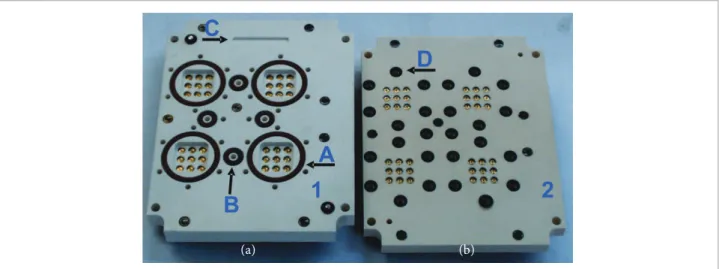
Irradiator Module (IM): he main body of the IM contains the biological material distributed in four 1 mL square wells called “Irradiated slots,” where the irradiation takes place; four 25 μL “background slots”, where no irradiation occurs; and one fence, designed to contain two thermoluminescent solid state dosimeters (TLD-100 - LiF : Mg,Ti), used to quantify the environmental ionizing radiation. Each one of the 4 irradiated slots has 18 UV-A LEDs (NICHA Co. model NSHU550A UV-A 375 nm) facing its surfaces. he LEDs are distributed over its upper and bottom halves (Fig. 3), containing 9 units on each side. hese slots are isolated from the environment by biological barriers that are implemented with silicon and nitrilic rubber o-rings and Scotch Weld®
2216 epoxy adhesive.
Fan cable Fixed at this side
Fan
Irradiator Upper
Bottom UV Irradiator
cable
Memory
Memory Module
Power Cable ISS Ground ISS Ground
Irradiator and Fan Grounging
Fixed at this side Irradiator
Module Fan Module
A B
ISS Power bus Female Connectors
Male Connectors Power
Eletronic Module
D
C
A
A B
B
C
C D
D
Upper
Bottom
UV irradiator cable Fan cable Figure 1. CIM block diagram.
Figure 2. Compact Irradiator Modulus interconnected. (A) Irradiator (IM); (B) Fan (FM); (C) Connector to attach Memory (MM); and (D) Electronic (EM).
Figure 3. (a) Bottom half; (b) Upper half of inner Irradiator Module. (A) One Irradiated slot with the silicon rubber o’ring; (B) One background slot with the silicon rubber o’ring; (C) Thermoluminescent dosimeter fence; (D) nitrilic rubber o’rings. The screws which fasten the two halves are passed through nitrilic o’rings. The picture presents (4x) 9 UVA LEDs facing the upper half and (4x) 9 LEDs facing the bottom half of the irradiated slot.
below 30°C. Convective cooling was generated by two 60 mm ball bearing type fans (one redundant). Pre-light temperature controlled tests demonstrated that, while fan cooling was applied, the irradiation slot temperature did not exceed 8°C above room temperature, merely reaching an equilibrium with room temperature.
Memory Module (MM): he MM is composed of two serial EEPROM IC memories (one redundant), mounted in a military/high reliability speciication connector and encapsulated with a silicone rubber compound. his module is attached to the Electronic Module by a faced external connector (Fig. 2 c). All relevant experiment data is recorded in it. Ater integration and initialization of the experiment, this module recorded the 8051 irmware status and the following relevant parameters: (1) the temperature within the slots; (2) the temperature of the irradiation module itself; (3) the irradiation status (on/of) and; (4) the voltage values in the memory module. Time resolution of acquisition data was 1 minute. his data was recovered on Earth at the mission’s end.
Electronic Module (EM): his module was composed of the 8051 family microcontroller, which commanded both the IM and FM. he power supply used by the fan module was provided by the ISS DC bus. It had two internal DC/DC converters which provided the DC power to all the other modules of the experiment. he ISS safety requirements specify that maximum temperature of any external surface of an experiment device should not exceed 40°C. To meet this requirement, the aluminum case (alloy AL 6063 T6), used in the EM was deeply anodized in order to increase its heat emissivity (to a depth of not less than 0.82). The less dissipating electronics were placed on the bottom-front panel, while the upper part of the irradiator module was loaded with the 5 most dissipating components: two DC/DC converters, two Voltage Regulators, and one EMI Filter (for a total of 7.6 Watts during the irradiation period).
UV: UV-A dosimetry was conducted by measuring the spatial distribution of light intensity inside all irradiation slots, since the bacteria will occupy this volume randomly during the experiment. he irradiation conditioning was simulated by illing up the 1 mL slot with the same saline solution used in the light experiment. Parallel planes within the slot composed by the array of 9 LEDs at the upper surface and the same at the bottom of the Irradiator Module were analyzed. UV-A spatial distribution was obtained experimentally by screening the light intensity horizontally and vertically inside the slot, using a photocell covered by a mask with a 1 mm oriice diameter at
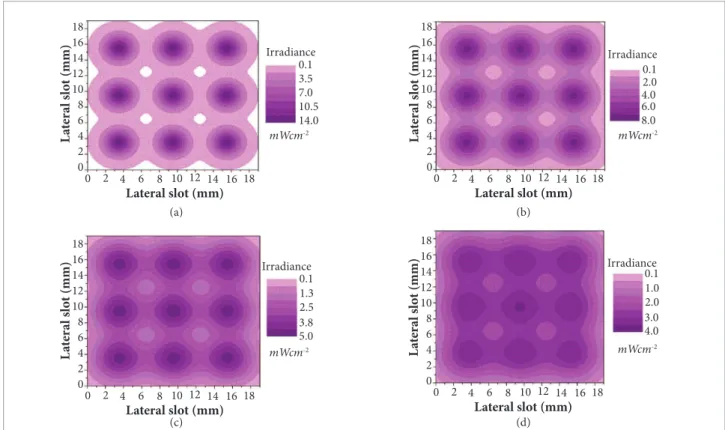
its center. his photocell was previously calibrated by a UV-A sensor (ORIEL 70260 Radiant Power Meter and ORIEL 70282 Photodiode Absorber Head, that provide sensitivity between 3 mW to 300 mW for a 375 nm wavelength lighting source). Vertical resolution of each step of measurement was 0.1 mm and 0.2 mm for the horizontal axis. Figure 4 depicts the coniguration of the isopleths of irradiance at 4 diferent distances from the LED array (upper or bottom part of the irradiation slot). Taking into account both surfaces with 9 LEDs, we obtain each plane’s irradiance distribution. his procedure made it possible to compile a complete description of the UV-A intensity distribution inside the irradiation slot. he statistical analysis of the results is presented in Fig. 5. he median value of this collection is 4.38 mW.cm-2, this
value was used as total volume slot irradiance (Sampaio, 2007). Operation and procedures: Aboard the ISS, the astronaut had to follow the unpacking procedures, assemble the Memory and Fan cables; then interconnect the module cables to the EM, and the power cable to the ISS DC bus. Once it was switched on, the EM irmware started a CIM checkup. he Memory and Fan cables were veriied and two LEDs on the EM front panel indicated the test condition. Ater this automatic test, the UV Irradiation was begun by an astronaut command through an EM front panel pushbutton. he IM with FM attached was 154 mm in length, 149 mm wide, and 65 mm high, weighing 1.45 kg. he EM with MM was 149 mm x 130 mm and 100 mm (l,w,h), weighing 1.1 kg. All light models, including cables, extra fuses and the spare MM, were disposed of in three diferent Nomex®
bags. he overall CIM launch dimensions were 260 mm x 200 mm x 250 mm (l x w x h) and the total mass was 3.08 kg. he return mass was 1.24 kg. During the irradiation period, the maximum CIM consumption was 16.6 W (28 VDC, 0.59 A).
Ater the irradiation period, the equipment was shut down and disabled. he IM and MM were packaged for return to Earth and all other parts were prepared for disposal.
BACTERIAL STRAINS, TRANSPORT,
FLIGHT AND EXPERIMENTAL STRATEGY
Figure 4. Isopleths plots for layer irradiance distribution inside one slot: horizontal plane at (a) 0.5 mm from LED surface; (b) 1.3 mm; (c) 2.1 mm and (d) 2.9 mm. These layers present partial contribution for one slot surface with 9 LEDs.
8% 7% 6% 5% R el at iv e f re q u enc y
Median Value 4.38 mWcm-2
Irradiance inside the slot (mW cm-2)
0 2 4 6 8 10 12 14 16 18 20 22 24
4%
3%
2%
1%
0%
Figure 5. Histogram of Irradiance values inside the irradiated slot. The median value of this collection represents a total slot Irradiance of 4.38 mW.cm-2.
A L a te ra l s lo t (mm)
Lateral slot (mm)
Irradiance 0.1 3.5 7.0 10.5 14.0 mWcm-2 18 18 16 16 14 14 12 12 10 10 8 8 6 6 4 4 2 2 0 0 B L a te ra l s lo t (mm)
Lateral slot (mm)
Irradiance 0.1 2.0 4.0 6.0 8.0 mWcm-2 18 18 16 16 14 14 12 12 10 10 8 8 6 6 4 4 2 2 0 0 C L a te ra l s lo t (mm)
Lateral slot (mm)
Irradiance 0.1 1.3 2.5 3.8 5.0 mWcm-2 18 18 16 16 14 14 12 12 10 10 8 8 6 6 4 4 2 2 0 0 L a te ra l s lo t (mm)
Lateral slot (mm)
and SOS), AB2480 (as AB1157, but u v r A - r e cA — deicient in nucleotide excision repair, recombination and SOS) and DNA polymerase I deicient strain P3478, a polA1 mutant derivative from E. coli wild-type W3110 strain. hey were transported from Brazil (Rio de Janeiro State University) directly to the desert of Baykonur (Kazakhstan). he transport was conducted under room temperature and bacterial strains were ixed in Millipore ilters of 47 mm diameter, enclosed in a sterilized plastic holder. In Baykonur, a compact biological laboratory was adapted in an installation of the Russian Flight Center, in order to maintain basic conditions concerning the handling and inoculation of the the biological material in the experimental apparatus.
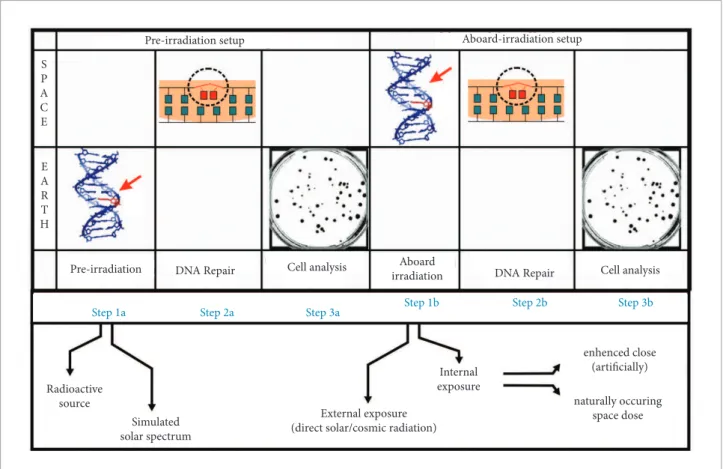
Figure 6 depicts typical experimental setups for pre-irradiation (ground pre-irradiation) and onboard pre-irradiation (mostly aboard the ISS, MIR, nanosatellites and Shuttle missions) as indicated in Table 1. he basic diference in protocol steps is where the irradiation takes place. In both cases, it is assumed that the initial phases of the biological repair mechanism occur in microgravity. he inoculation of the biological material took place 6 hours before the launch of the Soyus TMA-8 spacecrat. On March 29th, the biological material was boarded onto the
Reentry Module and on March 31st, 2006 (02:30 h GMT), Soyus
was launched from Baykonur. he experimental apparatus was transferred to the ISS on March 31st and the total period of stay
aboard the ISS was 9 days and 12 hours. he equipment was installed and operated close to the air conditioning outlow on the “PIRS docking compartment”, between the Zarya and Zvezda modules. Indoor temperature at that site was maintained constant, during the 9 days, at ~ +21°C. he apparatus, containing the bacterial strains, returned to Earth on April 9th (GTM: 20:04, April 8th), using the identiication “Module of
Biological Urgency” and immediately transported to Moscow/ Russia where it was analyzed, in the same compact biological laboratory once installed in Baykonur. A detailed chronology of the experiment is presented in Table 2.
EXTERNAL RADIATION DOSE AND
SPACE WEATHER CONDITIONS
DURING THE EXPERIMENT
Even in low Earth orbits, such as the orbital altitude of the ISS, any biological material is under the inluence of Solar Cosmic Rays (SCR) and Galactic Cosmic Rays (GCR), which are formed by particles whose energies vary from 10-1 to 108 MeV.
Besides these contributions, trapped particles, especially protons (Reitz et al., 2005), by the Earth’s magnetosphere in the Van
Table 2. Chronology of the experiment during the Centenary Mission (March-April 2006)
Experimental procedure Date Time
GMT
Experiment chronology
Temperature amplitude
Inoculation of bacterial strains in the irradiator in Baykonur March, 29th 06:00 h 00:00 h ~ +25oC
Pre-light tests March, 29th 06:30 h 00:30 h ~ +21oC
Refrigeration of the Irradiator with the bacterial strains March, 29th 07:00 h 01:00 h ~ +10oC
Boarding the apparatus in the Soyus TMA-8 March, 29th 12:20 h 06:20 h ~ +22 to +23oC
Lauching of Soyus TMA-8 March, 30th 02:30 h 20:30 h ~ +22 to +23oC
Soyus TMA 8 docked to the ISS April, 1st 04:18 h 2 days + 22:18 h ~ +21oC
Begin of UV-A irradiation April, 7th 13:40 h 9 days + 07:40 h ~ +21oC *
End of UV-A irradiation April, 7th 17:40 h 9 days + 11:40 h ~ +21oC *
Soyus TMA 7 undocked from the ISS April, 8th 20:23 h 10 days + 14:23 h ~ +21oC
Reentry at Earth’s atmosphere April, 8th 23:47 h 10 days + 17:47 h ~ +25oC
Delivery of the apparatus to the research team at Moscow April, 9th 08:00 h 11 days + 02:00 h ~ +10 to +25oC
Begin of survival and mutagenesis tests April, 9th 12:40 h 11 days + 06:40 h ~ +25oC
Allen belts, may also contribute to doses. During the light experiment, we monitored the dose at the irradiation slots by two thermoluminescent solid state dosimeters: TLD-100 (LiF : Mg,Ti), measuring 3.2 mm x 3.2 mm x 0.9 mm. he dosimetry based only on passive TLD detectors is not enough to describe the total interaction of ionizing radiations with the biological material on board the ISS, but may allow an indication of any abnormal radiation event occurring during the light. he integrated efective dose for the ~10 days of light was 3.7 mSv, if a mean radiation quality factor of 2.2 is assumed (Reitz et al., 1996). his value is slightly higher than the TLD dosimetric value (3.8 mSv during 15 days in orbit) obtained during the space experiment REPAIR and KINETICS, conducted by Horneck et al. (1996), performed during the IML-2 mission in July 1994 (also during a period of solar minimum). In addition, during the present mission, solar X-ray emissions detected by the GOES satellite did not registered any important enhancement related to solar events higher than a C 9.0 lares (correspondent to a peak lux of 9 x 10⁻⁶ W.m-2, in
the 1-8 A energy channel). During the hours that the UV-A
radiation was induced in the experiment, only a B5.0 solar lare was measured by the GOES detectors, which is considered a minor event (correspondent to a peak lux of 5 x 10⁻⁷ W.m-2).
Moreover, there was not report any CME event or anomalous galactic cosmic ray lux interacting with the earth. In short, there was no relevant anomaly in the parameters that characterize the geo-space behavior during the experiment.
RESULTS AND DISCUSSION
he analysis of the ionizing irradiation carried out during ISS orbit, the performance of the CIM system, and the results of the biological experiment follow.
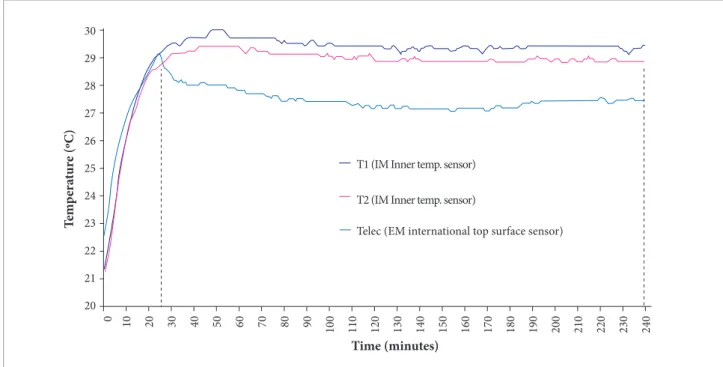
Memory Module data results: Ater an analysis of Irradiance follow-up data stored in the MM, it was noted that the sets of LEDs in the two slots turned of ater 25 minutes, contrary to the 240 minutes programmed in the irmware, due to an undetermined
Pre-irradiation setup
Pre-irradiation
Radioactive source
Simulated solar spectrum
External exposure (direct solar/cosmic radiation)
Internal exposure
enhenced close (artificially)
naturally occuring space dose
Step 1a Step 2a Step 3a Step 1b Step 2b Step 3b
DNA Repair Cell analysis irradiationAboard DNA Repair Cell analysis S
P A C E
E A R T H
Aboard-irradiation setup
failure. he temperature data for the EM was coherent with this observation, showing an inlection at 25 minutes into the recording, as shown in Fig. 7 (T3 - EM cover temperature).
Since the EM did not return to Earth, and the IM did not present any signs of failure in later tests carried out with the engineering model of the EM and irmware from the light, nor were any problems found ater a detailed analysis of the electronic circuits, watchdog registers and irmware design, we suspect there was a momentary failure due to radiation in the environment, such as SCR - Solar Cosmic Rays and GCR - Galactic Cosmic Rays, creating a SEU (Single Event Upset), associated with the use of COT components of medium-scale integration. Electronic failures of the ISS orbit are generally due to proton low from the South Atlantic Anomaly– (SAA) (Kuznetsov, 2005). It was not possible to correlate the time of failure (April 7, 2006, 14:06 GMT) with the possible passage of the ISS through the SSA, in virtue of limited access to orbital data. Considering the mean UV irradiance value found for each slot was 4.38 mW.cm-2,
and the time the LEDs were turned on, the irradiation dose for the AB1157 and P3478 strains was 6.6 J.cm-2 and the dose for the
AB2463 and AB2480 strains was 63.6 J.cm-2.
Observed biological response to UV-A radiation in a microgravity environment: In the experiment, the wild type strain (AB1157) and p o l A mutant (P3478) were irradiated
with 6.6 J.cm-2, while the strains uvrA recA (AB2480) and recA (AB2463) mutants followed the original irradiation protocol, with of 63.6 J.cm-2. he above irradiation periods
were recorded in the CIM memory module. Ground control experiments were conducted ater the mission, employing the same irradiation module of the light and similar irradiation periods and temperature conditions, as recorded. Considering the relative diferences in survival frequency, the wild type strain (AB1157) was more sensitive onboard the ISS than on Earth. In contrast, the uvrA recA mutant (AB2480) was more resistant on ISS than on Earth. It has been reported that UV-A induces high quantities of cyclobutane pirimidine dimmers (CPD), which are lesions repaired via NER (Tyrrell, 1973; Douki et al., 2003 and Rochette et al., 2003). On the other hand, the uvrA recA mutant (AB2480) lacking NER would produce less DNA breaks than the wild type strain. In contrast, on Earth, where there are relatively lower doses of environmental ionizing radiation, the uvrA recA mutant was more sensitive than the wild type strain, since the absence of NER can represent a severe injury to the cells. he AB2463 (recA) and P3478 (polA) strains did not show diferent results in UV-bacterial survival experiments carried out on Earth or on ISS. With the exception of the wild type strain (AB1157), the mutants presented higher or equivalent “spontaneous
30
29
T
em
p
er
at
ur
e (ºC)
Time (minutes) T1 (IM Inner temp. sensor)
Telec (EM international top surface sensor) T2 (IM Inner temp. sensor)
28
27
26
25
24
23
22
21
20
0 10 20 30 40 50 60 70 80 90
100 110 120 130 140 150 160 170 180 190 200 210 220 230 240
REFERENCES
Cogoli, A., 1996, “Biology under microgravity conditions in Spacelab International Microgravity Laboratory 2 (IML-2)”, Journal of Biotechnology, Vol. 47, No 2-3, pp. 67-70. doi: 10.1016/0168-1656(96)01413-7.
Dodd, P. E. and Massengill, L.W., 2003, “Basic Mechanisms and Modeling of Single-Event Upset in Digital Microelectronics”, IEEE Transactions on Nuclear Science, Vol. 50, No 3, pp. 583-602. doi: 10.1109/TNS.2003.813129.
Douki, T., Reunaud-Angelin, A., Cadet, J. and Sage, E., 2003, “Bipyrimidine photoproducts rather than oxidative lesions are the main type of DNA damage involved in the genotoxic effect of solar UVA radiation”, Biochemistry, Vol. 42, No 30, pp. 9221-9226. doi: 10.1021/bi034593c.
Favre, A., Hajnsdorf, E., Thiam, K. and Araujo, A.C., 1985, “Mutagenesis and growth delay induced in Escherichia coli by near-ultraviolet radiations”, Biochimie, Vol. 67, Issue 3-4, pp. 335-342. doi: 10.1016/S0300-9084(85)80076-6.
Horneck, G., Rettberg, P., Baumstark-Khan, C., Rink, H., Kozubek, S., Schäfer, M. and Schmitz, C., 1996, “DNA repair in microgravity: studies on bacteria and mammalian cells in the experiments REPAIR and KINETICS”, Journal of Biotechnology, Vol. 47, No 2-3, pp 99-112.
Kiefer, J. and Pross, H.D., 1999, “Space radiation effects and microgravity”, Mutation Research, Vol. 430, Issue 2, pp. 299-305. doi:10.1016/S0027-5107(99)00142-6.
Kobayashi, Y., Kikuchi, M., Nagaoka, S. and Watanabe, H.,1996, “Recovery of Deinococcus radiodurans from radiation damage was enhanced under microgravity”, Biological Sciences in Space, Vol. 10, No 2, pp. 97-101. doi:10.2187/bss.10.97.
Kobayashi, Y., Watanabe, H., Kikuchi, M. and Narumi, I., 2000, “Effect of the space environment on the induction of DNA-repair related proteins and recovery from radiation damage”, Advances in Space Research, Vol. 25, No 10, pp. 2103-2106.
mutation” frequency on ISS. his could be explained by the elevated doses of cosmic radiation on ISS. Nevertheless, when irradiated by UV-A on ISS, the wild type strain (AB1157) and
uvrA recA mutant (AB2480) decreased in mutation frequency. Taking into account that UV-A inhibits the protein synthesis, leading to cell growth delay (Favre et al., 1985), this agent could inhibit mutagenesis due to the local ionizing radiation, probably through blocking the DNA-replication, which would suppress the expression of the mutant phenotype. Yet, polA
(P3478) and recA (AB2463) mutants presented growth delay when irradiated with UV-A. his efect would not interfere on mutation frequency of these strains.
CONCLUSIONS
he reduction of environment radiation efects on electronic devices should be better evaluated in a future version of this experiment. Techniques, such as redundancy and the use of components that are less susceptible to SEE, should be employed as Dodd and Massengill (2003) and LaBel et al. (1996) experiments conclusions. he irradiance modeling of the CIM irradiation wells, displayed in “UV irradiance”, is of fundamental importance for future comparisons (even if in other systems) with the results obtained in the DRM experiment. Moreover, the techniques used in the modeling may be employed for other geometries and other, more powerful types of LEDs already on
the market. In the microgravity experiment we could observe that, besides the environmental high cosmic ionizing radiation, compared to conditions on Earth, the induced UV-A irradiation could inhibit mutagenesis, probably because it inhibits the protein synthesis, leading to cell growth delay. Yet, polA (P3478) and
recA (AB2463) presented growth delay when irradiated with UV-A. Nevertheless, these results suggest that more experiments would be conducted using the above experimental conditions in order to better understand the biological responses under high elevated irradiation environments.
ACKNOWLEDGMENTS
The authors are grateful to the Brazilian Space Agency (AEB) under Microgravity Program for sponsoring this project and to the Instituto de Aeronáutica e Espaço (IAE) and
Instituto Nacional de Pesquisas Espaciais (INPE), especially the Engineers Agnaldo Eras, Narli B. Lisboa and Dilmar Vieira dos Santos for their great help in the development of the instrumentation; we also thank the Brazilian astronaut Marcos Cesar Pontes, who performed the Brazilian experiment aboard the ISS, and the technical and scientific staff of the
Kuznetsov, N. V., 2005, “The Rate of Single Event Upsets in Electronic Circuits onboard Spacecraft”, Cosmic Research, Vol. 43, No 6, pp. 443–451. doi:10.1007/s10604-005-0066-9.
LaBel, K. A., Gates, M.M., Moran, A.K., Marshall, P.W., Barth, J., Stassinopoulos, E.G., Seidleck, C.M. and Dale, C.J., 1996, “Commercial Microelectronics Technologies for Applications in the Satellite Radiation Environment”, In: Proceedings Aerospace Applications Conference, Vol. 1, pp. 375-390. doi: 10.1109/AERO.1996.495897.
Manti, L., 2006, “Does reduced gravity alter cellular response to ionizing radiation?”, Radiation and Environmental Biophysics, Vol. 45, No 1, pp. 1-8. doi: 10.1007/s00411-006-0037-4.
Nicholson, L.W., Ricco, A.J., Agasid, E., Christopher, B., Diaz-Aguado, M., Ehrenfreund, P., Friedricks, C., Ghassemieh, S., Henschke, M., Hines, J.W., Kitts, C., Luzzi, E., Ly, D., Mai, N., Mancinelli, R., McIntyre, M., Minelli, G., Neumann, M., Parra, M., Piccini, M., Rasay, M.R., Ricks, R., Santos, O., Schooley, A., Squires, D., Timucin, L., Yost, B. and Young, A., 2011, “The O/OREOS Mission: First Science Data from the Space Environment Survivability of Living Organisms (SESLO) Payload”, Astrobiology, Vol. 11, No 10, pp. 951-958. doi: 10.1089/ast.2011.0714.
Ottolenghi, A., Ballarini, F. and Biaggi, M., 2001, “Mechanistic bases for modelling space radiation risk and planning radiation protection of astronauts”, Physica Medica, Vol. 17, Suppl 1, pp. 272-277.
Olsson-Francis, K. and Cockell, C.S., 2010, “Experimental methods for studying microbial survival in extraterrestrial environments”, Journal of Microbiological Methods, Vol. 80, pp. 1-13. doi:10.1016/j.mimet.2009.10.004.
Pross, H.D., Kost. And Kiefer, J., 1994, “Repair of radiation induced genetic damage under microgravity”, Advances in Space Research, Vol. 14, Issue 10, pp. 125-130. doi:10.1016/0273-1177(94)90461-8.
Pross, H.D., and Kiefer, J., 1999, “Repair of cellular radiation damage in space under microgravity conditions”, Radiation and Environmental Biophysics, Vol. 38, No 2, pp. 133-138. doi:10.1007/s004110050149.
Pross, H.D., Casares, A. and Kiefer, J., 2000, “Induction and Repair of DNA Double-Strand Breaks under Irradiation and Microgravity”, Radiation Research, Vol. 153, No 5 Pt 1, pp. 521-525.
Reitz, G., Beaujean, R., Benton, E., Burmeister, S., Dachev, Ts., Deme, S., Luszik-Bhadra, M. and Olko, P., 2005, “Space radiation measurements on-board ISS-the DOSMAP experiment”, Radiation Protection Dosimetry, Vol. 116, No 1-4 Pt 2, pp. 374-379. doi:10.1093/rpd/nci262.
Reitz, G., Beaujean, R., Kopp, M., Leicher, M. and Strauch, K., 1996, “Dosimetric mapping in BIORACK on IML2”, Journal of Biotechnology, Vol. 47, Issue 2-3, pp. 83-88. doi: 10.1016/0168-1656(96)01372-7.
Rettberg, P., Eschweiler, U., Strauch, K., Reitz, G., Horneck, G., Wänke, H., Brack, A. and Barbier, B., 2002, “Survival of Microorganisms in space protected by Meteorite material: Results of the experiment ‘EXOBIOLOGIE’ of the Perseus mission”, Advances in Space Research, Vol. 30, No 6, pp. 1539-1545. doi: 10.1016/S0273-1177(02)00369-1.
Rochette, P.J., Therrien, J.P., Drouin, R., Perdiz, D., Bastien, N., Drobetsky, E.A. and Sage, E., 2003, “UVA-induced ciclobutane pyrimidine dimers from predominantly at thymine dipyrimidine and correlate with the mutation spectrum in rodent cells”, Nucleic Acids Research, Vol. 31, No 11, pp. 2786-2794.
Sampaio, M., 2007, “Design, Dosimetry and performance of a UV irradiator system used in space biology”, Ph.D. Thesis, Technological Institute of Aeronautics, São José dos Campos, Brazil, 158p. (In Portuguese).
Saffary, R., Nandakumar, R., Spencer, D., Robb, F.T., Davila, J.M., Swartz, M., Ofman, L., Thomas, R.J. and DiRuggiero, J., 2002, “Microbial survival of space vacuum and extreme ultraviolet irradiation: strain isolation and analysis during a rocket light”, FEMS Microbiology Letters, Vol. 215, No 1, pp. 163-168.
SSP41163, 1999, “International Space Station Program: Russian Segment Speciication, Revision G. National Aeronautics and Space Administration & Russian Space Agency”, Houston, Texas, USA & Moscow, Russia, 452 pp.
SSP50094, 2000, “NASA/RSA JOINT SPECIFICATIONS: Standards Document for the ISS: Russian Segment. Revision A. National Aeronautics and Space Administration & Russian Space Agency”, Houston, Texas, USA & Moscow, Russia, 532 pp.
SSP50146, 1998, “NASA/RSA Bilateral Safety and Mission Assurance Process Requirements for the ISS Revision A. National Aeronautics and Space Administration & Russian Space Agency”, Houston, Texas, USA & Moscow, Russia, 159 pp.
Takahashi, A., Ohnishi, K., Takahashi, S., Masukawa, M., Sekikawa, K., Amano, T., Nakano, T., Nagaoka, S. and Ohnishi, T., 2001, “The effects of microgravity on induced mutation in Escherichia coli and Saccharomyces cerevisiae”, Advances in Space Research, Vol. 28, Issue 4, pp. 555-561. doi: 10.1016/S0273-1177(01)00391-X.
Takahashi, A., Suzuki, H., Omori, K., Seki, M., Hashizume, T., Shimazu, T., Ishioka, N. and Ohnishi, T., 2011, “Expression of p53-regulated genes in human cultured lymphoblastoid TSCE5 and WTK1 cell lines after spacelight in a frozen state”, Advances in Space Research, Vol. 47, Issue 6, pp. 1062-1070. doi: 10.1016/j.asr.2010.11.002.
Tyrrell, R.M., 1973, “Induction of pyrimidine dimers in bacterial DNA by 365 nm radiation”, Photochemistry and Photobiology, Vol. 17, Issue 1, pp. 69-73. doi: 10.1111/j.1751-1097.1973.tb06334.x.
Yatagai, F., Honma, M., Ukai, A., Omori, K., Suzuki, H., Shimazu, T., Takahashi, A., Ohnishi, T., Dohmae, N. and Ishioka, N., 2012, “Preliminary results of space experiment: Implications for the effects of space radiation and microgravity on survival and mutation induction in human cells”, Advances in Space Research, Vol. 49, Issue 3, pp. 479-486. doi: 10.1016/j.asr.2011.10.015.