Endo ge no us o piate analge sia induce d
by to nic im m o bility in guine a pigs
Departamento de Fisiologia, Faculdade de Medicina de Ribeirão Preto, Universidade de São Paulo, Ribeirão Preto, SP, Brasil
C.R.A. Leite-Panissi, C.L. Rodrigues, M.R. Brentegani and L. Menescal-de-O liveira
Abstract
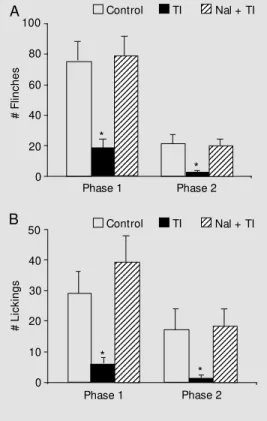
A function of the endogenous analgesic system is to prevent recupera-tive behaviors generated by tissue damage, thus preventing the emis-sion of species-specific defensive behaviors. Activation of intrinsic nociception is fundamental for the maintenance of the behavioral strategy adopted. Tonic immobility (TI) is an inborn defensive behav-ior characterized by a temporary state of profound and reversible motor inhibition elicited by some forms of physical restraint. We studied the effect of TI behavior on nociception produced by the formalin and hot-plate tests in guinea pigs. The induction of TI produced a significant decrease in the number of flinches (18 ± 6 and 2 ± 1 in phases 1 and 2) and lickings (6 ± 2 and 1 ± 1 in phases 1 and 2) in the formalin test when compared with control (75 ± 13 and 22 ± 6 flinches in phases 1 and 2; 28 ± 7 and 17 ± 7 lickings in phases 1 and 2). In the hot-plate test our results also showed antinociceptive effects of TI, with an increase in the index of analgesia 30 and 45 min after the induction of TI (0.67 ± 0.1 and 0.53 ± 0.13, respectively) when compared with control (-0.10 ± 0.08 at 30 min and -0.09 ± 0.09 at 45 min). These effects were reversed by pretreatment with naloxone (1 mg/kg, ip), suggesting that the hypoalgesia observed after induction of TI behavior, as evaluated by the algesimetric formalin and hot-plate tests, is due to activation of endogenous analgesic mechanisms involv-ing opioid synapses.
Co rre spo nde nce
L. Menescal-de-O liveira Departamento de Fisiologia FMRP, USP
Av. Bandeirantes, 3900 14049-900 Ribeirão Preto, SP Brasil
Fax: + 55-16-633-0017 E-mail: lmdolive@ fmrp.usp.br
Presented at the XV Annual Meeting of the Federação de Sociedades de Biologia Experimental, Caxambu, MG, Brazil, August 23-26, 2000.
Research supported by CNPq, CAPES and FAPESP (No. 97/14286-9).
Received April 10, 2000 Accepted November 29, 2000
Ke y wo rds
·Tonic immobility
·Guinea pig
·Antinociception
·O pioids
·Naloxone
·Analgesia
Intro ductio n
Many antinociceptive systems have been identified which modulate nociception at dif-ferent levels of the neural axis (1,2). Endog-enous analgesic mechanisms are influenced by fear and by a defensive system which functions to inhibit pain when an organisms safety is threatened (3). One of the adaptive functions of endogenous analgesic mechan-isms is to prevent the recuperative behaviors
pro-longed physical contact with no possibility of escape for the prey, the animal displays the tonic immobility (TI) behavior. It is the last resource used by the prey to reduce the probability of continued attack on the part of the predator, thus being of adaptive value. This response is characterized by a revers-ible state of profound physical inactivity and a relative lack of responsiveness to the envi-ronment (5).
Within this context, the defensive behav-ioral responses elicit the activation of an antinociceptive system so that the strategy adopted will be successful. However, it is highly improbable that analgesia associated with active flight and analgesia associated with TI could be mediated in a similar man-ner in terms of form (active/passive) and function (avoiding capture vs reducing preda-tor interest upon capture) since these de-fense reactions are obviously very different. During an active defense response such as flight or struggling, the analgesia involved does not seem to be opioid, whereas during TI, a response that may last seconds or hours, analgesia appears to be of the opioid type (7). However, the literature has reported little evidence supporting this hypothesis.
Like TI, freezing is an inhibitory species-specific behavior (5). However, whereas TI is a post-encounter response, freezing in-volves the anticipation of a situation of dan-ger and is therefore a pre-encounter response. In the laboratory, freezing can be triggered by various Pavlovian fear stimuli and can also produce a reduction in pain sensitivity as indicated by a suppression of formalin-induced recuperative behavior. This decrease in responsiveness to painful stimulation is reversed by opioid antagonists (8). On the other hand, it has been shown in mice that repeated pinching of the scruff of the neck produces catalepsy and analgesia that are functionally interdependent, and that anal-gesia is abolished by naloxone (9).
Despite these remarkable advances, little is known about the natural circumstances
under which endogenous analgesia systems are activated. On this basis, the objective of the present study was to investigate the pos-sibility that TI behavior activates the endog-enous antinociceptive system and also to assess the role of the opioid mechanism in this response. For this purpose, we induced TI behavior in the laboratory and observed its effect on the nociception produced by the formalin and hot-plate tests, as well as the action of previous administration of nalox-one (a nonselective opioid antagonist) in different groups of guinea pigs.
Anim als and Me tho ds
Adult male guinea pigs (Cavia porcellus, N = 48) weighing 450-600 g were used. The animals were kept under controlled temper-ature (24 ± 1oC) on a 12/12-h light/dark cycle (lights on at 6:00 a.m.) in Plexiglas-wall cages (56 x 17 x 39 cm, 5 animals per cage) with free access to water and food. Conditions of animal housing and all exper-imental procedures obeyed the ethical guide-lines of the International Association for the Study of Pain for investigations of experi-mental pain in conscious animals (10).
sub-mitted to five control maneuvers of TI induc-tion and the durainduc-tion of the episodes was recorded. The control duration for each group corresponded to the mean of these five TI episodes. On the next day five TI maneuvers were again performed, formalin was imme-diately injected into the hindpaw and the number of flinches and lickings was recorded as done for group 1. Group 3 (Nal + TI) was submitted to the same experimental proce-dure as group 2, but naloxone (1 mg/kg, ip; Sigma Chemical Co., St. Louis, MO, USA) was administered 10 min before TI induc-tion. The results of the formalin test are reported as mean number of flinches and lickings of the treated paw per 10-min period in phase 1 and phase 2.
The animals in groups 4, 5 and 6 were submitted to nociceptive thermal stimula-tion provided by a standard hot-plate appara-tus. The hot plate consisted of a Fanem D 112 water bath and pump that heated and circulated 53 ± 0.5oC water through the chan-neled interior of an aluminum plate. A 28-cm high, 26-28-cm long and 18-28-cm wide Plexiglas cage fitted with a removable lid restrained the guinea pig on the surface of the plate. The hot-plate test is performed by placing the guinea pig on the heated plate and the time (latency) the animal takes to lick its genitals is recorded. When this test was standardized for guinea pigs in our labo-ratory, we observed that the behavior first exhibited by the animals was to lick the genital region instead of one of the hindpaws, as is usually the case for rats and mice. Latency is considered to be the time taken by the animal to present this response, and the cut-off time was set at 70 s to avoid possible tissue injury. The baseline comprised 3 meas-urements of the latency time in the hot-plate test.
In group 4 (control), after determination of the baseline, latency measurements were made in the hot-plate test at 15-min intervals for 1 h. In group 5, before the measurement of latency in the hot-plate test, the animals
were submitted to five maneuvers of TI in-duction and then to the hot-plate test as done for group 4. Group 6 (Nal + TI) was submit-ted to the same procedure as described for group 5, except that naloxone (1 mg/kg, ip) was administered 10 min before the induc-tion of experimental TI. Control TI and hot-plate determinations were made on consecu-tive days before the experiment.
Each hot-plate latency was normalized using an index of analgesia (IA) according to the following formula: plate test - hot-plate control/cut-off time - hot-hot-plate control, where hot-plate control is the average of 3 baselines of hot-plate latencies taken at 5-min intervals, and hot-plate test is the mean latency recorded of each group.
In groups 2, 3, 5 and 6 the induction of TI was attempted by holding the animal around the thorax with the hands, quickly inverting it, and pressing it down into a V-shaped plywood trough (25 cm long x 15 cm high). The pressure applied by the hands of the experimenter was proportional to the resis-tance offered by the animal to the restraining maneuvers. The manual restraint and pos-tural inversion maneuvers used in the labo-ratory are an attempt to simulate the preda-tion condipreda-tion. When the animal stopped moving, the experimenters hands were slowly withdrawn and a chronometer was started to time the duration (in seconds) of the response, which ended when the animal resumed the upright position. When TI oc-curs, it persists in the absence of restraint for periods varying from a few seconds to sev-eral minutes. In our experiments, the mean duration for the groups was about 420 s.
Re sults
The induction of TI behavior promoted an alteration of nociception in both tests used (formalin and hot plate), with previous naloxone administration inhibiting the anti-nociception induced by TI. In group 2 the induction of TI produced a decrease in the number of flinches and lickings in phases 1 and 2 (Figure 1) when compared to the con-trol and Nal + TI groups (groups 1 and 3). Analysis of variance applied to the number of flinches and lickings revealed a signifi-cant difference between treatments (F2,21 = 8.46, P<0.01; F2,21 = 4.14, P<0.05, to flinches in phases 1 and 2, respectively, and F2,21 = 6.68, P<0.01; F2,21 = 3.63, P<0.05, to lickings in phases 1 and 2, respectively). The Duncan test showed a significant differ-ence between group TI and control (P<0.05) and between the TI and Nal + TI groups (P<0.05) for both responses (flinches and lickings). In group 5, the TI behavior pro-moted an increase in the hot-plate latency at the 30- and 45-min intervals (Figure 2) when compared to control and to the Nal + TI group (groups 4 and 6). Analysis of variance applied to hot-plate latency revealed a sig-nificant difference between treatments (F2,20 = 9.78, P<0.01; F2,20 = 5.32, P<0.01, at 30 and 45 min, respectively). The Duncan test showed a significant difference between group TI (group 5) and control and the Nal + TI group (groups 4 and 6, P<0.05).
Naloxone caused no changes in TI dura-tion episodes in any of the groups studied, suggesting that the function of opioid recep-tors is not essential for the induction and maintenance of TI behavior.
D iscussio n
Some investigators demonstrated that preadministration of naloxone (4) and nal-trexone (8) blocks the analgesic response but not the defensive response of freezing. This does not demonstrate that freezing and
Figure 1 - Hypoalgesia in the for-malin test after induction of tonic immobility (TI). M ean number of flinches (A) and lickings (B) per 10-min period in phase 1 (0-10 min after injection of formalin) and phase 2 (20-60 min) of the f orm alin t est f or t he cont rol group (control, N = 8), after TI induction (TI, N = 8) and for the group pretreated w ith naloxone and submitted to TI induction (Nal + TI, N = 8). The vertical bars indicate the standard error of the mean. * P<0.05 compared to control and to the Nal + TI group (Duncan test).
Figure 2 - Index of analgesia (IA) in the hot-plate test for the control group (control, N = 8), immediately after induction of the five episodes of tonic immobility (TI, N = 8), and for the group pretreated w ith naloxone and submitted to TI induction (Nal + TI, N = 8). Time zero represents the baseline and the vertical bars indicate the standard error of the mean. * P<0.05 compared to control and to the Nal + TI group (Duncan test).
# F lin c h e s 100 123456 123456 123456 123456 123456 123456 123456 123456 123456 123456 123456 123456 123456 123456 123456 123456 123456 123456 123456 123456 123456 123456 123456 123456 123456 123456 123456 123456 123456 123456 123456 123456 80 60 40 20 0 * *
Phase 1 Phase 2
Control TI 123Nal + TI
123 # L ic k in g s 50 40 30 20 10 0
Phase 1 Phase 2
123456 123456 123456 123456 123456 123456 123456 123456 123456 123456 123456 123456 123456 123456 123456 123456 123456 123456 123456 123456 123456 123456 123456 123456 123456 123456 123456 123456 123456 123456 123456 123456 123456 123456 123456 123456 123456 123456 * *
Control TI Nal + TI
123 123 123 A B IA 0.8 0.4 0.6 0.2 0.0 -0.2 -0.4
0 10 20 30 40 50 60
Control TI Nal + TI
*
*
analgesia are mediated by different processes but rather that an opioid synapse is present in the final pathway critical for the expression of analgesia but not in the final pathway producing freezing (11). Similarly, our find-ings showed that blockade of opioid recep-tors by naloxone does not alter the duration of TI behavior but can change the antinoci-ception induced by TI as determined in the formalin and hot-plate tests. Furthermore, in experiments on TI a lack of naloxone effects has been described in rabbits (12), guinea pigs (13) and chickens (14). However, stud-ies conducted on rabbits by Carli et al. (15,16) have demonstrated the occurrence of anal-gesia during TI and have suggested that the pain response is blocked by a mechanism similar to that of morphine.
The mechanisms by which the endoge-nous analgesic system is activated under natural conditions remain unknown. One natural condition that activates the descend-ing analgesic system is fear, such as that caused by exposure to a predator. It has been suggested that the central nucleus of the amygdala and periaqueductal grey matter
pathway is an important network in fear-induced analgesia (17). The maneuvers used in the laboratory to induce TI are an attempt to simulate the physical restraint that occurs during predation and is accompanied by in-tense fear. Thus, it may be proposed that during TI there is activation of endogenous analgesic mechanisms responsible for the reduction in the nociceptive responses stud-ied. On this basis, exposure to threatening stimuli has been shown to elicit forebrain-mediated analgesia through fear circuits in the amygdala which in turn activate a de-scending pain inhibitory system in the brain-stem (18-20). Hypoalgesia may be opera-tionally defined as a partial reduction of the response to nociceptive stimulation (16). Ac-cording to this definition, there is no doubt that hypoalgesia occurs during TI since we observed not only a significant reduction of flinches and lickings after formalin, but also an increased latency of the response to the hot-plate test. Indeed, with respect to forma-lin, licking the injected paw is unanimously considered to be an index of pain and a decrease of this behavior reflects hypoalgesia.
Re fe re nce s
1. Basbaum AI & Fields HL (1984). Endoge-nous pain control systems: brain-stem
spi-nal pathw ays and endorphin circuitry.
An-nual Review of Neuroscience, 7: 309-338. 2. Watkins LR & M ayer DJ (1986). M ultiple endogenous opiate and nonopiate analge-sic systems: evidence of their existence
and clinical implications. Annals of the
New York Academy of Sciences, 467: 273-299.
3. Rhudy JL & M eagher M W (2000). Fear and anxiety: divergent effects on human
pain thresholds. Pain, 84: 65-75.
4. Fanselow M S (1984). Shock-induced anal-gesia on the formalin test: effects of shock severity, naloxone,
hypophysec-tomy, and associative variable. Behavioral
Neuroscience, 98: 79-95.
5. Ratner SC (1967). Comparative aspects of
hypnosis. In: Gordon JE (Editor),
Hand-book of Clinical and Experimental Hypno-sis. M acM illan, New York.
6. Blanchard DC & Blanchard RJ (1988). Ethoexperimental approaches of the
biol-ogy of emotion. Annual Review of
Psy-chology, 39: 43-68.
7. Rodgers RJ & Randall JI (1987).
Defen-sive analgesia in the rats and mice. The
Psychological Record, 37: 335-347. 8. Fanselow M S & Baackes M P (1982).
Con-ditioned fear-induced opiate analgesia on the formalin test: evidence for tw o
aver-sive motivational systems. Learning and
M otivation,13: 200-221.
9. Amir S (1986). Catalepsy induced by body pinch: relation to stress induced
analge-sia. Annals of the New York Academy of
Sciences, 467: 226-237.
10. Zimmermann M (1983). Ethical guidelines for investigations of experimental pain in
conscious animals. Pain, 16: 109-110.
11. Fanselow M S & Helmstetter FJ (1988). Conditional analgesia, defensive freezing,
and benzodiazepines. Behavioral
Neuro-science, 102: 233-243.
12. Galeano C, M orcos R, Cloutier R, Desma-rais PA & Beaudry P (1978). The
immobil-ity reflex: effect of naloxone. Life
Sci-ences, 23: 61-64.
13. M ucha RF (1980). Effect of naloxone and morphine on guinea pig tonic immobility.
Behavioral and Neural Biology, 28: 111-115.
14. Peters AH & Hughes RA (1978). Naloxone interactions w ith morphine and shock po-tentiated tonic immobility in chickens.
Pharmacology, Biochemistry and
Behav-ior, 9: 153-156.
15. Carli G (1975). Some evidence of
analge-sia during animal hypnosis. Experimental
Brain Research, 23 (Abstract collection): 35.
16. Carli G, Farabollini F, Fontani G & Grazzi F (1984). Physiological characteristics of pressure immobility. Effect of morphine,
Re-search, 12: 55-63.
17. LeDoux JE, Iw ata J, Cicchetti P & Reis DJ (1988). Different projections of the cen-tral amygdaloid nucleus mediate auto-nomic and behavioral correlates of
condi-tioned fear. Journal of Neuroscience, 8:
2517-2529.
18. M eagher M W, Grau JW & King RA (1990).
Role of supraspinal systems in environ-mentally induced antinociception: effect of spinalization and the descerebration on brief shock-induced and long
shock-in-duced antinociception. Behavioral
Neuro-science, 104: 328-338.
19. Helmstetter FJ & Bellgow an PS (1993). Lesions of the amygdala block conditional
hypoalgesia on the tail-flick test. Brain
Re-search, 612: 253-257.
20. Fanselow M S (1994). Neural organization of the defensive behavior system
respon-sible for fear. Psychonomic Bulletin &