Asian Online Journals (www.ajouronline.com) 217
Facility Localization: Strategic Decision on Insular Territory
Armindo Frias1, João Cabral2
1
Instituto Superior de Economia e Gestão da Universidade Técnica de Lisboa
Lisboa, Portugal
2
Centro de Matemática Aplicada e Tecnologias de Informação da Universidade dos Açores
Ponta Delgada, Portugal
_________________________________________________________________________________
ABSTRACT— The global market advent, with consumers, that requires speed, quality of service and respect for the environment came to dictate the change of some imposed paradigms. We are seeing the integration of internal and external supply chains following the customers concerns about the environment and social friendly processes, making it sustainable.
The collection and treatment of waste in the islands have great economic, social and environmental importance. Several critical points, such as transport, storage and processing must be integrated. By its growing influence on the performance on the majority of economy sectors, freight transport is assumed to be one of the activities with the greatest importance. The location of facilities or infrastructure is a critical factor for the public or private organizations. The decision-making process of its location falls within strategic and when is situated in insular space must meet their specific characteristics of sustainability.
With the objective of analyzing the configuration and performance of the reverse logistics chain implemented for waste collection and treatment, in concerns to facilities location, we performed a study based in secondary data, regarding to the used tires collection in the São Miguel Azorean island.
From the implementation of the developed facilities location model, taking also the solution already implemented we developed several alternative possible scenarios. The results obtained meet the empirical expectations, and despite not corroborate the implemented solution as great, for the case of a collection facility, consider the actual one as acceptable. It is made a proposal to improve the implemented collection of used tiers network.
The optimization of the transport network, by the correct facilities location, allows the minimization of economic costs, social impacts and the polluting emissions caused by means of transport, or by the conditions of storage of waste. We conclude, trough the mathematical model that the obtained model is appropriate, getting close to the already implemented solution. Also, the conducted study, serves as a datable application to other similar problems. Keywords— facilities localization, islands, sustainability, transportation, waste collection
____________________________________________________________________________________________________________
1. INTRODUCTION
The emergence of global market and consumers who demand fastness, quality and respect for the environment, came to dictate the change of paradigms. As pointed out by Casaca and Marlow (2005), we are witnessing the integration of internal and external supply chains and the business bet on the environment and social respect processes that goes right to the concerns of customers, making business sustainable.
The huge increasing of production and consumption, with the consequent waste rising production, combined with the need to value recovery, the obligation to comply with increasingly strict legislation and enforcement to meet social and environmental consumer demands, motivates the reverse logistics development, as stated in De Brito and Dekker (2003). In this sense, assumes paramount importance the existence of integrated waste management policies, with the objective of minimizing the waste hazard and the quantity produced as well to implement a process for maximizing the quantity recovered for recycling. With the publication, in 2001, of specific national legislation on the management of tyres and used tyres, Portugal transposed into national territory the set of European Union rules and placed particular emphasis on this kind of waste.
Attempt to the isolated areas, such as small islands specificities, the waste collection and treatment assumes special relevance. On the other hand, the geographical dispersion of supply chain, an imposed condition in insular territory,
Asian Online Journals (www.ajouronline.com) 218
increases management and storage costs as well as rises the time for order fulfilment, as can be seen in Lorentz et al. (2012).
Considering the importance of the transport network and the location of its facilities for the performance of reverse supply chain, prompted the authors to undertake the study of reverse logistics chain configuration implemented on the São Miguel Island, in the Azores archipelago, directed to the used tyres collection and recycling network facilities location. This multidisciplinary study contributes to a better understanding of the used tyres collection and recycling system implemented on the island, to develop an innovative location facility model, as well as a tool that allows us to analyse the network facility’s location efficiency in networks comparable with the one’s study. Based on the results obtained in the study, the authors have developed a concrete proposal to improve the efficiency of the current system in 2013, and analyse the possible reasons why used tyres generated in the Azores are exclusively shipment to energy recovery.
2. ISLANDS ESPECIFICITY
For most part of the people, islands are synonymous to paradise, idyllic places where can relax and enjoy nature at its best. However, according to Matas (1997), this is a concept far from reality. As stated by Baldacchino (2008), the islands are not small continents, are remote territories limited by water, predisposed to suffer external shocks, relative resource scarcity. Adrianto and Matsuda (2002) expanded this notion by saying that these territories are especially exposed to natural disasters.
The Rio Declaration on Environment and Development, 1992, in the context of Agenda 21 (Chapter 17 G), the United Nations recognized the Small Island Developing States (SIDS) as a distinct group of countries facing social, economic and environmental vulnerability conditions. As stated by Briguglio (1995) and Adrianto and Matsuda (2002), small islands and SIDS, although small isolated territories, have economic disadvantages because of their small size, insularity, isolation, propensity for natural disasters and environmental factors that can extremer without notice. Those territories face several constraints related to the availability of a limited resource base, depriving them from the economies of scale benefits; small domestic markets and strong dependence on external and remote markets; high costs for energy, communications and transportation infrastructure; long distances from import and export markets; low and irregular volumes to transport; little resistance to natural disasters; fast population growth, high volatility of economic growth; few opportunities for the private sector and large dependence from the public sector; and fragile natural environments. From an economic standpoint, Adrianto and Matsuda (2002) believe that small islands have distinctive characteristics, namely: few options for economic and environmental sustainable development; the public service provision is expensive; human resources are scarce; much of the economic development relies on external intervention.
To insular firms, geographical dispersion means supply chain dispersion, in obtaining resources or markets to trade their products. The study by Lorentz et al. (2012) found that increased geographical dispersion of the supply chain increases the time for order fulfilment, and upstream higher costs for storage and management. Downstream, the increases in inventory day of finished product with higher inventory costs and the increase of time to be paid. Instead, the increased of production network dispersion reduces the time to satisfy orders. Another element arising from the geographical dispersion is the increased complexity of supply chains, with all the disadvantages that this entails that already justified by Lorentz et al. (2012). Thus, island businesses have to consider, in advance, the inconveniences arising from the geographical dispersion of its supply chain.
In an epoch of technology that allows the existence of the global market, the proximity depends less from physical distance and increasingly from cognitive factors such as institutional, organizational or social proximity. Despite this reality, as stated by Hall and Jacobs (2010), we have close ties in various regions that allow them to maintain economic supremacy. The modern transport means enable islands to have greater connectivity with the rest of the world, removing the preponderance to the geographical boundaries. However, as argued Deschenes and Chertow (2004), the transport means don’t eliminate this isolation, subsisting technical limitations, time and costs.
As identified in Baldacchino (2008), the mere existence or improvement of transport infrastructure does not guarantee social and economic progress. Thus, it can be said that although the technology mitigates the physical distance - in islands situations we reference to their physical distance - the cultural, socioeconomic, and others distance continue to be an element of detachment towards what happens on the mainland.
3. TRANSPORT NET
According to Terry (1996), referenced by Casaca and Marlow (2005), the way European companies conduct their logistics is changing, noting the integration of internal and external supply chain as well as its geographical expansion. Consequently, firms have been looking for outsourcing as a strategy to focus on core business, obtaining adaptability and flexibility to respond to a more competitive and flexible market, as well to the centralization of production and storage. This trend, according to Casaca and Marlow (2005), implies a growing need for transport with consequent negative impacts on pollute emissions level, energy consumption and traffic congestion.
Asian Online Journals (www.ajouronline.com) 219
For its growing influence on the performance of most economy sectors, Crainic and Laporte (1997) see freight transportation as one of the highest relevance activities. Owen and Daskin (1998) concluded that facilities location is a critical element for public and private organizations, Chaabane et al. (2012) emphasize that the decision making process for facility location is in strategic framework and, when situated in insular space, Frias (2011), must meet islands specific sustainability factors.
According to Chaabane et al. (2012), strategic planning includes decisions regarding to the configuration of supply chain, such as facilities location, resources and skills to be used, new product development or after use products selection. Strategic planning decisions also include the product flow definition, inventory planning, direct and reverse transport circuit configuration or recovery of product decisions. In Morales-Fusco et al. (2012), we see that companies who need to move small volumes in spread geographically spaces, tend to hire freight transport companies. The decision to choose the freight transporter can focus on several factors such as the time required for transportation, total cost, perception of quality, the benefits of scale, force of habit and resilience.
In the Committee of the Regions, CoR-EU (2002), the Commission for Territorial Cohesion of the European Union concerning the White Paper European Transport Policy for 2010, considers beneficial the policies to promote a transport network that is more sustainable, flexible, versatile and faster than the existing road network. This initiative should not marginalize isolated regions that can’t benefit from policy decisions based on continuous continental territory. In this sense, it welcomes the proposal to revise the rules for granting support to isolated areas that have particular difficulties in transport, as islands. One of the identified cases is the need for air transport protection that serves remote areas; island areas that not benefited by the construction of high-speed rail lines.
Transport is an important human activity support, Crainic and Laporte (1997), enabling the social life, the economy functioning and all types of exchanges. The same authors believe that freight transport is one of the highest importance activities by their contribution to the country’s gross domestic production. In everyday citizen’s life, the transport importance is possible to measure as a significant contribution to the price of most products and as a form of economy assessment.
The different sectors of the economy search for efficiency came to dictate lower inventory levels, demand just-in-time, providing more services to their customers and greater quality control and using more efficient information systems. These changes require from the transportation industry greater speed, reliability, low cost and wider level of services.
The transport sector, according to Crainic and Laporte (1997), generates a complex activity with multiple actors that needs to made an agile respond to market, with various levels of decision and requires an intensive long-term investment, so, it is necessary to have advance methods and tools to support planning and decision making.
In transportation systems it is possible to identify three levels of planning: strategic, tactical and operational. The strategic, or long-term, determine the general policies and plans definition for system operation, for example the network design and evolution of major facilities location, the resources acquiring policy, defining the level of services get by outsource or pricing policy. The tactical planning is to ensure, in the medium term, rational and efficient allocation of existing resources, with the aim of improving the performance of the whole system. The main activities we have the choice of routes and the kind of services provided; defining the general operation rules of various structures and replacement, allocation of resources and the activities planning for the next period. Operational planning or short-term, local administration is carried out in a highly dynamic environment where time is a critical factor. This level is developed scheduling tasks, teams identifying, resource allocation or maintenance activities scheduling. See Carinic and Laporte (1997) for m a more detailed explanation about these three levels of planning.
Thus, according to Crainic and Laporte (1997), and given the contextual dynamics, the key issues that should be placed concerning transport structure changes are: what are the impacts on system performance caused by the infrastructure modification? - Generally this issue is part of the cost-benefit analysis; how demand evolution affects the system use? - This trend can be seen in terms of volume, spatial distribution and composition; what are the impacts of government policies in the industry? - these policies may be related to the customs rules definition, laws on energy imports, road tolls imposition or hazard substances transport regulating rules.
4. CONCEPTUAL FRAMEWORK
The legislative developments have created increasingly restrictive and larger environmental concern rules and legal obligations. From the analysis of European Union directives, that sketch waste management at Community level, Barroso and Machado (2005) consider that these have as a primary objective the prevention of waste creation, it proper treatment by reuse, recycling and other forms of waste recovery and minimizing environmental risks of the treatment and proper disposal. It also seeks to harmonize the various national activities in the waste management field, and to ensure the internal market proper functioning. The European environmental policy is based on the polluter/payer principle and on
Asian Online Journals (www.ajouronline.com) 220
the prevention and repair of environmental damage principle. In Portuguese and Azorean levels, a wide-ranging and modern legal building is growing, that reflects the general European doctrine of respect for consumers and the environment. For more detailed about these philosophies can be consult the synthesis done by Frias (2011) on the subject.
Meeting the legal and corporate obligations, Portugal implemented the Used Tyres Management Integrated System (SGPU – “Sistema Integrado de Gestão de Pneus Usados”), that is based on a centralized model, where the decision centre is the used tyres managing entity, the “Valorpneu - Sociedade de Gestão de Pneus, Lda” firm. This kind of organization enhances the coordination and optimization of the various resources available, enabling the achievement of efficiencies (Valorpneu, 2013).
5. THE SÃO MIGUEL USED TIERS REVERSE LOGISTICS
How is justified in Frota-Neto et al. (2008), from the three pillars of sustainability integration in decisions related to the supply chain design, its emergence a new approach that emphasizes the need for sustainable supply chain designing, going against what is advocated by Chaabane and al. (2012), which according to this line of thought, the adoption of a methodology that takes into account the life cycle assessment erects the success of sustainable supply chain over time.
With the objective to analyse the reverse logistics chain configuration implemented for the collection and recycling of used tyres, regarding to the facility location, the authors developed a case-study applied to the São Miguel Island. To accomplish this objective we tested the following hypotheses:
Hypothesis 1: Does the current collection point location allow the greater implemented network efficiency?
Hypothesis 2: Does the existence of two collection points would bring efficiencies into the current system? What are the geographical locations?
Hypothesis 3: Are there conditions to send the collected used tyres in the São Miguel Island for recycling instead to energetic valuation?
When testing the hypothesis 1 and hypothesis 2 we obtained the location of the collection point, the minimum total distances travelled, and consequently a solution that involves lower cost. For the purpose was considered the p-median location model with quantified nodes, with the objective function (1).
(1)
We implement the function (1) restrictions (2), (3), (4), (5) and (6).
(2) (3) (4) (5) (6)
Asian Online Journals (www.ajouronline.com) 221 i - Potential collection site(s) locations correspond to the matrix rows;
j - Used tyres holders sites, correspond to the matrix columns; j
v
- Number of tyres handled by each actor / node, in tons;i
w
- Number of tyres handled by each collection site, in tons; i jd
- Distance between vertices i and j;p - The number of known or desired collection sites (vertices) to be selected for medians;
a - Percentage of container transport cost, compared with transport cost made by holders. ij
x
- Is an affectation matrix, square of n order, such thatx
ij
1
if vertices j is served by a centre located at the vertices i and,x
ij
0
otherwise;i
y
- The elementy
i is a discrete variable assumes value one if the median is located at the vertices i and, zero otherwise.The inclusion of the expression in the objective function (1), relates to the need to consider, in our
study, the distance and the amount of tyres moved among p vertices selected as medians and the place for receipt the tyres by the contracted freight transporter that ensures it carrying to the mainland.
Based on obtained data, from the used tyres managing entity, was generated the distance matrix. Because the matrix is too large to be placed in this article, we decided to omit it, but it can be found at Frias (2011:72). From the distance matrix analysis, it was found that are 23 values less than 0.5 kilometres. Considering that the average distance among nodes is about 10 kilometres and that many of these 23 used tyres holders had low weight, corresponding to small workshops located in villages or industrial areas, these pairs of holders have been transformed, in our study, in a single geographically intermediate point with the weight corresponding to the sum of the initial points. With this operation we were able to eliminate 23 nodes, turning the matrix of distances, which initially had an order 67, for an order 44. This simplification resulted in a substantial complexity reduction on the calculations to make. This reduction of complexity allows the resolution of a problem that literature classifies as NP-Hard, as we can find in Kariv and Hakimi (1979), using the Microsoft Office Excel 2007 ® with supplement Risk Solver Platform V10.0. ®.
The model was calculated for one and two medians, p = 1 and p = 2, respectively, thus allowing to answer the first and second hypotheses.
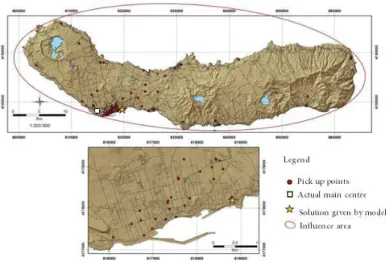
Considering the obtain results, we can stats that in the situation of one median, associated with the first hypothesis, the midpoint is located in the urban area of the Ponta Delgada city and have a 2.1 km distance from the current collection centre, as seen in Figure 1.
Asian Online Journals (www.ajouronline.com) 222
In the circumstance of creating a second collection point, associated with the second hypothesis, it was found that the node located within the Ponta Delgada city should remain as median and receive 86% of the tyres. The second median should be located in Nordeste village and only receives 14% of the total quantity of tyres produced. These 14% refer to five holders, three located in the Povoação village and two in the Nordeste village. Note also that, of the five holders, one of them represents almost 80% of the total volume of 130.883 tons delivered.
To confirm the model robustness, it was also calculated for three, four and five medians. In turn, the results obtained in the simulation p = 5, the model was again calculated, but now with the objective of obtaining a midpoint of the five medians previously found. This resolution method using several iterations, to obtain successive approximations, gradually, is a method based on cluster analysis, whose mathematical fundamentals will be presented, by the authors of this article, in future specialize magazine publishing. Note that the result obtained using two iterations (p = 5/1) confirms the results found for p = 1, since both identified as midpoint the same node.
In an attempt to answer the third hypothesis, it wasn’t possible to identify any technical reason that inhibits, permanently, the sending of use tyres from the Azores to recycling. Having in mind the preferential principle of recycling over energy recovery provided by law, it is considered that, in addition to an economic assessment, should be taken into account the environmental and social benefits from the volume increased of recycling over energy recovery. Based on the information that the recycling valuation firms are working over capacity, this explains temporarily the current operating procedure of sending the total used tiers produce on the Azores to energy recovery.
Assuming that economic agents prefer the actions that give them higher return, it becomes feasible to send tyres for recycling rather than energy recovery, when inequality (7) is true.
(7) Separating the transportation costs into its components, obtains the inequality (8).
(8)
Constant values involved in (7) and (8) have their genesis in the information that a container carries, on average, four tons of whole tyres and eighteen tons if they have been previously crushed. Thus, the transportation cost of whole tyres in the container is four and a half times higher than the transporting cost of crushed tyres.
Note that indices 1 are related to energy recovery and 2 for recycling, and to get a better perception of inequalities (7) and (8) we list the used variables.
V - Amount paid by the managing entity to logistic provider, per ton; CP - Cost of processing in the collection centre, per ton;
CT - Cost of transporting a container between collection centre and recovery firm; Cta - Cost of transporting a container in Azores region;
CTm - Cost of shipping a container from the Azores to the mainland;
CTc - Cost of transporting a container on the mainland, from sea port to recovery firm; CA - Environmental costs
CS - Social costs
The inclusion of environmental costs (CA) and social costs (CS) relates to the benefit of considering the three components of sustainability.
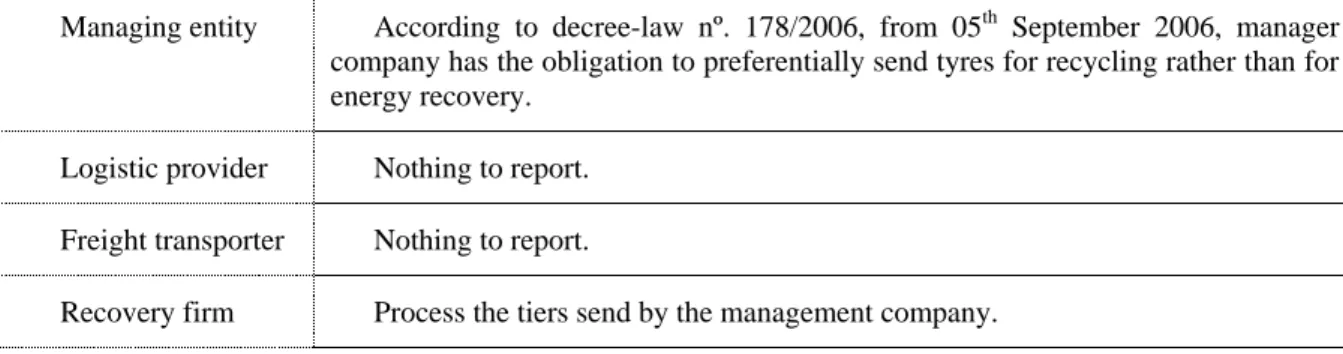
Considering the unavailability of data that allows performing quantitative analysis, it was decided to make a theoretical analysis that focuses on legal, technical, economic and logistical factors that affects each stakeholder - the managing entity, logistics provider, freight transporter and recovery firm - that can be found in Table 1-5. It is important to note that, considering the environmental aspect, there are benefits of recycling option in comparison with energy recovery, as express in legal preference.
Asian Online Journals (www.ajouronline.com) 223
Table 1: Third hypothesis involved factors - Legal factor
Managing entity According to decree-law nº. 178/2006, from 05th September 2006, manager company has the obligation to preferentially send tyres for recycling rather than for energy recovery.
Logistic provider Nothing to report. Freight transporter Nothing to report.
Recovery firm Process the tiers send by the management company.
Table 2: Third hypothesis involved factors - Technical factors Managing entity Just administrative action
Logistic provider For recycling, must clean and sorting the received tyres;
For energy recovery, do the cargo consolidation and may shredding the tyres to obtain transport economy.
Freight transporter Transports containers regardless of their content.
Recovery firm Recycling technology has its own requirements as to receive material, in particular regarding to the standardization of size, shape, physical constitution and cleaning.
The energy recovery firms, like cement makers, may use as fuel coal, fuel oil, gas, among others, so are undemanding about requirements.
Table 3: Third hypothesis involved factors - Economic factors
Managing entity In addition to the value of 0,025 €/kg paid to logistic providers by collected and screened tyres, as stated in the on order nº. 31203/2008 from the Portuguese’s Ministries of Economy and Cities, Land Management and Environment, from the 4th December 2008, it wasn’t possible to establish any other amount contracted under the SGPU;
Logistic provider Since their financial advantage derives from the amount of tyres delivered to SGPU manager company, it must evaluate the compensation gives by each option. Freight transporter The price for containers transported is independent of weight. It has the benefit
from recycling option since it represents a large number of containers shipped. Recovery firm It is unknown the values contracted with the SGPU management company. It is
Asian Online Journals (www.ajouronline.com) 224
Table 4: Third hypothesis involved factors - logistics factors
Managing entity May have contractual clauses for quantities to provide value, particularly with firm that provide energy recover.
Logistic provider Both options represent different logistical requirements, recycling is more demanding about skilled manpower and energy recovery in terms of technological means to crush tiers. The option of energy recovery allows greater processing capacity.
Freight transporter Nothing to report
Recovery firm Treatment capacity in quantitative terms
6. CONCLUSIONS
In the authors view, this study has some immediate applications. We obtain a better understanding from the used tyres collection and processing system organized in São Miguel Island, which may be adapted to any other island in the same archipelago. With the creation of this innovative facility location model, with two additional procedures applied, it fleeing from the standardization found in the literature, reaching some success in adapting to the case study, we also developed a software tool that analyses the efficiency of localization in networks of small and medium size. This work may allow future study of larger networks, and is easily adaptable to the realities of small discontinuous territories.
The two changes made in the traditional method, a number of nodes simplification that allowed the distance matrix reduction and, the use of concepts originating in the hierarchical cluster analysis, resulted in a phased model implementation to network parts, according to a geographic criterion, enables its subsequent application to a simplified network where the nodes are the medians of partial networks previously encountered. By implementing this model, we also able to identify the specificity of the holders of use tyres located in the north-eastern part of the island and contribute to a mathematical justification of the question of sending used tyres exclusively for energy recovery and the reasons behind it.
Thus, using the obtained results, it can be concluded that the SGPU implemented on the São Miguel Island is not efficient, given the location of their facilities, but nevertheless, having as a basis the disadvantage associate to the localization of collecting site in urban areas and its small distance from the actual midpoint, its current location is accepted as correct, in 2013. A second collection point creation shall bring efficiency the system in its wholeness. The current procedure of sending all used tyres, produced in the Azores, for energy recovery isn’t based on permanent technical assumptions, lacking further economic and environmental analysis.
Due to the results obtained in second hypothesis and pursuing the goal of improving overall system performance, the authors propose the load aggregation of tiers produced by the five holders located in the north-eastern part of the island, assuming the holder with more weight the role of local collection centre facility.
In future work, the authors intend to apply the model created to SGPU as a whole, evaluating the location of collection sites not only for upstream transportation costs but also downstream existing costs. Using the phased implementation tested technique, it will be possible to apply the model presented to the entire archipelago, presenting the system in its completeness and understanding the relationships that develop among islands. Another opportunity to study will be the analysis of construction, in Azores territory, of a recycling used tyres facility to process the produced tiers in the region, thus eliminating the need to send it to the mainland. Finally, the analysis of SGPU in dynamic terms, looking for a future based on historical data and review of treatment technologies used tyres existing and hatching.
7. REFERENCES
Adrianto, L., Matsuda, Y., “Developing economic vulnerability indices of environmental disasters in small island regions”, Environmental Impact Assessment Review, vol. 22, no. 4, pp. 393-414, 2002.
Baldacchino, G., “Trains of Thought: Railways as Island Anthitheses”, Shima: The International Journal of Research into Island Cultures, vol. 2, no. 1, pp. 29-40, 2008.
Asian Online Journals (www.ajouronline.com) 225
Barroso, A., Machado, V., “A Gestão Logística dos Resíduos em Portugal”, Investigação Operacional, vol. 25, pp. 179-194, 2005.
Briguglio, L., “Small island developing states and their economic vulnerabilities”, World Development, vol. 23, no. 9, pp. 1615-1632, 1995.
Casaca, A., Marlow, P., “The competitiveness of short sea shipping in multimodal logistics supply chains: service attributes”, Maritime Policy & Management: The flagship journal of international shipping and port research, vol. 32, no. 4, pp. 363-382, 2005.
Chaabane, A., Ramudhin, A., Paquet, M., “Design of sustainable supply chains under the emission trading scheme”, International Journal of Production Economics, vol. 135, no. 1, pp. 37-49, 2012.
Crainic, T., Laporte, G., “Planning models for freight transportation”, European Journal of Operational Research, vol. 97, no. 3, pp. 409-438, 1997.
De Brito, M., Dekker, R., “A Framework for Reverse Logistics”, Erasmus Research Institute of Management Report Series Reference No. ERS-2003-045-LIS, 2003.
Deschenes, P., Chertow, M., “An island approach to industrial ecology: towards sustainability in the island context”, Journal of Environmental Planning and Management, vol. 47, no. 2, pp. 201-217, 2004.
EU-CoR, “Opinion of the Committee of the Regions of 13 March 2002 on the White Paper European Transport Policy for 2010: time to decide”, European Union - Commission for Territorial Cohesion, The Committee of the Regions, Brussels 2002.
Frias, A., “A configuração da cadeia logística inversa para o tratamento dos pneus usados – um problema de optimização de localização”, Universidade dos Açores, Ponta Delgada, 2011.
Frota-Neto, Q., Bloemhof-Ruwaard, J., van-Nunen, J., van-Heck, E., “Designing and evaluating sustainable logistics networks”, International journal of Production Economics, vol. 111, no. 2, pp. 195–208, 2008.
Hall, P., Jacobs, W., “Shifting Proximities: The Maritime Ports Sector in an Era of Global Supply Chains”, Regional Studies, vol. 44, no. 9, pp. 1103-1115, 2010.
Kariv, O., Hakimi, L., “Algorithmic approach to network location problems II: The p-medians”, SIAM Journal on Applied Mathematics, vol. 37, no. 3, pp. 539-560, 1979.
Lorentz, H., Töyli, J., Solakivi, T., Hälinen, H., Ojala, L., “Effects of geographic dispersion on intra-firm supply chain performance”, Supply Chain Management: An International Journal, vol. 17, no. 6, pp. 611-626, 2012.
Matas, J., “Recognition of the island factor”, In Proceeding of the 1st European Conference on Sustainable Island Development - Minorca commitments, pp. 13-14, Minorca,1997.
Morales-Fusco, P., Saurí, S., Lago, A., “Potential freight distribution improvements using motorways of the sea”, Journal of Transport Geography, vol. 24, pp. 1-11, 2012.
Owen, S., Daskin, M., “Strategic facility location: A review”, European Journal of Operational Research, vol. no..111, pp. 423-447, 1998.
Terry, M., “Survey Logistics 96: Revolution progress”, Financial Times, 15 October, pp. 3, 1996.
Valorpneu, Valorpneu – Sociedade de Gestão de Pneus Lda., obtain at 02 june 2013 in http://www.valorpneu.pt/.
Zsigraiova, Z., Tavares, G., Semião, V., Carvalho, M., “Integrated waste-to-energy conversion and waste transportation within island communities”, Energy, vol. 34, no. 5, pp. 623–635, 2009.