L
OOKING
FOR
ORIO
N
l i t e r a t u r e a t t h e i n t e r f a c e o f c o s m o p o l i t a n i s m a n d t r a n s l o c a t i o n s
l i t e r a t u r e a t t h e i n t e r f a c e o f c o s m o p o l i t a n i s m a n d t r a n s l o c a t i o n s
l i t e r a t u r e a t t h e i n t e r f a c e o f c o s m o p o l i t a n i s m a n d t r a n s l o c a t i o n s
l i t e r a t u r e a t t h e i n t e r f a c e o f c o s m o p o l i t a n i s m a n d t r a n s l o c a t i o n s
l i t e r a t u r e a t t h e i n t e r f a c e o f c o s m o p o l i t a n i s m a n d t r a n s l o c a t i o n s
Laura P. Z. Izarra
USPR
R
R
R
R
E S U M OE S U M OE S U M OE S U M OE S U M OEste ensaio apresenta a Literatura como um novo local, um espaço translocal, que consiste em vários espaços fraturados e conectados de conhecimentos. Usando como metáfora a escultura do artista irlandês Rowan Gillespie Looking for Orion analisarei como essa interconexão de espaços abre novos caminhos de representações literárias que compreendem não só as contradições internas da modernização (Theodor Adorno and Max Horkheimer), mas também outras formas de irregularidade e estranhamento que revelam estados da mente específicos não familiares com a racionalização. Ultrapassando as fronteiras dos textos literários na interface com língua, pintura, música, cinema e multimídia, farei uma re-visão dos velhos dramas sociais mundiais, como a fome, a migração e o nacionalismo desde um ponto de vista crítico multi-axial em que a literatura já é um espaço translocal institucional. É o espaço da memória e da imaginação que re-conta narrativas cosmopolitanas suspensas e mitos que estão abertos ao passado e ao presente. A arte da escrita se encontra num ponto de mutação ao interrogar “a imagem ‘eterna’ do passado” (Walter Benjamin), questões de identidade e subjetividade. Analisarei três contos como exemplo de confluência cosmopolitana: “Hunger” (1928) do escritor irlandês James Stephens, “Hunger” (1997) da escritora indiana Kamala Markandaya, e “The Chandelier” (2002) do escitor libanês-americano Gregory Orfaela.
P
P
P
P
P
A L A V R A SA L A V R A SA L A V R A SA L A V R A SA L A V R A S---
C H A V EC H A V EC H A V EC H A V EC H A V ELiteratura, espaço translocal, leitura crítica multi-axial
I
f Literature is considered a mode of interrogating human knowledge and ofrepresenting its transformations within a web of interrelations, a very brief reshuffling of an apparently consensual understanding of the concept of interface must be done before proposing to “re-vision” literature at the interface of cosmopolitanism and translocations. Interface refers to an abstraction in the process of self-representation. It can also provide multiple abstractions of itself and be interpreted as a means of translation between entities which do not speak the same language, such as between a human and a computer, or which do not share the same codes of representation, such as between
different kinds of arts and levels of knowledge. Interfaces are a form of indirection as well as of convergence and therefore I would like to pull together and present some issues I have been thinking about the past couple of years.
In the literary field, there was a turning-point conference held at Strathclyde University in 1986 which had the participation of wellknown critics and writers such as Raymond Williams, Mary Louise Pratt, Stanley Fish, Frederic Jameson, H.G. Widdowson, Jacques Derrida, among others. The aims were, at that time, “to assess the achievements of the interdisciplinary study of literary language over the past quarter-century and to
explore new directions for future work in this area.”1 The results were published in a
work entitled The Linguistics of Writing. Arguments between Language and Literature edited by Nigel Fabb, Derek Attridge, Alan Durant and Colin MacCabe. From then on, there have been many works devoted to the interface of language and literary studies. The first series of books entitled Interface was published at the end of the 1980s; Ronald Carter was the editor, and Roger Fowler, Mary Louise Pratt and Michael Halliday, its associate editors. Its aim was clearly stated: “to examine topics at the interface of language studies and literary criticism and in so doing to build bridges between these traditionally divided disciplines.” 2 Most of the authors of those books prefer the term “literatures” to
a singular notion of literature and explore the role of ideology at the interface of language and literature.3 Some authors replace “literature” altogether with the term “text” thereby
giving emphasis not only to the literary language of canonical literary texts, but also to the linguistic heterogeneity of literature and the appropriation of other discourses such as newspaper editorials, advertisements, historical writings, etc. This approach also
motivates the studies of narrative stylistics and literary awareness.4 Undoubtedly the
term “literature” itself is historically variable and different social and cultural assumptions condition what is regarded as literature.5
In the last decades, two new ways of approaching linguistic and literary studies entered the arena of academic debate: multimodality and intermediality. The first one focuses on the multiple semiotic modes of textual production going beyond the verbal
1 FABB et al. The Linguistics of Writing. Arguments Between Language and Literature, p. 3. 2 STEPHENS & WATERHOUSE. Literature, Language and Change, p. ii - xiii.
3 It is worth mentioning that postcolonial and multicultural studies also claimed the pluralization of the
word literature and, thus, the hegemony of English Literature and North-American Literature was broken in the English curricula. In the Brazilian curricula there was a strong concern about teaching foreign languages and literatures from a socio-historical and postcolonial perspectives. In English Literature courses, the introduction of other literatures started in 1980 with Munira H. Mutran with an Irish Literature postgraduate discipline. See MUTRAN, M. & IZARRA, L. (Ed.) ABEI Journal N.1(1999) and Pesquisa e Crítica: Irish Studies in Brazil, and later in 1994 with the publication of a special issue of Ilha do Desterrro dedicated to Canadian Studies, edited by Sigrid Renaux, which was followed by works by Susana Funck and Sandra Regina Goulart Almeida. Thus, the way to the study of other “non-canonical” and “hyphenated” literatures in English (Caribbean, Indian, African, African-American, Chinese-American, Native-American etc.) was opened.
4 In Brazil, Sonia Zyngier has developed a research on literary awareness, stylistics, empirical studies and
corpus analysis of literary discourse. See ZYNGIER. Literary Awareness: A Coursebook for EFLIT Students, and WATSON, G. & ZYNGIER, S. (Ed.). Literature and Stylistics for Language Learners. Theory and Practice.
limits,6 and the second goes beyond the limits of the literary text focusing on the interface
between literature and other semiotic systems. Thus, studies of literary texts at the interface of painting, cinema, and other multimedia sources, as well as music, open up new ways of reading audio-visual intertexts translated into words and vice-versa. The pioneering work on the relationship between music and literature goes back to 1948 Calvin Brown’s Music and Literature and to 1980 Alex Aronson’s Music and the Novel. It was not until the last decades of the twentieth century, however, that a more systematic approach to the study of the music/literature nexus began to emerge. The “interdisciplinary turn” was somewhat responsible for the emergence of culture as a common object of study for formerly demarcated systems, and the attempt to bring such systems into mutually illuminating understanding. In the 1990s, Word and Music Studies appeared and we can mention, among other publications, Edward Said’s Musical Elaborations (1991) which compiles a series of lectures at California University at Irvine, about themes such as Theodor Adorno’s
musical attention critique, and the presence of musical images in Marcel Proust.7
It is not, however, my aim here to theorize the changes that occurred in Literary Studies over these past years. I believe that Literature educators theorizing Literature undertake the same enterprise as the twentieth-century fictional author Pierre Menard when he undertook to compose Don Quixote, not another Quixote, but the Quixote. According to Borges’s story, the coincidence then becomes so total that Pierre Menard rewrites Cervantes’s novel literally, word for word, and without referring to the original. Borges presents in the end this astonishing sentence: “Cervantes’ text and Menard’s are verbally identical, but the second is almost infinitely richer (More ambiguous, his detractors will say, but ambiguity is richness).”8 I would affirm then, that alike
twentieth-century readers who unconsciously rewrite the masterpieces of past centuries, literary critics and educators rethink literature in cyclically renewed ways at various intersections, making reading perceptions and critiques infinitely rich. Therefore, I would like to ask: is there a way of rewriting on the edge theoretically once again?
My proposal here is to see literary narratives at the interface of cosmopolitanism and translocations. I will consider literature as a new kind of location, a trans-location in itself, which consists of variously connected spaces of different kinds of knowledges. Though this is not a new concept and echoes new transdiciplinary knowledges that were initiated in the “multicultural” academy, I would like to reassess reading practices that are required to perceive and understand what is beyond the transnational, translational and aesthetic concerns that would configure Literature as a space of translocation.
6 See SOUZA’s Language, Culture, Multimodality and Dialogical Emergence. Language and Intercultural
Communication, v. 6, 2006, p. 107-112, and Voices on Paper: Multimodal Texts and Indigenous Literacy in Brazil. Social Semiotics, London, v. 13, n. 1, p. 29-42, 2005.
7 It is on this line of interpretation that Solange Ribeiro de Oliveira published Literatura e música.
Modulações pós-coloniais (2002) in which Said’s musical metaphors are associated with literary and sociocultural elements using Brazilian, Nigerian, Jamaican and Cuban narratives as examples. She is also author of Literatura e artes plásticas.
I
Taking Rowan Gillespie’s sculpture “Looking for Orion” as a metaphorical starting point, I will discuss how that interconnection of spaces open up alternative ways of literary representations that will apprehend not only the internal contradictions of modernization (the effects of “the dialectic of enlightenment,” as seen by Theodor Adorno and Max Horkheimer) but also other forms of unevenness and strangeness that disclose specific states of mind that are unfamiliar with rationalization in the art of writing.
Why “Looking for Orion,” then? In the Greek myth, Orion was a great giant and the strongest man in the world who could stand on the ocean floor and still see above the waves. He fell deeply in love with the beautiful goddess Merope. Her father told Orion he could only marry her if he destroyed all the wild beasts and barbaric forces of the land. The mighty hunter succeeded and returned to claim his prize but the King refused to give Orion the hand of his daughter. The King was outraged because he had taken her by force and he sent a scorpion that only blinded the great giant. Blind and an outcast, Orion crawled through the darkness towards the mountains and down into the great volcano to find the only man who could restore his sight, Hephaestus, god of the forge and god of all craftsmen. He led him to the end of the Earth to have his sight restored by Helios, the god of the sun. Immediately, Orion returned to take vengeance on the King but he had fled and the hunter was unable to find him. He went on to Crete and he lived there as Artemis’s huntsman till the goddess killed him. After his death he was placed in heaven as a constellation, which shows him with a girdle, sword, club and lion’s skin.
The myth of Orion will be used as a form of thinking, open to both the past and
the present,9 and as a double-bound metaphor throughout this essay. First, to explore
what one of the most distinguished North-American poets, Adrienne Rich, calls “the arts of the possible” referring to the complex relationship between art and social justice. Following this line of thought, the myth exemplifies the pursuit of Orion to have both his beloved and sight restored and, although he was deprived of his love, he succeeded in regaining his sight. In the end, he became a constellation of stars in the sky where he could see everything and could be seen from everywhere. Thus, I will refer to a renewed space of literature at the interface of social disciplines, in pursuit of representing social and cultural displacements of the past in the light of the present, in an attempt to reflect on the ideological yokes that kept those displacements and resulting man-made sufferings, repeating themselves again and again without attaining a social justice. The proposal is to re-vision the process, to look back and enter likewise old world social dramas, such as the famine in connection with migration and nationalism, to have part of the claims restored, at least the “sight restored.”
9 The idea of myth allows and conditions interpretations of reality. According to Ashis Nandy, history,
as a modern myth, “selects for us what should be remembered on grounds of objectivity. Myths, as self-consciously selective memories, not only aid memory but also select for us what should be forgotten on ground of compassion” (NANDY, 2004, p. 25).
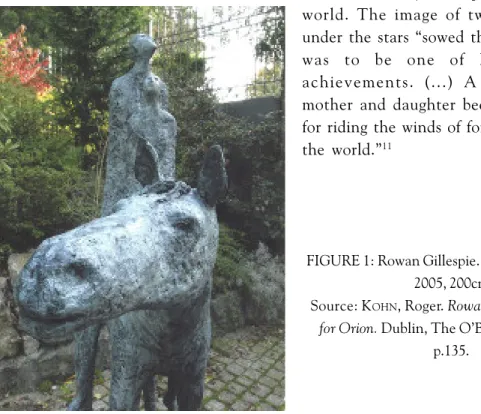
Secondly, I would also like to keep in mind the implications of the cosmopolitan image that inspired the Irish sculptor Rowan Gillespie when creating the statue “Looking for Orion,” commissioned by an eminent dental surgeon from Liechtenstein. Marion Matt told Rowan that she had once told her daughter Hanna who had left home to make it on her own in the world, that, “whenever they were separated in the world they only had to look up to the stars and find the constellation of Orion to know that in some
essential sense they shared the same space together.”10 This is possible because the
brilliant stars of the constellation of Orion are found on the celestial Equator and are visible from any hemisphere around the world. The image of two figures alone under the stars “sowed the seeds for what was to be one of Rowan’s finest achievements. (...) A horse carrying mother and daughter became the symbol for riding the winds of fortune together in the world.”11
Thus, the constellation becomes the space of coexistence in which mother and daughter meet through the imaginative manner of vision while gazing skywards and looking for Orion. The closeness in distance provides a symbolic space, a “non-space,” which is not only subjective but also cosmopolitan if we consider Walter Mignolo’s
assertion that cosmopolitanism is a set of projects toward “planetary conviviality.”12
What is worth noting in this sculpture is that there is no melancholic tone in the representation of absence in symbolic presence and, according to Kohn, the masterstroke that completes the equation mother-daughter together under the stars is the horse, “which is also looking for Orion with a sense of the absurd anthropomorphic humour reminiscent of Jacob Epstein’s ‘Rock Drill’.”13
FIGURE 1: Rowan Gillespie. Looking for Orion, 2005, 200cm
Source: KOHN, Roger. Rowan Gillespie Looking
for Orion. Dublin, The O’Brien Press, 2007, p.135.
10 KOHN. Rowan Gillespie Looking for Orion, p. 134. 11 KOHN. Rowan Gillespie Looking for Orion, p. 134
12 MIGNOLO. The Many Faces of Cosmo-polis: Border Thinking and Critical Cosmopolitanism, p. 157. 13 KOHN. Rowan Gillespie Looking for Orion, p. 134.
Returning to my previous argument in a metaphoric way, the myth of Orion at the interface of Gillespie’s sculpture helps us to see literature with fresh eyes–as a translocation. I believe that literature consists of fractured concepts that are metafictionally represented and related to a network of interconnected spaces of knowledge, as it happens with the constellation of Orion – once the stars are linked to one another, they correspond to the figure of the hunter in the sky which is observed from different locations and brings together simultaneous spatial perceptions. Literature as translocation is the space of memory and imagination that reveals suspended narratives and myths, which are linked to the past and the present, and to subjectivity and to cosmopolitan forms of human experience. One often finds oneself in the interstices of the old and the new memories, of the past of preserved old memories and retrograde amnesia and the new memories and anterograde amnesia, the impaired formation of
new memories in the future.14
Moreover, according to Pollock et al. (2002), cosmopolitanism is a way to live in terrains of historic and cultural transition. Transitional territories have to be negotiated while “a minoritarian modernity (as a source for contemporary cosmopolitical thinking) is visible in the new forms of transdiciplinary knowledges.”15 Literary narratives create
a potential space of tangential encounters of memories in which knowledges “touch” on slightly provoking turning points in the process of representation. Then, transdisciplinary knowledge is “more readily a translational process of culture’s in-betweenness than a transcendent knowledge of what lies beyond difference, in some common pursuit of the
universality of the human experience.”16 Contemporary narratives of nation, migration,
(dis)placement, location and culture intersections are related to what constitutes social and cultural identities and different modes and histories have been the source of aesthetic concerns for many writers, artists and social scientists.
In the introductory essay “Cosmopolitanisms,” Pollock et al. affirm:
it is understood that the cosmopolitanism of our times does not spring from the capitalized virtues of Rationality, Universality and Progress; nor is it embodied in the myth of the nation writ large in the figure of the citizen of the world. Cosmopolitans today are often the victims of modernity, failed by capitalism’s upward mobility and bereft of those comforts and customs of national belonging. Refugees, peoples of the diasporas and migrants and exiles represent the spirit of the cosmopolitical community.17
This situation brings us back to colonialism, which for many was a powerful cultural experience of displacement that dislodged people from territories as well as from “tradition.” These experiences gave meaning to nationalist narratives that emphasize ideas that connect identities to imaginations of place: home, boundary, territory, and
14 Hans Markowitsch refers to the retrograde and anterograde kinds of amnesia suffered by people who
had had a traumatic experience or had been under great stress: parts of their memory are affected in two temporal directions, towards the past or the future (GALLE et al. 2009).
15 POLLOCK, BHABHA, BRECKENRIDGE and CHAKRABARTY. Cosmopolitanisms, p. 6.
16 POLLOCK, BHABHA, BRECKENRIDGE and CHAKRABARTY. Cosmopolitanisms, p. 6-7.
roots. If loyalties and local allegiances determine not what we are, but who we are, literature as a space of translocations and at the interface of cosmopolitanism is the process of representation of displaced identities and the process of construction of identities in dialogue with new locations and cultures; thus, it is the confluence of various kinds of knowledges and life experiences.
II
Three literary representations of a social catastrophe caused by the political systems of the British and Ottoman Empires will be analysed as examples of the interface of cosmopolitanism and translocations in the intersection of Gillespie’s sculptures “Famine”: the Famine in Ireland (1845-52) and India (1876-79; 1943-44) – James Stephens’s “Hunger” (1928) and Kamala Markandaya’s “Hunger” (1997) respectively, and the Famine in
Lebanon (during the First World War) – Gregory Orfaela’s “The Chandelier” (2002).18
The word “famine” has highly emotional and political connotations. A famine is defined as “a widespread shortage of food”, a phenomenon that is “usually accompanied by regional malnutrition, starvation, epidemies and increased mortality.” Historically, most famines have generally occurred “among the poor because of agricultural problems such as drought, crop failure, or pestilence,”19 as it is shown in the first two examples.
This historical circumstance has conditioned people used to naturalize the causes and social consequences assuming the collective attitude that the cause is “an act of God.” This naturalization hinders criticism of the real situation and prevents people from noticing the economic and political causes underlying the social drama. It is also true that war or economic policies could worsen a famine because they influence food distribution: “though famine has infrequently occurred amid plenty, acts of economic or military policy have sometimes deprived certain populations of sufficient food to ensure survival,”20 as it is explicit in the third example. However, due to the imperial
historical context of the three countries, the literary examples chosen here represent different layers and effects of the catastrophe.
According to Leela Gandhi, “the emergence of ‘independent’ nation-states after colonialism is frequently accompanied by a desire to forget the colonial past,”21 mainly
the trauma it caused to their people. Considering that literature as translocation is the space of memory formation and intersections of knowledges, the retrograde postcolonial amnesia has a variety of cultural and political motivations and “it urges for historical self-invention or the need to make a new start – to erase painful memories of colonial
subordination.”22 However, the possible anterograde amnesia of the future memories has
to be incorporated as well in order for us to become aware of the effects of the catastrophe
18 I thank Glaucia Renate Gonçalves who shared with me her postdoctoral research on
Lebanese-American writers and called my attention to this story.
19 <http://www.absoluteastronomy.com/topics/Famine#encyclopedia>. Accessed on: 24th May 2009. 20 <http://www.absoluteastronomy.com/topics/Famine#encyclopedia>. Accessed on: 24th May 2009. 21 Apud LLOYD. Irish Times.Temporalities of Modernity, p. 23.
in the postcolonial present. In the case of Ireland, the representations of the Great Famine of 1845-52 and the commemoration of its 150 years during the 1990s could be seen as acts of historical representation and the importance of keeping the popular memory alive; as a revisionism of nationalism and modernity; and as a renewed sense of survival and mourning. The massive work of research that has been done since the 1980s greatly added to popular and academic knowledge about the subject. According to David Lloyd in Irish Times. Temporalities of Modernity (2008), the catastrophe of the Famine was clearly not simply a natural disaster but the effect of “intersecting vectors
of social change that preceded the years of starvation in radically different forms”.23
The arrival of the blight may have been the effective cause of the failure of the potato crop, but the catastrophe is the consequence of “a colonial matrix” of economic and political forces “regulated by a racializing discourse on the Irish”:24
A longstanding political and ethnological objectification of the Irish as a population trapped in pre-modernity and incapable of attaining to subjecthood permitted the view, articulated quite clearly, (...) by administrators and economists like Charles Trevelyan and Nassau Senior, that the Famine was providential. A godsend that made possible the clearing of the land of a redundant people. 25
Thus, the famine – conceived as a calamity sent by God to teach the Irish a lesson as Sir Trevelyan advocated in 1846 – must be seen as the culmination of a social, biological, political, economic and supernatural catastrophe that profoundly altered Irish culture and tradition. It was a colonial catastrophe with terrible consequences: death and emigration.
In “Hunger,” James Stephens, a contemporary of James Joyce, tells the story of a poor urban family fighting with all their strength to survive the famine: the mother, her three children, one of them crippled, and her husband, a house-painter. The story is divided into twelve short parts which, in dramatic economic details, tell the suffering of the family with the passing of the months of the year: “They could scarcely die of hunger for they were native to it. They are hunger. There was no other hunger but them: and they
only made a noise about food when they saw food.”26 The youngest child died, and the
husband emigrates to Scotland to look for work. In the meantime she begged, she looked for assistance when she is about to be evicted for not having paid the rent, and finally, one day when she arrived home with some food (two loaves of bread), her second child
would not turn to her, and would not turn to her again, for he was dead; and he was dead of hunger. She could not afford to go mad, for she still had a boy (...) She fed him and fed herself; running from him in the chair to that other in its cot, with the dumb agony of an animal who must do two things at once, and cannot resolve which thing to do.27
23 LLOYD. Irish Times. Temporalities of Modernity, p. 30. 24 LLOYD. Irish Times. Temporalities of Modernity, p. 30. 25 LLOYD. Irish Times.Temporalities of Modernity, p. 30-31. 26 STEPHENS. Hunger, p. 25-26.
In the end of the story, the writer expresses in the intersection of the mother’s despair, the state of the mind of the charitable gentleman who went to her house to pay the rent and witnessed that painful scene: “he went away all hot and cold; beating his hands together as he walked. And feeling upon his shoulders all the weariness and misery of the world.”28
What is left in the mind of the reader is the ambiguous effects of trauma. Lloyd, based on Frantz Fanon’s concept that colonialism is a nervous condition, affirms that trauma is defined “not so much as the undergoing of intense, inflicted pain, but as a state of what is strictly terror.”29 In Stephens’s short story, it is terror of the worst – dishonour,
dehumanization; not rage! The complexity of the paradoxical attitudes of the characters proves the various layers of terrors: the payment of the rent even if the family starves for it; hope for her husband’s return, who everybody thought had deserted his wife; dissociation and dislocation of the mother at the moment she had to beg in the streets to collect money for feeding her children; honour regained despite death, when the gentleman brought the news from Scotland that the morning after her husband got a job he was found dead of hunger and exposure. As the horse in the sculpture “Looking for Orion,” the woman could only “look from the gentleman who told it to her little son who listened to it. She moistened her lips with her tongue; but she could not speak, she
could only stammer and smile.”30 Her husband had not deserted her contrarily to what
people believed. This news ironically restores humankind and I would affirm that after reading Stephens’s story, Oscar Wilde’s statement is deeply resignified: “We’re all in the gutter but some of us are looking at the stars.”31
I would like to ask, up to what extent this literary realist representation of hunger is fictional? How and why a catastrophe like this could be commemorated in the 1990s? What are the therapeutic effects of the Famine commemoration?
Following Lloyd’s argument, the “will-to-forget” or amnesia of the victim is related to this terror of the occasion; trauma entails violent intrusion and annihilates the person as subject, not as agent. The unspeakableness of the trauma itself denies the very existence of a subject that could remember; the victim and the perpetrator insist on the condition of silence. However, “in eviction, homelessness, death and scattering of emigration, there is no recovery to be traced but only the conditions of a transformed
subjectivity, subdued but not subjected”.32 An emerging ethics of cultural and economic
survival in the midst of the brutality and humiliation of eviction, for example, arises in writing, in wording it out, in commemorating memory. Let’s see this story in the interface
of Rowan Gillespie’s sculptures called “Famine” (1997).33
28 STEPHENS. Hunger, p. 53.
29 LLOYD. Irish Times. Temporalities of Modernity, p. 23. 30 STEPHENS. Hunger, p. 53.
31 Apud KOHN. Rowan Gillespie Looking for Orion, p. 134 32 LLOYD. Irish Times. Temporalities of Modernity, p. 37.
33 The sculptures were commissioned by the renowned Irish philanthropist and art collector Norma
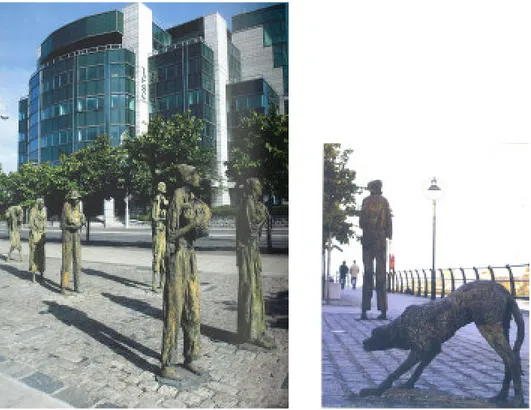
“Seven desperate emaciated figures, shadowed by a ravenous opportunist dog, stand silently on the quayside, near the Custom House alongside the River Liffey in
Dublin.”34 This is the way Roger Kohn describes
Gillespie’s Famine sculptures whose visitors have often been moved to tears. They were placed where thousands of emigrants departed on board of “coffin” ships to an uncertain future in the new world after suffering the loss of their loved ones. The hyper-realism of the figures, “although linked together through family
bonding and shared grief,”35 makes them appear
solitary and introverted. As Kohn says, “death is personal; a time to assimilate grief in quiet reflection”.36 This
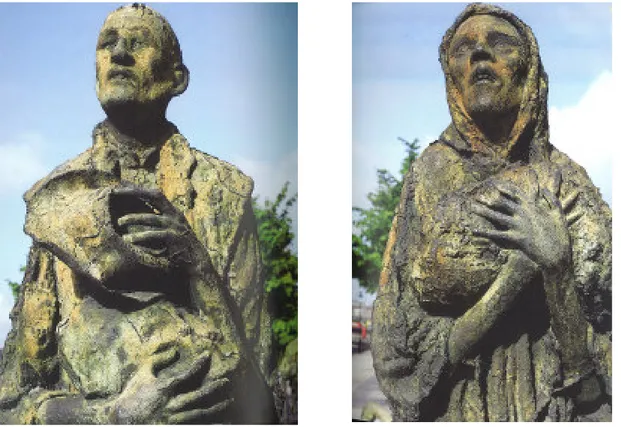
spirit of grief expressed by the figure of the father
FIGURE 2: Rowan Gillespie. Famine, 1997, ranging from 200 to 250 cm. Custom House Quay, Dublin. Source: KOHN, Roger. Rowan Gillespie Looking for Orion. Dublin, The O’Brien Press, 2007, p.135.
34 KOHN. Rowan Gillespie Looking for Orion, p. 86. 35 KOHN. Rowan Gillespie Looking for Orion, p. 95. 36 KOHN. Rowan Gillespie Looking for Orion, p. 95.
FIGURE 3: Rowan Gillespie. Famine, detail. Source: KOHN, Roger. Rowan Gillespie Looking for Orion.
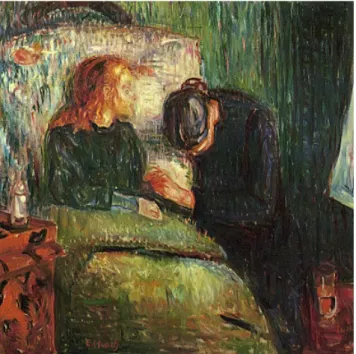
carrying the dead child on his shoulders intersects the pathos of Stephens’s story when the mother is trapped in the empty room not knowing what to do with the dead body of one of her sons. Edvard Munch’s painting “The Sick Child” (1886) and Gillespie’s own painful personal experience were his sources for portraying the depth of human suffering during the most tragic chapter of Irish history. He knew well the vacant look of the starving as he drew upon the memory of his sister Lorraine, who had died tragically at the age of twenty-four having suffered from anorexia for many years. Gillespie transposed Munch’s technique of “The Sick Child” to his own search for a medium to express such an overpowering emotional and physical state. The aesthetic effect achieved by a canvas in a raw state is similarly manifested in the unfinished nature of the sculptures. Kohn says, “Rowan’s bronze is cracked and raw. The figures appear as they emerged from the mould with no machined finishing. Necessary welding of parts is skilfully hidden. Oxidisation creates age and the impression of bitter experience and deterioration reminiscent of creeping rust.”37
But what does it mean to mourn the Famine in the turn of the century? There is a connection between the individual trauma and a socio-historical cure; a people could be released of the burden of the past and become agents in the present fighting against those conditions that victimized them once. The economic and social crisis in post-Cold War era has provoked a “globalization of poverty” and famine is the continuing global issue that has been brought to the West’s attention by journalists and, as Kohn also points out, musicians such as George Harrison, whose “Concert for Bangladesh” puts human suffering back on the global agenda in the 1970s. Therefore, Gillespie’s figures portray not only the victims of the Irish Great Famine but also “the unacceptable global starvation that haunts us all. The sculpture is not a historical monument but a reminder of the wake-up call to all affluent societies.”38 The reading of the Irish literary
narrative from an actual world perspective at the interface of the commemorations of the Famine in the 1990s with Rowan’s hyper-real sculpture and many other events in Ireland, the United States and Canada, brings the meaning of the Famine, eviction and emigration to a turning point and is vividly apprehended in its contemporaneity.
FIGURE 4: Edvard Munch. “The Sick Child” (1907)
37 KOHN. Rowan Gillespie Looking for Orion, p. 95. 38 KOHN. Rowan Gillespie Looking for Orion, p. 95.
The perception of Ireland and India as “zones of famine” led many nineteenth-century observers to draw analogies between these two troublesome colonies of the British empire. Despite some divergences, strong continuities exist between the two interventions. In both cases it involved a critique of a laissez-faire dogmatism – whether manifest in the “Trevelyanism” of 1846–50 or the Lytton-Temple system of 1876–9. Moreover, Indian Famine of 1943-44 was one of the greatest crimes of British imperialism, because the famine was entirely man-made and about 3.5 million people died as a result. There was no overall grain shortage: wheat was still being exported from India, as had happened in Ireland a century before, and if rice had been rationed there would have been no shortage of that, either.39
Kamala Markandaya’s “Hunger” (1997) portrays indirectly those other issues in addition to the effects of the natural disaster upon a rural Indian family: “That year the rains failed. A week went by, two. We stared at the cruel sky, calm, blue, indifferent to
our need.”40 Similarly to James Stephens’s short story, the Indian writer uses the same
economy of words to narrate despair and hope “‘Perhaps tomorrow’, my husband said. ‘It is not too late’.”41 The drought seems to be the cause of their afflictions:
39 <http://en.wikipedia.org/wiki/Bengal_famine_of_1943>. Accessed on: 25th May 2009.
40 MARKANDAYA. Hunger, p. 81.
41 MARKANDAYA. Hunger, p. 81.
FIGURE 5 and 6: Rowan Gillespie. Famine, detail.
The drought continued until we lost count of the time. Day after day the pitiless sun blazed down, scorching whatever still struggled to grow and baking the earth hard until at last it split and great irregular fissures gaped in the land. Plants died and the grasses rotted, cattle and sheep crept to the river that was no more and perished there for lack of water, lizards and squirrels lay prone and gasping in the blistering sunlight.42
Extreme opposites provoke no feelings; barrenness of the land and of the mind are the most terrible effects of profound distress:
Then after the heat had endured for days and days, and our hopes had shrivelled with the paddy – too late to do any good – then we saw the storm clouds gathering, and before long the rain came lashing down, making up in fury for the long drought and giving the grateful land as much as it could suck and more. But in us there was nothing left – no joy, no call for joy. It had come too late.43
Though lack or excess of rain is the cause of crop failure in India, the writer focuses on the corrosion of ethical values represented through the effects of usury and human misery: the violence of the man who collects his master’s dues although nothing was left after the drought; the painful bargain of the last “precious” things the farmers have to sell in order to get money to pay the rent and not to lose their land; greed and cheating to get half a mud pot of water to survive; deceit and betrayal that makes both wife and husband share the last portions of rice with an “evil and powerful” woman who benefited from the past infidelity of the couple.
While in Stephens’s story the family relations are sublimated through hunger and human strength – husband and wife are true to family and Christian values despite hunger – in Markandaya’s story, human passions are brought into conflict as a question of survival. It is not only hunger but disbelief, disillusionment, anger, reproach, pain,
“desperate competition that made enemies of friends and put an end to humanity.”44
Fear, hunger and despair turned into relief when “no more scheming and paring would
make it go any further: the last grain had been eaten.”45 And a “new peace” came to
the couple Nathan and Rukmani “freed at last from the necessity for lies and concealment and deceit”,46 with the fear of betrayal lifted from them.
Similarly again to Stephens’s story, this Indian representation of hunger deals with hope and fear but it ends in emptiness: “Then that too is gone, all pain, all desire, only a great emptiness is left, like the sky, like a well in drought, and it is now that the strength drains from your limbs, and you try to rise and find you cannot, or to swallow water and your throat is powerless, and both the swallow and the effort of retaining the liquid tax you to the uttermost.”47 However, an echo of hope is still present when Nathan
would murmur “It will not be long before the harvest” and she would agree “Ah yes, not
42 MARKANDAYA. Hunger, p. 86. 43 MARKANDAYA. Hunger, p. 87. 44 MARKANDAYA. Hunger, p. 95. 45 MARKANDAYA. Hunger, p. 95. 46 MARKANDAYA. Hunger, p. 94. 47 MARKANDAYA. Hunger, p. 95.
long now; only a little time before the grain is ripe.”48 Husband and wife are reconciled
in hope through a story that is retold in free indirect speech in terms of a lack, an absence – not only material lack but human incompleteness. Though in both stories the cause of famine is due to a natural phenomenon, in the Indian story there is a sense of human atrocity provoked by previous acts of distress that are opposed to the sense of Christian resignation present in the former story.
Arguably famine-vulnerable communities have strategies for coping with the trauma, creating either new bonds between individuals at home through the common experience of endurance, or new communities of survival abroad through the experience of emigration. Literature of the diaspora, migration or exile not only represents geographical movements and all modes of displacement but also transitions and transformations. Exiles become nowadays closer to the norm and narratives represent these kinds of experience of crossing boundaries and charting new territories in defiance of canonical enclosures. It is a fact that the traditional understanding of locations as stable are increasingly undermined. Translocation is not only a process, such as the transfer of people and cultural products to different locales or the physical and textual redrawing of borders, but can also mean a new kind of location consisting of interconnected spaces that are simultaneously conjured up.
The third story, briefly analysed here in a contrapuntal way with the previous ones, illustrates a community of survival abroad, marked by the family’s famine experience in the land of origin. Gregory Orfaela’s “The Chandelier” (2002) is the story of a Lebanese immigrant living in Pasadena, in Southern California, who relates his childhood memories in the times of hunger in Beirut during the First World War. At that time the Turks were holding over all the Arab lands and the Germans were allied with the Turks. They blockaded Beirut harbor and “for four years there was no food to be had in Mount Lebanon”49
where Mukhlis lived with his mother and two brothers and two sisters. In order to survive starvation, he transgressed the law: after being robbed of the only money he had to buy some milk for his starving brothers, he robbed the chandelier made of gold and rubies which was hanging from the ceiling of an abandoned monastery in the snowy mountains, crossed them facing his own fears and the attack of the wolves, and bargained it for two jugs of milk and a pack of bread when he reached the village on the other side of the mountain. However, when he got back home, it was too late for his little brother Wadie. The despair of the mother “squeezing the lambskin of milk until half of it was dripping out of his mouth to the floor,” and Mukhlis pulling it from her hands saying “mother, don’t, don’t! You’re wasting it,”50 intersects with the Irish story analysed above.
The three stories represent different experiences of famine in the second half of the nineteenth century and first half of the twentieth century. In these examples, literature as translocation creates a politics of space where experiences of life meet and enact “the arts of the possible” as their narratives refer to the complex relationship
48 MARKANDAYA. Hunger, p. 95.
49 ORFAELA. The Chandelier, p. 148. 50 ORFAELA. The Chandelier, p. 155.
between art and social justice. Writing is more than images and form; it is revelation, information; it can offer clues, intimations, keys to questions and questions not yet framed. There is also an unstable balance between making visible and skillfully masking unexplored interconnections through intersecting rhetorics. Readers must account for the web of connections between texts and societies, between literatures of the peripheries and literature of the metropolitan centres, between literature and other arts or other kinds of knowledges. For example, when the analysed stories intersect they become part of that web. In the Irish story the unnamed characters are sublimized, becoming symbols of a catastrophe in which human and Christian values gain visibility. Honour, resignation and charity are challenged by a stagnant political and economic situation of the country as well as by an individual paralysis marked by impotence. The Indian story reveals the characters’ endurance and the conflicts of human passions – an acceptance of karma – present in natural and human disasters. They are individuals, they have names, and they face facts within limited action. The Lebanese-American story is much more complex at the encounter of cultures: there is the paradoxical individual strife for the American Dream versus human disgrace because of Lebanese individualism; lack of food in Lebanon and its excess in North America. All the characters have names except the great-nephew, born in the United States; both immigrants, brother and sister after the catharsis of their memories, return to their everyday life in a capitalist society: Mukhlis goes to receive the rent of his states and Wardi to buy more food to fill the refrigerator.
In an analogy to the myth of Orion, although justice is not restored, at least consciousness (“sight”) is regained: the protagonists are not materially compensated, but they become aware of human conditions, virtues and vices, passions, individualism, chance, and migration. While the three stories end in emptiness, the outer-limits of communicability are reached metonymically and metaphorically. Like the giant Orion, these authors, writing in different temporalities and from different countries, fight against their own national beasts: oppression, famine, and migration. Recovering private and collective memories, they rewrite the ghosts of their culture to purge them and open up ways for the future generations. Literature then becomes even more significant if we consider it as a space of translocations, a space of flow, discontinuity, and endless change. Literature thus becomes a space of mutation of the human mind.
Edward Said already proposed in 1991 the “contrapuntal lines of a global analysis, in which texts and worldly institutions are seen working together, in which Dickens and Thackeray as London authors are read also as writers informed constitutively by the colonial enterprises of which they were so aware, and in which the literature of one
commonwealth is involved in the literature of the others,”51 as in the examples here
presented. This expanded notion of literature at the interface of translocations requires Said’s global and contrapuntal analysis, “not modelled on the notion of a symphony (as
earlier notions of Comparative Literature were modelled)” but as “atonal ensembles.”52
51 SAID. Figures, Configurations, Transfigurations, p. 71. 52 SAID. Figures, Configurations, Transfigurations, p. 71.
According to Said, this kind of analysis “has to do with spatial and rhetorical practices as inflections, limits, constraints, intrusions, inclusions, prohibitions tending towards
elucidations of a complex and uneven topography.”53 Said affirms that “readers and
writers in the configurations and by virtue of the transfigurations taking place around us” are intellectuals with moral responsibilities.54 This multi-faceted concept of literature
as cosmopolitan translocations considers art as a form of expression of a wider world viewpoint. Gayatri Spivak (2003) goes further and says that the crossing of borders under the auspices of Comparative Literature supplemented by Area Studies has widened the horizons in the field of literary criticism, thinking of it as a “figure” that invites us “to read the logic of the metaphor.” Nevertheless, “to learn to read is to learn to dis-figure the undecidable dis-figure into a responsible literality, again and again. (...) [I]nitiation into cultural explanation is a species of such a training in reading” 55; and
she claims that collectivities “might attempt to figure themselves as planetary rather
than continental, global or worldly.”56 According to the critic, we have to imagine
ourselves as planetary subjects rather than global agents as “alterity remains underived from us; it contains us as much as it flings us away.”57
III
If we believe in the power of literature as an aesthetic web of interconnections, it can be affirmed that the three writers were looking for Orion from three different country experiences and they encountered in the incommensurable space of the future. Following David Lloyd’s argument applied to the Irish case and extending it to the other two cases, what was to be mourned was not so much the Famine dead and their sufferings, “but the meaning of the event itself for the present, as the effect of a fixation on the past
that was seen to inhibit the advent of modernity.”58
Literature at various interfaces is like a constellation of potentiality. It is a renewed way of considering the literary space as a space of confluence where the representation of various kinds of knowledges is more a matter of recognizing that the frontiers are invisible and their crossings are totally imaginary.
Literature as translocation is as if we were having a view of Orion from various points in the planet earth; it is the imaginary shared space in which various knowledges coexist simultaneously. For many writers like Borges, literature is the space of the probable, the possible and even the impossible, where past, present and future exist simultaneously as it happens in our dreams.59 It is the space of paradoxical intellectual
53 SAID. Figures, Configurations, Transfigurations, p. 71. 54 SAID. Figures, Configurations, Transfigurations, p. 72. 55 SPIVAK. Death of a Discipline, p. 71-72.
56 SPIVAK. Death of a Discipline, p. 72. 57 SPIVAK. Death of a Discipline, p. 73.
58 LLOYD. Irish Times. Temporalities of Modernity, p. 31. It would be challenging for Brazilians to read
these stories in the intersection with Vidas Secas by Graciliano Ramos, published in 1938.
59 Borges reveals in his short stories how he plays with mind, dreams, space and time. See, for example,
possibilities. Literature at the interface of cosmopolitanism and translocations is like Borges’s “Library of Babel,” the image of the universe, infinite and always beginning again. Did I say that I was going to present something new here? All has already been said but I ran the risk of recreating it, so I would like to end with a question: would literature conjure a different social and historical consciousness towards the potential future of world famine, or of human violence, or of a new planetary insight?
This should be another chapter to be written altogether.
A
A
A
A
A
B S T R A C TB S T R A C TB S T R A C TB S T R A C TB S T R A C TThis essay discusses Literature as a new kind of location, a trans-location consisting of fractured and variously connected spaces of knowledges. Taking Rowan Gillespie’s sculpture “Looking for Orion” as a metaphorical starting point, I argue how that interconnection of spaces opens up alternative ways of literary representations that will apprehend not only the internal contradictions of modernization (Theodor Adorno and Max Horkheimer) but also other forms of unevenness and strangeness that disclose specific states of mind unfamiliar with rationalization. Moving beyond the edge of literary texts at the interface of language, painting, music, cinema, and multimedia sources, I would like to re-vision old world social dramas, such as the famine, migration, and nationalism from a multi-axial critical perspective in which literature is already an institutional translocation. It is the space of memory and imagination that retells cosmopolitan suspended narratives and myths that are open both to the past and the present. The art of writing is brought to a turning point questioning “the ‘eternal’ image of the past” (Walter Benjamin), issues of identity and subjectivity. I analyse three short stories as an example of cosmopolitan confluence: James Stephens’s “Hunger” (1928), Kamala Markandaya’s “Hunger” (1997) and George Orfaela’s “The Chandelier” (2002).
K
K
K
K
K
E Y W O R D SE Y W O R D SE Y W O R D SE Y W O R D SE Y W O R D SLiterature, translocation, multi-axial critical reading
W
W
W
W
W
O R K SO R K SO R K SO R K SO R K SC I T E DC I T E DC I T E DC I T E DC I T E D
BHABHA, Homi. The Vernacular Cosmopolitan. In: DENNIS, Ferdinand; NASEEM, Khan (Ed.). Voices of the Crossing. London: Serpent’s Tail, 2000, p. 133-142.
BORGES, Jorge Luis. Pierre Menard. Author of the Quixote. In: ____. Labyrinths. Selected Stories & Other Writings. Edited and Translated by Donald A. Yeats & James E. Irby. New York: A New Directions Book, 1964. p. 36-44.
FABB, Nigel et al. The Linguistics of Writing. Arguments Between Language and Literature. Manchester: Manchester University Press, 1987.
KOHN, Roger. Rowan Gillespie Looking for Orion. Dublin: The O’Brien Press, 2007.
LLOYD, David. Irish Times. Temporalities of Modernity. Dublin: University of Notre Dame/Field Day, 2008.
MARKANDAYA, Kamala. “Hunger”. In: SALMAN, Rushdie; WEST, Elizabeth (Ed.). The Vintage Book of Indian Writing 1947-1997. London: Vintage, 1997. p. 81-95.
MARKOWITSCH, Hans. Pré-requisitos emocionais e cognitvos da memória autobiográfica. In: GALLE, Helmut; OLMOS, Ana Cecília; KANZEPOLSKY, Adriana; IZARRA, Laura (Org.). Em primeira pessoa. Abordagens de uma teoria da autobiografia. São Paulo: Annablume, 2009. p. 63-78.
MIGNOLO, Walter. The Many Faces of Cosmo-polis: Border Thinking and Critical Cosmopolitanism. In: BRECKENRIDGE, C.; POLLOCK, S., BHABHA, H.; CHAKRABARTY, D. Cosmopolitanism. Durham/London: Duke University Press, 2002. p. 157-187.
NANDY, Ashis. Cultural Frames for Social Transformation. A Credo. ______. Bonfire of Creeds. The Essential Ashis Nandy. New Delhi: Oxford University Press, 2004. p. 17-29. OLIVEIRA, Solange Ribeiro de. Literatura e música. Modulações pós-coloniais. São Paulo: Perspectiva, 2002.
OLIVEIRA, Solange Ribeiro de. Literatura e artes plásticas. Ouro Preto: Editora UFOP, 1994.
ORFALEA, Gregory. The Chandelier. In: BROWN, Wesley; LING, Amy (Ed.). Imagining America. Stories from the Promised Land. New York: Persea Books, 2002. p. 345-353. POLLOCK, Sheldon; BRECKENRIDGE, Carol; BHABHA, Homi; CHAKRABARTY, Dipesh. Cosmopolitanisms. In: ______. (Ed.). Cosmopolitanism. Durham/London: Duke University Press, 2002. p. 1-14.
RICH, Adrienne. Arts of the Possible. New York: W.W. Norton, 2001. STEPHENS, James. Hunger. New York: The Macmillan Company, 1928.
STEPHENS, John, and WATERHOUSE, Ruth. Literature, Language and Change: from Chaucer to the Present. London: Routledge, 1990.
SAID, Edward. Figures, Configurations, Transfigurations. THARU, Susie (Ed.). Subject to Change. Teaching Literature in the Nineties. Hyderabad: Orient Longman, 1998. p. 52-72. SOUZA, Lynn Mário Menezes de. Language, Culture, Multimodality and Dialogical Emergence. Language and Intercultural Communication, v. 6, p. 107-112, 2006.
SOUZA, Lynn Mário Menezes de. Voices on Paper: Multimodal Texts and Indigenous Literacy in Brazil. Social Semiotics, London, v. 13, n. 1, p. 29-42, 2005.
SPIVAK, Gayatri. Death of a Discipline. New York: Columbia University Press, 2003. WATSON, G. & ZYNGIER, S. (eds.). Literature and Stylistics for Language Learners. Theory and Practice. New York: Palgrave Macmillan, 2007.
ZYNGIER. S. Literary Awareness: A Coursebook for EFLIT Students. Rio de Janeiro: UFRJ, 1994 & 2004.