
Hugo Miguel Ferreira Beleza
Estimation of the glottal flow from the speech or
singing voice
Dissertação de Mestrado
Mestrado em Bioinformática
Trabalho efetuado sob a orientação dos
Professor Doutor Rui Manuel Ribeiro Castro Mendes
Professor Doutor Aníbal João de Sousa Ferreira
DECLARAÇÃO
Nome: Hugo Miguel Ferreira Beleza
Título da dissertação: Estimation of the glottal flow from the speech or singing voice
Orientadores:
Professor Doutor Rui Manuel Ribeiro Castro Mendes Professor Doutor Aníbal João de Sousa Ferreira
Ano de conclusão: 2016 Mestrado em Bioinformática
É AUTORIZADA A REPRODUÇÃO INTEGRAL DESTA DISSERTAÇÃO APENAS PARA EFEITOS DE INVESTIGAÇÃO, MEDIANTE DECLARAÇÃO ESCRITA DO INTERESSADO, QUE A TAL SE COMPROMETE.
Universidade do Minho, 15/01/2016
R
ESUMO
O processo de produção humana de voz é, resumidamente, o resultado da convolução entre o sinal de excitação, o impulso glótico, e a resposta impulsiva resultante da função de transferência do trato vocal. Este modelo de produção de voz é frequentemente referido na literatura como um modelo fonte-filtro, em que a fonte representa o fluxo de ar que sai dos pulmões e passa pela glote (espaço entre as pregas vocais), e o filtro retrata as ressonâncias do trato vocal e a radiação labial/nasal.
Estimar a forma do impulso glótico a partir do sinal de voz é de importância significativa em diversas áreas e aplicações, uma vez que as características de voz relacionadas, por exemplo, com a qualidade da voz, esforço vocal e distúrbios da voz, devem-se, principalmente, ao fluxo glotal. No entanto, este fluxo é um sinal difícil de determinar de forma direta e não invasiva.
Ao longo das últimas décadas foram desenvolvidos vários métodos para estimar o impulso glótico mas sem o desenvolvimento de um algoritmo eficiente e automático. A maioria dos métodos desenvolvidos baseia-se num processo designado por filtragem inversa. A filtragem inversa representa a desconvolução, ou seja, procura obter o sinal de entrada aplicando o inverso da função de transferência do trato vocal ao sinal de saída. Apesar da simplicidade do conceito, o processo de filtragem inversa não é simples uma vez que o sinal de saída pode incluir ruído e não é alcançável modelar com precisão as características do filtro do trato vocal.
Nesta dissertação apresentamos um novo método de filtragem de um sinal de modo a melhorar um método robusto de estimação da fonte glótica, no domínio das frequências, que usa uma característica de fase baseada nos Atrasos Relativos Normalizados (NRD) dos harmónicos. Este modelo é aplicado a diversos sinais de voz (sintéticos e reais), e os resultados obtidos da estimação do impulso glótico são comparados com os obtidos usando outros métodos analisados no estado da arte com e sem o referido método de filtragem.
Palavras-Chave: impulso glótico, estimação do impulso glótico, filtragem inversa, integração no domínio das frequências, estimação do impulso glótico no domínio das frequências.
A
BSTRACT
The human speech production system is, briefly, the result of the convolution between the excitation signal, the glottal pulse, and the impulse response resulting from the transfer function of the vocal tract. This model of voice production is often mentioned in the literature as a source-filter model, where the source represents the flow of the air leaving the lungs and passing through the glottis (space between the vocal folds), and the filter stands for the resonances of the vocal tract and the lip/nostrils radiation. The estimation of the shape of the glottal pulse from the speech signal is of significant importance in many fields and applications, since the most important features of speech related to voice quality, vocal effort and speech disorders, for example, are mainly due to the voice source. Unfortunately, the glottal flow waveform which is at the origin of the glottal pulse, is a very difficult signal to measure directly and non-invasively.
Several methods to achieve the estimation of the glottal flow have been proposed over the last decades, but an efficient and automatic algorithm which performs reliably is not yet available. Most of the developed methods are based on the inverse filtering method. The inverse filtering approach represents a deconvolution process, i.e., it seeks to obtain the source signal by applying the inverse of the vocal tract transfer function to the output speech signal. Despite the simplicity of the concept, the inverse filtering procedure is complex because the output signal may include noise and it is not straightforward to accurately model the characteristics of the vocal tract filter.
In this dissertation we discuss a new filtering method for voiced signals with the goal to improve the assessment of a robust frequency-domain algorithm for glottal source estimation that uses a phase-related feature based on the Normalized Relative Delays (NRDs) of the harmonics. This model is applied to several speech signals (synthetic and real), and the results of the estimation of the glottal pulse are compared with the ones obtained using other state-of-the-art methods with and without the presence of that filtering method.
KEYWORDS:glottal pulse, estimation of the glottal pulse, filter, algorithm, frequency-domain glottal source
C
ONTENTSResumo... iii
Abstract... v
List of Figures ... viii
List of Table ... ix Acronyms ... X 1. Introduction ... 1 1.1 Motivation ... 4 1.2 Goals ... 4 2. Vocal Organs ... 5
2.1 Anatomy & Physiology ... 5
2.2 Glottal Flow ... 9
3. Glottal Flow Estimation Algorithms ... 13
3.1 Representative Estimation Algorithms ... 13
3.1.1 Iterative Adaptive Inverse Filtering Algorithm ... 15
3.1.2 Complex Cepstrum Decomposition ... 17
3.1.3 Frequency-Domain Glottal Pulse Estimation ... 19
3.2 Glottal Flow Parameterization ... 22
3.3 Applicability in Biomedical Applications ... 25
4. Experimental Tests ... 29
4.1 Tests with Synthetic Speech Signals ... 30
4.1.1 Parks-McClellan Algorithm ... 31
4.2 Tests with Real Speech Signals ... 31
5. Results & Discussion ... 33
5.1 Synthetic Speech Signals ... 33
5.2 Real Speech Signals ... 42
6. Conclusion ... 47
L
IST OF
F
IGURES
Figure 1 - Cycles from a voiced speech signal showing the voice source signal... 3
Figure 2 - Illustration of the LPC method. ... 4
Figure 3 – The respiratory system. ... 5
Figure 4 - Anterior and posterior views of the larynx and the cartilages ... 6
Figure 5 - Vocal folds as seen from above ... 7
Figure 6 – Speech production model... 10
Figure 7 – Glottal flow waveform ... 10
Figure 8 - ZZT decomposition algorithm ... 15
Figure 9 - Block diagram of the Iterative Adaptive Inverse Filtering method ... 16
Figure 10 - Block diagram of the Complex Cepstrum-based decomposition. ... 18
Figure 11 – Block diagram of FD-GPE algorithm ... 20
Figure 12 - The flow pulse phases ... 22
Figure 13 – Group delay of the synthesized female signals ... 34
Figure 14 – Group delay of the synthesized male signals ... 35
Figure 15 – Frequency magnitude response of the female synthesized speech. ... 36
Figure 16 – Frequency magnitude response of the male synthesized speech. ... 37
Figure 17 - Glottal flow derivative estimation of female vowel “a”. ... 38
Figure 18 - Glottal flow estimation of female vowel “a” ... 38
Figure 19 - Glottal flow derivative estimation of female vowel “i”. ... 39
Figure 20 - Glottal flow estimation of female vowel “i” ... 39
Figure 21 - Glottal flow derivative estimation of male vowel “a”. ... 40
Figure 22 - Glottal flow estimation of male vowel “a” ... 40
Figure 23 - Glottal flow derivative estimation of male vowel “i”. ... 41
Figure 24 - Glottal flow estimation of male vowel “i” ... 41
Figure 25 - Glottal flow estimation of the female subject vowel “a” ... 43
Figure 26 - Glottal flow estimation of the woman’s vowel “i” ... 43
Figure 27 - Glottal flow estimation of male subject vowel “a” ... 44
L
IST OF
T
ABLE
Table 1 – SNR results for the synthetic signals ... 42 Table 2 – SNR results for the human speech. ... 45
A
CRONYMS
ANN – Artificial Neural Network CP – Closed Phase
ClQ – Closing Quotient
DAP – Discrete All-pole Modelling DFT – Discrete Fourier Transform EGG – Electroglottographs
F0 – Instantaneous Fundamental Frequency
FD-GPE – Frequency-Domain Glottal Pulse Estimation FIR – Finite Impulse Response
GCI – Glottal Closure Instant
GHNR’ – Glottal Related Harmonic-to-Noise Ratio GIF – Glottal Inverse Filtering
GMM – Gaussian Mixture Model GOI – Glottal Opening Instant HNR – Harmonic-to-Noise Ratio HRF – Harmonic Richness Factor IAIF – Iterative Adaptive Inverse Filtering IIR – Infinite Impulse Response
LF – Liljencrants-Fant LP – Linear Prediction
LPC – Linear Predictive Coding MFC – Mel Frequency Cepstral NAQ – Normalized Amplitude Quotient NRD – Normalized Relative Delay OP – Open Phase
OQ – Open Quotient
PCA – Principal Component Analysis PD – Parkinson Disease
SJE – Spectral Jitter Estimator SNR – Signal to Noise Ratio SQ – Speed Quotient
SVLN – Separation of the Vocal tract with the Liljencrants-Fant model plus Noise SVM – Support Vector Machine
UC – Unit Circle
1. I
NTRODUCTION
Mankind is well-known for countless characteristics and one of those is socialization. The basic mechanism used to fulfill their social needs is through communication and therefore humans use their vocal organs to execute a process, entitled phonation, generating the man’s most natural communication technique, speech. Although people do not realize, since speech is very present in our everyday life, voicing is a very complex phenomenon that delivers a high rate of information and constitutes a combinatory system in which syllables can be mixed into a large number of sequences originating words that are combined to form phrases. Due to this complexity, speech is a research goal in several areas such as engineering, medicine, phonetics, linguistics, phoniatrics and singing. Another example of voicing complexity is that even after quite a few decades of research not all of its features are known and documented. All the fields of speech science are based on the utilization of the speech pressure waveform which can be difficult based on the fact that humans are capable of varying extensively the functioning of their vocal organs due to the utterance produced, the language, the gender and the emotional state of the speaker among others. Flanagan, in 1972, categorized speech sounds into three main classes according to the mechanism of production: voiced sounds, which result from a quasi-periodic vibration of the vocal folds; unvoiced sounds, where the sound excitation is turbulent noise and plosives, which are transient-type sounds made up by abruptly releasing the air flow that has been blocked by the lips[1]. Vowels, a sub-category of voiced sounds, represent the research goal of most interest because of their crucial phonetic role in most languages.
The phonation process has three main groups of organs involved. The first group are the lungs which are the source of energy to provide an airflow that passes though the trachea and reaches the second main group, the larynx, where the modulation of the airflow occurs. Present in the larynx are the vocal folds, a very important component of phonation, and the glottis, the space comprised between the vocal folds. The glottal modulation provides either the quasi-periodic vibration or the turbulent noise to the last main group, the vocal tract. This group is constituted by the pharyngeal, oral and nasal resonant cavities and here is where the airflow is shaped in terms of timbre. Finally, the airflow reaches and pressures the lips as a velocity flow that results in speech. This airflow is commonly called the glottal flow. The glottal behavior manipulates both pitch and volume, as well as the voice quality. Pitch represents the perceived fundamental frequency of a voiced sound and, along with volume, represents
important features for controlling stress and intonation of speech. Voice quality is a measure of the laryngeal phonation style and provides paralinguistic information. Glottal flow processing refers to the methods that study the estimation, modeling and characterization of the glottal source, as well as the integration of associated information. Estimation of the glottal flow is quite challenging, as the oscillation of the vocal folds can neither be examined directly due to their hidden position in the larynx nor be observed without aids because of the high speed of the oscillations. The methods developed are grounded on visual, electrical and electromagnetic methods. Visual analysis is widely used with numerous techniques, such as video stroboscopy, digital high-speed stroboscopy and kymography. Other type of devices such as electroglottographs (EGG) or laryngographs measure the impedance between the vocal folds, which is an indirect image of the glottal opening. High-speed imaging implies introducing a laryngoscope positioned in such a way as to allow visualization of the larynx. Unfortunately, acquiring visual information requests for invasive measurements and, although they are informative about the glottal behavior, these methods only analyze an image of the real glottal flow. Fortunately, an alternative to the analysis methods referred above exists, by acoustically investigating the functioning of the human speech production mechanism with several mathematical models.
Most models of the voice production system assume that voice is the result of an excitation signal which is modulated by a filter function that is determined by the shape of the vocal tract. This is frequently mentioned as a source-filter approach. In several speech processing applications, separating source and filter is important as the separation could lead to the distinct characterization and modeling of the two features. This is advantageous since these two components act on different properties of the speech signal, but it is also one of the most difficult challenges in speech processing, since neither the glottal or the vocal contributions are observable in the speech waveform. The glottal flow process can be divided into three main steps[2]:
i. Synchronization with the glottal cycles. In this step the frequency of vibration of the vocal folds, also known as instantaneous fundamental frequency (F0), the polarity of the speech signal and the instants of significant excitation in each glottal cycle (called Glottal Closure Instants (GCIs)) are determined (Figure 1);
ii. Estimation and parameterization of the glottal flow. In the second step, the glottal flow is estimated from the speech signal. The glottal flow estimate is then parameterized by extracting relevant features;
iii. Incorporation of the glottal information in the target application. In this last step, the resulting glottal information is used to increase the performance of a voice technology application.
Figure 1 - Cycles from a voiced speech signal showing the voice source signal. The glottal closing instant (GCI), glottal opening instant (GOI), the closed phase (CP) and open phase (OP) are indicated[3].
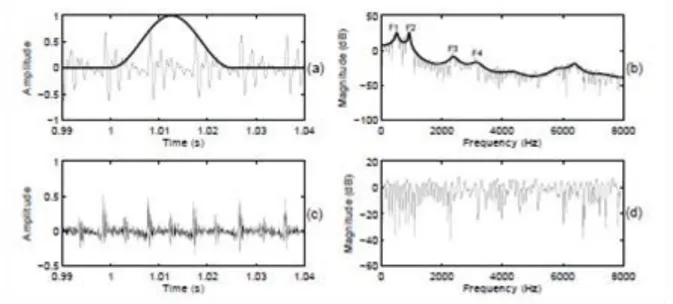
Due to the aforementioned limitations, using the real glottal flow in standard speech processing systems is commonly avoided. It is usual to consider, for the filter, the contribution of the spectral envelope of the speech signal, and for the source, the residual signal obtained by glottal inverse filtering (GIF). The idea of GIF is to custom a computational model for the filtering effects of the vocal tract and lip radiation and then to cancel these effects from speech by filtering the recorded signal through the inverses of the vocal tract and lip radiation model. GIF aims to estimate the input of the vocal system (the glottal excitation) using just the output, i.e. the speech signal. In most GIF methods, the estimation of the vocal tract and lip radiation is computed from the acoustical speech pressure signal, which makes the analysis non-invasive. This technique is typically used in association with parameterization of the estimated glottal flow in order to describe voice production quantitatively. Methods that parameterize the filter, such as the Linear Predictive Coding (LPC) (Figure 2) or Mel Frequency Cepstral (MFC) features, are widely used in practically every field of Speech Processing[4]. Contrarily to the methods mentioned above, techniques modeling the excitation signal are still not well proven and there might be knowledge to extract by combining these modeling methods with several applications.
Figure 2 - Illustration of the LPC method. (a): the speech signal (thin line) and the applied window (solid line), (b): the magnitude spectrum of the speech signal (thin line) and its LPC spectral envelope (solid line), with the four first formants indicated for information, (c): the LPC
residual signal obtained by inverse filtering, (d): the magnitude spectrum of the residual signal[5].
1.1 Motivation
This work was developed to improve the robustness of the algorithms used in the estimation of the glottal source of the human voice, in order to provide the medical community with a non-invasive method to determine the condition of the human vocals folds.
1.2 Goals
This dissertation aims to achieve an improvement in the estimation of the glottal flow. More precisely, the goal is to determine if the current assumption that the vocal tract filter is modelled by an all-pole infinite impulse response (IIR) filter does not negatively affect the estimation of the glottal flow. To accomplish that, a linear-phase finite impulse response (FIR) filter with the frequency magnitude of the all-pole filter will be used to cancel perturbations caused by the vocal tract filter in the glottal flow estimation of three algorithms. Both IIR and linear-phase FIR models of the vocal tract filter will be used to synthesize vowel sounds such as to study the impact of those models on the performance of three different algorithms estimating the glottal excitation.
2. V
OCAL
O
RGANS
2.1 Anatomy & Physiology
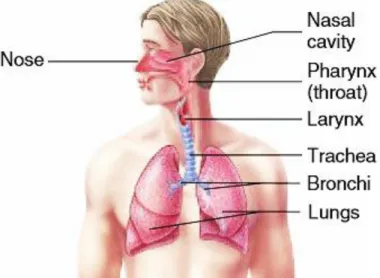
The respiratory system consists of the nasal cavity, the pharynx, the larynx, the trachea, the bronchi, and the lungs (Figure 3). The term upper respiratory tract refers to the nose, the pharynx, and associated structures; and the lower respiratory tract includes the larynx, trachea, bronchi, and lungs.
Figure 3 – The respiratory system.
The nose, consists of the external nose and the nasal cavity. The external nose is the visible structure that forms a prominent feature of the face. The nasal cavity extends from the nares to the choanae. The nares, are the external openings of the nasal cavity and the choanae are the openings into the pharynx. The hard palate is a bony plate that forms the floor of the nasal cavity that separates the nasal cavity from the oral cavity. The nasal cavity has several functions:
i. The nasal cavity is a passageway for air that’s open even when the mouth is full of food. ii. The nasal cavity cleans the air. The vestibule is lined with hairs that trap some of the large
particles of dust in the air. The mucus traps debris in the air, and the cilia on the surface of the mucous membrane sweep the mucus posteriorly to the pharynx.
iii. The nasal cavity humidifies and warms the air. Moisture from the mucous epithelium and from excess tears that drain into the nasal cavity through the nasolacrimal duct is added to the air as it passes through the nasal cavity. Warm blood flowing through the mucous membrane warms
the air within the nasal cavity before it passes into the pharynx, thus preventing damage from cold air to the rest of the respiratory passages.
iv. The olfactory epithelium, the sensory organ for smell, is located in the most superior part of the nasal cavity.
v. The nasal cavity and paranasal sinuses are resonating chambers for speech.
The pharynx is the common opening of both the digestive and respiratory systems. It receives air from both the nasal cavity and the oral cavity. The pharynx is connected to the respiratory system at the larynx. The pharynx is divided into three regions: the nasopharynx, the oropharynx, and the laryngopharynx.
The nasopharynx is the superior part of the pharynx and extends from the choanae to the soft palate. The soft palate prevents swallowed materials from entering the nasopharynx and nasal cavity. The posterior surface of the nasopharynx contains the pharyngeal tonsil which aids in defending the body against infection.
The oropharynx extends from the uvula to the epiglottis. The oral cavity opens into the oropharynx through the fauces. Thus, air, food, and drink all pass through the oropharynx.
The laryngopharynx extends from the tip of the epiglottis to the esophagus and passes posterior to the larynx.
The larynx consists of an outer casing of nine cartilages that are connected to one another by muscles and ligaments (Figure 4). Six of the nine cartilages are paired, and three are unpaired. The largest of the cartilages is the unpaired thyroid cartilage, or Adam’s apple.
Figure 4 - Anterior (A) and Posterior (B) views of the larynx and the cartilages. Image from Anatomy & Physiology for Speech, Language and Hearing[6]
The most inferior cartilage of the larynx is the unpaired cricoid cartilage, which forms the base of the larynx on which the other cartilages rest. The third unpaired cartilage is the epiglottis. It’s attached to the thyroid cartilage and projects as a free flap toward the tongue. During swallowing, the epiglottis covers the opening of the larynx and prevents materials from entering it.
Two pairs of ligaments extend from the anterior surface of the arytenoid cartilages to the posterior surface of the thyroid cartilage. The superior ligaments are covered by a mucous membrane called the vestibular folds, or false vocal cords (Figure 5). When the vestibular folds come together, they prevent food and liquids from entering the larynx during swallowing and prevent air from leaving the lungs, as when a person holds breath.
Figure 5 - Vocal folds as seen from above. The true vocal folds appear white upon examination as a result of the superficial layer of squamous epithelial tissue. Seen immediately superior to the true vocal folds are the ventricular folds[6]
The inferior ligaments are covered by a mucous membrane called the vocal folds, or true vocal cords. The vocal folds and the opening between them are called the glottis. The larynx performs three important functions:
i. The thyroid and cricoid cartilages maintain an open passageway for air movement. ii. The epiglottis and vestibular folds prevent swallowed material from moving into the larynx. iii. The vocal folds are the primary source of sound production. Air moving past the vocal folds
causes them to vibrate and produce sound. The greater the amplitude of the vibration, the louder is the sound. The force of air moving past the vocal folds determines the amplitude of vibration and the loudness of the sound. The frequency of vibrations determines pitch, with higher frequency vibrations producing higher pitched sounds and lower frequency vibrations
producing lower pitched sounds. Variations in the length of the vibrating segments of the vocal folds affect the frequency of the vibrations. Higher pitched tones are produced when only the anterior parts of the folds vibrate, and progressively lower tones result when longer sections of the folds vibrate. The sound produced by the vibrating vocal folds is modified by the tongue, lips, teeth, and other structures to form words. A person whose larynx has been removed can produce sound by swallowing air and causing the esophagus to vibrate.
Movement of the arytenoid and other cartilages is controlled by skeletal muscles, thereby changing the position and length of the vocal folds. When only breathing, lateral rotation of the arytenoid cartilages abducts the vocal folds, which allows greater movement of air. Medial rotation of the arytenoid cartilages adducts the vocal folds, places them in position for producing sounds, and changes the tension on them. Anterior/posterior movement of the arytenoid cartilages also changes the length and tension of the vocal folds.
The trachea is a membranous tube that consists of dense regular connective tissue and smooth muscle reinforced with 15–20 C-shaped pieces of cartilage. The cartilages protect the trachea and maintain an open passageway for air. The trachea descends from the larynx to the level of the fifth thoracic vertebra and divides itself to form two smaller tubes called primary bronchi which extend to the lungs. The most inferior tracheal cartilage forms a ridge called the carina, which separates the openings into the primary bronchi. The carina is an important radiologic landmark.
Beginning with the trachea, all the respiratory passageways are called the tracheobronchial tree. Based on function, the tracheobronchial tree can be subdivided into the conducting zone and the respiratory zone.
The conducting zone extends from the trachea to small tubes called terminal bronchioles. The conducting zone functions as a passageway for air movement and contains epithelial tissue that helps to remove debris from the air and move it out of the tracheobronchial tree.
The primary bronchi divide and continue to branch giving rise to bronchioles. The bronchioles also subdivide several times to become even smaller terminal bronchioles.
The respiratory zone extends from the terminal bronchioles to small air-filled chambers called alveoli, which are the sites of gas exchange between the air and blood. The terminal bronchioles divide to form respiratory bronchioles, which have a limited ability for gas exchange because of a few attached alveoli. The respiratory bronchioles give rise to alveolar ducts, which are like long branching hallways with many open doorways. The doorways open into alveoli, which become so numerous that the alveolar duct wall
is little more than a succession of alveoli. The alveolar ducts end as two or three alveolar sacs, which are chambers connected to two or more alveoli.
The right lung has three lobes, and the left lung has two. The lobes are subdivided into bronchopulmonary segments. The bronchopulmonary segments are subdivided into lobules by incomplete connective tissue walls. The lobules are supplied by the bronchioles.
2.2 Glottal Flow
The phonetic system, consists of three different systems: the breathing apparatus, the vocal folds and the vocal tract. The vocal folds are the most important functional components of the voice organ, because they function as a generator of voiced sounds.
As air rushes through the vocal folds, these may start to vibrate, opening and closing, in alternation, the passage of air flow, triggering a series of short pulses of air, which increases the supraglottal pressure and gives rise to the suction phenomenon referred to as the Bernoulli Effect. This effect, due to the decrease of the pressure across the glottis, sucks the folds back together, and the subglottal pressure increases again, forcing the vocal folds to open, giving rise to a new pulse of air[7].
The sustained vibration of the vocal folds is described as the balance between three aspects: the lung pressure, the Bernoulli principle and the elastic restoring force of the vocal fold tissue. The Bernoulli force, along with the asymmetrical force at the glottis due to the mucosal wave as well as the closed and open phase of the folds, is considered the sustaining model for vocal fold vibration[8].
The length of the vocal folds is what defines the frequency of vibration of the vocal folds, called the fundamental frequency. The values of the fundamental frequency of female voices are higher than those of male voices because frequency is inversely proportional to the length of the vocal folds, as for female voices, the values of the fundamental frequency are close to 220 Hz while for male voices are around 110 Hz[9].
The combination of adduction and abduction actions, when performed at certain frequencies, causes the production of a sound wave that is then propagated towards the lip opening. The sounds produced as a result of the vibration of the vocal folds are called voiced sounds, and the sounds produced without vibration of the former are referred to as unvoiced[9].
When the vocal folds vibrate and form pressure pulses near the glottis, the energy of the frequencies of the excitation is altered as these travel through the vocal tract[10]. Consequently, the sound produced
is shaped by the resonant cavities above the glottal source and, therefore, the vocal tract is responsible for changing acoustically the voice source (Figure 6).
Figure 6 – Speech production model
The shape of the glottal source waveform in a single period is denoted by glottal pulse (Figure 7). As the vocal folds open and close the glottis at identical intervals, the frequency of the sound generated is equal to the frequency of vibration of the vocal folds[7].
Figure 7 – Glottal flow waveform
Each cycle consists of four glottal phases: closed, opening, opened and closing. Typically, when the folds are in a closed position, the flow begins slowly, builds up to a maximum, and then quickly decreases to zero when the vocal folds abruptly shut[11]. However, studies have indicated that total closure of the glottis is an idealistic assumption and that the majority of the individuals exhibit some sort of glottal leakage during the assumed closed phase[12]. Still, most of the glottal models assume that the source has zero flow during the closed phase of the glottal cycle. The time interval during which the vocal folds are closed and no flow occurs is referred to as the glottal closed phase. The next phase, during which there is nonzero flow and up to the maximum of the airflow velocity is called the glottal opening phase, and the time interval from the maximum to the time of glottal closure is referred to as the closing or return phase. Many factors can influence the rate at which the vocal folds oscillate
through a closed, open and return cycle, such as the vocal folds muscle tension, the vocal fold mass and the air pressure below the glottis[11].
3. G
LOTTAL
F
LOW
E
STIMATION
A
LGORITHMS
Glottal-based analysis of speech production consists typically of two stages. In the first stage, glottal flow waveforms are estimated using signal processing techniques. These techniques generally require synchronization information such as knowledge of F0 or GCI locations. In the second stage, the estimated waveforms are parameterized by expressing their most important properties in a compressed numerical form.
3.1 Representative Estimation Algorithms
During the last 20 years, numerous methods and techniques have been developed for the estimation of the glottal waveform using voiced speech and it remains an active research field. Miller, in 1951, published the first study in this field using GIF as the method of estimation[13]. In this, the inverse model of the vocal tract consisted of lumped analog elements which were adjusted based on visual observations of the filter output via an oscilloscope in which the tuning of the anti-resonances was done searching for settings that yielded a maximally flat closed phase of the glottal pulse form. Oppenheim and Schafer (1968) studied the so-called homomorphic analysis of speech in which the convolved signal components are transformed into additive components using cepstral analysis[14]. Separation of speech into the glottal source and vocal tract was studied as an example of Cepstral analysis, hence presenting the first digital signal processing-based experimental results of GIF. Digital cepstral analysis has been used to separate the glottal source from the vocal tract. In 1970, Nakatsui and Suzuki introduced digital filtering as a means to implement the anti-resonances of the vocal tract inverse model[15]. A GIF technique that is based on inverse filtering the volume velocity waveform recorded in the oral cavity rather than the acoustic speech pressure signal captured in the free field outside the mouth was proposed by Martin Rothenberg [16]. A special pneumotachograph mask, as a transducer capable of measuring the volume velocity at the mouth, recorded the signal which was then subjected to inverse filtering, where analog antiresonances were determined using spectrographic analysis. The use of the pneumotachograph mask provides an estimate for the absolute direct DC level of the glottal airflow, a subject that cannot be achieved with GIF techniques that use the free field microphone recording as the input. Rothenberg later studied how the pneumotachograph mask could be optimized[17] and how the mask recordings could be used in the estimation of the glottal area function
by utilizing time-varying non-linear inverse filtering[18]. The use of the pneumotachograph mask has later been combined with digital inverse filtering[19]. Another method, closed phase (CP) covariance analysis, was proposed by Strube in 1974[20]. The CP analysis method is capable of separating the glottal source and the vocal tract. The use of linear prediction (LP) introduced a remarkable improvement in GIF because the vocal tract model adjusts automatically to the underlying speech signal[21]. The method is sensitive to the extraction of the closed phase region, and even small errors might result in severe distortion of the estimated glottal excitation[22]. This drawback can be fairly lessened by using an EGG instead of the acoustic speech signal to estimate the closed phase region[21]. The performance of CP has been reported to show improvements by using speech samples from consecutive cycles[22], adaptive high-pass filtering[23] and/or constrained LP in the modulation of the vocal tract[24]. Computation of a parametric all-pole model of the vocal tract jointly with a source model, proposed by Milenkovic (1986) as a source of his GIF technique, supports the use of speech samples over the entire fundamental period in the optimization of the vocal tract, an issue which is not fulfilled in the basic form of the CP analysis[25]. This method helps with the estimation of the glottal excitation from high-pitch speech and in sounds where the glottal closure is not completed. A joint optimization of the vocal tract and glottal source was later used by Fu and Murphy[26]. They have utilized an approach with the autoregressive model with an exogenous input, where the input has been represented in a pre-defined parametric form by using the Liljencrants-Fant (LF) model of the voice source that also involved quantifying the turbulent noise from voiced speech segments.
A innovative idea for the estimation of the glottal excitation, proposed in the studies of Bozkurt, was a non-parametric method exploiting the maximum-phase properties of the speech signal[27]. Zeros of Z-Transform (ZZT), does not utilize the LP analysis to estimate the source-tract separation, but rather expresses the speech sound with the help of the z-transform as a large polynomial (Figure 8). The roots of the polynomial are separated into two parts, corresponding to the glottal excitation and the vocal tract, based on their location with respect to the unit circle. Separation based on phase characteristics fits the phase spectrum of a model to that of the observed signal at harmonic components by minimizing the mean square phase difference[28]. The technique proposed is different from the true GIF techniques (e.g. CP, IAIF) in the sense that the glottal source signal is not explicitly computed but model parameters are rather solved. A method called Separation of the Vocal tract with the Liljencrants-Fant model plus Noise (SVLN) represents the baseline method the PaReSy is built upon and enables high-quality voice transformations[29]. The key differences lie in the energy model, the VTF
representation and the estimation of the stochastic noise component. SVLN constructs the latter through a high pass filter of white noise, application of an amplitude modulation parameterized by the glottal flow vector, and cross fading between consecutive synthesized noise segments. The gain quantifies the energy level at analysis to control the stochastic energy at the synthesis step[29].
Figure 8 - ZZT decomposition algorithm (UC acronyms unit circle and DFT acronyms discrete Fourier transform)[27].
3.1.1 Iterative Adaptive Inverse Filtering Algorithm
Iterative Adaptive Inverse Filtering (IAIF) (Figure 9), a straightforward and semi-automatic GIF method proposed by Alku in 1992, estimates the contribution of the glottal excitation on the speech spectrum with a low order LP model that is computed with a two-stage procedure[30]. The vocal tract is then estimated using either conventional LP or discrete all-pole modeling (DAP) that utilizes the Itakura-Saito distortion measure[31].
This procedure has three fundamental parts: analysis, inverse filtering and integration. The glottal contribution to the speech spectrum is initially estimated using an iterative structure. This contribution is cancelled and, then, the transfer function of the vocal tract is modelled. Finally, the glottal excitation is estimated by cancelling the effects of the vocal tract (using inverse filtering) and lip radiation (by integration). The algorithm has been changed from that described by Alku by replacing the conventional linear predictive analysis (LPC) with the discrete all-pole modelling (DAP) method. These modifications, by Alku et al.[32], allow to reduce the bias due to the harmonic structure of the speech spectrum in the
formant frequency estimates. The method operates in two iterations: the first phase, which consists of the stages 1 to 6, makes an estimation of the vocal tract function and applies inverse filtering to the signal with that estimate, and generates an estimate of the glottal source which is used as input of the second phase (stages 7 to 12) to achieve a more accurate estimate. A more detailed description of each step is provided below[33].
Figure 9 - Block diagram of the Iterative Adaptive Inverse Filtering method[5]
1. The speech signal is first high-pass filtered using a linear-phase finite impulse response (FIR) filter to remove disturbing low-frequency fluctuations. To avoid filtering out relevant information, the cut-off frequency should be lower than the fundamental frequency of the speech signal.
2. The output of the previous step is analyzed by a first-order DAP and there is a first estimate of the combined effect of the glottal flow and the lip radiation effect on the speech spectrum.
3. The input signal is inverse filtered using the filter obtained in step 2. The spectral tilt caused by the spectrum of the excitation signal and the lip radiation effect is removed.
4. A new analysis by DAP is calculated to obtain a model of the vocal tract transfer function. The order p of the DAP analysis can be adjusted by the operator of the IAIF method and it is related to the number of formants modeled in the relevant frequency band.
5. The input signal is inverse filtered using the inverse of the pth-order model from the previous step. 6. Lip radiation is cancelled by integrating the output of the previous step. Then, a first estimation of the glottal flow is obtained and this completes the first phase of the procedure.
7. A 2nd to 4th-order analysis of the obtained glottal flow estimate is calculated giving a spectral model of the effect of glottal excitation on the speech spectrum.
8. The input signal is inverse filtered using the model of the excitation signal to eliminate the glottal contribution.
9. The output of the previous step is integrated in order to cancel the lip radiation effect.
11. The input signal is then inverse filtered, with the vocal tract model obtained, in order to remove the effect of the vocal tract.
12. The final estimate of the glottal flow is obtained, removing the lip radiation effect by integrating the signal.
The output of the Alku’s algorithm are estimations of the glottal flow and the glottal flow derivative.
3.1.2 Complex Cepstrum Decomposition
Homomorphic systems, as the case where inputs are convolved, are important in speech processing. Separation can be achieved by a linear homomorphic filtering in the complex cepstrum domain, which presents the property to map time-domain convolution into addition. In speech analysis, complex cepstrum is usually employed to deconvolve the speech signal into a periodic pulse train and the vocal system impulse response [34].
The complex cepstrum (CC) ŝ(n) of a discrete signal s(n) is defined by the Discrete-Time Fourier Transform (DTFT) (Equation 1), the complex logarithm (Equation 2) and the inverse DTFT (IDTFT) (Equation 3) [35]: S(ω) = ∑∞𝑛=−∞𝑠(𝑛)𝑒−𝑗𝜔𝑛 (1) log[𝑆(ω)] = log(|𝑆(ω)|) + 𝑗∆𝑆(ω) (2) ŝ(𝑛) = 1 2𝜋∫ log[𝑆(ω)]𝑒 𝑗𝜔𝑛𝑑ω 𝜋 −𝜋 (3)
One difficulty when computing the CC lies in the estimation of ∆S(ω), which requires an efficient phase unwrapping algorithm. This approach uses the complex cepstrum in order to avoid any factorization. This decomposition arises from the fact that the complex cepstrum ŝ(n) of an anticausal (causal) signal is zero for all n positive (negative). Thus, if one considers only the negative part of the CC, it is possible to estimate the glottal contribution. The CC-based method relies on FFT and IFFT operations offering the possibility of integrating a causal-anticausal decomposition module into a real-time application, which was previously almost impossible with the ZZT-based technique. Causal-anticausal decomposition can be performed using the complex cepstrum (Figure 10), as follows [36]:
1. Window the signal;
2. Compute the complex cepstrum ŝ(n) using Equations 1, 2 and 3; 3. Set ŝ(n) to zero for n > 0;
4. Compute ğ(n) by applying the inverse operations of Equations 1, 2 and 3 on the resulting complex cepstrum.
Figure 10 - Block diagram of the Complex Cepstrum-based decomposition[37].
A simple linear filtering keeping only the negative (or positive) indexes of the complex cepstrum allows the isolation of the maximum and minimum phase components of voiced speech.
Windowing is known to be a critical issue for obtaining an accurate complex cepstrum and the need of aligning the window center with the system response is essential [34]. Analysis is performed on windows centered on the Glottal Closure Instant (GCI), as this particular event defines the boundary between the causal and anticausal responses and removes the linear phase contribution [38]. However the window has a considerable effect on the root location in the Z-plane and usual windows (i.e. Hanning or Hamming) are generally not the best-suited [39]. A window whose duration is about 2 to 3 pitch periods gives a good trade-off for being consistent with the convolutional model [34]. The best decomposition is achieved for two period-long windows (typically a Hanning-Poisson or Blackman window).
Many factors may affect the quality of the described decomposition. An obvious assumption, is the interference between minimum and maximum-phase contributions. The stronger this interference, the more difficult the decomposition. Basically, this interference is influenced by three parameters:
- The pitch F0, which governs the spacing between two successive vocal system responses; - The first formant F1, which influences the minimum phase time response;
- The glottal formant FG, which controls the maximum-phase time response.
A strong interference then implies a high pitch, with low F1 and FG values. A performance degradation occurs with the evolution of these factors, equally touching CC and ZZT-based techniques. Also the CC method suffers from the same noise sensitivity as the ZZT does.
The CC-based method just relies on FFT and IFFT which can be efficiently computed as opposed to the computational load of the ZZT-based technique which requires to compute the roots of generally high-order polynomials, despite the accuracy of the current polynomial factoring algorithms. Thus, the complex cepstrum can be effectively used as a fast alternative to the ZZT algorithm.
3.1.3 Frequency-Domain Glottal Pulse Estimation
In order to analyze and synthesize the glottal source, for a given acoustic signal, the frequency-domain glottal pulse estimation (FD-GPE) algorithm, which does not depend on GCI localization and that relies instead on accurate sinusoidal/harmonic analysis and synthesis, characterizes the magnitude and Normalized Relative Delays (NRDs) of the harmonics (Figure 11). FD-GPE takes advantage of the spectral diversity between sinusoidal and noise components of voice speech in order to decouple the phase and magnitude contributions of both source and filter parts of voice production, by also relying on a model of the glottal pulse (the hybrid Liljencrants-Fant/Rosenberg). This decoupling leads to incremental accuracy and flexibility since the combination in the frequency domain of the source, filter and lips/nostrils radiation is multiplicative in the magnitude domain, and additive in the phase or group-delay domains. One advantage of this approach is that the normalized spectral magnitudes and NRDs of the harmonics allow to thoroughly define a time waveform shape independently of its fundamental frequency, time-shift or amplitude, which is essential for a glottal source model. A frequency-domain analysis-synthesis framework was developed for this approach that includes three main features[40]:
i. The ability to perform accurate signal integration or signal differentiation in the frequency domain;
ii. The capacity to selectively analyze and resynthesize the harmonic content of a signal modified or not;
iii. Independent manipulation of both magnitude and phase signal, which makes flexible the processing of the phase and magnitude contributions acquired from the glottal pulse and vocal tract filter.
Figure 11 – Block diagram of FD-GPE algorithm[41].
Relatively to the glottal flow model, several mathematical models exist, such as the Rosenberg and LF models (reference models)[42], but their correspondence to physiological data is not clear. For example, the spectral decay of the LF model (about -16 dB/octave) is significantly higher than the -12 dB/octave reference. This slope reference is usually considered as the natural decay of the glottal pulse spectrum[42]. Alternatively, the Rosenberg model has a discontinuity in its derivative and, thus, is not a realistic model. The slope of the linear regression model of the LF model is significantly higher than that of the Rosenberg model. In fact, the linear approximation for the LF model is given by Equation 4:
𝑦 = 0.0849𝑥 + 0.511 (4)
where x represents the index of the harmonic, for 𝑥 ≥ 2, since by definition the NRD of F0 is always zero, and for the Rosenberg model is given by Equation 5:
𝑦 = 0.0090𝑥 + 0.2412 (5)
Taking these aspects into consideration, Dias and Ferreira created a hybrid model by using the average of the normalized magnitudes of the first 24/30 harmonics of each model (LF & Rosenberg), as well as the corresponding unwrapped NRD coefficients[43]. The different combinations of both linear regressions were used in order to build an NRD model for the hybrid glottal pulse model. The smoothest result was obtained for the LF NRD linear model. In fact, the hybrid model is smoother on the closing phase than the LF and Rosenberg models, nonetheless it reasonably approaches the LF model while evading the discontinuity on the derivative signal of the Rosenberg glottal model[44]. Regarding the estimation, a region of a voiced sound is first analyzed so as to extract harmonic information and a smooth spectral envelope model (ceps). Harmonic information includes the
frequencies, magnitudes and phases of all sinusoidal components that are harmonics of a fundamental frequency.
Concerning magnitudes, the magnitude of individual harmonics is first found for each frame of the source signal, by applying a Sine Window with 1024 samples and using 50% overlap between adjacent frames at the analysis. Then, for each record the average normalized magnitude of all detected harmonics (mS) is determined.
A smooth magnitude interpolation of the ceps is determined based on the mS, using the Matlab function interp1 and a 16-coefficient real cepstrum approach instead of the popular LPC method because it performs a better match of the poles and the zeros. The smooth envelope is achieved by “short-pass filtering” the output of ceps.
The dB difference (dBdf) between the magnitude of the spectral peaks and the spectral envelope model is estimated using Equation 6:
dBdf = mS – ceps (6)
The magnitudes of the glottal source harmonics (mG) (Equation 7) are estimated by adding dBdf to the magnitude of the spectral peaks of the hybrid glottal model (mGHM):
mG = mGHM + dBdf (7)
Using the frequencies and phases, the NRD coefficients of the voiced speech signal (NRDS) are determined. In most cases the unwrapped NRDs can be approximated by a line, however its slope is strongly vowel dependent. Therefore, in order to obtain the linear regression model, the frame where the highest number of harmonics (up to 30) can be identified is selected. Then, the NRDs of the source signal (NRDG) are estimated using a compensation function, as follows (Equation 8):
NRDG = NRDS + NRDslope_dif × hind (8) where NRDslope_dif corresponds to the difference between the slope of the NRDs of the speech signal and that of the source signal and hind corresponds to the harmonic index. This compensation function suggests that the acoustic signal delay between the vocal folds and the region outside the lips, predominates over non-linear phase effects due to the vocal tract filter.
Using the magnitude of the spectral peaks of the glottal model (Equation 7) and the estimated NRDs (Equation 8), the glottal pulse is synthesized.
3.2 Glottal Flow Parameterization
The estimation of the glottal pulse has usually a final step consisting in the parameterization, whose purpose is to determine quantitative features of the signal that characterize the glottal wave and may quantify a perception parameter[45]. Once the glottal flow waveform has been estimated it can be parameterized by expressing its most important properties in a compressed numerical form. Parameterization of the time-domain glottal flow signals can be computed using time-based or amplitude-based methods. In the former, the most straightforward classical method is to compute time duration ratios between different phases of the glottal flow pulse[46]. Thus, the flow pulse is separated into three parts (Figure 12): the closed phase (Tc), the opening phase (To), and the closing phase (Tcl).
Figure 12 - The flow pulse phases
The most widely used time-based parameters are defined as follows: open quotient (Equation 9), speed quotient (Equation 10), and closing quotient (Equation 11),
𝑂𝑄 = (𝑇𝑜+ 𝑇𝑐𝑙) 𝑇⁄ (9)
𝑆𝑄 = 𝑇𝑜⁄𝑇𝑐𝑙 (10)
𝐶𝑙𝑄 = 𝑇𝑐𝑙⁄𝑇 (11)
where the length of the fundamental period is denoted by Equation 12:
𝑇 = 𝑇𝑐+ 𝑇𝑜+ 𝑇𝑐𝑙 (12)
Time-based measures are vulnerable to distortions in the glottal flow waveforms due to incomplete cancelling of formants by the inverse filter, reducing the precision and robustness of these parameters. Therefore, computation of the time-based parameters is sometimes performed by replacing the true opening and closure instants by the time instants when the glottal flow crosses a level which is set to a
given value between the minimum and maximum amplitude of the glottal cycle. The Quasi-Open Quotient (QOQ), defined as the ratio between the quasi-open time and the quasi-closed time of the glottis, and corresponds to the timespan (normalized to the pitch period) during which the glottal flow is above 50% of the difference between the maximum and minimum flow. It was proposed as a parameter describing the relative open time of the glottis. The quasi-open phase is the duration between time instants prior to and following the maximum amplitude of the glottal flow that descend below 50% of this peak amplitude[47].
Time-based features of the glottal source can be quantified by measuring the amplitude-domain values of the glottal flow and its derivative[48]. Amplitude-based measures were first used in the parameterization of the voice source by Gobl and Chasaide whom proposed methods to express three LF-based parameters (glottal frequency, skew parameter, and open quotient) in terms of amplitude-based measures[49].
The computation of the Normalized Amplitude Quotient (NAQ) is done from two amplitude values: the AC-amplitude of the flow (noted fAC) and the negative peak amplitude (dmin) of the glottal flow derivative (Equation 13)[50].
𝑁𝐴𝑄 = 𝑓𝐴𝐶⁄𝑑𝑚𝑖𝑛∙ 𝑇 (13)
Since these two amplitude measures are the largest values of the flow and can be found in every glottal cycle, it is straightforward to extract them even when the estimated glottal sources are distorted. Another parameter called the waveform peak factor (WPF), which measures the decay characteristics of a speech waveform during a single pitch period, was proposed by Wendahl in 1963. The WPF value of a speech waveform with narrow pulses and separated by a long glottal closure is large and for pulses of long duration the WPF is near unity[51].
When GIF is computed with the flow mask of Rothenberg it is possible to parameterize the amplitude-based properties of the time-domain waveforms of the glottal flow and its derivative. The most widely used amplitude parameters are the minimum flow (also called the DC-offset), the AC-flow and the negative peak amplitude of the flow derivative. The ratio between the AC and DC information has been used in the amplitude-based quantification of the glottal source. It is also possible to parameterize the time-domain voice source by searching for a model waveform that matches the estimated glottal excitation (or its derivative)[52]. Time-domain reproduction of the glottal excitation estimated by inverse filtering is also possible by searching for the physical parameters (e.g. vocal fold mass and stiffness) of
the underlying oscillator rather than through explanation of the waveform of the volume velocity signal[53].
In Gudnason et al. [3] a data-driven approach was developed for glottal flow estimation, and was first computed with IAIF and the obtained waveform was then processed with Principal Component Analysis (PCA) in order to achieve dimensionality reduction. The first few PCA components were then modelled with Gaussian Mixture Models (GMMs). GMMs are a generative learning algorithm which involve modelling a given class of data using a mixture of multi-variate Gaussians[47]. The obtained GMMs were shown to enable parameterizing source features, such as non-flatness of the closed phase that traditional approaches fail to model[3]. Artificial Neural Networks (ANNs) are in general used for learning the mapping function ƒ from I to T as detailed in [47]. Another classification algorithm used in the mentioned work was Support Vector Machines (SVMs). SVMs in general look to find a separating hyperplane which maximizes the functional margin between two classes. Techniques also exist to extend the binary classification capability to more than two classes. A different automatic parameterization method of the voice source is based on simulating the strategies that are used in manual optimization of the LF parameters. The technique proposed has three main parts. First, an exhaustive search is executed to get a group of most suitable parameter settings. A dynamic programming algorithm is then used to select the best path of the parameter values by considering two costs (target and transition) in the parameter trajectories of the modeled glottal pulses. As the final part, an optimization method is employed to refine the fit[54].
Frequency domain parameterization of the glottal source has been computed by measuring the spectral skewness with the so called alpha ratio, which is the ratio between spectral energies below and above a certain frequency limit (typically 1.0 kHz) that quantify the spectral slope of the glottal source by utilizing the level of the fundamental frequency and its harmonics. Obtaining the spectrum pitch synchronously opens up the possibility of taking a variety of spectral measurements specifically related to glottal flow characteristics and perturbations. We may give as examples the average percentage amplitude perturbation for the first harmonic named APAP, the distortion factor (amplitude of F0 divided by total signal amplitude) and the H1–A3, that measures the amplitude of the 1st harmonic to that of the first formant frequency[55]. The harmonic richness factor (HRF), proposed by Childers and Lee, is defined for the spectrum of the estimated glottal flow as the ratio of the sum of the amplitude of the higher harmonics and the 1st harmonic[51]. In addition, levels of spectral harmonics have been used in the parameterization of the glottal flow to measure the decay of the voice source spectrum by
performing linear regression analysis over the first eight harmonics[56]. Analysis of the spectral slope of the voice source of singers by computing the difference, denoted by H1-H2, between the amplitude of the fundamental and the second harmonic was attempted by Titze and Sundberg[57]. A similar measure of the spectral tilt is computed directly from the radiated speech signal by correcting the effects of vocal tract filtering without computing the glottal flow by GIF. Alku introduced, in 1997, a frequency domain method based on fitting a low-order polynomial in the pitch synchronous source spectrum[58]. Parabolic spectrum parameter (PSP) is another frequency-domain parameter, which fits a second-order polynomial to the flow spectrum to gain an estimate of the spectral slope[59].
Also, it is possible to quantify the glottal excitation by measuring the ratio between the harmonic and non-harmonic components, especially in the analysis of disordered voices, in which the glottal excitation typically involves an increasing amount of aperiodicities due to jitter, shimmer, aspiration noise, and modifications in the pulse waveform[55].
3.3 Applicability in Biomedical Applications
At the crossroads between biomedical engineering and signal processing, glottal source processing has been demonstrated to be useful in several health-related applications. Its most direct application is for voice disorder detection. Speech pathologies are frequently associated with a dysfunction of the vocal folds, as an edema, or a polyp or nodule.
Features used to define the glottal behavior are therefore of great importance for the automatic audio-based detection of voice pathologies. Two of these measures, jitter and shimmer, are parametrized to characterize anomalies in a quasi-periodic signal[60]. Jitter refers to the variation in the duration of consecutive glottal cycles, while shimmer reflects the alterations in amplitude of consecutive glottal cycles. Different methods to estimate the amount of jitter in speech signals with an objective on their ability to detect pathological voices are known. Short-term jitter estimates are best provided by the spectral jitter estimator (SJE), which is centered on a mathematical description of the jitter phenomenon[61]. SJE was proposed in order to analyze continuous speech. The jitter values obtained were able to confirm studies presenting a decrease of jitter with increasing fundamental frequencies, as well as a more frequent presence of high jitter values in the pathological voices. A variant of the traditional Harmonic-to-Noise Ratio (HNR) measure, called glottal-related HNR (GHNR’), was proposed to overcome the F0 dependency denoted in the usual HNR formulation[62]. For voice pathology
discrimination, GHNR’ is shown to provide statistically significant differentiating supremacy over a conventional HNR estimator. The use of the glottal source estimation to detect voice disorders show that speech and glottal-based features are relatively complementary, despite some synergy with prosodic characteristics[63]. The combination of glottal and speech-based features offers higher discrimination capacities. The phase information, generally associated with the glottal production, is shown to be appropriate to highpoint irregularities in phonation when compared to its magnitude equivalent.
The use of glottal source processing in medical applications is not only restricted to pathological voices as the technologies developed can also be applied to examine healthy voices in danger of becoming disordered due to vocal loading[64]. Vocal loading refers to extended usage of voice in association with environmental factors such as background noise and/or poor air quality[65]. Since the number of employees in the voice-intensive occupations has been increasing, the work-related voice care will become a progressively essential application area for glottal source processing.
Glottal characterization has also been helpful with the classification of clinical depression in speech since the vocal jitter and glottal flow spectrum were proposed as possible indications of a patient’s risk of committing suicide[66]. Three groups were considered: high-risk near-term suicidal patients, major depressed patients, and non-depressed control subjects. The mean vocal jitter was found to be a significant discriminator between suicidal and non-depressed control groups, while the slope of the glottal flow spectrum shown a substantial discriminating capacity among all three groups. Discriminating depressed speech from normal speech was also analyzed and it showed that the combination of glottal and prosodic features produces enhanced discrimination over the combination of prosodic and vocal tract features[67]. It is also emphasized that glottal features are essential components of vocal affect analysis. Towards the goal of objective observation of depression severity, vocal-source biomarkers for depression were considered[68]. These biomarkers are specifically source features and their results highlight the statistical associations of these vocal-source biomarkers with psychomotor activity and depression severity. Using an Auto-Regressive eXogenous (ARX) model combined with the LF model, a human voice can be classified as joy, anger, neutral or sad speech, which facilitates a psychological evaluation of patients. For joy speech and anger speech, the shape of glottal flow looks like triangular wave, a result that fits with the human speech production mechanism when in excited state. In the production of joy and anger speech, the glottis has high pressure and the glottal folds vibrate more quickly. For sad speech the shape of glottal flow is smoother because air flow
arrives slowly at the vocal folds which makes the glottal folds open slowly when humans are in a sad state. Also, the high frequency energy of joy and anger speech is higher than neutral speech, and sad speech’s is the lowest[69].
The use of the glottal source can also be useful in applications for laryngectomees. Patients having undergone total laryngectomy cannot produce speech sounds in the orthodox method since their vocal folds have been removed. Allowing patients to regain voice is then the major goal of the post-surgery process. Several approaches aimed the resynthesis of an enriched form of alaryngeal speech, in order to develop its quality and intelligibility. For this purpose, generation of an artificial excitation signal based on the understanding of glottal production is necessary. For example, Qi, Weinberg and Bi [70] have concluded that analyzing resynthesized female alaryngeal words with a synthetic glottal waveform and with smoothed and raised F0 showed that the replacement of the glottal waveform and F0 smoothing alone produces the most significant enhancement, while increasing the average F0 leads to less dramatic improvement. A speech repair system, that resynthesizes alaryngeal speech using a synthetic glottal waveform, reduces jitter and shimmer and applies a spectral smoothing and a tilt correction algorithm along with a reduction of the perceived breathiness and harshness of the voice[71].
Dysphonia measures (similar to those used for voice pathology evaluation) were shown to outperform previous results in the detection of Parkinson’s disease (PD)[72]. These features complement existing algorithms in maximizing the capability to distinguish healthy controls from PD subjects and represent a promising step toward the early non-invasive diagnostic of PD.
4. E
XPERIMENTAL
T
ESTS
Most of the techniques for the estimation of the glottal source are based on the source-filter model and, thus, have a model for the vocal tract transfer function in order to eliminate the effect of the vocal tract filter and to cancel the lip/nostrils radiation from the speech signal. In the literature, most often, the vocal tract filter is modelled as an all-pole filter that shapes the spectrum of the source according to the resonances of the vocal tract, and the lip/nostrils radiation is typically modelled as a first-order discrete-time derivative operator of the pressure wave at the output of vocal tract. This operation converts volume velocity of the air flow into sound pressure variation, the physical quantity captured by a microphone. Thus, the glottal pulse inverse filtering requires a first-order integration operation in order to eliminate the lip/nostrils radiation from the speech signal. Most of the inverse filtering techniques implement this operation in time domain (e.g., IAIF), but it motivates two sources or approximation errors: a first error is due to the first-order differentiator, since the frequency response clearly differs from the frequency response of an ideal differentiator, especially at high frequencies; a second error is due to the inverse transfer function of the first-order differentiator, in order to avoid the pole at z =1 and to insure stability. This is achieved by moving the pole slightly away from Z=1 (in order to insure stability) and by affecting the gain, a typical difference equation of such an approximate integrator is represented by Equation 14,
𝑦[𝑛] = (1 − 𝛼)𝑥[𝑛] + 𝛼 × 𝑦[𝑛 − 1] (14)
where α is a positive constant less than the unity. For this experience some assumptions were made:
• 2 adult volunteer subjects participated, one of each gender; • All subjects have healthy voices, i.e., no voice disorders;
• The subjects uttered (the back and front) common Portuguese vowels “a” and “i”.
The choice of the sustained vowels “a” and “i” was because they represent a relatively stable condition of the phonatory system and there is a minor vocal tract influence in their glottal source[73].
The original recording sampling frequency was 22050 Hz in order to facilitate subsequent processing, namely in terms of spectral analysis.
In this section the new approach to speech filtering for glottal source estimation, described previously, is tested with twelve speech signals including eight synthetic and four real. The results from three
![Figure 1 - Cycles from a voiced speech signal showing the voice source signal. The glottal closing instant (GCI), glottal opening instant (GOI), the closed phase (CP) and open phase (OP) are indicated[3]](https://thumb-eu.123doks.com/thumbv2/123dok_br/17562044.817472/15.892.204.684.190.384/figure-cycles-showing-glottal-closing-instant-glottal-indicated.webp)
![Figure 4 - Anterior (A) and Posterior (B) views of the larynx and the cartilages. Image from Anatomy & Physiology for Speech, Language and Hearing [6]](https://thumb-eu.123doks.com/thumbv2/123dok_br/17562044.817472/18.892.204.689.802.1083/figure-anterior-posterior-cartilages-anatomy-physiology-language-hearing.webp)


![Figure 8 - ZZT decomposition algorithm (UC acronyms unit circle and DFT acronyms discrete Fourier transform) [27]](https://thumb-eu.123doks.com/thumbv2/123dok_br/17562044.817472/27.892.179.713.278.612/figure-decomposition-algorithm-acronyms-acronyms-discrete-fourier-transform.webp)
![Figure 9 - Block diagram of the Iterative Adaptive Inverse Filtering method [5]](https://thumb-eu.123doks.com/thumbv2/123dok_br/17562044.817472/28.892.125.711.283.432/figure-block-diagram-iterative-adaptive-inverse-filtering-method.webp)
![Figure 10 - Block diagram of the Complex Cepstrum-based decomposition [37] .](https://thumb-eu.123doks.com/thumbv2/123dok_br/17562044.817472/30.892.145.736.179.541/figure-block-diagram-complex-cepstrum-based-decomposition.webp)
![Figure 11 – Block diagram of FD-GPE algorithm [41] .](https://thumb-eu.123doks.com/thumbv2/123dok_br/17562044.817472/32.892.129.766.113.415/figure-block-diagram-fd-gpe-algorithm.webp)
