www.jped.com.br
ORIGINAL
ARTICLE
Analysis
of
contextual
variables
in
the
evaluation
of
child
abuse
in
the
pediatric
emergency
setting
夽
Ana
Nunes
de
Almeida
a,
Vasco
Ramos
a,∗,
Helena
Nunes
de
Almeida
b,
Carlos
Gil
Escobar
b,
Catarina
Garcia
baUniversidadedeLisboa,InstitutodeCiênciasSociais,Lisboa,Portugal
bHospitalProfessorDoutorFernandodaFonseca,DepartamentodePediatria,UnidadedeUrgênciaeCuidadosIntensivos,
Amadora,Portugal
Received3June2016;accepted14September2016
KEYWORDS Physicalviolence; Sexualviolence; Children; Portugal; Hospitalurgency Abstract
Objective: This article comprises a sample of abuse modalities observed in a pediatric emergencyroomofapublichospitalintheLisbonmetropolitanareaandamultifactorial char-acterizationofphysicalandsexualviolence.Theobjectivesare:(1)todiscusstheimportance ofsocialandfamilyvariablesintheconfigurationofbothtypesofviolence;(2)toshowhow physicalandsexualviolencehavesubtypesandinternaldiversity.
Methods: A statistical analysis was carried out ina database (1063 records ofchild abuse between2004and2013).Aformwasappliedtocaseswithsuspectedabuse,containingdataon thechild,family,abuseepisode,abuser,medicalhistory,andclinicalobservation.Afactorial analysisofmultiplecorrespondencewasperformedtoidentifypatternsofassociationbetween socialvariablesandphysicalandsexualviolence,aswellastheirinternaldiversity.
Results: Theprevalenceofabuseinthispediatricemergencyroomwas0.6%.Physicalviolence predominated(69.4%),followedbysexualviolence(39.3%).Exploratoryprofilesofthesetypes ofviolencewereconstructed.Regardingphysicalviolence,thegenderoftheabuserwasthe firstdifferentiatingdimension;thevictim’sgenderandagerangewerethesecondone.Inthe caseofsexualviolence,theageoftheabuserandco-residencewithhim/hercomprisedthe firstdimension;thevictim’sageandgendercomprisedtheseconddimension.
Conclusion: Patternsofassociationbetweenvictims,familycontexts,andabuserswere iden-tified.Itisnecessarytoalertcliniciansabouttheimportanceofsocialvariablesinthemultiple facetsofchildabuse.
©2017SociedadeBrasileiradePediatria.PublishedbyElsevierEditoraLtda.Thisisanopen accessarticleundertheCCBY-NC-NDlicense(http://creativecommons.org/licenses/by-nc-nd/ 4.0/).
夽 Pleasecitethisarticleas:AlmeidaAN,RamosV,AlmeidaHN,EscobarCG,GarciaC.Analysisofcontextualvariablesintheevaluation ofchildabuseinthepediatricemergencysetting.JPediatr(RioJ).2017.http://dx.doi.org/10.1016/j.jped.2016.09.005
∗Correspondingauthor.
E-mail:[email protected](V.Ramos).
http://dx.doi.org/10.1016/j.jped.2016.09.005
0021-7557/©2017SociedadeBrasileiradePediatria.PublishedbyElsevierEditoraLtda.ThisisanopenaccessarticleundertheCCBY-NC-ND license(http://creativecommons.org/licenses/by-nc-nd/4.0/).
PALAVRAS-CHAVE Violênciafísica; Violênciasexual; Crianc¸as; Portugal; Urgênciahospitalar
Análisedasvariáveiscontextuaisnaavaliac¸ãodosmaus-tratosinfantisapartirda realidadedeumaurgênciapediátrica
Resumo
Objetivo: Esteartigoapresentaumacasuísticademodalidadesdemaus-tratosnumaUrgência Pediátrica(UP)deumhospitalpúbliconaÁreaMetropolitanadeLisboaeumacaracterizac¸ão multifatorialdaviolênciafísicaeviolênciasexual.Osobjetivossão:1)discutiraimportância devariáveissociaisefamiliaresnaconfigurac¸ãodeambos;2)mostrarcomoviolênciafísicae violênciasexualapresentamsubtiposediversidadeinterna.
Métodos: Realizou-se umaanáliseestatísticadeumabasededados(1063registosde maus-tratosinfantis,entre2004-2013). Utilizou-seoformulárioaplicadoacasoscomsuspeitade maus-tratos,comdadossobreacrianc¸a,família,episódiodemaus-tratos,agressor,história médicaeobservac¸ãoclínica.Foirealizadaumaanálisefatorialdecorrespondênciasmúltiplas paraidentificarpadrõesdeassociac¸ãoentrevariáveissociaiseviolência,físicaesexual,bem comosuadiversidadeinterna.
Resultados: Aprevalênciademaus-tratosnestaUPfoide0,6%.Predominamaviolênciafísica (69,4%)eaviolênciasexual(39,3%).Perfisexploratóriosdestestiposforamconstruídos.Quanto àviolência física,osexo doagressor estruturaaprimeira dimensãodiferenciadora;sexo e grupoetáriodavítimaestruturamasegunda.Nocasodaviolênciasexual,aidadedoagressor ecoresidênciacomeleestruturamaprimeiradimensão;idadeesexodasvítimasorganizama segundadimensão.
Conclusão: Identificaram-sepadrõesdeassociac¸ãoentrevítimas,contextosfamiliarese agres-sores.Énecessárioalertaros clínicospara aimportância dasvariáveissociais nasmúltiplas facesqueosmaus-tratosassumem.
©2017SociedadeBrasileiradePediatria.PublicadoporElsevierEditoraLtda.Este ´eumartigo OpenAccesssobumalicenc¸aCCBY-NC-ND(http://creativecommons.org/licenses/by-nc-nd/4. 0/).
Introduction
In its several forms, child abuseremains a characteristic thataffectscontemporarychildhoodonaworldwidescale. Itoccursinavarietyofcontexts,particularlythosewhere thechildshouldbesaferandmoreprotected(family,home, school,institutionswhere careis provided).1 Itisa major causeofchildhoodmorbidityandmortality,andits conse-quencesforthedevelopmentandwell-beingofchildrenare devastating.1,2
It is estimated that 4---16% of children in high-income countriesarephysicallyabusedandoneintensuffers psy-chological violence or neglect.3 According to the World HealthOrganization(WHO),18millionchildreninEuropeare victimsofsexualviolence,44million,ofphysicalviolence, and55million,ofpsychologicalviolence;approximately850 childrendieeachyearasaresultofthesetypesofabuse.4 Theactualityandseverityofthisproblempersists,3despite child protection policies developed internationally since the 1970s.5 In a scenario of greater social intolerance to suchsituations,6 thecontribution of researchers and pro-fessionals is crucial so that decision-makers can promote adjustedpublicpolicies(forinformationregistration, train-ingoftechnicians,prevention,intervention,andfollow-up inthefield).
In the last decade, Portugal has implemented specific policiesonchildsafety,allowingthecountrytomake signif-icantprogressinthisarea.However,reliablenationaldata arenotyetavailabletoallowafullandaccurateassessment ofthesituation.
Aimingtoovercomethelackofstudiesinthearea,this article presents a series of maltreatmentmodalities in a pediatricemergencyroom(PER)unitofapublichospitalin Lisbonandamultifactorialcharacterizationofthetwomost frequenttypes,physicalviolence,andsexualviolence.The objectivesare(1)todiscusstheimportanceoffamilyand socialvariables (e.g.,genderof victimsandabusers,type ofrelationship,time)intheconfigurationofboth typesof abuse;(2)toshow howphysicaland sexualviolencehave subtypesandinternaldiversity.
Definitions
Inline withtheConventionontheRightsofthe Child,an individualyoungerthan18yearsisconsidereda‘‘child’’.In 1999,theWHOdefinedchildabuseasallformsofphysical or emotional abuse,sexualviolence,neglect,or commer-cialexploitationthatresultsinactualorpotentialharmto thechild’shealth,survival,development,ordignityinthe contextofarelationshipofresponsibility,trust,orpower.6It considersasphysicalviolenceanactionbyanycaregiverthat causesactualorpotentialphysicalharmtothechild.Sexual violenceisanactinwhichthecaregiverusesthechildfor hisorhersexualgratification.Emotionalviolenceincludes the failure by the caregiver to provide a child-friendly environment(e.g.,restrictingmovement,threatening, ridi-culing, intimidating, discriminating, rejecting, and other non-physicalformsofhostile treatment),7whichadversely impactsthechild’sdevelopmentandemotionalhealth. Bul-lyingconstitutesaspecificprocessofviolencebasedonthe
intimidationandcontinuousabuseofa childover another whohasnochancetodefendhimorherself.8,9
Neglectorabandonmentisdefinedasthecaregiver’s fail-uretoensurethechild’sdevelopmentinareasconsideredto bevital,suchashealth,education,emotionaldevelopment, nutrition,shelter,andsafety.8
Methods
Participants
Thisstudyincludedrecordsof1063childrenoveraten-year period(from 2004 toOctober 2010, aged0---16 years and fromthelastdateuptoage18),identifiedasallegedvictims ofsomeformofchildabuse(bythepatienthimorherself, his/hercaregiver,ortheattendingphysician),whocameto, orwerereferencedtothePERunitofthehospital.
Tools
Asdatacollectioninstrument,aspecificformwasusedfor caseswithsuspectedabuse,filledoutbythemedicalteam during the emergency episode. This is a semi-structured questionnaire thatcontains data onthe child andhis/her family,theabuseepisode,theabuser,medicalhistoryand clinicalobservation,andthesubsequentrecommendations forthesituation.Thecollectiondependedontheinterview andobservationperformedbytheattendingclinicianinthe PERunitand,thus,thereissomeheterogeneityinthe com-pletionofthesocialfields.
Procedures
The variables of the collectiontool,ona paper form(up to 2011) and computer file (from 2011 onwards), were retrospectivelyinserted intoa computerizeddatabase for posterior analysis by the multidisciplinary team (Hospi-tal Support Center for at-Risk Child and Youth). Data includedthevictim’scharacteristics(gender,age,household composition,personalhistoryofchronicdiseases,domestic violenceintheusualdomicile),theabuser’scharacteristics (gender andage,relationship withthevictim), andabuse (dateofoccurrence,typeofabuse),aswellasthe subse-quentlyimplementedmeasures.
Statistical
analysis
Firstly,thestudysamplewasbrieflydescribed.Exploratory models were then constructed, containing the two most frequent types of abuse in the sample: physical violence (64.2%)andsexualviolence(39.3%).Themodelsarebased onthemultiplecorrespondencefactorialanalysis,usingthe optimal scaling method.10,11 This technique aims to ana-lyze associations between variablesin a multidimensional space, summarizing information about a large number of category variables, facilitating the understanding of how they organize themselves into specific patterns. For the numerical variables with normal distribution, the means andthestandarddeviationswerecalculated.Forthe varia-bles without normal distribution, the median, minimum
andmaximumvalueswerecalculated.Thechi-squaredtest wasusedforthecomparativeanalysesincategorical varia-bles. This technique does not replace any predictive or riskmodel.Statisticalanalyseswereperformed usingSPSS Statistics®(IBMSPSSStatisticsforWindows,Version24.0.NY, USA).
Ethicalconsiderations
Thedatacollectionduringtheclinicalprocessisperformed bytheclinicianafterverbalconsentprovidedbythechild’s oradolescent’scaregiverinthePERunit,accordingtothe law.Theproceduresforcollecting,processing,and analyz-ingdatawereapprovedbytheHospitalEthicsCommitteeof thePERunit.
Results
Duringthestudyperiod,1063casesofabusewererecorded, correspondingto 0.6% of occurrences in this PE. Most of thevictimswerefemale(62.4%)andthemeanagewas8.8 years(SD±5.1).Overall,mostepisodesoccurredinchildren aged10---14years(32.7%).Femalevictimstendedtobeolder (mean=9.4,SD±5.0).Mostofthemalevictimswereaged 0---4yearsold(32.5%).Regardingthevictims’parents,the meanageofthemotherswas35years(SD±8),whereasthe meanageofthe fatherswas38 years(SD±9).Mostwere employed(83.6%offathersand76.6%ofmothers)andmore thanhalf(56.2%)weredivorcedorseparated.In158cases, therewasareport ofdomestic violence in thehousehold wherethechildusuallylived.
Physicalviolence was the mostcommon type ofabuse (69.4%),followedbysexual(39.3%)andemotionalviolence (22.2%).In 8.7% of the cases, theassessed children were victims of neglect and in 0.7% of cases, they had been abandoned.Mostoftheabusers aremales(72.3%), witha meanage of32years(SD±13.3).Withslightvariationsin theirrelativeweight,thisisthepatterntypicallyseenina PERunit,12,13differentfromwhatisfound,forinstance,at theChildandYouthProtection Commissions(Comissõesde Protec¸ãodeCrianc¸as eJovens[CPCJ]),whereneglectand emotionalviolencearethemostfrequentlyrecordedtypes (Table1).14
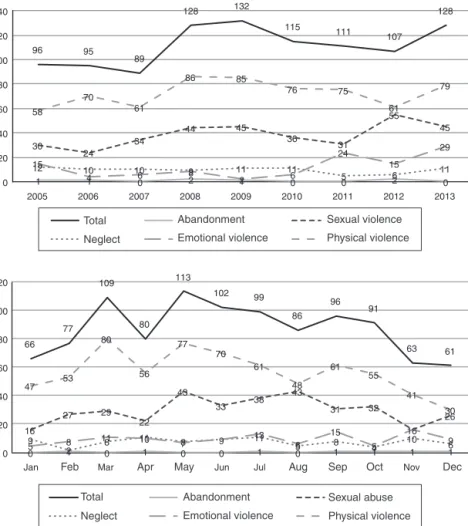
Timeintroducesothercharacterizationpatterns.Despite theannualvariations(thelongitudinalanalysisdidnot con-sidertheyear 2004,sincetheformwasnotinuseonthe beginningofthatyear),therewasanincreasingtrendinthe numberofcasesdetected.Buttheannualevolutionpertype ofabuseisdifferentiated.Thenumberofcasesofsexual vio-lencehasremainedstable,withpeaksin2007and2012.As forthecasesofemotionalviolence,theyhaveincreasedin recentyears(Fig.1).
The analysis of the monthly distribution of reported episodes of violence indicates a cumulative mean of 83 occurrences. The monthly variation, which refers to sea-sonalrhythmsofsociallife,issignificant:thereweremore casesinthespringandsummermonths(March,May,June, July, September, and October) and fewer cases in late autumn and winter (November, December, and January). Physical violence was the most common type of abuse throughouttheyear.Sexualabusepeakedinthesummerand
Table1 Samplecharacteristics.
Variable Categories n % Descriptivedata
Victim’sgender(n=1060) Male 399 37.60%
Female 661 62.40%
Victim’sage(years;n=1061)
Mean:8.8 Median:9.0
Standarddeviation:5.1 Min---max:0.1---18.0
Victim’sagerange(years;n=1061)
0---4years 294 27.70%
5---9years 238 22.50%
10---14years 353 33.30%
15---18years 175 16.50%
Maternalage(years;n=723)
Mean:34.9 Median:35.0
Standarddeviation:8.0 Min---max:16.0---59.0
Paternalage(years;n=616)
Mean:38.4 Median:39.0 Standarddeviation:9.0 Min---max:17.0---74.0 Maternal employ-ment (n=838) Unemployed 179 21.40% Employed 642 76.60% Retired 5 0.60% Absent 12 1.40% Paternalemployment(n=733) Unemployed 77 10.50% Employed 613 83.60% Retired 14 1.90% Absent 29 4.00% Divorced/separatedparents(n=828) No 363 43.80% Yes 465 56.20% Domesticviolence(n=272) No 114 41.90% Yes 158 58.10% Typeofabuse(n=1063) Physicalviolence 682 65.20% Sexualviolence 358 34.20% Emotionalviolence 114 10.90% Neglect 91 8.70% Abandonment 7 0.70%
Abuser’sgender(n=823) Male 595 72.30%
Female 228 27.70% Abuser’sage(583) Mean:32.0 Median:33.0 Standarddeviation:13.3 Min-max:5.0---80.0 (n=583)
Source:Emergencysignformfortheabusedchild(2004---2013).
inDecember(monthsthatcoincidewithschoolholidaysand childrenstaying at home). Emotional violence caseswere morecommoninthelasttwomonthsoftheyear(November andDecember).
Exploratory
profiles
of
physical
violence
and
sexual
violence
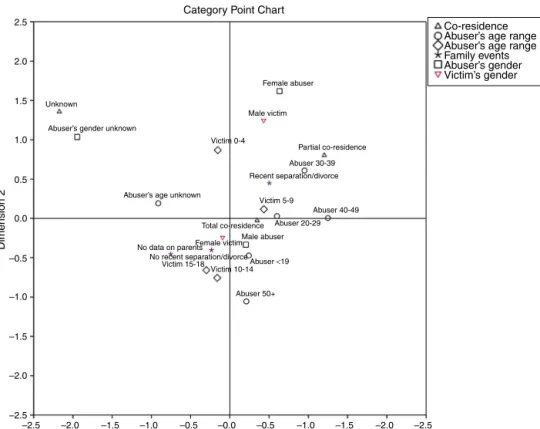
Exploratoryprofilesoftheassociationbetweensocial varia-blesandthemostcommontypesofabuseweredelineated usingtheFAMC.TheresultsareshowninFigs.2and3. Varia-blesassociatedwiththevictimandwiththeabuser(gender
andagegroup)andfamilycontext(divorced/separated par-ents)wereincluded.
Asforphysicalviolence,theabuser’sgenderconstitutes thefirstdimension,whilethevictim’sgenderandagegroup constitutesthe second one(Fig.2). The abuser’sage is a factorthatmediatesthesetwoelements.
Afirstprofileofphysicalviolencewasidentified,inwhich victimsandabusersareadolescents(lowerright-hand cor-ner),insituationsofpeerviolence(i.e.,bullying)occurring both insideandoutsidetheschoolsettings.Asecond pro-file(lowerleft-handcorner) correspondstomaleabusers, tendingtobeolder,whoattackvictims,especiallyfemales, between 10and 14yearsof age; victimsandabusers live
96 95 89 128 132 115 111 107 128 1 1 0 2 1 0 0 2 0 30 24 34 44 45 36 31 55 45 12 10 10 9 11 11 5 6 11 15 4 6 8 2 6 24 15 29 58 70 61 86 85 76 75 61 79 0 20 40 60 80 100 120 140 2005 2006 2007 2008 2009 2010 2011 2012 2013 Total Neglect Abandonment Emotional violence Sexual violence Physical violence 66 77 109 80 113 102 99 86 96 91 63 61 0 1 0 1 0 0 1 0 1 1 1 1 16 27 29 22 43 33 38 43 31 32 26 9 2 8 11 8 11 5 8 4 10 6 5 8 11 10 7 9 13 6 15 5 16 9 47 53 80 56 77 70 61 48 61 55 41 30 0 20 40 60 80 100 120
Jan Feb Mar Apr May Jun Jul Aug Sep Oct Nov Dec
Total Neglect
Abandonment Sexual abuse Physical violence Emotional violence
Figure1 Annualandmonthlyevolution(totalandpertypeofcase).
Source:Emergencysignformfortheabusedchild(2004---2013).
together.Athirdprofile(upperleft-handcorner)highlights femaleabusers,separated,or divorced,betweentheages of20 and39.Here,thevictimstend tobemaleandvery young(between5and9yearsofage)andlivingin partial co-residencewiththeabuser.Thereisafourthprofile,less defined,intheupperright-handcorner,inwhichthevictims areverysmall,malechildren;informationabouttheabuser andthemaritalstatusoftheparentsisscarce.
Regarding sexualviolence, thedataarestructured dif-ferently. Theageof theabuserandco-residencewiththe aggressor constitute the firstdimension. The victims’age and gender constitute the second one. The abuser’s gen-der and recent separation/divorce are the elements that connectthetwodimensions.
There is an association between male aggressor and female victims(bottom of thechart). In thisprofile, vio-lence occurs in situations where the victim comes from familiesinwhichthe parentsarenotseparated/divorced. Thesearemaleabuserswhoattackpre-adolescentor ado-lescentfemalevictims.Asecondprofile(upperpartofthe chart)associatesfemaleabusersbetweentheagesof30and 39withyoungervictims,whocomefromsettingsinwhich theparentshaveseparated.Thequalityofthedatapresents somebiashereduetothelackofinformationontheidentity andageoftheabuser,whichcompromisesthedescription oftheothertwoquadrants.This signsuggeststherelative
opacitythatsurrounds sexualviolencesituations involving veryyoungchildren,inadditiontothefactthattheymaybe practicedbywomenorthroughtheirconnivance/protection oftheabuser/partner.
Discussion
Thepresentseries,obtainedfromthecontextofaPERunit doesnotdifferfromothersfoundintheliterature,namely Portuguesestudies.8,9Thedescriptivestatisticsshowedthat thetypeofabusemostfrequentlyobservedinthePER (phys-ical and sexual violence) are, therefore, forms of active maltreatment,as opposedto neglect (typicallyidentified throughsocial work services and technicians),1 and their relativeweightfollowcommonpatterns.15
This sample showed signs of physical violence among peers, especially among older children. If, in other countries,bullyinghasacquiredsomestatisticalvisibility,as wellasinpediatricnewspapers,5,16inPortugaltheapproach ofthesubjectremainsincipient.Thisiscertainlyduetothe disregardor lack of notificationof these situationsin the currentprotocolsofinformationcollection.
The gender of the child and of the abuser were consideredin theanalysis.The gendervariablehada rel-ativelypredictable performance, compared to theknown
Category Point Graph
Co-residence Abuser’s age range Abuser’s age range Family events Abuser’s gender Victim’s gender Dimension 2 2.0 1.5 1.0 0.5 0.0 –0.5 –1.0 –1.5 –2.0 –2 –1 0 1 2 Dimension 1 Partial co-residence Abuser 20-29 Recent separation/divorce Victim 0-4 Unknown Victim 5-9 Male victim
Abuser’s age unknown No data on parents
Abuser’s gender unknown
Victim 10-14 Victim 15-18 No recent separation/divorce Abuser 40-49 Abuser 50+ Abuser <19 Female abuser Male abuser Total co-residence Female victim Abuser 30-39 Normalization variable
Figure2 Factorialanalysisofmultiplecorrespondence:physicalviolencea.
Category Point Chart
2.5 2.0 1.5 1.0 0.5 0.0 –0.5 –1.0 –1.5 –2.0 –2.5 –2.5 –2.0 –1.5 –1.0 –0.5 –0.0 –0.5 –1.0 –1.5 –2.0 –2.5 Dimension 2 Dimension 1 Co-residence Abuser’s age range Abuser’s age range Family events Abuser’s gender Victim’s gender
Unknown
Abuser’s gender unknown
Victim 0-4 Female abuser Male victim Partial co-residence Abuser 30-39 Recent separation/divorce Victim 5-9 Victim 15-18 Victim 10-14Abuser <19 Abuser 50+ Abuser 40-49 Total co-residence
Abuser’s age unknown
Abuser 20-29 Male abuser Female victim No data on parents
No recent separation/divorce
literature,17 as follows: abusers are mostly males (72%), with mainly female victims (62%); gender was important in structuring the closeness or distance between illustra-tivevariablesintheconstructionofbothtypesofviolence, physicalorsexual.
Compared toothers,thisstudy testedtheintroduction ofsocialvariablesthatareseldomusedintheanalysisand characterizationofchildabuse.Time,ontheonehand,and themaritalrelationshipbetweenthechild’sparents,onthe otherhand,showedinnovativeresults.
The seasonal pattern of abuse has become apparent: springandsummershowmaximumpeaks,whereaslatefall andwintershowminimumvalues.Therelativestabilityof physical violence throughout the year contrasts with the concentrationofsexualviolenceinthesummermonthsand in December. Further research will allow a better under-standingof thisvariability;but the rhythmsof school life (with children staying at home for longerperiods of time orexclusivelyunderthecustodyofthefamilyduringschool vacation)maybepartoftheexplanation.
Conversely, the nature of the marital relation-ship between the child’s parents (married parents vs.
divorced/separatedparents) wasan explanatory variable. Itisaresultthatstandsoutfromthedominantapproachin theliteratureonchildabuse,whichfavors---inthe charac-terizationofthecouple’srelationship---thequestionofthe presence of violence.18 Thus, the parents’ marital status (whethertheyaretogetherorseparated),initself,playsa roleintheconfigurationoftwosubtypesofsexualviolence: between male abusers and pre-adolescent or adolescent female victims and between female abusers and younger children.Thefirstscenariois associatedwithparentswho livetogether;thesecond,withseparated/divorcedparents. The data refers primarily to suspectedcases of violence; sometimes,atayoungage,theyaredifficulttoproveand dependonthe(biased?)reportoftheparentaccompanying thechildtothePERunit,whomaybeinvolvedinasituation oflitigiousseparation.
Thisarticle alsoattemptedtoapplyamultidimensional methodology, not commonly employed in the literature, whichallowed thediscovery ofother subtypesofphysical andsexualviolence.Genderplaysanimportantroleinthe structuringoftheseprofiles:thegenderofthechildandof theabuserinphysicalviolence,aswellasthechild’sgender inthedifferentformsofsexualviolence.Itisalsoworth not-ingtheexistence,incasesofsexualviolence,ofthewoman astheabuserof ayoungerchild, whichis areality rarely identifiedordiscussedinsimilarstudies,19buttowhichthe interventionmustbeattentive.
Thelimitationsofthisstudyoriginate,toagreatextent, fromthegapsinthefillingoutofdatabytheprofessionalsof thePERunit,asituationenhancedbythecircumstancethat, todate,protocolcompletionisnotmandatory.Thefactthat itis filledoutduring thebusyhospitalworking hoursalso contributestothelowerprecisionandattentiongiventothis process.Thesefactorsexplainthelowerqualityorevenlack ofdataonthechild’ssocialbackground,particularlyevident in thecase ofparents of sexualviolence victims(levelof education,occupation,andemployment,amongothers).
ItisknownthatthesituationsreportedinaPERunitare onlya fractionofcasesof childabuse,evenamongthose where the child is taken tothe hospital20; and that such
abuse is often only detected after multiple visits.21 The expansionand improvement of the questions used in the formanditsconversionintoamandatoryplatform,attached tothehospitalfile,willcontributetoovercomethe prob-lemsof dataincompletion,aswellastoincreasetherate ofdetectionofsituationsofviolence,inthewakeof docu-mentedgoodpractices.15,22
Betterawarenessoftheimportanceofsocialandfamily variables,aswellasoftheschoolcontextonthemultiple facetsofabuse,willinevitablybeusefultohealthcare pro-fessionals,trainedmainlyfortheassessmentoforganicor psychologicalriskfactors.This studyintendstocontribute inthissense.
Conflicts
of
interest
Theauthorsdeclarenoconflictsofinterest.
Acknowledgements
TheauthorswouldliketothanktheteamofthePediatrics DepartmentofHospitalFernandoFonseca,EPE,for provid-ingtheinformationandforthesupportprovidedduringthis study.Theywould alsoliketothank DéboraTerrafor the reviewofthemanuscriptinBrazilianPortuguese.
References
1.RadfordL,CorralS,BradleyC,FisherHL.Theprevalenceand impactofchildmaltreatmentandothertypesofvictimization intheUK:findingsfromapopulationsurveyofcaregivers, chil-dren and young people and young adults. Child AbuseNegl. 2013;37:801---13.
2.UNICE.F.Hiddeninplainsight---astatisticalanalysisofviolence againstchildren.NewYork:UNICEF;2014.
3.GilbertR,WidomCS,BrowneK,FergussonD,WebbE,JansonS. Burdenandconsequencesofchildmaltreatmentinhigh-income countries.Lancet.2009;373:68---81.
4.WHO. European report on preventing child maltreatment. Copenhagen:WorldHealthOrganization;2013.
5.GilbertR,FlukeJ,O’DonnellM,Gonzalez-IzquierdoA,Brownell M,GulliverP,etal.Childmaltreatment:variationintrendsand policiesinsixdevelopedcountries.Lancet.2012;379:758---72. 6.WHO. Report of theconsultationon child abuseprevention.
Geneva:WorldHealthOrganization;1999.
7.RunyonD,WattamC,IkedaR,HassanF,RamiroL.Childabuse and neglectbyparentsand othercaregivers. Geneva:World HealthOrganization;2002.
8.FanteC.Fenômenodebullying:comopreveniraviolêncianas escolaseeducarparaapaz.Campinas:Verus;2005.
9.RodriguezNE.Bullying,guerranaescola.Lisboa:SinaisdeFogo; 2004.
10.GreenacreMJ. Correspondenceanalysis inpractice. 2nd ed. BocaRaton:Chapmann&Hall/CRC;2007.
11.MeulmanJJ.Optimalscalingmethodsformultivariate categor-icaldataanalysis.Leiden,TheNetherlands:LeidenUniversity; 1998.
12.CruzME,Gonc¸alvesE,BarbosaMC,VianaV,IlharcoMJ,Sequeira F,etal.Crianc¸asmaltratadas:apontadoicebergue.Acta Pedi-atrPort.1997;28:35---9.
13.MartinsA,SampaioV,CorreiaC,MouraJ.Crianc¸amaltratada: casuísticadecincoanos.ActaPediatrPort.1997;28:135---9.
14.NascimentoJ,FerreiraI,ZilhãoC,PintoS,FerreiraC,CaldasL, etal.Oimpactodoriscosocialnuminternamentopediátrico. ActaPediatrPort.2013;44:15---9.
15.Louwers EC, Korfage IJ, Affourtit MJ, Scheewe DJ, van de MerweMH,Vooijs-MoulaertFA,etal.Detectionofchildabusein emergencydepartments:amulti-centrestudy.ArchDisChild. 2011;96:422---5.
16.deOliveiraWA,SilvaMA,daSilvaJL,de MelloFC,doPrado RR, Malta DC.Associations between thepractice ofbullying and individual and contextualvariables from theaggressors’ perspective.JPediatr(RioJ).2016;92:32---9.
17.May-Chahal C.Genderand childmaltreatment:theevidence base.SocWorkSoc.2006;4:53---68.
18.Mills LG, Friend C, Conroy K, Fleck-Henderson A, Krug S, Magen RH, et al. Woman abuse and child protection: a
tumultuousmarriage(PartII)Childprotectionanddomestic vio-lence:training,practice,andpolicyissues.ChildYouthServRev. 2000;22:315---32.
19.BarthJ,BermetzL,HeimE,TrelleS,ToniaT.Thecurrent preva-lenceofchildsexualabuseworldwide:asystematicreviewand meta-analysis.IntJPublicHealth.2013;58:469---83.
20.Flaherty E, Sege R. Barriers to physician identification and reportingofchildabuse.PediatrAnn.2005;34:349---56. 21.RavichandiranN,SchuhS,BejukM,Al-HarthyN,ShouldiceM,
AuH,etal.Delayedidentificationofpediatricabuse-related fractures.Pediatrics.2010;125:60---6.
22.LouwersEC,KorfageIJ,AffourtitMJ,ScheeweDJ,vandeMerwe MH,Vooijs-MoulaertAF,etal.Effectsofsystematicscreening detectionofchildabuseinemergencydepartments.Pediatrics. 2012;130:457---64.