INTRODUCTION
Address to: Dr. Ricardo de Amorim Corrêa. Depto Clínica Médica/FM/UFMG. Av. Prof. Alfredo Balena 110/3o andar, 30130-100 Belo Horizonte, MG, Brasil. Phone: 55 31 3409-9419; Fax: 55 31 3409-9255
e-mail: [email protected] Received 28 March 2013 Accepted 26 June 2013
Contributions of culture and antimicrobial susceptibility
tests to the retreatment of patients with
pulmonary tuberculosis
Bruno Horta Andrade
[1],
Dirceu Bartolomeu Greco
[2],
Maria Tereza da Costa Oliveira
[3],
Natalia Priscila Lacerda
[4]and Ricardo de Amorim Côrrea
[2][1] . Hospital das Clínicas, Universidade Federal de Minas Gerais, Belo Horizonte, MG. Fundação Hospitalar do Estado de Minas Gerais, Hospital Julia Kubitschek, Belo Horizonte, MG. [2]. Departamento de Clínica Médica, Faculdade de Medicina, Universidade Federal de Minas Gerais, Belo Horizonte, MG. [3]. Secretaria Municipal de Saúde de Belo Horizonte, Belo Horizonte, MG. [4]. Fundação Hospitalar do Estado de Minas Gerais, Hospital Infantil João Paulo II, Belo Horizonte, MG.
ABSTRACT
Introduction: This study evaluated the effi cacy of retreatment of pulmonary tuberculosis (TB) with regard to treatment outcomes
and antimicrobial susceptibility testing (ST) profi les. Methods: This retrospective cohort study analyzed 144 patients treated at
a referral hospital in Brazil. All of them had undergone prior treatment, were smear-positive for TB and received a standardized retreatment regimen. Fisher’s 2-tailed exact test and the χ2 test were used; RRs and 95% CIs were calculated using univariate
and multivariate binary logistic regression. Results: The patients were cured in 84 (58.3%) cases. Failure was associated with
relapsed treatment and abandonment (n=34). Culture tests were obtained for 103 (71.5%) cases; 70 (48.6%) had positive results. ST results were available for 67 (46.5%) cases; the prevalence of acquired resistance was 53.7%. There were no signifi cant differences between those who achieved or not therapeutic success (p=0.988), despite being sensitive or resistant to 1 or more drugs. Rifampicin resistance was independently associated with therapeutic failure (OR: 4.4, 95% CI:1.12-17.37, p=0.034). For those cases in which cultures were unavailable, a 2nd model without this information was built. In this, return after abandonment
was signifi cantly associated with retreatment failure (OR: 3.59, 95% CI:1.17-11.06, p=0.026). Conclusions: In this cohort, the
general resistance profi le appeared to have no infl uence on treatment outcome, except in cases of rifampicin resistance. The form of reentry was another independent predictor of failure. The use of bacterial culture identifi cation and ST in TB management must be re-evaluated. The recommendations for different susceptibility profi les must also be improved.
Keywords: Pulmonary tuberculosis. Retreatment. Drug resistance. Antimicrobial susceptibility testing. Treatment outcome.
Although tuberculosis (TB) is among the oldest and
most prevalent of human diseases, specific and effective
treatment only became available in 1944 with the discovery
of streptomycin1-3. Within a few years after this discovery,
antimicrobial resistance could be recognized from the observation of reduced effectiveness3-5. Although there has
been little progress in the development of new drugs since the
introduction of isoniazid and rifampicin, TB remains a curable and preventable disease6. However, the management of resistant
cases is complex and presents therapeutic limitations.
In this context, the most concerning situation is the
retreatment of patients who are often exposed to conditions
associated with future failures that are attributable to microbial resistance. The management of the most resistant forms requires the use of more complementary tests, as well as more expensive and toxic drugs, which are accompanied by diminished
effectiveness2,7,8. In this sense, ongoing global efforts aim to reduce and control the disease. Special attention is being paid to reducing disease transmission and developing preventive
measures, such as vaccines, and cures through new drugs. Meanwhile, the occurrence of resistant forms of TB has increased signifi cantly since the 1980s2. In the 1990s,
outbreaks of multidrug-resistant (MDR) TB due to nosocomial transmission were characterized by late diagnosis, the use of inadequate treatment regimens and high transmission and
mortality rates2,9. In the following decade, extensively
drug-resistant TB (XDR-TB) was described. XDR-TB is underscored by a high mortality rate (98%) and shorter median survival
period, suggesting poor TB control programs and potential adaptation of the bacteria3,10-13.Current studies acknowledge
that patients infected with MDR strains are more prone to
treatment failure, progression to chronic forms of the disease and death14.
METHODS
RESULTS
as well as culture and susceptibility tests, although the benefi t of this practice has yet not been suffi ciently evaluated in Brazil15,16.
This study’s primary aim was to evaluate the effi cacy of a
retreatment regimen for patients referred to a referral hospital
in Minas Gerais, Brazil, with regard to the measurements of cure (i.e., success) or abandonment and failure and these measurements’ relationship with the bacterial susceptibility profi le to the drugs used. The secondary aim was to determine possible exploratory associations between clinical variables and
treatment outcomes.
This was a retrospective cohort study of patients referred
for retreatment of pulmonary TB at Hospital Júlia Kubitschek
(HJK), a TB referral center located in Belo Horizonte, State of
Minas Gerais, Brazil, from January 2004 to December 2007. The study enrolled patients with diagnoses of pulmonary
TB, based on smear-positive results and a history of
previous TB treatment. Patients were selected from the medical records of the hospital archives (Department of Medical Archives, SAME) and from the Hospital Admission System (SIH), Information System for Notifi able Diseases (SINAN) and Mortality Information System (SIM) databases. Patients in retreatment with regimens other than the IR regimen (i.e., rifampicin, isoniazid, ethambutol and pyrazinamide) (n=912), cases of death from other causes (n=6) and cases with no information about treatment outcome (n=45) were excluded. From the database, 1,124 treatments were selected, and those cases with clinical indications for use of the 2RHZE/4RHE (two months of
daily administration of rifampicin [R], isoniazid [H], pyrazinamide
[Z] and ethambutol [E], followed by four months of daily R, H, E), standardized regimen were reviewed. After exclusions, 144
patients remained (Figure 1). In the case of multiple treatments,
only the data for the later treatment were considered for analysis.
Mycobacterium tuberculosis was isolated using
Lowenstein-Jensen (LJ) culture medium, and susceptibility testing (ST) was
performed using the proportion method17. All of the tests were
performed at the Central Laboratory (LACEN) of the State of
Minas Gerais, which is internationally certifi ed.
Outcomes were considered successful (i.e., cured) or treatment failures (i.e., death, failure or treatment abandonment), based on the medical records and review of the databases (SIH, SINAN and SIM). Both proven cures and unproven cures (2 negative smears at the end of treatment and when the patient could not perform the smear) were considered because the designations were made by the attending physician. Categorical variables were compared using the χ2 test or Fisher’s exact test
when applicable. Multiple regression analysis was performed to estimate possible independent associations between variables and outcomes, including their relative risks (RRs) and 95% confi dence intervals (CIs). Variables with a p-value less than 0.20 in univariate binary logistic regression were entered into the model. The database was created using Epidata for Windows, Entry 3.1 (EpiData Association, Copenhagen, Denmark);
Eligible treatments (n=1124)
Non-eligible (n=912)
♦1st treatment (n=671) ♦CNS TB (n=33)
♦MDR TB (n=46)
Treatments* (n=146)
Treatments per patientduring the studyperiod
♦1 treatment (n=185) ♦2 treatments (n=6)
Excluded
♦Death unrelated to TB (n=6) ♦Outcome not entered (n=45)
Patients (n=144) Selected(n=212)
FIGURE 1 -Selection of retreatment cases, Hospital Júlia Kubitschek , from 2004 to 2007. MDR TB: multidrug-resistant tuberculosis; CNS TB: central nervous system tuberculosis. Note: *only the data for later treatments were considered for analysis.
inconsistencies were checked by double entry. The analysis was performed using SPSS for Windows (version 13.0; SPSS Inc., Chicago, IL, USA).
Ethical considerations
This study was approved by the Ethics in Research
Committees of HJK and the Federal University of Minas Gerais
(COEP-UFMG), and a waiver of informed consent was obtained.
Demographic and epidemiological characteristics
The study included 144 patients, with a mean age of 38.8 years old (SD: ±12.4 y; range: 16-79 years old), and 70.1% were men (101/144). For 41 (28.5%) patients, there was no
information on culture results. Data on skin color, educational
level and weight and height were available in 54.2%, 26.4% and 17.4% of records, respectively. There were no statistically significant differences between groups with regard to demographic variables. In 123 (85.4%) cases, there were records of testing for human immunodefi ciency virus (HIV), 10 (6.9%) of which were positive for the virus. Substance abuse was recorded in 105 (72.9%) cases: alcohol and tobacco (42.7% with more than 20 packs/year with a mean of 24.2 packs/year) in 86 patients each and illegal drug use in 11 (7.6%). Eight (5.5%) patients had both pulmonary and extrapulmonary TB. Comorbidities included prior liver disease, 9 (6.2%); silicosis, 7 (4.9%); chronic renal insuffi ciency, 2 (1.4%) and diabetes mellitus, 2 (1.4%) (Table 1).
TABLE 1 - Demographic and epidemiological characteristics of 144 patients with pretreatment with regard to current treatment outcomes. Success Failure Total
Age (years) (n=84) (n=60) (n=144)
Mean ± SD 39.9±13.3 36.4±10.7 38.8±12.4
Min-Max 16-79 16-59 16-79
n % n % n % p
Male 59 70.2 42 70.0 101 70.1 0.975
HIV-positive, n (%) 5 7.1 5 9.4 10 6.9 0.645
Use of alcohol, n (%) 45 58.4 41 75.9 86 59.7 0.038
Smoking, n (%) 49 63.6 37 71.1 86 59.7 0.374
Other associated diseases 10 12.0 7 12.7 17 12.3 0.905
Extrapulmonary involvement 3 3.6 5 8.3 8 4.9 0.219
Five or more pretreatments 5 6.0 10 16.6 15 10.4 0.038
Relapse after cure 24 28.9 5 8.5 29 20.4 0.001
Readmission after failure 59 65.0 54 91.5 113 79.6 0.003
readmission after abandonment 50 60.2 52 88.1 102 71.8
-readmission after failure 6 7.2 1 1.7 7 4.9
-readmission for intolerance 3 3.6 1 1.7 4 2.8
-Hospital/outpatient treatment 50 34.7 30 20.8 80 55.6 0.435
Availability of ST 60 71.4 37 61.7 97 67.4 0.218
SD: standard deviation; ST: susceptibility testing; HIV: human immunodeficiency virus.
approximately 2.5 months, which was followed by outpatient management. Fifteen (10.4%) patients were not admitted to the
hospital (Table 1).
Susceptibility test results
The results of culturing were available for 103 (71.5%) of the 144 patients in retreatment: 70 (48.6%) were positive, and 33 (22.9%) were negative. Therefore, ST could be performed in 67 (46.5%) patients of the sample or 65% of the available results). The mean interval between the collection and provision of results was 3 months (range: 20 days to 8.9 months). In 25 (37.3%) patients, ST results were made available 4 months after collection. There was no significant difference in treatment outcomes with regard to the availability of ST results
(Table 1).
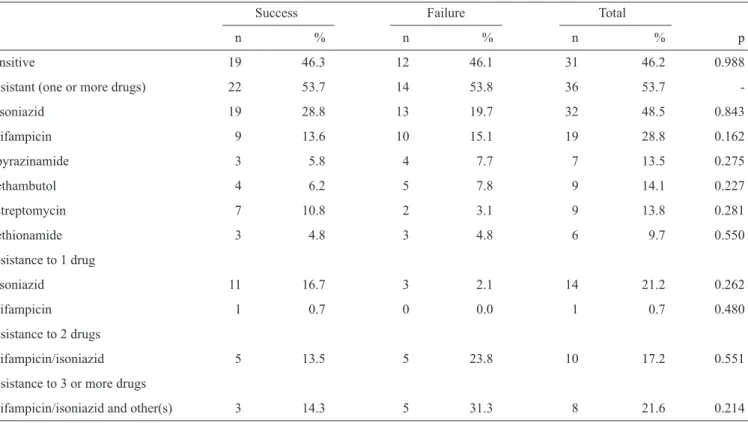
Among the available ST results, 32 (48.5%) cases were resistant to isoniazid (H), 19 (28.8%) to rifampicin (R), 9 (14.1%) to ethambutol (E), 7 (13.5%) to pyrazinamide (Z), 9 (13.8%) to streptomycin (SM) and 6 (9.7%) to ethionamide (ETH) (Table 2). Fourteen patients were monoresistant to
isoniazid (INHr-TB), 1 was monoresistant to rifampicin (RIFr-TB), and 18 were resistant to both drugs (RH) (MDR-TB). Of these, 8 patients exhibited resistance to RH and to 1 additional drug. The prevalence of acquired resistance was 53.7%. There was no significant difference between those patients who
achieved therapeutic success and those who did not (p=0.988; χ2 test) regarding being sensitive or resistant to 1 or more
drugs (Table 2).
Treatment outcomes
Success with the retreatment regimen (2RHZE/4RHE) was observed in 84 (58.3%) patients. Among the failures, 34 (23.6%) represented new abandonment, 15 (10.4%) failed the existing treatment, and 11 (7.6%) were due to deaths. Excluding the cases of new abandonment, the rate of success was 76.4%.
Univariate analysis revealed that the variables signifi cantly associated with treatment failure were alcohol use, the presence
of concomitant diseases, history of 5 or more treatments, retreatment due to abandonment, retreatment due to failure
and rifampicin resistance (Table 3). These variables and
the length of hospital stay were included in the multivariate
logistic regression analysis. For this analysis, the variable of return due to failure replaced that of return due to abandonment because both represent the same phenomenon. In contrast,
in the multivariate analysis, only rifampicin resistance was independently associated with therapeutic failure (OR: 4.4; 95% CI: 1.12-17.37; p=0.034; Table 3). In the second model
TABLE 3 - Univariate and multivariate analyses (Cox model), including odds ratios and 95% confi dence intervals, of the tuberculosis retreatment outcomes.
Univariate analysis Multivariate analysis I† Multivariate analysis II‡
Variable Category OR (95% CI) p OR (95% CI) p OR (95% CI) p
Resistance to rifampicin Yes* 2.15 (0.73-6.36) 0.162 4.40 (1.12-17.37) 0.034 -
-Form of reentry After failure 4.39 (1.57-12.33) 0.003 3.07 (0.59-15.85) 0.181 3.51 (1.17-11.06) 0.026
After success reference
Alcohol use Yes* 2.24 (1.04-4.85) 0.038 1.71 (0.45-6.49) 0.432 1.99 (0.83-4.77) 0.122
Associated diseases Yes* 1.06 (0.38-2.99) 0.086 1.33 (0.18-9.69) 0.780 1.66 (0.52-5.27) 0.392
Pretreatments More than 5 3.16 (1.02-9.79) 0.038 5.55 (0.86-35.70) 0.071 3.72 (0.97-14.27) 0.055
1 to 4 reference
Admission shorter than 2 months Yes* 1.50 (0.77-2.91) 0.235 1.47 (0.42-5.11) 0.547 2.09 (0.95-4.59) 0.068
OR: odds ratio; 95% CI: 95% confi dence intervals; *Reference category: no; † Model I: susceptibility testing available; ‡ Model II: susceptibility
testing not available.
TABLE 2 - Profi le of the drug susceptibility of 67 bacterial isolates from patients undergoing retreatment for tuberculosis. Success Failure Total
n % n % n % p
Sensitive 19 46.3 12 46.1 31 46.2 0.988
Resistant (one or more drugs) 22 53.7 14 53.8 36 53.7
isoniazid 19 28.8 13 19.7 32 48.5 0.843
rifampicin 9 13.6 10 15.1 19 28.8 0.162
pyrazinamide 3 5.8 4 7.7 7 13.5 0.275
ethambutol 4 6.2 5 7.8 9 14.1 0.227
streptomycin 7 10.8 2 3.1 9 13.8 0.281
ethionamide 3 4.8 3 4.8 6 9.7 0.550
Resistance to 1 drug
isoniazid 11 16.7 3 2.1 14 21.2 0.262
rifampicin 1 0.7 0 0.0 1 0.7 0.480
Resistance to 2 drugs
rifampicin/isoniazid 5 13.5 5 23.8 10 17.2 0.551
Resistance to 3 or more drugs
rifampicin/isoniazid and other(s) 3 14.3 5 31.3 8 21.6 0.214
DISCUSSION
The primary aim of this study was to evaluate the effi cacy of the retreatment regimen available in Brazil for pulmonary
TB patients who were managed at a referral center of a public hospital in Minas Gerais, according to the measurement of cure
(i.e., success) or relapse and failure, and the regimen’s possible
association with the microbacterial susceptibility profi le of the
drugs. The secondary objective was to determine exploratory
associations among clinical variables and treatment outcomes.
Despite the low availability of ST results, the high rate of acquired resistance and multiple forms of resistance, the main results showed a cure rate of 58% among retreatment cases and no associations between this outcome and the bacterial susceptibility profi les.
The results of the culture test, which represents a propedeutic breakthrough and which has been included in the national guidelines for all retreatment cases since 2004, were present in 71.5% of records15. Cultures were negative in 33 (32%) cases,
The lack of information about culture exams in approximately
25% of the cases can be attributed to the absence of a request by the attending physician at the time of admission. This low
yield of culture testing can also be explained by the limitations
of the test itself and the scarcity of clinical specimens, which are often insuffi cient. However, these cases were considered
representative of the sample because of their randomness. In addition, the long period until the release of the ST results
(approximately 3 months) can be attributed at least in part to the need to send materials to a laboratory not associated with
the hospital and to the use of the proportion method.
A large number of patients exhibited polyresistance to 2 or
more drugs (24/36, 66.6%). There were 18 patients resistant
to MDR-TB, and 6 presented other combinations of multiple
resistance. This fi nding could be due to the use of a state-level reference center, as is the case with HJK, which receives more referrals for complex cases. This fi nding might also have been
a determining factor in the recognition of rifampicin as an independent predictor of failure because 18 of the 19 patients resistant to rifampicin exhibited MDR-TB (Table 2).
Secondary resistance was quite high, i.e., 53.7% of the sample. However, this rate is lower than the rate of secondary resistance of 69% reported by Fiuza de Melo et al. in São Paulo18.
The delay in the recognition and identifi cation of resistant forms of the disease or a satisfactory clinical response to unique
forms of resistance, as reported in some studies, might also have been instrumental in this aspect19. Among the patients who
obtained their ST results, 19 (28.1%) were resistant to rifampicin, 32 (48.5%) were resistant to isoniazid, and 10 (17.2%) were
resistant to both simultaneously. According to Kritsky et al.20,
patients with dual rifampicin and isoniazid resistance receiving
the 2RHZE/4RHE regimen for a long time until the release of ST results present a risk for the use of ethambutol as monotherapy in the maintenance phase of treatment20.
In Belo Horizonte, Minas Gerais, 54% of all TB cases are
diagnosed in hospitals, emergency services and outpatient referral clinics. According to unpublished data from the Municipal Health
Department, the cure rate with retreatment was 51.8% between 2004 and 2007 with 13% abandonment. In the present study, the cure rate was 58.3%, which is very similar to the 51.8%
mentioned above but higher than the cure rates recently published
by the WHO, i.e., 26% and 38% for Brazil and the Americas,
respectively, in 200521; this difference might be due to the high
proportion of patients not evaluated in those samples, i.e., 25% and 21%, respectively. Moreover, most (89.6%) of the patients in the present study initiated their treatment in a hospital setting, with an average that was stay longer than the fi rst phase of treatment, which might have contributed to better results.
In 2007, Bierrenbach et al. reported a cure rate of 58.9%
among retreatment cases throughout Brazil22. Regarding
regional differences, the southeast region had the lowest (40.5%)
cure rate22.
In this study, the cure rate was 76.4% when patients who abandoned treatment were excluded. When MDR forms (e.g., RH) were excluded, the cure rate was 66.6%.
There was no information regarding the use of supervised treatment strategies for patients treated as outpatients. No resistance profiles were significantly altered because of
treatment (Table 2).
The prevalence of HIV was 6.9% among patients in this study, a rate that could be considered low compared to the HIV prevalence in Belo Horizonte in 2010 (12.5%) and compared to the most recent data published by the WHO for Brazil (16%)22,23.
This fi nding might have been due to the patients with this
diagnosis being managed at local HIV/AIDS referral hospitals. This study had limitations associated with its retrospective
design. There were many losses attributed to misinformation regarding the outcomes of many treatments and the yield of ST.
Other limitations that are worth mentioning include only patients from one referral center being included, and the recurrence of
resistant forms after cure was not evaluated.
In summary, the resistance profi le presented by ST appears
to be dissociated from the treatment outcome, namely cure or failure, of retreated TB pulmonary patients. The fi nding of resistance to rifampicin or the method of retreatment in the absence of ST should be analyzed as possible predictors of treatment failure.
The appropriate management of these patients regarding the use of the different microbacterial drug susceptibility profi les
requires further research.
REFERENCES
The authors declare that there is no confl ict of interest.
CONFLICT OF INTEREST
1. Shinnick TM, Good RC. Mycobacterial taxonomy. Eur J Clin Microbiol Infect Dis 1994; 13:884-901.
2. Caminero JA. A tuberculosis guide for specialist physicians. Paris (France): International Union Against Tuberculosis and Lung Disease; 2003.
3. Jassal M, Bishai WR. Extensively drug-resistant tuberculosis. Lancet Infect Dis 2009; 9:19-30.
4. Nachega JB, Chaisson RE. Tuberculosis drug resistance: a global threat. Clin Infec Dis 2003; 36:S24-S30.
5. Ministério da Saúde. Secretaria de Vigilância em Saúde. Centro de Referência Prof Hélio Fraga. Tuberculose multirresistente: guia de vigilância epidemiológica. Rio de Janeiro (Brasil): Ministério da Saúde; 2006.
6. Partnership STB. The Global Plan to Stop TB, 2006-2015. Actions for life: towards a world free of tuberculosis [Executive Summary]. Int J Tuberc Lung Dis 2006; 10:240-241.
7. Barbara JS. Multidrug-resistant tuberculosis. Infect Dis Clin North Am 2002;16:73-105.
8. Caminero JA. Manejo de los casos en retratamiento de tuberculosis con sospecha de resistencia a fármacos. Biomédica 2004; 24 (supl I):212-227. 9. Dalcolmo MP, Andrade MKN, Picon PD. Tuberculose multirresistente
no Brasil: histórico e medidas de controle. Rev Saude Publica 2007; 41: 34-42.
11. Dahle UR. Extensively drug resistant tuberculosis: Beware patients lost to follow-up. BMJ 2006; 333:705.
12. Gandhi NR, Moll A, Sturm AW, Pawinski R, Govender T, Lalloo U, et al. Extensively drug-resistant tuberculosis as a cause of death in patients co-infected with tuberculosis and HIV in a rural area of South Africa. Lancet 2006; 368:1575-1580.
13. World Health Organization. Anti-tuberculosis drug resistance in the world. Fourth global report.WHO/HTM/TB/2008.394. Geneva (Switzerland): WHO; 2008.
14. Faustini A, Hall AJ, Perucci CA. Risk factors for multidrug resistant tuberculosis in Europe: a systematic review. Thorax 2006; 61:158-163. 15. Castelo Filho A, Kritski AL, Barreto AW, Lemos ACM, Ruffi no Netto
A, Guimarães CA, et al. II Consenso brasileiro de tuberculose: diretrizes brasileiras para tuberculose 2004. J Bras Pneumol 2004; 30 (supl I):S57-S86.
16. Conde MB, Fiuza de Melo FA, Marques AMC, Cardoso NC, Pinheiro VGF, Dalcin PTR, et al. III. Diretrizes para Tuberculose da Sociedade Brasileira de Pneumologia e Tisiologia. J Bras Pneumol 2009; 35:1018-1048.
17. Canetti G, Rist N, Grosset J. Mesure de la sensibilité du bacille tuberculeux aux drogues antibacillaires par la méthode dês proportions.
Méthodologie, critères de résistance, résultats, interprétation. Rev Tuberc Pneumol 1963; 27:217-272.
18. Fiuza de Melo FA, Penteado CB, Almeida EA. Resistência pós-primária do Mycobacterium tuberculosis às drogas antituberculosas segundo os antecedentes terapêuticos em uma unidade de referência na cidade de São Paulo. Bol Pneumol Sanit 2002; 10:21-26.
19. Cattamanchi A, Dantes R, Metcalfe J, Jarlsberg L, Grinsdale J, Kawamura M, et al. Clinical Characteristics and Treatment Outcomes of Patients with Isoniazid-Monoresistant Tuberculosis. Clin Infect Dis 2009; 48:179-185. 20. Kritski AL, Jesus LSR, Andrade MK, Werneck-Barroso E, Vieira MAMS,
Hoffner A, et al. Retreatment tuberculosis cases: factors associated with drug resistance and adverse outcomes. Chest 1997; 111:1162-1167. 21. World Health Organization. Global tuberculosis control - surveillance,
planning, fi nancing.WHO/HTM/TB/2012.6. Geneva (Switzerland): WHO; 2012.
22. Bierrenbach AL, Gomes ABF, Noronha EF, Souza MFM. Incidência de tuberculose e taxa de cura, Brasil, 2000 a 2004. Rev Saude Publica 2007; 41:24-33.