Article
Printed in Brazil - ©2015 Sociedade Brasileira de Química0103 - 5053 $6.00+0.00A
*e-mail: [email protected]
Polymerization of Ethylene with Zirconocene Heterogenized on Spherical ZSM-5
Cristiano Favero,a Marcelo L. Mignoni,b Roberto F. de Souza†,a and
Katia Bernardo-Gusmão*,a
aInstituto de Química, Universidade Federal do Rio Grande do Sul, 91501-970 Porto Alegre-RS, Brazil
bDepartamento de Química, Universidade Regional Integrada do Alto Uruguai e das Missões (URI), Campus Erechim, CP 743, 99400-000 Erechim-RS, Brazil
Homogeneous polymerization catalysts require large amounts of solvent and cannot control the polymer morphology. In order to solve this issue, a narrow-shaped spherical ZSM-5 zeolite was used in ethylene polymerization as a support for zirconocene (Cp2ZrCl2). Several heterogeneous catalytic precursors were prepared and used in ethylene polymerization reactions, which showed yields (between 980-8019 kg PE mol-1 h-1) and were efficient at promoting morphological replication
of the support. So, a well-established protocol for slurry polymerization reaction was found, yielding well-defined polymer particles in an advantageous polymerization process.
Keywords: polymerization, ethylene, zirconocene, ZSM-5
Introduction
Since the discovery of metallocene/MAO (methyl-aluminoxane) polymerization catalytic systems, this area has shown a remarkable development.1 Metallocene
catalysts showed new ways of obtaining polyolefins, becoming very attractive due to their outstanding activity, which was superior to Ziegler-Natta or Phillips catalysts, and selectivity, allowing access to new products.2-4 These
characteristics have strongly stimulated research into this area, but there are still some important issues.5 An
important limitation comes from the use of homogeneous (solution) processes, which results in poor control over growing polymer particles.6 Several studies have been
devoted to the use of supported catalysts. The preferred supports include inorganic products, polymeric resins, magnesium chloride and silica.7-10 Amorphous silica
is the most common support, due to its high surface area and porosity, commercial availability and easy preparation.
For crystalline supports, such as zeolites, their own acidity can be used to stabilize the active species during the polymerization. In addition, they can induce the growth of polymeric chains inside the channels, forming polymer fibres which are extruded outside the pores.11-14
Highly active catalysts were obtained by reacting common alkylaluminums (AlR3) with hydrated zeolites to form “in situ” alkylaluminoxanes. These catalysts can be
activated without using MAO during the polymerization.15-17
Hybrid zeolitic-mesostructured materials showed excellent results due the enhancement of the textural properties. Larger pores (mesopores) contribute to the diffusion process, thus allowing monomer and co-catalyst to reach the active centres.18
Zeolites synthesized by employing ionic liquids as structure directing agents showed homogeneous particle shape and size.19 Ionic liquid was necessary for
the sphere-shaped arrangement, otherwise the zeolite would grow shapeless like the standard ZSM-5. We also observed that by using β-zeolite-nickel diimine catalyst for oligomerization reactions, the ionic liquid inside of the zeolite strongly contributes to the performance of the catalyst, which doubles its activity.
In this work, a spherical ZSM-5 zeolite, obtained with defined morphology (homogeneous microspheres of approximately 16 µm of diameter) due to the action of methyl-butyl-imidazolium chloride (ionic liquid), was used as a support for Cp2ZrCl2. Polymerization was performed
Experimental
General procedures
All manipulations were performed using standard Schlenk tube technique under argon. The catalyst precursor Cp2ZrCl2 (Aldrich) and the co-catalyst PMAO-IP
(AkzoNobel, 7.0 wt.% of Al in toluene) were used as received. Argon (5.0, White Martins) was dried and deoxygenated by passing through columns of activated molecular sieves (3 Å) and BTS (BASF). Ethylene polymerization grade (2.0, White Martins) was used as received. Toluene was distilled over metallic sodium and benzophenone and stored under argon. The ZSM-5 spherical zeolite was obtained as reported previously by our workgroup.19
Preparation of supported catalysts
All supports used were pre-treated under reduced pressure at 110 °C for 12 h before catalyst immobilization. The zeolites, spherical zeolite containing ionic liquid (SZ-IL), spherical zeolite-calcined (SZ-CA); and zeolite-standard (Z-St); were used for zirconocene direct immobilization, as shown in Figure 1a.20 The heterogeneous
catalyst precursors were prepared starting from 15 mL of Cp2ZrCl2 toluene solution (2 µmol mL-1) added to a zeolite
suspension (1.5 g in 15 mL of toluene). The resulting suspension remained under stirring for 24 h at room temperature. The following step was to remove the solvent under reduced pressure. The washing step was performed once and led to catalysts with the same productivity as that of the dried solid used directly in ethylene polymerization reactions (without the washing step). The three different supported catalysts were named SZ-IL-Zr, SZ-CA-Zr, and Z-St-Zr, respectively. The MAO treated support (SZ-IL-MAO), see Figure 1b, was obtained from 1.5 g of SZ-IL treated with 60 mL of MAO solution (0.6% in toluene) for 3 h at 60 °C. The reactional liquid was removed by filtration under argon flow and the solid was washed three times with toluene (20 mL). The MAO-treated catalyst was obtained after the reaction of a Cp2ZrCl2 solution (20 mL,
0.5% m/m in toluene) and SZ-IL-MAO.6 The reaction
proceeded under stirring during 0.5 h at room temperature. The solid was washed three times with toluene (20 mL). The amount of incorporated zirconium on the support was determined by inductively coupled plasma optical emission spectrometry (ICP-OES, Perkin Elmer Instruments, model Optima 2000 DV), which was determined as being 0.12% for the first catalyst made (named SZ-IL-MAO-0.12) and 0.18% for the second catalyst (named SZ-IL-MAO-0.18).
Polymerization reactions
All polymerization reactions were carried out in a 200 mL double-walled glass reactor equipped with magnetic stirrer and thermostatic bath at 60 °C. Toluene and the co-catalyst were added to the reactor under argon atmosphere. The system was kept under stirring during 5 min. Then, the reactional mixture was purged and saturated with ethylene for 10 min immediately before the addition of either the homogeneous or the heterogeneous precursor (toluene suspension). The total reaction volume was 30 mL for all experiments. The reaction was kept at a constant feeding of ethylene (4 bar) for 10 min. The product was precipitated with acidified ethanol (5% HCl), washed with ethanol and water several times and dried under reduced pressure at room temperature.
Polyethylene characterization
The polymer melting temperature (Tm) and crystallinity (χc) were obtained with differential scanning calorimeter
equipment (DSC-Q20/RCS40-TA Instruments) calibrated with indium. The rate of heating and cooling used was 10 °C min-1 and the temperature range from 30 to 180 °C.
Two cycles of heating were performed and only the results of the last scan were considered. The scanning electron microscopy (SEM) images were obtained in an EVO 50-Carl Zeiss equipment. The materials were deposited on a carbon tape and covered with gold prior to analysis.
Results and Discussion
Homogeneous reactions
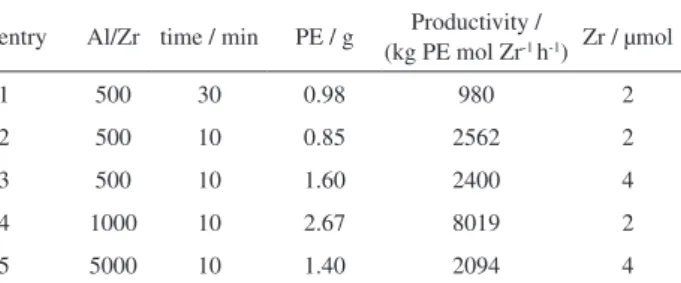
Experiments in solution were performed, optimized and the parameters were applied, at a later time, to the heterogeneous catalysts. Table 1 summarizes the results
Figure 1. Different routes (a) and (b) for obtaining heterogeneous
for the homogeneous catalyst. The catalytic precursor quickly looses productivity, lasting just a few minutes, and the polymer mass recovered for entries 1 and 2 were very similar, even at longer reactional times. This deactivation may be attributed to the low monomer diffusion, blockage of reaction sites, binuclear deactivation, among other effects.
Higher amounts of catalyst, such as in entry 3 (4 µmol) lead to productivity close to the entry 2 (2 µmol). For this reason, despite the good result for higher content of catalyst, the amount of precursor used for the heterogeneous catalysts varied between 0.4-2 µmol.
The Al/Zr ratio had strong influence on productivity. Three different Al/Zr ratio were used 500, 1000 and 5000 (entries 2, 4 and 5) and the best result was achieved in entry 4 (Al/Zr =1000). Metallocene catalysts depend on high Al/M ratios for proper activation and reactivation of latent sites. MAO reactivates inactive species formed by hydrogen-transfer reactions.21 However, higher MAO
concentrations lead to a drop in productivity. One of the reasons is that the free trimethylaluminium (TMA) present in the MAO can coordinate to the active species, in this way unfavorable to the monomer coordination.22 The
optimized conditions were applied to the heterogeneous precursors as a measure to observe the catalytic system behavior.
Heterogeneous reactions
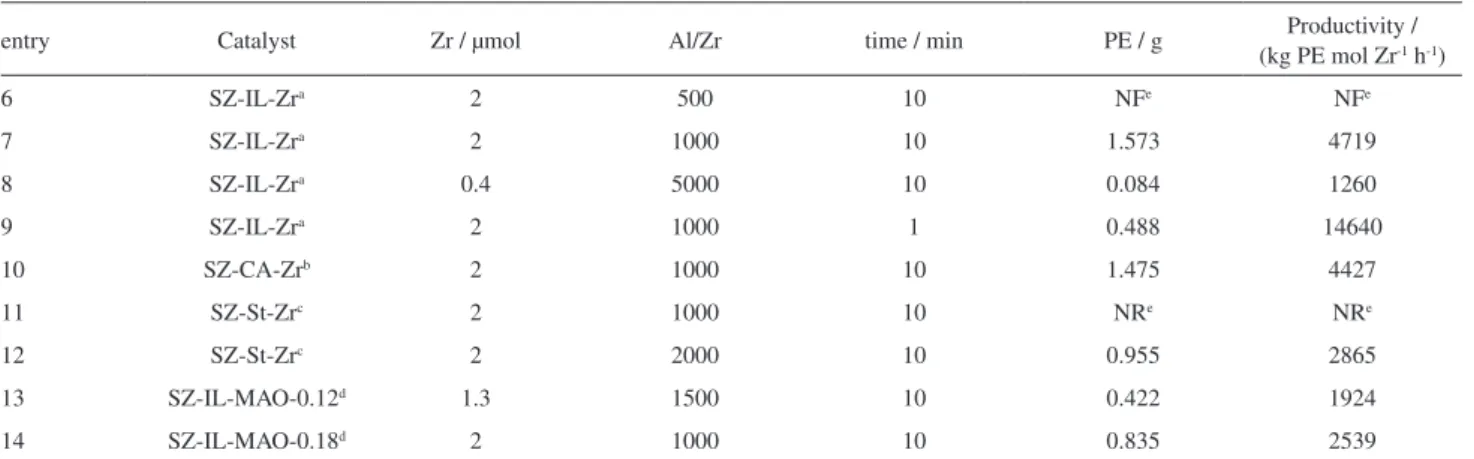
The supported catalysts were tested on ethylene polymerization reaction. For catalyst SZ-IL-Zr, as shown in Table 2, the best Al/Zr ratio was 1000 (entry 7). Metallocenes require large excess of MAO for good productivity, since MAO plays different roles in polymerization reactions: as alkylating agent, Lewis acid and scavenger.23 Lower
Al/Zr ratio, such as entry 6 (Al/Zr = 500) was not sufficient for activation and, consequently, polyethylene was not produced. Most likely, MAO reacted with the support surface
instead of carrying out metallocene activation. The influence of the support and textural characteristics, can also affect the active species, as the monomer and co-catalyst require access to the active centre.24,25 Higher Al/Zr ratio gave results
similar to homogeneous systems: the productivity suffered a drastic drop (entry 8).
Entry 9 shows a very active catalyst, which produces one third of the polymer mass in the first minute of reaction, comparatively to the reference experiment (entry 7). If the productivity were constant, after 10 min, the polymer mass would be ten times higher. This can be explained by the easy substrate access to the catalytic centre during initial moments, while the medium viscosity remains low. Other important fact is the deactivation, which is exactly what occurred to the homogeneous system.
The results for catalyst SZ-CA-Zr did not change considerably when compared to the catalyst SZ-IL-Zr under same conditions. This fact clearly demonstrates that the ionic liquid inside the zeolite pores does not influence negatively the reaction and both catalysts possess almost the same productivity. The Al/Zr ratio had to be raised to 2000, while the productivity lowered to less than half of that in entry 7. With regard to higher productivity and lower Al/Zr required ratio, the spherical zeolite had a better performance than the standard zeolite. The reactions using the catalysts SZ-IL-MAO-0.12 and SZ-IL-MAO-0.18 (entries 13 and 14) yielded the best results for morphological replication of the support. The precursor was efficiently heterogenized on immobilized MAO. However, catalysts SZ-IL-MAO-0.12 and SZ-IL-MAO-0.18, although they showed lower productivity than catalyst SZ-IL-Zr or SZ-CA-Zr, it showed better performance than catalysts SZ-St-Zr. Both types of heterogenization methods yielded better catalysts by using the spherical ZSM-5 when compared to a standard ZSM-5 zeolite.
The data in Table 3 show the crystallinity (χc)
for the homogeneous case in comparison with the supported cases. The catalyst heterogenization can change polymerization behavior and, as a consequence, the polymer characteristics.26 When MAO was used on
the pre-treatment, the interaction between complex and support was minimized, because MAO mediated the immobilization. So, the polymer properties remain closer to those of the homogeneous system (entry 13).27
Polyethylene morphology
One of the greatest advantages of using the spherical ZSM-5 is related to both the size and shape uniformity of the zeolite particles (Figure 2). Zeolite spheres have a narrow diameter distribution, so each particle can homogeneously
Table 1. Experiments using soluble Cp2ZrCl2 in homogeneous conditions
entry Al/Zr time / min PE / g Productivity /
(kg PE mol Zr-1 h-1) Zr / µmol
1 500 30 0.98 980 2
2 500 10 0.85 2562 2
3 500 10 1.60 2400 4
4 1000 10 2.67 8019 2
5 5000 10 1.40 2094 4
Reaction conditions: T: 60 oC; ethylene pressure (P
Tot): 4 bar; 1 mL of
Cp2ZrCl2 solution ([M] = 2 or 4 µmol mL-1); MAO and toluene (total
distribute similar amounts of catalytic precursor and, as a consequence, generate particles with similar sizes.
The polymers obtained with the heterogeneous systems showed higher apparent density and favourable polymer-growth control. It was also found that, in all heterogenized cases, the support allowed better polymerization control,
with regard to polymer shape and size. The polymer could grow as it followed a model (the shape of the zeolite) and formed clusters with well-defined morphology (Figure 3a). In some cases, as for the MAO-treated zeolite, the polymer grew in the form of thin layers, which allowed easy access to the monomer in the inner core (Figure 3b).
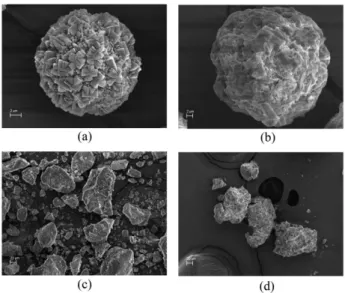
The replication process can be clearly seen in Figure 4, the shape of the polymer (Figure 4b) follows the shape of the zeolite (Figure 4a) and has more than double its diameter. When a zeolite without a defined morphology was employed led to polymer with poor morphological control (Figures 4c and 4d).
Polymers obtained by the homogeneous process, showed fine particles, with low apparent density and no morphological control. The polymer particles grew disorderly (see Figure 5) due to the homogeneous nature of the catalyst and absence of a support.
Conclusions
The results showed that the ZSM-5 spherical zeolite, used as a support for the catalytic precursor Cp2ZrCl2,
Table 2. Reactions using Cp2ZrCl2 heterogenized on ZSM-5 by different methods
entry Catalyst Zr / µmol Al/Zr time / min PE / g (kg PE mol ZrProductivity / -1 h-1)
6 SZ-IL-Zra 2 500 10 NFe NFe
7 SZ-IL-Zra 2 1000 10 1.573 4719
8 SZ-IL-Zra 0.4 5000 10 0.084 1260
9 SZ-IL-Zra 2 1000 1 0.488 14640
10 SZ-CA-Zrb 2 1000 10 1.475 4427
11 SZ-St-Zrc 2 1000 10 NRe NRe
12 SZ-St-Zrc 2 2000 10 0.955 2865
13 SZ-IL-MAO-0.12d 1.3 1500 10 0.422 1924
14 SZ-IL-MAO-0.18d 2 1000 10 0.835 2539
Reaction conditions: T: 60 oC; ethylene pressure (P
Tot): 4 bar; MAO and toluene (total volume: 30 mL); aCp2ZrCl2 supported on spherical ZSM-5 zeolite; bCp
2ZrCl2 supported on calcined spherical ZSM-5 zeolite; cCp2ZrCl2 supported on standard ZSM-5 zeolite; dCp2ZrCl2 supported on MAO treated ZSM-5
zeolite; eproduct not observed.
Table 3. Comparison between homogeneous and heterogeneous systems in terms of structural and thermal properties
entry System Al/Zr (kg PE mol ZrProductivity / -1 h-1) Tm / °C χc / %
4 Homogeneous 1000 8019 135 54
6 SZ-IL-Zra 1000 4719 135 48
10 SZ-CA-Zrb 1000 4427 136 49
12 SZ-St-Zrc 2000 2865 136 46
13 SZ-IL-MAO-0.12d 1500 1924 136 53
aCp
2ZrCl2 supported on spherical ZSM-5 zeolite; bCp2ZrCl2 supported on calcined spherical ZSM-5 zeolite; cCp2ZrCl2 supported on standard ZSM-5 zeolite; dCp
2ZrCl2 supported on MAO treated ZSM-5 zeolite.
fulfilled its role satisfactorily. Under the same conditions, the spherical ZSM-5 catalysts demanded less co-catalyst and showed higher productivity when compared with the
conventional ZSM-5 zeolite catalyst. The ionic liquid inside the spherical zeolite did not show any influence on the catalytic behaviour. Moreover, the characteristics of the polymers obtained with the metallocene precursor remained untouched or equal to those of the homogeneous process using the heterogeneous catalysts. The SEM images allowed the observation of well-defined polymer growth. The experiments using the MAO-treated zeolite produced laminated particles, which constitute an advantage, due to the easy access of the monomer to the catalytic centre. For all the supported catalysts tested in this work, the morphological control was better than that of the catalyst in solution.
Acknowledgements
The authors thank FAPERGS/PRONEX/CNPq for their financial support and CNANO for the SEM images.
References
1. Sinn, H.; Kaminsky, W.; Adv. Organomet. Chem.1980, 18, 99. 2. Silveira, F.; Petry, C. F.; Pozebon, D.; Pergher, S. B.; Detoni, C.; Stedile, F. C.; Santos, J. H. Z.; Appl. Catal., A 2007, 333, 96.
3. Alt, H. G.; Koppl, A.; Chem. Rev.2000, 100, 1205.
4. Cobzaru, C.; Hild, S.; Boger, A.; Troll, C.; Rieger, B.; Coord. Chem. Rev.2006, 250, 189.
5. Talebi, S.; Duchateau, R.; Rastogi, S.; Kaschta, J.; Peters, G.; Lemstra, P.; Macromolecules2010, 43, 2780.
6. Cavarrubias, C.; Quijada, R.; Catal. Commun.2009, 10, 995.
7. Jang,Y.; Nenov, N.; Klapper, M.; Miillen, K.; Polym. Bull.2003,
50, 343.
8. Shearer, A. S.; Miguel, Y. R.; Minich, E. A.; Pochan, D.; Jenny, C.; Inorg. Chem. Commun.2007, 10, 262.
9. Conte, A.; Marques, M. F. V.; Eur. Polym. J. 2001, 37, 1887.
Figure 3. (a) Group of ZSM-5 spherical zeolites covered with polyethylene, catalyst SZ-IL-Zr (magnification of 2000×) and (b) ZSM-5 particles covered with PE, catalyst SZ-IL-MAO-0.12 (magnification of 2000×).
Figure 4. (a) ZSM-5 spherical zeolite (magnification of 9000×); (b) morphology replication process of polyethylene particle (magnification of 5000×) obtained with spherical ZSM-5 zeolite; (c) standard ZSM-5 zeolite particles (magnification of 500×); (d) polyethylene particle (magnification of 500×) obtained with standard ZSM-5 zeolite.
10. Severn, J. R.; Chadwick, J. C.; Duchateau, R.; Friederichs, N.;
Chem. Rev.2005, 105, 4073.
11. Kaminsky, W.; Kinet. Catal.2006, 47, 221.
12. Ye, Z. B.; Zhu, S. P.; Wang, W. J.; Alsyouri, H.; Lin, Y. S.;
J. Polym. Sci., Part B: Polym. Phys.2003, 41, 2433.
13. Costa Vaya, V. I.; Belelli, P. G.; Santos, J. H. Z.; Ferreira, Z.; Damianiy, D. E.; J. Catal.2001, 204, 1.
14. Marques, M. F. V.; Moreira, S. C.; J. Mol. Catal. A: Chem. 2003, 192, 93.
15. Novokshonova, L. A.; Kovaleva, N. Y.; Ushakova, I. N.; Meshkova, V. G.; Krasheninnikov, T. A.; Ladygina, I. O.; Leipunskii, A. N.; Zhigach, A. N.; Kuskov, M. L.; Kinet. Catal. 2005, 46, 853.
16. Meshkova, I. N.; Ushakova, T. M.; Ladygina, T. A.; Kovaleva, N. Y.; Novokshonova, L. A.; Polym. Bull.2000, 44, 461. 17. Meshkova, I. N.; Kudinova, O. I.; Kovaleva, N. Y.; Grinev, V. G.;
Ladygina, T. A.; Kiseleva, E. V.; Novokshonova, L. A.; Polym. Sci., Ser. B 2009, 51, 401.
18. Carrero, A.; van Grieken, R.; Paredes, B.; Catal. Today2012,
179, 115.
19. Bernardo-Gusmão, K.; Mignoni, M. L.; Souza, M. O.; Pergher, S. B. C.; Souza, R. F.; Appl. Catal., A2010, 374, 26.
20. Ruiter, R.; Jansen, J. C.; van Bekkum, H. In Synthesis of
Microporous Materials; Occelli, M. L.; Robson, H. F., eds.;
van Nostrand: New York, 1992, vol. 1, p. 167.
21. Kaminsky, W.; Bark, A.; Steiger, R. J. Mol. Catal. 1992, 74, 109.
22. Kunrath, F. A.; Mauler, R. S.; Souza, R. F.; Casagrande, J. O. L.; Macromol. Chem. Phys.2002, 203, 2058.
23. Ciardelli, F.; Altomare, A.; Michelotti, M.; Catal. Today1998,
41, 149.
24. Quijadas, R.; Rojas, R.; Narvaez, A.; Alzamora, L.; Rutuert, J.; Rabagliate, M.; Appl. Catal., A 1998, 166, 207.
25. Silveira, F.; Petry, C. F.; Pozebon, D.; Pergher, S. B.; Detoni, C.; Stedile, F. C.; Santos, J. H. Z.; Appl. Catal., A 2007, 333, 96.
26. Haag, M. C.; Krug, C.; Dupont, J.; Galland, G. B.; Santos, J. H. Z.; Uozumi, T.; Sano, T.; Soga, K.; J. Mol. Catal. A: Chem. 2001, 169, 275.
27. Chien, J. W.; He, D.; J. Polym. Sci., Polym. Chem.1991, 29,
1603.
Submitted: January 6, 2015
Published online: May 5, 2015