Article
J. Braz. Chem. Soc., Vol. 26, No. 6, 1232-1246, 2015. Printed in Brazil - ©2015 Sociedade Brasileira de Química 0103 - 5053 $6.00+0.00
A
http://dx.doi.org/10.5935/0103-5053.20150089*e-mail: [email protected]
Preliminary Investigation of Medicinal Herb Adulteration Using Comprehensive
Two-Dimensional Gas Chromatography and Chemometric Analysis
Juliane E. Welke,a,b Flaviana C. Damasceno,b Karine P. Nicolli,b Lilian Mentz,c
Elina B. Caramão,b Fernando H. Pulgatid and Cláudia A. Zini*,b
aInstituto de Ciência e Tecnologia de Alimentos and bInstituto de Química, Universidade Federal do
Rio Grande do Sul (UFRGS), Av. Bento Gonçalves, 9500, 91501-970 Porto Alegre-RS, Brazil
cFaculdade de Farmácia, UFRGS, Av. Ipiranga, 2752, 90610-000 Porto Alegre-RS, Brazil
dInstituto de Matemática, UFRGS, Av. Bento Gonçalves, 9500, 91509-900 Porto Alegre-RS, Brazil
Anise is frequently found among the ingredients described in the label of cosmetic products. However, the use of fennel instead of anise may occur due to the lower price of fennel. The main differences in volatile profile of anise and fennel fruits were, for the first time, evaluated using comprehensive two-dimensional gas chromatography with time-of-flight mass spectrometric detection (GC×GC/TOFMS) and chemometric analysis. Aproximately 950 peaks were found in chromatograms of each sample and Fisher ratio appointed 31 volatile analytes as the most discriminating between anise and fennel samples. These 31 compounds were used in principal component analysis and canonical discriminant analysis that designated seven compounds (estragole, methyl eugenol, 4,5-dehydro-isolongifolene, calamenene, linalool, β-ocimene and fenchol) as the most important to verify the use of fennel or anise in personal care products. Among these seven compounds, thrree coeluted with other compounds and were correctly identified only with the use of GC×GC/TOFMS.
Keywords:Foeniculum vulgare, Pimpinella anisum, GC×GC, estragole, adulteration
Introduction
Fennel (Foeniculum vulgare Mill.) and anise
(Pimpinella anisum L.) belong to Apiaceae family (also
known as Umbelliferae) and their fruits, mistakenly called “seeds”, have been extensively used in perfumes, food and also in the pharmaceutical industry, especially in personal care products due its pleasant aroma.1 These fruits are
widely used to make tea and present similar morphological aspect from the general public perspective (non-experts). This similarity may cause confusion among consumers who purchase in bulk whenever they need to choose between both fruits. Similar taste and aroma profiles also corroborate to create confusion between both seed fruits. In Brazil, fennel fruits of some commercial brands are sometimes designated as “national anise”, which makes the choice of the consumer even more difficult. A very important aspect in this context is that anise is the herb usually found in the descriptions of ingredients in the packaging
of cosmetic products. The price of anise fruits is higher than the price of fennel (roughly, $ 18 for anise compared to $ 7 for fennel per pound or per 450 g) in Amazon’s web
page2 and such a difference may stimulate the practice of
adulteration, as the similar taste and flavor of both plant fruits also help to cover up the real composition of these cosmetic products. In addition to flavoring properties and to the extensive use of these fruits in cosmetics, the fruits themselves, their essential oils or the aqueous extracts of fennel and anise have showed important therapeutic applications due to their antioxidant1 and antimicrobial
properties.3 According to popular knowledge, both products
have been utilized in gastrointestinal treatment and fennel infusion is indicated in the treatment of flatulence and baby colic, whereas, anise has been used to increase the amount of milk in lactating women.4
Some authors have found anethole as the major constituent of both essential oils and fruits of anise5-7 and
fennel.6,8-10 This compound was identified as the main
Welke et al. 1233 Vol. 26, No. 6, 2015
dopamine and this characteristic may explain the relaxing effect on the intestine caused by fennel and anise.4
Despite the beneficial property of anethole, another component called estragole (also called p-allylanisole or
methyl chavicol, an isomer of anethole) has been identified as genotoxic and carcinogenic11,12 and its addition as a flavoring
substance to foodstuffs has been banned by the regulatory authorities of the European Union.13 Almeida et al.6 found
estragole in essential oil of fennel fruits, but this compound was not detected in the essential oil of anise fruits grown in Salerno (Italy). Fennel from China showed higher chromatographic area percentage of estragole, (2.98% of normalized peak area) when compared to anise (0.97%).8
According to our knowledge, the characterization of fruits and essential oils obtained from fruits of fennel and anise has already been done using one one-dimensional gas chromatography with a mass spectrometric detector
(1D-GC/MS).6-8 A detailed verification at these 1D-GC
data shows that there are many unresolved peaks, due to the high complexity of these samples. Two or more co-eluting compounds may prevent the achievement of a correct identification of these volatile compounds and this is especially cumbersome when traces of volatile compounds are hidden by other co-eluting compounds. This means that important information on volatile composition may be missing and consequently misidentification of target
components may occur.13
Comprehensive two-dimensional gas chromatography with time-of-flight mass spectrometry detection (GC×GC/TOFMS) is an excellent choice for the investigation of the composition of complex samples, as it allows the analysis of the whole sample in the same analysis time required for a normal 1D-GC run, providing the selectivity of two different stationary phases, along with superior sensitivity and structurally organized elution of components in the 2D plots.14 GC×GC/TOFMS has already
been employed to verify distinctions among more expensive herbs and false and cheaper herbs,15 although in this case the
interpretation of color plots was performed through manual inspection, which is a time consuming and tedious task. The use of GC×GC/TOFMS along with chemometric tools have helped to design a more inclusive and fast approach where all the 2D data is employed for the preliminary analysis of the most discriminant compounds among classes. This strategy has already been successfully applied by this research group to verify distinctions among the volatile profile of wines according to different grape variety16 and
also to investigate which compounds differentiate sparkling wines from base wines.17 Investigation of adulteration in
sesame and peanut oils18 and differentiation of two clam
species19 have also been performed using a similar strategy,
however, it has not yet been used to investigate consistent differences between real and false herbs that may be subjected to adulteration.
The purpose of this study is, for the first time; investigate the main differences in volatile profiles of fennel and anise fruits, as well as in personal care products based on these two medicinal herbs, using GC×GC/TOFMS data and chemometric tools in order to verify the possibility of adulteration of personal care products with fennel, which is the less expensive between the two herbs under study.
Experimental
Sample preparation analytical reagents, and supplies
Fruits of fennel and anise were purchased from different suppliers in four different markets in Porto Alegre city (state of Rio Grande do Sul, Brazil) and were kept in the dark prior to analysis. The fruits were sampled from plants cultivated in Rio Grande do Sul and the botanical identity of each purchased sample was verified according to morphological characteristics with the supervision of a botanist. Five samples were collected from each commercial brand of fennel and anise fruits and placed inside glass vials in order to provide five replicates of extraction and analyses for each product. Fruits were analyzed as a whole, without any pre-treatment. The five cosmetic products evaluated were shampoo, hair conditioner, liquid soap, deodorant, skin-clearing lotion.
The dibasic sodium phosphate (Na2HPO4) and potassium
dihydrogen phosphate (KH2PO4) were purchased from
Synth (São Paulo, Brazil). Standard compounds 1-hexanol, 3-methyl butanol, α-pinene, eucalyptol, benzyl alcohol, linalool, phenylethylalcohol, 4-terpineol and γ-terpinene were obtained from Sigma (Steinheim, Germany) and prepared in hexane at a concentration of 5 mg L−1.
Headspace solid phase micro extraction of volatile compounds
Preliminary Investigation of Medicinal Herb Adulteration J. Braz. Chem. Soc. 1234
and anise fruits. The buffer solution was a 0.025 mol L−1
solution of sodium phosphate dibasic and potassium
dihydrogenphosphate (Na2HPO4/KH2PO4). The fiber
was exposed to the sample headspace during a period of 20 min at 30 °C. After sampling, the fiber was thermally desorbed in a GC×GC injection port at 230 °C for 15 min in splitless mode. In order to avoid carryover, the fiber was reconditioned for 5 min at 260 °C prior to each analysis.
Chromatographic determination of volatile compounds
A GC×GC/TOFMS Pegasus-4D system equipped with a liquid nitrogen quad-jet modulator and a CTC Combipal autosampler was used. The GC×GC system consisted of an Agilent 6890N (Agilent Technologies, Palo Alto, CA, USA) equipped with a Pegasus time-of-flight mass spectrometry detector (Leco Corporation, St. Joseph, MI, USA). The column set consisted of a polyethylene
glycol phase (DB-Wax) in the first dimension (1D) of
30 m, 0.25 mm i.d. and 0.25 µm film thickness (df),
coupled to a dimethylpolysiloxane phase (DB-1) column (1.7 m length × 0.1 mm i.d. × 0.1 µm df) in the second
dimension (2D). Both columns were purchased from
Agilent Technologies (Santa Clara, California, USA). The injector and detector port temperature were kept at 230 °C and the primary oven temperature was programmed to start at 60 °C, where it was kept for 0.20 min, being raised to 190 °C at 3 °C min−1. The secondary oven offset
was 40 °C and the interface temperature was 200 °C. The modulation period and the hot pulse duration were 4 s and 1.6 s, respectively. The MS parameters were as follows: electron ionization of 70 eV, detector voltage at −1500 V, acquisition rate of 100 Hz and mass range (m/z) from
40 to 400. The maximum number of peaks before Chroma TOF data treatment was set to 1000. Linear temperature
programmed retention index (LTPRI)20 was calculated
1D-GC/MS for the purpose of tentative identification of volatile compounds. The LTPRI was experimentally determined for a DB-5 column (5% diphenyl-95% dimethyl polysiloxane, 30 m × 0.25 mm × 0.25 µm, J&W Scientific Inc., Folsom, CA) and for a DB Wax (polyethylene glycol, 30 m × 0.25 mm × 0.25 mm, J&W Scientific Inc.) column. Experimental conditions of 1D-GC were: injector and detector temperature at 250 °C for DB-5 and 220 °C
for DBWax. Helium flow rate was 1.0 mL min−1. Oven
temperature program was initially 60 °C and reached
250 °C at 3 °C min−1 for DB-5 column and 200 °C for
DBWax column. Quadrupole mass spectrometric detector was operated in the electronic impact mode at 70 eV, and mass/charge range was 40 to 450. Electron multiplier was at 1250 V.
Data processing
LECO ChromaTOF version 4.22 software was used for all acquisition control, data processing and Fisher ratio calculations. Automated peak find and spectral deconvolution with a baseline offset of 0.5 and signal-to-noise (S/N) of three were employed during data treatment for peak detection. Tentative identification of volatile compounds was achieved by comparing 1D-GC experimental LTPRI with retention indices reported in the scientific literature. Nine compounds (listed in the Experimental section and indicated in Table 1) were positively identified through comparison of retention and mass spectra data of unknown compounds with those of authentic standards. Retention data obtained with a series
of n-alkanes (C9 to C24), under the same experimental
conditions employed for the chromatographic analysis of volatiles of herbs and personal care products were used to determine experimental LTPRI of volatile compounds. Mass spectrometric information of each chromatographic peak was compared to NIST mass spectra library version 2005, considering a minimum similarity value of 80%. Chromatographic analyses of all samples were made in a short period of time, continuously, in order to assure comparable performance of the mass spectrometric detector response for all samples.
The area percentage of each compound was obtained considering the sum of the areas of all compounds present in the samples, which represents 100%. Chromatographic peaks related to column bleeding and to compounds that have shown spectral similarity below 80% were not taken into consideration when the area percentage of a specific compound was calculated. In a general view, the chromatograms of anise samples were very similar; the same was observed for fennel samples. Then, one chromatogram of each type of sample (anise and fennel) was used to calculate a rough estimate of the area percentage of every compound in each type of herb. Linear response of the mass spectrometric detector was verified using compounds considered as representative of the several classes of compounds present in the headspace of samples (Figure S1 and Table S1, in the Supplementary Information (SI) section).
Statistical analysis
Welke et al. 1235 Vol. 26, No. 6, 2015
The Fisher ratio is a supervised method applied when the classes of samples are previously known. The whole set of GC×GC/TOFMS data was employed for the initial Fisher ratio determination, including column and SPME bleed and chromatographic peaks that showed low spectral similarity with the information found in the mass spectral library. The idea behind this procedure is to perform a simplified data treatment that has not demanded a previous manual analysis of the data before statistical treatment. In fact, calculation of Fisher ratio allowed a simplification of GC×GC data, as it showed the compounds that had the greatest changes in their chromatographic peak areas through comparison of the three classes under study: fennel, anise and personal care products. Compounds with Fisher ratios higher than 2590 were used in the second stage of the statistical analysis (PCA) as these components showed signal-to-noise ratio (S/N) value at least two times higher in class 1 (fennel) than in class 2 (anise) or vice versa. S/N ratio was calculated
using ChromaTOF software.
Data obtained by ChromaTOF software (retention data, chromatographic areas and mass spectra) were exported to Predictive Analytics Software Statistics 18, release 18.0.0 for PCA, MANOVA and CDA that are unsupervised methods.
PCA was employed to transform the set of variables selected by Fisher ratio into another set of fewer synthetic variables denominated factors. The association between the variables was investigated and the dimension of variables was defined by eigenvalues higher than one.
MANOVA was used to compare the differences between the mean vectors of fennel, anise and personal care products. The significant compounds appointed by MANOVA were used in CDA, which is a supervised method applied for classification purposes. CDA classification model was constructed through the application of a stepwise variable selection procedure. Wilk’s lambda was employed as selection criteria to help choosing the most significant variables and F-statistic factor was used to determine the significance of changes in lambda whenever the influence of a new variable was evaluated. The variables (most discriminant compounds) were included in the model one by one, choosing at each step the variable that made the most significant additional contribution to the discrimination (i.e., with the largest F-value). Whenever a different variable was tested in the model, the resulting classification of samples was compared to the previously proposed classification to check their agreement. The Wilk’s lambda selection algorithm is a measure of discrimination between groups. The larger the dispersion among groups, the lower the Wilk’s lambda value and the greater the significance of that compound
for the classification method.21 The prediction capacity of
the discriminant models was studied by a “leave-one-out” cross validation. The strategy of this method of validation consists of discarding one observation of the reference group and estimating the classification model with the other observations. The observation left out is then used to assess the performance of the classifier method and the whole process is repeated for all the other samples, until each one has been left out once.22
Results and Discussion
On average, over 950 peaks were detected per sample
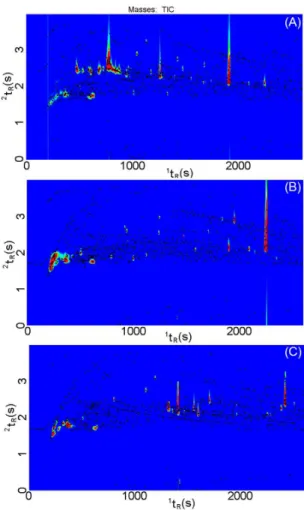
and they included spurious components (column and SPME bleeding, compounds with spectral similarity below 80%, etc.) and compounds of several chemical classes mainly terpenic compounds, esters, acids, aldehydes, ketones, alcohols, phenols, and others. After taking out the spurious chromatographic peaks, roughly 175 compounds remained. The sum of the areas of approximately 175 chromatographic peaks was considered as 100% of the compounds for the purpose of area percentage calculation. Figure 1 shows color plots obtained after HS-SPME-GC×GC/TOFMS analyses of fennel and anise fruits and personal care products based on these fruits, where sample complexity and co-elutions in 1D are easily observed, as well the high
number of volatile compounds detected.
The major compound of anise and fennel fruits is anethole (approximately 68% and 56%, respectively). This compound was also found as the major component
of fennel essential oils grown in Italy (76%),6 China
(68%),8 Egypt (66%),9 Turkey (84%)10 and Brazil
(78%).23 Moreover, high proportions of anethole has
been also found in anise from Serbia (88%),5 Italy
(97%),6 and from various European countries including
France, Greece, Scotland, Spain and Germany (around
94%).7 Anethole is the most studied compound of anise
and fennel. The interest of pharmaceutical industry for isolated constituents of natural materials has increased and scientific research has demonstrated the inhibitory effect
of anethole in nonimmune inflammation,24 its inducing
property of apoptosis in human breast cancer25 and its
anti-inflammatory effect in lung injury.26
Preliminary Investigation of Medicinal Herb Adulteration J. Braz. Chem. Soc. 1236
Taking into account that only 31 compounds presented a major contribution for differentiation between fennel and anise fruits, it is possible to conclude that volatile profiles of both fruits are rather similar.
The tentatively identified compounds, their respective CAS number, classification of chemical class, spectral similarity between mass spectra of sample compounds and NIST library, Fisher ratio value, as well as experimentally determined LTPRI and literature LTPRI for each compound are shown in Table 1. Compounds are sorted in descending order according to their Fisher ratio values. Differences between experimentally determined LTPRI and literature LTPRI for tentatively identified compounds were less than 16 units.
Considering all 31 compounds chosen by the Fisher ratio criteria as a 100%, sesquiterpenes were the predominant chemical class (35.5%). Other compounds tentatively identified among this group belong to monoterpenes hydrocarbons (22.6%), oxygenated monoterpenes (22.6%), alcohols (12.9%) and phenylpropanoids (6.4%) (Table 1).
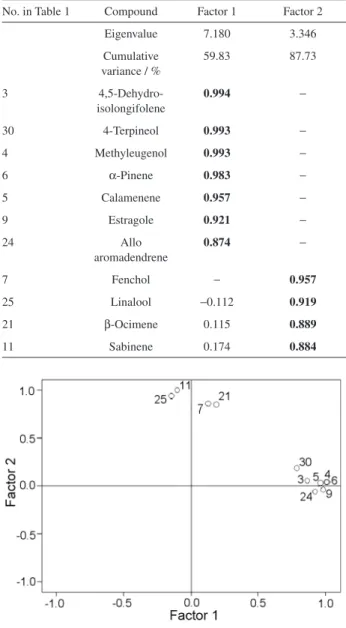
PCA was carried out in the second step of chemometric analysis and included all the 31 compounds of Table 1. This approach selected two factors with eigenvalues greater than one, which included 11 volatile compounds and explained the 87.7% of the total variance (Table 2). Eigenvalues correspond to the variance of each principal component and the number of significant eigenvalues was determined by the Kaiser rule, which considers only the components with eigenvalue greater than one. Variables with higher loading values are the ones that significantly contributed to explain the factors and they are marked in bold letters in Table 2. Variables related to components 1 and 2 are positioned according to factor loadings in Figure 2.
The following statistical tools were applied in an attempt to validate a model to differentiate fennel and anise fruits based on their volatile profiles: MANOVA and CDA. This model will be employed to identify the compounds that might be used to verify which one of these herb fruits were employed in the manufacture of different personal care products that are designated as anise products. MANOVA was applied in the third stage of statistical analysis and the results are shown in Table 3. The distribution of the samples in the plan defined by the first two components was obtained by PCA (Figure 3). Volatile compounds related to the first factor (Table 3) that differentiate anise, fennel and personal care products were 4,5-dehydro-isolongifolene, methyleugenol, calamenene, α-pinene, 4-terpineol, alloaromadendrene and estragole. Furthermore, these compounds are responsible for the similarity between personal care products and fennel. These results indicate that the anise (as stated on the product label) may have been replaced by fennel in elaboration of personal care products. Volatiles associated with the second factor (Table 3) that differentiate the three types of samples analyzed in this work were β-ocimene, sabinene, fenchol and linalool (Figure 3).
Chromatographic areas of β-ocimene, sabinene and
fenchol were higher in the headspace of anise fruits than those found in fennel fruits, and linalool was found only in fennel as observed in a closer view of the chromatograms of fennel and anise (results not shown). However, these compounds had not been found in personal care products, probably due to chemical reactions that might occur during the preparation/storage of these products. β-Ocimene, for
Figure 1. GC×GC/TOFMS total ion current chromatograms (TIC) presented as color plots of volatile compounds of the headspace of (A) fennel fruits, (B) anise fruits and (C) personal care products. Retention time in seconds in the first dimension [1t
R(s)] and in the second dimension [2t
W
elk
e
et al.
1237
V
ol. 26, No. 6, 2015
Table 1. Tentatively identified compounds appointed by Fisher ratio as the most important analytes to differentiate fennel and anise fruits through HS-SPME and GC×GC/TOFMS analyses. The compounds
were sorted in descending order according to their Fisher ratio values
No. Compound CAS Chemical class Sa LTPRI
DB-5expb
LTPRI DB-5litc
LTPRI waxexpd
LTPRI waxlite
Fisher
ratio Structural formula
Area / %f
Fennel Anise
1 1-Methoxy-4-(1-propenyl) benzene; anethole 104-46-1 Phenyl propanoidg 900 1295 128927 1820 180828 15296 O C H3
CH3
56.00 68.00
2
3,5,5-Trimethyl-9-methylidene-2,4a,6,7,8,9a-hexahydro-1H-benzo(7)annulene;
α-himachalene
3853-83-6 Sesquiterpene 889 1448 144729 1600 161030 8343
CH2
C H3
C H
3
CH3
0.05 0.42
3 4,5-Dehydro-isolongifolene 156747-45-4 Sesquiterpene 927 1514 150031 1903 191332 7610 CH3
C H
3
C H3
CH3 0.75 0.89
4 1,2-dimethoxy-4-(2-propenyl)-benzene; methyleugenolh 93-15-2 Phenyl propanoidg 884 1405 140129 2017 200733 6661
O
O
O H
CH
3
C H2
4.40 h
5 1,6-Dimethyl-4-(propan-2-yl)-1,2,3,4-tetrahydronaphthalene; calamenene 483-77-2483-77-2 Sesquiterpene 855 Nf j 154029 1834 182634 6347
C H
3
CH3 C
H3 CH3
0.08 0.10
6 4,7,7-Trimethylbicyclohept-3-ene; α-pinenei 80-56-8 Monoterpene
hydrocarbon 897 935 93929 1046 103435 6246
CH
3
C H
3
C H
3
0.07 1.28
7 1,3,3-Trimethylbicycloheptan-2-ol; fenchol 1632-73-1 monoterpeneOxygenated 881 Nf j 111729 1370 137136 5344
CH3
CH
3
CH
3
OH
Preliminary In
vestig
ation of Medicinal Herb
Adulteration
J. Br
az. Chem. Soc.
1238
Table 1. Tentatively identified compounds appointed by Fisher ratio as the most important analytes to differentiate fennel and anise fruits through HS-SPME and GC×GC/TOFMS analyses. The compounds were sorted in descending order according to their Fisher ratio values (cont.)
No. Compound CAS Chemical class Sa LTPRI
DB-5expb
LTPRI DB-5litc
LTPRI waxexpd
LTPRI waxlite
Fisher
ratio Structural formula
Area / %f
Fennel Anise
8 1-Methyl-4-(1,2,2-trimethylcyclopentyl)-benzene; cuparene 16982-00-6 Sesquiterpene 873 Nf j 150229 1791 180337 4920 HC
3
C H3 H3C CH3
0.09 0.24
9 4-Methylidene-1-propan-2-ylbicyclohexane;
sabinene 3387-41-5
Monoterpene
hydrocarbon 905 979 97629 1122 113433 4908
CH3
CH3 C
H
2
0.08 0.17
10 1-Ethenyl-1-methyl-2,4-di(prop-1-en-2-yl)cyclohexane;
β-elemene 515-13-9 Sesquiterpene 845 Nf j 137529 1590 159535 4335
C H2
C H
3
C H2
CH3
CH
3
CH2
0.33 0.11
11 1-Methoxy-4-prop-2-enylbenzene; estragoleh 140-67-0 Phenyl propanoidg 889 1199 119529 1670 166133 4214 O C H
3
CH2
14.00 h
12 6,6-Dimethyl-5-methylidenebicycloheptane;
camphene 79-92-5
Monoterpene
hydrocarbon 912 Nf j 95329 1070 107735 4095
O
CH3
CH3 0.02 0.15
13 4,7-Dimethyl-1-propan-2-yl-1,2,3,5,6,8a-hexahydronaphthalene;
δ-cadinene 483-76-1 Sesquiterpene 882 1512 152429 1735 172938 2602
CH3 C H3
CH
3
C H3
0.11 0.25
14
1-Methyl-5-methylene-8-(1-methyethyl)-1,6-cyclodecadiene; germacrene D 23986-74-5 Sesquiterpene 932 Nf j 148029 1711 172235 4024
CH
2
CH3 CH
3
CH3
0.08 0.01
15 4,7,7-Trimethyl-8-oxabicyclo[2.2.2]octane; 1,8-cineole; eucalyptoli 470-82-6 monoterpeneOxygenated 917 1030 103329 1229 122439 3704 O C H
3
CH3
CH3
W
elk
e
et al.
1239
V
ol. 26, No. 6, 2015
Table 1. Tentatively identified compounds appointed by Fisher ratio as the most important analytes to differentiate fennel and anise fruits through HS-SPME and GC×GC/TOFMS analyses. The compounds
were sorted in descending order according to their Fisher ratio values (cont.)
No. Compound CAS Chemical class Sa LTPRI
DB-5expb
LTPRI DB-5litc
LTPRI waxexpd
LTPRI waxlite
Fisher
ratio Structural formula
Area / %f
Fennel Anise
16 Benzylalcoholi 100-51-6 Alcohol 926 1040 103229 1891 188240 3681
OH
0.02 1.72
17 1,3,3-Trimethylbicycloheptan-2-one;
fenchone 1195-79-5
Oxygenated
monoterpene 908 1091 109441 1401 140241 3519
CH3 CH3 O CH3
0.03 0.95
18
4,7-Dimethyl-1-propan-2-yl-1,2-dihydronaphthalene; α-calacorene 21391-99-1 Sesquiterpene 911 Nf j 154842 1912 190143 3491
CH3
CH3 C H3
CH
3
0.26 0.09
19 3-Methyl-1-butanoli 123-51-3 Alcohol 947 Nf j 73429 1228 123044 3264
C
H3 OH
CH3
0.03 5.45
20 Phenylethylalcoholi 60-12-8 Alcohol 924 1126 111029 1924 193144 3133
OH
5.05 0.03
21 3,7-Dimethyl-1,3,6-octatriene; β-ocimene 3779-61-1 Monoterpene hydrocarbon 906 Nf j 104029 1245 124535 2859 H2C
CH3
C
H3 H3C
0.04 0.16
22 1-Hexanoli 111-27-3 Alcohol 897 Nf j 86729 1362 136039 2714 H3C OH 1.01 0.85
23 1,7,7-Trimethylbicycloheptan-2-one; camphor 76-22-2 monoterpeneOxygenated 900 1148 114329 1510 149845 2663
C H3
C H3
CH3
O 0.08 0.05
24 Decahydro-1,1,7-trimethyl-4-methylene-cyclopropazulene; allo aromadendrene 25246-27-9 Sesquiterpene 888 1457 146129 1662 165046 2641
CH3 CH3 C
H
2
CH
3
Preliminary In
vestig
ation of Medicinal Herb
Adulteration
J. Br
az. Chem. Soc.
1240
Table 1. Tentatively identified compounds appointed by Fisher ratio as the most important analytes to differentiate fennel and anise fruits through HS-SPME and GC×GC/TOFMS analyses. The compounds were sorted in descending order according to their Fisher ratio values (cont.)
No. Compound CAS Chemical class Sa LTPRI
DB-5expb
LTPRI DB-5litc
LTPRI waxexpd
LTPRI waxlite
Fisher
ratio Structural formula
Area / %f
Fennel Anise
25 3,7-Dimethyl-1,6-octadien-3-ol; linalooli,h 78-70-6 Oxygenated
monoterpene 937 1102 109829 1558 155435 2639 CH3 C
H3
C H
2
OH H3C
0.06 h
26 1-(1,5-Dimethyl-4-hexenyl)-4-methyl
benzene; α-curcumene 644-30-4 Sesquiterpene 860 1480 148329 1779 176434 2635
C H3
CH3
CH3
CH3
0.02 0.27
27 1-Methyl-4-(1-methylehtylidene)
cyclohexene; γ-terpinenei 99-85-4
Monoterpene
hydrocarbon 892 1058 106229 Nf 126235 2622 H3C
CH3
CH3
0.09 0.01
28 3,7-Dimethyl-1,3,7-octatriene; p-cymene 99-87-6 Monoterpene hydrocarbon 854 1027 102629 1274 128235 2610
CH3
CH3 C
H
3 0.07 0.10
29 1,7,7-Trimethyl-bicyclo[2.2.1]heptan-2-ol;
borneol 507-70-0
Oxygenated
monoterpene 939 Nf j 116529 1650 164246 2605 CH3 CH3 CH
3
O H
2.94 h
30 2-(4-Methyl-1-cyclohex-3-enyl)propan-2-ol; 4-terpineoli 562-74-3 monoterpeneOxygenated 901 1181 117729 1608 161635 4092
C
H3 OH
CH3
C H3
0.33 0.01
31 1-Methyl-4-prop-1-en-2-ylcyclohexene;
limonene 5989-27-5
Monoterpene
hydrocarbon 933 1030 103129 1201 121239 2590
CH2
CH
3
C
H3 0.05 0.01
aSimilarity=S (S means similarity of the mass spectrum of a wine compound with the spectra of standard compounds in the NIST05); bLinear temperature programmed retention index (LTPRI) calculated using
n-alkanes (C9-C24) in apolar column (DB-5, 5% polyethyleneglycol); Conditions for the chromatographic analysis are described in Chromatographic determination of volatile compounds, in Experimental section. LTPRI were calculated based on first dimensional separation retention data; cLTPRI: literature LTPRI on a DB-5 columns or equivalent stationary phase; dLinear temperature programmed retention index
(LTPRI) calculated using n-alkanes (C9-C24) in polar column (DB-Wax, 100% polyethyleneglycol); eLTPRI: literature LTPRI on a DB-WAX columns or equivalent stationary phase; fThe area percentage of each
compound was obtained considering the sum of the areas of all compounds present in the samples, which represent 100%. Chromatographic peaks resulting from column or SPME bleeding or compounds that showed spectral similarity below 80 % when compared to commercial library mass spectra were not considered in this determination; gTerpene derivative; hCompound found only in fennel samples; iCompound
Welke et al. 1241 Vol. 26, No. 6, 2015
example, has been reported to promptly undergo oxidation within a short exposure to air.47 Similarly, sabinene and
fenchol may be degraded when exposed to high temperature (38 °C).48 Due to the fact that these monoterpenes may
rapidly undergo chemical changes and be absent in products derived from anise, they are not appropriate as markers to verify authenticity of products made with anise.
Figure 2. Distribution of volatile compounds in a plane defined by the first two factors obtained in PCA. Numbers refer to the tentatively identified compounds that are indicated in Table 1: (3) 4,5-dehydro-isolongifolene; (4) methyleugenol; (5) calamenene; (6) α-pinene; (7) fenchol; (9) sabinene; (11) estragole; (21) β-ocimene; (24) allo aromadendrene; (25) linalool; (30) 4-terpineol.
Table 2. Factor loadings obtained in principal component analysis of volatile compounds tentatively identified in the headspace of fennel and anise fruits after determination of Fisher ratio used to find the more important compounds to differentiate these two groups of samples. The variables with higher loadings values are the ones that contributed most significantly to explain that specific factor and they are marked in bold letters
No. in Table 1 Compound Factor 1 Factor 2
Eigenvalue 7.180 3.346
Cumulative variance / %
59.83 87.73
3
4,5-Dehydro-isolongifolene
0.994 −
30 4-Terpineol 0.993 −
4 Methyleugenol 0.993 −
6 α-Pinene 0.983 −
5 Calamenene 0.957 −
9 Estragole 0.921 −
24 Allo
aromadendrene
0.874 −
7 Fenchol − 0.957
25 Linalool −0.112 0.919
21 β-Ocimene 0.115 0.889
11 Sabinene 0.174 0.884
Figure 3. Three distinct groups of samples (fennel, anise and personal care products) positioned on the first two components set-up according to the variables that demonstrated significant differences by multivariate analysis of variance (MANOVA).
Table 3. Results of multivariate analysis of variance (MANOVA) used to check for significant differences between fennel, anise and personal care products in relation to each volatile compound selected by factor analysis
No. in
Table 1 Compound Sample Meana
Factor 1
3 isolongifolene
4,5-Dehydro-Anise Fennel Products 15.124a 6.847b 6.847b 4 Methyleugenol Anise Fennel Products 17.826a 6.847b 6.847b 5 Calamanene Anise Fennel Products 16.822a 6.972b 6.847b 6 α-Pinene Anise Fennel Products 14.053a 7.284b 6.847b 9 Estragole Anise Fennel Products 16.337a 7.649b 6.847b 30 4-Terpineol Anise Fennel Products 17.507a 6.847b 6.847b
24 Allo aromadendrene
Preliminary Investigation of Medicinal Herb Adulteration J. Braz. Chem. Soc. 1242
CDA was applied in the fourth step of statistical analysis to obtain a classification model for fennel, anise and personal care products that contain one of these fruits. The results are shown in Table 4. Eigenvalues indicate that the first discriminant function has the maximum canonical correlation (1.000) and explains almost the total of variance (99.8%). According to these values, the first two functions are responsible for discrimination because they provide the contribution to the total discrimination (100%). The statistical significance of each discriminant function was evaluated on the basis of the Wilk’s lambda factor. This parameter ranges from 1.0 (no discriminatory power) to 0.0 (perfect discriminatory power).22 The Wilk’s lambda
values of the first two discriminant functions are 0.000 and 0.049, respectively (Table 4), which indicates a very good discriminant power of the model. The significance values less than 0.002 (values lower than 0.05 were considered significant) and chi-square test indicates that there is a highly significant difference between the groups’ centroids. Centroids of each group of samples, which correspond to the average value of a discriminating factor, are viewed in Figure 4 and the higher the value of chi-square, the more the function contributes to the discrimination between groups of samples (Table 4). Figure 4 shows the separation among sample groups by plotting the first and second discriminant
functions. This separation occurred due to the differences in volatile profile of fennel and anise, which have been discussed along the text.
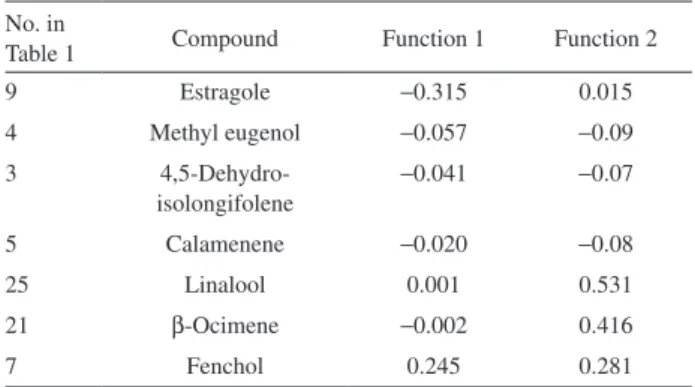
The structure matrix coefficients of canonical discrimination were used to verify the correlations of each variable in the model in relation to the two main discriminant functions (Table 5). The first discriminant function is correlated to estragole, methyleugenol, 4,5-dehydro-isolongifolene and calamenene. This can be seen through the highest values of coefficients of canonical discrimination in function 1 of Table 5. In the same way, the second discriminant functions are related to linalool, β-ocimene and fenchol, which present the highest values of coefficients of canonical discrimination in function 2.
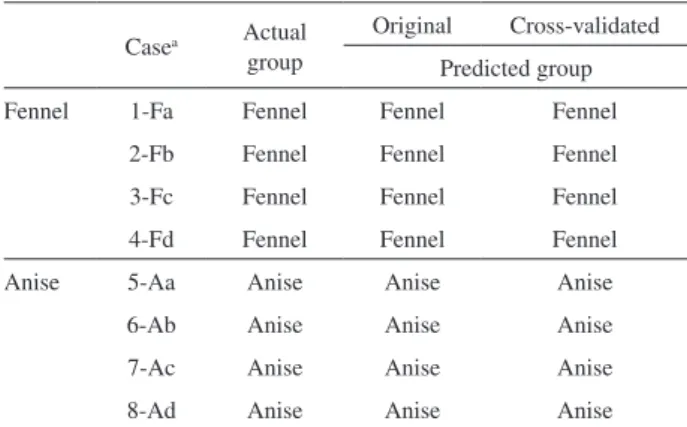
The canonical discriminant functions appeared to have a good classification power with 100% of the original group cases being correctly classified. In order to determine the model stability, a “leave-one-out” cross validation was done and 100% of the cases were correctly classified (Table 6). These results confirm that the model is suitable to verify the presence of fennel or anise in personal care products.
Among the seven terpenic compounds appointed by canonical discriminant model as the most important to differentiate fennel, anise and personal care products, three of these compounds, including estragole, methyleugenol and calamenene, co-eluted with other compounds in the
first dimension (1D) of GC×GC. These co-elutions in
Figure 4. Plot of samples on a plane defined by two canonical discriminant functions related to the volatile compounds of fennel, anise and personal care products containing fennel and/or anise. Centroids correspond to the average discriminating score for each group.
Table 4. Canonical discriminant characteristics of selection test of the variables used to obtain a model of classification of fennel, anise and personal care products that contain one of these fruits
Fa Eigenvalue Variance / %b Canonical correlation Wilk’s lambda Chi-square Dfc Signif.d
1 9076.544 99.8 1.000 0.000 84.896 14 0.000
2 19.356 100 0.975 0.049 21.094 6 0.002
aFunction; bcumulative variance; cdegrees of freedom; dsignificance (values < 0.05).
Table 5. Structure matrix coefficients of canonical discrimination related to fennel, anise and personal care products used to verify the correlations of each variable in the model in relation to the two main discriminant functions
No. in
Table 1 Compound Function 1 Function 2
9 Estragole −0.315 0.015
4 Methyl eugenol −0.057 −0.09
3
4,5-Dehydro-isolongifolene
−0.041 −0.07
5 Calamenene −0.020 −0.08
25 Linalool 0.001 0.531
21 β-Ocimene −0.002 0.416
Welke et al. 1243 Vol. 26, No. 6, 2015
1D indicate the difficulties that may arise whenever only
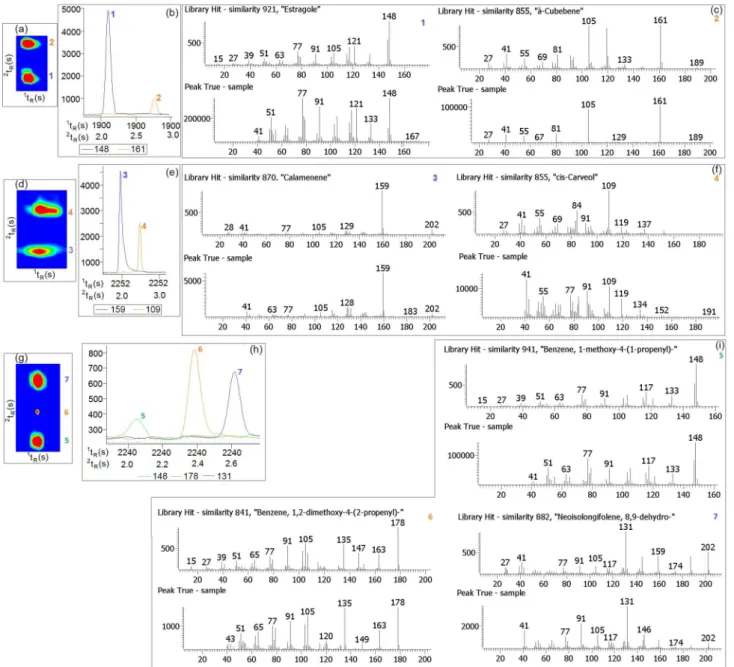
1D-GC/MS is employed, possibly resulting in insufficient chromatographic separation and consequently, incorrect identification. Figures 5a, 5d and 5g present an expansion of part of the GC×GC color plot of Figure 1, showing the usefulness of the 2D column for resolution of selected
volatile compounds of anise and fennel. After using GC×GC to have a detailed idea of the composition of the complex samples, it might be possible to define the target volatile analytes that are important for discriminating between anise and fennel. A subsequent step might be choosing a stationary phase that separates these specific compounds in 1D-GC. Such an approach would imply in simplification of this analytical procedure for routine quality control. However, GC×GC would be important as a preliminary step, as it reveals the co-elutions present in complex samples with a faster and more accurate approach. Another important aspect to improve the present approach is a higher number of samples and the use of a more strict quantitative treatment49 to validate the results obtained in
the present approach.
Separation of co-eluted compounds in 2D is shown
in Figures 5b, 5e and 5h. Estragole was found only in fennel samples and eluted with cubebene. This co-elution would probably prevent its correct identification in 1D-GC. Similarly, estragole was not either found in Serbian5 neither in Italian6 anise. The correct identification
of estragole is important due to its ability to give rise to DNA adducts that characterize its genotoxic potential. The carcinogenic effects of estragole have been extensively discussed and were revised by Gori et al.50 Most studies
deal with the toxicological profile of this sole molecule and do not provide a comprehensive risk profile of the whole
complex phytochemical mixture of fennel constituents, where other bioactive compounds may occur and impart their own health effects or may present synergistic or antagonistic actions with other components present in this herb. In any case, using fennel instead of anise in personal care products implies in exposure of the population to health risks. Cubebene has also been recently studied due to its neuroprotective effect, having been suggested for the treatment for neurodegenerative disease.51 This
sesquiterpene has not been found in anise samples of Italy6
and Serbia.5
Another compound identified by CDA as important to differentiate fennel, anise and personal care products was methyleugenol, which co-eluted with anethole
and 8,9-dehydro-neoisolongifolene in 1D of GC×GC.
Methyleugenol was not found in anise samples, but was identified in the headspace of fennel fruits and of personal care products. Methyleugenol has been appointed as an initiating agent of hepatocellular carcinoma in rats because this compound may form adducts with DNA after its biotransformation that occurs mainly in liver.52 In view
of this genotoxic effects, methyleugenol was classified as a possible carcinogenic to humans (group 2B).53 The
beneficial properties of anethole were formerly presented in this manuscript. In relation to biological properties of 8,9-dehydro-neoisolongifolene, no information was found in scientific literature and this compound has not yet been reported in other fennel or anise samples.5,6,8,10
Calamenene coeluted with cis-carveol in 1D of GC×GC.
Properties of these terpenic compounds have been poorly investigated. Takei et al.54 found that calamenene showed
good results regarding induction of immune response to cancer. Cis-carveol is a fragrance ingredient used in
cosmetics and no toxic or beneficial effects have been reported about it.55
Conclusions
The use of HS-SPME-GC×GC/TOFMS and chemometric analysis, including Fisher ratio, PCA, MANOVA and CDA, allowed the differentiation of fennel and anise fruits based on their volatile profile. Furthermore, these tools provided a comprehensive and interesting preliminary approach to verify which of these herbs might have been used in adulteration of formulations of personal care products. Seven compounds were appointed by statistical analysis as the most important to differentiate fennel and anise fruits: estragole, methyl eugenol, 4,5-dehydro-isolongifolene, calamenene, linalool, β-ocimene and fenchol. However, a higher number of samples will be necessary to confirm the potential markers of adulteration of products of anise with
Table 6. Classification and cross-validation results of samples of fennel and anise according to volatile compounds related to the two first canonical discriminant functions
Casea Actual group
Original Cross-validated Predicted group
Fennel 1-Fa Fennel Fennel Fennel
2-Fb Fennel Fennel Fennel
3-Fc Fennel Fennel Fennel
4-Fd Fennel Fennel Fennel
Anise 5-Aa Anise Anise Anise
6-Ab Anise Anise Anise
7-Ac Anise Anise Anise
8-Ad Anise Anise Anise
Preliminary Investigation of Medicinal Herb Adulteration J. Braz. Chem. Soc. 1244
fennel, as indicated in this preliminary approach, as well as a more strict quantitative treatment in order to validate these results. The resolution power of GC×GC/TOFMS was demonstrated through the separation of three compounds that were among the seven components appointed by chemometric tools as the most discriminant ones for anise and fennel fruits (estragole, calamenene and methyl eugenol), which were separated from other four components due to the aditional selectivity obtained with the second chromatographic dimension. The strategy
proposed in this manuscript to find out differences among products of two herbs through their volatile profiles might be beneficial if considered for different cases of adulteration involving diverse products, such as personal care products, food and beverage, traditional and herbal medicines, etc.
Supplementary Information
Supplementary data are available free of charge at http://jbcs.sbq.org.br as PDF file.
Welke et al. 1245 Vol. 26, No. 6, 2015
Acknowledgements
T h e a u t h o r s t h a n k C o n s e l h o N a c i o n a l d e Desenvolvimento Científico e Tecnológico (CNPq), Fundação de Amparo à Pesquisa do Estado do Rio Grande do Sul (FAPERGS) and Coordenação de Aperfeiçoamento de Pessoal de Nível Superior (CAPES) for financial support and scholarships.
References
1. Singh, G.; Maurya, S.; Lampasona, M. P.; Catalan, C.; Food Control 2006, 17, 745.
2. http://www.amazon.com/Starwest-Botanicals-Anise-Seed-Whole/dp/B002DXZII6/ref=sr_1_2?s=grocery&ie=UTF8&q id=1406565151&sr=1-2&keywords=anise+seeds+%28Whol e%29+pimpinella&dpPl=1, accessed in April 2015.
3. Türkölmez, S.; Soylu, E. M. J.; J. Essent. Oil-Bear. Plants 2014,
19, 203.
4. Saini, N.; Singh, G. K.; Nagori, B. P.; Int. J. Res. Ayurveda Pharm. 2014, 5, 74.
5. Samojlik, I.; Mijatović, V.; Petković, S.; Škrbić, B.; Božin, B.; Fitoterapia2012, 83, 1466.
6. Almeida, L. F. R.; Frei, F.; Mancini, E.; Martino, L.;Feo, V.; Molecules2010, 15, 4309.
7. Orav, A.; Raal, A.; Arak, E.; Nat. Prod. Res.2008, 22, 227. 8. Diao, W. R.; Hu, Q. P.; Zhang, H.; Xu, J. G.; Food Control2014,
35, 109.
9. Viuda-Martos, M.; Mohamady, M. A.; Fernández-López, J.; Abd ElRazik, K. A.; Omer, E. A.; Pérez-Alvarez, J. A.; Sendra, E.; Food Control2011, 22, 1715.
10. Telci, I.; Demirtas, I.; Sahin, A.; Ind. Crops Prod.2009, 30, 126.
11. Van den Berg, S. J.; Klaus, V.; Alhusainy, W.; Rietjens, I. M.; Food Chem. Toxicol.2013, 62, 32.
12. http://www.efsa.europa.eu/en/supporting/pub/280r.htm, accessed in April 2015.
13. Welke, J. E.; Zanus, M.; Lazzarotto, M.; Zini, C. A.; Food Res. Int.2014, 59, 85.
14. Beens, J.; Brinkman, U. A.; Analyst2005, 130, 123.
15. Shellie, R. A.; Marriott, P. J.; Huie, C. W.; J. Sep. Sci.2003, 26, 1185.
16. Welke, J. E.; Manfroi, V.; Zanus, M.; Lazzarotto, M.; Zini, C. A.; Food Chem. 2013, 141, 3897.
17. Welke, J. E.; Zanus, M.; Lazzarotto, M.; Pulgati, F. H.; Zini, C. A.; Food Chem. 2014, 164, 427.
18. Zhao, F.; Liu, J.; Wang, X.; Li, P.; Zhang, W.; Zhang, Q.; Eur. J. Lipid Sci. Technol. 2013, 115, 337.
19. Rocha, S. M.; Freitas, R.; Cardoso, P.; Santos, M.; Martins, R.; Figueira, E.; J. Chromatog. A2013, 1315, 152.
20. Van den Dool, H.; Kratz, P. D.; J. Chromatogr. A1963, 11,463.
21. Berrueta, L. A.; Alonso-Salces, R. M.; Heberger, K.; J. Chromatogr. A2007, 1158, 196.
22. Johnson, R. A.; Wichern, D. W.; Applied Multivariate Statistical Analysis, 4th ed.; Prentice-Hall: Rio de Janeiro, 1999.
23. Moura, L. S.; Carvalho, R. N.; Stefanini, M. B.; Ming, L. C.; Meireles. A. A.; J. Supercrit. Fluids2005, 35, 212.
24. Domiciano, T. P.; Dalalio, M. M. O.; Silva, E. L.; Ritter, A. M. V.; Estevão-Silva, C. F.; Ramos, F. S.; Caparroz-Assef, S. M.; Cuman, R. K. N.; Bersani-Amado, C. A.; Naunyn-Schmiedeberg’s Arch. Pharmacol.2013, 386, 331.
25. Chen, C. H.; deGraffenried, L. A.; Phytomedicine2012, 19, 763.
26. Kang, P.; Kim, K. Y.; Lee, H. S.; Min, S. S.; Seol, G. H.; Life Sci.2013, 93, 955.
27. Leffingwell, J. C.; Alford, E. D.; J. Environ. Agric. Food Chem.
2005, 4, 899.
28. Olivero, J.; Gracia, T.; Payares, P.; Vivas, R.; Diaz, D.; Daza, E.; Geerlings, P.; J. Pharm. Sci.1997, 86, 625.
29. Adams, R. P.; Identification of Essential Oil Components by Gas Chromatography/Mass Spectrometry; Allured Publishing Corporation: Carol Stream, 1995.
30. Yilmaztekin, M.; Cabaroglu, T.; Gunata, Z.; J. Inst. Brew.2011,
117, 622.
31. Rubalcava, M. L. M.; Hernández-Bautista, B. E.; Oropeza, F.; Duarte, G.; González, M. C.; Glenn, A. E.; Hanlin, R. T.; Anaya, A. L.; J. Chem. Ecol.2010, 36, 1122.
32. Sun, Q. L.; Hua, S.; Ye, J-H.; Zheng, X-Q.; Liang, Y-R.; Afr. J. Biotechnol. 2010, 9, 3817.
33. Lee, S-J.; Umano, K.; Shibamoto, T.; Lee, K-G.; Food Chem. 2005, 91, 131.
34. Cavalli, J.-F.; Tomi, F.; Bernardini, A.-F.; Casanova, J.; Flavour Fragrance J. 2003, 18, 532.
35. Choi, H.-S.; J. Agric. Food Chem. 2003, 51, 2687.
36. Shellie, R.; Mondello, L.; Marriott, P.; Dugo, G.; J. Chromatogr. A
2002, 970, 225.
37. Miyazawa, M.; Kurose, K.; Itoh, A.; Hiraoka, N.; J. Agric. Food Chem.2001, 49, 5433.
38. Janzantti, N. S.; Macoris, M. S.; Garruti, D. S.; Monteiro, M.; LWT-Food Sci. Technol.2012, 46, 511.
39. Hognadottir, A.; Rouseff, R. L.; J. Chromatogr. A2013, 998, 201.
40. Boido, E.; Lloret, A.; Medina, K.; Fariña, L.; Carrau, F.; Versini, G.; Dellacassa, E.; J. Agric. Food Chem. 2003, 51, 5408. 41. Bilia, A. R.; Flamini, G.; Tagliolia, V.; Morelli, I.; Vincieria,
F. F.; Food Chem.2002, 76, 307.
42. Kowalski, R.; Wolski, T.; Flavour Fragrance J. 2005, 20, 306.
43. Khan, M.; Mousa, A. A.; Syamasundar, K. V.; Alkhathlan, H. F. Z.; Nat. Prod. Commun.2012, 7, 1079.
Preliminary Investigation of Medicinal Herb Adulteration J. Braz. Chem. Soc. 1246
45. Varming, C.; Petersen, M. A.; Poll, L.; J. Agric. Food Chem.
2004, 52, 1647.
46. Nishimura, O.; J. Agric. Food Chem.1995, 43, 2941. 47. Kar, A.; Pharmacognosy and Pharmacobiotechnology, New
Age International Publishers: New Delhi, 2003. 48. Turek, C.; Stintzing, F. C.; J. Food Sci. 2011, 76, C1365. 49. Bicchi, C.; Liberto, E.; Matteodo, M.; Sgorbini, B.;
Mondello, L.; Zellner, B. A.; Rosaria Costa, R.; Rubiolo, P.; Flavour Fragrance J. 2008, 23, 382.
50. Gori,L.; Gallo, E.; Mascherini,V.; Mugelli,A.; Vannacci, A.; Firenzuoli, F.;J. Evidence-Based Complementary Altern. Med.
2012, 860542.
51. Park, S. Y.; Son, B. G.; Park, Y. H.; Kim, C. M.; Park, G.; Choi, Y. W.; Son, B. G.; Park, Y. H.; Kim, C. M.; Park, G.; Choi, Y. W.; Neurochem. Res. 2014, 39, 1759.
52. Herrmann, K.; Engst, W.; Meinl, W.; Florian, S.; Cartus, A. T.; Schrenk, D.; Appel, K. E.; Nolden, T.; Himmelbauer, H.; Glatt, H.; Carcinogenesis2014, 35, 935.
53. http://monographs.iarc.fr/ENG/Monographs/vol101/mono101-013.pdf, accessed in April 2015.
54. Takei, M.; Umeyama, A.; Arihara, S.; Eur. J. Pharmacol.2006, 537, 190.
55. Bhatia, S. P.; McGinty, D.; Letizia, C. S.; Api, A. M.; Food Chem. Toxicol. 2008, 46, S85.
56. Karlsson, M. F.; Birgersson, G.; Prado, A. M. C.; Bosa, F.; Bengtsson, M.; Witzgall, P.; J. Agric. Food Chem. 2009, 57, 5903.
Submitted: February 6, 2015
Published online: April 10, 2015