Short Report
S
J. Braz. Chem. Soc., Vol. 22, No. 1, 187-193, 2011.Printed in Brazil - ©2011 Sociedade Brasileira de Química 0103 - 5053 $6.00+0.00
*e-mail: [email protected]
Synthesis of New 2-Aminocarbohydrate-1,4-Naphthoquinone Derivatives Promoted
by Ultrasonic Irradiation
Caroline F. J. Franco,a Alessandro K. Jordão,a Vitor F. Ferreira,a Angelo C. Pinto,c
Maria C. B. V. de Souza,a Jackson A. L. C. Resendeb and Anna C. Cunha*,a
aDepartamento de Química Orgânica, Instituto de Química and bDepartamento de Química Inorgânica, Laboratório Regional de Difração de Raios X (LDRX), Outeiro de São João Batista,
Universidade Federal Fluminense, 24020-141 Niterói-RJ, Brazil
cDepartamento de Química Orgânica, Instituto de Química,Universidade Federal do Rio de Janeiro, Cidade Universitária, 21941-590 Rio de Janeiro-RJ, Brazil
Neste trabalho nós descrevemos o uso do ultrassom na síntese de novas naftoquinonas, 6a-f e 7a-c, contendo na posição 2 do anel quinonoídicosubstituintes do tipo aminocarboidratos. Estas substâncias foram preparadas, em condições brandas, através da reação da 1,4-naftoquinona (8a) ou do metoxi-lapachol (8b) com diferentes aminocarboidratos 9a-d. As estruturas das substâncias foram conirmadas através das técnicas de RMN de 1H e de 13C-APT, uni- e bi-dimensionais (COSY-1H vs. 1H e HETCOR 1J
CH), e por espectrometria de massas de alta resolução com ionização por electrospray (ESI MS).
In this report we describe the ultrasound-accelerated synthesis of new naphthoquinone derivatives 6a-f and 7a-c, which possess an aminocarbohydrate chain at the C-2 position of the quinone ring. This novel type of 1,4-naphthoquinone derivative has been synthesized under mild conditions by the reaction of 1,4-naphthoquinone (8a) or methoxylapachol (8b) with different aminocarbohydrates 9a-d. Characterization of all substances was conirmed by one- and two-dimensional nuclear magnetic resonance (NMR) techniques (1H, 13C-APT, cosy-1H vs. 1H and HETCOR 1J
CH) and by high-resolution electrospray ionization mass spectrometry (HR ESI MS).
Keywords: naphthoquinones, aminocarbohydrates, sonochemistry
Introduction
The naphthoquinones are important natural substances that are widely distributed in different families of plants, fungi and some animals;1 many of them play integral roles in vital biochemical processes. For example, vitamins K1 and K2 are natural naphthoquinones that are responsible for the human blood coagulation mechanism.2 Due to this involvement in metabolism, this class of substances has been extensively studied concerning their various biological properties. Many of them have ceased to be mere curiosities and have become very useful drugs for mankind.3
Recent reports in the literature2,4-8 point out that their mechanisms of action normally involve the generation of active oxygen species (e.g., superoxide radical anions,
Several methods for the conversion of quinones into their amino derivatives have been reported in the literature: a) reduction of nitroso-quinone compounds16 with sodium dithionate; b) reaction of hydrazoic acid with quinones,17,18 c) nucleophilic substitution reactions of 2-methoxy-quinone4,10,15,19,20 or halo-derivatives21-23 with amines; d) direct 1,4-type addition of amines to the quinones with24 or without25,26 Lewis acid catalysis (e.g., CeCl3.H2O); e) Lewis acid catalyzed addition (e.g., CeCl3, CAN, FeCl3 and I2) under ultrasonic irradiation;27 f) nuclear amination of p-hydroquinones with primary aromatic amines catalyzed by fungal laccases;28 and g) Michael-type addition of 2,3-dichloronaphthoquinone with potassium cyanate.29
Sugar-containing quinones30,31 (O-glycoside derivatives) or N-heterocyclic moiety32 have been found in many compounds possessing signiicant antitumor activity.
Although these methods previously described have been used for the synthesis of aminoquinones, there is a lack of synthetic studies for the preparation of sugar-aminonaphthoquinones. Additionally, the development of a versatile method for their preparation in mild conditions is of great importance since it is possible that these new substances can constitute a new class of bioactive naphthoquinone derivatives.
As part of an ongoing research program on the synthesis of new biologically active naphthoquinones and on the basis of our experience in the ield of the use of readily available carbohydrates33,34 in organic reactions, herein we report the ultrasound-accelerated synthesis of new naphthoquinone derivatives 6a-d and 7a-c (Schemes 1 and 2) possessing an aminocarbohydrate chain at C-2 position of the quinone moiety.
Results and Discussion
Methyl 5-amino-5-deoxy-1,2-O -isopropylidene-β-D -r i b o f u r a n o s i d e 9 a, 6 - a m i n o - 1 , 2 : 3 , 4 - d i -O -isopropylidene-α-D-galactopyranose 9b and 5-amino-5-deoxy-1,2-O-isopropylidene-α-D-xilofuranose 9c
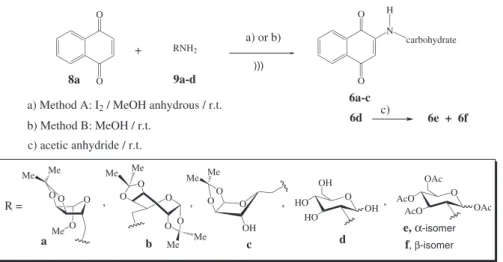
were prepared from their corresponding commercially reagents D-ribose, D-xylose and D-galactose by using known methods of carbohydrate protection and derivatization.35-37 The ultrasound-accelerated 1 , 4 - a d d i t i o n o f a m i n o c a r b o h y d r a t e s 9 a-c t o 1,4-naphthoquinone (8a) was irst carried out in the presence of iodine at room temperature, following the procedure described in the literature27 (Scheme 1, method A). The novel aminonaphthoquinones 6a-c were puriied by lash column chromatography using 50% n-hexane/ ethyl acetate as eluent. The yields of these reactions are listed in Table 1. The reaction of D-glucosamine hydrochloride 9d using method A failed to produce the compound 6d. Thus, the reaction under ultrasound irradiation was also investigated in the absence of iodine (Scheme 1, method B). This method led to better yields of the aminonaphthoquinones 6a-c, as shown in the Table 1. In this case, the 1,4-addition reaction between naphthoquinone 8a and D-glucosamine hydrochloride
9d resulted in the compound 6d, as a mixture of two diastereoisomers, α:β (1:1) in 40% yield. The treatment of this mixture with acetic anhydride in pyridine in excess produced the desired tetraacetate derivative in 60% yield as a mixture of anomers (3:1), being 6e the major isomer. The yields of the quinones 6a-d were dependent on the structure of the aminocarbohydrates
9a-d in question. The reactions worked very well with primary amines 9a-c, affording the corresponding coupling products in good yields, while more hindered amine, e.g., 9d, led to the product 6d in moderate yield. The characterization of the aminonaphthoquinone structures 6a-c and 6e was performed by using one- and two-dimensional NMR techniques and by HR ESI MS. The preferential conformations of the carbohydrates were assigned based upon the proton coupling constants (J) of furan or pyran ring, and by chemical shift comparison with previous data reported in the literature for analogous carbohydrates.38-41
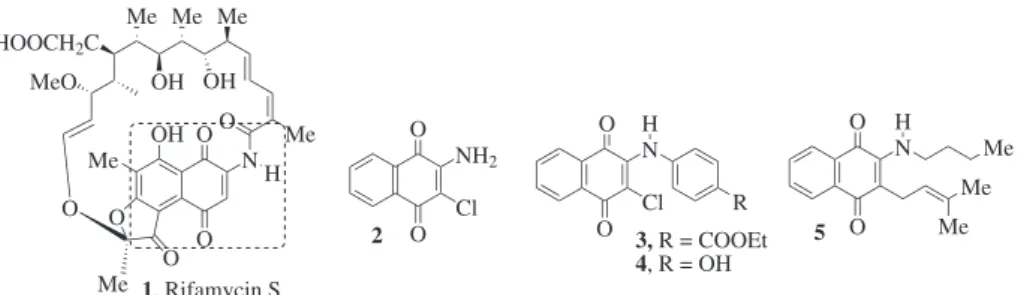
The 1H NMR spectrum of compound 6a showed the anomeric proton (H-1’) as a singlet at d 4.98. The protons H-2’ and H-3’ appeared as doublets at d 4.59 Figure 1. Some examples of bioactive products with the aminonaphthoquinone moiety.
O
O N O
Me OH
O
O Me
Me
Me
OH Me
OH Me HOOCH2C
MeO
H
O
1, Rifamycin S
2
O
O N H
Me
5 O
O NH2
Cl
O
O N
Cl H
3, R = COOEt 4, R = OH
R
(JH-2’, H-3’ = 6.1 Hz) and d 4.57 (JH-3’, H-2’ = 6.1 Hz), respectively. The protons H-4’ and H-5’ were identiied as multiplets at d 4.41-4.45 and 3.16-3.29, respectively. The absence of vicinal coupling indicates a trans relationship between protons H-1’ and H-2’ and the β-anomeric coniguration for the carbohydrate.41 The envelope conformations OE and 4E for compounds 6a and
6c, respectively, were established on the basis of X-ray crystallographic data of 5-modiied analogous of methyl 2,3-O-isopropylidene-β-ribofuranoside42 and 5-deoxy-1,2-O-isopropylidene-α-D-xylofuranose.43
The twist-boat conformation of the D-galactose ring in
6b was conirmed by the 1H-1H vicinal coupling constants values JH-1’,H-2’, JH-2’,H-3’, JH-3’,H-4’ and JH-4’,H-5’ (5.0, 2.4, 8.0 and 1.5 Hz, respectively) of the ring protons.38
The α:β ratio of D-glucosamine derivatives 6e and
6f was determined by the areas of the H-1’ peaks of the respective anomers in the 1H NMR spectra. The α-coniguration at position C-1’ of the major isomer 6e
is supported by the small coupling constant between H-1’ and H-2’ (d, JH-1’, H-2’ = 4.0 Hz). The structures of
the two possible chair conformations (4C-1 and 1C-4) of the α-pyranose form are shown in Figure 2. The large vicinal coupling constants for the protons 3J
H-2’, H-3’ and 3J
H-3’, H-4’ (10.0 and 9.5 Hz, respectively) are in agreement with trans-diaxial arrangements for the protons H2’-H3’ and H3’-H4’, suggesting a 4C-1 conformation for the pyran ring.
The use of 2-methoxy-3-(3-methyl-2-butenyl)-1,4-naphthoquinone (8b) (2-methoxylapachol ) in ultrasound-accelerated reaction (Scheme 2) with aminocarbohydrates
9a-c was also studied. The novel sugar-lapachol derivatives 7a-c were prepared in moderated yields by nucleophilic substitution reaction of 8b with amines 9a-c
(Table 1).
For comparison purposes, the reactions of amine 9a
with naphthoquinone 8a or methoxylapachol 8b were carried out under conventional heating. In both cases, no conversion into products was observed after a 2 h reaction, indicating that the ultrasound irradiation is essential for the activation and performing of these coupling reactions. The effects of sonication on reactions can be related to high temperature and pressure resulting from acoustic cavitation.44
The structures proposed for compounds 7a, 7b and 7c
are supported by their HR ESI MS and NMR spectroscopic data (1H, APT, HETCOR 1J
CH and nJ
CH, n = 2,3). Table 1. Aminonaphthoquinones 6a-d and 7a-c reaction yields
Quinones carbohydrates Products Methodsa
A Yield % B Yield %
8a 9a 6a 63 73
8a 9b 6b 51 70
8a 9c 6c 68 75
8a 9d 6d - 40
8b 9a 7a - 20
8b 9b 7b - 27
8b 9c 7c - 37
aMethod A: I
2 / MeOH anhydrous / r.t.; Method B: MeOH / r.t..
Figure 2. Two possible conformations of pyranose ring of 6e.
Scheme 1. Synthesis of novel 2-aminonaphthoquinones 6a-f.
O
OH O O Me Me 9a-d
+ RNH2
O O
O O
N H
carbohydrate
8a
6d
O HO
HO OH
OH
R = , ,
b c
O O
O O O Me
Me Me
Me d
6e + 6f
O AcO
AcO OAc
e, α-isomer
, a) or b)
c) a)Method A: I2 / MeOH anhydrous / r.t.
b) Method B: MeOH / r.t.
6a-c
, c) acetic anhydride / r.t.
OAc
f, β-isomer a
O O O O
Me Me Me
Experimental
Chemical reagents and all solvents used in this study were purchased from Merck AG (Darmstadt, Germany) and VETEC LTDA. The synthesis of new aminonaphthoquinones
6a-d and 7a-c was performed in an ultrasonic bath (40 KHz) model USC 1400, ultrasonic cleaner, UNIQUE. Melting points were determined with a Fisher-Johns instrument and are uncorrected. Infrared (IR) spectra were recorded on Perkin-Elmer FT-IR model 1600 spectrophotometer, in KBr pellets. NMR spectra, unless otherwise stated, were obtained in deuterated CDCl3 using a Varian Unity Plus 300 MHz spectrometer. Chemical shifts (d) are expressed in ppm and the coupling constants (J) in Hertz. High-resolution electrospray ionization mass spectrometry (HR ESI MS) was performed in positive ion mode on a Waters-Micromass Q-Tof Micro instrument. The progress of all reactions was monitored by TLC performed on 2.0 cm × 6.0 cm aluminum sheets precoated with silica gel 60 (HF-254, E. Merck) to a thickness of 0.25 mm. The developed chromatograms were viewed under ultraviolet light at 254 nm. Merck silica gel (60-200 mesh) was used for column chromatography.
Synthesis
General procedure for the preparation of the novel aminonaphthoquinones 6a-d and 7a-c
A solution of naphthoquinone 8a or 8b (0.5 mmol) and aminocarbohydrate 9 (0.5 mmol) in methanol (MeOH) (2 mL) was sonicated for 2 h at r.t.. The solvent was removed under reduced pressure. The residue was puriied by lash column chromatography (gradient elution, 10-30% AcOEt in hexane) to afford the desired compounds 6a-c and 7a-c.
2-(Methyl-5’-deoxy-2’,3’-O-isopropylidene-β-
D-ribofuranosid-5’-yl)-amino-1,4- naphthoquinone, 6a The reaction between naphthoquinone 8a (158 mg,
1 mmol) and aminocarbohydrate 9a (101 mg, 0.5 mmol) yielded 6a (74 mg, 0.2 mmol, 73%) as a brown solid: mp 140-142 oC; IR (KBr) ν
max/cm
-1 3244 (N−H); 1683 and
1601 (C=O), 1567 (C=C); 1H NMR (300 MHz, CDCl 3)
d 1.25 (s, 3H, C(CH3)2), 1.42 (s, 3H, C(CH3)2), 3.16-3.29 (m, 2H, H-5’ and H-5’’), 3.34 (s, 3H, OCH3), 4.41-4.45 (m, 1H, H-4’), 4.57 (d, 1H, J 6.1, H-3’), 4.59 (d, 1H, J 6.1 Hz, H-2’), 4.98 (s, 1H, H-1’), 5.67 (s, 1H, H-3), 6.40 (dd, 1H, J 4.4 Hz, N−H), 7.54 (td, J 7.5 and 1.5 Hz, H-7), 7.65 (td, J 7.5 and 1.5 Hz, H-6), 7.98 (dd, J 7.9 and 1.5 Hz, H-8 ), 8.03 (dd, J 7.5 and 1.5 Hz, H-5); 13C NMR (75.0 MHz, DMSO-d6) d 24.8 [C(CH3)2], 26.3 [C(CH3)2], 45.3 (C-5’ and C-5’’), 55.3 (OCH3), 82.1 (C-3’), 84.3 (C-4’), 85.2 (C-2’), 101.3 (C-3), 109.5 (C-1’), 112.7 [C(CH3)2], 126.1 (C-5), 126.2 (C-8), 130.4 (C-8a), 132.0 (C-7), 133.4 (C-4a), 134.6 (C-6), 148.0 (C-2), 182.9 (C-1), 198.9 (C-4); HRMS (ESI) [M+Na]+ Found: 382.1256. Calc. for C
19H21NO6Na: 382.1261.
2-(6’-Deoxy-1’,2’:3’,4’-di-O-isopropylidene-
D-galactopyranos-6’-yl)-amino-1,4- naphthoquinone, 6b The reaction of naphthoquinone 8a (158 mg, 1 mmol) and aminocarbohydrate 9b (128 mg, 0.5 mmol) formed 6b
(90 mg, 0.22 mmol, 70%) as a brown solid: mp 60-62 oC; IR νmax/cm-1 1609 and 1678 (C=O), 1572 (C=C), 3379 (N−H); 1H NMR (300 MHz, DMSO-d
6) d 1.35 (s, 3H, C(CH3)2), 1.42 (s, 3H, C(CH3)2), 1.45 (s, 3H, C(CH3)2), 1.52 (s, 3H, C(CH3)2), 3.40-3.51 (m, 2H, H-6’ and H-6’’), 4.01-4.10 (m, 1H, H-5’), 4.25 (dd, 1H, J 8.0 and 1.5 Hz, H-4’), 4.34 (dd, 1H, J 5.0 and 2.4 Hz, H-2’), 4.73 (dd, 1H, J 8.0 and 2.4 Hz, H-3’), 5.56 (d, 1H, J 5.0 Hz, H-1’), 5.80 (s, 1H, H-3), 7.58 (dd, 1H, J 6.2 Hz, N−H), 7.61 (td, 1H, J 7.5 and 1.5 Hz, H-7), 7.72 (td, 1H, J 7.5 and 1.5 Hz, H-6), 8.04 (dd, 1H, J 7.5 and 1.5 Hz, H-8), 8.10 (dd, 1H, J 7.5 and 1.5 Hz, H-5); 13C NMR (75.0 MHz, DMSO-d
6) d 24.5 [C(CH3)2], 25.0 [C(CH3)2], 25.9 [C(CH3)2], 26.2 [C(CH3)2], 42.5 (C-6’ and C-(C-6’’), 64.7 (C-5’), 70.1 (C-2’), 70.5 (C-3’), 71.0 Scheme 2. Synthesis of 1,4-naphthoquinone derivatives 7a-c.
O
OH O O Me Me 9a-d
+ RNH2
O
O 8b
O
O N H
carbohydrate Me
Me MeOH / r. t.
OMe
Me
Me
R =
, ,
a b c
O O
O O O Me
Me Me
Me
7a-c
O O O O
Me
Me Me
(C-4’), 95.9 (C-1’), 100.2 (C-3), 108.3 [C(CH3)2], 108.9 [C(CH3)2], 125.6 (C-5), 126.2 (C-8), 130.5 (C-8a), 132.6 (C-7), 133.2 (C-4a), 135.2 (C-6), 148.7 (C-2), 181.7 (C-1 or C-4), 181.8 (C-1 or C-4); HRMS (ESI) [M+Na]+ Found: 438.1541. Calc. for C22H25NO7Na: 438.1523.
2-(5’-Deoxy-1’,2’-O-isopropylidene-D- xylofuranos-5’-yl)-amino-1,4- naphthoquinone, 6c
The reaction of naphthoquinone 8a (158 mg, 1 mmol) and aminocarbohydrate 9c (95 mg, 0.5 mmol) led to formation of 6c (72 mg, 0.2 mmol, 75%) as a brown solid: mp 160-163 oC; IR ν
max/cm
-1 1608 and 1679 (C=O), 1566
(C=C), 3390 (N−H); 1H NMR (300 MHz, DMSO-d 6) d 1.33 (s, 3H, C(CH3)2), 1.51 (s, 3H, C(CH3)2), 3.43-3.61 (m, 2H, H-5’ and H-5’’), 4.16 (dd, 1H, J 4.8 and 2.9 Hz, H-3’), 4.36-4.42 (m, 1H, H-4’), 4.56 (d, 1H, J 4.0 Hz, H-2’), 5.62 (d, 1 H, J 4.0 Hz, OH), 5.89 (s, 1H, H-3), 5.97 (d, 1 H, J 4.0 Hz, H-1’), 7.60 (dd, 1H, J 6.0 and 6.2 Hz, N−H), 7.85 (td, 1H, J 7.5 and 1.5 Hz, H-7), 7.95 (td, 1H, J 7.5 and 1.5 Hz, H-6), 8.06 (dd, 1H, J 7.5 and 1.5 Hz, H-8), 8.10 (dd, 1H, J 7.5 and 1.5 Hz, H-5); 13C NMR (75.0 MHz, DMSO-d6) d 26.1 [C(CH3)2], 26.7 [C(CH3)2], 41.1 (C-5’ and C-5”), 73.9 (C-3’), 77.8 (C-4’), 85.0 (C-2’), 99.7 (C-3), 104.4 (C-1’), 110.8 [C(CH3)2], 125.5 (C-5), 126.0 (C-8), 130.4 (C-8a), 132.4 (C-7), 133.0 (C-4a), 135.0 (C-6), 148.8 (C-2), 181.6 (C-1 or C-4), 181.7 (C-1 or C-4); HRMS (ESI) [M+Na]+ Found: 368.1112. Calc. for C18H19NO6Na: 368.1104.
2-(Methyl-5’’-deoxy-2’’,3’’-O-isopropylidene-β-
D-ribofuranosid-5’’-yl)-amino- 3-(3’-methyl-buten-2’-yl)-1,4- naphthoquinone, 7a
The reaction of naphthoquinone 8b (158 mg, 1 mmol) and aminocarbohydrate 9a (101 mg, 0.5 mmol) formed
7a (43 mg, 0.1 mmol, 20%) as a brown oil; IR νmax/cm-1 1670 and 1732 (C=O), 1600 (C=C), 3343 (N−H); 1H NMR (500 MHz, DMSO-d6) d 1.35 (s, 3H, C(CH3)2), 1.48 (s, 3H, C(CH3)2), 1.75 (s, 3H, H-1’), 1.82 (s, 3H, H-5’), 3.35 (s, 3H, OCH3), 3.37 (d, 1H, J 6.0 Hz, H-4’), 3.69-3.72 (m, 2H, H-5’’ and H-5’’’), 4.42 (dd, 1H, J 7.0 and 6.5 Hz, H-4’’), 4.68 (d, 1H, J 6.0 Hz, H-3’’), 4.86 (d, 1H, J 6.0 Hz, H-2’’), 5.10 (s, 1H, H-1’’), 5.14 (t, 1H, J 6.0 Hz, H-3’), 6.63 (dd, 1H, J 6.5 and 6.0 Hz, N−H), 7.83 (td, 1H, J 7.5 and 1.5 Hz, H-7), 7.91 (td, 1H, J 7.5 and 1.5 Hz, H-6), 8.04 (dd, 1H, J 7.5 and 1.5 Hz, H-8), 8.10 (dd, 1H, J 7.5 and 1.5 Hz, H-5); 13C NMR (125.0 MHz, DMSO-d
6) d 15.4 (C-5’), 20.3 (C-4’), 22.1 [C(CH3)2], 22.9 (C-1’), 23.7 [C(CH3)2], 44.6 (C-5’’), 51.9 (OCH3), 78.9 (C-2’’), 82.1 (C-3’’), 82.5 (C-4’’), 106.4 (C-1’’), 109.1 [C(CH3)2], 112.9 (C-3), 119.9 (C-3’), 123.0 (C-5) or (C-8), 123.2 (C-5) or (C-8), 127.7 4a), 129.3 8a), 130.0 2’), 132.0 6), 143.4
(C-2), 179.1 (C-4), 180.0 (C-1); HRMS (ESI) [M+Na]+ Found: 450.1915. Calc. for C24H29NO6Na: 450.1818.
2-(6’’-Deoxy-1’’,2’’:3’’,4’’-di-O-isopropylidene-D- galacto-pyranos-6’’-yl)-amino-3-(3’-methyl-buten-2’-yl)-1,4- naphthoquinone, 7b
The reaction of naphthoquinone 8b (158 mg, 1 mmol) and aminocarbohydrate 9b (128 mg, 0.5 mmol) formed 7b
(77 mg, 0.16 mmol, 32%) as brown oil; IR νmax/cm-1 1600 and 1668 (C=O), 1570 (C=C), 3347 (N−H); 1H NMR (500 MHz, DMSO-d6) d 1.21 (s, 3H, C(CH3)2), 1.23 (s, 3H, C(CH3)2), 1.30 (s, 3H, C(CH3)2), 1.34 (s, 3H, C(CH3)2), 1.62 (H-1’), 1.69 (H-5’), 3.27 (dd, 1H, J 7.0 Hz, H-4’), 3.60 (dd, 1H, J 14.0 and 8.0 Hz, H-6’’), 3.72 (dd, 1H, J 14.0 and 4.0 Hz, H-6’’’), 3.84-3.85 (m, 1H, H-5”), 4.19 (dd, 1H, J 8.0 and 1.5 Hz, H-4’’), 4.30 (dd, 1H, J 4.5 and 2.5 Hz, H-2’’), 4.58 (dd, 1H, J 8.0 and 2.5 Hz, H-3’’), 5.02-5.04 (m, 1H, H-3’), 5.42 (d, 1H, J 5.0 Hz, H-1’’), 6.36 (dd, 1H, J 6.5 and 6.0 Hz, N−H), 7.69 (td, 1H, J 7.7 and 1.5 Hz, H-7), 7.77 (td, 1H, J 7.5 and 1.5 Hz, H-6), 7.90 (dd, 1H, J 7.8 and 1.5 Hz, H-8), 7.91 (dd, 1H, J 7.5 and 1.5 Hz, H-5); 13C NMR (125.0 MHz, DMSO-d6) d 18.20 (C-5’), 23.0 (C-4’), 24.4 [C(CH3)2], 25.0 [C(CH3)2], 25.6 (C-1’), 25.8 [C(CH3)2], 26.1 [C(CH3)2], 44.9 (C-6’’ and C-6’”), 66.9 (C-5’’), 70.1 (C-2’’), 70.5 (C-3’’), 71.0 (C-4’’), 95.9 (C-1’’), 108.2 [C(CH3)2], 108.9 [C(CH3)2], 115.8 (C-3), 122.5 (C-3’), 125.6 (C-8), 125.9 (C-5), 130.6 (C-4a), 131.5 (C-8a), 132.7 (C-7), 134.7 (C-6), 146.9 (C-2), 181.8 (C-4), 182.8 (C-1).
2-(5’’’-Deoxy-1’’’,2’’’-O-isopropylidene-D- xylofuranos-5’’’yl)-amino-3-(3’-methyl-buten-2’-yl)-1,4- naphtho-quinone, 7c
The reaction of naphthoquinone 8b (158 mg, 1 mmol) of aminocarbohydrate 9c (95 mg, 0.5 mmol) led to formation of 7c (74 mg, 0.18 mmol, 37%) as a brown oil; IR νmax/ cm-1 1600 and 1670 (C=O), 1600 (C=C), 3343 (N−H), 3400-3500 (OH); 1H NMR (500 MHz, DMSO-d
(C-8), 123.2 (C-5), 129.3 (C-4a), 129.8 (C-7), 130.0 (C-8a), 132.1 (C-6), 143.4 (C-2), 181.9 (C-4), 183.0 (C-1); HRMS (ESI) [M+Na]+ Found: 436.1750. Calc. for C
23H27NO6Na: 436.1730.
2-(2’-Deoxy-D-glucopyranos-2’-yl)-amino-1,4- naphtho-quinone, 6d
The reaction of naphthoquinone 7a (316 mg, 2 mmol) and aminocarbohydrate 8d (384 mg, 1 mmol) led to formation of 2-(2’-deoxy-D-glucopyranos-2’-yl) amino-1,4-naphthoquinone 6d, as mixture of two diastereoisomers, α:β (1:1), in 40% yield.
2-(2’-Deoxy-1,3,4,6-tetra-O-acetyl-α-D- glucopyranos-2’-yl)-amino-1,4- naphthoquinone, 6e
Cold acetic anhydride (3.0 mL) was added to a stirred suspension of brown oil 6d (1,120 mg, 3.36 mmol) in anhydrous pyridine (5.4 mL) at 0 oC. The mixture was stirred at this temperature until dissolution was complete; it was then kept at room temperature for 12 h. The solution was poured into cold water (15 mL) and cooled for 1 h. The resulting solid was separated by iltration, washed with water, and dried over phosphorous pentoxide. The product was chromatographed on a silica gel column, using 50% n-hexane/ethyl acetate as mixture eluent, giving a brown solid in 60% yield as a mixture of anomers (3:1), 6e being the predominant isomer. IR νmax/cm-1 1610 (C=O), 1677 (C=O), 1750 (C=O), 1576 (C=C), 1221 (C−O), 3365 (N−H); 1H NMR (500 MHz, DMSO-d
6) d 1.37 (s, 3H, CH3C=O), 1.48 (s, 3H, CH3C=O), 1.77 (s, 3H, CH3C=O), 1.84 (s, 3H, CH3C=O); 4.13-4.17 (m, 1H, H-5’), 4.26-4.30 (m, 1H, H-6’ and H-6’’), 4.33 (dd, 1H, J 12.5 and 4.0 Hz, H-6’’), 4.52 (td, 1 H, J 10.0 and 3.5 Hz, H-2’), 5.29 (dd, 1 H, J 9.5 and 9.5 Hz, H-4’), 5.53 (dd, 1H, J 10.0 and 9.5 Hz, H-3’), 6.23 (d, 1H, J 4.0 Hz, H-1’), 6.33 (s, 1H, H-3), 6.56 (d, 1H, J 9.5 Hz, N−H), 7.87 (td, 1H, J 7.5 and 1.5 Hz, H-7), 7.96 (td, 1H, J 7.5 and 1.5 Hz, H-6), 8.06 (dd, 1H, J 7.5 and 1.5 Hz, H-8), 8.09 (dd, 1H, J 7.5 and 1.5 Hz, H-5); 13C NMR (125.0 MHz, DMSO-d
6) d 20.0 (CH3C=O), 20.5 (CH3C=O), 20.6 (CH3C=O), 20.7 (CH3C=O), 52.7 (C-2’), 61.5 (C-6’ and C-6”), 67.7 (C-4’), 69.4 (C-5’), 71.2 (C-3’), 89.1 (C-1’), 102.2 (C-3), 125.6 (C-8), 126.2 (C-5), 130.3 (C-8a), 132.7 (C-4a), 132.9 (C-7), 135.2 (C-6), 148.5 (C-2), 169.3 (CH3C=O), 169.5 (CH3C=O), 170.3 (CH3C=O), 170.5 (CH3C=O), 181.3 (C-1), 182.6 (C-4); HRMS (ESI) [M+Na]+ Found: 526.1317. Calcd for C24H25NO11Na: 526.1319.
Conclusions
We have developed a method for the synthesis of new series of substituted-2-aminonaphthoquinones 6a-d
and 7a-c by the reaction of 1,4-naphtoquinone (8a) or 2-methoxylapachol (8b) with different aminocarbohydrates
9a-d, under ultrasonic irradiation, which accelerate the 1,4-addition, in the absence of iodine (method B) being a faster and cleaner direct access for the synthesis of new sugar-based quinone compounds. Further efforts are being dedicated towards the evaluation of the biological proiles of this novel type of 1,4-naphthoquinone derivatives.
Acknowledgments
This work was supported by the Brazilian agency FAPERJ-PRONEX. Fellowship granted to UFF, by FAPERJ (E-26/171.512/2006) is gratefully acknowledged. We would like to thank the Universidade Federal do Rio de Janeiro, Departamento de Química Orgânica, LABEM - Laboratório Multiusuário de Espectrometria de Massas for the mass spectra.
References
1. Mahapatra, A.; Mativandlela, S. P. N.; Binneman, B.; Fourie, P. B.; Hamilton, C. J.; Meyer, J. J. M.; van der Kooy, F.; Houghton, P.; Lall, N.; Bioorg. Med. Chem.2007, 15, 7638.
2. Da Silva, M. N.; Ferreira, V. F.; De Souza, M. C. B. V.; Quim. Nova2003, 26, 407.
3. Suh, M.-E.; Parka, S.-Y.; Lee, C.-O.; Bioorg. Med. Chem.2001, 9, 2979; Da Silva, F. C.; Ferreira, S. B.; Kaiser, C. R.; Pinto, A. C.; Ferreira, V. F.; J. Braz. Chem. Soc.2009, 20, 1478. 4. Francisco, A. I.; Casellato, A.; Neves, A. P.; Carneiro, J. W. M.;
Vargas, M. D.; Visentin, L. C.; Magalhães, A.; Câmara, C. A.; Pessoa, C.; Costa-Lotufo, L. V.; Filho, J. D. B. M.; Moraes, M. O.; J. Braz. Chem. Soc.2010, 21, 169.
5. Boudalis, A. K.; Policand, X.; Sournia-Saquet, A.; Donnadieu, B.; Tuchagues, J.-P.; Inorg. Chim. Acta2008, 361, 1681. 6. Tonholo, J.; Freitas, L. R.; De Abreu, F. C.; Azevedo, D. C.;
Zani, C. L.; De Oliveira, A. B.; Goulart, M. O. F.; J. Braz. Chem. Soc.1998, 9, 163.
7. Da Silva, M. N.; Ferreira, S. B.; Jorqueira, A.; De Souza, M. C. B. V.; Pinto, A. V.; Kaiser, C. R.; Ferreira, V. F.; Tetrahedron Lett.2007, 48, 6171.
8. De Moura, K. C. G.; Emery, F. S.; Neves-Pinto, C.; Pinto, M. C. F. R.; Dantas, A. P.; Salomão, K.; De Castro, S. L.; Pinto, A. V.; J. Braz. Chem. Soc.2001, 12, 325.
9. Tandon, V. K.; Maurya, H. K.; Mishra, N. N.; Shukla, P. K.; Eur. J. Med. Chem.2009, 44, 3130.
10. Camara, C. A.; Pinto, A. C.; Rosa, M. A.; Vargas, M. D.; Tetrahedron2001, 57, 9569.
11. Asche, C.; Mini-Rev. Med. Chem.2005, 5, 449.
Costa-Lotufo, L. V.; Montenegro, R. C.; Moraes, M. O.; Ferreira, V. F.; Bioorg. Med. Chem.2007, 15, 7035; Neves, A. P.; Barbosa, C. C.; Greco, S. J.; Vargas, M. D.; Visentin, L. C.; Pinheiro, C. B.; Mangrich, A. S.; Barbosa, J. P.; da Costa, G. L.; J. Braz. Chem. Soc.2009, 20, 712.
13. Kapadia, G. J.; Azuine, M. A.; Balasubramanian, V.; Sridhar, R.; Pharmacol. Res.2001, 43, 363.
14. Yuk, D.-Y.; Ryu, C.-K.; Hong, J.-T.; Chung, K.-H.; Kang, W.-S.; Kim, Y.; Yoo, H.-S.; Lee, M.-K.; Lee, C.-K.; Yun, Y.-P.; Biochem. Pharmacol.2000, 60, 1001.
15. Silva, T. M. S.; Camara, C. A.; Barbosa, T. P.; Soares, A. Z.; Cunha, L. C.; Pinto, A. C.; Vargas, M. D.; Bioorg. Med. Chem.
2005, 13, 193.
16. Oliveira, C. G. T.; Miranda, F. F.; Ferreira, V. F.; Freitas, C. C.; Rabello, R. F.; Carballido, J. M.; Corrêa, L. C. D.; J. Braz. Chem. Soc.2001, 12, 339.
17. Fieser, L. F.; Hartwell, J. L.; J. Am. Chem. Soc.1935, 57, 1482. 18. Couladouros, E. A.; Plyta, Z. F.; Haroutounian, S. A.; J. Org.
Chem.1997, 62, 6.
19. Cunha, A. S.; Lima, E. L. S.; Pinto, A. C.; Esteves-Souza, A.; Echevarria, A.; Câmara, C. A.; Vargas, M. D.; Torres, J. C.; J. Braz. Chem. Soc.2006, 17, 439.
20. Francisco, A. I.; Vargas, M. D.; Carneiro, J. W. M.; Lanznaster, M.; Torres, J. C.; Câmara, C. A.; Pinto, A. C.; J. Mol. Struct.
2008, 891, 228.
21. Win, T.; Bittner, S.; Tetrahedron Lett.2005, 46, 3229. 22. Illos, R. A.; Harlev, E.; Bittner; S.; Tetrahedron Lett.2005, 46,
8427.
23. Tapia, R. A.; Cantuarias, L.; Cuéllar, M.; Villena, J.; J. Braz. Chem. Soc.2009, 20, 999.
24. Valderrama, J. A.; Ibacache, J. A.; Arancibia, V.; Rodriguez, J.; Theoduloz, C.; Bioorg. Med. Chem.2009, 17, 2894.
25. Tandon, V. K.; Maurya, H. K.; Tetrahedron Lett.2009, 50, 5896. 26. Couladouros, E. A.; Plyta, Z. F.; Papageorgiou, V. P.; J. Org.
Chem. 1996, 61, 3031.
27. Liu, B.; Ji, S.-J.; Synth. Commun.2008, 38, 1201.
28. Niedermeyer, T. H. J.; Lalk, M.; J. Mol. Catal. B: Enzym.2007, 45, 113.
29. Bittner, S.; Meenakshi, C.; Temtsin, G.; Tetrahedron2001, 57, 7423.
30. Messori, L.; Temperini, C.; Piccioli, F.; Animati, F.; Di Bugn, C.; Orioli, P.; Bioorg. Med. Chem.2001, 9, 1815.
31. Hauser, F. M.; Hu; X.; Org. Lett.2002, 4, 977.
32. Molina-Ruiz, R.; Saíz-Urra, L.; Rodríguez-Borges, J. E.; Pérez-Castillo, Y.; González, M. P.; García-Mera, X.; Cordeiro, M. N. D. S.; Bioorg. Med. Chem.2009, 17, 537.
33. Pereira, L. O. R.; Cunha, A. C.; Souza, M. C. B. V.; Ferreira, V. F.; J. Braz. Chem. Soc.2002, 13, 368.
34. Santos, F. C.; Abreu, P.; Castro, H. C.; Paixão, I. C. P. P.; Cirne-Santos, C. C.; Giongo, V.; Barbosa, J. E.; Simonetti, B. R.; Garrido, V.; Bou-Habib, D. C.; Silva, D. O.; Batalha, P. N.; Temerozo, J. R.; De Souza, T. M.; Nogueira, C. M.; Cunha, A. C.; Rodrigues, C. R.; Ferreira, V. F.; Souza, M. C. B. V.; Bioorg. Med. Chem.2009, 17, 5476.
35. Secrist, J. A.; Logue, M. W.; J. Org. Chem.1972, 37, 335. 36. Sharma, G. V. M.; Gopinath, T.; Tetrahedron Lett.2001, 42,
6183.
37. Yang, J.; Fu, X.; Jia, Q.; Shen, J.; Biggins, J. B.; Jiang, J.; Zhao, J.; Schmidt, J. J.; Wang, P. G.; Thorson, J. S.; Org. Lett.2003, 5, 2223.
38. Roslund, M. U.; Klika, K. D.; Lettila, R. L.; Tahtinen, P.; Sillanpaa, R.; Leino, R.; J. Org. Chem.2004, 69, 18. 39. Liberek, B.; Melcer, A.; Osuch, A.; Wakiec, R. ; Milewskib, S.;
Wisniewskia, A.; Carbohydr. Res.2005, 340, 1876.
40. Medgyes, A.; Farkas, E.; Lipták, A.; Pozsgay, V.; Tetrahedron
1997, 53, 4159.
41. Arakawa, K.; Miyasaka, T.; Hamamichi, N.; Chem. Lett.1976, 1119.
42. Crystallographic data (excluding structure factors) for the structures in this paper have been deposited in the Cambridge Crystallographic Data Centre as supplementary publication number CCDC 762331. Copies of the data can be obtained, free of charge, via www.ccdc.cam.ac.uk/conts/retrieving.html or from the Cambridge Crystallographic Data Centre, CCDC, 12 Union Road, Cambridge CB2 1EZ, UK; fax: +44 1223 336033. E-mail: [email protected].
43. Horton, D.; Levine, B. R.; Norris, P.; Luck, R. L.; Silverton, J. V.; Acta Crystallogr., Sect. C: Cryst. Struct. Commun.1997, 53, 120.
44. Mason, T. J.; Chem. Soc. Rev. 1997, 26, 443; Guo, W.-X.; Jin, H.-L.; Chen, J.-X.; Chen, F.; Ding, J.-C.; Wu, H.-Y.; J. Braz. Chem. Soc.2009, 20, 1674.