Short Report
Printed in Brazil - ©2013 Sociedade Brasileira de Química0103 - 5053 $6.00+0.00S
*e-mail: [email protected]
Electrochemical Behavior of Hydroquinone and Catechol at a
Silsesquioxane-Modified Carbon Paste Electrode
Paulo S. da Silva, Bianca C. Gasparini, Hérica A. Magosso and Almir Spinelli*
Grupo de Estudos de Processos Eletroquímicos e Eletroanalíticos, Departamento de Química, Universidade Federal de Santa Catarina, 88040-900 Florianópolis-SC, Brazil
Um eletrodo de pasta de carbono modificado com o polímero cloreto de 3-n-propil-4-picolina silsesquioxano foi testado como sensor para isômeros do di-hidroxibenzeno. O sensor apresentou desempenho excelente para a determinação eletroanalítica simultânea de hidroquinona e catecol. As curvas de calibração obtidas foram lineares na faixa de concentração de 10,0 a 450,0 µmol L−1
para a hidroquinona (r = 0,998) e de 10,0 a 300,0 µmol L−1 para o catecol (r = 0,997). O limite de
detecção visual foi de 10,0 µmol L−1 para ambos os isômeros.
A carbon paste electrode modified with 3-n-propyl-4-picolinium chloride silsesquioxane polymer was tested as a sensor for dihydroxybenzene isomers. The sensor showed excellent performance for simultaneous electroanalytical determination of hydroquinone and catechol. The calibration curves obtained were linear in the concentration range of 10.0 to 450.0 µmol L1 for
hydroquinone (r = 0.998) and 10.0 to 300.0 µmol L−1 for catechol (r = 0.997). The visual limit of
detection was 10.0 µmol L−1 for both isomers.
Keywords: modified carbon paste electrode, silsesquioxane, dihydroxybenzenes,
electroanalysis
Introduction
In recent years, several organic-inorganic hybrid materials modified with organofunctionalized silica with desirable properties for several applications have been reported.1,2
These materials combine the physical properties of glass, such as thermal stability and rigidity, with the exchange properties of the organofunctional group. Among the hybrid materials, the organo-bridged silsesquioxanes have been the subject of great interest due to their increasing potential for technological applications in multiple fields, such as heterogeneous catalysis, protective coatings, absorbents and optical devices.3-5 The silsesquioxane derivatives containing
a pyridinium or a picolinium cationic group have been tested in the development of chemically-modified electrodes.4,6-10
While the pyridinium-derivative silsesquioxane polymer has been extensively used to build sensors,7-9,11 the
picolinium-derivative silsesquioxane polymer has been little explored for this purpose6,10 and its use for the determination
of organic compounds has apparently not been reported in the literature.
Hydroquinone (HQ) and catechol (CC) are two important dihydroxybenzene isomers widely used as raw materials in the chemical and pharmaceutical industries.12,13
However, HQ and CC are highly toxic and even at very low concentrations can be harmful to animals and plants.14
Therefore, sensitive and selective analytical methods are necessary for their determination. Several methods12-19 have
been used for dihydroxybenzene isomers determination, including chromatography, spectrophotometry, pH-based flow injection analysis, synchronous fluorescence and voltammetry. Herein, it was show for the first time, the use of cyclic and differential pulse voltammetry associated with a simple and sensitive electrode based on a 3-n-propyl-4-picolinium chloride silsesquioxane polymer-modified carbon paste electrode (Si4Pic+Cl−/CPE)
for electrochemical studies and simultaneous determination of HQ and CC.
Experimental
Millipore (Bedford, MA, USA) system. Si4Pic+Cl− was
prepared and characterized according to the procedure described elsewhere.3 Solutions of 1.0 mmol L−1 HQ and
CC were freshly prepared. As supporting electrolyte, 0.1 mol L−1 phosphate buffer solution (PBS) at different
pH values was used. The pH value was adjusted with 1.0 mol L−1 NaOH or HCl.
The modified carbon paste electrode (CPE) was prepared by mixing 60 mg of Si4Pic+Cl− (40%, m/m) and
90 mg of graphite powder (60%, m/m) in an agate mortar for 20 min in order to obtain a homogeneous uniform mixture. In the next step, 4 drops of Nujol® were added, and mixing
was applied for a further 20 min. The paste obtained was placed in a 1.0 mL plastic syringe and a carbon rod of 0.5 cm diameter, connected to a copper wire, was inserted to obtain the electrical contact. Si4Pic+Cl−/CPE was stored
in the supporting electrolyte (pH 7.0) at room temperature when not in use.
The electrochemical experiments were carried out using a potentiostat/galvanostat (Autolab model PGSTAT101) coupled to a personal computer with specific data acquisition software installed (Nova 1.7). A conventional three-electrode cell was employed with Si4Pic+Cl−/CPE as the working
electrode, a platinum sheet as the auxiliary electrode and an Ag/AgCl (3.0 mol L−1 KCl) as the reference electrode. Cyclic
voltammetry (CV) and differential pulse voltammetry (DPV) were performed between −0.2 and +0.7 V. In addition, for the reestablishment of the initial condition of the electrode surface, ten successive cyclic voltammograms were obtained at between −2.0 and +2.0 V at 300 mV s−1 in PBS (pH 7.0)
after each measurement. All experiments were carried out at 25 ± 2 ºC.
Results and Discussion
Enhanced sensitivity to the CC oxidation was obtained when Si4Pic+Cl−/CPE was submitted to a conditioning step.
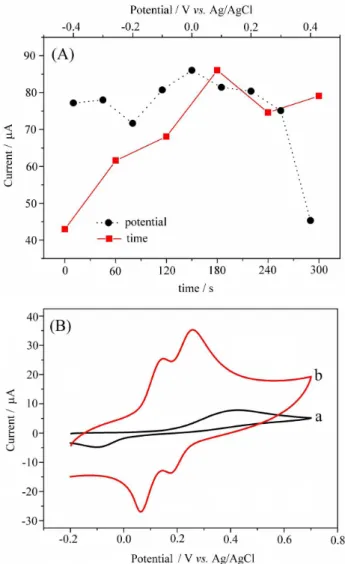
Figure 1A shows the effect of the conditioning time and potential on the oxidation current of 0.5 mmol L−1 CC in PBS
(pH 7.0) obtained by CV. As can be seen, the highest currents were achieved when the potential and time were 0.0 V and 180 s, respectively. The effect of the conditioning step on the electrochemical performance of Si4Pic+Cl−/CPE has
been attributed to the strong electrostatic interactions that the polymer network exerts on the dihydroxybenzene isomer.8,9,11
The conditioning step was applied in all experiments. CVs of a mixture containing 0.5 mmol L–1 HQ and
CC in PBS (pH 7.0) at CPE and Si4Pic+Cl−/CPE are
shown in Figure 1B.At CPE (Figure 1B-a), a large broad peak centered at +0.420 V is observed for the oxidation reaction, while a narrower peak centered at −0.100 V
is observed for the reduction reaction. This behavior characterizes the overlapping of the oxidation and reduction peaks of HQ and CC. Also, the peak separation (∆Ep)
of 520 mV indicates the irreversibility of the reactions. On the other hand, at Si4Pic+Cl−/CPE (Figure 1B-b),
two pairs of well-defined peaks are apparent. The peaks at +0.145 and +0.259 V correspond to the oxidation of HQ and CC, respectively. The reduction peaks are observed at +0.062 V (HQ) and +0.172 V (CC). Additionally, values of ∆E
p = 83 mV for HQ and ∆Ep = 87 mV for CC and,
more importantly, a separation of 114 mV between the oxidation peaks of HQ and CC, which is large enough for the simultaneous determination of the dihydroxybenzene isomers, were determined. This behavior can be attributed to the increased catalytic activity promoted by Si4Pic+Cl−
present in the carbon paste, which improves the kinetics of the electrochemical process of HQ and CC.
Figure 1. Effect of the conditioning time (0, 60, 120, 180, 240 and 300 s) and potential (−0.4, −0.3, −0.2, −0.1, 0.0, +0.1, +0.2, +0.3 and +0.4 V) on the oxidation current of 0.5 mmol L1 CC at Si4Pic+Cl−/CPE in 0.1 mol L−1
PBS (pH 7.0) (A), and CVs of 0.5 mmol L−1 HQ and CC at (a) CPE and
The effect of the solution pH on the electrochemical response of HQ and CC at Si4Pic+Cl−/CPE was investigated
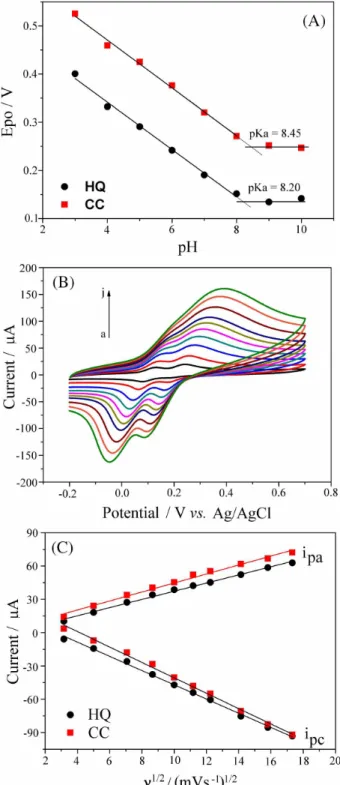
over the range of 3.0 to 10.0. For HQ, the value for the oxidation peak current increased until pH 9.0 and then decreased rapidly. For CC, the maximum current was observed at pH 7.0 (data not shown). In addition, the values for the oxidation peak potential (Epo) for both isomers
shifted to less positive values as the solution pH increased from 3.0 to 8.0, remaining almost constant at pH values above 8.0 (Figure 2A). The linear regression equation for HQ was Epo/ V = 0.538 − 0.0491 pH (R = 0.9964), while
for CC it was Epo/ V = 0.669 – 0.0496 pH (R = 0.9971),
indicating that the same number of protons and electrons are involved in the redox reactions of the two dihydroxybenzene isomers.18 According to the literature, two electrons and two
protons are involved in the oxidation process for both HQ and CC.17 The intersections of the straight lines observed
in Figure 2A are consistent with the pKa values for HQ and CC. The values obtained in this study (8.2 for HQ and 8.5 for CC) are slightly lower than those of 9.8 and 9.4, respectively, reported in the literature.16 The difference
observed can be attributed to the slow electron transfer reaction at the Si4Pic+Cl−/CPE surface, despite of the
modified electrode to show a catalytic effect much higher than the carbon paste. As earlier demonstrated, the peak separation was ∆E
p = 83 mV for HQ and ∆Ep = 87 mV for
CC, different of 56.9 mV, the expected value for (rapid) reversible electrochemical reactions. Based on the results described above, pH 7.0 was selected for the simultaneous determination of HQ and CC. The two dihydroxybenzene isomers are in their protonated form at this solution pH.14
The influence of the scan rate (ν) on CVs obtained for the
HQ/CC mixture at Si4Pic+Cl−/CPE is shown in Figure 2B.
For each dihydroxybenzene isomer, a pair of redox peaks is observed for scan rates of up to 150 mV s−1. For scan rates
higher than 150 mV s−1, the oxidation peak for HQ is less
evident. Therefore, to investigate the relationship between peak currents and scan rate, CVs were obtained separately for HQ and CC (data not shown). As shown in Figure 2C, the anodic (ipa) and cathodic (ipc) peak currents for both
organic compounds were linearly proportional to the square root of the scan rate (ν1/2) within the range of 10-300 mV s−1.
The corresponding linear regression equations are ipa/µA = 0.4213 + 3.6826 ν
1/2/(mV s−1)1/2 (R = 0.9974)
and ipc/µA = 17.084 – 6.4040 ν1/2/(mV s−1)1/2 (R = 0.9986)
for HQ, and ipa/µA = 4.2035 + 4.0483 ν
1/2/(mV s−1)1/2
(R = 0.9950) and ipc/µA = 28.643 – 6.9318 ν1/2/(mV s−1)1/2
(R = 0.9979) for CC. These results indicate that the redox reactions of HQ and CC at Si4Pic+Cl−/CPE are diffusion
controlled processes. Furthermore, the oxidation (Epo) and
reduction (Epr) peak potentials shift to more positive and
negative values, respectively, with increasing scan rate, indicating a behavior typical of quasi-reversible reactions.
For the simultaneous determination of HQ and CC, DPV curves were recorded at different concentrations of one isomer while the concentration of the other isomer remained constant at 0.2 mmol L−1 (Figure 3). Two well defined peaks
Figure 2. Effect of the solution pH on Epo for 0.5 mmol L−1 HQ and
CC (A), CVs for 0.5 mmol L−1 HQ and CC in 0.1 mol L−1 PBS (pH 7.0)
at Si4Pic+Cl−/CPE, ν (a-j) = 10, 25, 50, 75, 100, 125,150, 200, 250 and 300 mV s−1 (B) and plot i
at +46 and +120 mV, corresponding to the oxidation of HQ and CC, respectively, were observed. On maintaining the concentration of CC constant (Figure 3A), the ipa of
HQ increased linearly with its concentration in the range of 10.0 to 450.0 µmol L−1. The linear regression equation
obtained for the calibration curve shown in the inset is ipa/A= 7.91 × 10⁻⁷ + 0.066 [HQ]/(mol L−1) (R = 0.998).
In addition, the ipa value for CC remained practically
unchanged indicating that CC does not interfere in the determination of HQ. Similarly, as shown in Figure 3B, the ipa value increases linearly with the CC concentration in the
range of 10.0 to 300.0 µmol L−1, with a linear regression
equation of ipa/A = 1.55 × 10⁻⁶ + 0.121 [CC]/(mol L−1)
(R = 0.997). Thus, it can likewise be concluded that HQ does not interfere in the determination of CC. The visual limit of detection for both isomers was assumed as 10 µmol L−1.
The relative standard deviation (RSD) of five successive detections of 50 µmol L−1 CC carried out with the
same Si4Pic+Cl−/CPE was 0.85%, indicating the good
repeatability of the results furnished by the same electrode. Additionally, three different Si4Pic+Cl−/CPEs were
independently prepared by the same procedure and an RSD value of less than 5.0% was obtained for the determination of 50 µmol L−1 CC, also indicating the good repeatability
for the electrode preparation procedure. The modified electrode was stored in the supporting electrolyte at room temperature for 30 days. After this period, the electrode was used to carry out the same measurements described above. The ipa value decreased by only 6% compared to
a freshly-prepared electrode, indicating good stability of Si4Pic+Cl−/CPE. Therefore, these results imply that
Si4Pic+Cl−/CPE can be applied to quantitatively analyze a
HQ/CC mixture without interference from one isomer in the determination of the other.
Conclusions
The electrochemical behavior of HQ and CC was investigated at a Si4Pic+Cl−/CPE electrode by CV and
DPV. Compared to the unmodified electrode (CPE), an improved reversibility and an enhanced current for the redox process involving HQ and CC were evidenced, which can be attributed to the performance of the silsesquioxane polymer. The DPV results identified two well-defined redox peaks for HQ and CC, and the separation between the peak potentials was large enough for the simultaneous determination of these compounds. The modified electrode exhibited good repeatability and stability and represents a promising sensor device for the simultaneous determination of dihydroxybenzene isomers.
Acknowledgements
The authors wish to thank the Brazilian government agencies, Brazilian Federal Agency for Support and Evaluation of Graduate Education (CAPES) and National Council for Technological and Scientific Development (CNPq) for fellowships and financial support.
References
1. Kanezashi, M.; Kawano, M.; Yoshioka, T.; Tsuru, T.; Ind. Eng. Chem. Res. 2012, 51, 949.
2. Moore, J. P.; Shumaker, J. A.; Houtz, M. D.; Sun, L. R.; Khramov, A. N.; Jones, J. G.; J. Sol-Gel Sci. Technol. 2012,
63, 168.
Figure 3. DPPVs of (a-l: 10, 25, 50, 75, 100, 150, 200, 250, 300, 350, 400 and 450 µmol L−1) HQ and 200 µmol L−1 CC (A); (a-i: 10, 25, 50,
75, 100, 150, 200, 250 and 300 µmol L−1) CC and 200 µmol L−1 HQ (B)
at Si4Py+Cl−/CPE in 0.1 mol L−1 PBS (pH 7.0). Step potential: 2.0 mV,
3. Magosso, H. A.; Fattori, N.; Kholin, Y. V.; Gushiken, Y.; J. Braz. Chem. Soc. 2009, 20, 744.
4. Gushikem, Y.; Benvenutti, E. V.; Kholin, Y. V.; Pure Appl. Chem. 2008, 80, 1593.
5. Magosso, H. A.; Panteleimonov, A. V.; Kholin, Y. V.; Gushikem, Y.;
J. Colloid Interface Sci. 2006, 303, 18.
6. Arguello, J.; Magosso, H. A.; Landers, R.; Pimentel, V. L.; Gushikem, Y.; Electrochim. Acta 2010, 56, 340.
7. de Jesus, C. G.; dos Santos, V.; Canestraro, C. D.; Zucolotto, V.; Fujiwara, S. T.; Gushikem, Y.; Wohnrath, K.; Pessoa, C. A.;
J. Nanosci. Nanotechnol. 2011, 11, 3499.
8. Fujiwara, S. T.; Gushikem, Y.; Pessoa, C. A.; Nakagaki, S.;
Electroanalysis 2005, 17, 783.
9. Fujiwara, S. T.; Pessoa, C. A.; Gushikem, Y.; Electrochim. Acta 2003, 48, 3625.
10. Magosso, H. A.; Luz, R. C. S.; Gushikem, Y.; Electroanalysis 2010, 22, 216.
11. Lucho, A. M. S.; Oliveira, E. C.; Pastore, H. O.; Gushikem, Y.;
J. Electroanal. Chem. 2004, 573, 55.
12. Zhao, D. M.; Zhang, X. H.; Feng, L. J.; Jia, L.; Wang, S. F.;
Colloids Surf., B 2009, 74, 317.
13. Zhang, Q.; Qu, Y. Y.; Zhang, X. W.; Zhou, J. T.; Wang, H. T.;
Biosens. Bioelectron. 2011, 26, 4362.
14. Ahammad, A. J. S.; Rahman, M. M.; Xu, G. R.; Kim, S.; Lee, J. J.; Electrochim. Acta 2011, 56, 5266.
15. Hu, X. F.; Li, J.; Wang, J. C.; Electrochem. Commun. 2012, 21, 73.
16. Yin, H. S.; Zhang, Q. M.; Zhou, Y. L.; Ma, Q. A.; Liu, T.; Zhu, L. S.; Ai, S. Y.; Electrochim. Acta 2011, 56, 2748.
17. Zhang, X.; Duan, S. O.; Xu, X. M.; Xu, S. A.; Zhou, C. L.;
Electrochim. Acta 2011, 56, 1981.
18. Liu, Z. M.; Wang, Z. L.; Cao, Y. Y.; Jing, Y. F.; Liu, Y. L.; Sens. Actuators, B. 2011, 157, 540.
19. Sun, X. Y.; Hu, S.; Li, L. F.; Xiang, J.; Sun, W.; J. Electroanal. Chem. 2011, 651, 94.
Submitted: October 5, 2012