Heritable Change Caused by Transient Transcription
Errors
Alasdair J. E. Gordon1., Dominik Satory1., Jennifer A. Halliday1
, Christophe Herman1,2*
1Department of Molecular and Human Genetics, Baylor College of Medicine, Houston, Texas, United States of America,2Department of Molecular Virology and Microbiology, Baylor College of Medicine, Houston, Texas, United States of America
Abstract
Transmission of cellular identity relies on the faithful transfer of information from the mother to the daughter cell. This process includes accurate replication of the DNA, but also the correct propagation of regulatory programs responsible for cellular identity. Errors in DNA replication (mutations) and protein conformation (prions) can trigger stable phenotypic changes and cause human disease, yet the ability of transient transcriptional errors to produce heritable phenotypic change (‘epimutations’) remains an open question. Here, we demonstrate that transcriptional errors made specifically in the mRNA encoding a transcription factor can promote heritable phenotypic change by reprogramming a transcriptional network, without altering DNA. We have harnessed the classical bistable switch in thelacoperon, a memory-module, to capture the consequences of transient transcription errors in livingEscherichia colicells. We engineered an error-prone transcription sequence (A9 run) in the gene encoding the lac repressor and show that this ‘slippery’ sequence directly increases epigenetic switching, not mutation in the cell population. Therefore, one altered transcript within a multi-generational series of many error-free transcripts can cause long-term phenotypic consequences. Thus, like DNA mutations, transcriptional epimutations can instigate heritable changes that increase phenotypic diversity, which drives both evolution and disease.
Citation:Gordon AJE, Satory D, Halliday JA, Herman C (2013) Heritable Change Caused by Transient Transcription Errors. PLoS Genet 9(6): e1003595. doi:10.1371/ journal.pgen.1003595
Editor:Josep Casadesu´s, Universidad de Sevilla, Spain
ReceivedJanuary 24, 2013;AcceptedMay 13, 2013;PublishedJune 27, 2013
Copyright:ß2013 Gordon et al. This is an open-access article distributed under the terms of the Creative Commons Attribution License, which permits unrestricted use, distribution, and reproduction in any medium, provided the original author and source are credited.
Funding:This work was funded by NIH (1R01GM088653) and NSF (MCB1022327). Support for the BCM Cytometry and Cell Sorting Core was funded by the NIH (NCRR grant S10RR024574, NIAID AI036211 and NCI P30CA125123). The funders had no role in study design, data collection and analysis, decision to publish, or preparation of the manuscript.
Competing Interests:The authors have declared that no competing interests exist.
* E-mail: [email protected]
.These authors contributed equally to this work.
Introduction
Stable phenotypic change is mostly associated with DNA alteration [1], the hardware of the cell, but rarely as the consequence of errors in the transmission of cellular genetic programs, the software of the cell [2,3]. Transcription factors play a critical role in establishing cellular programs and heritable cellular identity [4], as elegantly shown by somatic cell nuclear transfer [5] and more recently reprogramming of differentiated cells into pluripotent cells [6]. Among cellular genetics programs, bistable gene networks play an important role in cellular differentiation and identity by allowing expression of multiple stable and heritable phenotypes from one single genome [7]. Examples of bistable systems include the E. coli lactose-operon-repressor system [8], the lambda bacteriophage lysis–lysogeny switch [9], the genetic toggle switch in bacteria [10] and human cells [11], phosphate response in yeast [12], cellular signal transduction pathways in Xenopus [13], HIV virus development [14], and the ‘‘restriction point’’: the critical switch by which mammalian cells commit to proliferation and become independent of growth stimulation in cancer [15]. Recent studies on single cell genealogy analysis have revealed that heritable stochastic change can occur by dysregulation of bistable regulatory networks [16,17]. This phenotypic switching has been associated with infrequent
large bursts in transcription, generated by the stochastic dissoci-ation of a transcription factor from its DNA regulatory site and resulting in a change of expression pattern [17].
In E. coli, the lac operon has been shown to behave like a bistable switch and is considered a model system of gene regulation. The lac operon comprises a positive feedback loop that allows bistability under a specific concentration of inducer, thio-methylgalactoside (TMG), known as the maintenance con-centration [8]. The lactose permease protein (encoded by thelacY
gene) transports its own inducer, which in turn activates permease synthesis by derepressing its operon via inactivation of the lac
repressor. Due to this autocatalytic positive feedback loop thelac
operon exhibits two persistent and heritable expression states depending on the cellular history [8,18,22]. In the presence of the maintenance level of inducer, cells with permease will stay induced (ON) and cells without permease will stay uninduced (OFF) but will have a probability of switching ON. In their classic experiment, Novick and Weiner showed the persistence of the two heritable expression states for over 180 generations in a chemostat [8].
To directly test that transcription errors in the mRNA of a transcription regulator can promote phenotypic change, we engineered a transcriptional error-prone sequence into the lacI
repressor gene, which dictates the fate of a heritable ON/OFF epigenetic switch in thelacoperon. If our model that transcription errors cause epigenetic switching is correct, we predict that this engineered transcription error-prone sequence would lead to increased epigenetic ON-switching in the bistablelacsystem.
Results and Discussion
Engineering an Error-prone Sequence in thelacI
Transcript
To directly look at the consequence of transcription errors in
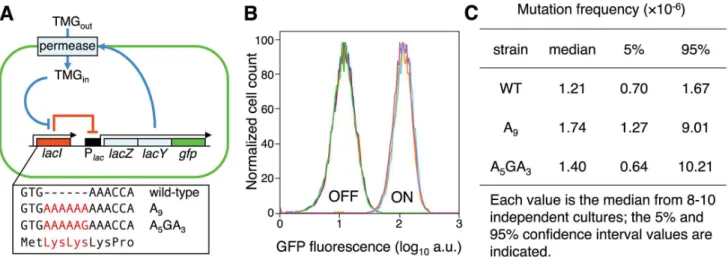
lacImRNA, we elongated the native A3sequence at the 59end of the chromosomal lacIgene to an A9 run or an A5GA3 control sequence (Figure 1A; Figure S4A) and thereby created a novellac
repressor that has two additional N-terminal appended Lys residues. Monotonous runs of adenines in DNA are hotspots for RNA polymerase slippage events during transcription in E. coli
[23–26],Thermus thermophilus[27], yeast [25,28] and human cells [29–31]. During transcription, the ,8 bp hybrid between the
nascent RNA chain and the DNA template maintains the proper register of the RNA transcript [32]. With a T9run in the template (and an A9run in the coding strand, as is found in our study), the growing chain with eight or nine A residues can dissociate from the template and realign out of frame, while still maintaining the required 8 bp RNA:DNA hybrid. Therefore, the minimum length of the T run to promote transcriptional slippage is T9[24,27,28]. In a wild-type gene, this transcriptional slippage results in the addition or deletion of a ribonucleotide in the A run in the transcript, resulting in a shift in the open reading frame and producing a burst of nonfunctional truncated protein.
Single cell analysis by flow cytometry shows that the GFP fluorescence histograms produced from OFF and ON populations of wild-type, A9 and A5GA3 repressor strains are identical demonstrating that the engineered Lys-Lys addition does not perturb repressor function (Figure 1B). The altered repressors still recognize and bind thelac operator, negatively regulate thelac
operon and remain responsive to TMG, which binds to the structurally distinct C-terminal core domain and induces an allosteric transition inlacrepressor so that it no longer binds to the
lacoperator. Moreover, all three repressor allele strains (wild-type, A9 and A5GA3) exhibit the same basal level of b-galactosidase activity in OFF populations indicating that the altered repressors bind as well as the wild-type repressor to thelacoperator (Figure S4B). In addition, there is no difference in the spontaneous
lacI+
RlacI2 mutation frequency for these two altered lacIalleles
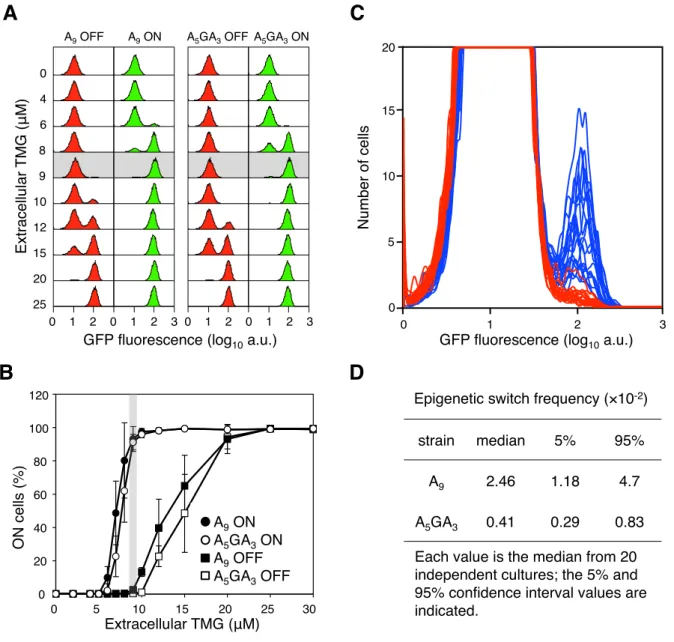
(Figure 1C; Text S1). Finally, the A9 and A5GA3 repressor/lac operon gene networks also exhibit bistability and hysteresis as has been shown for the nativelacsystem (Figures 2, 3A,B; Figure S4C) [8,18,22]. To interrogate a larger number of cells, we used flow cytometry (Figure S1) and validated this method by showing that the frequencies of switching in diverse genetic backgrounds are similar to what we previously published (Figure S2). Thus, the discrimination afforded by flow cytometry analysis of GFP fluorescence between ON and OFF cells for the wild-type and variantlacIalleles is sensitive and sufficient to monitor stochastic switching.
Transcriptional Slippage in thelacIGene Increases Epigenetic Stochastic Switching
To determine the proportion of cells that are ON, we used the green fluorescent protein gene integrated within the lac operon (Figure 1A) [18]. During growth of OFF cells in a maintenance concentration of TMG, if a cell suffers a stochastic event leading to derepression of thelacoperon,e.g.a transcription slippage error in
lacI, the lac operon will be transiently derepressed triggering permease synthesis and activation of the autocatalytic positive-feedback loop, resulting in green fluorescent cells [18]. As a result, the OFF state will transition to the ON state and be heritably maintained in the following generations, mimickinglacImutation in this system (i.e. transient stochastic events in information transfer can have heritable phenotypic consequences; Figure 2A,B) [8,18]. We calculate the switch frequency as number of ON cells over the total number of cells interrogated, following the convention used in determininglacI2mutation frequencies [33]. The observed ON switch frequency is therefore dependent on both the number of switch events that have occurred and the number of generations after a discrete switch event has occurred, as in a classical fluctuation test; our experiments run for,28 bacterial generations
(see Materials and Methods).
Between the two strains harbouring A9and A5GA3alleles, we can assess how slippery transcription sequences affect stochastic
Author Summary
The transfer of information from cell to cell is crucial for preserving cellular identity. Errors in DNA, RNA or protein synthesis are universal and inevitable. While errors in DNA synthesis can produce heritable mutations that can change the phenotype of the cell, errors in transcription are considered transient with no long-term consequence since mRNA is short-lived and the encoded erroneous proteins are eventually degraded. Previously, using thelac
switching in the bistable lac system. We observe a 6 to 12-fold increase in switch frequency (Mann-Whitney Rank Sum Test,
p,0.001) for the A9construct compared with the A5GA3control in a wild-type background at the maintenance concentration of TMG (Figure 3C,D; Figure S5). This A9 epigenetic switch frequency is fully 10,000 times greater than the genetic lacI2
mutation frequency demonstrating that it is not mutation underlying the observed stochastic switching.
In addition, the observed increase in phenotypic switch frequency cannot be explained by problems in transcription initiation or early termination for the following reasons. First, native lacI mRNA, produced from a weak constitutive promoter, includes a 28 nucleotide (nt) untranslated leader sequence before the GTG initiation codon [34] and the A9run (or the A5GA3broken run) should not affect transcription initiation. Since the nascent transcript is 31 nt in length before the A9run is first encountered, transcription of this sequence will be the processive synthesis of RNA as an RNA polymerase-DNA transcription complex and not as an RNA polymerase-promoter initial transcribing complex [35]. Second, aborted transcripts, if they occur from thelacIpromoter, are also not relevant here; abortive events occur within 8–15 nt from the promoter, far away from the A9(and the A5GA3) sequence. The absence of GreA function increases transcription abortion [35], however, we see no difference in transcript elongation in lacI
monitored by alacIZYAfusion in the absence of GreA, GreB or GreA,B function with these constructs whereas we see a significant increase in phenotypic switching in the absence of GreA,B (Figure 4). Third, we show that 61 frameshifting in the coding sequence of lacI does not cause early transcription termination before downstream transcription into the lac operon (Figure S6). Together these experiments suggest that perturbations in transcrip-tion initiatranscrip-tion and early terminatranscrip-tion are not involved in the increased OFF to ON switching frequency we observe. The net decrease in functional repressor in a cell, due to transcription error, may further require the dilution of ‘old’ wild-type repressors via
partitioning during cell division to promote stochastic switching [36].
Transcription not Translation Errors Influence Stochastic Switching
To gain experimental evidence that transcription error and not translational frameshifting promotes stochastic switching in the A9
lacI allele, we introduced the A9 and A5GA3 lacI alleles into a
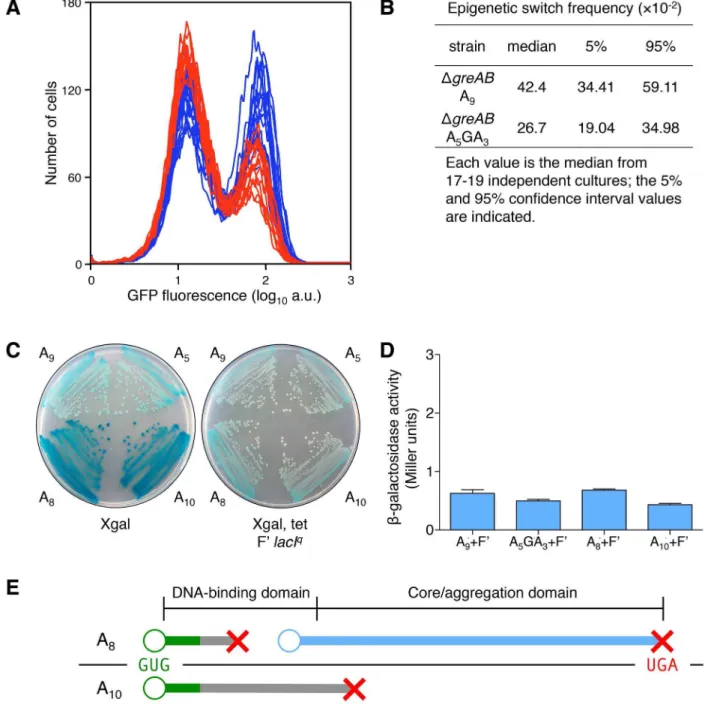
DgreABstrain that contains deletions of thegreAandgreBgenes that encode auxiliary fidelity factors that facilitate the proofreading of misincorporations that arise in nascent mRNAs during transcrip-tion [37–39]. We reasoned that if the switching is due to transcription slippage, removing transcription fidelity factors GreAB may promote more slippage and increase phenotypic switching. The increase in switch frequency in the presence of an error-prone sequence in the absence of RNA editing function is more than additive: the median switch frequency for the A9allele in the DgreAB background (42.4%) is greater than the median switch frequency for the A9allele (2.46%) and theDgreABA5GA3 background (26.7%) combined (Figure 5A,B). When a slippery transcribed sequence is in a sloppy RNA transcription fidelity background, the switching frequency is significantly increased (Mann-Whitney Rank Sum Test, p,0.001), suggesting that misalignments due to transcriptional frameshifting are prevented by RNA editing of the Gre factorsviatranscription back-tracking/ correction and support the role of transcription slippages in phenotypic change.
Furthermore, phenotypic switching has been associated with a large burst in permease synthesis [17]. An average gene transcript in E. coli will produce about 20–40 full-length polypeptides [40,41]. Therefore, one transcription frameshift will produce 20– 40 non-functional lac repressor sub-units (lac repressor is a tetramer), while one translational frameshift event will produce only one non-functionallac repressor sub-unit along with 20–40 functional lac repressor sub-units; a ratio of at least 20:1 of functional over non-functionallacrepressor sub-units will be the result. Therefore, the effects of a transcription error will be amplified nonlinearly over the original stochastic event generating tens of aberrantlacrepressor polypeptides allowing a large burst of permease that is required for phenotypic change [17].
Figure 1. Novel system to study the consequences of error-prone transcription sequences.(A) Under maintenance conditions, thelac operon is OFF (indicated by the solid red line) and the inducer TMG remains extracellular; stochastic events that lead to a transient derepression of thelacoperon will initiate an autocatalytic positive-feedback response (indicated by solid blue lines). The box highlights the first three codons of the wild-typelacrepressor gene and the Lys-Lys additions encoded by the A9and A5GA3lacIalleles (in red). (B) ThelacIA9and A5GA3Lys-Lys N-terminal
addition alleles encode functionallacrepressors. Representative flow cytometry analyses measuring GFP fluorescence of OFF and ON populations of wild-type (red, brown), A9(blue, light blue) and A5GA3(green, violet)lacIcells produce identical histograms; 104cells of each strain were interrogated.
(C) ForwardlacI+
RlacI2mutation frequencies. No significant difference in mutation frequency between the A9and A5GA3strains is observed
(Mann-Whitney Rank Sum Test,p= 0.23). The wild-type strain is added for comparison. doi:10.1371/journal.pgen.1003595.g001
To measure the effect of translation frameshifting on lac
operon induction, we created merodiploids that provide a 10-fold excess of wild-type transcripts over 61 frameshift transcripts derived from the lacI A8 and A10 alleles we
constructed on the chromosome (Table S2). We introduced an F9 factor with a wild-typelacIgene under control of the Iq up-promoter mutation, producing 10-fold morelacI transcription [42], into recAderivatives of our A8 and A10 frameshifted lacI
Figure 2. Bistability, hysteresis and stochastic switching in thelacsystem.(A) SinglelacIA9cells in minimal succinate media6maintenance
TMG were grown into microcolonies in a microfluidic flow chamber (approximately 100 cell divisions per microcolony originating from a single cell; number of divisions equals final number of cells in a microcolony minus 1). Comparison of bright field images (panel series on the left) with GFP fluorescence images (panel series on the right) allows clear distinction between OFF and ON cells in the microcolony. (I) panels show microcolonies that arose from single ON cells that were subsequently grown in the presence of maintenance level TMG; (II) panels show mirocolonies that arose from single OFF cells that were subsequently grown in the presence of maintenance level TMG; (III) panels show mirocolonies that arose from single OFF and single ON cells that were subsequently grown in the presence of maintenance level TMG; (IV) panels show a mirocolony that arose from ON cells that were subsequently grown in the absence of maintenance level TMG. Exposure to fluorescence illumination was 3000 ms. (B) A singlelacIA9
cell in minimal succinate media+maintenance TMG was grown into a microcolony in a microfluidic flow chamber and monitored by time-lapse fluorescence microscopy. Presented here are four still images from a full time series of images (available as Movie S1; images shown correspond to frames 25, 28, 30, 39). Comparison of bright field images (panel series on the left) with GFP fluorescence images (panel series on the right) allows distinction between OFF and ON cells in the microcolony. (I) all cells in the microcolony are OFF (100 ms exposure to fluorescence illumination); (II) a recently divided cell is just becoming ON indicated by the arrow (100 ms exposure to fluorescence illumination); (III) the now separated cells have become ON (100 ms exposure to fluorescence illumination); (IV) further cell division has occurred in the microcolony creating one lineage of ON cells amongst many other lineages of OFF cells (3000 ms exposure to fluorescence illumination). The 100 ms exposure time images were over-exposed using the ColorSync Utility to observe the faint fluorescence signal.
strains (and intorecAderivatives of our A9and A5GA3in-frame
lacI strains; see Table S2). Therefore, the ratio of wild-type transcript over frameshifted transcript, at the level of transcrip-tion (10:1), will be a very conservative approximatranscrip-tion of the situation that would arise if during the translation of one A9 transcript, one translational frameshift event would occur since a ratio of at least 20:1 of wild-type repressor sub-units over frameshifted sub-units would result. As shown in Figure 5C,D,E, a translation error on a pristine mRNA producing just one aberrant polypeptide amongst many wild-type polypeptides has no large effect onlacoperon induction, demonstrating that more
than one frameshifted repressor sub-unit is required to promote phenotypic switching.
Finally, efficient translation frameshifting is dependant on specific downstream sequence elements in E. coli [27] that are not obvious in our A9lacIconstruct.
All together, these results show that insertion of a known transcription slippage sequence in the lacI transcript increases phenotypic switching in the bistablelacsystem due to transcription error in the mRNA and accumulation of a frameshifted and non-functional lac repressor leading to a transcription burst of lac
permease.
Figure 3. The error-prone A9run in thelacItranscript increases stochastic phenotypic switching.(A) Representative flow cytometry GFP
fluorescence histogram series of A9and A5GA3lacIcells that were originally ON (green histograms) or OFF (red histograms) were sub-cultured and
grown in media containing various concentrations of TMG indicated on the vertical axis (104cells interrogated). Below 5
mM TMG and above 20mM TMG, the previous history of the cell (ON or OFF) does not affect the current state of the cell; between these TMG concentrations the system exhibits hysteresis. The shaded area highlights the maintenance concentration of 9mM TMG for these strains. (B) Cells that were originally ON or OFF were sub-cultured and grown in media containing various concentrations of TMG, as above. Each value is the average6SD from 5 to 15 independent cultures. The shaded area highlights the maintenance concentration of 9mM TMG for these strains. (C) OFF A5GA3lacIcells (red histograms) and A9 lacIcells (blue histograms) were diluted and grown in media containing 9mM TMG. After 42 h growth, flow cytometry was performed to determine the frequency of epigenetically ON cells in 20 independent cultures of each strain; the A5GA3histograms are superimposed over the A9histograms
(104cells interrogated). (D) The A
9epigenetic-switch frequency is significantly increased over the A5GA3value (Mann-Whitney Rank Sum Test, p,0.001).
doi:10.1371/journal.pgen.1003595.g003
Stochastic Errors in Information Transfer Have Heritable Phenotypic Consequences
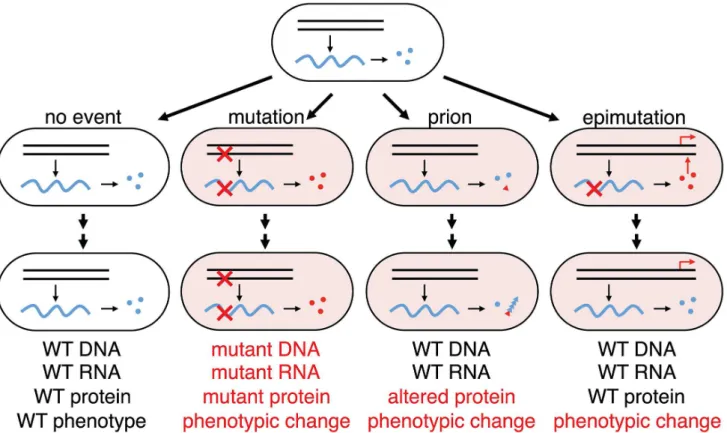
DNA makes RNA makes protein; until now, errors in making two of the three elements in information transfer, DNA replication and protein folding, have been shown to modify cellular inheritance through mutation or prion conformational change [43] (Figure 6). Our results show that acute errors in mRNA, the transient element in information transfer, can also effect heritable change when they affect transcription factors involved in bistable gene networks. Transcription errors have been shown to have phenotypic consequences for the cell, but in the cases reported so far, chronic transcription errors can provide partial function or ‘leakiness’ giving an altered phenotype from a mutant or wild type gene [29–31,44–46]. For example, a 21 frameshift mutation in the apolipoprotein B gene in a polyA run caused hypobetalipoproteinemia and transcription slippage at the polyA track restores the reading frame by insertion of an additional A and ameliorates the disease [29,30]. In Alzheimer’s patients, it was found that 22 frameshifts accumulated in amyloid precursor and ubiquitin B transcripts over time, which are thought to be important in nonfamilial early- and late-onset forms of Alzheimer’s disease [47]. In contrast to these examples of chronic transcriptional errors producing a partial phenotype, we show that one acute transcription error on a poorly transcribed mRNA may promote heritable phenotypic change due to a change of connectivity in a transcription network. Although epimutation, a heritable change in gene expression that does not affect the actual base pair sequence of DNA, is usually associated with methylation patterns and epigenetic silencing of gene expression, the heritable stochastic switching due to transient transcription error we observe here, may also be included as epimutation.
RNA transcription errors are inevitable, ubiquitous and frequent (about 10,000 times more frequent than DNA replication errors) [48] and bistable gene networks sensitive to stochastic fluctuation in protein level are found in bacteria [17], yeast [49], fly [50],Xenopus[13], mammalian stem cells [51] and viruses such as HIV and lambda [52]. Furthermore, recent studies in E. coli [53], yeast [54] and human cells [55,56] have shown that a majority of proteins involved in transcription networks are usually present at low abundance so it is easy to imagine that errors in one low abundant mRNA can have a drastic reduction in the protein concentration and trigger epigenetic change. So far, permanent activation or removal of transcription factors by genetic manipulation has been shown to promote a stable change of phenotype in a process known as transdifferentiation [57] and we speculate that transient disappearance of a transcription factor involved in a bistable switch may have the same phenotypic effect. Although here we focus on a slippery A9 sequence in the lacI gene, any kind of transcription error along thelacI transcript
Figure 4. Creation of a lacIZYA operon fusion to assess the levels of gene expression from thelacIgene promoter.(A) An operon fusion was created by first inserting a kanamycin cassette from pKD4 (Table S3) into the intervening region betweenlacIandlacZand then,via a flippase reaction, removing most oflacoperator O3, the
complete lac promoter and lac operator O1. Therefore, the lacIZYA
fusion transcript is under the expression of the weakly constitutivelacI promoter with no interference from any lac repressor binding (lac repressor does not negatively regulatelacexpression throughO2alone)
[60]. The complete sequence of the intervening region from the TGA stop codon of thelacIgene to the ATG start codon of thelacZgene is shown in Figure S3. (B) Expression levels of thelacIZYAoperon fusion strains are equivalent regardless of GreA, GreB or GreAB status indicating the absence of any or all Gre functions does not influence overalllacexpression levels. Cells were grown in minimal A salts plus glucose andb-galactosidase levels were determined by the method of Miller [33]; the average6SD for three independent cultures is shown. To make functionalb-galactosidase in this fusion strain the transcription complex must produce at least a 4,271 nt transcript including thelacI non-translated leader, thelacIgene, the FRT scar sequence and thelacZ gene; if the transcript terminates afterlacA, at the usuallactermination site, then the entire transcript will be over 6.2 kb in length. (C) At maintenance level of TMG, the absence of GreA or GreB does not increase stochastic switching over wild-type levels but when both Gre
Figure 5. Transcription errors, not translational frameshifting, at thelacIA9sequence influences stochastic switching.(A) Stochastic
phenotypic switching is significantly increased when the error-prone A9run is in a transcription fidelity-deficient background (DgreADgreBcells). OFF
DgreABA5GA3lacIcells (red histograms) andDgreABA9lacIcells (blue histograms) were diluted and grown in media containing 9mM TMG. After 42 h growth, flow cytometry was performed to determine the frequency of epigenetically ON cells in 17–19 independent cultures of each strain; the histograms from theDgreABA5GA3lacIcultures are superimposed over the histograms from theDgreABA9lacIcultures; each histogram represents
the interrogation of 104cells. (B) The median for theDgreABA9lacIstrain is significantly different from theDgreABA5GA3lacIvalue (Mann-Whitney
Rank Sum Test,p,0.001). (C) To model translation frameshifting in our system we have created merodiploids that provide a 10-fold excess of wild-type transcripts over 61 frameshift transcripts (as modeled by the A8 and A10 lacI alleles). Therefore, the ratio of wild-type transcript over
frameshifted transcript, at the level of transcription (10:1), will be a very conservative approximation of the situation that would arise if during the translation of one A9transcript, one translational frameshift event would occur (20:1 wild-type sub-units over frameshifted sub-units). The wild-type
repressor allele is completely dominant over the frameshifted repressor alleles: left panel, thelacIallele strains without the F9; right panel, thelacI allele strains with the F9overproducing wild-typelacI. The glucose minimal plates include Xgal (40mg/ml) and tetracycline (Tet, 12.5mg/ml), as indicated beneath the plate. Tet is used to maintain the F9in the cell. (D) Quantitative measurement of the phenotype observed in (C). The level ofb -galactosidase in all four strains is comparable and does not exceed 1 Miller unit, which is the basalb-galactosidase of uninducedE. colicells [33]; the average6SD for three independent cultures is shown. (E) A21 translational frameshifting event at the A9sequence would cause translation to
terminate at codon 4/5 (green line denotes wild-type protein; gray line denotes frameshifted protein; red X denotes translation termination; blue line denotes translation reinitiation protein; the A9transcript is shown as a black line with the GUG start codon in green letters and the UGA stop codon in
that would generate a non-functional lac repressor, may also initiate a stochastic switching event. Indeed, any transcribed DNA sequence that is problematic for RNA polymerase, due to a mono-, di-, tri- or some higher order nucleotide repeat or to hairpin or other secondary structures would produce a variety of mRNA species from the same gene. Therefore, transcription errors, epimutation, might be a general mecha-nism to create epigenetic heterogeneity in a clonal cell population and should be considered as one of the origins of phenotypic change that could lead to altered or aberrant cell behavior, impacting human health, including cancer if the dysregulation of key genetic bistable networks are altered by errors in transcription [58].
Materials and Methods
Bacterial Strains
All strains used in this study are derived from the wild-type sequencedE. coliMG1655 strain (Table S2). Manipulation of the MG1655 genome was accomplished by standard method-ologies [33,59]. To monitor the proportion of cells that are ON or OFF forlac operon expression, we have replaced thelacA
gene in the wild-typeE. coliMG1655 chromosome with a gfp
cassette, so that when thelacZYA::gfptranscript is expressed,b -galactosidase, galactoside permease, and green fluorescent protein are produced from the lacZ, lacY, and gfp genes, respectively.
would not only decrease the net total of repressor sub-units by one, but might also decrease the cell’s netlacrepressors by one, since it has been shown that one dominant-negative sub-unit with three wild-type sub-units may abolish the function of the tetramericlacrepressor [42]. A+1 translational frameshifting event at the A9sequence (generating a A10transcript) would cause translation to terminate at codon 83/84 and would
therefore only result in the net decrease of one repressor sub-unit in the cell, since no dominant-negative sub-unit can be made this far into the core domain. When the wild-type sub-unit is made at 10-fold the level of61 transcription frameshift events (and61 translation protein products), the wild-type sub-units dominate and thelacoperon is repressed (as seen in the Xgal Tet F9lacIq
plate in (C) and therefore any net decrease by one translation frameshift event is negligible when compared to the net decrease in repressor sub-units due to a transcription error. When a transcription error occurs at the A9sequence, all the nascentlacrepressor sub-units will be non-functional (and/or dominant-negative); when a translational
frameshift occurs at the A9sequence, less than 1/10 of all nascentlacrepressor sub-units will be non-functional (and/or dominant-negative).
doi:10.1371/journal.pgen.1003595.g005
Figure 6. Phenotypic consequences from errors in information transfer in a cellular lineage.Wild-type genes (black parallel lines) make wild-type transcripts (blue wavy lines) make wild-type functional proteins (blue circles); mutant genes make mutant transcripts (red crosses) make mutant proteins (red circles); protein mis-folding can trigger phenotypic change by changing protein conformation to the prion state (red triangle) that can self-perpetuate by templating the aberrant conformation with nascent native proteins (blue triangles). From wild-type genes can also come altered mRNA (epimutation) making altered proteins that can perturb transcriptional networks in a nonlinear manner generating a heritable phenotypic change (red arrows) from a transient stochastic error in information transfer. In this case no trace of the error will remain in the lineage after the phenotypic change as indicated: while change through mutation will retain evidence of the original stochastic error in the progeny cell (mutant DNA, mutant RNA and mutant protein), change through epimutation will retain no evidence of the original stochastic error in the progeny cell (WT DNA, WT RNA and WT protein). Errors in DNA and RNA synthesis occur at rates of, very roughly, 1029and 1025errors per residue, respectively [48]; yeast cells in the non-prion [psi2] state spontaneously switch [43] to [PSI+] at a frequency of 1026; the great majority of cells will not have
Growth Conditions and Media
To demonstrate hysteresis and bistability in lac operon expression in single cells, a bacterial culture grown in minimal A salts [33] plus MgSO4(1 mM) with succinate (0.2%), was diluted 1:5 in fresh medium with (ON culture) or without 1 mM TMG (OFF culture) and shaken at 37uC for 7 h. After this induction period, the two cultures were individually diluted and,200 cells
were seeded to new tubes containing fresh medium that contained varying amounts of TMG, and shaken at 37uC for 42 h (,28
generations). Flow cytometry was used to determine the percent-age of cells that were induced forlacoperon expression (ON cells). To determine epigenetic and genetic switch frequencies, a bacterial culture grown in minimal succinate media, was diluted and ,200 cells were seeded to new tubes containing fresh
medium, with (epigenetic assay) or without (genetic assay) a maintenance level of TMG, and shaken at 37uC for 42 h. To determine genetic-mutation frequencies, dilutions of the subcul-tures were spread on selection plates (minimal A medium supplemented with 75mg/ml phenyl-b-D-galactoside [Pgal] and 1.5% purified agar) and minimal A glucose (0.2%) plates and incubated for 2–3 days at 37uC. Pgal is a substrate of b -galactosidase and can act as a carbon source but does not induce
lacoperon expression, therefore only cells constitutively expressing
b-galactosidase (lacI2) can form colonies [33].
Flow Cytometry
To determine the percentage of cells that were induced forlac
operon expression (ON cells), 10ml of culture was diluted into 300ml filtered minimal A salts plus MgSO4(1 mM) and subjected to flow cytometry analysis with GFP fluorescence measured in a BD FACSCanto II Flow Cytometer (Becton, Dickinson and Company, USA) with Diva acquisition software (Becton Dick-inson) and FloJo analysis software (Tree Star, Inc. USA). To monitor fluorescent cells in a culture we used a narrow gating for forward and side scattering so that the most represented cell population was evaluated (Figure S1). For each independent culture 10,000 cells were interrogated.
Microscopy and Microfluidics
To follow the growth of single cells into microcolonies we used the CellASIC ONIX Microfluidic Platform (Millipore) including microfluidic perfusion system, microfluidic flow chamber for bacteria (BO4A plates) and FG software. Time-lapse microscopy was performed using a Zeiss HAL100 inverted fluorescence microscope. Fields were acquired at 1006magnification with an EM-CCD camera (Hammamatsu). Bright field and fluorescence (EGFP cube = Chroma, #41017; X-Cite120 fluorescence illumi-nator [EXFO Photonic Solutions]) images were acquired and image analysis was performed using AxioVision Rel. 4.6 (Zeiss). To maintain a constant 37uC environment throughout the experiment, the microscope was housed in an incubation system consisting of Incubator XL-S1 (PeCon) controlled by TempMo-dule S and Heating Unit XL S (Zeiss).
Supporting Information
Figure S1 Gating used in flow cytometry analysis. (A) A forward (FSC) and side scatter (SSC) plot of 104lacoperon ON cells. We typically use a flow rate of 2,000 to 5,000 events per second. The gating we use is outlined in black; fully 97% of all events fall within this gating. (B) A FSC and SSC scatter plot of 367 non-cellular events (flow cytometry was performed on filter-sterilized buffer); such events occur typically at 30–50 events per second. When gated as in (A), 29% of all this non-cellular population fall within
the gated area. (C) When the 367 non-cellular un-gated events are superimposed over the 10,000 cellular un-gated events, it is apparent that the two populations share a common FSC and SSC space. We superimpose these two populations to provide an estimation of how many false-cellular events to consider in our flow cytometry analyses. Since the number of events we observe per second during analysis of cell populations is about 50–100 times greater than we observe during buffer interrogation, we may therefore reasonably expect that a few percent of our experimental cellular population is actually non-cellular events. (D) When the two un-gated populations are now plotted with SSC against GFP fluorescence, it becomes apparent that the non-cellular events frequently fall in the OFF cellular space, and very infrequently in the ON cellular space. Of the 10,00 cellular events, fully 96% are considered ON; of the non-cellular events fully 1.6% are considered ON (6 events). (E) The gated non-cellular population is now superimposed over the gated cellular population. (F) When the two gated populations are now plotted with SSC versus GFP fluorescence, a more accurate estimation is achieved concerning the number and character of non-cellular events in the experimental population. Therefore, a few percent of the considered experimental population will be non-cellular events (106 cellular events in this instance), but only one or two non-cellular events will be considered positive with respect to lac
operon induction (false-positives in our analysis). With these results we can conclude that for any of our samples, while a few percent of the total from flow cytometry will be false negative with respect to
lacoperon induction, only a few 0.1 percent of the experimental population will be false-positive with respect to lac operon induction. Therefore, we have confidence in our experimental procedure, and the results obtained with this procedure, since we are monitoring thelac operon OFF to ON stochastic epigenetic switch frequency.
(PDF)
frequency is 38-fold over wild-type level [18]. (D) Absence of GreAB increases stochastic switching in the lac operon system. Each value is the median epigenetic-switch frequency from 27 to 30 independent cultures of each strain; the 5% and 95% confidence interval values are included. The mean for theDgreA DgreB strain is significantly different from the wild-type value (Mann-Whitney Rank Sum Test,p,0.001) [18].
(PDF)
Figure S3 Creation of a lacIZYA operon fusion to assess the levels of gene expression from thelacIgene promoter. An operon fusion was created by first inserting a kanamycin cassette from pKD4 (Table S3) into the intervening region betweenlacIandlacZ
and then,viaa flippase reaction, removing most oflacoperatorO3, the complete lac promoter and lac operator O1. Therefore, the
lacIZYA fusion transcript is under the expression of the weakly constitutive lacI promoter with no interference from any lac
repressor binding (lac repressor does not negatively regulate lac
expression throughO2alone) [60]. The complete sequence of the intervening region from the TGA stop codon of thelacIgene to the ATG start codon of thelacZ gene is shown before and after the fusion was created. Black boxes denotelacoperator sequences, the green box denotes thelacpromoter and the purple box denotes the
FRT sequence left after the kanamycin resistance cassette was flipped out. The kanamycin cassette was amplified using oligos OC365 and OC366 (Table S4) and pKD4 as a template; the homology of the oligos allowed this cassette to be recombined between the STOP codon oflacIand the START codon oflacZ. The sequences of all constructs were analyzed.
(PDF)
Figure S4 Recombineering an error-prone A9sequence and the broken run A5GA3sequence intolacIon theE. colichromosome creating a functionallacrepressor. (A) The approach is outlined; the sequences of the OC primers indicated are found in Table S4; the genotypes of the CH strains are found in Table S2. The phenotype of the original, intermediate and final construct is indicated on the right (Lac, ability to utilize lactose as a carbon source; Cm, sensitivity and resistance to the antibiotic chloram-phenicol); R in the altered sequence indicates a purine residue. The entirelacIgene, after the initial GTG start codon, along with the first 5 codons oflacZ, was replaced with the chloramphenicol resistance gene from pKD3. The A9and A5GA3lacIalleles were then recombined into the chromosome replacing thecatgene and restoring thelacZgene andlacoperon function. Additionally, we also created A8and A10lacIalleles (not shown) at this same site creating frameshiftedlacIopen reading frames with oligos OC 359 and 360, respectively, each with OC 464, to restorelacZwith an alteredlacIallele. The sequences of all constructs were analyzed. (B) N-terminal Lys-Lys appended lac repressors are functional. Induced and uninduced populations of wild-typelacIcells, andlacI
A9and A5GA3cells, were grown in minimal A salts plus glucose and b-galactosidase levels were determined by the method of Miller [33]; the average 6SD for three independent cultures is shown. This result is entirely consistent with the flow cytometry results presented in Figure 1B. (C) The lacI N-terminal Lys-Lys appendage creates an increased tight-bindinglacrepressor. While being a functional lac repressor in all aspects, the A9/A5GA3 alteredlacrepressor requires an increased TMG concentration to achieve maintenance (9mM versus 6mM for the native lac
repressor, indicated by the shaded regions); see Table S1. We suggest that the Lys-Lys addition creates a tighter binding lac
repressor. Most amino acid substitutions at positions 2, 3 or 4 of the lac repressor result in a wild-type phenotype or in a tight-binding phenotype [62]. Moreover, the amino terminus of thel
repressor has the sequence NH2-Ser-Thr-Lys-Lys-Lys-Pro- which is similar to the sequence of the A9/A5GA3alteredlacrepressor, namely NH2-Met-Lys-Lys-Lys-Pro-; it is this Lys-Lys-Lys amino acid sequence that forms the arm of thel repressor that wraps around the DNA adding additional protein:DNA contacts to augment the usual helix-turn-helix DNA-binding motif [63]. Essentially,viathe Lys-Lys addition generating a Lys-Lys-Lys run, we have tacked on a flexible DNA-binding segment to the lac
repressor and this is reflected in the increased maintenance concentration observed for these cells. Each value is the average6
SD from 5 to 20 independent cultures. (PDF)
Figure S5 The error-prone A9run in thelacItranscript increases stochastic phenotypic switching. (A) Uninduced (OFF) A5GA3lacI cells (red histograms) and A9 lacI cells (blue histograms) were diluted and grown in media containing 10mM TMG. After 42 h growth, flow cytometry was performed to determine the frequency of epigenetically ON cells in 20 independent cultures of each strain; the histograms from the A9lacIcultures are superimposed over the histograms from A5GA3 lacI cultures; each histogram represents the interrogation of 104 cells. (B) The Y axis scale is changed from a maximum of 250 cells to 60 cells to allow a close examination of the resulting histograms, clearly showing that the A9 run in the lacI transcript increases stochastic phenotypic switching. (C) Each value is the median epigenetic-switch frequency from 20 independent cultures of each strain; the 5% and 95% confidence interval values are included. The mean for the A9 lacI strain is significantly different from the A5GA3 lacI value (Mann-Whitney Rank Sum Test,p,0.001).
(PDF)
Figure S6 The lacIZYA operon fusion: The nature of thelacI
sequence does not affect downstream lacZYA operon expression (i.e.frameshift events at the A9run are not polar). A novellacI+
-ZYAoperon fusion, and altered lacI-ZYA fusion derivatives, was created to determine if read-through transcription that initiates at thelacIpromoter and continues into thelacoperon was affected by transcriptional frameshift events at the 59end of thelacImRNA. Details of the fusion construction are shown in Figure S3. The native lacI transcript is not terminated by a transcriptional terminator sequence, but instead transcription is terminated when the RNA polymerase encounters lac repressor bound to the lac
operator [64,65]; read-through transcription is thought to be responsible for the basal levels oflacoperon activities in uninduced cells [64,65], and therefore transcriptional events that affectlacI
transcript stability would also affect the basal levels oflacfunctions, and perturb the normal system. In the fusion strains, the lac
promoter, all oflacoperatorO1and half ofO3have been replaced with an FRT sequence, and therefore transcription that initiates at thelacIpromoter will continue through thelacZYAoperon creating a novel operon, lacIZYA, and a transcript encoding the lac
repressor,b-galactosidase, permease and transacetylase. Operator
demonstrating that 61 frameshift events in the A9 lacI allele, generating A8and A10runs, are not polar, do not affect the fusion mRNA stability and do not affect expression of downstream
lacZYAgenes in the single transcript. Cells were grown in minimal A salts plus glucose andb-galactosidase levels were determined by the method of Miller [33]; the average 6 SD for three independent cultures is shown. Constitutive transcription in all the lacIZYA operon fusion strains also provides enough Lac function for colonies to grow slowly on lactose agar plates, and to appear blue on glucose 5-bromo-4-chloro-3-indolyl-b -D-galacto-side (Xgal) indicator plates, with or without inducer (data not shown). Therefore, these operon fusions demonstrate our system is competent for the study of transcriptional frameshift events. (PDF)
Movie S1 Stochastic switching of one cell in a clonal population in the same environment. The growth of a singlelacIA9OFF cell in TMG maintenance media into a microcolony was followed in a microfluidics flow chamber by time-lapse microscopy. Each frame was, on average, taken about 60 minutes apart (some frames were lost due to loss of focus). The bright field frames are on the left, the GFP fluorescence frames are on the right and begin after the microcolony has become well established. The cell outlined in yellow is the cell that will change phenotype from OFF to ON, and the descendants of that cell will also manifest the ON phenotype. The cell outlined in red is the direct relative of the cell that switches ON, but that cell, and all the descendants of that cell remain OFF. All the GFP fluorescence frames, until the last frame, have 100 ms exposure times and the resulting images were over-exposed using the ColorSync Utility to observe the faint fluorescence signal. The last GFP fluorescence frame had a 3000 ms exposure time. The movie shows that an OFF cell growing in TMG maintenance media will be OFF, but has the possibility of switching ON, and once switched ON will initiate a cell lineage of ON cells, even though other surrounding cells in the same microcolony will be OFF.
(MOV)
Table S1 Maintenance of ON phenotype of cells grown in 9mM TMG. To demonstrate maintenance of lacoperon expression in single cells, an overnight bacterial culture of the strain of interest carrying thelacZYA::gfpconstruct, inoculated from a single colony and grown in minimal succinate media, was diluted 1:5 in fresh medium with 1 mM TMG (ON culture) and shaken at 37uC for
7 h. After this induction period, the cultures were individually diluted and,200 cells were seeded to new tubes containing fresh
medium that contained 9mM TMG, and shaken at 37uC for 42 h. To determine the percentage of cells that remained ON forlac
operon expression, 10ml of culture was diluted into 300ml filtered minimal A salts plus MgSO4 (1 mM) and subjected to flow cytometry analysis with a BD FACSCanto II Flow Cytometer (Becton, Dickinson and Company, USA). At this TMG concen-tration, all the strains exhibit maintenance (over 90% of the original ON cells and their descendants remain ON after prolonged growth at 9mM TMG), and can be considered as samples of the same population and therefore directly compared, since the differences between the populations are not significant (Kruskal-Wallis One Way Analysis of Variance on Ranks,
p= 0.10). Each value is the median from 5–25 independent cultures; the 5% and 95% confidence interval values are indicated. (PDF)
Table S2 Bacterial strains. (PDF)
Table S3 Plasmids. (PDF)
Table S4 Oligos. (PDF)
Text S1 Considering lacI+
RlacI2 forward mutation frequency
analysis. (DOCX)
Text S2 References for supporting information. (DOCX)
Acknowledgments
We thank S. Rosenberg, H. Bellen, G. Ira and H. Dierick for critically reviewing the manuscript. We thank the anonymous reviewers for stimulating discussion. This work is dedicated to Franc¸ois Jacob.
Author Contributions
Conceived and designed the experiments: AJEG DS JAH CH. Performed the experiments: AJEG DS JAH. Analyzed the data: AJEG DS JAH CH. Contributed reagents/materials/analysis tools: AJEG DS JAH CH. Wrote the paper: AJEG DS JAH CH.
References
1. Rando OJ, Verstrepen KJ (2007) Timescales of genetic and epigenetic inheritance. Cell 128: 655–668. doi:10.1016/j.cell.2007.01.023.
2. Drummond DA, Wilke CO (2009) The evolutionary consequences of erroneous protein synthesis. Nat Rev Genet 10: 715–724. doi:10.1038/nrg2662. 3. Satory D, Gordon AJ, Halliday JA, Herman C (2011) Epigenetic switches: can
infidelity govern fate in microbes? Curr Opin Microbiol 14: 212–217. doi:10.1016/j.mib.2010.12.004.
4. Monod J, Jacob F (1961) General conclusions: teleonomic mechanisms in cellular metabolism, growth, and differentiation. Cold Spring Harb Symp Quant Biol 26: 389–401.
5. Pasque V, Jullien J, Miyamoto K, Halley-Stott RP, Gurdon JB (2011) Epigenetic factors influencing resistance to nuclear reprogramming. Trends Genet 27: 516– 525. doi:10.1016/j.tig.2011.08.002.
6. Takahashi K, Tanabe K, Ohnuki M, Narita M, Ichisaka T, et al. (2007) Induction of pluripotent stem cells from adult human fibroblasts by defined factors. Cell 131: 861–872. doi:10.1016/j.cell.2007.11.019.
7. Dubnau D, Losick R (2006) Bistability in bacteria. Mol Microbiol 61: 564–572. doi:10.1111/j.1365-2958.2006.05249.x.
8. Novick A, Weiner M (1957) Enzyme induction as an all-or-none phenomenon. Proc Natl Acad Sci USA 43: 553–566.
9. Ptashne M (2004) A genetic switch. New York: Cold Spring Harbor Laboratory Press. 164 p.
10. Gardner TS, Cantor CR, Collins JJ (2000) Construction of a genetic toggle switch inEscherichia coli. Nature 403: 339–342. doi:10.1038/35002131.
11. Kalmar T, Lim C, Hayward P, Mun˜oz-Descalzo S, Nichols J, et al. (2009) Regulated fluctuations in Nanog expression mediate cell fate decisions in embryonic stem cells. PLoS Biol 7: e1000149. doi:10.1371/journal.-pbio.1000149.g008.
12. Wykoff DD, Rizvi AH, Raser JM, Margolin B, O’Shea EK (2007) Positive feedback regulates switching of phosphate transporters inS. cerevisiae. Mol Cell 27: 1005–1013. doi:10.1016/j.molcel.2007.07.022.
13. Ferrell JE, Machleder EM (1998) The biochemical basis of an all-or-none cell fate switch inXenopusoocytes. Science 280: 895–898.
14. Weinberger LS, Dar RD, Simpson ML (2008) Transient-mediated fate determination in a transcriptional circuit of HIV. Nat Genet 40: 466–470. doi:10.1038/ng.116.
15. Yao G, Lee TJ, Mori S, Nevins JR, You L (2008) A bistable Rb–E2F switch underlies the restriction point. Nat Cell Biol 10: 476–482. doi:10.1038/ ncb1711.
16. Kaufmann BB, Yang Q, Mettetal JT, van Oudenaarden A (2007) Heritable stochastic switching revealed by single-cell genealogy. PLoS Biol 5: e239. doi:10.1371/journal.pbio.0050239.
17. Choi PJ, Cai L, Frieda K, Xie XS (2008) A stochastic single-molecule event triggers phenotype switching of a bacterial cell. Science 322: 442–446. doi:10.1126/science.1161427.
18. Gordon AJE, Halliday JA, Blankschien MD, Burns PA, Yatagai F, et al. (2009) Transcriptional infidelity promotes heritable phenotypic change in a bistable gene network. PLoS Biol 7: e44. doi:10.1371/journal.pbio.1000044.st002.
19. Stepanova E, Lee J, Ozerova M, Semenova E, Datsenko K, et al. (2007) Analysis of promoter targets forEscherichia colitranscription elongation factor GreAin vivo
andin vitro. J Bacteriol 189: 8772–8785. doi:10.1128/JB.00911-07.
20. Kaplan C (2009) Alternate explanation for observed epigenetic behavior? PLoS Biol 7: e44. Available: http://www.plosbiology.org/annotation/listThread. action?root = 22157.
21. Gordon AJE (2009) Pregnant pauses? PLoS Biol 7: e44. Available: http://www. plosbiology.org/annotation/listThread.action?root = 9457.
22. Ozbudak EM, Thattai M, Lim HN, Shraiman BI, Van Oudenaarden A (2004) Multistability in the lactose utilization network ofEscherichia coli. Nature 427: 737–740. doi:10.1038/nature02298.
23. Chamberlin M, Berg P (1962) Deoxyribonucleic acid-directed synthesis of ribonucleic acid by an enzyme fromEscherichia coli. Proc Natl Acad Sci USA 48: 81.
24. Wagner LA, Weiss RB, Driscoll R, Dunn DS, Gesteland RF (1990) Transcriptional slippage occurs during elongation at runs of adenine or thymine inEscherichia coli. Nucleic Acids Research 18: 3529–3535.
25. Strathern JN, Jin DJ, Court DL, Kashlev M (2012) Isolation and characteriza-tion of transcripcharacteriza-tion fidelity mutants. Biochim Biophys Acta 1819: 694–699. doi:10.1016/j.bbagrm.2012.02.005.
26. Strathern J, Malagon F, Irvin J, Gotte D, Shafer B, et al. (2013) The fidelity of transcription: RPB1 (RPO21) mutations that increase transcriptional slippage in
S. cerevisiae. J Biol Chem 288: 2689–2699. doi:10.1074/jbc.M112.429506. 27. Larsen B, Wills NM, Nelson C, Atkins JF, Gesteland RF (2000) Nonlinearity in
genetic decoding: homologous DNA replicase genes use alternatives of transcriptional slippage or translational frameshifting. Proc Natl Acad Sci USA 97: 1683–1688.
28. Zhou YN, Lubkowska L, Hui M, Court C, Chen S, et al. (2013) Isolation and characterization of RNA PolymeraserpoB mutations that alter transcription slippage during elongation inEscherichia coli. J Biol Chem 288: 2700–2710. doi:10.1074/jbc.M112.429464.
29. Linton MF, Pierotti V, Young SG (1992) Reading-frame restoration with an apolipoprotein B gene frameshift mutation. Proc Natl Acad Sci USA 89: 11431– 11435.
30. Linton MF, Raabe M, Pierotti V, Young SG (1997) Reading-frame restoration by transcriptional slippage at long stretches of adenine residues in mammalian cells. J Biol Chem 272: 14127–14132.
31. Young M, Inaba H, Hoyer LW, Higuchi M, Kazazian HH, et al. (1997) Partial correction of a severe molecular defect in hemophilia A, because of errors during expression of the factor VIII gene. Am J Hum Genet 60: 565–573. 32. Nudler E, Mustaev A, Lukhtanov E, Goldfarb A (1997) The RNA-DNA hybrid
maintains the register of transcription by preventing backtracking of RNA polymerase. Cell 89: 33–41.
33. Miller JH (1992) A short course in bacterial genetics. New York: Cold Spring Harbor Laboratory Press. 456 p.
34. Steege DA (1977) 59-Terminal nucleotide sequence of Escherichia colilactose repressor mRNA: features of translational initiation and reinitiation sites. Proc Natl Acad Sci USA 74: 4163–4167.
35. Goldman SR, Ebright RH, Nickels BE (2009) Direct detection of abortive RNA transcriptsin vivo. Science 324: 927–928. doi:10.1126/science.1169237. 36. Huh D, Paulsson J (2010) Non-genetic heterogeneity from stochastic partitioning
at cell division. Nat Genet 43: 95–100. doi:10.1038/ng.729.
37. Erie DA, Hajiseyedjavadi O, Young MC, Hippel von PH (1993) Multiple RNA polymerase conformations and GreA: control of the fidelity of transcription. Science 262: 867–873.
38. Shaevitz JW, Abbondanzieri EA, Landick R, Block SM (2003) Backtracking by single RNA polymerase molecules observed at near-base-pair resolution. Nature 426: 684–687. doi:10.1038/nature02191.
39. Zenkin N, Yuzenkova Y, Severinov K (2006) Transcript-assisted transcriptional proofreading. Science 313: 518–520. doi:10.1126/science.1127422. 40. Kennell D, Riezman H (1977) Transcription and translation initiation
frequencies of theEscherichia coli lacoperon. J Mol Biol 114: 1–21.
41. Cai L, Friedman N, Xie XS (2006) Stochastic protein expression in individual cells at the single molecule level. Nature 440: 358–362. doi:10.1038/ nature04599.
42. Mu¨ller-Hill B, Crapo L, Gilbert W (1968) Mutants that make morelacrepressor. Proc Natl Acad Sci USA 59: 1259–1264.
43. Halfmann R, Jarosz DF, Jones SK, Chang A, Lancaster AK, et al. (2012) Prions are a common mechanism for phenotypic inheritance in wild yeasts. Nature 482: 363–368. doi:10.1038/nature10875.
44. van Leeuwen F, van der Beek E, Seger M, Burbach P, Ivell R (1989) Age-related development of a heterozygous phenotype in solitary neurons of the homozygous Brattleboro rat. Proc Natl Acad Sci USA 86: 6417–6420.
45. Benson KF (2004) Paradoxical homozygous expression from heterozygotes and heterozygous expression from homozygotes as a consequence of transcriptional infidelity through a polyadenine tract in the AP3B1 gene responsible for canine cyclic neutropenia. Nucleic Acids Research 32: 6327–6333. doi:10.1093/nar/ gkh974.
46. Taddei F, Hayakawa H, Bouton M, Cirinesi A, Matic I, et al. (1997) Counteraction by MutT protein of transcriptional errors caused by oxidative damage. Science 278: 128–130.
47. van Leeuwen FW (1998) Frameshift mutants ofbamyloid precursor protein and Ubiquitin-B in Alzheimer’s and Down patients. Science 279: 242–247. doi:10.1126/science.279.5348.242.
48. Ninio J (1991) Connections between translation, transcription and replication error-rates. Biochimie 73: 1517–1523.
49. Ozbudak EM, Becskei A, van Oudenaarden A (2005) A system of counteracting feedback loops regulates Cdc42p activity during spontaneous cell polarization. Developmental Cell 9: 565–571. doi:10.1016/j.devcel.2005.08.014.
50. Wernet MF, Mazzoni EO, C¸ elik A, Duncan DM, Duncan I, et al. (2006) Stochastic spineless expression creates the retinal mosaic for colour vision. Nat Cell Biol 440: 174–180. doi:10.1038/nature04615.
51. Ben D . MacArthur, Ma’ayan A, Lemischka IR (2009) Systems biology of stem cell fate and cellular reprogramming. Nat Rev Mol Cell Biol 10: 672–681. doi:10.1038/nrm2766.
52. Nachman I, Ramanathan S (2008) HIV-1 positive feedback and lytic fate. Nat Genet 40: 382–383. doi:10.1038/ng0408-382.
53. Taniguchi Y, Choi PJ, Li GW, Chen H, Babu M, et al. (2010) QuantifyingE. coli
proteome and transcriptome with single-molecule sensitivity in single cells. Science 329: 533–538. doi:10.1126/science.1188308.
54. Holland MJ (2002) Transcript abundance in yeast varies over six orders of magnitude. J Biol Chem 277: 14363–14366. doi:10.1074/jbc.C200101200. 55. Velculescu VE, Madden SL, Zhang L, Lash AE, Yu J, et al. (1999) Analysis of
human transcriptomes. Nat Genet 23: 387–388.
56. Sigal A, Milo R, Cohen A, Geva-Zatorsky N, Klein Y, et al. (2006) Variability and memory of protein levels in human cells. Nature 444: 643–646. doi:10.1038/nature05316.
57. Jopling C, Boue S, Belmonte JCI (2011) Dedifferentiation, transdifferentiation and reprogramming: three routes to regeneration. Nat Rev Mol Cell Biol 12: 79–89. doi:10.1038/nrm3043.
58. Brulliard M, Lorphelin D, Collignon O, Lorphelin W, Thouvenot B, et al. (2007) Nonrandom variations in human cancer ESTs indicate that mRNA heterogeneity increases during carcinogenesis. Proc Natl Acad Sci USA 104: 7522–7527. doi:10.1073/pnas.0611076104.
59. Datsenko KA, Wanner BL (2000) One-step inactivation of chromosomal genes inEscherichia coliK-12 using PCR products. Proc Natl Acad Sci USA 97: 6640– 6645. doi:10.1073/pnas.120163297.
60. Oehler S, Eismann ER, Kra¨mer H, Mu¨ller-Hill B (1990) The three operators of thelacoperon cooperate in repression. EMBO J 9: 973–979.
61. Platt T, Weber K, Ganem D, Miller JH (1972) Translational restarts: AUG reinitiation of alacrepressor fragment. Proc Natl Acad Sci USA 69: 897–901. 62. Kleina LG, Miller JH (1990) Genetic studies of thelacrepressor. XIII. Extensive amino acid replacements generated by the use of natural and synthetic nonsense suppressors. J Mol Biol 212: 295–318. doi:10.1016/0022-2836(90)90126-7. 63. Clarke ND, Beamer LJ, Goldberg HR, Berkower C, Pabo CO (1991) The DNA
binding arm of lambda repressor: critical contacts from a flexible region. Science 254: 267–270.
64. Sellitti MA, Pavco PA, Steege DA (1987)lacrepressor blocksin vivotranscription oflaccontrol region DNA. Proc Natl Acad Sci USA 84: 3199–3203. 65. Abo T, Inada T, Ogawa K, Aiba H (2000) SsrA-mediated tagging and