Fascicle VI – Food Technology 34(1)
ORIGINAL ARTICLE
COMPARISON OF ANALYTICAL METHODS SENSITIVITY FOR SAMPLES INJECTION IN THE DETECTION OF COMPOUNDS WITH FLAVOURING POTENTIAL OF WINES*
RODICA STURZA, CONSTANTIN SÎRGHI, MARIANA VRÎNCEAN
Technical University of Moldova [email protected]
SUSANNE BÖHME
Shimadzu Europa GmbH
Received 9 April 2009 Revised 16 May 2009
The study has been focused on the comparative analysis of various analytical techniques for the injection of samples applied to detect the additives with flavouring potential that are used to obtain illicitly the "Muscat" and "Isabella" wines, by implementing the GC/MS method with injection of liquid samples directly into the capillary column, using the "Head-space" method and the solid phase microextraction (SPME).
Keywords: GC/MS, head-space, SPME, wine and flavours
1. Introduction
The wine aroma is a basic element of the quality of wine obtained from grapes. Aroma compounds are most closely associated with the volatile fraction of food (Natera, 2003).
The study of the volatile fraction in enological products has become necessary and is more than sufficiently justified, considering these compounds make a major contribution to the consumer's overall perception of the quality of particular food and drink products. In fact, these complex volatile compounds largely determine the acceptance or rejection of many products by the consumer. In addition, product characteristics known as “off-flavours”, caused by the presence of volatiles that give rise to disagreeable odour and flavours, often imply microbial contamination; therefore the study of volatiles becomes part of the larger subject of food safety (Morale, 2001). The determination of the volatile fraction is normally performed by gas chromatography (GC), a technique which in recent years has made great advances.
Given that SPME is very appropriate for application in the field of volatile compounds, this technique is being widely used for the characterization of wines (Favretto et al., 1998). Bonino and others (Bonino et al., 2003) utilized HS-SPME for the extraction of aroma compounds characterizing a Piedmont wine (Ruché) derived from a non-aromatic wine. The most aromatic monoterpenes, are in the form of monoterpenic alcohols, namely linalool, α-terpineol, nerol, geraniol, citronellol, hotrienol (HO-trienol, (5E)-3,5-dimethylocta-1,5,7-trien-3-ol), which provide the rose flavour (Riberau-Gayon, 1998; irdea, 2007).
The "headspace” method refers to the determination of volatile organic substances in the gaseous phase, which are in a state of equilibrium with those from liquid or solid phase (Gocan, 1998). The sample is thermostated until the establishment of balance of the components which are in gaseous, and respectively liquid or solid phases.
In order to improve the gustatory and olfactory properties of grape wines or in order to give them certain characteristics, the wine aromatisation often is carried out illegally by adding different flavoured substances both of plant and synthetic origin.
*
Paper presented at the International Symposium Euro - aliment 2009, 9th
– 10th
The usage of any type of flavoured elements, of synthetic origin included, for the natural wine production is prohibited by the EU and RM legislation (INVV in the Republic of Moldova, 2008). The objective of this research was to compare the efficiency of various analytical techniques for the injection of samples used to detect the additives with flavouring potential that are utilised for the illicit obtaining of "Muscat" and "Isabella" wines on the basis of raw material wine with neutral aromatic potential.
2. Materials and methods
Research materials
For the analysis, the raw material wine of „Mixture of European white varieties” and „Mixture of European red varieties” type were used, to which have been added naturally identical aromatizers of "Muscat" (white wine) and "Isabella" (red wine) type from commerce, in the recommended amount (1:10000). Subsequently, the comparative analysis of the composition of raw material wine and of the “variety” wine has been carried out using the GC/MS method by injecting liquid samples directly into the capillary column, the „head-space” (HS) method and the solid phase microextraction (SPME). The Laboratory apparatus
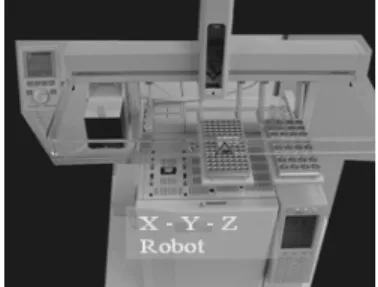
All tests have been carried out using the Shimadzu GC system coupled with a single quadrupole mass-spectrometer GCMS-QP2010 Plus equipped with the three-dimensional automated system for the injection of samples AOC-5000 (GCMS-QP2010 PlusxAOC-5000) (Figure 1).
Figure 1 Three-dimensional automated system for the injection of samples AOC-5000 (GCMS- QP2010xAOC-5000)
Applied method
In the case of injection of samples by the HS and SPME methods, the 20 ml vials have been used, in which 10 ml of sample and 4 g of NaCl were administered. For the solid phase, microextraction (SPME), the 100μm Carboxen-PDMS fibre was used, which provides the extraction of volatile and semi-volatile compounds on a concentration range from tenths of ppb up to tens of ppm (Mohamed, 2005).
For the identification, the general library of NIST-5 mass spectra and the FFNSC 1.3, a library which was specially developed for flavours and fragrances (available from Shimadzu Europa GmbH) were used. The accuracy of displacement has been verified according to the library of Covatz retention indices (MLRI). The analysis of the experimental data was carried out with the GC/MS Solution software (Shimadzu), which contains the SCAN/SIM options (Fast Automated Scan/SIM Type (FASST); creation of automatic SIM (Scan/SIM) table (COAST).
3. Results and discussions
of Compounds with Flavouring Potential of Wines
The reason for this phenomenon consists in the matrix effect of the majority components of wine - ethanol, organic acids, esters, and, in particular, glycerine, which has an extremely large trace. This fact demonstrates the minor sensibility of the GC/MS method with the injection of liquid samples directly into the capillary column for the analysis of wine components with flavouring potential (Van Wyk, 2006).
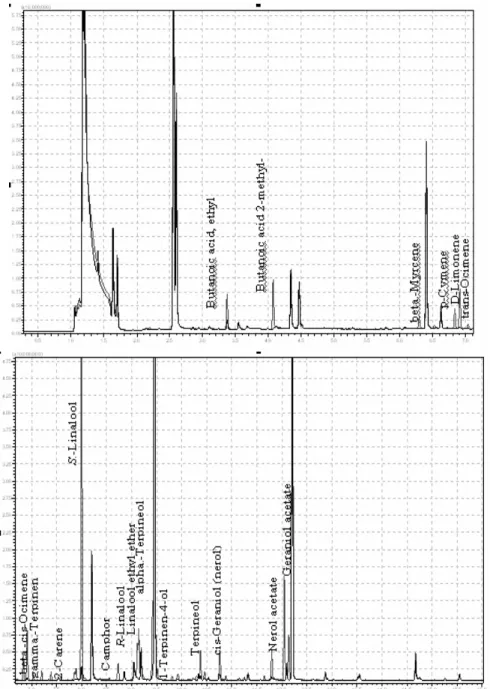
The differential analysis of the composition of raw material wine and of “variety” wine, made by the administration of "Muscat" naturally identical aromatizer using the GC/MS method with the injection of samples by HS method, demonstrates the presence of some significant differences (Figure 2).
Figure 2. The identification of differences between the composition of raw material wine (white) and “Muscat” wine using the GC/MS method with sample injection by HS method (the identified substances are lacking in the
In the "Muscat" wine, the presence of a range of monoterpenes (C10H16) is identified: beta-myrcen
(2,6,7-octatriene), p-cymen, D-limonen, beta (Z, E)-ocimene and terpineol. All these monoterpenes were identified in grapes of flavoured varieties (Sanchez-Palomo, 2005), although these are formed in insignificant amounts and are not of interest in the olfactory field. At the same time, they are part of the composition of essential oils extracted from exotic and flavoured plants: limonen - from lemons and oranges, terpinol - from coriander, myrcenelum - from Myrcia acris plant, ocimenum – from basil leaves, p-cymen - from camphor tree wood. The presence of an insignificant trace, from the point of view of intensity, but identified with certainty (camphor) demonstrates once again that the concerned monoterpenes were not formed in grapes, but come from essential oils extracted from plants (but in any case, they are not of synthetic origin).
The terpene monohidroxilic alcohols (terpenols) are the most important compounds with flavouring potential, because these represent volatile free flavours from aromatic grapes. From the quantitative point of view, they represent about 40-50% of dosed volatile aromatic substances, having a very low threshold of volatile perception, of 0,1-0,5 mg/L of wine (Rosillo, 1999). The main terpenols are linalool, geraniol, nerol, citronelol, hotrienol (HO-trienol, (5E)-3,5-dimethylocta-1,5,7-trien-3- ol) and
α
-terpineol. In the case of “Muscat” wine, obtained by using the naturally identical aromatizer, the presence of S-linalool and of ethyl ester of linalool was identified. The S-linalool trace abundance is maximum compared to other compounds with flavouring potential. The linalool presence has been identified in the essential oils of many plants (linaloil - a tree in Central America, orange, bergamot, rose, etc.). In the grapes of "Muscat" varieties, the linalool represents 53.4% of the total of terpenic alcohols, nerol and geraniol, that always accompany the linalool, represent only 17,6-31,8% (Van Wyk, 2006). In the examined case, the presence of nerol and geraniol acetate were detected, the abundance of traces being insignificant.The fatty acids and their volatile esters represent real indicators of the fermentation aroma, which prints the “vinous” character through odorous nuances of fruits. In the raw material wine, an important number of volatile esters of inferior fatty acids with short and medium chain have been found (Table 1).
The differential scanning of the chromatograms of raw material wine and “variety” wine allowed to detect an essential increase of the content of an ester with fruit aromatic notes: ethyl butanoate (pineapple).
As well, the presence of 2-ethyl methylbutanoate with apple aromatic nuance was detected (Figure 3). These two aromatic compounds, which characterize the wines of "Muscat" type, have an extremely
low olfactory perception threshold: 0.02 mg/l for the ethyl butanoate and 1μg/l for ethyl
methylbutyrate.
In the raw material wine, the 3-ethyl methylbutanoate is present, but the abundance of this trace is much lower than of its isomers found in wine with “variety” flavour. It is obvious that the presence of these two abundant traces in wine with “variety” flavour cannot be attributed to the accumulation of these compounds in grapes, a fact also confirmed by the difference between the two isomers.
The carried out research shows with certainty that the GC/MS technique with sample injection by the "Headspace" method, allows the assessment of qualitative and semi-quantitative composition of the substances with wine flavouring potential even in the absence of the respective standards. Meanwhile, the method also allows the detection of residues of contaminants or pollutants - for example, in the raw material wine, the signs of diethylftalat have been found.
of Compounds with Flavouring Potential of Wines
SPME is a solvent less extraction technique that can be used to extract analytes from both liquid and solid matrices. The quantitative use of this technique has been proven with the automatic robot. The use of SPME for the analysis of flavours and off-flavours in food and beverages is an important preparation tool.
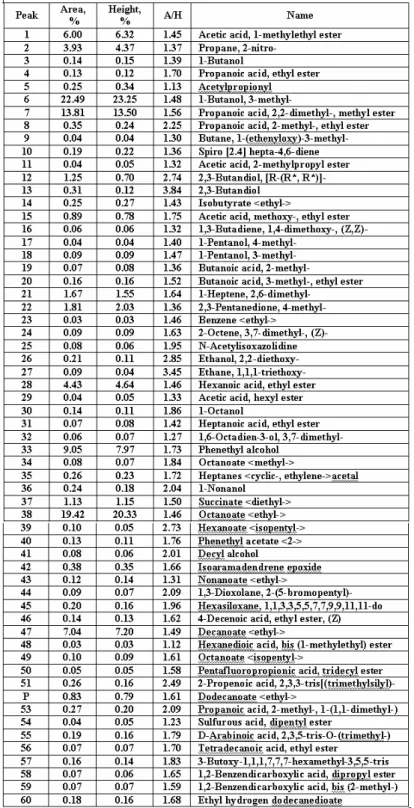
Table 1. The chemical composition of volatile fraction of raw material wine "Mixture of white European varieties"
In addition to the compounds detected by the "Headspace" sample injection method, the presence of the following monohidroxylic terpenic alcohols was reported: terpineol, alpha-terpineol and 1-terpinen-4-ol. The presence of nerol acetate was also additionally detected. The presence of these compounds with flavouring potential, although in insignificant quantities, demonstrates the natural origin of the used aromatizer (essential oils).
the analysis of compounds with wine flavouring potential, has certain drawbacks – the vapour phase composition varies essentially from the liquid phase composition. The volatility of components has a predominant role in this case.
Figure 3. The identification of differences between the composition of raw material wine (white) and “Muscat” wine using the GC/MS method with samples injection by the solid phase microextraction (SPME)
The testing of raw material wine "Mixture of European red varieties" using the GC/MS method with samples injection through the solid phase microextraction (SPME) has allowed the identification of 60 compounds, these belonging to different classes of substances (Table 2).
of Compounds with Flavouring Potential of Wines
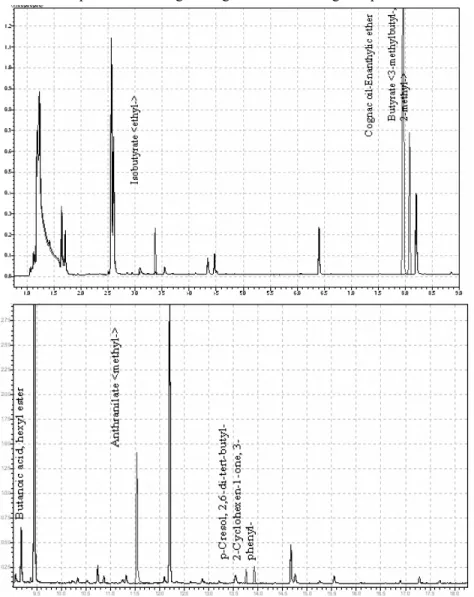
features) demonstrated the presence of the following traces (Figure 4). The presence of methhylanthranilat is attested – a component of the primary flavours of American hybrid grapes. The abundance of this trace is prevalent among the registered flavouring components.
Figure 4. The identification of the differences between the composition of raw material wine (red) and "Izabella" wine using GC/MS method with samples injection by the solid phase microextraction (SPME)
The ethyl izobutirat was found, an ester with a nuance of fruit and fusel flavour, which is characteristic for the wines of Muscatel type, with a very low threshold of olfactory perception - 0.02mg/L. Its presence in the composition of flavouring substances is not characteristic for the wines of Vitis Labrusca varieties. As well, two significant traces of enantilic and butyrate ether <3-methylbutil, 2-methyl-> were recorded - two chemicals of synthetic origin with pineapple flavour (enantilic ether) and fruit caramel (butyrate < 3-metilbutil-, 2-methyl->). The hexilic ester of the butanoic acid, present in extremely low quantity (pineapple flavour) can be of synthetic origin, but it is also detected in the composition of natural wines (Form No. 203-821-270 3/08, 2008).
flavouring compounds, but is included in the composition of the synthetic aromatizer for its antioxidant effect.
3-phenyl-2-cyclohexene-1-one also represents a synthetic compound that could be used as a solvent for p-Cresol, 2,6-di-tert-butyl.
of Compounds with Flavouring Potential of Wines
4. Conclusions
1. The carried out research has demonstrated that the usage of the GC/MS method with sample injection by "Headspace" method and with the solid phase microextraction (SPME) can be successfully applied to identify the aromatic profile of wines, to detect the wine counterfeiting (by using nature identical and synthetic aromatizers).
2. It is relatively easy to detect the origin of the aromatizer. In the case of the naturally identical, the presence of a greater number of traces, characteristic for substances with flavouring potential, has been detected. The number of components bearing flavouring potential is lower for the synthetic aromatizer (only 5 components bearing flavouring potential have been found), while other two chemical having nothing in common with flavouring substances but fulfilling various functions have also been recorded.
3. The sensitivity of the method decreases in the order to use the following analytical techniques for samples injection:
SPME > „Headspace” >> injection of liquid samples directly into the capillary column
4. The GC/MS method with the injection of liquid samples directly into the capillary column cannot be applied to identify the aromatic profile of wines, as in this case the effect of the matrix leads to the decrease of sensibility in the detection of substances that are present in very small quantities.
5. The GC/MS method with the samples injection by the solid phase microextraction provides a higher sensibility than the method of samples injection by application of the "Headspace" technique.
References
Analysis of Grape Volatiles by Solid Phase Microextraction and Comprehensive Two-Dimensional Gas
Chromatography with Time-of-Flight Mass Spectrometry (GCxGC-TOFMS). Form No. 203-821-270 3/08-
REV©2008 LECO Corporation MI 49085.
Bonino, M., Schellino, R., Rizzi, C., Aigotti, R., Delfini, C. and Baiocchi, C. 2003. Aroma compounds of an Italian wine (Ruche) by HS-SPME analysis coupled with GC-ITMS. Food Chemistry, 80, 125-133.
Favretto, D., Grandis G., Allegri, G. and Traldi P. 1998. SPME in combination with capillary gas chromatography and subsequent detection in the FID, Rapid Communications in Mass Spectrometry,12, 1595-1600.
Gocan, S. 1998. Cromatografia de gaze. In Cromatografia de înaltă performanţă Partea 1., Ed. Dacia, Cluj-Napoca.
Institutul Na ional pentru Viticulturăşi Vinifica ie din Republica Moldova. 2008. Realizări inovative în domeniul Viti-vinicol,
Edi ie specială a Conferin ei Interna ionale consacrate comemorării mc. AŞM Petru Ungureanu, 18-19 septembrie, Chişinău.
Mohamed, A., Menno, B., Hans-Ulrich, B., Rene, J.J. Vreuls, Brinckman Udo, A.TH., Comprehensive Two-Dimensional Gas Chromatography coupled to rapid-scanning Quadrupole Mass Spectrometer (GC×GC– qMS): Principles and Applications, Journal of Chromatography A, 1067(1-2), 4 March 2005, 245-254. Morales, ML, Gonzales, GA, Casas, JA, Troncoso, AM. 2001. Multivariate Analysis of Commercial and
Laboratory Produced Sherry Wine Vinegars: Influence of Acetification and Aging, Euopean Food Reseche Technology,212, 676-682.
Natera, R., Castro, R., Morena, M.V.G., Hernandez, M.J. and Barroso, C.G. 2003. Chemometric Studies of Vinegaerds from Different Raw Materials and Processes of Production, Agricultural and Food Chemistry, 51, 3345 – 3351.
Riberau-Gayon, P. 1998. Les composées phénoliques des végétaux, Dunod, Paris, p.410.
Rosillo, L., Salinas, M.R., Garijo, J. and Alonso, G.L. 1999. Study of volatiles in grapes by dynamic headspace analysis - Application to the differentiation of some Vitis vinifera varieties. Journal of Chromatography A, 847(1), 155-159.
Sanchez-Palomo, E. and Diaz-Maroto, C. 2005. Rapid determination of volatile compounds in grapes by HS-SPME coupled with GC–MS, Talanta, 66(5), 1152-1157.
Sîrghi, C., Zironi, R. 1994. Aspecte inovative ale enologiei moderne, Editura Sigma, Chişinău irdea, C. 2007. Chimia şi analiza vinului, Editura Ion Ionescu de la Brad, Iaşi.