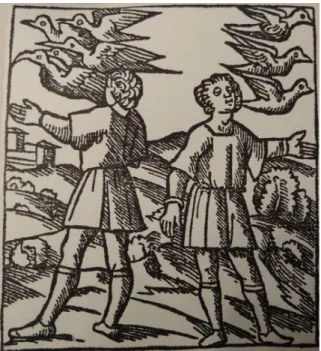
A Bird of the Heaven Will Carry Your Voice (Ecclesiastes 10:20): The Wisdom of
Tiarin
Um pássaro do céu vai levar a sua voz (Eclesiastes 10:20): a sabedoria de Tiarin Abraham Ofir Shemesh*
Ariel University | Ariel, Israel [email protected]
Abstract: The current study discusses the interpretation of the Midrash to Ecclesiastes 10:20: "for a bird of the heaven will carry your voice". The Midrash stresses that Ecclesiastes refers to receiving unknown information from birds. The foundation of the Midrash is that in ancient times people believed that hidden information is transferred from birds to humans through observation of their flight or listening to their cries.
Keywords: Ecclesiastes. Ornithomancy. Midrash.
Resumo: O presente estudo discute a interpretação do Midrash para Eclesiastes 10:20: "para uma ave do céu vai levar a sua voz". O Midrash enfatiza que o Eclesiastes se refere ao recebimento de informações desconhecidas das aves. A base do Midrash é que, nos tempos antigos, as pessoas acreditavam que as informações ocultas eram transferidas das aves para os seres humanos por meio da observação de seu voo ou da escuta de seus gritos.
Palavras-chave: Eclesiastes. Ornitomancia. Midrash.
A list of interpretations have been offered for Ecclesiastes 10:20: "Even in your thought, do not curse the king, nor in your bedchamber curse the rich; for a bird of the heaven (In the Revised Standard Version [RSV]: "A bird of the air") will carry your voice, or some winged creature tell the matter". The customary meaning is that one should not curse kings, ministers, or other powerful figures, even clandestinely, as there is a good chance that they will find out, since the birds in the sky above
might inform them of anything they hear.1 As Roland E. Murphy said, Ecclesiastes
referred earlier to the care that must be taken when dealing with rulers and their
* Senior Lecturer in Facultaty of Social Sciences and Humanities, Ariel University.
1 In Leviticus Rabbah, 32:2, the list of informative agents was expanded to include
inanimate objects: "A winged creature shall make the matter known – R. Levy said the road has ears and the wall has ears" – i.e., even elements such as walls and roads are suspected of communicating incriminating information. See MARGALIOT, 1993, p. 737.
mechanisms (see for example, Ecclesiastes 8: 2-4; 10:4), and our verse as well expresses concerns with regard to voicing anti-government opinions that might be
revealed. 2
The purpose of the current study is to discuss the interpretation of the midrash that Ecclesiastes means to receiving information from birds by divination i.e., to reveal something unknown or to prophesy the future (on the definition of divination see Bos 2017). As I shall show below the people in the ancient times believed that hidden information is transferred from birds to humans through observation of the birds' flight or by listening to their cries, a practice termed ornithomancy.
Review of the interpretations
The traditional commentators, as well as modern biblical scholars, grappled with the fundamental question that is key to understanding the verse – what is the meaning of the term "bird of the heavens"? Do the scriptures mean actual birds or is this a metaphor? Based on this question, the interpretations may be categorized as following three approaches:
a. Actual birds – According to the approach cited in the midrash aggadah, birds are indeed capable of absorbing knowledge, however they do not convey it to people rather to God, who understands the language of all His creatures: "In your bedchamber do not curse a king – do not curse the King of the World. And in your sleeping rooms do not curse a rich man – He who holds the riches of the world. For a
bird of the heavens shall carry the voice." 3 In other words, the birds are God's
informative agents and at His beck and call. They convey information about the deeds of humans and this act reflects their role as His servants. The concept of the creatures as performing missions on behalf of God is an element that appears in various sources, for example Psalms 104:4.
Scholars such as Scott, Barton, and Zer-Kavod have suggested that the verse be
interpreted literally, i.e., that birds convey secrets to people. 4Gordon suggested that
these are carrier pigeons used by spies to communicate information, however some
claim that carrier pigeons were first employed only in the Greco-Roman period.5
b. "Bird of the heavens" is a metaphor for metaphysical entities – Another approach suggests understanding "bird of the heavens" and "winged creature" not literally, rather as a metaphor for divine informative agents. Several midrashic traditions
2MURPHY, 1992, p. 106.
3 MARGALIOT, 1953-1958, 32:2, p. 737.
4 SCOTT, 1965, p. 250; BARTON, 1993, p. 176: "The mysterious paths by which secrets
travel attributed to the agency of birds"; ZER-KAVOD, 996, p. 66.
5 GORDON, p. 105. On carrier pigeons in ancient world see BODENHEIMER, 1956,
ascribe the transfer of information to supreme forces that are not under human control. One of these perceives the bird of the heavens as a metaphor for God, who
reveals the secret inequities of sinners who fear public realization of their sins. 6
Another midrash claims that the birds of the heavens are angels who are aware of
human deeds,7 while yet another identifies "winged creature" as a transcendental
entity designated thus, who in the night transfers to God knowledge of one's deeds
during the daytime. 8 According to this approach, there is a hierarchy within
information transferred from humans to God. The knowledge is transferred in stages and through agents, from a low element to a higher element. The highest element in charge of communicating the information to God is the "winged creature".
c. A metaphor for human spies – Hartom and Gordon suggested interpreting the verse as referring to methods of exposing hidden information in the ancient world of
internal and external espionage. 9 "Bird of the heavens" is an analogy for spies who
work in the secret service of rulers. Examples of external spying are the spies sent by Moses to explore the Land of Canaan (Numbers 13:1-29) and the spies sent by Joshua (Joshua 2:24). Internal spying appears in the Book of Esther – Mordechai informs Esther of the agreement between Haman and Ahasuerus to destroy the Jews of the Persian kingdom (Ester 4:7) and he also gives Esther information about the gatekeepers' intention to assassinate the king (Ester 2:21-23).
As part of their duties spies are "planted" in key positions within government systems, in the kingdom or externally, and they might receive sensitive information and pass it on to their senders. Similar to birds who do not arouse one's concerns, "innocent" people who do not arouse suspicion might be hidden spies who provide incriminating information to the authorities.
Wisdom of the tiarin – revealing hidden information by the birds of the heavens In Midrash Tehilim the verse "for a bird of the heaven will carry your voice, or some winged creature tell the matter" is explained as the concern that hidden information will be revealed through ornithomancy:
6NUMBERS RABBAH, 9:12, p. 53.
7 DEUTERONOMY RABBAH, 6, 10, p. 224. Compare to Rashi's interpretation of
Ecclesiastes, where he ascribes the communication of information to one's soul or to the angel that escorts every human being: "A bird of the heavens - the soul, which is placed within you, which will ultimately fly up to the heaven. And a winged creature - the angel who escorts you."
8 MARGALIOT, 1953-1958, 32:2, p. 737.
For a bird of the heavens shall carry the voice (Ecclesiastes 10:20), R. Jeremiah said:
This is the raven, wisdom of the tiarin.10
Midrash Tehilim is indeed a late midrash, but it gathered material from ancient
midrashim, and this lends it authority as a preserver and documenter of ancient
customs. 11The tradition brought in the name of R. Jeremiah, one of the greatest Eretz
Israel amoraim of the third and fourth generation, ascribes "carrying the voice" to the
"wisdom of the tiarin", i.e., "wisdom of the birds".12 The word tayyar (in plural: tiarin)
comes from Aramaic and it means bird, fowl, i.e., in the midrash context -
ornithomancy.13 According to the midrash, divination refers specifically to ravens
because they had a major role in this branch of the occult (see below).
Divination using birds was considered as an important wisdom in the ancient world because of its practical applications. In the next lines, I shall introduce the historical background of Ornithomancy and its uses.
Ornithomancy in ancient times
The practice Ornithomancy was common among civilizations and faiths in ancient
times.14 Omens and signs were determined using a variety of animals, however, birds
omens received special significance among the animal world. 15 Prophesying by
means of birds was customary among the Hittites in Anatolia, ancient Egyptians and
in Mesopotamia.16
The omens and signs were determined using a variety of animals, such as ants, bees,
snakes, scorpions, an oryx, a fox, farm animals.17 Bird omens received special
significance among the animal world, although less valued than divination by
reading the liver, heavenly bodies, or drops of oil.18
10 BUBER, 1891, 7:1, 31b.
11On this Midrash and the period in which it was written see FRANKEL, 1993, v. 3, p.
1104.
12 In Arabic bird, fowl=ﺮِﺋﺎَط , ﺮْﯿَط, in plural: رﻮُﯿُط. On the meaning of the word tiarin in
Arabic see ALMALIAḤ, 1929, p. 422, entry ﺮْﯿَط.
13 JASTROW, 1985, p. 531; SOKOLOFF, 1990, v. II, p. 223. It should be noted that in
Arabic as well bird, fowl=ﺮِﺋﺎَط ,ﺮْﯿَط, in plural: رﻮُﯿُط. (ALMALIAḤ, 1929, p. 422, entry
ﺮْﯿَط).
14 BOISSIER, 1905-1906, p. 73-109; HALLIDAY, 1967, p. 246-247.
15 BODENHEIMER, 1950, p. 143-152.
16 DIODORUS, 1933, I, 7; BURKERT, 1992, p. 42; BOISSIER, 1905-1906, p. 73-109;
BODENHEIMER, 1950, p.143-152; OPPENHEIM, 1977, p. 219-220; REINER, 1995, p. 86-87; SAKUMA, 2013.
17 HERODOTUS, 1926, I, 78; PLINY 1961, XI, 55.
In classical times, the time which the midrashim were began to be created, divination and mantic practices occupied an important place in culture and religion. Ornithomancy dates back to early Greek times. It was mentioned in the texts of
Hesiod and Homer, as well as in on Archaic vases.19 observations were a vehicle for
interpreting the attitude of the gods towards public actions and decisions, and a means of knowing whether a certain course of action was fated to succeed or not One conspicuous example from the history of the classical world is the legend of Romulus and Remus, the founders of Rome, who decided that the location of the city would be determined by observing the flight of eagles. Remus, who looked in one direction, saw six eagles, while Romulus, who looked in the other, saw twelve, and demanded
the right to set the location (Figure 2).20
Figure 2: Romulus and Remus, the founders of Rome, deciding the location of the city by observing the flight of eagles.
Ornithomancy was popular all over the Mediterranean area, and it was a practice
used for both civil and military purposes.21 The success of a military campaign or
course of action were determined by a diviner who preceded the army and signaled to the commanders whether to proceed or not based on the flight of the birds (alites)
and their cries (oscines).22
19 BURKERT, 1985, p. 112; LUCK, 1985, p. 250-251; POTTER, 1994, p. 58-206;
BERCHMAN, 1998, p. 9-45; BONNECHERE, 2010, p. 151.
20 PLUTARCH, 1914, The Parallel Lives, v. I, 9, 4-5, LCL edition, p. 116.
21 CICERO, 1923, I, 41, 91; 42, 94.
22 HALLIDAY, 1967, p. 246-247; POTTER, 1994, p. 152-154; POLLARD, 1977, p.
The Greek and Romans attributed prediction or revealing hidden information to ten or twelve species of birds. The most prominent of which are the hawk, the falcon, the owl, the eagle, the cock, and the raven, and in special cases also imaginary birds (See
figure 2). 23 The caw of the raven (Corvus sp.) was considered an omen of disaster,
death, or the failure of royal campaigns. The flight of the raven was also meaningful,
for instance if it flew to the right or to the left.24 Greek authors relate that diviners
who followed the flight of birds used Romulus' lituus to mark out a ritual space in
the sky (see figures 2, 3, 4).25
Figure 2: Roman augurs observing hen. The woman in the middle is holding a lituus, a curved wand which often used as a symbol of augury on Roman.
Figure 3: Roman coin, Minted in 135 BCE. In the right side, an augur holding a lituus to mark out quadrants of the sky for receiving bird signs.
23 HALLIDAY, 1967, p. 270; POLLARD, 1977, p. 116-129.
24 TRANQUILLUS, 1889, DOMITIANUS, 23; CASSIUS DIO, 1924, LVIII, 5, 5.
Figure 4: A lituus as cult instrument, in this coin celebrating the pietas of the Roman Emperor Herennius Etruscus.
Discussion and Conclusion
Ornithomancy was not mentioned explicitly in the Bible, however it has diverse representations in post-biblical literature, such as in midrashic literature. Midrash Tehilim interprets the verse "for a bird of the heaven will carry your voice, or some winged creature tell the matter" in Ecclesiastes 10:20 as the concern that hidden information will be revealed through ornithomancy.
The belief that birds convey messages, omens, and signs that predict the future or hold hidden information appears in both Jewish and non-Jewish ancient sources. The Midrash Tehilim we discussed indicate that Jewish sages perceived the practice of ornithomancy as a type of wisdom which has validity, although they expressed
reservations because it is contrary to Jewish law26.
The reliability of ornithomancy was disputed by scholars in the Greek and Roman
world. 27 Some claimed that it is not that the birds themselves know the future or
hold in hidden information but rather the gods communicate various matters
through them. 28 In contrast, Greek philosophers with their typical stoic outlook, such
as Diogenes of Babylon (c. 230 – c. 150/140 BCE) and Panaetius of Rhodes (c. 185-110 BCE), dismissed and scoffed at the claim that the gods convey omens through animals, as this technique is considered to be inappropriate for the gods and
disrespectful, and the gods would not wish to appear to humans in this way.29
The validity of ornithomancy also constituted a focus of Jewish-Gentile debates. Josephus Flavius, who lived during the destruction of the Second Temple in the first century CE, quotes Hecataeous of Abedra, who relates the story of a Jew who publicly mocked non-Jews for their belief in divination with birds, as it has no logical basis. Josephus tells of an incident that occurred during one of Alexander the Great's
26 LIEBERMAN, 1955, p. 27.
27 BAR-KOCHVA, 1996, p. 323-341, especially pp. 332-334.
28 XENOPHON, 1923, Book I, 1, 3-4.
29 On the attitude of these philosophers towards divination by ravens see CICERO,
war campaigns in the fourth century BCE. The Greek army made use of an "augur" who observed the birds and decided how and when to advance based on their movements. Among the warriors was a Jewish mercenary called Mosollamus who told the augur that his instructions are useless and was consequently strongly criticized by the soldiers, who perceived augury as a legitimate act of military intelligence. Flavius writes:
Among the escort of Jewish cavalry which accompanied us was one named Mosollamus, a very intelligent man, robust, and, by common consent, the very best of bowman, whether Greek or barbarian. This man, observing that a number of men were going to and fro on the route and that the whole force was being held up by a seer who was taking the auspices, inquired why they were halting. The seer pointed out to him the bird he was observing, and told him that if it stayed in that spot it was expedient for them all to halt; if it stirred and flew forward, to advance; if backward, then to retire. The Jew, without saying a word, drew his bow, shot and struck the bird, and killed it. The seer and some others were indignant, and heaped curses upon him. 'Why so mad, you poor wretches?' he retorted; and then, taking the bird in his hands, continued, 'Pray, how could any sound information about our march be given by this creature, which could not provide for its own safety? Had it been gifted with divination, it would not have come to this spot, for fear of
being killed by an arrow of Mosollamus the Jew.30
Mosollamus claimed that the technique of observing the birds is futile, as the birds have no knowledge of future events. Moreover, he used his bow and arrow to shoot down the bird on which the augur based his prophecies, in order to prove that it is a vulnerable creature that lacks metaphysical value. In this story, Mosollamus indeed did not cite his Jewish faith as the basis for his objections, but as claimed by researcher Aryeh Kasher, through the story of Mosollamus the Jew Josephus sought
to "proudly represent the Jewish faith, whose norms on this subject were ancient." 31
However, the authenticity of this story was doubted even by the sages in the classical era. Several modern researchers are convinced that the description of the wise Jew who ridicules the superstitions of the idolatrous nations shows that its author could not have been Hecataeous of Abedra, known as one of the greatest Hellenistic
ethnographers, and the author was probably Jewish. 32
30 JOSEPHUS, 1926, v. 1, Book I, 22, p. 245.
31 KASHER, v. 1, p. 209.
References
ALMALIAḤ, Abraham. Hebrew-Arabic – Arabic-Hebrew Dictionary. Jerusalem, 1929. [Heb.]
BAR-KOCHVA, Bezalel. Meshulam the Jew, the Greek Mantic and Hecataeus of Abdera. In: GAFNI, Isaiah M.; OPPENHEIMER, Aharon and SCHWARTZ, Daniel (Eds.). The Jews in the Hellenistic Roman World: Studies in Memory of Menaḥem
Stern. Jerusalem: Zalman Shazar Center, 1996. p. 323-341. [Heb.]
BARTON, George A. The Book of Ecclesiastes. The International Critical Commentary (ICC). Edinburgh: T& T Clark, 1993.
BERCHMAN, Robert M. Mediator of the Divine: Horizons of Prophecy, Divination,
Dreams and Theurgy in Mediterranean Antiquity. Atlanta: Scholars Press, 1998.
BODENHEIMER, Shimon Frits. Animals in Biblical Lands. I-II. Jerusalem: Mossad Bialik, 1950-1956. [Heb.]
BOISSIER, Alfred. Choix de textes relatifs à la divination assyro-babylonienne. Genève:
Henry Kündig, 1905–1906.
BOS, Gerrit. Jewish Traditions on Magic with Birds (Ornithomancy).
<https://www.academia.edu/13127246/Jewish_Traditions_on_Magic_with_Birds_Orn
ithomancy?_auto=download. 10.9.2017>.
BONNECHERE, Pierre. “Divination”. In: Ogden, Daniel (Ed.). A Companion to Greek
Religion. UK: Wiley-Blackwell, 2010.
BUBER, Solomon. Midrash Tanḥuma. Vilna: Re'em 1885.
BUBER, Solomon. Midrash Tehilim (Shocher Tov). Vilna: Re'em 1891.
BURKET, Walter. Greek Religion. Cambridge: Harvard University Press, 1985.
BURKET, Walter. The Orientalizing Revolution: Near Eastern Influences on Greek Culture
in the Early Archaic Age. PINDER, Margaret E. and BURKERT, Walter (trans.).
Cambridge: Harvard University Press, 1992.
CASSIUS DIO, Roman History. Herbert B. Foster (trans.). Loeb Classical Library. Cambridge: Harvard University Press, 1924.
CICERO, On divination. William Armistead Falconer (trans.). Loeb Classical Library. Cambridge Mass. and London: Harvard University Press, 1923.
DEUTERONOMY RABBAH, Vilna: Re'em. 1885-1887.
DIODORUS SICULUS. The Library of History. Loeb Classical Library. Cambridge: Mass.: Harvard University Press, 1933.
ECCLESIASTES RABBAH. Vilna: Re'em. 1885-1887.
GORDON, Samuel Leib. Five Scrolls with New Commentary: Ecclesiastes. Tel Aviv: Masada (The year is missing). [Heb.]
HALLIDAY, William Reginald. Greek Divination: A study of its Methods and Principles. Chicago: Argonaut, 1967.
HARTOM, Eliya Samuel. Bible: Five Scrolls. Tel Aviv: Yavne, 1975.
HERODOTUS. The Histories. Denis, Alfred Godley (trans.). Loeb Classical Library. Cambridge, Mass: Harvard University Press, 1926.
JASTROW, A Dictionary of the Targumim, The Talmud Babli and Yerushalmi, and the
Midrashic Literature. New York: Judaica Press, 1985.
JOSEPHUS, Against Apion, H. St. J. Thackeray (trans.). Loeb Classical Library. Cambridge Mass. and London: William Heinemann and Harvard University Press, 1926.
KASHER, Arye. Josephus, Against Apion. Jerusalem: Zalman Shazar Institute, 1996. LIEBERMAN, Saul. Tosefta Sabbath. New York: Jewish Theological Seminary, 1955. LUCK, Georg. Arcana Mundi: Magic and the Occult in the Greek and Roman Worlds: A
Collection of Ancient Texts. Baltimore: Johns Hopkins University Press, 1985.
MARGALIOT, Mordechai. Leviticus Rabbah. New York and Jerusalem: The Maxwell Abbell Publication Fund and The Jewish Theological Seminary of America, 1993. MURPHY, Roland E. Ecclesiastes. World Biblical Commentary (WBC), v. 23A. Texas: Thomas Nelson, 1992.
NUMBERS RABBAH, Vilna: Re'em, 1878.
OPPENHEIM, Adolf Leo. Ancient Mesopotamia: Portrait of a Dead Civilization. Chicago: University of Chicago Press, 1977.
PLINY, Gaius Secundus. Natural History. Rackham, Harris (trans.). Loeb Classical Library. Cambridge, Mass.: Harvard University Press, 1961.
PLUTARCH. The Parallel Lives. Loeb Classical Library. Cambridge, Mass.: Harvard University Press, 1914.
POLLARD, John. Birds in Greek Life and Myth. London: Thames & Hudson, 1977. POTTER, David Stone. Prophets and Emperors: Human and Divine Authority from
Augustus to Theodosius. Cambridge: Harvard University Press, 1994.
REINER, Erica. Astral Magic in Babylonia, Transactions of the American Philosophical
Society. New Series, v. 85 [4]. Philadelphia: The American Philosophical Society, 1995.
SAKUMA, Yasuhiko. Terms of Ornithomancy in Hittite. Tokyo University Linguistc
SCOTT, Robert Balgarnie Young. The Anchor Bible, Proverbs-Ecclesiastes. Garden City, New York: Doubleday & Co., 1965.
SOKOLOFF, Michael. A Dictionary of Jewish Palestinian Aramaic of the Byzantine Period
Dictionaries of Talmud, Midrash and Targum. Ramat-Gan: Bar Ilan University, 1990.
[Heb.]
TRANQUILLUS, Suetonius C. The Lives of the Twelve: Domitianus, Alexander Thomson (ed.). Philadelphia: Gebbie & Co., 1889.
XENOPHON, Memorabilia (E. C. Marchant, ed.) Cambridge and London: Harvard University Press, MA and William Heinemann, Ltd., 1923.
ZER-KAVOD, Mordechai. Ecclesiastes, Da'at Mikra: Five Scrolls. Jerusalem: Mosad Ha-Rav Kook, 1996.
---
Recebido em: 29/01/2018. Aprovado em: 02/03/2018.