1 State U niversity of Goias, U nUCET, Anapolis, Goias, Brazil, Fone: + 55(62) 3328-1160. E-mail: [email protected] 2 Agricultural Eng. D ept. Federal University of Viçosa, Viçosa, MG, Brazil. E-mail: [email protected]; [email protected]
3 Animal Biology D ept. Federal University of Vicosa, Viçosa, MG, Brazil. E-mail: [email protected]
Electric signals for separation
of earthworms (
Eudrilus eugeniæ
)
M aria J. de M oraes1, D elly O liveira Filho2, José H . M artins2 & Luiz C. Santos3
A BST RA C T
The w orm Eudrilus eugeniæ is a species adapted to tropical climates and is highly demanded as fishing bait, therefore possessing high economic value. Separation of worms from humus is typically performed by manual, mechanical, behavioral and electric methods. The objective of this study was to characterize electric pulses for separation of worms (Eudrilus eugeniæ) from humus. To determine separation efficiency of worms from humus, a controlled pulse generator was used with frequencies of 1 and 5 Hz, voltages of 100 and 200 V, peak widths of 2, 3 and 4 x 10⁻³ s and exposure times of 15 and 30 min. The electrical pulse characteristics w hich resulted in greatest separation efficiency were: 1 Hz, 2 x 10⁻³ s and 200 V; and the maximum displacement index was 80% w hich occurred under these conditions. The survival index was 100% for the pulses w hich resulted in the greatest separation indices.
Key w ords: vermiculture, vermicomposting, electric stimulation
Sinais elétricos para a separação
de minhocas (Eudrilus eugeniæ
)
RESU M O
A minhoca (Eudrilus eugeniæ) é uma espécie adaptada ao clima tropical, razão pela qual é bastante demandada como isca para pesca e tem grande valor econômico na atualidade. N ormalmente, a separação de minhocas do húmus é realizada por método manual, mecânico, comportamental e elétrico. O objetivo desta pesquisa foi, caracterizar pulsos elétricos na separação de minhocas (Eudrilus eugeniae) do húmus. Para determinar a eficiência de separação de minhocas do húmus foram utilizados um gerador de pulsos controlados com: frequência de 1 e 5 Hz, tensões de 100 e 200 volts, duração do patamar de 2, 3 e 4 x 10⁻³ s e tempo de exposição de 15 e 30 min. As características elétricas dos pulsos, que resultaram na maior eficiência de separação, foram: 1 Hz, 2 x 10⁻³ s e 200 V. O índice de deslocamento máximo foi de 80%, ocorrendo na frequência de 1 Hz, com patamar de pulso de 2 x 10⁻³ s e tensão de 200 V. O índice de sobrevivência foi de 100% para os pulsos que resultaram em melhores índices de separação.
Palavras-chave: vermicultura, vermicompostagem, estimulação elétrica Revista Brasileira de
Engenharia Agrícola e Ambiental v.16, n.10, p.1137–1142, 2012
I
NTRODUCTIONThe production of earthworms is an activity that has been developed and perfected since the 1940’s in countries such as the United States and England. This activity is geared towards the management of solid wastes, commercialization of bait, production of animal feeds, as well as improving soil fertility and soil detoxification, and the production of vermicompost (Sinha et al., 2002). Worm production is an activity perfectly adapted to the small scale due to its simple management, emerging as a small income source for family farms, depending only on physical space and availability of organic material, but principally labor (Shiederck et al., 2006).
Human activities have caused an increase in the production of organic residues both in rural environments and urban cen ter s. Th ese r esidues cause lar ge en vir on men tal contamination problems, therefore there exists the need to eliminate or utilize these residues. One of the alternatives for use of these organic residues has been vermicomposting, which produces material that can be used to increase soil fertility and consequently diminish consumption of mineral fertilizers. This is because the worms play an important role in modifying chemical, physical and microbiological properties of the soil and in the decomposition of organic material. They also increase the infiltration rate, aggregate stability and macro porosity of the soils (Blanchart et al., 2004; Arancon et al., 2006; Johnson-Maynard et al., 2007).
Vermicomposting is a recycling process in which organic material is digested by the worms and excreted in the form of humus. Thus it is an organic material stabilization process due to the combined action of worms and microorganisms, being a natural, profitable and fast process, lasting one to two weeks (Adi & Noor, 2009).
While the bacteria biochemically degrade organic material, the worms drive the process, preparing the substrate and altering its biological activity (Suthar, 2009). The final product, denominated vermicompost (humus), contributes to greater vegetation growth and consequently an increase in productivity (Atiyeh et al., 2002). Desirable aesthetic characteristics and low concentration of contaminants makes commercialization of this product favorable (Ndegwa & Thompson, 2001).
Vermicomposting is an excellent alternative for reduction of environmental impacts, playing an important role in the bioaccumulation of heavy metals, aiding in the reduction of organic trash volumes and contributing to the treatment of pollutants, thus diminishing public health problems (Steffen et al., 2006).
Among the worm species utilized in the vermicomposting process, Eudrilus eugeniæ (African Nightcrawler) and Eisenia fœtida (California Redworm) are highlighted. The African nightcrawler is a species of the Eudrilidæ family, adapted to the tropical climate with an ideal temperature ranging from 10 to 30 °C. They present an average length of 20 to 22 cm while reaching up to 37 cm and weighing up to 6.5 g after 130 days of life and are commercialized as fishing when measuring 13 to 15 cm (Dominguez et al., 2001). The California red worm not only presents rapid growth but also great proliferation and consumes large quantities of organic material (Aquino et al., 1994).
The process of separating worms from humus requires great care. Its rationalization can significantly contribute to increase the economic attractiveness of vermiculture. Selection of the method principally depends on the destination of the worm, either for sampling or commercialization.
The methods commonly used today are manual, mechanical and behavioral, all presenting some inconveniences; manual collection requires significant labor and presents efficiency limited to small samples (Coja et al., 2008). Mechanical methods utilize revolving and/or vibrating sieves can injure the worms during extraction which complicates distinction between live and dead worms during collection (Bouma et al., 2001). Behavioral or dynamic methods aim to induce the animals to leave the substrate by the influence of stimuli such as heat, desiccation, electric shocks, inundation or chemical repellents, often being slow and can injure the animals (Bouma et al., 2001).
Rushton & Luff (1984), when evaluating separation of worms using electricity, used a fixed soil volume to which an electric field was administered and included one ring shaped electrode and another central electrode. The outer ring and the central electrode were connected to a transformer with a variable output from 1 to 240 V and current varying between 1 and 10 A. As a result the worms were repelled by the action of the electric field and the method showed to be most efficient on young worms.
Chaoui & Keener (2008), aware of the influence of an electric field on these animals, sought to develop a mathematical model which describes the efficiency of the electric field to repulse the worms and identify the factors that possibly affect movement of these animals, such as depth and spacing between the electrodes, current level and worm species.
The objective of the present study was to verify viability of controlled electric pulses used for efficient separation of
Eudrilus eugeniæ worms present in bovine manure humus.
M
ATERIAL ANDMETHODSThe experiment was performed at the Department of Agri-cultural and Environmental Engineering at the Universidade Federal de Viçosa. African night crawlers (Eudrilus eugeniæ) were used, provided by the Worm Farm at the Department of Animal Biology of the Universidade Federal de Viçosa, in Viçosa, Minas Gerais, Brazil.
The pulse was produced by a pulse generator normally used in electric fishing whose pulse width varied from 0.1 to 8 ms, voltage from 100 to 1000 V and frequency from 1 to 120 Hz. This pulse type is variable with time and presents a rapid vertical rise and gradual descent, as shown in Figure 1.
The experimental setup utilized in the statistical analysis was based on the combination of the three pulse widths (2, 3 and 4 x 10⁻³ s, two frequencies (1 and 5 Hz), two exposure times
(15 and 30 min) and two voltages (100 and 200 V), comprising a 3 x 2 x 2 x 2 factorial. Experiments were conducted in a completely randomized design with 4 replications. Effect of the treatments was evaluated in relation to the displacement index.
R
ESULTSANDDISCUSSIONIt is important to say that the subject of this research is pretty much not covered by the scientific literature and by the authors’ knowledge no other paper had discussed the effect of controlled electrical pulses for earthworm separation with the type of signal used in this research. But it is important to mention, that previously different investigators had researched with other types of electrical signals such as sinusoidal current and direct current (Rushton & Luff, 1984; Chaoui & Keener, 2008; Coja et al., 2008).
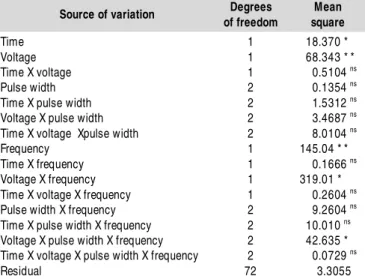
The main statistical analysis done was the study of the variance for the displacement index in function of the factors: exposure time, frequency, voltage and pulse width on the species Eudrilus eugeniæ. It was observed that the interaction between these four factors was insignificant, while interactions involving voltage, pulse width and frequency were significant at 0.05 probability, indicating that exposure time did not influence the displacement index; the effect of time was independent. The remaining factors were considered based on the following combinations. The exposure time was significant at 0.01 by the F test, showing that the average displacement index increased as the exposure time increased from 15 to 30 min. Table 1 summarize the statistical analysis performed.
In a complementary research Oliveira Filho et al. (2005) working with the same type of signal, same frequency observed that for a different glass container with dimensions similar to the commercial earthworms production, i.e. 0.90 m
Period
Pulse width
V
o
lt
ag
e,
V
10-3 S, Time
Figure 1. Pulse format produced by the controlled pulse generator
After the determined exposure time, the circuit was deactivated and a separation structure was introduced to the test recipient. This separation structure presented dimensions of 500 x 500 mm, being divided in 100 x 100 mm meshes with a height of 50 mm, totaling 25 square cells organized in 5 rows parallel to the electrodes (Figure 2). The separation structure was made of 1 mm galvanized steel, and after exposure to the electric signals, it was used to verify the position of each worm in relation to the 25 separation cells and consequently the pertaining row. Equation 1 was then used to determine the dislocation index which varied from -10 to 10, when -10 indicated dislocation in the direction of the cathode and 10 being dislocation in the direction of the anode.
Id =
m( n−3)
2 q
n = 1 p
n = 1
where:
Id - dislocation index
p - number of rows considered (5)
q - number of worms in each of the 5 rows after the exposure time
m - number of worms encountered in each of the 5 rows of square cells
n - location of the worms in relation to the rows of square cells
Figure 2. Test recipient wi th separation structure
Legend:
1. electrode cathode 2. electrode anode 3. test recipient 4. 1st row
5. 2nd row
6. 3rd row
7. 4th row
8. 5th row
* and * * significant at 0,01 and 0,05 probability, respectively. ns - not significant
Source of variation Degrees of freedom
Mean square
Time 1 018.370 *
Voltage 1 068.343 * *
Time X voltage 1 000.5104 ns
Pulse width 2 000.1354 ns
Time X pulse width 2 001.5312 ns
Voltage X pulse width 2 003.4687 ns
Time X voltage Xpulse width 2 008.0104 ns
Frequency 1 145.04 * *
Time X frequency 1 000.1666 ns
Voltage X frequency 1 319.01 *
Time X voltage X frequency 1 000.2604 ns
Pulse width X frequency 2 009.2604 ns
Time X pulse width X frequency 2 010.010 ns
Voltage X pulse width X frequency 2 042.635 *
Time X voltage X pulse width X frequency 2 000.0729 ns
Residual 72 3.3055
Table 1. Analysis of variance for the displacement index in function of exposure time, frequency, voltage and pulse width
length, 0.50 m width and 0.30 m of substrate and with earthworms and observed that the time of exposition to the controlled electrical pulses was significant to the amount of displaced earthworms.
Table 2 presents the average displacement indices for the voltages studied in each combination of frequency and pulse width. It was observed that nearly all displacement indices for each voltage, in the combinations of frequency and pulse width, were significant, except in combination C3. At the same frequency, the displacement index for combinations C1 and C2 increased as a function of voltage; the other combinations presented the opposite behavior, where an increase in voltage caused a reduction in the displacement index. It was verified that the greatest observed displacement index was for combination C1 with a voltage of 200 V, yet the displacement indices in combinations C2 for a voltage of 200 V and C3, C4 and C5 for a voltage of 100 V were all greater than 7. The lowest index occurred in combination C5 with voltage of 200 V. All displacement indices were positive, signifying that in all combinations the worms were directed towards the anode after the predetermined exposure period.
* and * * significant at 0,01 and 0,05 probability, respectively, (ns) not significant
Sources of variation Degrees of freedom Mean squares Voltage
(V) - 100
Frequency (Hz) - 1
Voltage (V) - 100
Frequency (Hz) - 5
Voltage (V) - 200
Frequency (Hz) - 1
Voltage (V) - 200
Frequency (Hz) - 5
Linear 01 50.7650* * 30.2000 * * 8.2656 ns 02.2005 ns
Quadratic 01 00.1302 ns 04.0833 ns 1.1718 ns 14.0830*
Residual 72 03.3055 03.3055 3.3055 03.3055
Table5. Analysi s of vari ance of the di splacement index in function of pulse width in the combi nations of vol tage and frequency
Table 2. Average displacement indices at the studied voltages for each of the frequency and pulse w idth combinations Interaction combinations Frequency (Hz) Pulse width (10-3 s) Voltage (V) 100 200
C1 1 2 3.75a 8.00 b
C2 1 3 5.37a 7.75 b
C3 1 4 7.31a 6.56 a
C4 5 2 7.75a 1.50 b
C5 5 3 7.25a 0.25 b
C6 5 4 5.00a 2.25 b
Means follow ed by the same letter in the same line for each voltage do not differ at a probability of 0,05, by the F test
Table 3. Average displacement indices at the studied frequencies i n each of the combi nations of vol tage and pulse width
Interaction combinations
Voltage (V)
Pulse width duration ( x 10-3
s)
Frequency (Hz)
1 5
C70 100 2 3.75a 7.75 b
C80 100 3 5.37a 7.25 b
C90 100 4 7.31a 5.00 a
C10 200 2 8.00a 1.50 b
C11 200 3 7.75a 0.25 b
C12 200 4 6.56a 2.25 b
Means followed by the same letter in the same line for each frequency do not differ at a probability of 0,05, by the F test
Table 4. Average displacement indices at the studied pulse widths in each of the combinations of voltage and pulse width Interaction combinations Voltage (V) Frequency (Hz )
Pulse width (10-3 s)
2 3 4
C13 100 1 3.75 5.37 7.31
C14 100 5 7.75 7.05 5.00
C15 200 1 8.00 7.75 6.56
C16 200 5 1.50 0.25 2.25
Table 3 shows the average displacement indices at the studied frequencies for each combination of voltage and pulse width. It was observed that displacement indices in function of the frequencies 1 and 5 Hz in the combinations of voltage and pulse width which presented no significant effect were the results of combination C9 (voltage of 100 V and pulse width of 4 ms). Displacement indices in the combinations C7 and C8 increased with an increase in frequency. In the other displacement indices this effect was inversed, showing a decrease. But when the tension increased to 200 V and the frequency to 5 Hz there were a decrease of the displacement index observed. According to Oliveira Filho et al. (2004),
studying at the same frequency and electrical tension observed that the most significant response for the animals’ displacement was for the frequency of 1 Hz. For the frequency of 5 Hz and tension of 200 V the results were not significant, probably due to the fact that at that tension the animals may have been injured and under greater stress.
In Table 4 the average displacement indices are presented for the pulse widths of 2, 3 and 4 ms, within the voltage combinations of 100 and 200 V and frequency of 1 and 5 Hz. This table also presents a summary of the corresponding analysis of variance.
It is verified in Tables 4 and 5 that combination C13 resulted in a significant increase in the average displacement index with the increase in pulse width for the combination of 100 V, 5 Hz and 200 V; at the frequency of 1 Hz the opposite was observed, where the increase in pulse width caused a decrease in the average displacement index, but only in the combination of 100V and 5 Hz was this reduction significant. In the combination of 200 V and 5 Hz, the displacement index diminished for the pulse width of 3 ms and increased for 4 ms, respectively.
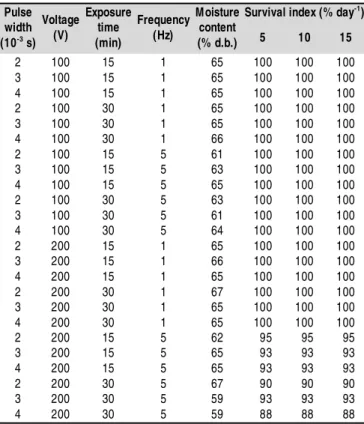
Table 6. Survival index at 5, 10 and 15 days after exposure to the electric fi eld i n function of each of the tested combinations and the moisture content of the substrate
combinations which utilized a voltage of 200 V and frequency of 5 Hz, where the survival rate varied between 87.5 and 95.0%. These deaths occurred in the first five days after exposure to the electric field. The same results were observed by Oliveira Filho et al. (2005) when studied the earthworms separation in bed with the same dimensions as the ones used in commercial earthworms production. In that case,the survival rate was 100% with pulses with 1 Hz and 96.5% for 5 Hz.
C
ONCLUSIONS1. Utilization of electric pulses is a technically viable method for separation of Eudrilus eugeniæ worms and there is also potential to apply this technology on the commercial scale. Worms are displaced towards the anode when submitted to controlled electric pulses.
2. The maximum displacement index was 80%, occurring at the frequency of 1 Hz, with pulse width of 2 x 10⁻³ s and voltage of 200
V. However the lowest displacement indices were found at frequency of 5 Hz, voltage of 200 V and pulse width of 3 x 10⁻³ s.
A
CKNOWLEDGMENTSThe authors are especially grateful to CAPES (Coordenação de Aperfeicoamento de Pessoal de Nível Superior), FAPEMIG (Fundação de Amparo a Pesquisa do Estado de Minas Gerais) and the Universidade Federal de Viçosa for their support to perform this study.
L
ITERATURE CITEDAdi, A. J.; Noor, Z. M. Waste recycling: Utilization of coffee grounds and kitchen waste in vermicomposting. Bioresource Technology, v.100, p.1027-1030, 2009.
Aquino, A. M.; Almeida, D. L.; Freire, L. R., Polli, H. de. Reprodução de minhocas (oligochaeta) em esterco bovino e bagaço de cana-de-açúcar. Pesquisa Agropecuária Brasileira, v.29, p.161-168, 1994.
Arancon, N. Q.; Edwards, C. A.; Bierman, P. Influences of vermicomposts on field strawberries: Part 2. Effects on soil microbiological and chemical properties. Bioresource Technology, v.97, p.831-840, 2006.
Atiyeh, R. M.; Lee, S.; Edwards, C. A.; Arancon, N. Q.; Metzger, J. D. The influence of humic acids derived from earthworm-processed organic wastes on plant growth. Bioresource Technology, v.84, p.7-14, 2002.
Blanchart, E.; Albrecht, A.; Brown, G.; Decaens, T.; Duboisset, A.; Lavelle, P.; Mariani, L.; Roose, E. Effects of tropical endogeic earth worms on soil er osion . Agriculture, Ecosystems and Environment, v.104, p.303-315, 2004. Bouma, J.; Curry, J. P.; Houba, V. J. G. Measuring physical,
chemical and biological soil parameters in grasslands. In: Field and laboratory methods for grassland and animal production research. New York: Cabi Publishing, 1.ed. p.279-303, 2001.
Chaoui, H.; Keener, H. M. Separating earthworms from organic media using an electric field. Biosystems Engineering, v.100, p.409-421, 2008.
Coja, T.; Zehetne,r K.; Bruckner, A.; Watzinger, A.; Meyer, E. Efficacy and side effects of five sampling methods for soil earthworms (Annelida, Lumbricidae). Ecotoxicology and Environmental Safety, v.71, p.552-565, 2008.
Dominguez, J.; Edwards, C. A.; Ashby, J. The biology and population dynamics of Eudrilus eugeniae (Kingberg) (Oligochaeta) in cattle waste solids. Pedobiologia, v.45, p.341-353, 2001.
Johnson-Maynard J. L.; Umiker K. J.; Guy S. O. Earthworm dynamics and soil physical properties in the first three years of no-till management. Soil & Tillage Research, v.94, p.338-345, 2007.
Ndegwa, P. M.; Thompson, S. A. Integrating composting and vermicomposting in the treatment and bioconversion of biosolids. Bioresource Technology, v.76, p.107-112, 2001. Oliveira Filho, D.; Ferraz, D. I.; Martins, J. H.; Santos L. C.;
Ribeiro Filho, O. P.; Costa, D. R. Avaliação do deslocamento de minhocas (Eudrilus eugeniae) submetidas a pulsos elétricos controlados. Revista Brasileira Engenharia Agrícola e Ambiental, v.9, p.433-440, 2005.
Oliveira Filho, D.; Ferraz, I. D.; Moraes, M. J.; Martins, J. H.; Santos, C. L. Evaluation of induced earthworms (Eudrilus eugeniae and Eisenia foetida) movement under controlled electric pulses. American Society of Agricultural Engineers, v.1, p.145-165, 2004.
Rushton, S. P.; Luff, M. L. A new electrical method for sampling earthworm populations, Pedobiologia, v.26, p.15-19, 1984. Pulse
width (10-3 s)
Voltage (V)
Exposure time (min)
Frequency (Hz)
Moisture content (% d.b.)
Survival index (% day-1 )
5 10 15
2 100 15 1 65 100 100 100
3 100 15 1 65 100 100 100
4 100 15 1 65 100 100 100
2 100 30 1 65 100 100 100
3 100 30 1 65 100 100 100
4 100 30 1 66 100 100 100
2 100 15 5 61 100 100 100
3 100 15 5 63 100 100 100
4 100 15 5 65 100 100 100
2 100 30 5 63 100 100 100
3 100 30 5 61 100 100 100
4 100 30 5 64 100 100 100
2 200 15 1 65 100 100 100
3 200 15 1 66 100 100 100
4 200 15 1 65 100 100 100
2 200 30 1 67 100 100 100
3 200 30 1 65 100 100 100
4 200 30 1 65 100 100 100
2 200 15 5 62 095 095 095
3 200 15 5 65 093 093 093
4 200 15 5 65 093 093 093
2 200 30 5 67 090 090 090
3 200 30 5 59 093 093 093
Sh iederck, G; Gonçalves, M. M.; Schwen gber, J. E. Minhocultura e produção de húmus para agricultura familiar. Pelotas: EMBRAPA, 2006.12 p. Manual Técnico
Sinha, R. K.; Heart, S.; Agarwal, S.; Asadi, R.; Carretero, E. Vermiculture and waste management: study of action of earthworms Eisenia fœtida, Eudrilus eugeniaeand Perionyx excavates on biodegradation of some community wastes in India and Australia. The Environmentalist, v.22, p.261-268, 2002.
Steffen, R. B.; Benedetti, T.; Antoniolli, Z. I. Caracterização molecular de duas espécies de oligoquetas. Revista Brasileira de Agroecologia, v.1, p.573-576, 2006.