Philosophy [i.e. physics] is written in this grand book — I mean the universe — which stands continually open to our gaze, but it cannot be understood unless one first learns to comprehend the language and interpret the characters in which it is written. It is written in the language of mathematics, and its characters are
triangles, circles, and other geometrical figures, without which it is humanly impossible to understand a single word of it; without these, one is wandering around in a dark labyrinth.
ABSTRACT
As pointed out on different occasions by both Richard Sennett and Villém Flusser, practice and theory,
technique and expression, art and technology, maker and user, once shared a common ground. Throughout history, however, they have become divided. Design stands in between.
This research proposal firstly aims to contribute to the diminishing of this historical inheritance. This, by means of providing a workflow for designers with the use of computational strategies. The present study will
apply this approach to the design and building of a surfboard.
The goal is to develop a co-designing platform allowing users to generate their own tailor-made surfboard by means of algorithmic/parametric modeling (Grasshopper and Shapediver).
A second aspect critically considers the materials used in the surf industry, with the objective of developing products using materials that are less harmful to the environment and with a greater capacity of control and alteration with regards to performance capabilities. In particular, this proposal aims to develop an algorithm that can be used to generate objects of paper structures composing their inner core. The specific object to be generated in this case, is a surfboard.
Key Words:
Algorithmic/Parametric modelling, Co-design, Digital Fabrication, Surf Industry, Paper Structures.
RESUMO
Em diferentes ocasiões, Richard Sennett e Vilém Flusser descreveram que a prática e a teoria, a técnica e a
expressão, a arte e a tecnologia, o criador e o usuário, antes compartilhavam a mesma raíz. Ao longo da história, no entanto, estes conceitos se dividiram com o design posicionado ao centro.
Esta proposta de pesquisa visa, em primeiro lugar, contribuir para a diminuição desta herdada separação. Isso, por meio do uso de estratégias computacionais aplicadas ao design. O presente estudo aplicará essa abordagem ao projeto e construção de uma prancha de surfe.
Um dos objetivos é desenvolver uma plataforma de co-design que permita aos usuários gerarem suas próprias pranchas de surf, por meio de modelagem algorítmica / paramétrica (Grasshopper e ShapeDiver).
Um segundo aspecto considera criticamente os materiais utilizados na indústria do surf, com o objetivo de desenvolver produtos que utilizem materiais menos nocivos ao meio ambiente e com maior capacidade de controle e alteração em relação às capacidades de desempenho. Em particular, esta proposta visa
desenvolver um algoritmo para gerar objetos com seus núcleos internos compostos por estruturas de papel. O objeto específico a ser gerado neste caso é uma prancha de surf.
Palavras-chave:
Modelagem Algorítmica / Paramétrica, Co-design,
Fabricação Digital, Indústria de Surf, Estruturas de Papel.
ACKNOWLEDGEMENT
I would like to thank my advisor Professor Jorge Luís Firmino Nunes of the Faculty of Architecture from the University of Lisbon. His support and patience in steering my work in the right direction has been much appreciated.
I would also like to thank the other members of the Jury, Dr. Pedro Duarte Cortesão Monteiro (President) and Dr. José Nuno Dinis Cabral Beirão (Arguer), for participating in my thesis defence and for providing me with invaluable and constructive feedback, which I will strive to apply to future works of this nature.
Finally, I am also very grateful to my family and partner who have not only endured me but have also provided me with unfailing support and continuous encouragement throughout the past few years of study and through the process of writing this thesis. This accomplishment would not have been possible without them. Thank you.
LIST OF ACRONYMS
CAD — Computer-Aided Design OSS — Open-Source Software
CNC - Computer Numerically Controlled
LIST OF ABBREVIATIONS
Tech.- Technology
GA.- Genetic Algorithm GH - Grasshopper
GLOSSARY
Algorithm - A procedure for solving a mathematical problem in a finite number of steps that frequently involves repetition of an operation
Co-design - Co-design is the act of creating with stakeholders to ensure the results meet their needs. Also called participatory design
Grasshopper - a visual programming language and
environment, that runs within the Rhinoceros3D computer-aided design (CAD) application.
Homo Faber - from latin, man as maker
Input – data or information that is passed into a computation
Laser Cutting – a technology that uses laser to cut materials.
Output - data or information that is passed out of a computation
Table of Contents
ABSTRACT ii ACKNOWLEDGEMENT iv LIST OF ACRONYMS v LIST OF ABBREVIATIONS v GLOSSARY viLIST OF ILLUSTRATIONS viii
INTRODUCTION 1 1. Title 5 2. Problematization 5 3. Research Topic 6 4. Research Questions 7 5. Objectives 7 5.1. General Objective 7 5.2. Specific Objectives 7 PART II 10 6. Theoretical Framework 11
6.1. Animal laborans, Homo faber, Homo sapiens sapiens 11
6.2 Computational Design 17
6.3. Surf and Surfboard history 21
PART III 25
7. Project Contextualization 27
7.1 Project Description 28
7.2 Phase 1 - Webshapingbay 28
7.3 Phase 2 - Patterns and materials exploration 46
CONCLUSION 66
LIST OF ILLUSTRATIONS
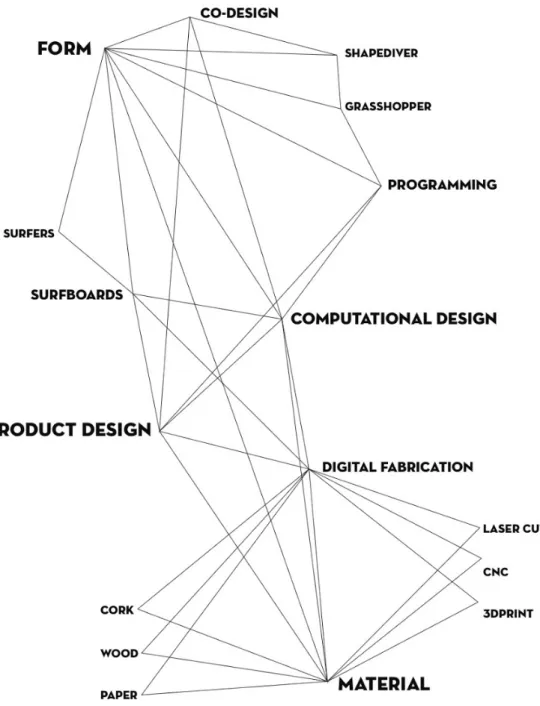
Figure 1- Areas diagram ... 9
Figure 2- Project synthesis image ... 26
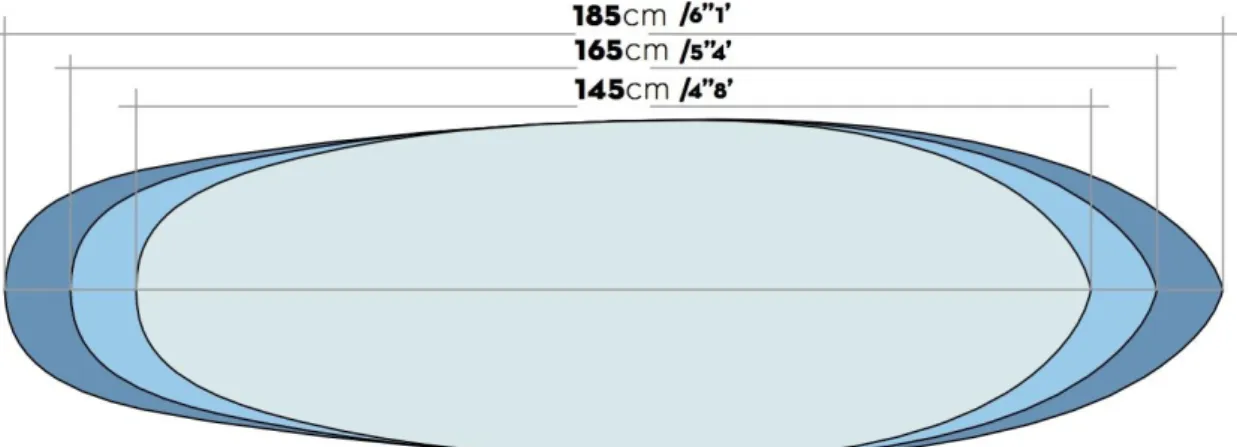
Figure 3- Surfboard dimension ... 30
Figure 4- GH components (dimension) ... 30
Figure 5- Surfboard control points ... 31
Figure 6- Surfboard rocker ... 32
Figure 7- GH components (rocker and control points) ... 32
Figure 8- Surfboard outline ... 33
Figure 9- GH components (outline) ... 34
Figure 10- GH components (nose) ... 34
Figure 11- Surfboard nose ... 35
Figure 12- Surfboard tail ... 36
Figure 13- Surfboard foil ... 37
Figure 14- GH components (foil) ... 37
Figure 15- Surfboard rail line ... 38
Figure 16- Surfboard rail foil ... 39
Figure 17- Surfboard deck ... 39
Figure 18- Surfboard bottom ... 40
Figure 19- ShapeDiver viwer(preview dimensions) ... 41
Figure 20- ShapeDiver viwer(preview control points) ... 42
Figure 21- ShapeDiver viwer(preview rocker line) ... 42
Figure 22- ShapeDiver viwer(preview control points) ... 43
Figure 23- ShapeDiver viwer(preview nose and tail) ... 43
Figure 24- ShapeDiver viwer(preview foil) ... 44
Figure 25 and 26- ShapeDiver viwer(preview rail) ... 44
Figure 27- ShapeDiver viwer(preview bottom contour) ... 45
Figure 28- ShapeDiver viwer(preview deck) ... 45
Figure 29- Paper studies ... 47
Figure 30- Hexagonal patterns ... 47
Figure 31- Hexagonal pattern (strips) ... 48
Figure 32- Prarametric Hexagonal patterns ... 49
Figure 33- 3 axial weave pattern ... 49
Figure 34- 3 axial weave pattern(strips) ... 50
Figure 35- Surfboard Solid (Brep) ... 51
Figure 36-Surfboard central Surface ... 51
Figure 38- Nose and tail division ... 52
Figure 39- Scaled division ... 52
Figure 40- Data structure ... 53
Figure 41- 3Axial weave tessellation on surface ... 53
Figure 42- Hexagonal weave tessellation on surface ... 53
Figure 43- Extrude ... 54
Figure 44- Split ... 54
Figure 45- Extrude rail line ... 54
Figure 46- Interim outcome ... 55
Figure 47- Intersections ... 55
Figure 48- Nesting ... 55
Figure 49- Nesting cluster ... 56
Figure 50- Rail subdivision ... 56
Figure 51- Joints and Tags ... 56
Figure 52- Plans ... 56
Figure 53- Pototype hexagonal pattern strips ... 57
Figure 54- Pototype hexagonal pattern surfboard ... 58
Figure 55- Prototype paralel lines test ... 59
Figure 56- Prototype full scale tests ... 59
Figure 57- Prototype handplane ... 60
Figure 58- Prototype handplane ... 61
Figure 59- Prototype laminated handplane ... 61
Figure 60- Cork rail handplane ... 62
Figure 61- Laminated handplanes ... 62
Figure 62- Sufboard structure ... 63
Figure 63- Laminated surfboard ... 63
Figure 64- Finbox placement ... 64
Figure 65- Final surfboard prototype ... 64
INTRODUCTION
In his essay "About the word design"1 Villém Flusser
looks back at the etymology and the present significance of the word design. He outlines the relationship between the words machine, technology, ars and art which
etymologically derived from the same root associated with the words cunning and deceit(to fool the laws of nature, to cause form to appear from shapeless materials).
However, according to the author, this connection has been denied and has resulted in the separation of art from technology. In the gap, the word design has formed a bridge between the two.
Over the past years, the rapid pace of the advances witnessed in the areas of information technology and digital fabrication have given way to new approaches to design projects. Programming in architecture and product design is starting to be used by many studios all over the world. As the tools available become more and more powerful and sophisticated, working methods must evolve. In particular they need to remain more flexible as
production techniques are becoming less rigid with the advance of digital fabrication tools.
An example of this is the use of CAD softwares as a tool to model objects and products before involving them in the physical production process. Although this is not new, the limits of this traditional workflow are becoming ever more evident resulting in the need to work with more flexible, personalised tools. A potential answer to this dilemma is the use of programming.
The present research project will explore the application of such computational design strategies to product
design, and in particular to the case of surfboards. This proposal draws its origins from notions of sustainability in the design process which has been an ongoing issue in the surf industry. The latter has a deep connection to the natural world as it depends on the ocean to exist, and therefore within it lies the need for sustainability
1
V. Flusser, The Shape of Things: a Philosophy of Design. Reaktion Books, 1999, p. 17.
2
in terms of surfboard production; the role of
environmentally friendly materials as well as their accessibility and longevity.
In his book "The Possibility of an Absolute
Architecture"2 Aureli draws a distinction between the idea of the project and the idea of design. Whereas the idea of design reflects the mere managerial praxis of building something, the idea of the project indicates the strategy on whose basis something must be produced.
"In the idea of the project, the strategy
exceeds the mere act of building and acquires a meaning in itself: an act of decision and judgment on the reality that the design or building of something addresses."3
The research starts with a short overview of the idea presented above. The analysis then moves on to further address the questions of how? and why? as explored by Hannah Arendt, Richard Sennett and Vilém Flusser in their discussions concerning the implications of production on modern society.
A next section of the project will explore the scope of computational design, using programming (in particular Grasshopper)in product design. Here, the benefits and potential of algorithmic and parametric modelling will be outlined and relevant examples will be presented along with the possibility of involving others in the design process that this workflow allows(in particular through Shapediver).
The research continues by exploring the history of the surf industry and the commercialisation of surfboards with a particular emphasis on materials and production methods. The aim will be to show the presence of high levels of rigidity and lack of creativity within these two components.
Once the contextual and theoretical aspects have been approached, the research component will be developed with the use of a case study: an algorithm will be developed and used in the design of a surfboard modelling tool that
2
P. V. Aureli, Possibility of an Absolute Architecture (Writing Architecture Series). MIT Press, 2011.
will be hosted through a website. The latter will be accessible to anyone exploring different types of
construction methods and materials, in this case another algorithm (definition-GH) will be developed to generate a paper structure(cardboard)core and plans to be laser cut. This section will consider the effects of changes to the parameters in terms of the elasticity, robustness and longevity of a surfboard. The workflow for achieving the final product will be outlined.
1. Title
Computational strategies applied to Product Design: A Surfboard study
2. Problematization
Sustainable Development was defined by the Brundtland Commission’s 1987 report4 as “development that meets the
needs of current populations without compromising the ability of future generations to meet their own needs.5”
The importance of sustainability and sustainable practices has come to the fore of public debate over recent years. It is perhaps the most important theme of the 21st century and provides a common ground upon which different cultures, religions and sectors can come
together and discuss the multiple and complex impacts that humans are having on our planet.
Efforts to tackle this global issue have been enshrined in various treaties and agreements at a global level and most recently, in 2015, countries adopted the 2030 Agenda for Sustainable Development6 and its 17 Sustainable
Development Goals (SDGs). The latter came at a time when the world’s population has become more and more aware of and impacted by the damaging impacts of unsustainable practices in their various forms. Three of the goals are of particular interest for the problematization to be presented in this section: 11. Sustainable cities and communities; 12. Responsible consumption and production; 14. Life Below Water.
These goals in order to be achieved require efforts from all countries in all sectors, including one that since its very early stages has aimed to embody a sustainable lifestyle based on human contact with nature: the surf industry. The estimated global surf population is between 10 - 15 million people (surfing at least once a year)
4
G. H. Brundtland, Report of the World Commission on Environment and Development:
"Our Common Future.". United Nations, 1987.
5 Ibid.
6 Sustainable Development Knowledge Platform, Transforming Our World: The 2030 Agenda
For Sustainable Development, 2016,
https://sustainabledevelopment.un.org/post2015/transformingourworld (accessed 01-10-2018)
depending on the source. Although this is a slightly
ambiguous figure, the relevance and ongoing growth of the market is evident and has become a billion dollar affair. However, with this growth and the changing priorities of consumers, questions have started to be posed concerning the use of unsustainable materials in surfboards.
Nowadays, surfboards incorporate several materials, the majority of which are petrol based and therefore toxic to the environment if not properly disposed of (which in most cases they are not). The evolution in terms of surfboard production and in particular the inherent
tensions which naturally occur when an industry based on craftsmanship and uniqueness and character of each
product, meets the growing demands of the market
industry, provide the core of the problem within which this thesis situates itself.
3. Research Topic
As a result of the context described above, this research proposes an investigation into new forms of production and materials that could be applied in order to achieve greater sustainability within the surf industry, and in particular for the production of surfboards.
The investigation will explore different options via the use of computational design applied to paper and other non-intrusive, sustainable materials. The logic
underpinning this idea is that recent advances in material science and digital fabrication have been
providing opportunities for industrial and product design as well as other related fields.
In order to take full advantage of these innovations, effective computational tools are needed that link creative design exploration with material realisation. Another goal is to include others into the design and fabrication process and in a way, create more awareness of the craft involved in a product. The idea here, is therefore, to abstract the material and fabrication constraints of a design into suitable geometric representations, and then solve the design using computational algorithms.
4. Research Questions
● How can Algorithmic modelling combined with both new digital fabrication processes and traditional
production processes,contribute to alternative design solutions?
● Can the application of computational strategies to the building of a surfboard, lead to better performance and freedom of creativity, as well as presenting new possible materials to the surf industry?
● Can Designers provide a workflow to involve others in the process of design and production of objects and therefore contribute towards a societal shift from “consumers” to “makers”?
5. Objectives
5.1. General Objective
Contribute towards a more sustainable approach to
production within the surf industry and include others into the design and fabrication process.
5.2. Specific Objectives
• Explore the applications of computational strategies to design projects.
• Develop an online tool for modelling surfboards
• Develop an algorithm that, through the previous models created on the online tool, can generate a paper
structure inner core providing drawing plans to be laser cut and assembled.
• Create a Grasshopper workflow for iterating
patterns(that can be physically fabricated using paper) into surfaces and then filling in solids, generating the plans and nesting into the sheets to optimize material usage.
6. Theoretical Framework
The theoretical framework for this project, will explore the individual and public dimensions of the philosophical and political condition relative to the inherently human desire to shape the world, a debate proposed by Hannah Arendt in the 1950’s and later revisited by Richard Sennett and Vilém Flusser. Although these authors were thinking and writing during a very different time, their debate has become very relevant within the current global context of growing support for totalitarian governments, and the limits on social and political freedoms which accompany such a move.
The ensuing topic to be broached is that of computational design, ranging from parametric- algorithmic modeling to digital fabrication in which the means of production are becoming more accessible and globalised.
Finally, surfing will be presented through the recounting of the history of surf, in particular with regards to the evolution of surfboard production methods and materials. After each chapter, conclusions will be drawn which
should aid and provide a basis for design strategies
which rethink the use of materials and production methods for surfboards.
6.1. Animal laborans, Homo faber, Homo sapiens sapiens
In her book The Human Condition7, Hannah Arendt draws a
distinction between Animal laborans, the labouring man or woman absorbed unreflectively in routine tasks, and Homo faber, a superior state in which we evaluate this work through discussion and draw moral conclusions about it. The sociologist Richard Sennett refutes such a
distinction, which implies a contempt for practical work. Another, more balanced view is that thinking and feeling are contained within the process of making.
In his book The Craftsman8 the sociologist Richard Sennett
explains Arendt’s view:
7
H. Arendt, The Human Condition, The University of Chicago Press, 2nd Ed, 1998. 8
Animal laborans is, as the name implies, the human being akin to a beast of burden, a drudge condemned to routine(...) Animal laborans takes the work as an end in itself.
By contrast, Homo faber is her image of men and women doing another kind of work, making a life in common(...) The Latin tag Homo faber means simply "man as maker". Thus, in her view, we human beings live in two dimensions. In one we make things; in this condition we are amoral, absorbed in a task. We also harbor another, higher way of life in which we stop producing and start discussing and judging together. Whereas Animal laborans is fixated in the question "How?" Homo faber asks "Why?"9
Sennett’s view is that Animal laborans, people of crafts, curious about things in themselves, may want to
understand how they might generate religious, social or political values. He believes that Animal laborans might serve as Homo faber's guide.
In certain aspects Vilém Flusser shares some of the same views as Richard Sennett and adds another perspective to this argument. In his essay The Factory10 he points out that to understand human evolution one should look at the factories throughout history and that the factory of the future will have to be the place where the homo faber becomes the homo sapiens sapiens because he has realized that manufacturing means the same thing as learning. In the foreword to The Human Condition11, Arendt states
that her purpose in the book was not to provide
theoretical answers to the perplexities of our time but to think about what we are doing, from our new
experiences and fears. Through the victory of the animal laborans, the worker, the maker of objects, and the man of action, what is seen in the modern era is a new
threshold in which humanity and animality have had their frontiers diluted, and the fruition of merely being alive becomes the horizon of happiness. First of all, in her 9 Ibid. p. 6-7. 10 V. Flusser, 1999, p. 43. 11 H. Arendt, 1998.
diagnosis of political modernity, Hannah Arendt refuses to conceive that freedom can find an adequate substitute in the relief provided by security against violence or happiness understood as satiety.
For Arendt, the decisive event of political modernity, which reflects its rupture with the classical
understanding of politics, is the entry into the
political sphere of biological life - the politicization of biological life or the instrumentalization of politics by mere living, understood as the supreme good. She
remained convinced that the opposition between freedom and biological life underlies all we can understand as politics and specifically political virtues, notably
courage. On the basis of this, we could even say that the very fact that politics is at stake today in the mere existence of all, from totalitarianism to liberal democracy, is the most evident sign of the political calamity of our world. Our politics knows no value other than life, and it is not the other reason to be based on the unconditioned unfolding of the economy, with which it is progressively confused. This keeps us tied to
totalitarianism, which makes the decision on life that deserves to be lived the supreme political criterion and assumes as its task more proper the decision on the
phatic existence of peoples.
In Arendt’s opinion this arises from the modern disregard of the necessary distinction between biological and
political life, as well as between the happiness that is experienced in the satisfaction of vital needs as well as in the enjoyment of political freedom. Biological life undermines the durability of the common world, the space of politics, and so engagement in political action always implies the ability to transcend the processes of life itself.
In the modern era, one of the manifestations of such a threat is the persistent treatment of objects of use as if they were consumer goods. The repetition and
interminability impressed upon the process of making objects after the industrial revolution has contaminated it with the peculiar circularity of labor, the production of goods for consumption, which leaves nothing durable behind it. Given the need to replace the mundane things that surround us as quickly as possible, due to the
permanent expansion of men's productive capacity, we no longer care for their durability. On the contrary, we end up consuming, by devouring, the objects of the world - our homes, our furniture, our cars as if they were
consumer goods. As a result, in modernity the ideals of the world's maker of objects, homo faber, which are permanence, stability and durability, are sacrificed in the name of abundance, satiety and comfort, which are the ideals of animal laborans. What is at issue is the human capacity to erect a way of life beyond its inextricable animality which, once unrealized, pave the way of
exclusive occupation with the extension of a comfortable life.
The author says that politically, it is important to
emphasize the fact that a consumer society is not able to take care of the world in which political life unfolds, since its way of dealing with all objects, the
consumption attitude, condemns to ruin everything In which it plays. The consumer is the reverse of the citizen. The victory of animal laborans translates the victory of the natural condition of living on any other condition of human existence. In modernity, according to Arendt, the consumer's way of life has won, and even the most pessimistic judgment on the political implications of such a victory is hardly an exaggeration. Arendt has always relied, nevertheless, on the ability of men and women to start over, to refuse the futility of a life that dissolves in the flow of the metabolism of the vital process.
The sociologist Richard Sennett, in his book The Craftsman12 looks to expand the definition of
craftsmanship to a broader understanding of the enduring human capacity for passionate engagement with one's work for its own sake.
He takes as false the division between Animal laborans and Homo faber because Arendt’s view slights the
practical man or woman at work.
"As she aged, my teacher (Arendt) became more
hopeful that Homo faber's power of judgment could save humanity from itself. In my winter,
12
I've become more hopeful about the human animal at work. The contents of Pandora's box can indeed be made less fearsome; we can achieve a more humane material life, if only we better understand the making of things."13
In Sennett's view the question of How? might lead to the question of Why? He believes that the consideration of the craftsman's way of working (problem finding and problem solving) can give people an anchor in material reality.
Mediated by technology, in some way anticipating the current scenario, in his afore-mentioned 1991 essay The Factory, Vilém Flusser intends to tell "the history of human evolution" by critically analising the Factory. He begins by rejecting the designation that attributes a double dose of wisdom to homo sapiens sapiens and adopts the anthropological one of homo faber. The factory
transforms the environment into product, the natural into artificial and increases the information.
"So, anybody who wants to know about our past should concentrate on excavating the ruins of factories. Anybody who wants to know about our present should concentrate on examining present-day factories critically. And anybody who addresses the issue of our future should raise the question of the factory of the future."14
According to Flusser, humanity has been through four periods: hands, tools, machines and robots.
The first industrial revolution marks the transition from hands to utensils and a new form of human existence,
surrounded by utensils, that is, culture, the first form of alienation of man, away from nature. Each new tool corresponds to a new form of human existence. According to Flusser, "A shoemaker not only makes leather shoes; he also make a shoemaker out of himself."15
13 Ibid, p. 8. 14 V. Flusser, 1999, p. 44. 15 Ibid, p. 45.
The second industrial revolution was marked by the evolution from utensils to machines. Machines, Flusser says, are designed and produced according to scientific theories, and to that extent they are more efficient, quick, and expensive. In the case of the utensil, the human being is the constant and the utensil is the
variable: when the needle of the shoemaker or the tailor is broken, it is replaced by another. In the case of the machine, this is the constant and the human being is the variable. Then there is a subversion that alters human existence. The machine is placed in the center of the laboratory or factory around which the city develops and the cities grow around these power stations. The second industrial revolution brought mankind to culture as the former had plucked it from nature. From this point of view, notes Flusser, the mechanized factory is a kind of madhouse.
If, in the second industrial revolution, what was meant by science were mainly the physics and chemistry with which machines were made, in the third industrial
revolution biology and neurophysiology came into play. In other words, the utensils empirically simulate the hands and the body, the machines are mechanical simulations, and the robots are neurophysiological and biological simulations.
There will be a radical transformation with the advent of robots, believed Flusser. Robots are much more
manageable, smaller and cheaper than machines and connected to humans in that they can only, robots and humans, work together. The robot only does what the human being wants, but the human being can only want what the robot can do. The human being is an "employee" of the robots that act in their function and vice versa. This new kind of humanity, the robotic employee, is connected to robots by thousands of invisible wires and
connections: wherever the human goes he/she takes devices or robots with him/her and whatever happens should be able to have a robotic interpretation. These future employees equipped with nano-robots will always be busy producing and in permanent connection with other
employees and robots, to transform and produce what they can.
Flusser hopes that the factory of the future will give place to the achievement of the creative potential of the homo faber. The man of the utensils received the
knowledge empirically, but the machines demanded also theoretical information and hence the school obligation: basic instruction to learn how to operate the machines, second and third cycles to learn how to maintain
machines, and high school to learn how to build new machines. Robots require more abstract cognitive
processes and disciplines not accessible to all, which makes predicting that the factories of the future will be similar to schools, where humans learn how robots work so they can replace humans in the future, the task of
transforming nature into culture. Then the factory will be nothing more than an applied school and that the school will be a factory where information is received. Only then, in Flusser's view, will the term homo faber acquire full dignity. The robot-man of the coming future is more of an academic than a craftsman, a worker, or a technician.
And then in these factory-schools of the future homo faber can finally be transformed into homo sapiens sapiens.
"The only crucial thing is that the factory of
the future will have to be the place where the homo faber becomes the homo sapiens sapiens because he has realized that manufacturing means the same thing as learning – i.e. acquiring, producing and passing on information.”16
6.2 Computational Design
In his article published in 1992 “About Forms and
Formulae”, Flusser envisages a future in which man can handle concrete languages and simulate images of the world and fabricate them from equations.
"Take a form, any form, in fact any algorithm that can be expressed numerically. Feed this
16
form via computer into a plotter. Stuff the form thus created as completely as possible with particles. And there you have it: worlds ready to serve"
The traditional designer workflow, to summarize, consists in sketching the idea, drawing it on a CAD software, then prototyping and moving back and forward through theses steps until arriving at the final design outcome. In this environment, the data that leads to design decisions is conducted by the designer to a final outcome. In this case computers are used in the same way as a sheet of paper(whether it is being used for 3dModeling,
documentation or creating spreadsheets),leading to a singular design solution as static representations of physical forms.17
A paradigm shift to that workflow occurs when instead of specifying a single static form, the process by which the design is created is defined. To do so, this design
environment must be abstracted. The data that previously was directed to a final, static, singular design, is now conducted to encode a set of instructions for how the design should be generated.18 A set of instructions can be called an algorithm.
In “AD READER - Computational Design Thinking”19 Achim Menges and Sean Ahlquist describe an algorithm as “a finite sequence of explicit, elementary instructions described in an exact, complete, yet general manner”20.
“The application and execution of algorithms on a computer happens through programming languages, which enable computing procedure. This is a fundamental property of computation as a technical achievement, but also as a theoretical framework for design. Computation has a profound impact on a contemporary understanding of form, space and structure. It
17
D. Nagy, Introduction to Computational Design, Generative Design, 2017. Available
at:https://medium.com/generative-design/introduction-to-computational-design-6c0fdfb3f1 18 Ibid. 19
A. Menges, E. Baharlou, Advanced Algorithmic Geometry, AD Reader, John Wiley & Sons Ltd, UK, 2011.
20
shifts the way one perceives form, the way in which form is purposed, and the way in which form is produced.21”
George Stiny, Professor of Design and Computation at the MIT, when asked about the relationship between design and computing, preferring word calculating as opposed to
computing. In his view the relationship between design and calculating is equality.
"If in fact calculating can be extended to
include design, and I think it can, then that runs the formula: design=calculating
Then the question becomes:“What do you learn about design by calculating?” You can pick particular kinds of styles or designs; you can investigate how rules change. You can come back later and apply different rules to change designs. It becomes very dynamic, a very open-ended kind of process. But this all depends on making calculating generous enough to include art and design. That really can’t be emphasized enough, because it’s not making design conform to calculating; it’s quite the opposite: as a result, calculating becomes more than it usually is.22"
In my opinion this workflow, that can be called
algorithmic modelling, computing design or computational design etc., opens a wide range of possibilities and can provide answers to design questions which cannot be
achieved through the traditional workflow. In fact, it makes way for a range of workflows within the workflow, and maybe that is why it is hard to give it a final
denomination (in particular the term Computational design will be used).
Computational design strategies usually produce many or even infinite final design solutions depending both on the parameters or on how the algorithm is put together. When applied to the product design field, the algorithm
21
Ibid.
22 G. Stiny, O. Gün, ‘Part 1: Understandings’ in ‘Computational Design’, Dosya 29, November 2012, p. 7.
is conceived to produce a ‘material’(made of material) object. Since the algorithm(virtual or ‘immaterial’) will in-form the object(real or ‘material’), the algorithm then might become as or more significant than the final object.
This brings us to another Flusserian debate: the opposition between matter and form - i.e. ‘content-container’.
"The basic idea is this: When I see something, a table for example, I see wood in form of a table.(...) But the table-form is eternal, since I can imagine it anywhere and at any time(see it my mind’s theoretical eye). Hence the form of the table is real, and the content of the table(the wood) is only apparent.”
This again locates design ‘in between’, in this case between the material and the immaterial. In Flusser’s view there are two ways of seeing and thinking: the
material and the formal. The material way emphasizes the apparent in a form, the formal way emphasizes the form in the appearance. One way ‘materializes’ form whereas the other ‘in-forms’ material.
In his essay Form and Material23 he points out:
“(...) The ‘burning issue’ is therefore the fact that in the past, it was a matter of forming the material to hand to make it appear, but now what we have is a flood of forms pouring out of our
theoretical perspective and our technical equipment, and this flood we fill with material so as to
‘materialize’ the forms. In the past, it was a
matter of giving formal order to the apparent world of material, but now it is a question of making a world appear that is largely encoded in figures, a world of forms that are multiplying uncontrollably. In the past, it was a matter of formalizing a world taken for granted, but now it is a matter of
realizing the forms designed to produce alternative worlds.”24 23 V. Flusser, 1999, p. 22. 24 Ibid, p. 25.
6.3. Surf and Surfboard history
The surfboard was chosen as the object of this study due to the fact that surfers are usually very connected to their surfboards (not excluding bodyboarding, bodysurf or any way one can use the energy of a wave to glide down the face of a breaking wave). Different surfboard designs can influence the very self expression (or “surf
expression”) of each surfer. Usually a certain surfboard design can favour certain “lines” that a surfer can draw on the wave, or it might be better suited to a specific style of surfing. Therefore, surfers are usually keen on shaping their own boards. Another reason why surfboards are the focus of this work is that a great range of different possible designs can be explored in order to alter the board’s performance, capabilities, flexibility, floatation, hydrodynamics and structural strength. In his book “The History of Surfing”25, Matt Warshaw
explores the origins and evolution of surfing and
surfboards. According to him, the debate on the origins of surf is somewhat controversial with both Peruvians and Polynesians claiming to be the precursors of the sport. According to Warshaw, Peruvians claim that the history of surfing began with the Caballito, a reed boat invented around 3000 B.C and used by fishermen and traders along the coast. The Caballito was made of dried “totora” reeds bound together in a canoe-style with a dagger-like lifted prow in order to avoid the board from nosing under the waves. It had a short life span of around 2 months and was approximately 12 feet long by 2 feet wide and weighed 40 kilograms. According to the author, it displayed
similarities with the ancient Egyptian Papyrus raft. This said, the more well-known theory on the origins of surf takes place in around 1200 A.D and is directly
linked to the ancient polynesian islands of Tonga, Samoa and Eastern Fiji which were inhabited by migrants from South-East Asia. The Polynesian culture which formed on these islands was exported to other surrounding islands
25
and eventually in approximately 300 B.C. travelled up from the Marquesas to Hawaii.
Warshaw describes the Hawaiian population as one with extremely close ties to the ocean, where surfing was inextricably intertwined with all aspects of society: religion, politics, sex etc. He describes how the
peasants “banged together”26 their surfboards while at a royal level “board-making was a serious matter, filled with rites and rituals”27. Building a board involved a large investment in terms of time and energy with the board being expected to perform well and reflect
favorably upon its builder. Royal boards were made from fine-grained wood, smoothed out and sanded down using coral heads and pumice stones and waterproofed with
coconut oil. These first boards had no stabilising fins. According to Warshaw, the Hawaiians came up with 3 basic types of surfboards28: the Paipo, which was a short and
round-nosed board used mainly by children and on which they simply lay and caught breaking waves; the Olo which was made of a type of wood known as “wiliwili” and used exclusively by the ruling class to catch unbroken waves, and was an impressive 6 meters long, 60 centimeters wide and weighed a monstrous 45 kilograms; and finally, the Alaia, which is the closest to surfing as the world now knows it. It was a round-nosed board with a square tail and no stabilising fin, measuring around 6 or 7 feet long and weighing around 45 pounds, on which surfers stood and caught breaking waves. The Alaia was used by all social classes.
The arrival of Captain Cook and other Westerners in the middle of the 18th century, marked the slow decline of surfing which would continue until the early 1900s. During this time the Hawaiians suffered greatly from imported diseases with a large portion of the population being wiped out (90%)29. In addition to this, as from,
1820 American missionaries established settlements on the islands and attempted to convert the hawaiians to
Christianity and a new way of life. “Islanders were
encouraged to wear more clothes, learn to read and write 26 Ibid. p 24. 27 Ibid. 28 Ibid. p 25. 29 Ibid. p 37.
English, and work rather than engage in nonproductive and dangerous recreation.”30
According to Warshaw, after almost a century, surfing’s revival in the 1900s made perfect sense in a context
whereby the sea was no longer seen as a “roiling vastness filled with sea monsters and splintered boats”31 but more
as a beautiful and mystical place. Across many
industrialised countries, the growing middle class had greater access to the sea via the use of automobiles and ships, whilst at the same time social acceptance of
mixed-beaches was increasing. Within this context and with the growing numbers of tourists visiting Hawaii, surf started to become popular again. Several names such as Jack London, George Freeth, Duke Kahanamoku among others, are hailed as great promoters of surfing during the early 1900s.
The greatest leap forward however, in terms of surfboard design took place in 1920, when Tom Blake a surf-obsessed lifeguard from California, travelled to Hawaii and worked on making surfboards lighter. He achieved this by
creating the first hollow “riding” boards which could weigh as little as 40 pounds. “A hollow was easier than a plank to store and transport, it paddled faster and
caught waves like a breeze. Because it was lighter it was marginally safe.”32. Later in in 1935, he also introduce the use of the stabilising fin which allowed for greater control and stability.
According to Rhodes33, the next leap came with Bob Simmons
who aimed to make the world’s fastest surfboard. He explored several different materials including balsa
wood, plywood and styrofoam compositions with the hope of achieving a lighter and faster design. He also added a second fin to surfboards. Around 1949, Simmons
experimented with a mahogany veneered polystyrene core sealed with fiberglass and resin. These boards quickly became the industry standard. Additionally, in the 60’s during the so-called “Golden Era of surfing” board sizes
30
The History of Surfing,(n.d), retrieved at https://www.swimoutlet.com/guides/history-of-surfing 31 M. Warshaw, 2010, p 42.
32
Ibid, p 64.
33 M. Rhodes, the Fascinating Evolution of the Surfboard, Design, 2016, available at: https://www.wired.com/2016/02/fascinating-evolution-surfboard/
started to decrease dramatically giving way to the shortboard which was around 8 feet (instead of 10).
According to the same author, not much changed until the mid 2000s when Clark Foam, the biggest distributor of polyurethane blocks, shut down abruptly leaving board designers to experiment with other materials such as polystyrene foam.
Since the recipe made up of ‘foam, fiberglass and resin’ was introduced to the surf industry, there has not been much change until today material-wise.
By the early 2000s, CAD softwares and CNC machines were introduced to the surfboard industry to automate shaping. In Andrew Warren and Chris Gibson’s opinion this has
transformed the surf industry. According to these authors the prevalence of automated production has transformed the industry from one based on artisanal-craft to one characterised by mass-producing forms of capital
intensive manufacturing.34
34
A, Warren,C. Gibson., Chapter 16: Soulful and Precarious: The Working Experience of Surfboard Makers, in The Critical Surf Studies, Eds. D. Z. Hough-Snee, A.S. Eastman, Duke University Press, 2017.
7. Project Contextualization
If we come back to Flusser’s idea about the factories, and analyze the surfboard factory of today, we see that the pattern of revolution from tools to machines is very recent. Up until a few years back, surfboard shapers used planers and other tools to shape a surfboard, whereas now the majority of shapers use a computer. Surfboards were up until not long ago locally produced and customized to each surfer’s individual needs, but nowadays shaping has become a mass-market business. A specific surfboard model is designed and then produced globally and sold all over the world. There has been an ongoing standardization of surfboards with taylor-made boards becoming rarer and more exclusive.
Advances in CAD and CNC technologies have strongly influenced, and in many ways supported, the changes in surfboard production described above. It has become easier for stages of the production chain to be outsourced and specialised.
The project presented in this chapter suggests that CAD and CNC technologies can actually be used to gain back some of the initial craftsmanship involved in a surfer making his own personal board or having the possibility to interact and participate in the design process. The underlying aim is to achieve a “democratisation” of design whereby citizens are encouraged to participate further in the process of making things and shaping the world. The intended result according to Arendt, is to achieve greater social and political participation of citizens in a world that is moving towards a state of totalitarianism whereby the economy prevails.
The growing popularity and accompanied mass production witnessed in the surf industry nowadays deviates
significantly from the original modalities and spirit of the sport. This perceived “consumerism” and
unsustainability has given rise to various attempts to bring back some of the more original techniques of board-making such as the use of wood and other natural
materials to make hollow boards. The project presented in the subsequent chapters incorporates this idea through
experimenting with paper and other more sustainable materials.
7.1 Project Description
The project will be separated into two phases: the first aims to develop a web based, co-designing platform. The latter will allow both surfers to design their
surfboards, and experienced shapers to share their design with customers and adapt it to each surfer’s needs. This phase will present the steps that were required for the development of the platform as well as the specificities related to the design of a surfboard.
The second phase will cover the process involved in generating the internal structure of the surfboard.
Again, the steps that resulted in the final solution will be outlined: an exploration of paper structures, origami and tessellations were carried out. Subsequently, tests and analysis were conducted to acquire the physical characteristics in these structures in search of a
pattern that could satisfy the requirements to be applied to a surfboard. This second phase will also present the workflow used to apply the pattern into the surfboard geometry.
7.2 Phase 1 - Webshapingbay
This phase consists in the development of a web-based tool for modelling surfboards called WebShapingBay
(https://rodrigoaranhalopes.wixsite.com/webshapingbay). Grasshopper was used for the development of the algorithm which was then hosted on the web through
Shapediver, an independent product brand specialised in industrial image processing35. Grasshopper (which is a visual programming interface) was chosen due to the fact that it is relatively easy to learn and does not require as much abstraction as a written programming language
does. It also has a very active community which provides learners and users with solid support through its online forum. Another factor taken into consideration was
Shapediver’s support and ease in hosting the GH definition.
The first step involved finding out the design patterns able to conform to the geometry of a surfboard. The term “design pattern” was first used by Christopher Alexander (1979) to describe an established
architectural configuration and the related explanation of its development and affordances.36
The key factor here was to understand the physical geometry, and how it could be encoded into a set of
instructions within Grasshopper. In this particular case, the algorithm consisted in the establishment of the
location of a series of points in space. Curves then pass through (interpolate) specific sets of points generating the surfaces (deck, bottom and rails) and eventually the solid overall form.
The surfboard geometry was broken down into the stages of the process involved in the manual shaping of a
surfboard. This was possible due to previous personal experiences with shaping as well as talks with, and
guidance from, experienced shapers. The steps involved in shaping a surfboard informed the steps of the algorithm.
Patterns express generic solutions to a
well-described problem. In parametric modeling patterns can be used to describe a “tactical” level of work, above mechanics and below design37.
The design patterns of surfboards were put together into:
Dimension; Control points; Outline; Rocker; Nose; Tail; Rails; Foil; Deck; and Bottom.
36 (PDF) Some Patterns for Parametric
Modeling, https://www.researchgate.net/publication/30876285_Some_Patt erns_for_Parametric_Modeling accessed on 21-12-2018.
7.2.1. Dimension
Dimension in this case is simply the length of a surfboard from nose to tail.
Figure 3- Author The dimension is selected(in this case, 165cm), and then divided by two to establish the nose point and the tail point. Nose(x82.5,y0.0,z0.0)Tail(x-82.5,y0.0,z0.0)
Figure 4- Author
7.2.2. Control points
Widepoint is the widest part of a surfboard. Usually, as a standard, the width of a surfboard is measured using 3 points: the widepoint (point at the middle of the widest section of the surfboard) and two other control points: one 12 inches from the nose and the other 12 inches from the tail.
In this case, the widepoint was used to define a point (not necessarily the widest point) in between the two
control points. These points were entitled 'N to W'(nose to widepoint) and 'T to W'(tail to widepoint) and refer to the length between nose and widepoint and tail and widepoint in this order. These control points are
moveable and able to influence the overall shape of the surfboard.
Figure 5- Author
7.2.3. Rocker
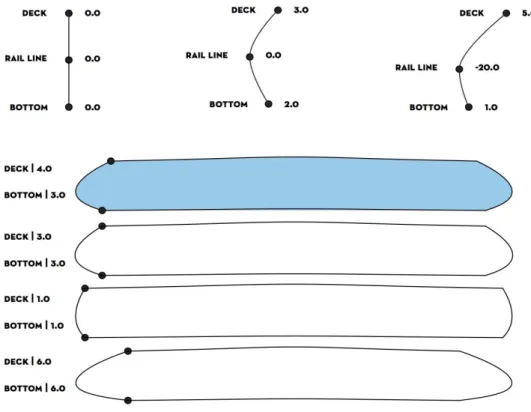
Rocker is the bottom curve of a surfboard, which can be either a continuous curve or a staged curve.
The nose and tail rocker can be controlled by the nose and the tail control points, the ´T to W` and the ´N to W´ control points define if the rocker will be staged or continuous and how the curve will be staged.
Figure 6- Author
The first two examples above are of a staged rocker which is a bottom curve that is proportionality flat through the mid section of the surfboard. The curve gets steeper at the entry and tail sections. The last example is of a continuous rocker which is a bottom curve with minimal or no flat sections.
Figure 7- Author The nose and tail points previously generated in the dimension part are then moved in 'Z' direction
originating the rocker.
At this stage, the location of the control points(NtoW, W, TtoW) are selected. The control points Ntow and TtoW
can also be moved in 'Z' direction. If set to '0' a continuous rocker will be originated, otherwise the surfboard will have a staged rocker.
7.2.4. Outline
The Outline or Template will determine the overall curve of a surfboard. The location of the outline curve
determines the width of the board.
Figure 8- Author
Having created the rocker line and the control points having been selected, the outline was generated by adding points in 'Y' direction (on both sides) previously
originated from the control points (rocker center line).
Figure 9- Author
7.2.4. Nose
Nose is the front part of a surfboard.
Figure 10- Author The Nose starts from the 'N to W' control point and goes all the way to the tip of the board. Many extra points were created, but only the ones that were used were translated into the final geometry due to a conditional statement which filtered the points having the 'Y'
coordinate in 0( dispatch GH component). To shape the nose usually one point is enough.
Figure 11- Author
The points can be moved in 'X' and 'Y' coordinates within a range from 0 to 1. In the 'X' coordinate, 0 means the tip of the nose and 1 relates to the 'N to W' point. As for the 'Y' coordinate, 0 stays at the center of the board (stringer) and 1 is the outline points for 'N to W'.
A rule was created in order to prevent any point from being closer to the center (in 'Y' coordinate) than the previous one. To follow the nose outline, the point 1 should be closer to the tip of the nose and the last to the 'N to W' outline. The tip of the nose can also be controlled and moved inwards('Nose end' point).
7.2.5. Tail
Tail is the rear part of the surfboard located opposite the nose. The tail usually varies more than the nose does, from one surfboard to the other.
Figu re 1
Figure 12- Author
The process of shaping the tail is exactly the same as the one employed for the nose, except that the references have changed.
In 'X' coordinate, 0 means the tip of the tail and 1 states for the 'T to W' point. As for 'Y' coordinate, 0 stays at the center of the board (stringer) and 1 is the outline points for 'T to W'. The same rule for point placement was created and the tip of the tail can be
moved( 'Tail end' point). In the tail case, the 'Tail end point' is more manipulated as it can be used to generate fishtails or squash tails, and other common design
variations.
7.2.6. Foil
The center foil is the volume distribution along the center of a surfboard from nose to tail.
Figure 13- Author
From the points that generated the rocker line, the foil line is created by adding new points to the 'Z'
coordinate.
Figure 14- Author
7.2.7. Rail
The rails connect the deck and the bottom throughout the whole surfboard. The rail sections may vary along the board.
The rails construction was separated into rail line and rail foil. The rail line is the outline in between the deck and the bottom, it can be controlled with the 'Z' coordinate between 1 and -1, where -1 is on the bottom level and 1 on the deck level.
Figure 15- Author
The rail line might be continuous or non continuous. The rail foil determines the rail profiles along the curve of the board though it is determined in each control point for the deck and for the bottom.
Figure 16- Author
7.2.8. Deck
The deck is the upper part of the surfboard which comes in contact with the surfer’s feet. Deck contours may vary from flat to crowned.
From the foil centerline, the point can be manipulated to vary the deck profile.
7.2.8. Bottom
The bottom is the lower part of the surfboard, which comes into contact with the water. Bottom contours can vary between flat, convex or concave. There is a wide range of possibilities and combinations for the bottom contours.
Figure 18- Author
The bottom points were separated into the center points, with the the possibility of making single concaves and vees, by moving in 'Z' direction. And the non centered points which can be moved in 'Y' direction and also in 'Z'. With these other points, double concaves can be generated.
7.2.9. Website
The Grasshopper definition was uploaded to Shapediver and embedded into the website. The Shapediver viewer could then be accessed in the website, where one can shape
their own surfboard and then export the file to an e-mail address.
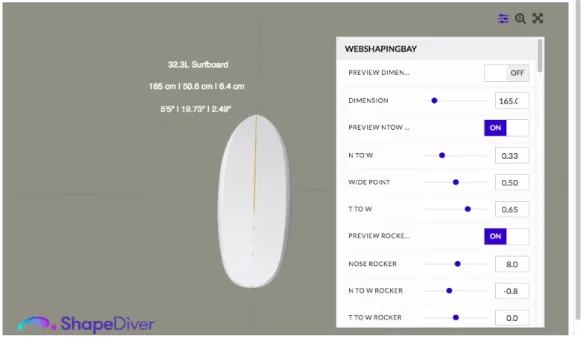
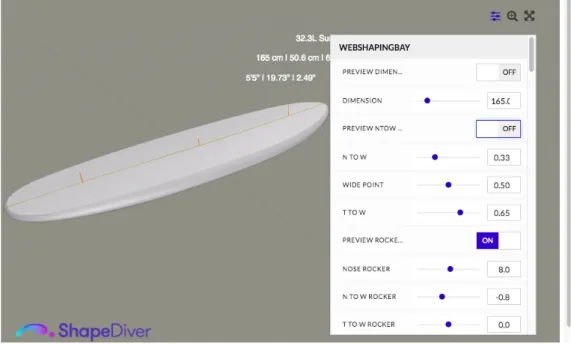
The Shapediver's viewer follows the structure presented previously, the 'preview' buttons separate each section from the other.
Starting off with the dimension component the preview button here shows a text displaying the dimensions in Metric and Imperial units. Firstly the Volume of the Surfboard is displayed, than the length, width and thickness.
Figure 19- Author
With regards to the control points: In order for the widepoint to locate at the centre of the board, the widepoint needs to be set to 50. When it is set to more than 50 it migrates towards the nose and at less than 50, towards the tail. The preview shows the control points location.
Figure 20- Author After selecting the control points, the rocker
dimensions are set. The preview shows a rocker line separated from the board geometry. When the numbers on the sliders are changed, the result can be seen on the geometry at the same time as on the rocker
preview line.
Figure 21- Author
The outline can be set up next. The preview shows the outline points originated from the control points.
Figure 22- Author
The definition of the Nose and Tail follows. Both
previews for the nose and the tail show the points and its consecutive number created to control the nose and the tail geometry.
Figure 23- Author
The next section is the Foil, which is represented by its points preview.
Figure 24- Author The rail line and rail foil can be previewed by the line representing the rail line and by each point for the deck rail and bottom rail.
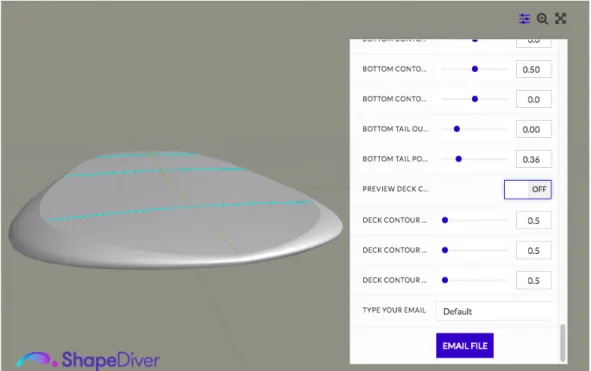
The following section is the bottom contour. The preview button shows the perpendicular lines contour in blue and the straight perpendicular lines in black for comparison.
Figure 27- Author The deck preview button shows the deck contour lines through the control points.
Figure 28- Author And the last section is the e-mail. In this section the user can type an e-mail address and send the file to the webshapingbay e-mail by pressing the button 'Email File'.
The .STEP file sent to the desired e-mail address
contains information that will be used to generate plans for building the core of the shaped surfboard(further information will be given in the part 2 of this
presentation). In the end, the user will receive both plans (to be laser cut) as well as the Solid surfboard shape generated on WebShapingBay. The former can be laser cut and assembled while the latter can be used to pre-shape the surfboard using a CNC (as is the standard in the surf industry).
7.3 Phase 2 - Patterns and materials exploration
Phase 2 of this project consists in the search for different, more sustainable construction methods and materials that could eventually be applied by the
surfboard industry. This chapter will be separated into 3 main sections: experimentation with paper structures and tessellations; patterns and the workflow to generate the structure; and finally the physical outcomes.
7.3.1 Experimentation with patterns and tessellations
A first step explored paper tessellations38, testing the
materials’ potential as a solid core structure, which would also provide the desired flexibility. Hollow wooden surfboards already have a internal structure that
sustains the outer shell. The idea behind having a paper tessellation as the internal or core structure of a
surfboard, is to be able to control the levels of flexibility.
The physical exploration of patterns for 2d tessellations that could be translated into a 3d geometry made of
paper, resulted in a GH workflow able to iterate the desired pattern and generate plans. After the first experiments were conducted, the best results to be cut and assembled were those in strips, that could be
assembled together to form a whole (see figure 29 bottom right).
38 An arrangement of shapes closely fitted together, especially of polygons in a
Figure 29- Author
Two basic rules were decided for the design of stripe patterns for the tessellations: 4 corner points; and lines must always end where the other begins.
Figure 30- Author
The hexagonal profile also creates hexagons in the gaps, and each stripe can be cut as indicated by the colors.
Figure 31- Author
This profile was further developed and parametrized to change the geometie of the pattern. The top and center lines of a corresponding side were set to the same
length, the lenght of these lines is then controled by a single multiplier was created. This created the
possibility that if set to one fourth of the distance between the corresponding points, the pattern would be rectangular, if set to half of the distance the pattern would be triangular, and any number between 0 and one fourth would result in a hexagonal pattern.
Figure 32- Author
Another profile was created inspired on 3-axial weaving and followed the same rules.
Figure 33- Author
The difference is that the strips flow in three different axis
7.3.2 Grasshopper workflow
Having created the patterns for the tessellation, the next step was to implement them into a workflow that would allow for their reproduction onto any surface or region.
With the files created in WebshapingBay, consisting in the surfboard solid core along with the central surface (surface between the deck and the bottom), Grasshopper was used in order to iterate the patterns into the geometries.
(left and top right) Figure 35- Author (bottom right) Figure 36- Author
The central surface acted as the canvas for drawing the pattern. This surface had to be subdivided into
quadrangular parts (meaning 4 corners for each division).
The GH component 'Surface Divide' was used for that and the parameters of 'U' and 'V' could be set (the lower the numbers the less tiling the tessellation would have). The output from that operation was be a set of points on the surface.
Figure 38- Author
Since the surface was created from endpoints as the nose and the tail of the surfboard, the output points of the nose and tail were equally spread from the tip to the next set of points, through the outline curve.
Figure 39- Author
The points were scaled to satisfy the need to have a
orthogonal piece to hold the rail (this might not be need for tessellating other objects).
The data was organized into quadrangles so the pattern could be reproduced into each quadrangle to form the tessellation.
Figure 40- Author This part done, any pattern could be drawn using the corner points as references.
Figure 41- Author
The two patterns created in section 7.3.1 - the 3 axial weaving and the parametric hexagonal - are represented in this order by the image above and the image below.
The curves constituting each stripe were joined and the data was organized by strips. Furthermore, the joined curves were extruded and intersected by the solid.
Figure 43- Author
Figure 44- Author The output of that operation was the strips in the form of the outer solid. As for the rail, the central surface was split and the rail stripe was created.
Figure 45 - Author
Figure 46- Author The stripe intersections were calculated and created the location for the joints.
Figure 47- Author
The strips with their various intersections, were unrolled into the 'XY' plane and organized(nested).
Figure 48- Author A nesting cluster was created. This operation computes the bounding box of each stripe and stacks under the next stripe bounding box. When the size of the stacked strip
exceeds the size determined by the sheet to be laser cut, the next set of strips are organized on the side of the previous until all the strips are organized.
Figure 49 - Author
The rail was also divided by the size of the sheet.
Figure 50- Author The joints were created and the strips were tagged.
Figure 51- Author