Vol.47, n. 5 : pp. 685-691, September 2004
ISSN 1516-8913 Printed in Brazil
BRAZILIAN ARCHIVES OF
BIOLOGY AND TECHNOLOGY
A N I N T E R N A T I O N A L J O U R N A L
Partition of Proteins in Aqueous Two-phase Systems Based
on Cashew-nut Tree Gum and Poly(ethylene glycol)
Leonie Asfora Sarubbo
1∗, Luciana Alves de Oliveira
2, Ana Lúcia Figueiredo Porto
3,4, Galba
Maria de Campos-Takaki
1and Elias Basile Tambourgi
21 Departamento de Química; NPCIAMB; Universidade Católica de Pernambuco; Rua Nunes Machado, 42,
Bloco J, Térreo; Boa Vista; 50050-590;Recife - PE - Brazil. 2 DESQ-FEQ; UNICAMP; Campinas - SP - Brazil.
3 Laboratório de Imunopatologia Keizo Asami; UFPE; Recife - PE - Brazil. 4 Departamento de Morfologia e
Fisiologia Animal; UFRPE; Recife - PE - Brazil
ABSTRACT
The partitioning of two proteins, bovine serum albumin (BSA) and trypsin was studied in an aqueous poly(ethylene glycol)(PEG)- Cashew-nut tree gum system. The phase diagram was provided for Cashew-nut tree gum and PEG molecular weight of 1500 at two different temperatures. The influence of several parameters including concentrations of polymers, pH, salt addition and temperature on the partitioning of these proteins were investigated.. The results of this research demonstrated the importance of the protein characteristics for partitioning in aqueous biphasic system.
Key words: Aqueous two-phase systems, bovine serum albumin, Cashew-nut tree gum, protein partition
∗ Author for correspondence
INTRODUCTION
Aqueous two-phase systems (ATPS) composed of water and two soluble polymers have found widespread use in biochemical research for separation and purification of macromolecules, cells and cell particles (Albertsson et al., 1981; Walter et al., 1985). ATPS can easily be scaled up without an appreciable change in the nature or efficiency of the process. In addition, since there is no solid phase, through mixing of the two phases is possible and hence interface transport is rapid. Very little time is required to bring most two-phase systems into equilibrium. Another benefit is that the phases are compatible with almost all known proteins. They are an attractive alternative procedure for the separation and purification of proteins on a large scale. The question of selectivity
in protein partitioning still needs to be better understood. An increased knowledge of protein behaviour in aqueous-two phase systems will also lead to the ability to predict the partitioning of specific materials (Silva and Franco, 2000).
et al., 2002) that has the potential to act as an alternative to fractionated dextran in aqueous two-phase systems.
To define a successful purification system, it is desiderable to understand the main physico-chemical parameters that affect protein partitioning. The present study investigated the use of PEG-Cashew-nut tree gum ATPS for the partitioning of proteins.
MATERIALS AND METHODS
Materials
Bovine serum albumin (BSA), trypsin and Poly (ethylene glycol) (PEG) 1500 were obtained from Sigma Chemical Co. (St. Louis, Mo, USA). Crude gum was collected as natural exudate from cultivated Anacardium occidentale trees of various localities in Pernambuco State, Brazil. Common-type plants about 20 years old, yellow cashew producers were utilised. All other chemicals were analytical grade.
Purification of gum
Clear nodules free of bark were selected to purification using ethanol (Rodrigues et al., 1993).
Phase Diagrams
Phase diagrams were determined at room temperature according to Albertsson’s procedure (Albertsson, 1986). The binodal of the phase diagram, the demarcation between PEG-Cashew-nut tree gum compositions showing monophasic and biphasic behaviour was obtained by direct observation of two phase formation for a large number of solutions containing varying concentrations of PEG and Cashew-nut tree gum. Systems that displayed a distinct phase/phase interface were considered biphasic and their top and bottom phases polymer composition were analysed. PEG concentration was determined according to Skoog (1979). Polysaccharide concentration was determined by measuring reducing sugars (Miller, 1959) concentration after a hydrolysis step with sulphuric acid.
Two-phase systems
The systems were prepared from stock solutions of polymers in water, 30% (w/w) cashew-nut tree gum and 70% (w/w) PEG. The polymers solutions were weighed and mixed with phosphate buffer (pH 6.0, 7.0 and 8.0), according to the desired pH.
The buffer concentration was 15 mM. Total weight of system was 4g. The systems were well vortex mixed for 5 min and then centrifuged at 236 g during 5 minutes to obtain two clear phases. The partition experiments were performed at 25°C± 2° and 40°C± 2° by mixing systems with a 400 µl of a 2mgml-1 protein solution. The study of protein partitioning was carried out at pH 6.0, 7.0 and 8.0 for two different tie-line lengths. Systems containing salts (pH 7.0) were prepared by dissolving powdered salt directly into the systems for salt concentrations of 0.1 M or 1 M.
Protein Partitioning
Protein concentration in the top phase was determined according to Bradford (1976) and partition coefficient (K) was defined as the ratio between protein in the upper (PEG) and lower (Cashew-nut tree gum) phases. Samples of the top phase were diluted in water, when necessary, and analysed for protein concentration. The protein concentration of the bottom phase, due to its viscosity, was calculated from mass balance, according to Venâncio et al. (1993) and Almeida et al. (1998). Protein concentration was determined for a set of three independent systems.
RESULTS AND DISCUSSION
Phase diagram for the system PEG-Cashew-nut tree gum system at 25°C± 2° and 40°C± 2° is displayed in Fig. 1. It could be seen that there was no significant displacement between the curves for the two temperatures studied. This result has already been reported for other systems (Albertsson, 1986). The carbohydrate polymer was enriched in the denser bottom phase while PEG was found in the upper phase. The total system compositions for the tie-lines and temperatures studied are given in Table 1 and 2.
were obtained for other polymer-polymer systems (Almeida et al., 1998; Christian et al., 1998; Kishida et al., 1998).
The effect of pH on the partition coefficients varied between proteins and with the type of system. The partition coefficients were obtained for BSA and trypsin at pH 6.0, 7.0 and 8.0. In this pH range, both proteins have net molecular charge. BSA was negatively charged (pI 5.1) while trypsin was positively charged (pI 9.2). BSA and trypsin partitioning showed little variation by changing the system pH, but a little increase of K could be detected as the pH was increased from 6.0 to 8.0 for both proteins (Fig. 2).
Although these proteins exhibited different properties, the similar trend observed could be influenced by other factors, such as conformation and specific interactions with phase-forming
polymers. Proteins partition coefficients in PEG 1500-Cashew-nut tree gum systems at pH 8.0 were not determined for the second tie-line length (13.8% PEG-22.5% gum) since the system turned uniphasic (homogeneous) after the addition of protein solution.
The small but significant unequal distribution of the small ions in the phases creates a partition potential between the phases. This potential in turn affects the distribution of the charged particles, such as proteins. Due to the large number of charges on these macromolecules, their behaviour is affected by the partition potential. The mechanisms that cause the uneven distribution of biomolecules are poorly understood and the ATPS widespread use has been limited because of the complexity of predicting the partition of materials.
Figure 1- Phase diagram for the system PEG1500-Cashew-nut tree gum at 25°C± 2° and 40°C± 2°
Table 1- Tie-lines composition (w/w) of PEG1500-Cashew-nut tree gum system at 25°C
Tie-line PEG 1500
1 2 System composition
Gum 21.0 22.5
PEG 13.0 13.8
H2O 66.0 63.7
Top phase composition
Gum 8.73 5.75
PEG 16.91 19.89
H2O 74.36 74.36
Bottom phase composition
Gum 39.20 45.15
PEG 7.0 4.73
H2O 53.80 49.12
0
5
10
15
20
25
0
20
40
60
% Gum (w/w)
%
P
E
G
150
0
(w
/w
) 25
40°C
0 0.1 0.2 0.3
part
ition
coef
fici
ent
(K
)
6 7 8
pH
Gum21%PEG13%
Gum22.5%PEG13.8%
0 0.1 0.2 0.3
partition
coefficie
nt
(K)
6 7 8
pH
Gum21%PEG13%
Gum22.5%PEG13.8%
a
b
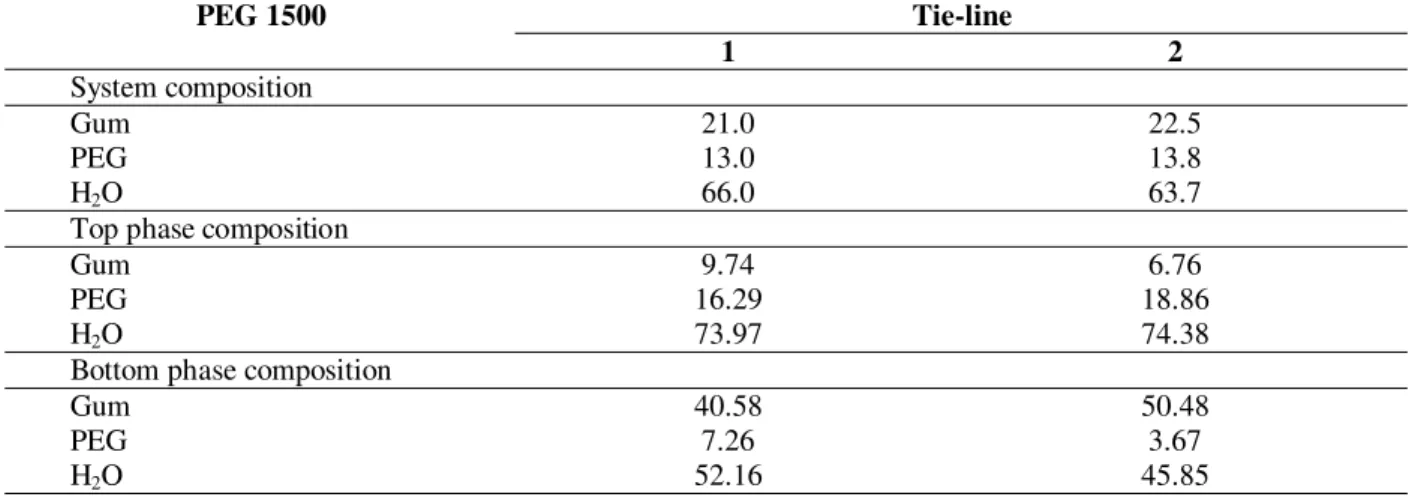
Table 2- Tie-lines composition (w/w) of PEG1500-Cashew-nut tree gum system at 40°C
Tie-line PEG 1500
1 2 System composition
Gum 21.0 22.5
PEG 13.0 13.8
H2O 66.0 63.7
Top phase composition
Gum 9.74 6.76
PEG 16.29 18.86
H2O 73.97 74.38
Bottom phase composition
Gum 40.58 50.48
PEG 7.26 3.67
H2O 52.16 45.85
Figure 2- Effect of tie-line length and pH on BSA (a) and trypsin (b) partition
coefficients in PEG1500-Cashew-nut tree gum system at 25°C± 2°
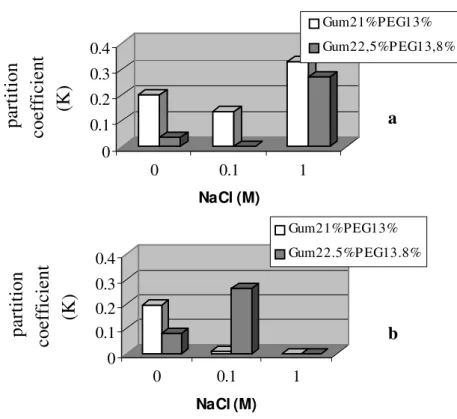
The influence of NaCl addition on the partition of BSA and trypsin at pH 7.0 is shown in Fig. 3. It was observed that the BSA partition coefficient decreased for 0.1M NaCl addition and increased for 1.0M NaCl addition for both tie-lines length. Similar results were obtained by Venâncio et al. (1993) for negatively charged proteins partitioned in polymer-polymer systems. BSA partitioning in PEG-Arabinigalactan systems (Christian et al.,
1998) and in PEG-Aquaphase PPT (Sturesson et al., 1990) decreased after the addition of 0.1M NaCl for systems at pH 7.0.
pH's showed an irregular partition trend with NaCl concentration.
By the analysis of the system composition, considering low salt concentrations, a small predominance of the chloride ion in the PEG-rich phase can occur, which becomes electrically more negative compared to the lower phase. Thus, the negatively charged substances are preferentially partitioned into the lower phase. The results obtained for BSA partitioning after the addition of 0.1M NaCl at pH 7.0, where the protein had a
negative charge, agreed with the explanation described above. However, for trypsin, which was positively charged at pH 7.0, such behaviour could not be observed. Probably, other factors might have influenced the partitioning in a different way as there existed a lot of parameters involved (e.g. hydrophobic interactions, concentration and phase-forming polymer properties and affinity of the macromolecule for the phase-forming polymer).
Figure 3- Effect of NaCl addition on BSA (a) and trypsin (b) partition coefficients in
PEG1500-Cashew-nut tree gum system at 25°C± 2°, pH 7.0
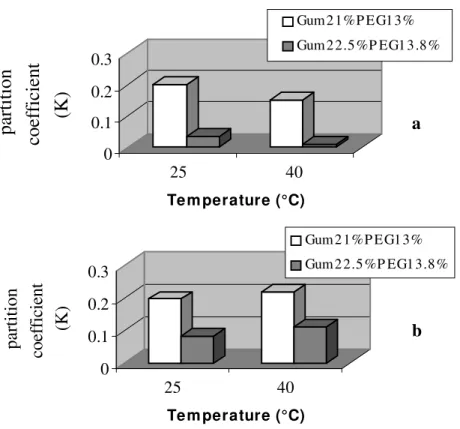
The effect of temperature is quite complex because the phase composition, the electrostatic interactions and the hydrophobic interactions are all coupled to the temperature. In addition, the proteins can undergo denaturation, conformational changes, and self association or dissociation when the temperature is raised. Some reports have described an increase in the partition coefficient with the temperature (Diamond and Hsu, 1992; Forciniti et al., 1991), others have
found that the partition coefficient showed no temperature dependence (Johansson et al., 1973; Tjerneld et al., 1985). The effect of temperature on the partition coefficient of BSA and trypsin was studied at 25°C± 2° and 40°C± 2° (Fig. 4). The results showed a little increase of K of trypsin with temperature, while BSA partitioning showed an opposite behaviour.
0 0.1 0.2 0.3 0.4
partition
coefficie
nt
(K)
0 0.1 1
NaCl (M)
Gum21%PEG13%
Gum22,5%P EG13,8%
0 0.1 0.2 0.3 0.4
partition
coefficie
nt
(K)
0 0.1 1
NaCl (M)
Gum21%PEG13%
Gum22.5%P EG13.8%
a
Figure 4- Effect of temperature on BSA (a) and trypsin (b) partition coefficients in PEG1500-Cashew-nut tree gum system at pH 7.0
As there was no significant change in phases composition in the PEG-Cashew-nut tree gum system when temperature was changed, the influence of this parameter on the partition coefficient seemed to be highly dependent on other factors, such as the kind of protein which is partitioned. These results showed that there could be many factors that influenced the partitioning behaviour of proteins in aqueous two phase systems. The complexity of the partitioning because of the involvement of several interacting properties between the solute and the phase forming components was related.
CONCLUSIONS
The partitioning of two proteins, BSA and trypsin, even with different characteristics showed similar traits when the influence of some parameters was investigated. The results obtained showed that it was possible to change the degree of partitioning by selecting the right conditions like pH, temperature and salt addition.
ACKNOWLEDGEMENTS
We would like to thank FAPESP and PRONEX/CNPq for financial support.
RESUMO
A partição de duas proteínas, albumina de soro bovino (BSA) e tripsina foi estudada no sistema bifásico aquoso Polietileno glicol(PEG) - Goma do cajueiro. O diagrama de fases foi estabelecido para a Goma do Cajueiro e para PEG de peso molecular 1500 em duas diferentes temperaturas. A influência de vários parâmetros na partição destas proteínas, incluindo concentração dos polímeros, pH, adição de sal e temperatura foi investigada. Os resultados desta pesquisa demonstraram a importância das características da proteína na partição em sistemas bifásicos aquosos.
0 0.1 0.2 0.3
partition
coefficie
nt
(K)
25 40
Tem perature (°C)
Gum 2 1%P EG1 3%
Gum 2 2.5 %P EG1 3 .8 %
0 0.1 0.2 0.3
partition
coefficient
(K)
25 40
Tem perature (°C)
Gum 2 1%P EG1 3%
Gum 2 2.5 %P EG1 3.8 %
a
REFERENCES
Albertsson, P. A. (1986), Partition of Cell Particles and
Macromolecules. 3rd ed. New York : Wiley.
Albertsson, P. A.; Andersson, B.; Larsson, C. and Akerlund, H. E. (1981), Methods Biochem. Anal., 28, 115-150.
Almeida, M. C.; Venâncio, A.; Teixeira, J. A. and Aires-Barros, M. R. (1998), Cutinase purification on poly(ethylene glycol)-hydroxypropyl starch aqueous two-phase systems. J. Chrom. B., 711, 151-159. Bradford, M. M. (1976), A rapid and sensitive method
for the quantification of microgram quantities of protein utilizing the principle of protein-dye binding.
Anal. Biochem., 72, 248-254.
Christian, T. J.; Manley-Harris, M. and Richards, G. N. (1998), A preliminary study of the use of larch arabinogalactan in aqueous two-phase systems.
Carbohydr. Polym., 35, 7-12.
Diamond, A. D. and Hsu, J. T. (1992), Aqueous two phase systems for biomolecule separation. Adv.
Biochem. Eng., 47, 89-135.
Forciniti, D.; Hall, C. K. and Kula, M. R. (1991), Temperature dependence of the partition coefficient of proteins in aqueous two-phase systems.
Bioseparation, 2, 115-128.
Johansson, G.; Anderson, M. and Akerlund, H. E. (1984), Counter current distribution of yeast enzymes with polymer-bound triazine dye affinity ligands. J.
Chrom., 289, 483-49.
Johansson, G.; Hartman, A. and Albertsson, P. A. (1973), Partition of proteins in two-phase systems containing charged poly(ethylene glycol). Eur. J.
Biochem., 33, 379-386.
Johansson, G. and Joelsson, M. (1985), Preparation of Cibacron blue F3GA (polyethylene glycol) in large scale for use in affinity partitioning. Biotechnol.
Bioeng., 27, 621-625.
Kishida, A.; Nakano, S.; Kikunaga, Y. and Akashi, M. (1998), Synthesis and funcionalities of poly (N-vinylalkylamide). VII. A novel aqueous two-phase systems based on poly(N-vinylacetamide) and Dextran. J. Appl. Pol. Science., 67, 255-258.
Miller, G. L. (1959), Use of dinitrosalicylic acid reagent for determination of reducing sugar. Anal. Chem., 31, 426-428.
Oliveira, L. A.; Sarubbo, L. A.; Porto, A. L. F.; Lima-Filho, J. L.; Campos-Takaki, G. M. and Tambourgi, E. B. (2002), Physical and rheological characterisation of PEG-Cashew-nut tree gum aqueous two-phase systems. J. Chrom. B., 766, 27-36.
Pietruszka, N.; Galaen, I. Y.; Kumar, A.; Brzozowski, Z. K. and Matiasson, B. (2000), New polymers forming aqueous two-phase polymer systems.
Biotechol. Prog., 16, 408-415.
Rodrigues, J. F.; Paula, R. C. M. and Costa, S. M. (1993), Métodos de isolamento de gomas naturais: comparação através da goma do cajueiro
(Anacardium occidentale L.). Polímeros: Ciência e
Tecnologia, 1, 31-36.
Sarubbo, L. A.; Oliveira, L. A.; Porto, A. L. F.; Duarte, H. S.; Carneiro-Leão, A. M. A.; Lima-Filho, J. L.; Campos-Takaki, G. M. and Tambourgi, E. B. (2000), New aqueous two-phase system based on cashew-nut tree gum and polyethylene glycol. J. Chrom. B., 743, 79-84. Silva, M. E. and Franco, T. T. (2000), Liquid-liquid
extraction of biomolecules in downstream processing - a review paper. Braz. J. Chem. Eng., 17, 1-30. Skoog, B. (1979), Determination of polyethylene glycols
4000 and 6000 in plasma protein preparations. J. Blood
Transf. Immunopathol., 37, 345-349.
Sturesson, S.; Tjerneld, F. and Johansson, G. (1990), Partition of macromolecules and cell particles in aqueous two-phase systems based on hydroxypropyl starch and poly(ethylene glycol). Appl. Biochem
Biotechnol., 3, 281-295.
Tjerneld, F.; Berner, S.; Cajarville, A. E. and Johansson, G. (1986), New aqueous two-phase system based on hydroxypropyl starch useful in enzyme purification.
Enzyme Microbiol. Technol., 8, 417-423.
Tjerneld, F., Persson, I. and Albertsson, P. A. (1985), Enzymatic hydrolysis of cellulose in aqueous two-phase systems. I. Partition of cellulases from Trichoderma
reesei. Biotechnol. Bioeng, 27, 1036-1043.
Venâncio, A. A. D.; Almeida, C.; Domingues, L. and Teixeira, J. A. (1993), Protein partition on a derivative guar gum based aqueous two-phase system. Bioseparation, 5, 253-258.
Walter, H.; Brooks, D. E. and Fisher, D. (1985), Partitioning in Aqueous Two-Phase Systems: Theory,
Methods, Uses, and Applications to Biotechnology.
Orlando : Academic Press.