Printed version ISSN 0001-3765 / Online version ISSN 1678-2690 www.scielo.br/aabc
Innovative molecular approach to the identification of
Colossoma macropomum
and its hybrids
FÁTIMA GOMES1
, HORACIO SCHNEIDER1, CLAUDENE BARROS2, DIONISO SAMPAIO1, DIOGO HASHIMOTO3, FÁBIO PORTO-FORESTI3and IRACILDA SAMPAIO1
1Instituto de Estudos Costeiros, Laboratório de Genética e Biologia Molecular, Universidade Federal do Pará,
Campus de Bragança, Alameda Leandro Ribeiro, s/n, 68600-000 Bragança, PA, Brasil
2 Centro de Estudos Superiores de Caxias, Universidade Estadual do Maranhão, Laboratório de Genética e Biologia Molecular,
Praça Duque de Caxias, s/n, 65604-380 Caxias, MA, Brasil
3Departamento de Ciências Biológicas, Faculdade de Ciências, Universidade Estadual Paulista (UNESP),
Campus de Bauru, Rua Engenheiro Luiz Edmundo Coube, 14-01, 17033-360 Bauru, SP, Brasil
Manuscript received on September 14, 2011; accepted for publication on November 9, 2011
ABSTRACT
Tambaqui (Colossoma macropomum) is the fish species most commonly raised in the Brazilian fish farms.
The species is highly adaptable to captive conditions, and is both fast-growing and relatively fecund. In
recent years, artificial breeding has produced hybrids with Characiform species, known as “Tambacu” and “Tambatinga”. Identifying hybrids is a difficult process, given their morphological similarities with the parent species. This study presents an innovative molecular approach to the identification of hybrids based primarily on Multiplex PCR of a nuclear gene (α-Tropomyosin), which was tested on 93 specimens obtained from fish farms in northern Brazil. The sequencing of a 505-bp fragment of the Control Region (CR) permitted the identification of the maternal lineage of the specimen, all of which corresponded
to C. macropomum. Unexpectedly, only two CR haplotype were found in 93 samples, a very low genetic
diversity for the pisciculture of Tambaqui. Multiplex PCR identified 42 hybrids, in contrast with 23 identified
by the supplier on the basis of external morphology. This innovative tool has considerable potential for
the development of the Brazilian aquaculture, given the possibility of the systematic identification of the
genetic traits of both fry-producing stocks, and the fry and juveniles raised in farms.
Key words: pisciculture, Multiplex PCR, mitochondrial DNA, genetic bottleneck.
INTRODUCTION
A number of native Brazilian fishes have considerable
potential for aquaculture, although for most species,
the lack of a reliable scientific and technological
database impedes the development of adequate
husbandry and the full economic potential of the
species (Ostrensky et al. 2008). The “Tambaqui”
(
Colossoma macropomum
), which is native to
Amazon and Orinoco basins (Lima and Goulding
1998), is the most widely-farmed native fish in
Brazil, and is found practically throughout the whole
country (IBAMA 2008). This species is renowned
for its excellent adaptation to captive conditions,
even in polyspecific arrangements, as well as for
its rapid growth, high fecundity and the excellent
flavor of its meat (Lima and Goulding 1998).
The Tambaqui has also been targeted in artificial
hybridization programs over the past few decades,
and has been crossed with a number of different
species with the aim of producing sterile individuals
or more productive breeds than either of the parent
species (Bartley et al. 2001). Given their considerable
fecundity, the female Tambaqui is normally preferred
for this procedure, and it is normally mated with
males of two other characiforme species,
Piaractus
mesopotamicus
(“Pacu”) and
Piaractus brachypomus
(“Pirapitinga”). This produces hybrids known as
“Tambacu” and “Tambatinga”, respectively. This
hybridization aims to combine the characteristics of
different species to produce an economically more
viable organism which is, in particular, faster growing,
and more resistant to disease and low temperatures
(Senhorini et al. 1988, Fontes et al
.
1990).
The marked similarities between the hybrids
and their parent species hampers the identification
of these animals based on morphology, or even
their behavior or ecology (Scribner et al
.
2001).
Given this problem, the genetic characterization
of stocks that have passed through some form of
artificial manipulation has become increasingly
important at fish farms where selective breeding is
practiced (Toledo-Filho et al
.
1994, Porto-Foresti
et al. 2006). Given this, the development of reliable
genetic markers has provided valuable insights,
and has become an important tool in pisciculture,
capable of generating data on endogamy, genetic
variability and relatedness, as well as providing
a basis for the identification of hybrids and their
lineages in breeding programs (García de Leon et
al
.
1998, Liu and Cordes 2004).
Multiplex PCR is one of the most important
modern molecular tools used in pisciculture for the
identification of species and the differentiation of pure
and hybrid specimens. This technique is a variation
of the traditional PCR (Polymerase Chain Reaction),
which allows the simultaneous amplification of a
number of different target regions using different
pairs of primers, and was developed by Chamberlain
et al. (1988). In Brazil, Multiplex PCR has been
applied successfully to the identification of native
elasmobranch fishes (sharks and rays) based on the
analysis of muscle tissue or fins (De-Franco et al.
2009, Mendonça et al. 2009, 2010), as well as the
differentiation of pure and hybrid specimens raised
in fish farms (Hashimoto et al.
2009).
Another widely-used technique in fishery
genetics is DNA sequencing, which can be applied
to both mitochondrial and nuclear regions, and has
been used successfully to solve questions related
to phylogeny, population structure and species
identification. Given its accelerated mutation rate,
mitochondrial DNA has been widely used for the
analysis of genetic variability at the population
level. Santos et al. (2007) recorded high levels
of genetic diversity in five native populations of
Colossoma macropomum
from the main channel
of the Amazon River using DNA sequences of the
mitochondrial Control Region. The parameters
established in this study are important for the
development of comparative studies of genetic
variability in fry-producing stocks.
MATERIALS AND METHODS
SAMPLES
A total of 93 samples were obtained from fish farms
located in the Brazilian states of Pará (Augusto
Corrêa, Bragança, Capitão Poço, Castanhal, Marabá,
Santarém, and Viseu) Rondônia (Pimenta Bueno),
Amapá (Macapá), and Piauí (Paulistana). The
identification of the maternal mitochondrial DNA
lineage was based on samples of native Tambaquis from
Lago Grande in Santarém (Pará) and mitochondrial
haplotypes of Pirapitinga (
Piaractus brachypomus
,
AF283958) and Pacu (
Piaractus mesopotamicus
,
AF283959) retrieved from Genbank. For multiplex
analyses, additional samples of
P. brachypomus
and
P.
mesopotamicus
were obtained from the Fish Genetics
Laboratory (LaGenPe) at São Paulo State University
in Bauru (UNESP-Bauru).
At the fish farms, the person who provided
the specimens was asked to identify the animal (as
pure Tambaqui, Tambacu or Tambatinga), and this
classification was recorded for later comparison
with the genetic identification. The tissue samples
(fragments of muscle or fin) were preserved in
absolute ethanol until analysis, in either the Genetics
or Molecular Biology Laboratory of the Coastal
Studies Institute of the Federal University of Pará
(for the sequencing of mitochondrial DNA) and the
LaGenPe at UNESP-Bauru (for the Multiplex PCR).
DNA EXTRACTION
Total DNA was isolated using the phenol/
chloroform extraction protocol and precipitation
with ethanol (Sambrook and Russel 2001). The
specimens were visualized by electrophoresis in
1% agar gel, colored with ethidium bromide.
PCR AND DNA SEQUENCING
The identification of the maternal mitochondrial
lineage was based on a fragment of DNA from
the Control Region. This segment was ampli fied
by Polymerase Chain Reaction (PCR), using the
primers D-loop L1 (5’-CCTAAC
TCCCAAA-GCTAGGTATTC-3’, Santa Brígida et al. 2007)
and D-loop H1, 5’-TGTTTATCACTG
CTGRRTT-CCCT-3’ (designed for this paper). This pair of primers
amplifies the whole Control Region (approximately
1100 base pairs or bps), but only some 500 bps were
used for the present analysis.
The PCR reactions were conducted in a total
volume of 25
m
l containing the following reagents:
2.5
m
l of (10X) buffer, 4
m
l of DNTP (1.25 mM),
1
m
l of MgCl
2(50 mM), 1.0 to 2.0
m
l of DNA
(50–100 ng/
m
l), 0.25
m
l of each primer and 0.2
m
l of Taq DNA polymerase (5 U/
m
l), topped off
with purified water in order to complete the final
reaction volume. The program used for the PCR
reactions consisted of initial denaturation at 94°C
for 3 minutes, followed by 35 cycles of denaturation
at 94°C (30 seconds), hybridization at 57°C (1
minute), and extension at 72°C (2 minutes), and a
final extension at 72
°C for 7 minutes.
The products of this amplification were
sequenced immediately using the ABI Prism
TM Dye Terminator Cycle Sequencing Reading
Reaction kit (Applied Biosystems), followed
by electrophoresis in an ABI 3130 automatic
sequencer. The DNA sequences were edited and
aligned in BIOEDIT 5.0.6 (Hall 1999), and the
species from which the mitochondrial lineage
was derived was identified through comparisons
with the sequences available for the Tambaqui,
Pacu, and Pirapitinga available in GenBank
(
Colossoma macropomum
DQ480074,
Piaractus
mesopotamicus
AF283959, and
Piaractus
brachypomus
AF283958). The new sequences
generated in the present study were deposited in
GenBank under the accession codes JN581982-83.
MULTIPLEX PCR
Multiplex PCR for the analysis of a nuclear marker
– the α-Tropomyosin gene – based on a protocol
adapted from Hashimoto et al. (2009). The
species-specific primers that discriminate
C. macropomum
,
P.
mesopotamicus
, and
P. brachypomus
were developed
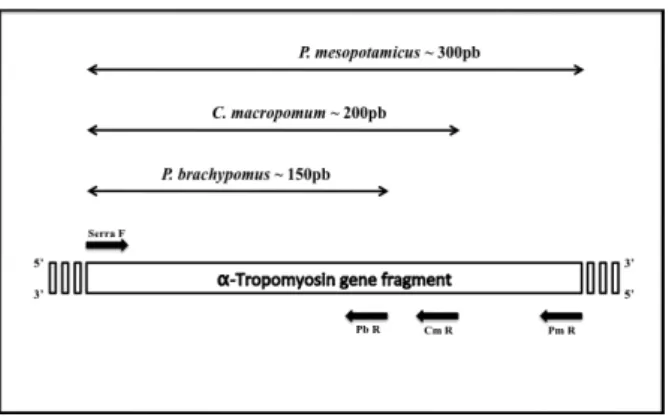
by the LaGenPe (UNESP-Bauru). The sequence
of each primer is as follows: Tropo Serra F (5`-
GAGTTGGATCGGGCTCAG- 3`), Tropo Cm R (5`-
ATACAACAATGCCATCGCT- 3`), Tropo Pm R (5`-
CTTCAGCTGGATCTCCTGA- 3`), and Tropo Pb
R (5`- TTGACTTTATGCCACACAAAT- 3`). Tropo
Serra F is a universal primer, and thus reco gnizes the
DNA of the three species, whereas the reverse primers
are specific to the three species, Tropo Cm R to
C.
macropomum
, Tropo Pm R to
P. meso potamicus
and
Tropo Pb R to
P. brachypomus
(Figure 1).
The Multiplex PCR reaction was conducted
in a total volume of 20
m
l containing the following
reagents: 2.0
m
l of (10X) buffer, 1.5
m
l of DNTP (1.25
mM), 0.75
m
l of MgCl
2(50 mM), 1.0 to 2.0
m
l of
DNA (50–100 ng/
m
l), 0.3
m
l of each primer (except
for CmR, for which a volume of 0.8
m
l was used)
and 0.2
m
l of Taq DNA polymerase (5 U/
m
l), topped
off with purified water in order to complete the final
reaction volume (reagents from Invitrogen, USA).
The program used for the PCR reactions consisted
of initial denaturation at 95°C for 5 minutes,
followed by 35 cycles of denaturation at 95°C (30
seconds), hybridization at 59°C (30 seconds) and
extension at 72°C (5 seconds), followed by final
extension at 72°C for 7 minutes. The size of the
DNA fragments was determined using a low DNA
mass ladder (Invitrogen), following electrophoresis
in 1.5% agar gel colored with Ethidium Bromide
and visualization under UV light. Photographs were
taken with a 5.1 megapixel Olympus CAMEDIA,
C –5060 digital camera.
MITOCHONDRIAL DNA SEQUENCES
A segment of 505 bps of the Control Region was
obtained from the 93 specimens obtained from
fish farms in the Brazilian states of Pará, Amapá,
Piauí, and Rondônia. These specimens presented
low haplotypic diversity, with only two haplotypes
being identified from the 93 sequences. These two
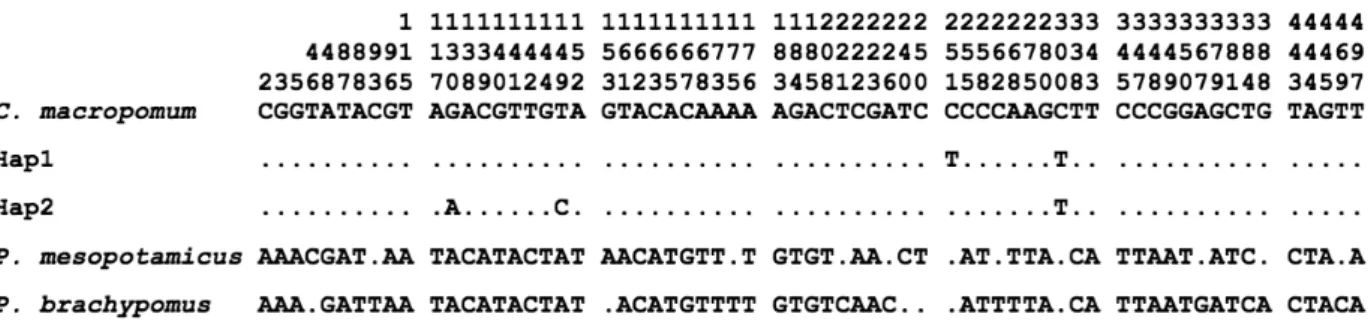
haplotypes (Hap1 and Hap2) differ in only three
nucleotides (Figure 2), and while Hap2 is exclusive
to Santarém, Hap1 was found at all the other farms.
The sequences obtained in the present study
were compared with those available in GenBank for
Colossoma macropomum
(DQ480074),
Piaractus
mesopotamicus
(AF283959) and
Piaractus
brachypomus
(AF283958), and a high degree
of similarity (99%) was found with sequence
DQ480074, i.e., Tambaqui,
C. macropomum
. The
differences between the sequence of this species and
those of the other two species were considerable.
The sequences of haplotypes Hap1 and Hap2 differ
from that of
P. mesopotamicus
(AF283959) at 57 and
55 sites, respectively, a divergence of
approxima-tely 11%, and from
P. brachypomus
(AF283958) at
59 and 57 sites (difference of 11.5%). The almost
complete similarity between the DNA sequences of
the specimens collected in the present study and those
of GenBank sequence DQ480074 and the native
specimen from Santarém confirms emphatically that
the maternal lineage of all the specimens is derived
from Tambaqui,
C. macropomum
.
Figure 1. Schematic diagram of the primers used for the multiplex
PCR analysis of the nuclear α-Tropomyosin gene. Primer Serra F (forward) is universal and reverse primers are species specific for
MULTIPLEX PCR
The multiplex amplification of the nuclear DNA of the
α-Tropomyosin gene revealed different electrophoretic
patterns for the three species (Tambaqui, Pacu, and
Pirapitinga). For Pacu (
P. mesopotamicus
) a band of
approximately 300 bps was obtained, whereas for
Tambaqui (
C. macropomum
) this band had around
200 bps, decreasing to approximately 150 bps in
Pirapitinga (
P. brachypomus
). Of the 93 specimens
analyzed here, 42 had a heterozygous pattern, with two
diagnostic bands, indicating the presence of hybrids.
As each band in the multiplex PCR corresponds
to an allele inherited from one of the parents, the
electrophoretic profile of a hybrid Tambacu (female
C. macropomum
x male
P. mesopotamicus
) contains
Figure 2. Variable sites in the mitochondrial Control Region haplotypes identified in Colossoma macropomum, Piaractus mesopotamicus
and P. brachypomus (sequences obtained from GenBank), farmed specimens of C. macropomum (Hap1 and Hap2, Genbank JN581982-83)
and a wild specimen of C. macropomum obtained from Lago Grande near Santarém, Pará (Genbank JN590242).
Origin Collection
date
Number of specimens
Origin of the fry
mtDNA haplotype
Identification by:
The supplier
Multiplex PCR (number of specimens)
Augusto Correa/Pará April
2008 7 Castanhal Tambaqui – Hap1 Tambaqui Tambacu (7)
Bragança/ Pará July 2008 19 Castanhal Tambaqui – Hap1 Tambaqui Tambaqui (13), Tambacu (6)
Capitão Poço/Pará April
2008 10 Castanhal Tambaqui – Hap1
Unidentified
hybrids* Tambacu (5), Tambatinga (5)
Castanhal/Pará June 2008 7 Castanhal Tambaqui – Hap1 Tambaqui Tambatinga (5), Tambacu (2)
Santarém/Pará June 2008 26 Santarém Tambaqui – Hap2 Tambaqui* Tambaqui (26)
Viseu/Pará May 2008 9 Castanhal Tambaqui – Hap1 Tambatinga Tambatinga (9)
Marabá/Pará April
2009 4 Castanhal Tambaqui – Hap1 Tambacu Tambaqui (3), Tambacu (1)
Pimenta Bueno/Rondônia August
2008 5
Porto
Velho Tambaqui – Hap1 Tambaqui Tambaqui (5)
Paulistana/Piauí July 2007 4 Unknown Tambaqui – Hap1 Tambaqui Tambaqui (2), Tambacu (2)
Macapá/Amapá September
2009 2 Castanhal Tambaqui – Hap1 Tambaqui Tambaqui (2)
TABLE I
Morphological and molecular identification of the specimens analyzed in the present study.
a 200-bp band, corresponding to the allele inherited
from the mother, and a 300-bp band, corresponding
to that inherited from the father. Similarly, in the
hybrid Tambatinga (female
C. macropomum
x male
P. brachypomus
), the 200-bp and 150-bp bands
correspond to the allele inherited from the mother
and father, respectively (Figures 3 and 4).
gene identified 42 hybrids, 23 Tambacus and 19
Tambatingas. Suppliers not only misidentified
hybrids as pure Tambaquis, but also in one case
pure Tambaquis were identified as hybrids,
re-emphasizing the difficulty of differentiating the
specimens based on external morphology (Table I).
DISCUSSION
The Tambaqui (
Colossoma macropomum
) is the
native fish species most commonly found in fish
farms in Brazil, where artificial hybridization
with other characiform species has generated a
number of hybrids, in particular Tambacu and
Tambatinga, which are also found throughout the
country. The genetic monitoring of this process
is important not only for the identification of
specimens, but also for the evaluation of the
genetic variability of fry-producing stocks.
The present analysis was based on a robust
genetic tool consisting of the sequences of a
fragment of mitochondrial DNA (used to identify
the maternal lineage) and multiplex PCR of a
nuclear marker, which enabled the differentiation
of pure specimens from hybrids. The combination
of these two approaches allowed us to characterize
the genetic traits of the sample of 93 specimens
obtained from ten fish farms located in four
northern Brazilian states.
The mitochondrial DNA of animals is
inherited from a single parent, that is, the mother
in most eukaryotes (Moritz et al. 1987, Parker et
al. 1998). In the present case, the sequences of the
mitochondrial Control Region confirmed that all
the specimens, both pure and hybrids, have the
maternal lineage of Tambaqui (
C. macropomum
).
The nuclear markers, by contrast, are inherited
from both parents and have been widely and
successfully used in studies of fish species for the
analysis of gene flow within and between species,
as well as for interspecific hybridization. Multiplex
PCR of mitochondrial genes has been successfully
Figure 4. Agar gel (1.5%) for the PCR of the α-Tropomyosin gene in (1)
Pacu, (2) Pirapitinga and (3) Tambaqui, and of specimens obtained from
a fish farm in Santarém, Pará (Brazil) (4-13). M = 1Kb Plus DNA Ladder. Figure 3. Agar gel (1.5%) for the PCR of the α-Tropomyosin gene in (1)
Pacu, (2) Pirapitinga and (3) Tambaqui specimens. Samples 4-13 were
obtained from a fish farm in Capitão Poço, Pará (Brazil), showing the
double banding representative of hybrid Tambacu (specimens 4, 5, 6, 7, and 13) and Tambatinga (8, 9, 10, 11, and 12). M = 1Kb Plus DNA Ladder. Except for Pacu, which the picture was retrieved from the internet (http:// pescariamadora.blogspot.com/2011/06/peixes-de-agua-doce-pacu.html), all remaining pictures were taken by the authors of this study.
used for the identification of the Brazilian shark
and ray species (De-Franco et al. 2009, Mendonça
et al. 2009, 2010), and for the differentiation of
pure and hybrid specimens produced in fish farms
(Hashimoto et al.
2009). De-Franco et al. (2009)
used multiplex PCR of cytochrome oxidase subunit
I (COI) to differentiate the guitarfish species
Rhinobatos horkelli, R. percellens
and
Zapteryx
brevirostris
. Mendonça et al. (2009) presented
an effective system of multiplex PCR and
PCR-RFLP techniques, which was used to differentiate
the shark species
Rhizoprionodon lalandii
and
R.
porosus
. In a subsequent study Mendonça et al.
(2010) developed a multiplex system for COI that
permitted the differentiation of nine species of
Lamniform and Carcharhiniform sharks.
In the case of Tambaqui and its hybrids
analyzed in the present study, it is important
to note that, while it is inherited from both
parents, multiplex PCR of the nuclear marker
α-Tropomyosin would not be sufficient, on its
own, to identify the parent species involved in the
hybridization, given that other types of hybrids,
such as the “Paqui”, produced by crossing a
female pacu with a male tambaqui, are now
common. The multiplex PCR banding pattern is
identical in Tambacus and Paquis – both have one
diagnostic band of 300 bps and one of 200 bps
– making these hybrids indistinguishable when
using only this technique. As shown in the present
study, this problem can be overcome by using the
mitochondrial DNA sequences in order to identify
the maternal lineage.
The mitochondrial haplotype variation
observed in the farmed specimens analyzed in the
present study was unexpected low. The presence of
only two haplotypes in the 93 specimens obtained
from the 10 fish farms located in four Brazilian
states indicates that all the individuals were
descended from only two females. In the specific
case of the Santarém farm, the only unit at which
haplotype 2 was recorded, the fry were obtained
locally from the Pará State Agriculture Ministry
(SAGRI). The fry from the Pimenta Bueno farm in
Rondônia (Hap1) were obtained locally, in the state
capital Porto Velho. The specimens from Paulistana
(Hap1) were from an artificial lake, although their
origin was not known. Specimens from the other
farms, in Amapá and Pará (both Hap1) were
acquired from the same facility in Castanhal, Pará.
This reduced mitochondrial diversity in the
Tambaqui stocks might be a result of the history of
the farming of the species in Brazil, which began
in the 1980s (Guimarães 1999). As in most other
domesticated species, this process tends to provoke
an accentuated genetic bottleneck, given that the
descendants of each generation are selected for the
establishment of the breeding stock of subsequent
generations. Our results are consistent with such a
bottleneck, especially in the case of the 67 specimens
from Rondônia, Piauí, Amapá, and Pará, which
presented only the Haplotype 1. As each female
Tambaqui normally is used only once or few times
a year for the production of fry (Kubitza 2004) and
the specimens analyzed in this study were obtained
in different months (Table I), they possibly were
not all descendants of the same mother. The overall
results, then, indicate a high rate of inbreeding in the
breeding stock of female Tambaqui.
A second question that demands attention is
the difficulty in identifying organisms produced
through artificial breeding programs, which
hampers the reliable identification of specimens.
The additional hybrids identified in the present study
through molecular analyses, and the consequent
reduction in the number of pure specimens, indicates
that many fish farmers are raising hybrids they
presume to be pure Tambaquis. This is understandable,
considering the marked morphological similarities
among the different forms, but it may have serious
economic consequences, given the distrust it may
provoke between the producers of farmed fish and
their consumers.
The correct identification of the products of
pisciculture reinforces the trust of the consumer and
strengthens the fish farming market. The genetic
tools developed in the present study represent a
major advance for the monitoring of the genetic
variability of Tambaqui and its hybrids, which are
now farmed throughout Brazil.
ACKNOWLEDGMENTS
We would like to thanks Jorge Queiroz for
supplying samples from Rondônia. This project
was financed by Ministério da Ciência e Tecnologia
(MCT)/Conselho Nacional de Desenvolvimento
Científico e Tecnológico (CNPq)/PPG7, Edital nº
48/2005 - SPC&T Fase II- Programa Piloto para a
Proteção das Florestas Tropicais do Brasil. Fatima
Gomes was supported by a master scholarship
from Coordenação de Aperfeiçoamento de
Pessoal de Nível Superior (CAPES).
RESUMO
O Tambaqui (
Colossoma macropomum
) é a
espécie de peixe mais comumente cultivada em
pisciculturas no Brasil. A espécie é altamente
adaptada às condições de cativeiro, apresentando
rápido crescimento e alta fecundidade. Nos últimos
anos tem ocorrido o cruzamento artificial entre
espécies de Characi formes, produzindo os híbridos
“Tambacu” e “Tambatinga”. A identificação de
híbridos é uma tarefa difícil, em virtude da grande
similaridade morfológica entre as espécies parentais.
O presente estudo apresenta uma abordagem
mole-cular inovadora para identificação de híbridos
com base em PCR Multiplex de um gene nuclear
(α-Tropomiosina), em que foram testados 93 espécimes
obtidos em pisciculturas da região norte do Brasil.
O sequenciamento de um fragmento de 505 pares de
bases da Região Controle permitiu a identificação
da linhagem materna de todos os espécimes como
sendo de
C. macropomum
. Inesperadamente foram
encontrados apenas dois haplótipos nas 93 amostras,
um baixíssimo índice de diversidade para populações
cultivadas de Tambaqui. A PCR multiplex identificou
42 híbridos, em contraste aos 23 híbridos citados
pelos fornecedores dos peixes, em uma identificação
realizada com base na morfologia. Esta ferramenta
inovadora possui um grande potencial para o
dese-nvolvimento da aquicultura brasileira dada a
possibi-lidade de identificação sistemática das caracte rísticas
genéticas tanto das matrizes produtoras de alevinos
quanto dos alevinos e juvenis criados em fazendas.
Palavras-chave:
piscicultura, PCR Multiplex,
DNA mitocondrial, “Gargalo-de-garrafa” genético.
REFERENCES
BARTLEY DM, RANA K AND IMMINK AJ. 2001. The use of inter-specific hybrids in aquaculture and fisheries. Rev Fish Biol Fish 10: 325-337.
CHAMBERLAIN JS, GIBBS RA, RANIER JE, PHI NGA, NGUYEN PN AND CASKEY CT. 1988. Deletion screening of the Duchenne muscular dystrophy locus via multiplex DNA amplification. Nucl Ac Res 16: 11141-11156. DE-FRANCO B, MENDONÇA FF, HASHIMOTO DT,
PORTO-FORESTI F, OLIVEIRA C AND FORESTI F. 2009. Forensic identification of the guitarfish species Rhinobatos horkelli, R. percellens and Zapteryx brevirostris using multiplex-PCR. Mol Ecol Resour 10: 197-199.
GARCÍA DE LEON FJ, CANONNE M, QUILLET E, BONHOMME F AND CHATAIN B. 1998. The application of microsatellite markers to breeding programs in the sea bass, Dicentrarchus labrax. Aquaculture 159: 303-316.
GUIMARÃES SF.1999. Criação de Colossoma e Piaractus no Brasil: II reunião do grupo de trabalho de Colossoma e Piaractus, Pirassunga SP, 13 a 15 de agosto de 1991; anais/Centro de Pesquisa e Treinamento em Aqüicultura. – Brasília: Ed. IBAMA, 286 p.
HALL TA. 1999. BIOEDIT: a user-friendly biological sequence alignment editor and analysis program for Windows 95/98/NT. Nucl Ac Symp Ser 41: 95-98.
HASHIMOTO DT, MENDONÇA FF, SENHORINI JA, BORTOLOZZI J, OLIVEIRA C, FORESTI F AND PORTO-FORESTI F. 2009. Identification of hybrids between Neotropical fish Leporinus macrocephalus and Leporinus elongates by PCR-RFLP and multiplex-PCR: Tools for genetic monitoring in aquaculture. Aquaculture 298: 346–349.
IBAMA - INSTITUTO BRASILEIRO DO MEIO AMBIENTE E DOS RECURSOS NATURAIS RENOVÁVEIS. 2008. Estatística da pesca 2006 Brasil: grandes regiões e unidades da federação /Brasília: Ibama, 174 p.
KUBITZA F. 2004. Coletânea de informações aplicadas ao cultivo do Tambaqui, do Pacu e de outros peixes redondos. Panorama da Aquicultura 14(82): 27-37.
LIMA CA AND GOULDING M. 1998. Os Frutos do Tambaqui: Ecologia, Conservação e Cultivo na Amazônia. Tefé, AM: Sociedade Civil de Mamirau, CNPq, v 4, 186 p.
LIU ZJ AND CORDES JF. 2004. DNA marker technologies and their applications in aquaculture genetics. Aquaculture 238: 1-37.
MENDONÇA FF, HASHIMOTO DT, PORTO-FORESTI F, GADIG OBF, OLIVEIRA C AND FORESTI F. 2010. Genetic identifi-cation of lamniform and carcharhiniform sharks using multiplex-PCR. Conserv Genet Resour 1: 31-35.
MENDONÇA FF, HASHIMOTO DT, PORTO-FORESTI F, OLIVEIRA C, GADIG OBF AND FORESTI F. 2009. Identification of the shark species Rhizoprionodon lalandii and R. porosus (Elasmobranchii, Carcharhinidae) by multiplex PCR and PCR-RFLP techniques. Mol Ecol Resour 9: 771–773.
MORITZ C, DOWLING TE AND BROWN WM. 1987. Evolution of animal mitochondrial DNA: relevance for population biology and systematic. Ann Rev Ecol Syst 18: 269-292. OSTRENSKY A, BORGHETTI JR AND SOTO D. 2008. Aquicultura
no Brasil: O Desafio é Crescer. Brasília, 276 p.
PARKER PG, SNOW AA, SCHUG MD, BOOTON GC AND FUERST PA. 1998. What molecules can tell us about populations: choosing and using a molecular marker. Mol Techniq Ecol 79: 361-382.
PORTO-FORESTI F, OLIVEIRA C, TABATA YA, RIGOLINO MG AND FORESTI F. 2006. NOR markers in the identification and management of cultured fish species: The case of Rainbow Trout stocks reared in Brazil. In: Pisano E, Ozouf-Costaz C, Foresti F and Kapoor BG (Eds), Fish Cytogenetics Science Publishers, New Hampshire, USA, 502 p.
SAMBROOK J AND RUSSEL DW.2001. Molecular Cloning: A Laboratory Manual. Cold Spring Harbor Laboratory press, Cold Spring Harbor, New York.
SANTA BRÍGIDA EL, CUNHA DB, REGO OS, SAMPAIO I, SCHNEIDER H AND VALLINOTO M. 2007. Population analysis of Scomberomorus cavalla (Perciformes, Scombridae) from the Northern and Northeastern coast of Brazil. J Braz Biol 67: 919-924.
SANTOS MCF, RUFFINO ML AND FARIAS IP. 2007. High levels of genetic variability and panmixia of the tambaqui Colossoma macropomum (Cuvier, 1816) in the main channel of the Amazon River. J Fish Biol 71: 33–44. SCRIBNER KT, PAGE KS AND BARTRON ML. 2001.
Hybridi-zation in freshwater fishes: a review of case studies and cytonuclear methods of biological inference. Rev Fish Biol Fish 10: 293-323.
SENHORINI JA, FIGUEIREDO GM, FONTES NA AND CAROSFELD J. 1988. Larvicultura e alevinagem do pacu Piaractus mesopotamicus (Holmberg, 1887), tambaqui Colossoma macropomum (Curvier, 1818) e seus respectivos híbridos. Bol Tec CEPTA 1:19-30.