http://www.uem.br/acta ISSN printed: 1806-2636 ISSN on-line: 1807-8672
Doi: 10.4025/actascianimsci.v35i3.18707
Acta Scientiarum. Animal Sciences Maringá, v. 35, n. 3, p. 311-319, July-Sept., 2013
Thermal conditioning during the first week on performance, heart
morphology and carcass yield of broilers submitted to heat stress
Jovanir Inês Müller Fernandes*, Lidiane Boareto Scapini, Elisangela Thaísa Gottardo, Alvaro Mario Burin Junior, Felipe Eduardo dos Santos Marques and Leonardo Gruchouskei
Universidade Federal do Paraná, Rua Pioneiro, 2153, 85950-000, Jardim Dallas, Campus Palotina, Palotina, Parana, Brazil. *Author for correspondence. E-mail: [email protected]
ABSTRACT. This study aimed to assess the influence of thermal conditioning during the first week, and to verify the effect of this, upon the heat challenge by the end of the productive period on performance, heart morphology and carcass yield. A total of 980 Ross male broiler chicks randomly assigned according to a completely randomized design with 4 treatment and 8 replications totaling 32 experimental units. The treatments consisted of different temperature ranges in the first week of life: thermal comfort temperature, temperature below the comfort zone, temperature above the comfort zone and thermal oscillation. At 35 days of age four replicates of each treatment were submitted or not to heat stress in last week's rearing (27 and 32°C). Animals submitted to thermal conditioning in the first week of life showed no adaptation to heat capable of increasing production and carcass characteristics when submitted to chronic heat stress during the final rearing period. Metabolic disorders such as ascites syndrome and sudden death syndrome can occur in both broilers reared above the temperature of thermal comfort in the first week, as those submitted to heat stress from 35 days of age, considering the heart morphometric analysis performed on these birds.
Keywords: chick, thermal conditioning, thermoregulatory system, meat quality.
Condicionamento térmico na primeira semana sobre o desempenho, morfometria cardíaca
e rendimento de carcaça de frangos submetidos ao estresse por calor
RESUMO. Este estudo objetivou avaliar a influência do condicionamento térmico durante a primeira semana de vida, e verificar o efeito após o desafio por calor até o final do período de produção sobre o desempenho, morfologia cardíaca e rendimento de carcaça. Um total de 980 pintos de corte, Ross, machos, foi alocado aleatoriamente de acordo com um delineamento inteiramente casualizado com quatro tratamentos e oito repetições totalizando 32 unidades experimentais. Os tratamentos consistiram em diferentes temperaturas de criação na primeira semana: temperatura de conforto térmico, temperatura baixa, temperatura alta, oscilação térmica. Aos 35 dias de idade, quatro repetições de cada tratamento foram submetidas ou não ao estresse por calor na última semana de criação (27 e 32°C). As aves submetidas ao condicionamento térmico na primeira semana de vida não apresentaram adaptação ao calor capaz de incrementar características produtivas e de carcaça, quando submetidas a estresse crônico por calor durante a fase final de criação. Transtornos metabólicos como a síndrome ascítica e a síndrome morte súbita podem ocorrer tanto em aves criadas acima da temperatura de conforto térmico na primeira semana, quanto àquelas submetidas a estresse por calor a partir dos 35 dias de idade, visto a redução das medidas cardíacas observadas.
Palavras-chave: pintos, condicionamento térmico, sistema termorregulatório, qualidade da carne.
Introduction
The production cycle of broiler chickens has been decreased over the years and will probably shorten even more in the future. The period immediately after hatching, when major developmental and physiological changes take place becomes more and more important. A broiler chicken seems anatomically complete after hatching, but digestive, immune, and thermoregulatory systems need further development and maturation.
temperature during the post-hatching period was reported to increase with advancing age and is controlled by neural and hormonal interactions (DEBONNE et al., 2008). In the early post hatching period, chicks act as poikilotherm and become fully homeotherm during the first 5 to 10 days after hatching (WEKSTEIN; ZOLMAN, 1971).
The heat stress during the first week may lead to greater adaptability to high temperatures in the final rearing period where the endogenous heat production is higher, due to high metabolic rate of broiler chickens (TAN et al., 2010).
Birds need to keep the internal body temperature at relatively constant levels in environments where thermo-hygrometric conditions are more variable, through organic control mechanisms represented by physiological compensation. These adjustments are done at the expense of production from these animals that instead of employing the nutrients for the synthesis, use them to generate or dissipate heat. In tropical countries, high temperatures become a serious factor on rearing of broilers, because the thermal stress in the age next slaughter affects directly the welfare of animals, negatively influencing the qualitative properties of the meat.
Under extreme heat conditions, the exclusive activation of heat loss mechanisms is not sufficient to maintain body temperature within physiological limits, as the level of heat tolerance in avian species is apparently related to their ability to reduce the endogenous production of heat (NICHELMANN; TZSCHENTKE, 2002). In general, birds under acute or chronic stress by high temperatures undergo a depression in productive capacity, reducing its performance. Ideally, poultry should be kept within its thermoneutral zone, with minimum energy expenditure and effort of thermoregulatory mechanisms, so that the bird can express its maximum genetic potential (AZAD et al., 2010).
According to Tan et al. (2010), with gradual increase of temperature, oxidative injury induced by hyperthermia in broilers becomes increasingly high as are levels of stress caused by heat. Azad et al. (2010) also emphasized that the acute exposure to heat affects the metabolic characteristics and causes oxidative damage to skeletal muscle. As a result, meat of broilers kept under heat stress showed impairment of functional properties of meat.
PSE meat (pale, soft, exudative) results from slaughtered birds exposed to stressful conditions (BARBUT, 1997). The resulting rapid post-mortem glycolysis, accelerates the decrease of pH while the carcass muscle temperature is still high, leading to
the denaturation of muscle proteins. There is a seasonal effect on poultry PSE meat during hot summers, which increases this syndrome and is directly related to weather conditions (MCCURDY et al., 1996).
The pulmonary and cardiac capacity of modern broilers is very similar to the old broiler strains, which forces their cardiopulmonary system to work very close to its physiological limit (LORENZONI; RUIZ-FERIA, 2006). The lung capacity does not always meet the oxygen demands required for a rapid growth. This results in impaired ability to regulate the energy balance under extreme conditions of ambient temperature (LUGER et al., 2003). If the lung of the chicken grows less rapidly than the rest of the body, hypoxia and ascites could result (JULIAN, 2000).
Although the technique of thermal conditioning is applied in an early stage of development of the bird, are not well known the effects on physiological and metabolic mechanisms of bird that could eventually compromise the zootechnical variables at slaughter.
Therefore, this study aimed to reproduce conditions that occur in the field, such as chicks heating difficulties, with thermal oscillations, overheating, or very low temperatures. Also, it was checked the effect of thermal conditioning, facing the challenge of heat at the end of the productive period, evaluating the effect of different temperatures in the first week on performance, carcass yield, and meat quality of broilers exposed to heat during the initial phase and also its effect on heart morphology and intestinal histomorphometry.
Material and methods
A total of 980 Ross male broiler chicks randomly assigned according to a completely randomized design with 4 treatments and 8 replicates each, with a total of 32 experimental units with 30 birds each. The treatments consisted of different temperature ranges in the first week of life: A- thermal comfort temperature (29 to 32°C), B - temperature below the thermal comfort zone (26 to 29°C); C - temperature above the thermal comfort zone (32 to 34°C) and D - thermal oscillation (day: 32 to 34°C and night: 26 to 29°C).
The broilers were housed allocated in a poultry house with automated control (exhaust fans, cooling plates, electronic control panel for temperature and humidity and heating hoods connected to the control board), divided into boxes of 3.75 m2,
Acta Scientiarum. Animal Sciences Maringá, v. 35, n. 3, p. 311-319, July-Sept., 2013 bellflowers with infrared heating lamps installed
individually on each box and chamber on Kraft paper boxes for treatments C and D.
The feed and water were provided ad libitum
during the experimental period. The nutritional program was divided into three phases: starter (1 to 21 days), grower (22 to 37 days) and slaughter (38 to 42 days). These diets based on corn and soybean meal, were formulated in accordance with the values of the chemical composition of foods and nutritional recommendations adopted by the poultry integrations of the region. The lighting program was used with 24 hours of light throughout the experiment.
At 7 days of age, all birds in each experimental unit and the remains of feed were weighed to determine the weight gain, feed intake and feed conversion ratio. These same ages, two birds per pen (12 birds treatment-1) were randomly selected and
euthanized by cervical dislocation and weighed individually. The carcasses were dissected in order to remove the small intestine, which was eventually weighed and measured. Fragments of approximately 5 cm length from the duodenum (from the pylorus until distal duodenal portion) were obtained, which were opened fixed longitudinally on polystyrene plates, and washed with saline solution. The samples were fixed in Bouin solution for 24 h for histological analysis, according to the process described by Beçak (1976). Each fragment was submitted to 5 μm-thick semi-serials cuts and stained by hematoxylin and eosin. In the morphometric study, images were captured using a light microscope (Olympus Bx 40, Artisan Scientific Corporation, Champaign, IL) and a system that analyzes computerized images (IMAGE PROPLUS 5.2 from Media Cybertechnics, São Paulo, Brazil). The height of twenty villi and the depth of 20 crypts of each replicate per segment were measured and the median obtained from these values.
At 35 days of age, four replicate per rearing temperature range, in the first week, were distributed into two environments - thermal comfort (26°C) and heat stress (32ºC). Therefore, the environment consisted of a second factor in this model, which was composed at the end of a 4 × 2 factorial (four ambient temperatures in the first week and two ambient temperatures). Birds were kept in these different environments until 42 days of age.
At 42 days of age, we evaluated the performance and two birds / replicate were slaughtered after fasting for 8 hours. Before slaughtering, the blood was collected from the same birds per experimental unit, to make the glass slides for heterophil and
lymphocyte counts. The heterophil / lymphocyte ratio was calculated as described by Campo and Dávila (2002). In this methodology, 100 leukocytes, including granular (heterophils, eosinophils and basophils) and non-granular (lymphocytes and monocytes) were counted on each slide and the blood heterophil / lymphocyte ratio was calculated.
The heart was collected and after removing the pericardium, the organ was cross-sectioned in atrioventricular direction and fixed in formalin. After 48 hours, the transverse surface was exposed and using a magnifying glass, the image was captured along with a 1 mm-calibration strip. The heart morphology was evaluated by analyzing digital images using a computerized image analyzer (IMAGE PROPLUS 5.2 from Media Cybertechnics, São Paulo, Brazil). We measured the total heart area, right ventricular area, right ventricular wall thickness (three points).
In order to obtain the carcass weight it was considered the hot eviscerated carcass without feet, head and abdominal fat relative to body weight obtained individually before slaughter. For the cuts yield, we considered the whole breast yield with skin and bones, and legs (thigh and drumstick with skin and bones) calculated in relation to the eviscerated carcass weight. The abdominal fat around the cloaca, cloacal bursa, gizzard, proventriculus and abdominal muscles adjacent were removed. Then, it was also weighed and calculated in relation to the eviscerated carcass weight.
The pH was measured directly in the poultry breast fillet used for carcass yield, with aid of the potentiometer Sentron 1001, 30 minutes and 24 hours post mortem. The electrode was inserted at the cranial ventral part of the fillet. Color measurements were performed on the ventral side of the fillet 24 hours post mortem, at three different points per sample for each color system, in the same samples of pH determination using the colorimeter Minolta CR10. The color analysis was performed by Hunter system, only considering the L* value (lightness). Data were subjected to analysis of variance using SAS Software.
Results and discussion
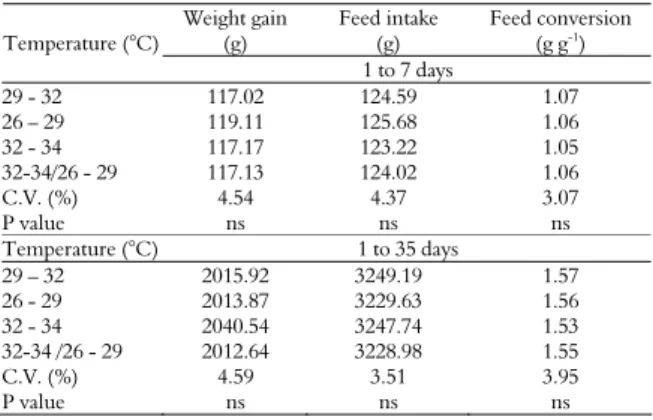
In the Table 1 are shown the results for the performance of broilers from 1 to 7 days and 1-35 days, under different temperature ranges in the 1st
researchers (BOTTJE et al., 1998; BASILIO et al., 2001; SHINDER et al., 2002; YARDIMCI et al., 2006).
Table 1. Effect of early thermal conditioning on the productive performance of broilers in periods from 1 to 7 days and 1 to 35 days.
Weight gain (g)
Feed intake (g)
Feed conversion (g g-1
) Temperature (°C)
1 to 7 days
29 - 32 117.02 124.59 1.07
26 – 29 119.11 125.68 1.06
32 - 34 117.17 123.22 1.05
32-34/26 - 29 117.13 124.02 1.06
C.V. (%) 4.54 4.37 3.07
P value ns ns ns
Temperature (°C) 1 to 35 days
29 – 32 2015.92 3249.19 1.57 26 - 29 2013.87 3229.63 1.56 32 - 34 2040.54 3247.74 1.53 32-34 /26 - 29 2012.64 3228.98 1.55
C.V. (%) 4.59 3.51 3.95
P value ns ns ns
ns: not significant.
Moreover, some studies have reported significant results for the heat treatment. Furlan and Macari et al. (2004) observed lower feed intake from chicks reared in temperatures far below the comfort zone (20ºC). These authors reported that the difference was even more pronounced from the third day of age onward and was related to the presence of nutritional reserves contained in the yolk sac up to this age, because until that the chicks have reserves contained in the yolk sac. In other studies, Oliveira et al. (2006) and Silva et al. (2009) found a lower weight gain in chicks reared in high temperature when compared with those reared in thermal comfort temperature. Furthermore, Oliveira et al. (2006) found a better feed conversion ratio in thermal comfort temperature.
In the present experiment, probably it was not possible to detect differences in the performance among the birds on different temperature zones due to little variation among them: comfort temperature heat (29 to 32°C) and low temperature (26 to 29°C), high temperature (32 to 34°C) and thermal oscillation (days 32 to 34°C and night: 26 to 29°C) when compared with those used in the experiments cited. According to Yardimci et al. (2006), the lack of significant effect of thermal conditioning on the body weight gain in broilers may suggest an enhancement in the capacity of the conditioned chicks to manage the effects of exposure to temperature extremes.
In the early post-hatch period, chickens act as poikilotherm animals and become fully homeotherm after about 10 days, when the thermoregulation development reaches a high level (NICHELMANN; TZSCHENTKE, 2002; TAZAWA et al., 1988; VAN DEN BRAND et al., 2010), this transition might be stimulated by early feeding after hatching (VAN DEN BRAND et al., 2010). Olanrewaju et al. (2010)
emphasized that chickens raised under high ambient temperature have higher energy needs than those under thermoneutral environment. Moreover, as a result of hyperthermia and dehydration, there is a reduction in feed intake and growth retardation.
In Table 2 are listed the values for the percentage of breast and gut (%) and morphometry of the duodenal mucosa of chicks at 7 days of age. No significant effect (p > 0.05) was observed considering different temperature zones on these parameters.
In contrast to this result, Uni et al. (2001) found a reduced enterocyte proliferation immediately after heat exposure during the first 3 days. However, they also observed an improvement in the proliferation of these cells and in the activity of brush border enzymes 48 hours after thermal conditioning.
Yahav and Mcmurtry (2001) reported that the thermal conditioning led to a growth retardation immediately followed by a period of compensatory growth that regained the weight of the birds, however, the feed intake at 42 days of age was higher. These variables are highly correlated with the digestion and absorption of nutrients, which demonstrated the importance of thermal comfort in the facilities, mainly in the 1st week of life.
An important association that deserves further study is the one between the mechanisms of thermal regulation in the post-hatching and the composition of pre-starter diet. Early feed may positively affect the development and maturation of the thermoregulatory system and specific nutrient components may play an important role in this development and maturation. According with Van Den Brand et al. (2010) chickens fed with pre-starter or extra fat pre-starter diet had higher body temperatures at 2nd and 3rd days and were
more resistant against cold exposure, expressed by a smaller decrease in rectal temperature. The reason that phase (1-7 days) diets have improved resistance against cold exposure may be related to the more complex diet composition, of energy intake and consequently increased metabolic rate and higher heat production, which trigger intestinal development and increase intestinal weight.
Acta Scientiarum. Animal Sciences Maringá, v. 35, n. 3, p. 311-319, July-Sept., 2013
Table 2. Effect of early thermal conditioning in broilers on gut development at 7 days of age.
Temperature, °C Breast, % Intestine, % Villus, μm Crypt, μm Villus:crypt ratio
29 – 32 14.37 10.19 465.60 56.99 8.39
26 – 29 13.82 9.85 450.71 66.74 6.98
32 – 34 13.94 10.62 459.54 59.91 7.89
32 - 34/26 - 29 13.80 9.64 438.77 61.76 7.48
C.V. (%) 9.71 12.71 16.97 22.67 23.72
P value ns ns ns ns ns
ns: not significant.
Table 3. Effect of early temperature conditioning in broilers, submitted or not to heat stress in the final phase (35 to 42 days) on the performance of broilers at 42 days of age.
Weight gain, g Feed intake, g
Temperature, °C TC HS Means TC HS Means
29 – 32 613.71 611.37 602.54 1375.88 1324.27 1384.19
26 – 29 690.44 565.43 627.94 1406.95 1285.63 1293.10
32 – 34 626.32 533.32 560.75 1371.62 1266.64 1420.00
32 - 34°C/26 - 29 607.41 615. 95 611.68 1483.40 1310.32 1412.58
Means 632.47 579.73 1409.46a 1296.71b
C.V. (%) 7.42 12.29 7.67 5.00
Interaction ns p < 0.05
Feed conversion ratio Relation H:L
29 - 32 2.24 2.20 2.21 2.39 1.67 2.06
26 - 29 2.05 2.28 2.16 2.42 1.83 2.17
32 - 34 2.10 2.32 2.26 2.59 2.63 2.61
32 - 34°C/26 - 29 2.23 2.13 2.23 2.28 1.81 2.05
Means 2.18 2.26 2.42 2.01
C.V. (%) 13.97 11.62 51.20 53.13
Interaction ns ns
p < 0.05 = significant effect, NS = not significant. TC: thermal comfort, HS: heat stress. Different small letters in the same line indicate significant difference among groups (p < 0.05).
Macari et al. (2004) argued that the adaptation of birds to heat stress partially involves the reduction in the food intake in an attempt to reduce endogenous heat production. According to some authors the reduction in broiler performance under the influence of heat is mainly attributed to the inability of birds to eliminate excessive body heat (OLIVEIRA et al., 2006). Birds exposed to high ambient temperature exhibited higher respiratory rates in an effort to dissipate heat by evaporation (OLANREWAJU et al., 2010).
In a similar experiment, Quinteiro-Filho et al. (2010) observed that heat stress (31 and 36°C) from day 35 to 42 for 10 hours per day, has decreased the body weight, food intake and feed conversion ratio in broiler chickens.
As already highlighted, the temperature of heat acclimation was very low to cause changes in the thermoregulatory response limit. Yahav and Hurwitz (1996) verified that broilers maintained at high temperatures (36ºC) at five days of age had higher rates of viability challenged with high temperatures at 42 days of age. These authors consider that this is due to the adaptive response to a previous exposure to the stressor. Thermal manipulations in very early stages of poultry, where the body temperature regulation and feedback mechanisms are still immature, may be used as important strategies in poultry houses subject to tropical climates (ARJONA et al., 1988; YAHAV, 2000).
In this sense, Nascimento et al. (2011) emphasized that the increasing sensible heat loss may promote heat tolerance in broilers, and this seems to be more beneficial than heat loss by evaporation, which may lead to dehydration.
Under conditions of high temperature, the chicken directs the energy used for its growth to maintain body temperature within normal range with minimal response to heat stress and ensuring the organic function of tissues within physiological limits (LIN et al., 2006). However, in higher degree of exposure occur changes in immunological parameters, such as the heterophil: lymphocyte ratio (H / L), an important indicator of stress in poultry.
Further, according to Shini et al. (2008) the exposure to corticosterone increases the heterophil:lymphocyte ratio and also induces ultrastructural morphological changes in heterophil size, shape, and granulation and lymphocyte cytoplasmic characteristics.
Table 4. Effect of early temperature conditioning in broilers, submitted or not to heat stress in the final phase (35 to 42 days) on total cardiac area (AC), right ventricular area (AVD) and right ventricular wall thickness (EPVD) at 42 days of age.
AC, mm2
AVD, mm2
EPVD, mm
Temperature, °C TC HS Means TC HS Means TC HS Means
29 – 32 425.28 391.67 407.18 54.26aA 51.09aAB 52.55 2.28 1.92 2.09
26 – 29 442.26 397.09 417.62 64.42aA 48.14aAB 55.54 2.28 1.91 2.08
32 – 34 418.66 342.85 375.34 49.43aA 29.85bB 38.24 1.96 1.61 1.76
32 - 34/26 - 29 436.90 390.77 412.06 54.25aA 53.09aA 53.63 2.17 1.92 2.03
Means 430.28a
378.66b
55.21a
44.89b
2.17a
1.83b
C.V. (%) 9.60 12.24 29.65 38.68 15.20 19.30
Interaction ns p < 0.05 ns
p < 0.05 = efeito significativo, NS = não significativo. TC: thermal comfort, HS: heat stress. Different small letters in the same line indicate significant difference among groups (p < 0.05). Different capital letters in the same ow indicate significant difference among groups (p < 0.05).
On the other hand, for the heart right ventricular area, no significant interaction (p < 0.05) was registered between heat treatments to which the birds were reared in the 1st week and thermal
conditions applied in the last week of life. It was observed that birds reared above the thermal comfort zone in the first week and submitted to heat stress during the last week of life had smaller right ventricular area when compared with birds not submitted to heat stress. Moreover, only for the group submitted to heat stress at 35 days of age were no significant differences (p < 0.05). Birds reared in the 1st week under thermal oscillation showed a
larger ventricular area compared with birds reared above the thermal comfort zone, but not different from the others. Also, birds submitted to heat stress during the last week of life had significantly reduced (p < 0.05) heart right ventricular area and right ventricular wall thickness.
The right ventricular hypertrophy may be attributed to increased need for blood flow during stress, to meet the demand of oxygen to the tissues. High performance broiler strains cannot adapt to the increased demand for oxygen in environments with excessively high temperatures. In these situations, there are impaired pulmonary gas exchange, difficulty in transporting oxygen and cardiac output, hypoxia (ANTHONY et al., 1994; BALOG et al., 1994). The decrease in the oxygen level below normal is the primary stimulus for the development of ascites (JONES, 1995).
Low ambient temperature stimulates an increase in heat production, which increases the oxygen requirement of the body (ÖZKAN et al., 2010). According to Furlan et al. (2002) in chicks reared in temperature below the thermal comfort zone in the first week, hypothermia can lead to pulmonary hypertension syndrome (ascites).
The causes of metabolic syndromes in chickens in the final phase come from a simple lack of management, the increased temperature along with low humidity, causing thus a greater pulmonary
frequency, which lead the cardiac system to work intensively. The cardiovascular system also participates in thermoregulatory processes through modulation of heat dissipation on the one hand, and by oxygen transport on the other (OLANREWAJU et al., 2010).
The technique of early thermal conditioning needs further study, since although not affecting the live weight of poultry, has negatively affected the heart area and also suggested a predisposition or indicative of the onset of ascites, seen as thin heart wall observed in broilers submitted to temperature above the thermal comfort zone in the first week of life. Chicks submitted to high temperatures during the first week of life have presented reduced heart measurements when submitted to heat stress during the last week of life, which may also contribute with the occurrence of SMS or other heart metabolic disorder.
According to the results presented in the Table 5, heat treatments applied in the first week of rearing have influenced (p < 0.05) the luminosity of breast fillet of broilers at 42 days of age regardless of heat stress in the last week of rearing. Chicks submitted to temperature above the thermal comfort zone in the first week of life showed a lower L* value compared with the filet of poultry reared within the comfort range.
The PSE phenomenon can be detected by the combination of pH values (below 5.8) and color (L* value above 53.0) measured at 24 hours after slaughter (BARBUT, 1997). In this way, the exposure of the bird in the first week of life to high temperatures can result in steaks with more intense color. Color is one of the most important factors in consumer perception on the meat quality because it is a characteristic that influences both the initial choice of the product and the acceptance by consumers (OLIVO et al., 2001).
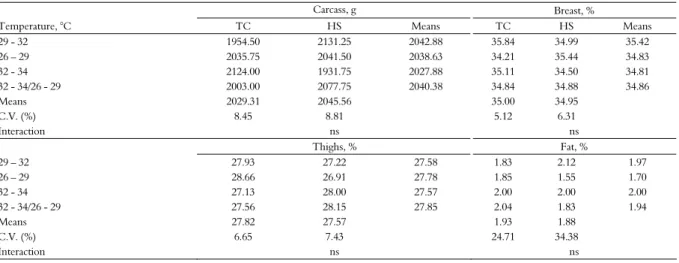
Acta Scientiarum. Animal Sciences Maringá, v. 35, n. 3, p. 311-319, July-Sept., 2013 carcass yield presented in Table 6, no significant
effect was registered (p > 0.05) in relation to environmental temperature or heat stress during the last week of life. These results are probably associated with the small variation between the temperatures used in the 1st week of bird life, not
allowing acclimatization of these birds and not influencing thus physiological responses to heat stress applied on the last week of life. Nevertheless, Yardimci et al. (2006) obtained similar results using more extreme temperatures. These authors submitted 5-6 days old chicks to 3 hours of cold (15ºC) daily and observed no change in carcass yield at 42 days of age.
Meanwhile, other authors found contradictory results, which can be explained by differences in the works. Oliveira et al. (2006) reported increasing
linear effect on carcass yield in birds reared at ambient temperatures of 16, 20, 25 and 32ºC from 22 days to 42 days old.
Basilio et al. (2001) described increased breast weight mass in birds at 41 days of age submitted to thermal conditioning (38ºC) until 5 days old. Also, a negative linear effect on breast yield was found by Oliveira et al. (2006), with increasing temperatures. This same author cited a quadratic reduction in legs yield until the estimated value of 19.4ºC and emphasized that this differentiated muscle growth related to the high temperature may be associated with characteristics of the muscle fibers, which in the case of the breast, are predominantly white, with smaller demand for blood supply, and in the thigh, are predominantly red and therefore more irrigated.
Table 5. Effect of early temperature conditioning in broilers, submitted or not to heat stress in the final phase (35 to 42 days) on body weight, initial pH, final pH and meat luminosity, at 42 days of age.
Body weight, g Initial pH
Temperature, °C TC HS Means TC HS Means
29 – 32 2702.50 2893.75 2798.13 6.25 6.20 6.22
26 – 29 2825.00 2758.75 2791.88 6.28 6.25 6.27
32 – 34 2923.75 2652.50 2788.13 6.21 6.31 6.26
32 - 34°C/26 -29 2782.50 2783.75 2783.13 6.13 6.26 6.18
Means 2808.44 2772.19 6.21 6.25
C.V. (%) 7.15 8.19 2.28 1.56
Interaction ns ns
pH 24 hours Color “L”
29 – 32°C 5.78 5.86 5.82 57.51 58.79 58.15a
26 – 29°C 5.86 5.83 5.84 55.75 57.30 56.53ab
32 – 34°C 5.93 5.89 5.91 48.25 54.57 52.47b
32 - 34C/26 -29 5.81 5.84 5.82 56.15 53.72 54.94ab
Means 5.83 5.85 55.30 56.10
C.V. (%) 1.73 1.61 8.84 5.71
Interaction ns P<0.05
NS = not significant. TC: thermal comfort, HS: heat stress. Different capital letters in the same row indicate significant difference among groups (p < 0.05).
Table 6. Effect of early temperature conditioning in broilers, submitted or not to heat stress in the final phase (35 to 42 days) on carcass yield of broilers at 42 days of age.
Carcass, g Breast, %
Temperature, °C TC HS Means TC HS Means
29 - 32 1954.50 2131.25 2042.88 35.84 34.99 35.42
26 – 29 2035.75 2041.50 2038.63 34.21 35.44 34.83
32 - 34 2124.00 1931.75 2027.88 35.11 34.50 34.81
32 - 34/26 - 29 2003.00 2077.75 2040.38 34.84 34.88 34.86
Means 2029.31 2045.56 35.00 34.95
C.V. (%) 8.45 8.81 5.12 6.31
Interaction ns ns
Thighs, % Fat, %
29 – 32 27.93 27.22 27.58 1.83 2.12 1.97
26 – 29 28.66 26.91 27.78 1.85 1.55 1.70
32 - 34 27.13 28.00 27.57 2.00 2.00 2.00
32 - 34/26 - 29 27.56 28.15 27.85 2.04 1.83 1.94
Means 27.82 27.57 1.93 1.88
C.V. (%) 6.65 7.43 24.71 34.38
Interaction ns ns
Conclusion
The early thermal conditioning had no effect on the production performance and measurements of duodenal mucosa at 7 days of age. The early thermal conditioning was not able to induce an adaptation to heat sufficient to enhance the production characteristics and carcass characteristics of broilers submitted to chronic stress by heat during the final phase. Broilers submitted to temperature above the thermal comfort zone both in the first week of life and in the final phase may lead to the development of metabolic syndromes such as ascites and SMS.
References
ANTHONY, N. B.; BALOG, J. M.; STAUDINGER, F. B.; WALL, C. W.; WALKER, R. D.; HUFF, W. E. Effect of a urease inhibitor and ceiling fans on ascites in broilers. 1. Environmental variability and incidence of ascites.
Poultry Science, v. 73, n. 6, p. 801-809, 1994.
ARJONA, A. A.; DENBOW, D. M.; WEAVER JR., W. D.. Effect of heat stress early in life on mortality of broilers exposed to high environmental temperature just prior to marketing. Poultry Science, v. 67, n. 2, p. 226-231, 1988. AZAD, M. A. K.; KIKUSATO, M.; MAEKAWA, T.; SHIRAKAWA, H.; TOYOMIZU, M. Metabolic characteristics and oxidative damage to skeletal muscle in broiler chickens exposed to chronic heat stress.
Comparative Biochemistry and Physiology, v. 155, n. 3, p. 401-406, 2010.
BALOG, J. M.; ANTHONY, N. B.; WALL, C. W.; WALKER, R. D.; RATH, N. C.; HUFF, W. E. Effect of a urease inhibitor and ceiling fans on ascites in broilers. 2. Blood variables, ascites scores and body and organ weights. Poultry Science, v. 73, n. 6, p. 810-816, 1994. BARBUT, S. Problem of pale soft exsudative meat in broiler chickens. British Poultry Science, v. 38, n. 4, p. 355-358, 1997.
BASILIO, V.; VILARIÑO, M.; YAHAV, S.; PICARDS, M. Early age thermal conditioning and a dual feeding program for male broilers challenged by heat stress.
Poultry Science, v. 80, n. 1, p. 29-36, 2001.
BEÇAK, W. P. J. Técnicas de citologia e histologia. Rio de Janeiro: Editora Livros Técnicos e Científicos S.A., 1976.
BOTTJE, W. G.; WANG, S.; BEERS, K. W.; CAWTHON, D. Lung lining fluid antioxidants in male broilers: age-related changes under thermoneutral and cold temperature conditions. Poultry Science, v. 77, n. 12, p. 1905-1912, 1998.
CAMPO, J. L.; DÁVILA, S. G. Influence of mating ratio and group size on indicators of fearfulness and stress hens and cocks. Poultry Science, v. 81, n. 8, p. 1099-1103, 2002.
DEBONNE, M.; BAARENDSE, P. J. J.; VAN DEN BRAND, H.; KEMP, B.; BRUGGEMAN, V.; DECUYPERE, E. Involvement of the hypothalamic-
pituitary-thyroid axis and its interaction with the hypothalamic- pituitary-adrenal axis in the ontogeny of avian thermoregulation: A review. World's Poultry Science Journal, v. 64, n. 3, p. 309-321, 2008.
DECUYPERE, E.; TONA, K.; BRUGGEMAN, V.; BAMELIS, F. The day-old chick: a crucial hinge between breeders and broilers. World's Poultry Science Journal, v. 57, n. 2, p. 127-138, 2001.
FURLAN, R. L.; MACARI, M. Termorregulação. In: FURLAN, R. L.; MACARI, M.; GONZALES, E. (Ed.).
Fisiologia Aviária aplicada a frangos de corte. Jaboticabal: Funep/Unesp, 2002. p. 209-230.
JONES, G. P. D. Response of broilers susceptible to ascites when grown in high and low oxygen environments. British Poultry Science, v. 36, n. 1, p. 123-133, 1995.
JULIAN, R. J. Physiological, management and environmental triggers of the ascites syndrome: A review.
Avian Pathology, v. 29, n. 6, p. 519-527, 2000.
LIN, H.; JIAO, H. C.; BUYSE, J.; DECUYPERE, E. Strategies for preventing heat stress in poultry. World’s Poultry Science Journal, v. 62, n. 1, p. 71-85, 2006. LORENZONI, A. G.; RUIZ-FERIA, C. A. Effects of vitamin E and Arginine on cardiopulmonary function and acites parameters in broiler chickens reared under subnormal temperatures. Poultry Science, v. 85, n. 12, p. 2241-2250, 2006.
LUGER, D.; SHINDER, D.; WOLFENSON, D.; YAHAV, S. Erythropoiesis regulation during the development of ascites syndrome in broiler chickens: A possible role of corticosterone on egg production. Journal of Animal Science, v. 81, n. 3, p. 784-790, 2003.
MACARI, M.; FURLAN, R. L.; MAIORKA, A. Aspectos fisiológicos e de manejo para manutenção da homeostase térmica e controle de síndromesmetabólicas. In: MENDES, A. A.; NAAS, I. A.; MACARI, M. (Org.).
Produção de frangos de corte. Campinas: Facta, 2004. p. 137-156.
MCCURDY, R. D.; BARBUT, S.; QUINTON, M. Seasonal effects on pale, soft, exudative (PSE) occurrence in young turkey meat. Food Research International, v. 29, n. 3-4, p. 363-366, 1996.
NASCIMENTO, G. R.; NAAS, I. A.; PEREIRA, D. F.; BARACHO, M. S.; GARCIA, R. Assessment of broiler surface temperature variation when exposed to different air temperatures. Brazilian Journal of Poultry Science, v. 13, n. 4, p. 259-263, 2011.
NICHELMANN, M.; TZSCHENTKE, B. Ontogeny of thermo-regulation in precocial birds. Comparative Biochemistry and Physiology, v. 131, n. 4, p. 751-763, 2002.
OLANREWAJU, H. A.; PURSWELL, J. L.; COLLIER, S. D.; BRANTON, S. L. Effect of ambient temperature and light intensity on physiological reactions of heavy broiler chickens. Poultry Science, v. 89, n. 12, p. 2668-2677, 2010.
Acta Scientiarum. Animal Sciences Maringá, v. 35, n. 3, p. 311-319, July-Sept., 2013 PSE and improves meat functional properties. Journal of
Food Biochemistry, v. 25, n. 4, p. 271-283, 2001. OLIVEIRA, G. A.; OLIVEIRA, R. F. M.; DONZELE, J. L.; CECON, R.; VAZ, R. G. M. V.; ORLANDO, U. A. D. Efeito da temperatura ambiente sobre o desempenho e as características de carcaça de frangos de corte dos 22 aos 42 dias. Revista Brasileira de Zootecnia, v. 35, n. 4, p. 1398-1405, 2006.
ÖZKAN, S.; TAKMA, C.; YAHAV, S.; SOGUT, B.; TURKMUT, L.; ERTURUM, H.; CAHANER, A. The effects of feed restriction and ambient temperature on growth and ascites mortality of broilers reared at high altitude. Poultry Science, v. 89, n. 5, p. 974-985, 2010. QUINTEIRO-FILHO, W. M.; RIBEIRO, A.; FERRAZ-DE-PAULA, V.; PINHEIRO, M. L.; SAKAI, M.; SA, L. R. M.; FERREIRA, A. J. P.; PALERMO-NETO, J. Heat stress impairs performance parameters, induces intestinal injury and decreases macrophage activity in broiler chickens. Poultry Science, v. 89, n. 9, p. 1905-1914, 2010.
SILVA, V. K.; SILVA, J. D. T.; GRAVENA, R. A.; MARQUES, R. H.; HADA, F. H.; MORAES, V. M. B. Desempenho de frangos de corte de 1 a 21 dias de idade alimentados com rações contendo extrato de leveduras e prebiótico e criados em diferentes temperaturas. Revista Brasileira de Zootecnia, v. 38, n. 4, p. 690-696, 2009. SHINI, S.; KAISER, P.; SHINI, A.; BRYDEN, W. L. Differential alterations in ultrastructural morphology of chicken heterophils and lymphocytes induced by corticosterone and lipopolysaccharide. Veterinary Immunology and Immunopathology, v. 122, n. 1-2, p. 83-93, 2008.
SHINDER, D.; LUGER, D.; RUSAL, M.; RZEPAKOVSKY, V.; BRESLER, V.; YAHAV, S. Early age cold conditioning in broiler chickens (Gallus domesticus): thermotolerance and growth responses. Journal of Thermal Biology, v. 27, n. 6, p. 517-523, 2002.
TAN, G. Y.; YANG, L.; FU, Y. Q.; FENG, J. H.; ZHANG, M. H. Effects of different acute high ambient temperatures on function of hepatic mitochondrial respiration, antioxidative enzymes, and oxidative injury in broiler
chickens. Poultry Science, v. 89, n. 1, p. 115-122, 2010.TAZAWA, H.; WAKAYAMA, H.; TURNER, J. S.; PAGANELLI, C. V. Metabolic compensation for gradual cooling in developing chick embryos. Comparative Biochemical Physiology, v. 89, n. 2, p. 125-129, 1988. UNI, Z.; GAL-GARBER, O.; GEYRA, A.; SKLAN, D.; YAHAV, S. Changes in growth and function of chick small intestine epithelium due to early conditioning.
Poultry Science, v. 80, n. 4, p. 438-445, 2001.
VAN DEN BRAND, H.; MOLENAAR, R.; VAN DER STAR, I.; MEIJERHOF, R. Early feeding affects resistance against cold exposure in young broiler chickens.
Poultry Science, v. 89, n. 4, p. 716-720, 2010.
YAHAV, S. Domestic fowl-strategies to confront environmental conditions. Avian and Poultry Biology Reviews, v. 11, n. 2, p. 81-95, 2000.
YAHAV, S.; HURWITZ, S. Induction of thermotolerance in male broiler chickens by temperature conditioning at an early age. Poultry Science, v. 75, n. 3, p. 402-406, 1996. YAHAV, S.; MCMURTRY, J. P. Thermotolerance acquisition in broiler chickens by temperature conditioning early in life – the effect of timing and ambient temperature. Poultry Science, v. 80, n. 12, p. 1662-1666, 2001.
YARDIMCI, M.; SENGOR, E.; SAHIN, E. H.; BAYRAM, I.; CETINGIIL, I. S. The influence of cold conditioning on the performance of the broiler chicken.
Turkish Journal of Veterinary and Animal Sciences, v. 30, n. 6, p. 583-588, 2006.
WEKSTEIN, D. R.; ZOLMAN, J. F. Cold stress regulation in young chickens. Poultry Science, v. 50, n. 1, p. 56-61, 1971.
Received on September 26, 2012. Accepted on December 14, 2012.