(Annals of the Brazilian Academy of Sciences)
Printed version ISSN 0001-3765 / Online version ISSN 1678-2690 www.scielo.br/aabc
Ameliorative potential of
Vernonia cinerea
on chronic constriction
injury of sciatic nerve induced neuropathic pain in rats
VENKATA R.K. THIAGARAJAN1,2,PALANICHAMY SHANMUGAM3, UMA M. KRISHNAN4 and ARUNACHALAM MUTHURAMAN5
1
School of Chemical and Biotechnology, Sastra University, Thanjavur-613402, Tamilnadu, India
2Department of Pharmacognosy, College of Pharmacy,
Madurai Medical College, Madurai-625011, Tamilnadu, India
3
Department of Pharmaceutical Sciences & Research, Sankaralingam Bhuvaneshwari College of Pharmacy, Thiruthangal, Sivakasi-626130, Tamilnadu, India
4
Center for Nanotechnology & Advanced Biomaterials, School of Chemical & Biotechnology Sastra University, Thanjavur-613402, Tamilnadu, India
5Department of Pharmaceutical Sciences & Drug Research,
Punjabi University, Patiala-147002, Punjab, India
Manuscript received on October 14, 2013; accepted for publication on January 17, 2014
ABSTRACT
The aim of the present study is to investigate the ameliorative potential of ethanolic extract of whole plant of Vernonia cinerea in the chronic constriction injury (CCI) of sciatic nerve induced neuropathic pain in rats. Behavioral parameters such as a hot plate, acetone drop, paw pressure, Von Frey hair and tail immersion tests were performed to assess the degree of thermal, chemical and mechanical hyperalgesia and allodynia. Biochemical changes in sciatic nerve tissue were ruled out by estimating thiobarbituric acid reactive
substances (TBARS), reduced glutathione (GSH) and total calcium levels. Ethanolic extract of Vernonia cinerea and pregabalin were administered for 14 consecutive days starting from the day of surgery. CCI of
sciatic nerve has been shown to induce significant changes in behavioral, biochemical and histopathological
assessments when compared to the sham control group. Vernonia cinerea attenuated in a dose dependent manner the above pathological changes induced by CCI of the sciatic nerve, which is similar to attenuation of the pregabalin pretreated group. The ameliorating effect of ethanolic extract of Vernonia cinerea against CCI
of sciatic nerve induced neuropathic pain may be due to the presence of flavonoids and this effect is attributed
to anti-oxidative, neuroprotective and calcium channel modulator actions of these compounds.
Key words: antioxidant, calcium, chronic constriction injury, reduced glutathione, thiobarbituric acid reactive substance.
Correspondence to: Venkata Rathina Kumar Thiagarajan E-mail:[email protected]
INTRODUCTION
Pain is initiated or caused by a primary lesion or
dysfunction in the peripheral nervous system. This
AIDS, diabetes, leprosy, multiple sclerosis, and
stroke are associated with neuropathic pain.
Traumatic injury due to lumbar disc syndrome,
traumatic spinal cord and brain injury and
occu-pational nerve entrapment (i.e., computer typing
work) injury are also associated with neuropathic
pain (Alston and Pechon 2005, Koltzenburg and
Scadding 2001). Chronic constriction injury of
the sciatic nerve is the common model for the
evaluation of anti-neuralgic agents and CCI is
clinically resemble to Complex Regional Pain
Syndrome (CRPS) (Kramer et al. 2009, Nagler 2010,
Muthuraman et al. 2008b). Drugs currently used
for treating neuropathy are gabapentin, pregabalin,
carbamazepine, amitriptyline, duloxetine, topical
treatments (lidocaine patch, capsaicin) and opioids
which are unable to alleviate the neuropathic pain (de
Leon-Casasola 2013, Kerstman et al. 2013). Adverse
effects have been reported for these medicaments
which limit their full clinical exploitation in the
management of painful neuropathy (Hammersla
and Kapustin 2012). Moreover, randomized
controlled studies revealed that these drugs were
ineffective in CRPS (Kalita et al. 2006). Therefore,
pharmacotherapy requires newer drug molecules
from alternative medicine for effective management
of neuropathy particularly in CRPS.
Herbal medicines
such as
Aconiti
tuber
,
Lindera angustifolia
,
Teucrium polium
,
Phyllanthus
emblica
,
Vochysia divergens, Cannabis sativa
,
Nigella sativa
,
Ocimum sanctum
and
Ginkgo
biloba
have been reported to produce the beneficial
effect on the management of painful neuropathy
(Muthuraman et al. 2008a). Clinical reports
have also been documented a beneficial effect of
herbal drugs in neuropathic pain management
(Ellis et al. 2009).
Vernonia cinerea
belongs to
the family
Asteraceae
which is a common weed
distributed throughout India. This plant is also called
“Sahadevi”, Naichette or Mukuthipundu. The
ethnomedical information reveals that this plant is
used for malaria fever, worms, pain, inflammation,
nervous disorders, infections, wounds, cancer,
edema, abortion and various gastrointestinal
disorders. It is also used as an astringent and tonic.
Flowers are used for conjunctivitis and rheumatism
(Vaidyaratnam 1994, Thiagarajan et al. in press).
This plant has been reported to possess analgesic,
anti-pyretic, anti-inflammatory and anti-arthritic
activity (Mazumder et al. 2003, Iwalewa et al.
2003, Latha et al. 1998). Antioxidant and anti
inflammatory activity have also been reported
for both in vitro and in vivo assays (Kumar and
Kuttan 2009, Pratheeshkumar and Kuttan 2010).
Other
Vernonia
species that shared some of these
medicinal values include
Vernonia brachycalyx,
Vernonia brasiliana, Vernonia herbaceae, Vernonia
subligera,
and
Vernonia coloralia.
This plant
has been reported in the presence of secondary
metabolites like flavonoids, tannins, sesquiterpene
lactones, sterols and triterpenoids (Misra et al.
1993). Flavonoids such as luteolin, apigenin,
chrysoeriol, quercetin, rutin,
stigmasterol-3-O-beta-D-glucoside, (+)-lirioresinol B, stigmasterol
and coumaric acids like caffeic acid, ferulic acid
and terpenoids like lupeol acetate were reported
from this plant (Rajamurugan et al. 2011, Zhu et
al. 2008). Fresh decoction of
Vernonia cinerea
has
been commonly used to relieve muscular pain,
knee pain and severe headache in some areas of
Palani, Vadalur and Ramanathapuram regions
in Tamil Nadu, India. Ayurvedic formulations
namely chandrakalarasa and Alamottadi khasayam
are prepared from this plant (Anonymous 2003).
Although ethnomedical information indicates that
this plant is used for nervous disorder. However,
this plant has not been evaluated for neuropathy
in experimental animals. It has also been reported
for analgesic and anti-inflammatory activity.
However, experimentally, its analgesic potential in
neuropathic pain remains unexplored. Therefore,
the present study was designed to investigate the
anti-nociceptive potential of
Vernonia cinerea
neuropathy in rats. Pregabalin (Lyrica
®) binds to
the α2-δ site of an auxiliary subunit of
voltage-gated calcium channels (N-type) in the central
nervous system, inhibiting excitatory
neuro-transmitter release, and it has been reported to
possess the potential management of neuropathic
pain (Muthuraman and Sood 2010). Therefore,
pregabalin served as a positive control in this study.
MATERIALS AND METHODS
DRUGS AND CHEMICALS
The gift sample of pregabalin was provided by
Pfizer Company, India. Vincristine 5,
5’-dithio-bis-(2-nitrobenzoic acid) (DTNB), bovine serum
albumin and reduced glutathione (GSH) were
pur-chased from Sisco Research Laboratories, Mumbai.
Thiobarbituric acid was purchased from Loba
Chemie (Mumbai). All other reagents were used as
an analytical grade in the present study.
PLANT MATERIAL
Fresh Whole plant of
Vernonia cinerea
was collected
from Madurai and authenticated by Dr. D. Stephen,
Asst. Prof., Department of Botany, American
College, Madurai. Plant sample has been kept in the
Department of Pharmacognosy (Voucher specimen
no: VC. 002/2007-2008 MMC, Madurai), Madurai
Medical College, Madurai.
EXTRACTION
The fresh whole plant of
Vernonia cinerea
was shade
dried at room temperature and reduced to a coarse
powder (sieve no. 10/40). The dried powdered plant
material of
Vernonia cinerea
(500 g) was defatted
with petroleum ether and then extracted with ethanol
(95%) in a Soxhlet apparatus (Süzgeç-Selçuk and
Birteksöz 2011). Ethanolic extract of
Vernonia cinerea
(
VC
) was concentrated under reduced pressure to
dryness (yield 15.12% w/w). The purity of flavonoids
in
VC
was analyzed by High Performance Liquid
Chromatography with VWD (Agilent Technologies
1220 infinity LC USA-Variable wavelength UV
detector). Apigenin and kaempferol were used
as (external standard) marker compounds. The
chromatographic analysis was performed on a C18
column (4.6 × 150 mm). Mobile phase comprised of
solvent A and solvent B and these two solvents were
used with a constant flow rate of 1.0ml/min. Solvent
A consisted of 19% aetonitrile, 5% methanol and
1% THF in water (pH 3.0), solvent B included 55%
acetonitrile and 15% methanol in water (pH 3.0). The
20 μl of
VC
was injected into an HPLC column and
detection was performed at 352 nm according to the
standard operating procedure (Oncina et al. 2000).
The retention time and spectrum of the
VC
were
compared with specific marker compounds.
DETERMINATION OF TOTAL PHENOLIC CONTENT
The total phenolic content of
Vernonia cinerea
was
determined by pectrophotometric method (Harborne
1980, Siddique et al. 2010). Approximately, 1 ml
(0.5 and 1 mg/ml in ethanol) of ethanolic extracts of
Vernonia cinerea
was separately mixed with 0.5 ml
of Folin Ciocalteu reagent (1 N) and allowed to stand
for 15 minutes. Then 1 ml of 10 percentage sodium
carbonate solution was added to the above solution.
Finally the mixtures were made up to 10 ml with
distilled water and the mixture of extract and reagent
incubated at room temperature for 30 minutes. The
absorbance of the reaction mixture was measured
at 760 nm spectrophotometrically. Gallic acid was
used as a reference standard and the gallic acid was
prepared in a variable concentration range i.e., 0, 2, 4,
6, 8 and 10 μg / ml of ethanol. The reaction mixture
without sample was used as blank. Total phenolic
content of ethanolic extract of
Vernonia cinerea
was
expressed in terms of mg of gallic acid equivalent per
gram of extract (mg GAE / g).
DETERMINATION OF TOTAL FLAVONOID CONTENT
The total flavonoid content of
Vernonia cinerea
was
determined by spectrophotometric method (Harborne
of 1:10 g/ml in ethanol) was separately mixed with
1.5 ml of ethanol, 0.1 ml of 10% w/v aluminum
chloride, 0.1 ml of 1 M potassium acetate and 2.8 ml
of distilled water. The mixture of extract and reagent
were incubated at room temperature for 30 min; the
absorbance of the reaction mixture was measured at
415 nm. Quercetin was used as a reference standard
and the quercetin was prepared in a variable
concentration range i.e., 0, 10, 20,30, 40 and 50 μg/
ml of ethanol. The content of total flavonoids was
expressed as quercetin equivalents (mg of quercetin
equivalents / g of VC extract).
ANIMALS
Wistar rats of both sex weighing 180-250 g,
main-tained on a standard laboratory diet (Kisan Feeds
Ltd., Mumbai, India) and having free access to tap
water
were employed in the present study. They
were housed in the departmental animal house
and were exposed to 12 hour cycles of light and
dark. The experimental protocol was approved by
the Institutional Animal Ethics Committee (IAEC)
and care of the animals were carried out as per
the guidelines of the Committee For the Purpose
of Control and Supervision of Experiments on
Animals (CPCSEA), Ministry of Environment and
Forest, Government of India (Reg No:- 874/ac/05/
CPCSEA and Ref. No. 2360/E2/4/2010/IAEC),
Madurai Medical College, Madurai.
INDUCTION OF PERIPHERAL NEUROPATHY
Painful peripheral neuropathy was induced in
experimental animal by chronic constriction injury
of the sciatic nerve in rat (Bennett and Xie 1988),
with slight modification (Sommer and Schafers
1998). Basically, rats were anesthetized with
thiopental sodium (35 mg/kg,
i.p.
). The skin of the
lateral surface of the left thigh was incised and a
cut was made directly through the biceps femoris
muscle to expose the sciatic nerve. Four loose
ligatures (silk 4-0), were placed around the nerve
proximal part of the trifurcation with a distance of
1 mm between each ligature. The ligatures were
loosely tied until a short flick of the ipsilateral hind
limb was observed. After performing nerve ligation,
muscular and skin layer was immediately sutured
with thread, and topical antibiotic was applied at
once. Nociceptive threshold was assessed before
and after performing surgery on different days
i.e.
0, 1, 3, 6, 9, 12, 15, 18 and 21
stday.
EXPERIMENTAL DESIGN
Ten groups, each comprising six Wistar rats were
employed in the present study.
Group I
(Normal control group):
Rats were not
subjected to any surgical procedure and were kept
for 21 days.
Group II
(Sham control group):
Rats were
subjected to the surgical procedure to expose the
left sciatic nerve without any nerve ligation process.
Group III
(CCI control group):
Rats were
subjected to the surgical procedure to expose and
ligate left sciatic nerve.
Group IV
(CCI + Vehicle treated group):
After
subjecting the rats to chronic constriction injury of
the sciatic nerve, 1% carboxy methyl cellulose was
administered orally for 14 consecutive days from
the day of surgery.
Group V
(VC per se):
Rats were subjected to
the administration of ethanolic extract of
Vernonia
cinerea
(400 mg/Kg,
p.o.
) for 14 consecutive days
from the day of surgery.
Group VI
(Pregabalin per se):
Rats were
subjected to administration of pregabalin (10 mg/Kg,
p.o.
) for 14 consecutive days from the day of surgery.
Group VII to IX
(CCI + VC treated group):
After
subjecting the rats to CCI, ethanolic extract of
Vernonia
cinerea
(VC 200, 300 and 400 mg/kg,
p.o,
for 14
consecutive days) was administered from the day of
surgery to Group VII, VIII and IX animals respectively.
All the groups of animals were employed to
assess behavioral tests to determine the degree of
nociceptive threshold on certain day intervals i.e., 0,
1, 3, 6, 9, 12, 15, 18 and 21
stday. All the animals were
sacrificed at the end of the 21
stday and biochemical
analysis was carried out in sciatic nerve tissue
homogenate for estimation of total protein content,
thiobarbituric reactive substance (TBARS), reduced
glutathione and total calcium levels.
BEHAVIORAL STUDIES
Heat hyperalgesic test
Heat thermal sensitivity of the hind paw was
assessed by using Eddy’s hot plate method (Eddy et
al. 1950), with slight modification, for assessing the
degree of noxious thermal sensation. The rats were
placed on the top of a preheated (52.5 ± 0.5°C) hot
plate surface, allowing access to the left hind paw
withdrawal response to the degree of the nociceptive
threshold. The cut-off time of 20 s was maintained.
Cold chemical allodynic test
Cold chemical thermal sensitivity of the hind
paw was assessed using acetone drop methods
(Choi et al. 1994), with slight modification, for
assessing the reactivity to non-noxious cold
chemical stimuli. The rats were placed on the top
of a wire mesh grid, allowing access to the hind
paws. Acetone (100 µl) was sprayed on the plantar
surface of the left hind paw of rat. Cold chemical
sensitive reaction with respect to paw licking,
shaking or rubbing the left hind paw was observed
and recorded as a paw withdrawal threshold. The
cut-off time of 20 s was maintained.
Mechanical hyperalgesic test
The mechanical sensation of the hind paw as
an index of the mechano-hyperalgesic test was
assessed by pressure stimulation method (Randall
and Selitto 1957). Mechanical nociceptive
thres-hold, expressed in grams, was measured by applying
increasing pressure to the left hind paw. Withdrawal
of the left hind paw was used to assess the mechanical
nociceptive threshold. The cut-off pressure 450 g
was maintained.
Mechanical allodynia test
The mechanical sensation of the hind paw was
assessed as an index of the mechano-allodynia
by
filaments touching method (Chaplan et al. 1994).
Calibrated nylon filaments, in terms of different
bending forces, was applied to the mid plantar surface
of the left hind paw. The filaments were applied ten
times, starting with the softest and continuing in
ascending order of stiffness. A brisk withdrawal of the
left hind limb was considered as a positive response.
The criterion for the threshold value, in grams, was
equal to the filament evoking a withdrawal of the paw
5 times out of 10 trials i.e., 50% response. The cut-off
pressure 30 g was maintained.
Tail heat hyperalgesic test
Spinal thermal sensitivity was assessed by the
tail immersion test method (Necker and Hellon
1978). The terminal part of the tail (1 cm) of the
rat was immersed in a heat-noxious temperature
(52 ± 0.5°C), until the tail was withdrawn. The
duration of the tail withdrawal reflex was used to
assess the thermal heat hyperalgesia. The cut-off
time of 10 s was maintained.
BIOCHEMICAL ESTIMATION OF OXIDATIVE STRESS MARKERS
Twenty-one days after surgery, animals were
sacrificed by cervical dislocation and sciatic nerve
was immediately isolated from the body. The
proximal part of sciatic nerve tissue homogenate
(10% w/v) was prepared with 0.1 M Tris-HCl buffer
Estimation of tissue protein
Protein concentration was estimated by
copper-protein complex reaction method (Lowry et al.
1951), using bovine serum albumin (BSA) as a
standard. The absorbance was determined
spectro-photometrically at 750 nm.
Estimation of lipid peroxidation
Estimation of lipid peroxidation was done by
measuring the levels of malondialdehyde [MDA:
thiobarbituric acid reactive substances (TBARS)]
by spectrophotometric method (Ohkawa et al. 1979).
The concentration of TBARS in tissue homogenate
was expressed in terms of nmol of malondialdehyde
per mg of protein. 1,1,3,3-Tetramethoxypropane
(1–10 nmol) was used as the standard.
Estimation of reduced glutathione
Reduced glutathione (GSH, endogenous anti-oxidant
molecule) was measured by spectrophotometric
method (Ellman 1959). Equal quantity of the
sciatic nerve homogenate was mixed with 10%
trichloroacetic acid and centrifuged to separate
proteins. To 10 µl of this supernatant, 2 ml of
phosphate buffer (pH 8.4), 500 µl of 5, 5’-dithio,
bis (2-nitrobenzoic acid) and 400 µl double distilled
water was added. The mixture was vortexed and the
absorbance was taken at 412 nm within 15 min. The
concentration of reduced glutathione was expressed
as µg per mg of protein in sciatic nerve tissue.
Estimation of total calcium
Total calcium levels were estimated from the sciatic
nerve tissue by atomic emission spectroscopic
method (Severinghaus and Ferrebee 1950) with
slight modification (Muthuraman et al. 2008a).
The sciatic nerve tissue homogenate was mixed
with 1 ml of trichloroacetic acid (4%) in ice cold
conditions and centrifuged at 2000 rpm for 10
minutes. The clear supernatant was used for the
estimation of total calcium ion by atomic emission
spectroscopy at 556 nm.
HISTOPATHOLOGICAL ASSESSMENT
Samples of sciatic nerve were stored in the fixative
solution (10% formalin) and cut into 4 µm thickness.
Staining was done by using hematoxylin and eosin
(H & E) method (Sudoh et al. 2004). Nerve sections
were analyzed qualitatively under light microscope
(450 X) for axonal degeneration.
STATISTICAL ANALYSIS
All the results were expressed as Standard Error
Mean (SEM). Data obtained from behavioral
tests was statistically analyzed by using two-way
repeated ANOVA, while the data of biochemical
parameters was analyzed using one way ANOVA.
In both cases, Tukey’s multiple range tests was
applied for
post-hoc
analysis. A value of P
<0.05
was considered to be statistically significant.
RESULTS
PHYTOCHEMICAL ANALYSIS OF ETHANOLIC EXTRACT OF Vernonia cinerea
The yield of ethanolic extract of
Vernonia cinerea
(
VC
) is found to be 14.06 grams per 100 grams of
coarse powder of
Vernonia cinerea
. In addition,
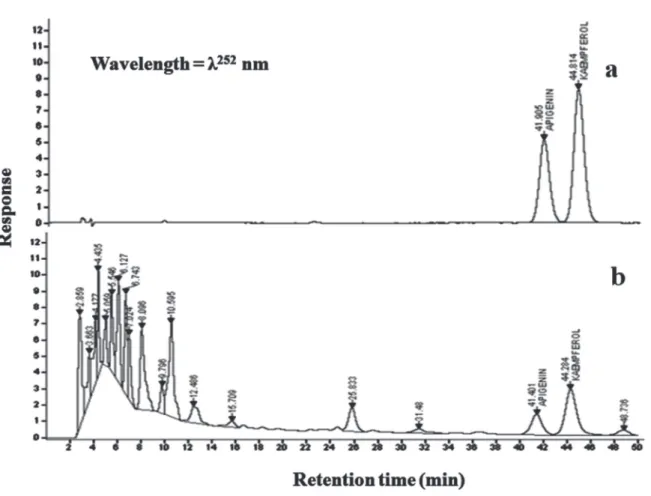
HPLC chromatogram analysis indicates 98% purity
of ethanolic extract of
Vernonia cinerea
with reference
to flavonoids marker compound (i.e., apigenen and
kaempferol). The Rt value for apigenin is 41.40
and for kaempferol is 44.28 minutes (Fig. 1). Total
phenolic and total flavonoids content of ethanolic
extract of
Vernonia cinerea
(
VC
) found to contain
79.11 mg of gallic acid equivalent / gram of
VC
EFFECT OF Vernonia cinerea ON HEAT HYPERALGESIC TEST
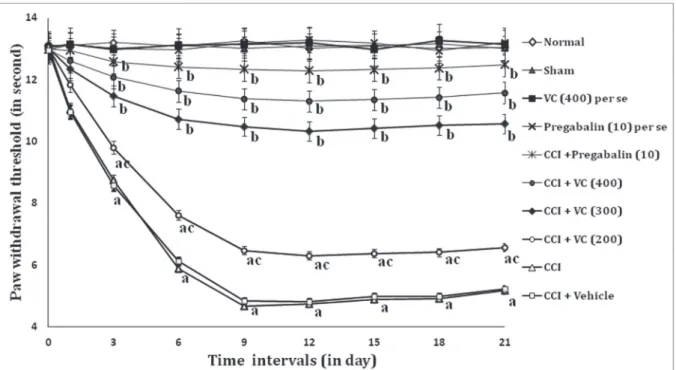
Chronic constriction injury (CCI) of sciatic nerve
resulted in significant development of noxious
thermal hyperalgesia, indicated by decrease in
left hind paw withdrawal threshold, after 3
rdday of surgery as compared to sham control.
Administration of ethanolic extract of
Vernonia
cinerea
(
VC
- 200, 300, and 400 mg/kg,
p.o.
)
attenuated CCI induced decrease in the nociceptive
threshold for thermal hyperalgesia in a dose
dependent manner. Treatment of pregabalin also
produced similar effects. However, statistically
significant attenuation was recorded only with
medium and high dose of
VC
. Further, vehicle,
VC
per se
and pregabalin did not show any significant
effect on heat hyperalgesic test (Fig. 2).
EFFECT OF Vernonia cinerea ON COLD CHEMICAL
ALLODYNIC TEST
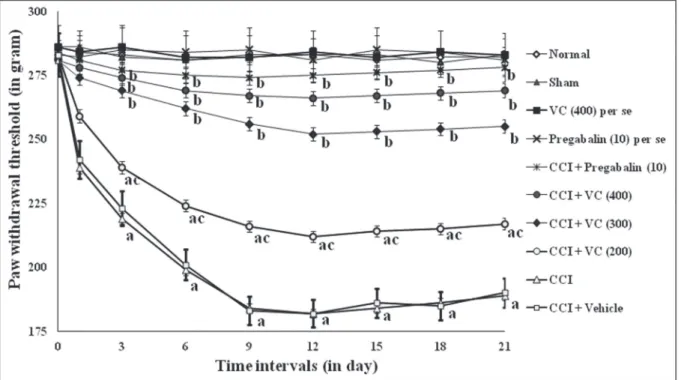
Chronic constriction injury of sciatic nerve resulted
in significant development of non-noxious cold
chemical allodynia, indicated by decrease in left hind
paw withdrawal threshold, after 3
rdday of surgery
as compared to sham control. Administration of
ethanolic extract of
Vernonia cinerea
(
VC
- 200,
300, and 400 mg/kg,
p.o.
) attenuated CCI induced
decrease in the nociceptive threshold for thermal
allodynia in a dose dependent manner. Treatment of
pregabalin also produced similar effects. However,
statistically significant attenuation was recorded only
with medium and high dose of
VC
. Further, vehicle,
VC
per se and pregabalin did not show any significant
effect on cold chemical allodynic test (Fig. 3).
Fig. 1 - HPLC chromatogram of Vernonia cinerea and standard compounds.Fig. 3 - The effect of Vernonia cinerea on paw cold allodynia test. Digits in parenthesis indicate dose in mg/kg. CCI, chronic constriction injury; VC, Vernonia cinerea. Data were expressed as mean ± SD, n=6 rats per group. ap<0.05 vs sham control group. b
p<0.05 vs CCI control group. cp<0.05 vs pregabalin treated group.
Fig. 2 - The effect of Vernonia cinerea on paw heat hyperalgesic test. Digits in parenthesis indicate dose in mg/kg. CCI, chronic constriction injury; VC, Vernonia cinerea. Data were expressed as mean ± SD, n=6 rats per group. ap<0.05 vs sham control
EFFECT OF Vernonia cinerea ON MECHANICAL
HYPERALGESIC TEST
Chronic constriction injury of sciatic nerve resulted
in significant development of noxious static
mecha-nical hyperalgesia, indicated by decrease in left hind
paw withdrawal threshold, after 3
rdday of surgery
as compared to sham control. Administration of
ethanolic extract of
Vernonia cinerea
(
VC
- 200,
300, and 400 mg/kg,
p.o.
) attenuated CCI induced
decrease in the nociceptive threshold for mechanical
hyperalgesia in a dose dependent manner. Treatment
of pregabalin also produced similar effects. However,
statistically significant attenuation was recorded only
with medium and high dose of
VC
. Further, vehicle,
VC
per
se
and pregabalin did not show any significant
effect on mechanical hyperalgesic test (Fig. 4).
Fig. 4 - The effect of Vernonia cinerea on paw mechanical hyperalgesia. Digits in parenthesis indicate dose in mg/kg. CCI, chronic constriction injury; VC, Vernonia cinerea. Data were expressed as mean ± SD, n=6 rats per group.ap<0.05 vs sham control group. b
p<0.05 vs CCI control group. cp<0.05 vs pregabalin treated group.
EFFECT OF Vernonia cinerea ON MECHANICAL
ALLODYNIC TEST
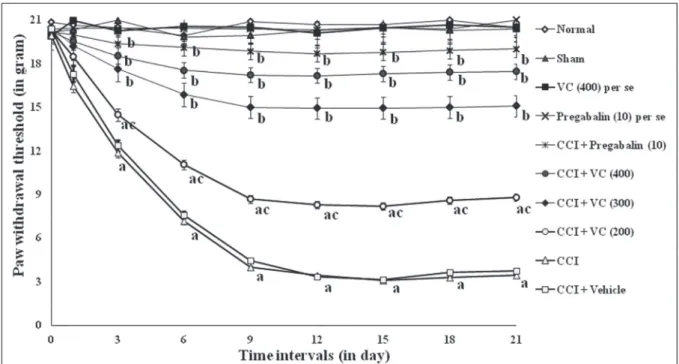
Chronic constriction injury of sciatic nerve resulted
in significant development of non-noxious tactile
mechanical hyperalgesia, indicated by decrease in
left hind paw withdrawal threshold, after 3
rdday of
surgery as compared to sham control. Administration
of ethanolic extract of
Vernonia cinerea
(
VC
-200, 300, and 400 mg/kg,
p.o.
) attenuated CCI
induced decrease in the nociceptive threshold
for mechanical hyperalgesia in a dose dependent
manner. Treatment of pregabalin also produced
similar effects. However, statistically significant
attenuation was recorded only with medium and
high dose of
VC
. Further, vehicle,
VC
per
se
and
pregabalin did not show any significant effect on
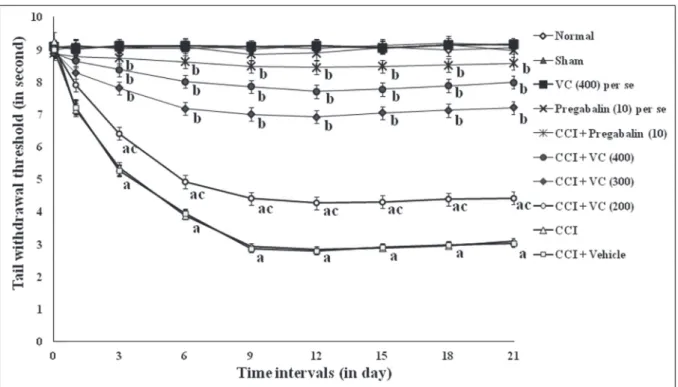
EFFECT OF Vernonia cinerea ON TAIL HEAT
HYPERALGESIC TEST
Chronic constriction injury of sciatic nerve resulted in
significant development of noxious thermal
hyperalgesia,
indicated by decrease in tail withdrawal threshold, after
3
rdday of surgery as compared to sham control.
Adminis-tration of ethanolic extract of
Vernonia cinerea
(
VC
- 200,
300, and 400 mg/kg,
p.o.
) attenuated CCI induced
decrease in the nociceptive threshold for thermal
hyperalgesia in a dose dependent manner. Treatment
of pregabalin also produced similar effects. However,
statistically significant attenuation was recorded only
with medium and high dose of
VC
. Further, vehicle,
VC
per
se
and pregabalin did not show any significant
effect on tail heat hyperalgesic test (Fig. 6).
EFFECT OF Vernonia cinerea ON OXIDATIVE STRESS
MARKERS AND CALCIUM LEVELS
Sciatic nerve ligation resulted in a significant rise in
TBARS, total calcium levels and in a decrease in the
levels of reduced glutathione, after the 21
stday of
surgery as compared to sham control. Administration
of the ethanolic extract of
Vernonia cinerea
(
VC
-200,
300, and 400 mg/kg,
p.o.
) attenuated CCI induced
rise in sciatic nerve tissue thiobarbituric reactive
substances (TBARS), total calcium and in a decrease
in GSH levels in a dose dependent manner. Treatment
of pregabalin also produced similar effects. Further,
vehicle,
VC
per se
and pregabalin did not show any
significant effect on biochemical levels (Table I).
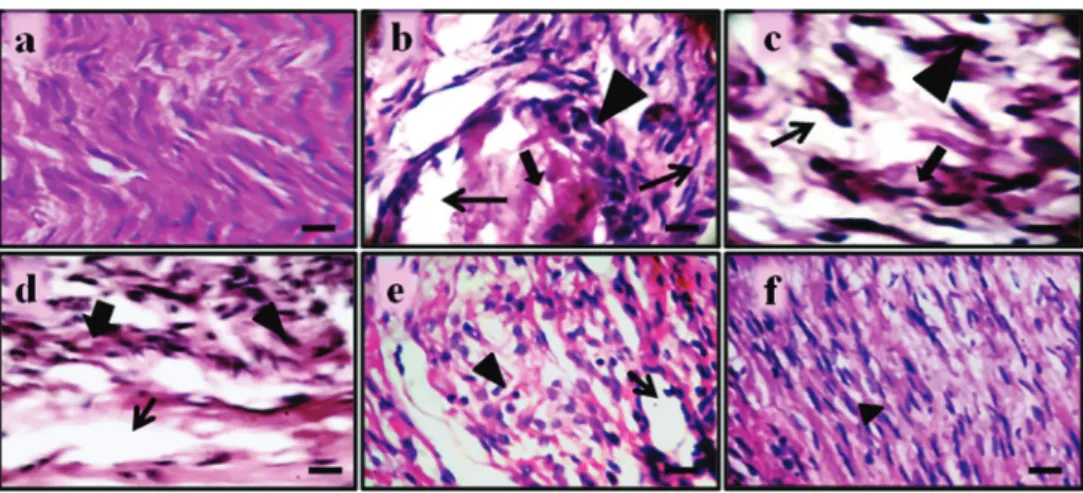
EFFECT OF Vernonia cinerea ON HISTOPATHOLOGICAL CHANGES
Chronic constriction injury of sciatic nerve resulted
in significant histopathological changes assessed in
a transverse section of the sciatic nerve. In transverse
section, nerve derangement, axonal swelling, increase
in the number of Schwann and satellite cells were
also noted. Administration of the ethanolic extract
of
Vernonia cinerea
(200, 300, and 400 mg/kg,
p.o.
)
significantly attenuated CCI induced axonal
degen-eration and histopathological altdegen-erations (Fig. 7).
Fig. 5 - The effect of Vernonia cinerea on paw mechanical allodynia. Digits in parenthesis indicate dose in mg/kg. CCI, chronic constriction injury; VC, Vernonia cinerea. Data were expressed as mean ± SD, n=6 rats per group.ap<0.05 vs sham control group. bFig. 6 - The effect of Vernonia cinerea on tail heat hyperalgesia. Digits in parenthesis indicate dose in mg/kg. CCI, chronic constriction injury; VC, Vernonia cinerea. Data were expressed as mean ± SD, n=6 rats per group. a
p<0.05 vs sham control group. b
p<0.05 vs CCI control group. cp<0.05 vs pregabalin treated group.
Groups (nmol/mg of protein)MDA (µg/mg of protein)GSH (ppm/mg of protein)Total calcium
Normal 3.09 ± 0.33 74.42 ± 2.36 2.83 ± 0.22
Sham 3.12 ± 0.39 74.26 ± 2.58 2.94 ± 0.31
CCI 4.39 ± 0.27a 48.25 ± 4.21 a 20.32 ± 0.47a
Vehicle in CCI 4.42 ± 0.29a 47.96 ± 3.63 a 19.49 ± 0.32 a
VC (400) per se 3.16 ± 0.21 73.56 ± 2.71 2.73 ± 0.39
Pregabalin (10) per se 3.09 ± 0.34 74.38 ± 2.58 2.85 ± 0.39
VC (200) in CCI 4.37 ± 0.24ac 53.37 ± 2.31ac 18.63 ± 0.19 ac
VC (300) in CCI 3.46 ± 0.29b 64.19 ± 2.84b 10.69 ± 0.34 b
VC (400) in CCI 3.24 ± 0.16b 68.38 ± 2.03 b 7.83 ± 0.42 b
Pregabalin (10) in CCI 3.27 ± 0.19b 72.51 ± 2.43b 5.02 ± 0.19 b
TABLE I
The effect of Vernonia cinerea on tissue biomarker changes.
Digits in parenthesis indicate dose in mg/kg.
DISCUSSION
In the present study,
Vernonia cinerea
attenuated
chronic constriction injury of sciatic nerve induced
behavioral [i.e., heat (paw and tail) hyperalgesia,
cold chemical allodynia, mechanical hyperalgesia
and allodynia], biochemical (TBARS, total calcium
and reduced glutathione) and histopathological
changes. Furthermore, this plant has also been used
as a nerve tonic to alleviate disorders related to
nerves and as an analgesic in muscular pain, joint
pain and severe headache.
Pathophysiological changes in diabetes and
their complications
i.e.,
diabetic neuropathy,
Freund’s adjuvant induced inflammation, CCI
and vincristine mediated neuropathy were also
mediated by reactive oxygen and reactive nitrogen
species (Honda et al. 2004, Gao et al. 2007, Otto
et al. 2003). In the present study, elevation of
TBARS (an index of lipid peroxidation) and
total calcium and fall in the reduced glutathione
(GSH, an endogenous anti-oxidant level) were
noted in the CCI induced animals thus supporting
the contention that free radicals may contribute
to the pathogenesis of neuropathy. CCI induced
peripheral and central behavioral changes
associated with oxidative stress marker alterations
were attenuated by the administration of ethanolic
extract of
Vernonia cinerea
(Bandyopadhyay et
al. 1999, Stanciu et al. 2000). Intracellular Ca
2+concentration was elevated by free radicals along
with activation of NMDA receptor, which has been
considered as having consanguineous relation with
pain modulation (Stanciu et al. 2000). Present
and other laboratory reports suggested that CCI
induced increases in the calcium level in sciatic
nerve (Muthuraman and Singh 2011). Electrical
hyper-excitability, depletion of ATP and activation
of calpains were noted with increased calcium ions
(Xie and Barrett 1991). Calcium induced activation
of calpain is also associated with the generation
Fig. 7 - The effect of Vernonia cinerea on histopathological changes.Figures 7a-7f show transverse-section of sciatic nerve of sham, CCI, VC (200, 300 and 400 mg/kg,
p.o.) and pregabalin (10 mg/kg, p.o) pretreated groups respectively. In figure 7, thin arrow shows
of reactive oxygen species from mitochondria
(Carriedo et al. 2000). Calcium-induced activation
of calpains has been shown to be responsible for
the axonal degeneration by alteration of stability of
axonal cytoskeleton protein (Glass et al. 2002).
Administration of
Vernonia cinerea,
attenuated
CCI induced rise in calcium ion and oxidative
stress markers and it plays a critical role to produce
the anti-nociceptive effects in painful peripheral
neuropathy. The noted decrease in calcium levels
with
Vernonia cinerea
may be attributed to its
anti-oxidant effects and free radicals are well reported to
increase calcium ions (Glass et al. 2002). However,
the possibility of direct action of
Vernonia cinerea
decrease in calcium level remains to be explored.
Moreover, increase in calcium ions is also associated
with an increase in oxidative stress (Carriedo et al.
2000). So, the noted antioxidant effects of
Vernonia
cinerea
may be the secondary effect in decrease of
calcium ion level in sciatic nerve. Similar results
were obtained in the pregabalin treated animals.
Pregabalin is a potential voltage dependent calcium
channel (α2–δ subunit) antagonist. It has also
been reported to possess the potential role in the
management of painful neuropathy in human and in
experimental animals (Kumar et al. 2010).
Vernonia
cinerea
extract was found to possess free radical
scavenging activity and proinflammatory cytokine
and TNF-alpha inhibition activity. Administration
of
Vernonia cinerea
extracts in mice significantly
increases the level of anti-oxidant markers such
as catalase, superoxide dismutase, glutathione,
glutathione peroxidase and glutathione-S transferase
in blood and liver, whereas lipid peroxidation activity
was significantly decreased (Pratheeshkumar and
Kuttan 2010, Kumar and Kuttan 2009, Rajamurugan
et al. 2011). Recent reports suggested that
Vernonia
cinerea
has analgesic, inflammatory,
anti-oxidant, radical scavenging and inhibition of
pro inflammatory cytokines like TNF-alpha
(Pratheeshkumar and Kuttan 2010, Rajamurugan et
al. 2011, Thiagarajan et al. in press).
CONCLUSION
The ameliorative potential of
Vernonia cinerea
against chronic constriction injury of sciatic
nerve induced neuropathic pain may be due
to its potential anti-oxidative, neuroprotective
and inactivation of calcium channel opening
actions. Nevertheless further studies are needed to
substantiate these findings.
ACKNOWLEDGMENTS
The authors are grateful to Prof. N. Chidambara
Nathan, Department of Pharmacology, KMCP,
Madurai and also thankful to Dr. K. Raadhika, MD,
Asst. Prof., Institute of Pharmacology, Madurai
Medical College, Madurai for their valuable
suggestions and support to carry out this work.
RESUMO
O objetivo do presente estudo é investigar o potencial
benéfico do extrato etanólico da planta inteira de
Vernonia cinerea sobre a dor neuropática induzida pela
lesão por constrição crônica (CCI) do nervo ciático em ratos. Parâmetros comportamentais, tais como
uma placa quente, uma gota de acetona, a pressão na
pata, teste do filamento de Von Frey e teste de imersão
da cauda foram realizados para avaliar o grau da
hiperalgesia e alodinia térmica, química e mecânica. Alterações bioquímicas no tecido do nervo ciático foram descartadas estimando substâncias reativas ao ácido tiobarbitúrico (TBARS), glutationa reduzida (GSH) e os níveis totais de cálcio. Extrato etanólico de Vernonia cinerea e pregabalina foram administrados por 14 dias consecutivos a partir do dia da cirurgia. Mostramos que
CCI do nervo ciático induziu mudanças significativas em parâmetros comportamentais, bioquímicos e
histopatológicos quando comparado com o grupo simulado controle. Vernonia cinerea atenuou, de uma
maneira dependente da dose, as alterações patológicas
acima descritas, induzidas por CCI do nervo ciático, o
que é semelhante à atenuação do grupo pré-tratado com
de Vernonia cinerea contra a dor neuropática induzida
pela CCI de nervo ciático pode ser devido à presença de flavonóides, e este efeito é atribuído às ações
anti-oxidativa, neuroprotetora e moduladora de canais de cálcio destes compostos.
Palavras-chave: antioxidante, cálcio, lesão por
cons-trição crônica, glutationa reduzida, substância reativa ao ácido tiobarbitúrico.
REFERENCES
ALSTON RP AND PECHON P. 2005. Dysaesthesia associated with sternotomy for heart surgery. Br J Anaesth 95: 153-158. ANONYMOUS 2003. The Ayurvedic Pharmacopoeia of India.
Ministry of Health & Family Welfare, Government of India, Department of Indian Systems of Medicine & Homeopathy New Delhi, India.
BANDYOPADHYAY U, DAS D AND BANERJEE RK. 1999. Reactive oxygen species: Oxidative damage and pathogenesis. Current Science 77: 658-666.
BENNETT GJ AND XIE YK. 1988. A peripheral mononeuropathy in rat that produces disorders of pain sensation like those seen in man. Pain 33: 87-107.
CARRIEDO SG, SENSI SL, YIN HZ AND WEISS JH. 2000. AMPA exposures induce mitochondrial Ca(2+) overload and ROS generation in spinal motor neurons in vitro. J Neurosci 20: 240-250.
CHAPLAN SR, BACH FW, POGREL JW, CHUNG JM AND YAKSH TL. 1994. Quantitative assessment of tactile allodynia in the rat paw. J Neurosci Methods 53: 55-63.
CHOI Y, YOON YW, NA HS, KIM SH AND CHUNG JM. 1994. Behavioral signs of ongoing pain and cold allodynia in a rat model of neuropathic pain. Pain 59: 369-376.
DE LEON-CASASOLA OA. 2013. Opioids for chronic pain: new evidence, new strategies, safe prescribing. Am J Med 126: S3-11.
EDDY NB, TOUCHBERRY CF AND LIEBERMAN JE. 1950. Synthetic analgesics; methadone isomers and derivatives. J Pharmacol Exp Ther 98: 121-137.
ELLIS RJ, TOPEROFF W, VAIDA F, VAN DEN BRANDE G, GONZALES J, GOUAUX B, BENTLEY H AND ATKINSON JH. 2009. Smoked medicinal cannabis for neuropathic pain in HIV: a randomized, crossover clinical trial. Neuropsychopharmacology 34: 672-680.
ELLMAN GL. 1959. Tissue sulfhydryl groups. Arch Biochem Biophys 82: 70-77.
GAO X, KIM HK, CHUNG JM AND CHUNG K. 2007. Reactive oxygen species (ROS) are involved in enhancement of NMDA-receptor phosphorylation in animal models of pain. Pain 131: 262-271.
GLASS JD, CULVER DG, LEVEY AI AND NASH NR. 2002. Very early activation of m-calpain in peripheral nerve during Wallerian degeneration. J Neurol Sci 196: 9-20.
HAMMERSLA M AND KAPUSTIN JF. 2012. Peripheral neuropathy: evidence-based treatment of a complex disorder. Nurse Pract 37: 32-39; quiz 39-40.
HARBORNE J. 1980. Methods of plant analysis. Phytochemical methods: Springer, p. 1-32.
HONDA K, CASADESUS G, PETERSEN RB, PERRY G AND SMITH MA. 2004. Oxidative stress and redox-active iron in Alzheimer's disease. Ann N Y Acad Sci 1012: 179-182. IWALEWA EO, IWALEWA OJ AND ADEBOYE JO. 2003. Analgesic,
antipyretic, anti-inflammatory effects of methanol, chloroform and ether extracts of Vernonia cinerea less leaf. J Ethnopharmacol 86: 229-234.
KALITA J, VAJPAYEE A AND MISRA UK. 2006. Comparison of prednisolone with piroxicam in complex regional pain syndrome following stroke: a randomized controlled trial. QJM 99: 89-95.
KERSTMAN E, AHN S, BATTU S, TARIQ S AND GRABOIS M. 2013. Neuropathic pain. Handb Clin Neurol 110: 175-187. KOLTZENBURG M AND SCADDING J. 2001. Neuropathic pain.
Curr Opin Neurol 14: 641-647.
KRAMER HH, HE L, LU B, BIRKLEIN F AND SOMMER C. 2009. Increased pain and neurogenic inflammation in mice deficient of neutral endopeptidase. Neurobiol Dis 35: 177-183. KUMAR N, LAFERRIERE A, YU JS, LEAVITT A AND CODERRE TJ.
2010. Evidence that pregabalin reduces neuropathic pain by inhibiting the spinal release of glutamate. J Neurochem 113: 552-561.
KUMAR PP AND KUTTAN G. 2009. Vernonia cinerea L. scavenges free radicals and regulates nitric oxide and proinflammatory cytokines profile in carrageenan induced paw edema model. Immunopharmacol Immunotoxicol 31: 94-102.
LATHA RM, GEETHA T AND VARALAKSHMI P. 1998. Effect of Vernonia cinerea Less flower extract in adjuvant-induced arthritis. Gen Pharmacol 31: 601-606.
LOWRY OH, ROSEBROUGH NJ, FARR AL AND RANDALL RJ. 1951. Protein measurement with the Folin phenol reagent. J Biol Chem 193: 265-275.
MAZUMDER UK, GUPTA M, MANIKANDAN L, BHATTACHARYA S, HALDAR PK AND ROY S. 2003. Evaluation of anti-inflammatory activity of Vernonia cinerea Less. extract in rats. Phytomedicine 10: 185-188.
MISRA TN, SINGH RS, SRIVASTAVA R, PANDEY HS, PRASAD C AND SINGH S. 1993. A New Triterpenoidal from Vernonia cinerea. Planta Med 59: 458-460.
MUTHURAMAN A, DIWAN V, JAGGI AS, SINGH N AND SINGH D. 2008A. Ameliorative effects of Ocimum sanctum in sciatic nerve transection-induced neuropathy in rats. J Ethnopharmacol 120: 56-62.
MUTHURAMAN A, JAGGI AS, SINGH N AND SINGH D. 2008B. Ameliorative effects of amiloride and pralidoxime in chronic constriction injury and vincristine induced painful neuropathy in rats. Eur J Pharmacol 587: 104-111. MUTHURAMAN A AND SINGH N. 2011. Attenuating effect of
MUTHURAMAN A AND SOOD S. 2010. Pharmacological evaluation of tacrolimus (FK-506) on ischemia reperfusion induced vasculatic neuropathic pain in rats. J Brachial Plex Peripher Nerve Inj 5: 13.
NAGLER RM. 2010. CRPS: Central aspects related to locus of pain, pathophysiology, and mood. Neurology 75: 109-110. NECKER R AND HELLON RF. 1978. Noxious thermal input
from the rat tail: modulation by descending inhibitory influences. Pain 4: 231-242.
OHKAWA H, OHISHI N AND YAGI K. 1979. Assay for lipid peroxides in animal tissues by thiobarbituric acid reaction. Anal Biochem 95: 351-358.
ONCINA R, BOTÍA J, DEL RÍO J AND ORTUÑO A. 2000. Bioproduction of diosgenin in callus cultures of Trigonella foenum-graecum L. Food chemistry 70: 489-492. OTTO M, BAK S, BACH FW, JENSEN TS AND SINDRUP SH. 2003.
Pain phenomena and possible mechanisms in patients with painful polyneuropathy. Pain 101: 187-192.
PRATHEESHKUMAR P AND KUTTAN G. 2010. Ameliorative action of Vernonia cinerea L. on cyclophosphamide-induced immunosuppression and oxidative stress in mice. Inflammopharmacology 18: 197-207.
RAJAMURUGAN R, SELVAGANABATHY N, KUMARAVEL
S, RAMAMURTHY C, SUJATHA V, SURESH KUMAR M AND THIRUNAVUKKARASU C. 2011. Identification, quantification of bioactive constituents, evaluation of antioxidant and in vivo acute toxicity property from the methanol extract of Vernonia cinerea leaf extract. Pharm Biol 49: 1311-1320.
RANDALL LO AND SELITTO JJ. 1957. A method for mea-surement of analgesic activity on inflamed tissue. Archives internationales de pharmacodynamie et de therapie 111: 409. SEVERINGHAUS JW AND FERREBEE JW. 1950. Calcium
determination by flame photometry; methods for serum, urine, and other fluids. J Biol Chem 187: 621-630. SIDDIQUE NA, MUJEEB M, NAJMI AK AND AKRAM M. 2010.
Evaluation of antioxidant activity, quantitative estimation of phenols and flavonoids in different parts of Aegle marmelos. Afr J Plant Sci 4: 1-5.
SOMMER C AND SCHAFERS M. 1998. Painful mononeuropathy in C57BL/Wld mice with delayed wallerian degeneration: differential effects of cytokine production and nerve regeneration on thermal and mechanical hypersensitivity. Brain Res 784: 154-162.
STANCIU M ET AL. 2000. Persistent activation of ERK contributes to glutamate-induced oxidative toxicity in a neuronal cell line and primary cortical neuron cultures. J Biol Chem 275: 12200-12206.
SUDOH Y, DESAI SP, HADERER AE, SUDOH S, GERNER P, ANTHONY DC, DE GIROLAMI U AND WANG GK. 2004. Neurologic and histopathologic evaluation after high-volume intrathecal amitriptyline. Reg Anesth Pain Med 29: 434-440.
SÜZGEÇ-SELÇUK S AND BIRTEKSÖZ A. 2011. Flavonoids of
Helichrysum chasmolycicum and its antioxidant and antimicrobial activities. South African Journal of Botany 77: 170-174.
THIAGARAJAN VR, SHANMUGAM P, KRISHNAN UM AND MUTHURAMAN A. IN PRESS. Ameliorative effect of Vernonia cinerea in vincristine-induced painful neuropathy in rats. Toxicol Ind Health.
VAIDYARATNAM P. 1994. Varier's Indian Medicinal Plants, a Compendium of 500 Species. Arya Vaidya Sala, Kottakal: Orient Longman Ltd.
WOOLF CJ AND MANNION RJ. 1999. Neuropathic pain: aetiology, symptoms, mechanisms, and management. Lancet 353: 1959-1964.
XIE XY AND BARRETT JN. 1991. Membrane resealing in cultured rat septal neurons after neurite transection: evidence for enhancement by Ca(2+)-triggered protease activity and cytoskeletal disassembly. J Neurosci 11: 3257-3267.