From the Discipline od Endocrinology, Hospital das Clínicas, Faculty of Medicine, University of São Paulo – São Paulo/SP, Brazil.
E-mail: [email protected]
Received for publication on March 22, 2004 Accepted for publication on May 31, 2004.
CASE REPORT
USE OF NONRADIOACTIVE LABELING TO DETECT
LARGE GENE REARRANGEMENTS IN
21-HYDROXYLASE DEFICIENCY
Priscilla Cukier, Tânia A. S. S. Bachega, Berenice B. Mendonça and Ana Elisa C. Billerbeck
CUKIER P et al. Use of nonradioactive labeling to detect large gene rearrangements in 21-hydroxylase deficiency. Rev. Hosp. Clín. Fac. Med. S. Paulo 59(6):369-374, 2004.
PURPOSE: To establish the Southern blotting technique using hybridization with a nonradioactive probe to detect large rearrangements of CYP21A2 in a Brazilian cohort with congenital adrenal hyperplasia due to 21-hydroxylase deficiency
(CAH-21OH).
METHOD: We studied 42 patients, 2 of them related, comprising 80 non-related alleles. DNA samples were obtained from peripheral blood, digested by restriction enzyme Taq I, submitted to Southern blotting and hybridized with
biotin-labeled probes.
RESULTS: This method was shown to be reliable with results similar to the radioactive-labeling method. We found
CYP21A2 deletion (2.5%), large gene conversion (8.8%), CYP21AP deletion (3.8%), and CYP21A1P duplication (6.3%).
These frequencies were similar to those found in our previous study in which a large number of cases were studied. Good hybridization patterns were achieved with a smaller amount of DNA (5 µg), and fragment signs were observed after 5 minutes to 1 hour of exposure.
CONCLUSIONS: We established a non-radioactive (biotin) Southern blot/hybridization methodology for CYP21A2
large rearrangements with good results. Despite being more arduous, this technique is faster, requires a smaller amount of DNA, and most importantly, avoids problems with the use of radioactivity.
KEYWORDS: Biotin labeling. Large rearrangements. Southern blotting. CAH-21OH.
Congenital adrenal hyperplasia (CAH) due to 21-hydroxylase defi-ciency (21OHD) is one of the most fre-quently inherited metabolism disor-ders. The impairment of 21OH activ-ity decreases cortisol synthesis, result-ing in chronic stimulation of the adre-nal cortex by adrenocorticotrophic hormone with consequent adrenal hy-perplasia, leading to accumulation of steroid precursors, including andro-gens, causing virilization.
Congenital adrenal hyperplasia due to 21-hydroxylase deficiency is tradi-tionally divided into classical and non-classical forms. The classical form
is divided into salt-wasting (SW) and simple virilizing (SV) forms.1 In the
classical form, virilization begins prenatally and females present ambigu-ous genitalia at birth, virilization con-tinues postnatally in both sexes caus-ing enlargement of the clitoris or pe-nis, precocious pubarche and advance of bone maturation resulting in re-duced final height.2 In about
two-thirds of the cases, a severe mineralo-corticoid deficiency develops, leading to the inability to conserve urinary so-dium (SW form) causing dehydration with hyponatremia and hyperkalemia at first weeks after birth.3 In the
The CYP21A2 gene and its
pseudogeneCYP21A1P are located 30
kb from each other on the short arm of chromosome 6 (6p21.3), within the lo-cus that codifies the human leukocyte antigen (HLA) complex class III, adja-cent to and alternating with the C4A
and C4B genes, which encode the
fourth component of complement. Both genes contain 10 exons and present high homology (98% in the exon sequences). The gene adjacent to
C4A is the pseudogene that has several
mutations and therefore does not pro-duce a protein, and the gene adjacent to C4B is the active gene that codifies
a protein with 494 amino acids.5,6
This region of chromosome 6 has at least 5 pairs of duplicated genes with high levels of nucleotide identity. This homology predisposes unequal pairing during meiosis, leading to un-equal crossing-over between the active gene and its pseudogene, causing de-letions, duplications, and transference of deleterious sequences from the
CYP21A1P gene to CYP21A2 (large
and microconversions).7,8
Usually, the large mutations are de-tected by Southern blot techniques followed by hybridization with a ra-dioactive probe, while the point mu-tations are studied by allele-specific polymerase chain reaction (PCR),9,10
direct sequencing of PCR products,11
allele-specific hybridization (ASO), 11-14 or ligase detection reactions.15,16 The
frequency of large mutations varies from 11% to 33% of the alleles of in-dividuals with CAH 21-OHD and oc-curs mainly in the classical form in dif-ferent populations.17-22
The Southern blot method nor-mally requires the use of radioactive material, usually 32P, to label probes.
The majority of the studies analyzing large rearrangements in CAH 21-OHD patients use this material.32P is highly
hazardous, and the laboratory needs a license and trained personal to work with this material.
Our aim was to establish the use of nonradioactive labeling with the Southern blot methodology, studying 42 patients with different clinical forms of CAH-21-OHD.
Nonradioactive labeling has al-ready been used in other studies with other genes.23,24
PATIENTS
All families gave their informed consent for the genetic study.
We studied 42 patients with CAH-21OH, 5 genetically males and 37 fe-males; 9 had the SV form, 11 had the SW form, and 22 had the NC form. These patients belong to 41 families, 2 of them related. One family reported first-degree consanguinity and there were 2 affected sons in another family. The parents, when available, were also studied in order to segregate the mu-tations. Therefore, we studied 80 non-related alleles, 16 of the SV form, 21 of the SW form, and 43 of the NC form.
The SV form was diagnosed when ambiguous genitalia was seen at birth in females and isosexual precocious puberty in males. In the SW form, in addition to the virilization signals, the patients also presented a history of salt-wasting crises during the first weeks of life. In the classical form, the basal levels of 17-hydroxyproges-terone were >60 ng/mL. The patients with the NC form presented precocious pubarche, primary or secondary amenorrhea, hirsutism, and 17-hydroxyprogesterone levels after ACTH stimulation >10 ng/mL.25
METHODS
DNA samples from patients and their relatives were obtained from pe-ripheral blood by the proteinase K phenol/chloroform method 26 and
stocked in TE 10:1 (Tris-HCl 10mM, pH 7.5 ; EDTA 1mM pH 8.0) at 4°C.
Six micrograms of genomic DNA was digested with the Taq I
(Invitrogen) restriction enzyme, with a concentration of 5 µg DNA, according to the manufacturer’s instructions. The digested DNA was submitted to elec-trophoresis for 36 hours at 40 V. After 36 hours, the DNA was transferred from the gel to nylon membranes by capil-larity using a 10x SSC solution (20x SSC = 3M sodium chloride, 0.3M so-dium citrate) and was fixed in the mem-brane by incubation for 1 hour at 80°C.
The probes were labeled with bi-otin-14-dCTP by random priming, us-ing the manufacturer’s instructions (Bioprime DNA Labeling Gibco-BRL). In brief, 200 ng of probe to-gether with a random primer solution were denatured by boiling for 5 min-utes and cooled in ice. A dNTP mix-ture and 40 UI of Klenow enzyme were added, and the solution was main-tained at 37oC for 3 hours. After that,
the reaction was stopped and the un-incorporated nucleotides were sepa-rated from the probe through a Sephadex G50 column.
Pre-hybridization, hybridization, and detection of the labeled probe were performed according to the manu-facturer’s instructions. Pre-hybridiza-tion and hybridizaPre-hybridiza-tion were performed at 42oC in 5xSSPE, 0.1% Denhardt’s
solution, 5% dextran sulfate, 1% SDS, 0.2mg/mL denatured salmon sperm DNA and 50% formamide solution. The pre-hybridization was carried out for 4 hours while hybridization took 24 hours. After hybridization, mem-branes were submitted to stringent washes (65oC and 50oC), and the
(Gibco-BRL). The membrane was incubated with an alkaline phosphatase substrate (LUMI-PHOS) that emits light when dephosphorylated and exposed to X-ray films. This procedure was per-formed to determine the number of copies of CYP21 genes. The number of
copies of a fragment was determined comparing the signal intensity of both
CYP21 genes in the same
electro-phoretic lane. The fragments of 3.7 and 2.5 kB correspond to the CYP21A2
gene and the fragments of 3.2 and 2.4 kB to the CYP21A1P gene. For a
pre-cise molecular diagnosis, as in the ra-dioactive labeling methodology, a
densitometric analysis to compare the intensity of the signal of the bands would be necessary, although results with and without densitometry were very similar.
RESULTS
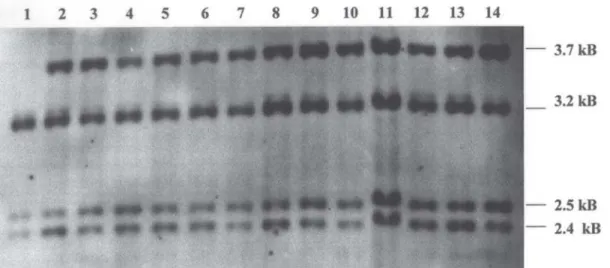
Hybridization patterns of the sam-ples obtained with the biotinylated probe are shown in Figure 1. The first column shows the lack of the 3.7 kB band and the presence of the 3.2, 2.5 and 2.4 kB bands with same intensity of signal, indicating a homozygous
large gene conversion. The third and fourteenth columns show a decreased signal in the 3.2 and 2.4 kB bands when compared respectively to the 3.7 and 2.5 kB bands, indicating a hetero-zygous CYP21A1P deletion. In the
fourth column, there is a heterozygous gene conversion because of decreased signal of the 3.7 kB band compared to the 3.2 kB, 2.4, and 2.5 kB bands with same intensity of signal. The fifth to twelfth columns represent normal hy-bridization patterns. For a better under-standing of the results, Figure 2 shows theTaq I restriction sites in CYP21A2
and its pseudogene.
Figure 2 - Representation of Taq I restriction sites of CYP21A1P and CYP21A2 genes. Fragments of 3,2 and 2,4 kB are from the pseudogene
(CYP21A1P) and fragments of 3,7 and 2,5 kB are from the active gene (CYP21A2).
Figure 1 - Hybridization pattern of the biotinylated CYP21A2 probe to genomic DNA digested by Taq I restriction enzyme. Lane 1 homozygous
gene conversion; lanes 2 and 13, heterozygous CYP21A1P duplication; lanes 3 and 14, heterozygous CYP21A1Pdeletion; lane 4, heterozygous
Analyzing these 80 unrelated alleles, we found that 78.6% of the alleles presented a normal hybridiza-tion pattern, 2.5% a CYP21A2 deletion
pattern, 8.8% a large gene conversion, and 3.8% and 6.3% presented
CYP21A1P deletion and duplication
patterns, respectively. As expected, the
CYP21A2 deletion and the large gene
conversion occurred only in the SW form, and the CYP21A1P duplication
was observed mainly in the non-clas-sical form, CYP21A2 duplication was
not found.
DISCUSSION
The main purpose of this work was establish in our service the screening of large mutations with a non-radiolabelling methodology, since ra-dioactive reagents are harder to obtain, have a short half life, are dangerous when used by people who are not well trained to handle them, and produce hazardous waste materials that require special facilities for long-term storage.
We observed that biotin labeling emits a signal equivalent in intensity to that of radioactive labeling. Another advantage of this method is that due to its greater sensitivity, smaller amounts of DNA are needed (2 - 5 µg compared to 10 µg when 32P is used).
Sometimes large amounts of DNA are not available. The smaller amount of DNA needed and the shorter time re-quired for exposure to X-ray films make this procedure more effective for use in prenatal diagnosis of large gene rearrangements in families with a his-tory of CAH 21-OHD.
In this study we found a low inci-dence of large rearrangements involv-ingCYP21A2 in our sample (10.3% of
non-related-alleles). CYP21A2
dele-tions were seen only in the SW form, and large gene conversions were ob-served in the NC (4.7%) and SW (23.8%) forms. The CYP21A1P
rearrangements are not mutations caus-ing disease but can be associated with
CYP21A2 point mutations. The
fre-quency of large rearrangement muta-tions in this sample was similar to that
found in a previous population study in a Brazilian sample performed by our group with different patients compris-ing a large number of cases.21 For
com-parison of both methodologies, some of the patients included in this study with biotin labeling had a previous molecular diagnosis by a radiolabeling methodology, with similar results.
In conclusion, the nonradioactive (biotin) labeling, although more ardu-ous, allowed accurate molecular diag-nosis of large gene rearrangements in patients with CAH 21-OHD with the advantages of the use of a small amount of DNA and avoiding the use of hazardous radioactive material. This technique proved to be a good alter-native for routine use.
ACKNOWLEDGEMENTS
We thank FAPESP that partially supported this work with a grant (95/ 8325-6) and supported TASSB (95/ 8325-6) and PC (98/03731-4).
RESUMO
CUKIER P e col. Uso de marcação não radiativa para identificação de grandes rearranjos gênicos na de-ficiência da 21-hidroxilase. Rev. Hosp. Clín. Fac. Med. S. Paulo 59(6):369-374, 2004.
OBJETIVO: Padronizar a técnica de Southern blotting usando hibridi-zação com material não radioativo para detectar grandes rearranjos no
geneCYP21A2 em uma amostra da
po-pulação brasileira com hiperplasia adrenal congênita.
MÉTODO: Foram estudados 42 pacientes, 2 dos quais aparentados, totalizando 80 alelos não relaciona-dos. As amostras de DNA foram obti-das de sangue periférico, digeriobti-das com enzima de restrição Taq I,
reali-zado Southern blotting e hibridizadas com sonda marcada com biotina.
RESULTADOS: O método se mos-trou eficaz, com resultados similares aos encontrados ao utilizar a metodo-logia com material radioativo. Foram encontradas 2,5% de deleção do
CYP21A2, 8,8% de grandes
conver-sões, 3,8% de deleção do CYP21A1P
e 6,3% de duplicação do CYP21A1P.
Estas freqüências foram similares às encontradas em nosso estudo prévio, onde um número significante de casos foi estudado. Um bom padrão de hibridização foi alcançado utilizando menor quantidade de DNA (5mg) e a emissão de sinais foi observada entre 5 minutos e 1 hora de exposição.
gran-des rearranjos no gene CYP21A2 com
bons resultados. Apesar de ser mais tra-balhoso, este método é mais rápido,
utiliza menores quantidades de DNA e, principalmente, evita problemas com o uso de radioatividade.
UNITERMOS: Biotina. Grandes rearranjos. Southern blotting. CAH-21OH.
REFERENCES
1. New MI, White PC, Pang S, Dupont B, Speiser PW. The adrenal hyperplasias. In: Sriver CR, Beaudet AL, Sly S, Valle D, editors. The Metabolic Basis of Inherited Diseases. 6th ed. New York: Mc Graw-Hill; 1989. p.1881-917.
2. Miller WL. Clinical review 54: Genetics, diagnosis, and management of 21-hydroxylase deficiency. J Clin Endocrinol Metab 1994;78:241-6.
3. Strachan T. Molecular pathology of congenital adrenal hyperplasia. Clin Endocrinol 1990 Mar;32:373-93. 4. Miller WL, Levine LS . Molecular and clinical advances in
congenital adrenal hyperplasia. J Pediatr 1987;111:1-17. 5. White PC, New MI, Dupont B. Structure of human steroid
21-hydroxylase genes. Proc Natl Acad Sci USA 1986;83:5111-5. 6. Higashi Y, Yoshioka H, Yamane M, Gotoh O, Fujii-Kuriyama Y. Complete nucleotide sequence of two steroid 21-hydroxylase genes tandemly arranged in human chromosome: a pseudogene and a genuine gene. Proc Natl Acad Sci USA 1986;83:2841-5.
7. White PC, New MI, Dupont B. HLA-linked congenital adrenal hyperplasia results from a defective gene encoding a cytochrome P-450 specific for steroid 21-hydroxylation. Proc Natl Acad Sci USA 1984;81:7505-9.
8. Miller WL. Congenital lipoid adrenal hyperplasia: the human gene knockout for the steroidogenic acute regulatory protein. J Mol Endocrinol 1997;19:227-40.
9. Wilson RC, Wei JQ, Cheng KC, Mercado AB, New MI. Rapid deoxyribonucleic acid analysis by allele-specific polymerase chain reaction for detection of mutations in the steroid 21-hydroxylase gene. J Clin Endocrinol Metab 1995;80:1635-40.
10. Wedell A, Luthman H. Steroid 21-hydroxylase deficiency: two additional mutations in salt-wasting disease and rapid screening of disease-causing mutations. Hum Mol Genet 1993;2:499-504.
11. Carrera P, Bordone L, Azzani T, Brunelli V, Garancini MP, Chiumello G, Ferrari M. Point mutations in Italian patients with classic, non-classic, and cryptic forms of steroid 21-hydroxylase deficiency. Hum Genet 1996;98:662-5.
12. Mornet E, Crete P, Kuttenn F, Raux-Demay MC, Boue J, White PC, Boue A. Distribution of deletions and seven point mutations on CYP21B genes in three clinical forms of steroid 21-hydroxylase deficiency. Am J Hum Genet 1991;48:79-88. 13. Ezquieta B, Oliver A, Gracia R, Gancedo PG. Analysis of steroid
21-hydroxylase gene mutations in the Spanish population. Hum Genet 1995;96:198-204.
14. Dardis A, Bergada I, Bergada C, Rivarola M, Belgorosky A. Mutations of the steroid 21-hydroxylase gene in an Argentinian population of 36 patients with classical congenital adrenal hyperplasia. J Pediatr Endocrinol Metab 1997;10:55-61. 15. Day DJ, Speiser PW, Schulze E, Bettendorf M, Fitness J, Barany F,
White PC. Identification of non-amplifying CYP21 genes when using PCR-based diagnosis of 21-hydroxylase deficiency in congenital adrenal hyperplasia (CAH) affected pedigrees. Hum Mol Genet 1996;5:2039-48.
16. Chin D, Speiser PW, Imperato-McGinley J, Dixit N, Uli N, David R, Oberfield SE. Study of a kindred with classic congenital adrenal hyperplasia: diagnostic challenge due to phenotypic variance. Clin Endocrinol Metab 1998;83:1940-5.
17. Speiser PW, Dupont J, Zhu D, Serrat J, Buegeleisen M, Tusie-Luna MT, et al. Disease expression and molecular genotype in congenital adrenal hyperplasia due to 21-hydroxylase deficiency. J Clin Invest 1992;90:584-95.
18. Carrera P, Ferrari M, Beccaro F, Spiga I, Zanussi M, Rigon F, et al. Molecular characterization of 21-hydroxylase deficiency in 70 Italian families. Hum Hered 1993;43:190-6.
19. Wedell A, Thilen A, Ritzen EM, Stengler B, Luthman H. Mutational spectrum of the steroid 21-hydroxilase gene in Sweden: implications for genetic diagnosis and association with disease manifestation. J Clin Endocrinol Metab 1994;78:1145-52. 20. Ezquieta B, Varela JM, Jariego C, Oliver A, Gracia R. Nonisotopic
detection of point mutations in CYP21B gene in steroid 21-hydroxylase deficiency. Clin Chem 1996;42:1108-10. 21. Bachega TA, Billerbeck AC, Madureira G, Arnhold IJ, Medeiros
22. Baumgartner-Parzer SM, Schulze E, Waldhausl W, Pauschenwein S, Rondot S, Nowotny P, et al. Mutational spectrum of the steroid 21-hydroxylase gene in Austria: identification of a novel missense mutation. J Clin Endocrinol Metab 2001;86:4771-5.
23. Rihn B, Coulais C, Bottin MC, Martinet N. Evaluation of non-radioactive Labeling and detection of deoxyribonucleic acids. Part One: Chemiluminescent methods. J Biochem Biophys Methods 1995;30:91-102.
24. Mansfield ES, Worley JM, McKenzie SE, Surrey S, Rappaport E, Fortina P. Nucleic acid detection using non-radioactive labelling methods. Mol Cell Probes 1995;9:145-56.
25. New MI, Lorenzen F, Lerner AJ, Kohn B, Oberfield SE, Pollack MS, et al. Genotyping steroid 21-hydroxylase deficiency: hormonal reference data. J Clin Endocrinol Metab 1983;57:320-6.