502
Address to: Dr. Francisco Chiaravalloti Neto. Deptº de Epidemiologia/FSP/ USP. Av. Dr. Arnaldo 715, 01246-904 São Paulo, SP, Brasil.
Phone: 55 11 3061-7920 e-mail: [email protected] Received 31 October 2011 Accepted 13 January 2012
Short Communication
Evaluation of two sweeping methods for estimating
the number of immature
Aedes aegypti
(Diptera : Culicidae) in large containers
Margareth Regina Dibo
[1],[2], Eliane Aparecida Fávaro
[2], Maisa Carla Pereira Parra
[2],
Thiciane Cristian dos Santos
[1], Juliana Haines Cassiano
[2], Keli Vanessa de Souza Deitz
[2],
Aline Michelle dos Santos Pagliotto
[1], Nathália Zini
[1], Daniela Regina Benetti
[2]and Francisco Chiaravalloti-Neto
[3][1]. Superintendência de Controle de Endemias, Governo do Estado de São Paulo, São José do Rio Preto, SP. [2]. Departamento de Epidemiologia e Saúde Coletiva, Faculdade de Medicina de São José do Rio Preto, São José do Rio Preto, SP. [3]. Departamento de Epidemiologia, Faculdade de Saúde Pública, Universidade de São Paulo, São Paulo, SP.
ABSTRACT
Introduction: Here, we evaluated sweeping methods used to estimate the number of immature Aedes aegypti in large containers. Methods: III/IV instars and pupae at a 9:1 ratio were placed in three types of containers with, each one with three different water
levels. Two sweeping methods were tested: water-surface sweeping and fi ve-sweep netting. The data were analyzed using linear
regression. Results: The fi ve-sweep netting technique was more suitable for drums and water-tanks, while the water-surface sweeping method provided the best results for swimming pools. Conclusions: Both sweeping methods are useful tools in epidemiological surveillance programs for the control of Aedes aegypti.
Keywords: Aedes aegypti. Sweeping. Entomological surveillance.
The quantifi cation of Aedes aegypti larvae and pupae is
practical in small- and medium-sized containers but becomes diffi cult in large ones. Sampling large containers is
labor-intensive and time-consuming, and it is also considered to be privacy-invasive by household residents1. Several authors1-4 have proposed alternative techniques, such as sweep-net
or sweeping methods, to estimate the number of immature
A. aegypti in large water-storage containers.
Based on studies of this technique, Tun-Lin et al.4,
Romero-Vivas et al.3 and Romero et al.5 reported that a single sweep
around the container at the water's surface (the water-surface
sweeping method) is suffi cient for estimating the number of
larvae and pupae present, while other authors have suggested that the method is more effective when performed in a swirling motion. Kubota et al.1 proposed eight sequential sweeps to
estimate the number of stage IV instars. Knox et al.2 argued that a fi sweep technique around the entire container (the fi ve-sweep netting technique) is able to estimate the total number of
immatures. The objective of this study was to conduct laboratory evaluations of two methods used to estimate the amount of immature A. aegypti in large storage containers,
water-surface sweeping and fi ve-sweep netting.
São José do Rio Preto is located in northwestern São Paulo
(20º49’11”S and 49º22’46”W), Brazil, 498m above sea level, with a population of 408,258. The climate is tropical, with an
av erage annual temperature of 25ºC and an annual precipitation of approximately 1,200mm.
The presence of A. aegypti in the city was detected by a
survey performed in 1985, and the fi rst autochthonous cases of
dengue were recorded in 1990 together with the introduction of the serotype 1 dengue virus (DEN 1) virus. The disease is considered to be endemic to the city6, and four viral serotypes
are currently in circulation.
Immature A. aegypti were obtained by placing oviposition traps at pre-selected sites in São José do Rio Preto. Straws
were removed from the traps and taken to the laboratory for
drying, counting and storing of the eggs. Next, the eggs were submerged in plastic trays for hatching. The larvae were fed with
fi sh feed until stage III/IV instars and pupae appeared, which were subsequently used for experimentation.
The experiments were conducted in three stages: the fi rst stage, performed in November 2008, included only A. aegypti
pupae; the second stage, performed in June/July 2009, included III/IV instars and pupae; the third stage, performed in July/ August 2010, also included III/IV instars and pupae. The
sweeps were performed using a fi ne white-mesh net (15cm in
diameter and 20cm in length) with a 1.5m handle. The water-surface sweeping method, consisting of a single sweep around the periphery of the container at the water's surface, was used in stages 1 and 23,4. The fi ve-sweep netting method, as described
by Knox et al.2, was used in stage 3.
503 Dibo MR et al - Method for estimating the number of immature A. aegypti
0 5 10 15 20 25 30 35 40 45
1/3. 2/3. 3/3. 1/3. 2/3. 3/3. 1/3. 2/3. 3/3. Second stage
0 5 10
1/3. 2/3. 3/3. 1/3. 2/3. 3/3. 1/3. 2/3. 3/3.
Drum
0 5 10 15
1/3. 2/3. 3/3. 1/3. 2/3. 3/3.
Third stage
CF Pupae
CF larvae
CF Pupae Swimming pool
Water-tank
Drum Water-tank Swimming pool
Drum Water-tank
CF larvae
CF Pupae First stage
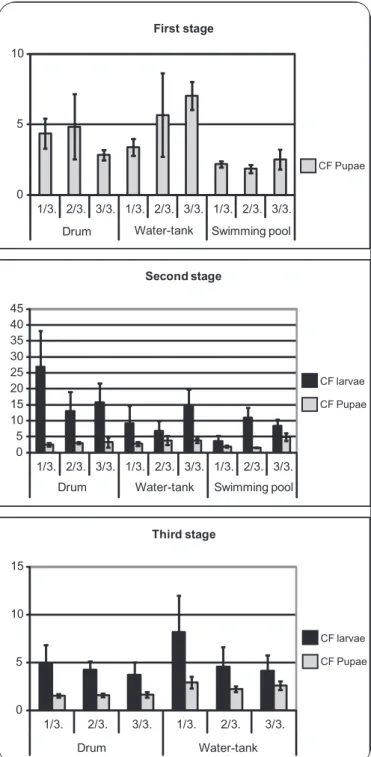
FIGURE 1 - Calibration factors (CFs) with 95% confi dence intervals for Aedes aegypti
pupae (stage 1 of the experiment) and III/IV instars and pupae (stages 2 and 3) in large water-storage containers. Stages 1 and 2: water-surface sweeping method; stage 3:
fi ve-sweep netting technique. The water-surface sweeping method was performed at
three water levels (1/ 3,
2/ 3 and
3/
3) in three large water-storage
containers: a 200 liters plastic drum, a 500 liters round
polyethylene water-tank and a 1,000 liters swimming pool. The fi ve-sweep netting method was performed in drums and water-tanks. A 15-sweep experiment was conducted for each
container type and water level.
In stage 1, each experiment involved introducing 70 pupae
into each container for the fi rst fi ve sweeps, 140 pupae for the next fi ve sweeps and 210 pupae for the last fi ve sweeps. In
stages 2 and 3, A. aegypti III/IV instars and pupae were placed in containers at a 9:1 larvae:pupae ratio at three different numbers
of immatures (60, 160 and 320), with fi ve sweeps per quantity.
Five minute intervals were observed between sweeps. The duration of each sweep was timed, and the water temperature was measured. All III/IV instars and pupae sampled from each sweep were counted, and dead or damaged immatures Aedes aegypti were replaced.
The experimental data were recorded in spreadsheets, and si mple linear regression analyses were used to calculate calibration factors (CFs)7, indexes that, when multiplied by
the number of immature Aedes aegypti collected by sweeping, allow estimation of the number of immature A. aegypti in each container type and volume3.
For linear regression analysis, the number of immature
A. aegypti collected by sweeping was considered as the dependent variable, the number of immature A. aegypti residing in the container was considered as the independent variable,
and the intercept was set equal to zero (the inexistence of immature forms harboring the container corresponded to zero
immature forms collected by sweeping). The outcomes of these
analyses were the linear regression coeffi cients, the va lues of the coeffi cients of determination (r2) that were used to compare the
calibration factors derived in the three stages of the study and the p-values of the models (F-test). The CF values corresponded
to the inverse of the regression coeffi cient values. Mean water
temperature and sweeping duration (± standard deviation) were measured in each experiment.
The CFs derived for larvae and pupae are shown in Figure 1, with respective 95% confi dence intervals for each stage, container type and volume. Regression analysis models
for all experiments were signifi cant, with p-values less than
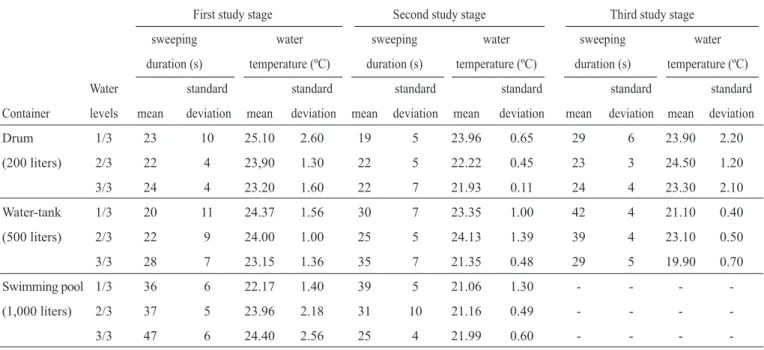
0.003 (F-test). The CFs derived for larvae were higher than those for pupae, indicating that a higher percentage of pupae were collected in all experiments compared to larvae. The mean water temperature (ºC) and sweeping duration (s) for each experiment are shown in Table 1. Generally, the mean water temperature showed little variability across the three study stages. The mean sweeping durations ranged from 19 to 47s and were lower for
the drum and water-tank and higher for the swimming pool.
The mean sweeping duration was higher in stage 3 compared to stages 1 and 2.
The coefficients of determination (r2) from the linear
regression analyses used to derive the CFs estimating the number of larvae and pupae are shown in Table 2. In stages 2 and 3, all
coeffi cients of determination were higher for pupae compared
to larvae, except in two cases. In stage 3, all coeffi cients of determination for larvae and pupae were equal to or higher
than those observed in stage 2, except in one case. Moreover,
the coeffi cients of determination for pupae in stage 3 exhibited
less variation than those in stages 1 and 2.
504
Rev Soc Bras Med Trop 46(4):502-505, Jul-Aug, 2013
TABLE 1 - Sweeping duration (s) and water temperature (°C) with respective standard deviations, according to study stage, container type and water level.
First study stage Second study stage Third study stage
sweeping water sweeping water sweeping water
duration (s) temperature (ºC) duration (s) temperature (ºC) duration (s) temperature (ºC)
Water standard standard standard standard standard standard
Container levels mean deviation mean deviation mean deviation mean deviation mean deviation mean deviation
Drum 1/3 23 10 25.10 2.60 19 5 23.96 0.65 29 6 23.90 2.20
(200 liters) 2/3 22 4 23,90 1.30 22 5 22.22 0.45 23 3 24.50 1.20
3/3 24 4 23.20 1.60 22 7 21.93 0.11 24 4 23.30 2.10
Water-tank 1/3 20 11 24.37 1.56 30 7 23.35 1.00 42 4 21.10 0.40
(500 liters) 2/3 22 9 24.00 1.00 25 5 24.13 1.39 39 4 23.10 0.50
3/3 28 7 23.15 1.36 35 7 21.35 0.48 29 5 19.90 0.70
Swimming pool 1/3 36 6 22.17 1.40 39 5 21.06 1.30 - - -
-(1,000 liters) 2/3 37 5 23.96 2.18 31 10 21.16 0.49 - - -
-3/3 47 6 24.40 2.56 25 4 21.99 0.60 - - -
-s: seconds.
TABLE 2 - Coeffi cient of determination (r2) values from linear regression analyses used to estimate calibration factors for Aedes aegypti
larvae and pupae according to study stage, container type and water level.
Study stage
I II III
Container Water level pupae larvae pupae larvae pupae
Drum 1/3 0.84 0.65 0.87 0.70 0.96
(200 liters ) 2/3 0.59 0.61 0.96 0.89 0.96
3/3 0.95 0.69 0.57 0.72 0.91
Water-tank 1/3 0.91 0.48 0.87 0.60 0.88
(500 liters) 2/3 0.55 0.59 0.69 0.63 0.95
3/3 0.94 0.70 0.91 0.68 0.92
Swimming poll 1/3 0.97 0.60 0.91 -
-(1,000 liters) 2/3 0.93 0.80 0.98 -
-3/3 0.81 0.84 0.84 -
-sometimes require the disposal of the accumulated water8. In this study, the use of the sweeping method coupled to a CF3 was
found to be a viable alternative for use in entomological surveys.
This technique allows for a rapid estimation of the number of
immatures in large water-storage containers without disposal of the water in the container. In this study, the average time for the entire procedure was always less than one minute, even for
the fi ve-sweep netting technique in water drums and tanks and
for the water-surface sweeping performed in swimming pools.
In a study conducted in Fortaleza, Martins et al.9 verifi ed that water drums and tanks corresponded to 11.8% and 9.8%
of the total containers that could harbour immature A. aegypti,
respectively. Water drums and tanks are still used for water
storage in São José do Rio Preto (SUCEN: unpublished data),
even though virtually all households in the city have adequate
tap water and sanitation systems10. When confronted by
entomological surveillance technicians, household residents strongly oppose the disposal of the water accumulated in these large containers for immature counting. Therefore, larger
water-storage containers should be surveyed with the fi ve-sweep netting technique, given the superior results obtained with this
method as compared to the water-surface sweeping method2. The superior results obtained with the fi ve-sweep netting
505
REFERENCES
The authors declare that there is no confl ict of interest.
CONFLICT OF INTEREST
FINANCIAL SUPPORT
This study was funded by Fundação de Amparo à Pesquisa do Estado de São Paulo (FAPESP; Foundation for Research
Support of São Paulo) - Process 2008/03799-1.
1. Kubota R, Brito M, Voltolini JC. Método de varredura para exame de criadouros de vetores de dengue e febre amarela urbana. Rev Saude Publica 2003; 37: 263-265.
2. Knox BT, Yen TY, Nam SV, Gatton LM, Kay HB, Ryan AP. Critical
Evaluation of Quantitative Sampling Methods for Aedes aegypti (Diptera: Culicidae) Immatures in Water Storage Containers in Vietnam. J Med Entomol 2007; 44:192-204.
3. Romero-Vivas CME, Llinás H, Falconar AKI. Three calibration factors,
applied to a rapid sweeping method, can accurately estimate Aedes aegypti
(Diptera: Culicidae) pupal numbers in large water-storage containers at all temperatures at which dengue virus transmission occurs. J Med Entomol 2007; 44:930-937.
4. Tun-Lin W, Kay BH, Burkot TR. Quantitative sampling of immature Aedes aegypti in metal drums using sweep net and dipping methods. J Am
Mosq Control Assoc 1994; 10:390-396.
5. Romero CME, Llinás H, Falconar AKI. Evaluation of rapid water-surface
sweeping method to accurately estimate numbers of Aedes aegypti (Diptera: Culicidae) late larval stages in large water-storage containers: comparison
with pupal estimates. Biomedica 2010; 30:268-275.
6. Mondini A, Chiaravalloti-Neto F, Sanches MGY, Lopes JCC. Análise espacial
da transmissão de dengue em cidade de porte médio do interior paulista. Rev Saude Publica 2005; 39:444-451.
7. Altman DG. Practical Statistics for Medical Research. Boca Raton: Chapman & Hall/CRC; 1999.
8. Focks DA. A review of entomological sampling methods and indicators for dengue vectors. Flórida, World Health Organization, 2003.
9. Martins VEP, Alencar CHM, Facó PEG, Dutra RF, Alves CR, Pontes RJS, et al. Distribuição espacial e características dos criadouros deAedes albopictus eAedes aegypti em Fortaleza, Estado do Ceará.Rev Soc Bras Med Trop 2010;43:73-77.
10. Prefeitura Municipal de São José do Rio Preto. Conjuntura Econômica [Internet]. São José do Rio Preto: Prefeitura Municipal [Cited 2011 October 19]. Available from: http://www.riopreto.sp.gov.br/PortalGOV/ do/subportais_Show?c=146/.
11. Focks DA, Brenner RJ, Hayes J, Daniels E. Transmission Thresholds for
dengue in terms of Aedes aegypti pupae per person with discussion of their utility in source reduction efforts. Am J Trop Med Hyg 2000; 62:
11-18.
12. Gomes AC, Silva NN, Bernal RTI, Leandro AS, Camargo NJ, Silva AM, et al. Especifi cidade da armadilha Adultrap para capturar fêmeas de Aedes aegypti (Diptera: Culicidae).Rev Soc Bras Med Trop 2007; 40:216-219.
13. Tun-Lin W, Kay BH, Barnes A. Understanding productivity, a key to Aedes aegypti surveillance. Am J Trop Med Hyg 1995; 53:595-601.
Dibo MR et al - Method for estimating the number of immature A. aegypti
of the water column after swirling, facilitating their collection with the net. However, this method is not viable for large containers with greater storage capacity. For such containers, water-surface3,4 sweeping should be used in a similar manner as for the case of swimming pools without adequate treatment
in the City of São José do Rio Preto.
Tun-Lin et al.4 observed that temperature affects the vertical
distribution of larvae in the water column and their recovery during sweeping; therefore, temperature should be considered when estimating immature numbers. In this study, there was little variation in water temperature because of the tropical climate,
and thus, temperature was not taken into account when deriving
the calibration factors.
Focks et al.11 argued that entomological measures used in A. aegypti control programs for quantifying vector infestation are ineffi cient because they are not directly associated with the risk of
dengue transmission. Authors such as Gomes et al.12 have sought
other methods to obtain entomological measurements, such as the use of Adultrap traps for the collection of female A. aegypti;
using these methods, the quantity collected could be related to the transmission of dengue. Focks8 proposed the quantifi cation of pupae as an alternative measure given their low mortality rates and direct
relationship with the number of adult mosquitoes. To search for better indicators of dengue risk, Tun-Lin et al.13 investigated the
productivity of immature A. aegypti and their use for surveillance of the vector. According to Romero et al.5, sweeping is an accurate
method for estimating the number of immatures in large water-storage containers, a result that is supported by data from this study. Thus, the sweeping method can be used in entomological surveillance programs to assess intervention methods and evaluate
th e risk of dengue virus transmission.
The water-surface and five-sweep netting methods for estimating numbers of larvae and pupae can be easily implemented in entomological surveys of A. aegypti through
appropriate training programs for technicians working in the fi eld of vector control. Nevertheless, the effect of water
temperature on the recovery rates of larvae and pupae4, as well as its possible infl uence on CF values, should be taken into account