HESSD
12, 2477–2495, 2015Variability of flow discharge in lateral
inflow-dominated stream channels
C.-M. Chang and H.-D. Yeh
Title Page
Abstract Introduction
Conclusions References
Tables Figures
◭ ◮
◭ ◮
Back Close
Full Screen / Esc
Printer-friendly Version
Interactive Discussion
Discussion
P
a
per
|
Discussion
P
a
per
|
Discussion
P
a
per
|
Discussion
P
a
per
|
Hydrol. Earth Syst. Sci. Discuss., 12, 2477–2495, 2015 www.hydrol-earth-syst-sci-discuss.net/12/2477/2015/ doi:10.5194/hessd-12-2477-2015
© Author(s) 2015. CC Attribution 3.0 License.
This discussion paper is/has been under review for the journal Hydrology and Earth System Sciences (HESS). Please refer to the corresponding final paper in HESS if available.
Technical Note: Variability of flow
discharge in lateral inflow-dominated
stream channels
C.-M. Chang and H.-D. Yeh
Institute of Environmental Engineering, National Chiao Tung University, Hsinchu, Taiwan
Received: 17 December 2014 – Accepted: 9 February 2015 – Published: 25 February 2015
Correspondence to: H.-D. Yeh ([email protected])
HESSD
12, 2477–2495, 2015Variability of flow discharge in lateral
inflow-dominated stream channels
C.-M. Chang and H.-D. Yeh
Title Page
Abstract Introduction
Conclusions References
Tables Figures
◭ ◮
◭ ◮
Back Close
Full Screen / Esc
Printer-friendly Version
Interactive Discussion
Discussion
P
a
per
|
Discussion
P
a
per
|
Discussion
P
a
per
|
Discussion
P
a
per
|
Abstract
The influence of the temporal changes in lateral inflow rate on the discharge variability in stream channels is explored through the analysis of diffusion wave equation (the
linearized St. Venant equations). To account for variability and uncertainty, the lateral inflow rate is regarded as a temporal random function. Based on the spectral
repre-5
sentation theory, analytical expressions for the covariance function and evolutionary power spectral density of the random discharge perturbation process are derived to quantify variability in stream flow discharge induced by the temporal changes in lateral inflow rate. Upon evaluating the closed-form expressions, it is found that the variabil-ity in stream flow discharge increases with distance from the upstream boundary of
10
the channel and time as well. The temporal correlation scale of inflow rate fluctuations plays a positive role in enhancing the variability of the flow discharge in channels. The treatment of the discharge variance gives us a quantitative estimate of uncertainty from the use of the deterministic model.
1 Introduction
15
Surface runofforiginates from precipitation intensities exceeding the infiltration
capac-ity of the surface. This process may result in lateral inflow to stream channels. Signifi-cant lateral inflows may contribute to streams during storm-runoffperiods when stream
reaches are of large lateral watershed area or upslope accumulated area (Jencso et al., 2009). These lateral inflows may be not only a source of water to the streams or
20
channels, but also a source of contaminants to surface water. Agricultural chemicals are frequently mixed into the shallow soil layers and lateral inflows may cause the re-lease and migration of them into streams (Govindaraju, 1996). The effects of the lateral
inflows on the stream channels are important in the analysis of contaminant transport in the surface water. Therefore, understanding and quantification of the influence of inflow
25
HESSD
12, 2477–2495, 2015Variability of flow discharge in lateral
inflow-dominated stream channels
C.-M. Chang and H.-D. Yeh
Title Page
Abstract Introduction
Conclusions References
Tables Figures
◭ ◮
◭ ◮
Back Close
Full Screen / Esc
Printer-friendly Version
Interactive Discussion
Discussion
P
a
per
|
Discussion
P
a
per
|
Discussion
P
a
per
|
Discussion
P
a
per
|
Natural variability, such as significant variability of rainfall events on both temporal and spatial scales (e.g. Ogden and Julien, 1993; Redano and Lorente, 1993; Wheater et al., 2000; Zhang et al., 2001; De Michele and Bernardara, 2005) and the great heterogeneity of soil types at the ground surface (e.g. Jencso et al., 2009; Fournier et al., 2013) and surface saturation (e.g. Schumann et al., 2009; Riley and Shen, 2014)
5
over a watershed, creates a very complex runoff process on the land surface. Many
practical problems of flood wave routing require predictions over relatively large time and space scales. The key question is how one can realistically incorporate the effect
of natural heterogeneity into models which extrapolate to predict behavior at large time and space scales. Due to a high degree of the natural heterogeneity of the surface
10
runoffprocess, the use of deterministic analysis techniques in stream flow modeling
is inevitably subject to large uncertainty. The theoretical understanding of variability in flood wave routing is far from complete. Motivated by that, this article focuses on quantification of the discharge variability in lateral-inflow-dominated stream channels.
In the follows, the response of transient stream flow process to spatiotemporal lateral
15
inflow in a diffusion wave model is analyzed stochastically by treating the fluctuations in
lateral inflow rate as temporal stationary random processes. The non-stationary spec-tral techniques are employed to obtain closed-form solutions for quantifying the dis-charge variability in stream channels. These solutions provide variance relations for flow discharge, and thereby allow for assessing the impact of statistical properties of
20
lateral inflow rate process on the discharge variability.
2 Description of the problem
This study considers the case of unsteady flow in open channels. The equations that describe the propagation of a flood wave with respect to distance along the channel and time in open channels, are the so-called Saint Venant equations, consisting of
25
HESSD
12, 2477–2495, 2015Variability of flow discharge in lateral
inflow-dominated stream channels
C.-M. Chang and H.-D. Yeh
Title Page
Abstract Introduction
Conclusions References
Tables Figures
◭ ◮
◭ ◮
Back Close
Full Screen / Esc
Printer-friendly Version
Interactive Discussion
Discussion
P
a
per
|
Discussion
P
a
per
|
Discussion
P
a
per
|
Discussion
P
a
per
|
negligible as they are small relative to terms arising from gravity and resistance forces (Henderson, 1963; Dooge and Harley, 1967; Daluz Viera, 1983), leading to a simplified model of open channel flow, the diffusion wave equation (e.g. Moussa, 1996; Sivapalan
et al., 1997):
∂Q ∂t +Cd
Q,∂Q
∂X
∂Q
∂X −qL
= 1
p
S0
∂ ∂X
Dh(Q)
∂Q
∂X −qL
(1)
5
where Q is the discharge, Cd and Dh are non-linear function of discharge generally known as wave celerity and hydraulic diffusivity, respectively, S
0is the bed slope, and
qL(X,t) represents the net lateral inflow distribution. The single diffusion Eq. (1) is
for-mulated by combining the continuity equations for both mass and momentum. The dif-fusion wave approximation is appropriate for simulations of the flood waves in rivers and
10
on flood plains with milder slopes ranging between 0.001 and 0.0001 (Kazezyı
lmaz-Alhan, 2012). Most natural flood waves can then be described with the diffusion wave
model.
Equation (1) is a nonlinear partial differential equation and has a complex
behav-ior in general. No analytical solution of Eq. (1) is available in the literature. However,
15
the problem can be solved analytically based on some simplifications to the Eq. (1), such as linearization for the case of initial steady uniform flow. Based on expansion of dependent variable and the nonlinear terms in Eq. (1) around the initial condition of steady uniform flow and limitation of the expansion to the first-order variation from the steady state, the result of linearization can be written as
20
∂Q′
∂t =D
∂2Q′
∂X2 −C
∂Q′
∂X +
CqL−D
∂qL
∂X
. (2)
In Eq. (2),Q′=Q−Q0(Q0≫Q′,qL),Q0is the initial uniform steady-state flow discharge,
andCandDrepresent constant celerity and diffusivity, respectively, which depend on
HESSD
12, 2477–2495, 2015Variability of flow discharge in lateral
inflow-dominated stream channels
C.-M. Chang and H.-D. Yeh
Title Page
Abstract Introduction
Conclusions References
Tables Figures
◭ ◮
◭ ◮
Back Close
Full Screen / Esc
Printer-friendly Version
Interactive Discussion
Discussion
P
a
per
|
Discussion
P
a
per
|
Discussion
P
a
per
|
Discussion
P
a
per
|
Napiorkowski (1987), Ponce (1990), Yen and Tsai (2001) or Tsai and Yen (2001) for the detailed development.
To derive the analytical solution of Eq. (2), one needs to specify the form ofqL(X,t).
In the present work, the focus is placed on the case that the net lateral inflow is well-approximated by the following spatial distribution (Lane, 1982; Capsoni et al., 1987;
5
Goodrich et al., 1997; Féral et al., 2003).
qL(X,t)=qM(t) exp
−x
η
(3)
whereqM is the peak inflow rate and ηis the distance along thex-axis for which the
inflow rate decreases by a factore−1with respect toqM. In particular,qMis considered
to be a temporally correlated stationary random field. It apparent from Eq. (2) that the
10
last two terms associated with the lateral inflow are introduced as the sources of fluc-tuations in stream flow discharge and treated here as temporally correlated stochas-tic processes. Equation (2) is then viewed as a stochasstochas-tic differential equation with
a stochastic outputQ′. The solution of Eq. (2) will provide a rational basis for quantify-ing the flow variability through the representation theorem.
15
Consider that the flow domain is bounded within the range 0≤x≤L, the associated initial and boundary conditions can be expressed as
Q′(X, 0)=0 (4a)
Q′(0,t)=0 (4b)
∂
∂xQ
′(L,t)=0. (4c)
20
Equation (4a) signifies that there is no perturbation from the reference discharge ini-tially while Eq. (4b) assumes no inflow at the upstream boundary at all times. The down-stream boundary condition represented by Eq. (4c) is under the condition of a zero-discharge gradient. Morris (1979) showed that this downstream boundary condition is applicable to a large class of problems.
HESSD
12, 2477–2495, 2015Variability of flow discharge in lateral
inflow-dominated stream channels
C.-M. Chang and H.-D. Yeh
Title Page
Abstract Introduction
Conclusions References
Tables Figures
◭ ◮
◭ ◮
Back Close
Full Screen / Esc
Printer-friendly Version
Interactive Discussion
Discussion
P
a
per
|
Discussion
P
a
per
|
Discussion
P
a
per
|
Discussion
P
a
per
|
3 General solutions via spectral theory
The approach followed is to develop the analytical solution of Eq. (2) in the Fourier frequency domain.
Temporal stationarity of theqMperturbation process admits a spectral representation
of the form (e.g. Priestley, 1965)
5
qL=qM(t) exp
−x
η
=exp
−x
η
Z∞
−∞
ei ωtdZq(ω) (5)
whereωis the frequency parameter,Zq(ω) is an orthogonal process, and dZqis a
zero-mean orthogonal increment process with
E[dZq(ω1)dZq∗(ω2)]=Sqq(ω1)δ(ω1−ω2)dω1dω2 (6)
in whichE[–] denotes the ensemble average, the superscript asterisk stands for the
10
complex-conjugation operator, and Sqq (–) is the power spectral density for the sta-tionary randomqM perturbation process. On the other hand, without the restriction on
the assumption of stationarity the random perturbed quantitiesQ′may be expressed in the form of the Fourier–Stieltjes integral representation as (e.g. Priestley, 1965; Li and McLaughlin, 1991)
15
Q′(X,t)=
∞
Z
−∞
ΘQq(X,t,ω)dZq(ω) (7)
whereΘ
Qq (–) is the transfer function depending on space, time, and frequency.
It follows from Eqs. (5) and (7) that Eq. (2) takes the form
∂Θ
∂t =D
∂2Θ Qq
∂X2 −C
∂Θ
∂X +exp
−X
η +iωt C+
D η
HESSD
12, 2477–2495, 2015Variability of flow discharge in lateral
inflow-dominated stream channels
C.-M. Chang and H.-D. Yeh
Title Page
Abstract Introduction
Conclusions References
Tables Figures
◭ ◮
◭ ◮
Back Close
Full Screen / Esc
Printer-friendly Version
Interactive Discussion
Discussion
P
a
per
|
Discussion
P
a
per
|
Discussion
P
a
per
|
Discussion
P
a
per
|
subject to the following initial and boundary conditions
Θ
Qq(X, 0)=0 (9a)
ΘQq(0,t)=0 (9b)
∂Θ
∂X (L,t)=0. (9c)
The method of eigenfunction expansion is used to solve this inhomogeneous boundary
5
value problem and the solution of Eq. (8) with Eq. (9) is:
Θ
Qq(X,t,ω)=2
D L
υ+1
µ
expυ 2ξ
X∞
n=0
an−βexp(−β) cos(nπ)
β2+a2 n
sin(anξ)
×exp(−iωt)−exp(−Fnt)
Fn−iω
(10)
whereυ=CL/D,µ=η/L,a
n=π(2n+1)/2,ξ=X/L,β=(υ/2)+1/µ, andFn=D[a
2
n+
υ2/4]/L2. Rewriting Eq. (7), using Eq. (10), yields the solution of Eq. (2) in frequency
10
domain as
Q′(X,t)=2D
L
υ+1
µ
expυ 2ξ
X∞
n=0
an−βexp(−β) cos(nπ)
β2+a2
n
sin(anξ)
× ∞
Z
−∞
exp(−iωt)−exp(−Fnt)
HESSD
12, 2477–2495, 2015Variability of flow discharge in lateral
inflow-dominated stream channels
C.-M. Chang and H.-D. Yeh Title Page Abstract Introduction Conclusions References Tables Figures ◭ ◮ ◭ ◮ Back Close
Full Screen / Esc
Printer-friendly Version Interactive Discussion Discussion P a per | Discussion P a per | Discussion P a per | Discussion P a per |
The covariance function of the flow discharge field,CQQ (–), can be computed based
on the representation theorem forQ′by
CQQ(X,t1,t2)=E[Q′(X,t1)Q′∗(X,t2)]=
∞
Z
−∞
Θ
Qq(X,t1,ω)Θ∗Qq(X,t2,ω)Sqq(ω)dω
=4D
2
L2
υ+1
µ
2
exp(υξ) ∞
X
m=0
∞
X
n=0
sin(amξ) sin(anξ)
β2+a2
m β2+a2n
×naman−βexp(−β)
am(−1)m+an(−1)n
+
β2(−1)m+nexp(−2β)o
5
× ∞
Z
−∞
exp[iω(t1−t2)]−exp(−Fmt1−iωt2)
−exp(iωt1−Fnt2)+exp(Fmt1+Fnt2)
FmFn+ω2+
iLD2a2n−a2mω
Sqq(ω)dω (12)
where am=π(2m+1)/2 and Fm=D[a2m+υ2/4]/L2. The variance of flow discharge
fluctuations is obtained by evaluating Eq. (12) at zero time lag as
σQ2(X,t)= C
QQ(X,t,t)=4
D2 L2
υ+1
µ
2
exp(υξ) ∞
X
m=0
∞
X
n=0
sin(amξ) sin(anξ)
β2+a2
m β2+a2n
×naman−βexp(−β)
am(−1)m+an(−1)n
+
β2(−1)m+nexp(−2β)o
10
× ∞
Z
−∞
1−exp[−(Fm+iω)t]−exp[(iω−Fn)t]+exp[(Fm+Fn)t]
FmFn+ω2+iLD2
a2n−a2mω
HESSD
12, 2477–2495, 2015Variability of flow discharge in lateral
inflow-dominated stream channels
C.-M. Chang and H.-D. Yeh Title Page Abstract Introduction Conclusions References Tables Figures ◭ ◮ ◭ ◮ Back Close
Full Screen / Esc
Printer-friendly Version Interactive Discussion Discussion P a per | Discussion P a per | Discussion P a per | Discussion P a per |
In addition, following Priestley (1965), the variance of theQ′process may be written in the form of
σQ2(X,t)=
∞
Z
−∞
|At(X,t,ω)|2E
dZq(ω)dZq∗(ω)
(14)
so that the evolutionary power spectral density of the non-stationary random process can be defined as
5
E
dZQ(X,t,ω)dZQ∗(X,t,ω)=
|At(X,t,ω)|2E
dZq(ω)dZq∗(ω)
(15)
whereAt (–) is referred to as the modulating function of the non-stationary process. The evolutionary spectrum has the same physical interpretation as the spectrum of a stationary process, namely, that it describes the distribution of mean square signal content (or fluctuations) of the random process at a given timet. Comparing Eq. (14)
10
to Eq. (13) leads Eq. (15) to
SQQ(X,t,ω)=4D
2
L2
υ+1
µ
2
exp(υξ) ∞
X
m=0
∞
X
n=0
sin(amξ) sin(anξ)
β2+a2
m β2+a2n
×naman−βexp(−β)
am(−1)m+an(−1)n
+
β2(−1)m+nexp(−2β)o
×1−exp[−(Fm
+iω)t]−exp[(iω−F
n)t]+exp[(Fm+Fn)t]
FmFn+ω2
+
iLD2
a2n−a2m
ω
Sqq(ω) (16)
whereSQQ(–) is the spectral density of theQ′perturbation process.
15
The infinite series in Eq. (10) converges rapidly whenτc=Dt/L
2
≫1/π2. Accord-ingly, Eq. (10) can reduce to
Θ
Qq(X,t,ω)=
D L
υ+1
µ
π−2βexp(−β)
β2+π2
4
expπ 2ξ
sinπ 2ξ
exp(iωt)−exp(−τ)
HESSD
12, 2477–2495, 2015Variability of flow discharge in lateral
inflow-dominated stream channels
C.-M. Chang and H.-D. Yeh
Title Page
Abstract Introduction
Conclusions References
Tables Figures
◭ ◮
◭ ◮
Back Close
Full Screen / Esc
Printer-friendly Version
Interactive Discussion
Discussion
P
a
per
|
Discussion
P
a
per
|
Discussion
P
a
per
|
Discussion
P
a
per
|
whereρ=D[π2+υ2]/(4L2) andτ=ρt. The timescale of the hydraulic system, τ c, is
referred to as the hydraulic response time (Gelhar, 1993). Here, it is interpreted as the characteristic time for a change in upstream discharge to reach the downstream end of the stream. For most practical applications, it is much greater than one, which is the main interest of this study.
5
The use of Eq. (17), in turn, simplifies Eqs. (13) and (16), respectively, to
σQ2(X,t)=D
2
L2
υ+1
µ
2[π−2βexp(−β)]2
β2+π2
4
2 exp(υξ)sin
2π
2ξ
× ∞
Z
−∞
1−2 exp(−τ) cos(ωt)+exp(−2τ)
ω2+ρ2 Sqq(ω)dω (18)
SQQ(X,t,ω)=D
2
L2
υ+1
µ
2[π−2βexp(−β)]2
β2+π2
4
2 exp(υξ)sin
2π
2ξ
×1−2 exp(−τ) cos(ωt)+exp(−2τ)
ω2+ρ2 Sqq(ω). (19)
10
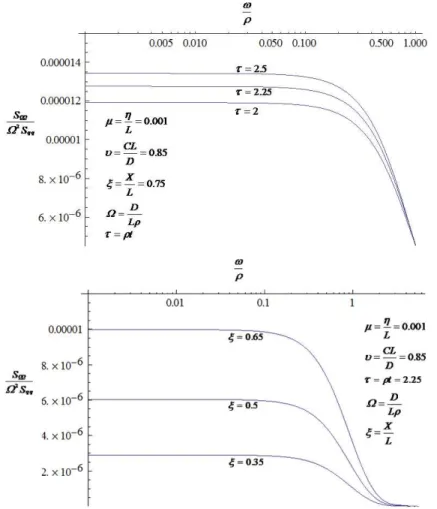
Equation (19) states that the spectrum of the discharge is a result of a competitive relation between the signal frequency and the properties of the stream channel and inflow. Generally, it is very difficult to quantify the variability of inflow rate. Equation (19)
thus provides information about the nature of inflow processes. For example, based on an observed discharge perturbation time series with known hydraulic parameters, the
15
nature of inflow processes may be determined from Eq. (19). After normalizing by the spectral densitySqq (–), the evolutionary power spectral density Eq. (19) as a function
of dimensionless frequency for various time scales and location are graphed in Fig. 1a and b, respectively. It shows that the spatial variation of spectral amplitude associated with a given frequency increases with the time and distance from the upstream
HESSD
12, 2477–2495, 2015Variability of flow discharge in lateral
inflow-dominated stream channels
C.-M. Chang and H.-D. Yeh
Title Page
Abstract Introduction
Conclusions References
Tables Figures
◭ ◮
◭ ◮
Back Close
Full Screen / Esc
Printer-friendly Version
Interactive Discussion
Discussion
P
a
per
|
Discussion
P
a
per
|
Discussion
P
a
per
|
Discussion
P
a
per
|
ary as well. It reveals that the variability of flow discharge increases with time and distance.
4 Closed-form expressionss for the variance and spectral density of discharge fluctuations
In this work, the spectrum of red noise is used to evaluate Eqs. (18) and (19) explicitly.
5
The analysis of discharge variability in this section assumes an exponential form for the autocovariance function of the random fluctuations in the peak inflow rate (Jin and Duffy, 1994; Kumar and Duffy, 2009), namely,
Cqq(ℓS)=σq2exp
−|ℓS|
λ
(20a)
which has the following spectral density function
10
Sqq(ω)=
σq2λ
π(1+λ2ω2) (20b)
where ℓS is the time lag and σ 2
q and λ are, respectively, the variance and temporal
correlation scale of peak inflow rate fluctuations.
Upon substituting Eq. (20b) into Eq. (18) and integrating it over the frequency do-main, one obtains the following expression for the variance of flow discharge
fluctua-15
tions as
σQ2(X,t)=16σ2 qL2
υ+1 µ
2
(π2+υ2)2
[π−2βexp(−β)]2
β2+π2
4
2 exp(υξ)sin
2π
2ξ
×τR
(
1+exp(−2τ)
1+τ R
−2exp(−τ) 1−τR2
exp(−τ)−τRexp
−τ
τR
)
HESSD
12, 2477–2495, 2015Variability of flow discharge in lateral
inflow-dominated stream channels
C.-M. Chang and H.-D. Yeh
Title Page
Abstract Introduction
Conclusions References
Tables Figures
◭ ◮
◭ ◮
Back Close
Full Screen / Esc
Printer-friendly Version
Interactive Discussion
Discussion
P
a
per
|
Discussion
P
a
per
|
Discussion
P
a
per
|
Discussion
P
a
per
|
whereτR=ρλ. It is apparent from Eq. (21) that there is a linear relationship between
the variances of fluctuations in the flow discharge and inflow rate, implying that the flow variability increases linearly with the heterogeneity of the inflow rate. With Eq. (20b), the resulting expression for the evolutionary power spectral density in Eq. (19) is given by
5
SQQ(X,t,ω)=σ
2
q
π D2 L2
υ+1
µ
2[π−2βexp(−β)]2
β2+π2
4
2 exp(υξ)sin
2π
2ξ
×1−2 exp(−τ) cos(ωt)+exp(−2τ)
ω2+ρ2
λ
1+λ2ω2. (22)
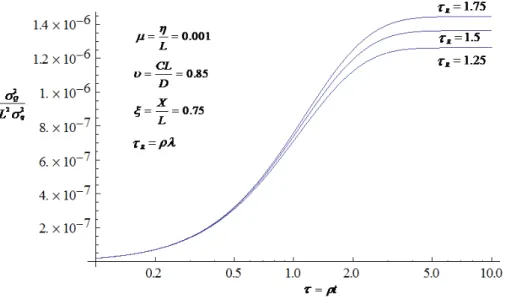
Figure 2 shows the plot of the dimensionless variance of discharge fluctuations in Eq. (21) as a function of dimensionless time for various dimensionless temporal corre-lation scales of inflow rate fluctuations. The figure indicates that the variability of flow
10
discharge induced by the variation of inflow rate increases gradually with time toward its asymptotic value at large time. The increase of discharge variability with the temporal correlation scale at a fixed time agrees with common physical intuition. A larger correla-tion scale means a larger temporal consistency of fluctuacorrela-tions in the inflow rate, which leads in turn to larger deviations of flow discharge from the initial uniform steady-state
15
flow discharge.
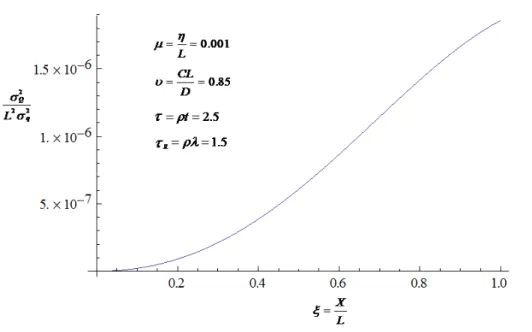
Variation of flow discharge with the distance from the upstream boundary is depicted in Fig. 3 according to Eq. (21). As noted in the figure, the variability of flow discharge grows monotonically with distance, implying that due to the naturally inherent variabil-ity of lateral inflow, uncertainty in the flow discharge calculations from a deterministic
20
model increases with the distance from the upstream boundary. In other words, the prediction of flow discharge distribution based on the deterministic simulation results is subject to the largest uncertainty in the downstream region. It is the downstream region that is important in most real applications of modeling and Eq. (21) provides a way of assessing the variation around the deterministic model prediction.
HESSD
12, 2477–2495, 2015Variability of flow discharge in lateral
inflow-dominated stream channels
C.-M. Chang and H.-D. Yeh
Title Page
Abstract Introduction
Conclusions References
Tables Figures
◭ ◮
◭ ◮
Back Close
Full Screen / Esc
Printer-friendly Version
Interactive Discussion
Discussion
P
a
per
|
Discussion
P
a
per
|
Discussion
P
a
per
|
Discussion
P
a
per
|
In many practical applications involving prediction over a large scale, it requires mea-surement of uncertainty. SD is the best way to accomplish that. In this sense, the pre-diction results from a deterministic model are treated as mean values. The mean value plus one SD (square root of Eq. 21) provides a rational basis for extrapolating relatively small-scale field observations to these large space scales. It is about 68.27% of the
5
time that value of flow discharge will lie within the range of the mean discharge±one SD.
5 Conclusions
The problem of fluctuations in flow discharge in open channels in response to temporal changes in lateral inflow rate is investigated stochastically for a finite flow domain. In
10
this study, the inflow perturbation field is modeled as a temporally stationary random process. For a complete stochastic description of flow discharge variability, expressions for the covariance function and evolutionary power spectral density of the random flow discharge perturbation process are developed. These expressions are obtained using a spectral representation theory. The variance relation developed here provides a
ra-15
tional basis for quantifying the uncertainty in applying the deterministic model.
It is found from our closed-form expressions that the discharge variability in stream channels induced by the temporal changes in lateral inflow rate increases gradually with time toward its asymptotic value at large time. A larger temporal correlation scale of inflow rate fluctuations which is of a more persistence of inflow perturbation process
20
will introduce more variability of the flow discharge. The increase of discharge variability with distance from the upstream boundary suggests that prediction of flow discharge distribution in channels using a deterministic model is subject to large uncertainty at the downstream of the stream channel.
Acknowledgements. This research work is supported by the Ministry of Science Technology 25
HESSD
12, 2477–2495, 2015Variability of flow discharge in lateral
inflow-dominated stream channels
C.-M. Chang and H.-D. Yeh
Title Page
Abstract Introduction
Conclusions References
Tables Figures
◭ ◮
◭ ◮
Back Close
Full Screen / Esc
Printer-friendly Version
Interactive Discussion
Discussion
P
a
per
|
Discussion
P
a
per
|
Discussion
P
a
per
|
Discussion
P
a
per
|
References
Capsoni, C., Fedi, F., Magistroni, C., Paraboni, A., and Pawlina, A.: Data and theory for a new model of the horizontal structure of rain cells for propagation applications, Radio Sci., 22, 395–404, 1987.
Daluz Viera, J. H.: Conditions governing the use of approximations for the Saint-Venant equa-5
tions for shallow water flow, J. Hydrol., 60, 43–58, 1983.
De Michele, C. and Bernardara, P.: Spectral analysis and modeling of space–time rainfall fields, Atmos. Res., 77, 124–136, 2005.
Dooge, J. C. I. and Harley, B. M.: Linear routing in uniform channels, in: Proc. Int. Hydrol. Symp., Fort Collins, 57–63, 1967.
10
Dooge, J. C. I. and Napiorkowski, J. J.: The effect of the downstream boundary condition in the
linearized St. Venant equations, Q. J. Mech. Appl. Math., 40, 245–256, 1987.
Féral, L., Sauvageot, H., Castanet, L., and Lemorton, J.: A new hybrid model of the rain hori-zontal distribution for propagation studies: 1. Modeling of the rain cell, Radio Sci., 38, 1056, doi:10.1029/2002RS002802, 2003.
15
Fournier, B., Guenat, C., Bullinger-Weber, G., and Mitchell, E. A. D.: Spatio-temporal hetero-geneity of riparian soil morphology in a restored floodplain, Hydrol. Earth Syst. Sci., 17, 4031–4042, doi:10.5194/hess-17-4031-2013, 2013.
Gelhar, L. W.: Stochastic Subsurface Hydrology, Prentice Hall, Englewood Cliffs, New Jersey,
1993. 20
Goodrich, D. C., Lane, L. J., Shillito, R. M., Miller, S. N., Syed, K. H., and Woolhiser, D. A.: Linearity of basin response as a function of scale in a semiarid watershed, Water Resour. Res., 33, 2951–2965, 1997.
Govindaraju, R. S.: Modeling overland flow contamination by chemicals mixed in shallow soil horizons under variable source area hydrology, Water Resour. Res., 32, 753–758, 1996. 25
Henderson, F. M.: Flood waves in prismatic channels, J. Hydr. Eng. Div.-ASCE, 89, 39–67, 1963.
Jencso, K. G., McGlynn, B. L., Gooseff, M. N., Wondzell, S. M., Bencala, K. E., and
Mar-shall, L. A.: Hydrologic connectivity between landscapes and streams: transferring reach-and plot-scale understreach-anding to the catchment scale, Water Resour. Res., 45, W04428, 30
HESSD
12, 2477–2495, 2015Variability of flow discharge in lateral
inflow-dominated stream channels
C.-M. Chang and H.-D. Yeh
Title Page
Abstract Introduction
Conclusions References
Tables Figures
◭ ◮
◭ ◮
Back Close
Full Screen / Esc
Printer-friendly Version
Interactive Discussion
Discussion
P
a
per
|
Discussion
P
a
per
|
Discussion
P
a
per
|
Discussion
P
a
per
|
Jin, M. and Duffy, C. J.: Spectral and bispectral analysis for single and multiple input nonlinear
phreatic aquifer systems, Water Resour. Res., 30, 2073–2095, 1994.
Kazezyılmaz-Alhan, C. M.: An improved solution for diffusion waves to overland flow, Appl.
Math. Model., 36, 4165–4172, 2012.
Kumar, M. and Duffy, C. J.: Detecting hydroclimatic change using spatio-temporal analysis of
5
time series in Colorado River Basin, J. Hydrol., 374, 1–15, 2009.
Lane, L. J.: Distributed model for small semiaridw atersheds, J. Hydr. Eng. Div.-ASCE, 108, 1114–1131, 1982.
Li, S.-G. and McLaughlin, D.: A nonstationary spectral method for solving stochastic groundwa-ter problems: unconditional analysis, Wagroundwa-ter Resour. Res., 27, 1589–1605, 1991.
10
Morris, E. M.: The effect of small slope approximation and lower boundary conditions on
solu-tion of Saint Venant equasolu-tions, J. Hydrol., 40, 31–47, 1979.
Moussa, R.: Analytical Hayami solution for the diffusive wave flood routing problem with lateral
inflow, Hydrol. Process., 10, 1209–1227, 1996.
Ogden, F. L. and Julien, P. Y.: Runoff sensitivity to temporal and spatial rainfall variability at
15
runoffplane and small basin scales, Water Resour. Res., 29, 2589–2597, 1993.
Ponce, V. M.: Generalized diffusion wave equation with inertial effects, Water Resour. Res., 26,
1099–1101, 1990.
Priestley, M. B.: Evolutionary spectra and non-stationary processes, J. Roy. Stat. Soc. B, 27, 204–237, 1965.
20
Redano, A. and Lorente, J.: Modelling the spatial and temporal distribution of rainfall intensity at local scale, Theor. Appl. Climatol., 47, 25–32, 1993.
Riley, W. J. and Shen, C.: Characterizing coarse-resolution watershed soil moisture heterogeneity using fine-scale simulations, Hydrol. Earth Syst. Sci., 18, 2463–2483, doi:10.5194/hess-18-2463-2014, 2014.
25
Schumann, G., Lunt, D. J., Valdes, P. J., de Jeu, R. A. M., Scipal, K., and Bates, P. D.: Assess-ment of soil moisture fields from imperfect climate models with uncertain satellite observa-tions, Hydrol. Earth Syst. Sci., 13, 1545–1553, doi:10.5194/hess-13-1545-2009, 2009. Sivapalan, M., Bates, B. C., and Larsen, J. E.: A generalized, non-linear, diffusion wave
equa-tion: theoretical development and application, J. Hydrol., 192, 1–16, 1997. 30
HESSD
12, 2477–2495, 2015Variability of flow discharge in lateral
inflow-dominated stream channels
C.-M. Chang and H.-D. Yeh
Title Page
Abstract Introduction
Conclusions References
Tables Figures
◭ ◮
◭ ◮
Back Close
Full Screen / Esc
Printer-friendly Version
Interactive Discussion
Discussion
P
a
per
|
Discussion
P
a
per
|
Discussion
P
a
per
|
Discussion
P
a
per
|
Wheater, H. S., Isham, V. S., Cox, D. R., Chandler, R. E., Kakou, A., Northrop, P. J., Oh, L., Onof, C., and Rodriguez-Iturbe, I.: Spatial-temporal rainfall fields: modelling and statistical aspects, Hydrol. Earth Syst. Sci., 4, 581–601, doi:10.5194/hess-4-581-2000, 2000.
Yen, B. C. and Tsai, C. W.-S.: On noninertia wave versus diffusion wave in flood routing, J.
Hydrol., 244, 97–104, 2001. 5
HESSD
12, 2477–2495, 2015Variability of flow discharge in lateral
inflow-dominated stream channels
C.-M. Chang and H.-D. Yeh
Title Page
Abstract Introduction
Conclusions References
Tables Figures
◭ ◮
◭ ◮
Back Close
Full Screen / Esc
Printer-friendly Version
Interactive Discussion
Discussion
P
a
per
|
Discussion
P
a
per
|
Discussion
P
a
per
|
Discussion
P
a
per
|
HESSD
12, 2477–2495, 2015Variability of flow discharge in lateral
inflow-dominated stream channels
C.-M. Chang and H.-D. Yeh
Title Page
Abstract Introduction
Conclusions References
Tables Figures
◭ ◮
◭ ◮
Back Close
Full Screen / Esc
Printer-friendly Version
Interactive Discussion
Discussion
P
a
per
|
Discussion
P
a
per
|
Discussion
P
a
per
|
Discussion
P
a
per
|
HESSD
12, 2477–2495, 2015Variability of flow discharge in lateral
inflow-dominated stream channels
C.-M. Chang and H.-D. Yeh
Title Page
Abstract Introduction
Conclusions References
Tables Figures
◭ ◮
◭ ◮
Back Close
Full Screen / Esc
Printer-friendly Version
Interactive Discussion
Discussion
P
a
per
|
Discussion
P
a
per
|
Discussion
P
a
per
|
Discussion
P
a
per
|