*Correspondence: I. Martins. Laboratório de Análises de Toxicantes e Fárma-cos, Faculdade de Ciências Farmacêuticas, Universidade Federal de Alfenas. Rua Gabriel Monteiro da Silva, 700, 37130.000 - Alfenas - MG, Brasil. Telefone: 55-35-3299-1342. Fax: 55-35-3299-1067. E-mail: [email protected]; [email protected]
A
vol. 49, n. 1, jan./mar., 2013
QuEChERS-HPLC-DAD method for sulphonamides in chicken breast
Simone Caetani Machado
1, Mariane Landin-Silva
1, Patrícia Penido Maia
1,
Susanne Rath
2, Isarita Martins
1,*1Laboratório de Análises de Toxicantes e Fármacos, Faculdade de Ciências Farmacêuticas, Universidade Federal de Alfenas ,2Instituto de Química, Departamento de Química Analítica, Universidade de Campinas
The development of a QuEChERS-HPLC-DAD method using a Lichrospher 60 RP-Select B column (250 x 4.6 mm x 5 µm) at 40°C, mobile phase constituted by phosphate buffer:acetonitrile (75:25, v/v) at a initial low rate of 0.5 mL min-1, increased by 1.2 mL min-1 and at 265 nm is presented for simultaneous determination of sulphadiazine, sulphametoxipiridazine and sulphamethoxazole in chicken breast samples. QuEchERS is inexpensive, fast and easy, and the extraction of the analytes of the matrix was successfully employed. In addition, the method presented linearity, in the range of 25, 50, 100, 150, 175, and 200 µg kg-1, precision, selectivity and sensitivity. The intraday precision (RSD %) for QuEChERS
method was between 3.6-10.8 (SDZ), 6.9-14.1 (SPZ) and 1.9-10.9 (SMX) and interday precision (RSD%) was between 1.5-9.7, 1.7-4.1 and 2.1-10.2, respectively. Results of accuracy (bias) were in the range of –8.6 to +11.9 %. Therefore, the validated method is clearly useful for the practical residue monitoring of the drugs evaluated in chicken samples, as all the values were within the acceptable criteria used for food safety. Of 6 samples analyzed, none of them showed contamination of the sulphonamides studied at detectable levels.
Uniterms: QuEChERS. Sulphonamides determination. Veterinary drugs residues. Chicken breast. HPLC-DAD
O desenvolvimento de um método QuEChERS-HPLC-DAD usando uma coluna Lichrospher RP-60 Select B (250 x 4,6 mm x 5 µm) a 40 °C, fase móvel constituída por tampão de fosfato: acetonitrila (75:25, v/v) a uma vazão inicial de 0,5 mL min-1, aumentando 1,2 mL min-1 e a 265 nm é apresentado para a determinação simultânea de sulfadiazina, sulfametoxipiridazina e sulfametoxazol em amostras de peito de frango. O QuEChERS é barato, rápido e fácil, e a extração dos analitos da matriz foi empregada com sucesso. Além disso, o método apresentou linearidade, na faixa de 25, 50, 100, 150, 175 e 200 µg kg-1, precisão, seletividade e sensibilidade. A precisão intradia (RSD %) para o método QuEChERS foi entre 3,6-10,8 (SDZ), 6,9-14,1 (SPZ) e 1,9-10,9 (SMX) e a precisão interdias (RSD%) foi entre 1,5-9,7, 1,7-4,1 e 2,1-10,1, respectivamente. Resultados de exatidão (tendenciosidade) foram na faixa de –8,6 a +11,9%. Portanto, o método validado é útil para a monitorização de resíduos de medicamentos avaliados em amostras de frangos, bem como todos os valores estavam dentro dos critérios aceitáveis utilizados para a segurança dos alimentos. De seis amostras analisadas, nenhuma apresentou contaminação de sulfonamidas nos níveis detectáveis estudados.
INTRODUCTION
Sulphonamides (SAs) are antimicrobial agents most commonly used in veterinary practice to treat diseases, to control and prevent infection and to promote growth and production eficiency; they are inexpensive and offer a wide spectrum of antimicrobial activity (Biswas et al., 2007; Mamani, Reyes, Rath, 2009). The inappropriate or excessive use of these drugs can result in the presence of drug residue in animal tissue, which contributes to the generation of long-term health effects, including microbial antibiotic resistance, and can cause potential adverse side effects in hypersensitive individuals (Chiaochan et al., 2010). Thus, many efforts, such as monitoring veterinary drug residues to ensure the safety of food, have been made to protect consumers’ health.
To limit human exposure, the European Union (EU) has set maximum residue limits (MRLs) for different food contaminants in a certain number of raw foods on the basis of toxicological data, acceptable daily intake values and the performance of current analytical technology. Within the EU, one of the main documents stating the MRLs of autho-rized veterinary drugs in food of animal origin is Council Regulation 2377/90/EC, which was repealed by Commis -sion Regulation 470/2009 of the European Parliament and the Council (European Commission, 2009a). The pharma-cologically active substances that have an MRL (permitted) are contained in Regulation 37/2010 of the Council, which provides an MRL of 100 µg kg-1 for SAs in foods of animal
origin, stating that the combined total residues of all sub-stances within the sulfonamide group should not exceed this MRL value (European Commission, 2009b). In Brazil, these limits are established in the Normative Instruction 14, dated May 25, 2009, from the Ministério da Agricultura, Pecuária e Abastecimento (MAPA, 2009).
Therefore, it is necessary to develop sensitive and easy analytical methods that can be used routinely, comply with current legislation and allow for the determination of residues of veterinary drugs in food of animal origin, thus ensuring the safety of the supplied products.
In 2002, the European Union (EU) issued a speciic regulation decision (2002/657/EC) concerning the perfor-mance of methods and the interpretation of results in the oficial control of residues in products of animal origin. It was mandatory that some new parameters must be cal -culated, such as the limit of decision (CCα) and detection capability (CCβ) (European Commission, 2002).
For detecting antimicrobial residues in food, bio-assay techniques are widely used in screening methods because of their simplicity and low cost (Knecht et al., 2004; Lamar, Petz, 2007). However, before samples are
condemned for containing levels of antimicrobials exceed-ing the stipulated levels, it is well recognized that these methods must be supported by suficiently selective and sensitive chemical methods (Bogialli, Di Corsia, 2009). The low selectivity at the detection step created a need for highly selective sample preparation that often included lengthy extractions and clean-up procedures.
Animal tissues are known to be rich in protein com -ponents (US Department of Agriculture, 2009), which can bind to antibiotics, especially polar compounds. Therefore, an appropriate sample treatment is essential for obtaining reliable results in antibiotic analyses. Organic solvents, such as acetonitrile, methanol, and ethanol, are commonly employed in the precipitation of proteins in biological matrices. Acetonitrile typically provides high extraction eficiency and often minimizes co-extraction of lipids from animal tissues (Chiaochan et al., 2010).
Several extraction methods have been used for SA-residue analysis; however, most are long and tedious, involving liquid-liquid extraction (LLE) (Haller et al., 2002; Chico et al., 2008), or solid-phase extraction (SPE)
(Pecorelli et al., 2004; Koesukwiwat, Jayanta, Leepipat -piboon, 2007; Bedor et al., 2008), which also include an
additional step to precipitate the proteins. In many instances, LLE and SPE were used in combination; for example, after deproteinization/analyte extraction by means of a suitable organic solvent and solvent removal, the extracts were subsequently puriied using suitable SPE procedures (Biswas et al., 2007; Soto-Chinchilla, García-Campaña, Gamiz-Gracia, 2007; Gamba et al., 2009). Procedures based on matrix solid-phase dispersion have been proposed to simplify the extraction step (Kishida, Furusawa, 2001; Bogialli et al., 2003; Posyniak, Zmudzki, Mitrowska, 2005).
Solid-phase microextraction (SPME) has been used for the determination of SAs in meat (Lu, Chen, Lee, 2007).
followed by a dispersive-SPE clean-up, which requires the addition of small amounts of bulk SPE packing sorbents to the extracts (Anastassiades et al., 2003).
Separation techniques, such as high-performance liquid chromatography (LC) (Tsai et al., 2010) and capil-lary electrophoresis (Kowalski et al., 2011; Chu et al., 2009), have been widely used to analyze SAs in food samples. These techniques require elaborate sample preparation procedures before quantitation to eliminate interferences from the food matrix and to concentrate the analyte. The extent of the sample preparation depends on the detection device of the chromatographic system in which the detection systems commonly used can be more or less selective and sensitive. LC has been the most frequently used instrumental technique coupled with UV, photodiode array detection (Christodoulou, Samanidou, Papadoyannis, 2007; García-Mayor et al., 2006), luori -metric detection (Costi, Sicilia, Rubio, 2010) and mass spectrometry (Sheridan et al., 2008).
The aim of the work was to develop and validate a method for the determination of three SAs (sulphadiazine, sulphamethoxypyridazine and sulphamethoxazole) in chicken breast. The method involves an easy extraction technique based on the QuEChERS procedure and analyti-cal determination by a HPLC-DAD method, which could be applied to quality control in routine analysis.
MATERIAL AND METHODS
Chemicals and reagents
Analytical standards of sulphadiazine (SDZ), sul -phamethoxypyridazine (SPZ) and sulphamethoxazole (SMX) were obtained from Sigma-Aldrich (St. Louis, MO, USA). Acetonitrile and methanol (HPLC-grade), anhydrous magnesium sulphate, sodium acetate, analyt-ical-grade disodium hydrogenphosphate and potassium dihydrogenphosphate were purchased from Vetec (Rio de Janeiro, RJ, BR), whereas phosphoric acid, acetic acid and the 25% ammonia solution (NH4OH) were purchased from Merck-Schuchard (Munich, Germany). The primary secondary amine (PSA)-bonded silica was supplied by Varian (Walnut Creek, CA, USA). Ultrapure water was obtained from a Milli-Q gradient water system (Millipore, Bedford, MA, USA). OASIS HLB (N-vinylpyrrolidone/ divinylbenzene copolymer) 200 mg/5 cm3 cartridges
(Waters, Milford, MA, USA) were used for clean-up during the development of the extraction procedure.
Stock standard solutions of individual compounds (with concentrations of 1 g L-1) were prepared by the exact
weighing of the powder and dissolved in 10 mL of metha
-nol for SMX and SPZ; for SDZ, the powder was dissolved in 10 mL of sodium hydroxide solution (0.025 mol L-1).
Both solutions were then stored at -20 °C in the dark. A multicompound-working standard solution at a concentra -tion of 20 µg mL-1 of each compound was prepared by the
appropriate dilutions of the stock solutions with methanol and stored in amber glass lasks closed at -20 °C in the dark. This solution was stable for 4 weeks, after which it was replaced with a fresh solution. A buffer solution was prepared by dissolving 3.48 g of potassium dihydrogen -phosphate and 1.38 g of disodium hydrogen-phosphate in 500 mL of ultrapure water and diluting it to 1000 mL. The pH of the phosphate buffer was adjusted to 3.5 by adding 10% phosphoric acid.
Apparatus and software
Chromatographic analyses were performed using a Shimadzu system consisting of a Model LC-10ATvp pump, a Model SIL-10AF auto injector, a Model CTO-10ASvp column oven, and a Model SPD-M10Avp PDA detector. The data were analyzed with ClassVP software, taking into account the peak area of the analytes. The sepa-ration was carried out on a reverse phase octyldecylsilane C18 stainless steel column Lichrospher 60 RP, Select B, 250 mm x 4 mm, 5 µm particle size (Merck, Darmstadt, Germany), preceded by a precolumn cartridge of the same material. The chromatographic separation was car -ried out with a mobile phase consisting of a mixture of acetonitrile:phosphate buffer (25:75, v/v), which was il -tered through a 0.45-µm nylon ilter with the assistance of a Millipore® support for iltration and degassed using an ultrasonic bath (Unique, Ultracleaner) before analysis. The mobile phase was monitored at a wavelength of 265 nm with a low rate of 0.5 mL min-1 for 11 min, increasing by
1.2 mL min-1 for 17 min, followed by a re-equilibration
time of 3 min at a low rate of 0.5 mL min-1, for a total run
time of 20 min at a column oven temperature of 40 °C. In the irst step of sample preparation of the modi -ied QuEChERS method, a high-volume centrifuge was used, while in the second step and in solid-phase extraction method, a Sigma 2-3 centrifuge was used. A Certomat (B. Braun Biotech International) vortex mixer, a pH meter, a combined glass electrode (Nova Técnica, São Paulo, Brazil), a Britania mixer and a Kern 410 analytical balance were also used.
Sample preparation
they were then deep-frozen until the analysis. For the construction of the analytical curves, samples of chicken breast purchased from local supermarkets were tested to verify the possible existence of the analyzed medications. The blank samples were fortiied with the multicompound working standard solution.
Modified QuEChERS method
For the modified QuEChERS method, 10 g of crushed tissue sample was taken into a 100-mL fortiied glass centrifuge tube, and 15 mL of acetonitrile with 1% acetic acid was added; the mixture was vortexed for 1 min. Afterward, 6 g of anhydrous magnesium sulphate and 1.5 g of sodium acetate were added, and the tubes were vortexed immediately for 1 min, followed by centrifugation at 3500 rpm for 10 min. A volume of 7 mL of the supernatant was taken and placed in a glass tube containing 175 mg of PSA and 1 g of anhydrous magnesium sulphate. The mixture was shaken manually for 30 s, and the tube was centrifuged for 15 min at 3500 rpm. Following centrifugation, a 5-mL aliquot was transferred to another tube to be evaporated to dryness under a stream of nitrogen at 40°C. The residual was reconstituted in 1 mL of the mobile phase and cen -trifuged at 3500 rpm for 10 min, and 100 µL was injected into the LC system.
Solid-phase extraction (SPE)
The modified procedure was based on two pro -cedures previously employed for the determination of trimethoprim and sulphonamide residues in buffalo meat (Biswas et al., 2007) and the determination of veterinary drugs in honey (Martínez-Vidal et al., 2009). For extrac-tion, 50 g of crushed chicken breast was taken into a 200 mL beaker, and 50 mL of ultrapure water was added. The mixture was homogenized for 2 min using a mixer. After that, 2 g of homogenate was accurately weighed in a glass tube of 15 mL by dispensing the homogenate with the help of a micropipette of 1000-5000 µL capac -ity. Then, 4 mL of acetonitrile was added to the sample, and the tube was held for 10 min at room temperature, vortexed at high speed for 10 min, and inally centrifuged at 3500 rpm for 15 min. A volume of 4 mL of supernatant was transferred to another tube to be evaporated to dry -ness under a stream of nitrogen at 40°C. The residual was reconstituted in 1 mL of a solution of water pH 9.0: ace -tonitrile (75:25, v/v). It was prepared daily, adjusting the pH of the water with a sodium hydroxide solution of 0.1 mol L-1, and then loaded into an OASIS HLB (200 mg)
cartridge previously conditioned with 1 mL of methanol
and 1 mL of ultrapure water. The cartridges were washed with 1 mL of ultrapure water and vacuum-dried for 2 min. The elution of analytes was carried out by adding sequentially 1 mL of methanol, 1 mL of acetonitrile and 1 mL of 0.12% (v/v) of 25% of ammonia solution in methanol. The collected eluent was evaporate under a stream of nitrogen, redissolved in 0.5 mL of the mobile phase and centrifuged at 3500 rpm for 10 min; inally, 100 µL was injected into the LC system.
Method validation
For the QuEChERS method, the validation was carried out according to internationally accepted criteria (European Commission, 2002), i.e., linearity, selectivity, limit of quantiication (LOQ), limit of detection (LOD), decision limit (CCα), detection capability (CCβ), preci-sion, recovery and accuracy. For the SPE method, the validation was carried out also according to internationally accepted criteria (European Commission, 2002), i.e., lin-earity, selectivity, accuracy and precision, recovery, limit of quantiication (LOQ), and limit of detection (LOD). Stability and ruggedness were also evaluated.
The linearity, linear range and sensitivity were established through the analytical curve obtained by six replicates of analysis for the three analytes, using six con-centration levels (30, 50, 100, 150, 175, and 200 µg kg-1 for
SDZ and 25, 50, 100, 150, 175, and 200 µg kg-1 for SMX
and SPZ) in the chicken breast matrix. Analytical curves were constructed by plotting the peak area against the concentration of each drug; they were evaluated by least squares regression analysis. The sensitivity is the slope of the calibration graph. The interference of endogenous compounds was assessed by analyzing drug-free samples and chicken breast spiked with SDZ, SPZ and SMX.
The limit of detection (LOD) and limit of quantita-tion (LOQ) were determined at the signal-to-noise ratios of 3 and 10, respectively, measured at the approximate retention time of the corresponding analyte peak.
The critical concentrations for MRL compliance (CCα, where α = 0.05) were calculated from the MRL value plus 1.64 times the standard deviation of the fortiied samples at the MRL. The CCβ was obtained by adding CCα 1.64 times the same standard deviation.
Inter- and intra-day variability of the method was determined by analyzing six replicates of three samples of low, medium and high concentrations (30, 100 and 200 µg kg-1 for SDZ and 25, 100 and 200 µg kg-1 for SMX
-lysts. The results were expressed as the relative standard deviation (RSD, %) of peak area measurements.
For the recovery and accuracy tests, SDZ, SPZ and SMX from chicken samples were measured at three levels (30, 100 and 200 µg kg-1 for SDZ and 25, 100 and
200 µg kg-1 for SMX and SPZ) prepared in six replicates.
The eficiency of the extraction was calculated by com -paring the peak areas of the analytes to those obtained by the analysis of spiked extracts of chicken blank samples, prepared as described above at the same concentration. For accuracy, after extraction and chromatographic analysis, the results were compared to the theoretically added values, and the results were expressed as the relative error (%).
The SA stability was determined in the solvent (working standard solution at 20 µg mL-1) and in the matrix
spiked at 100 µg kg-1. The stability of the stock standard
solutions in methanol was analyzed for one month, and the instrumental responses were compared to the peak areas obtained at the moment of solution preparation. The chemical stability of the analytes in chicken samples was tested in the following conditions: sitting at room temperature for 8 h (bench-top stability), stored at -20 °C and exposed to three freeze–thaw cycles. The extracts were tested for 24 h (auto-sampler stability). For comparison, all the stability determinations were assessed by preparing a set of freshly made samples. The analytes were considered stable if the variation of the concentrations between the assays were less than 15% of initial time response.
The method ruggedness was estimated for minor changes by means of the Youden robustness test. Three different factors, such as mobile phase pH (3.3 and 3.5), organic solvent in mobile phase (25 and 30%) and column temperature (35 and 40 °C) were chosen for the entire analytical chromatographic conditions because of their possible critical inluence.
RESULTS AND DISCUSSION
To ensure food safety, it is necessary to develop se-lective, sensitive, easy and inexpensive analytical methods that comply with current legislation, allow the routine,
simultaneous determination of several compounds of veterinary drugs and provide accurate quantitative data. In this study, a QuEchERS technique for the determination of SAs in chicken breast samples has been developed and compared with a traditional SPE technique, using a N -vinylpyrrolidone/divinylbenzene copolymer as a sorbent.
Chromatographic optimized conditions
We chose to use a low ramp to provide an effective separation of the analytes with a lower consumption of organic solvents, instead of using an increase of these sol-vents in the mobile phase. According to the UV spectrum, 265-270 nm was the absorbance maximum of the analyzed SAs. The use of the buffer with pH 3.5 in the mobile phase maintained the eficiency of the separation of the com -pounds (pKa1 between 1.4 and 2.2 values and pKa2 between
5.8 and 7.2 values), allowing greater interaction with the stationary phase by van der Waals forces. No interference was observed in the analytes’ retention time, which was established as 10.1 minutes for SDZ, 12.7 minutes for SPZ and 16.5 minutes for SMX.
In order to verify the system suitability the theoreti-cal plates (N) were theoreti-calculated for the chromatographic col -umn to evaluate the number of separate layers, the tailing factor (T) was a measure of the peak tailing, the resolution (Rs) described how well the species were separated, and the retention factor (k)was used to describe the migration rate of analytes on a column. The system was suitable, as the results of the test were considered satisfactory (US FDA 1994), according to Table I.
The European Commission Decision 2002/657/EC (European Commission, 2002) mentions that the absorp-tion maxima in the spectrum of the analyte shall be at the same wavelengths as those of the calibration standard within a margin determined by the resolution of the de -tection system. For diode array de-tection, this is typically within ± 2 nm. In our study, no differences were observed between the wavelength of maximum absorption of the extract and the calibration standards for the SMX (268 nm) and SPZ (264 nm), while for the SDZ the wavelength
TABLE I - System suitability parameters to developed method to simultaneous analysis of sulphonamides in chicken breast samples
Analytea Retention time Number of plates (N) Resolutionb (Rs) Tailing factor (TF) Retention factor (k)
SDZ 10.1 6248 - 1.04 9.12
SPZ 12.7 31744 3.22 1.00 11.68
SMX 16.5 38966 6.22 0.89 15.54
a Sulphadiazine (SDZ) sulphamethoxypyridazine (SPZ) and sulphamethoxazole (SMX); b Resolution was calculated between:
of maximum absorption for the extract was 266 nm and for the standard was 268 nm. Moreover, in the observed points, the difference between the two spectra should not exceed 10% of the absorbance of the calibration standard. The similarity indexes were 0.9708 (SMX), 0.9706 (SPZ) and 0.9697 (SDZ), obtained when compared samples extracted by the method QuEChERS with the calibration standards at a concentration of 100 µg kg-1.
Regarding robustness, the application of the Youden test consisted of the introduction of minor simultaneous changes in possible critical factors, which were chosen in the developed method according to an established ex-perimental design with the aim of identifying the critical factors that should be controlled to obtain accurate assay results. The standard deviation of the differences between two levels of each factor was then calculated, and the re -sults obtained demonstrated that only the variation in the % of organic solvent in the mobile phase affected the results.
Development of QuEChERS method
Traditional sample preparation for SAs in animal tissues involves isolation with an organic solvent (e.g., methanol, acetonitrile, ethyl acetate), followed by SPE with polar, non-polar or ion-exchange sorbent materials (Posyniak, Zmudzki, Mitrowska, 2005). Sergi et al. (2007) presented for sulphonamides (SAs) in animal tissues (raw meat and meat-based baby food), based on matrix solid phase dispersion (MSPD). The authors discussed that in complex matrices extraction is usually the critical step of analysis: several procedures were employed for the recovery of SAs in animal tissues, but often they entail
time and solvent-consuming processes. MSPD has dem-onstrated itself to be a very eficient extraction technique for matrices such as animal tissues, with simpliied and shortened procedures, and very low solvent consumption. The procedure allowed to obtain quantitative recovery, high selectivity improved by a cool eluant, and easy ap-plication. Good recoveries are accompanied by low RSDs and not a signiicative matrix effect. Frenich et al. (2010) published a comparison of several techniques for veteri-nary drugs in eggs. QuEChERS procedure was simpler and faster, but extracted fewer compounds than solvent extrac -tion. Pulido et al. (2011) evaluated the several techniques to determinate sulphas residues in shrimps. Different methods of extraction and cleaning were tested based on a partitioning of the analytes. Of the tested procedures, the QuEChERS showed better results in terms of recovery and lower interference from matrix constituents.
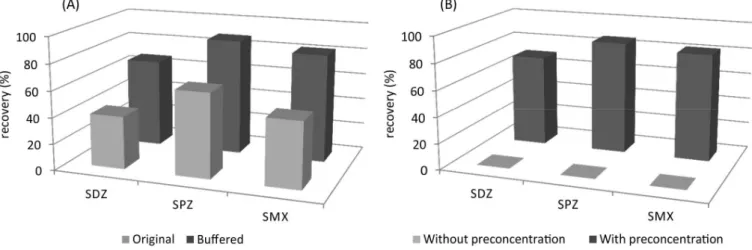
In Figure 1, the original (unbuffered) (Anastassia-des et al., 2003) and the buffered (Lehotay, Mastovska, Lightield, 2005) QuEchERS methodologies applied in the present study can be compared. The buffered meth-odology with acetonitrile could be highly suitable for the extraction of SAs evaluated from chicken breast, as this solvent can precipitate proteins. After the addition of mag-nesium sulfate and buffering salts (pH 5-5.5), the mixture is shaken intensively and centrifuged for phase separation. An aliquot of the organic phase is cleaned up by dispersive SPE employing bulk sorbent (PSA) and MgSO4 for the removal of residual water. The inal extract can be directly employed for HPLC analysis. In the present study, the dryness step was evaluated, and it provides an increment of the recovery of the analytes (Figure 1).
FIGURE 1 - (A) Comparison of the original and buffered QuEChERS method in the recovery of sulphonamides. (B) Effect of
preconcentration step in the QuEChERS method. Sulphadiazine (SDZ), sulphamethoxypyridazine (SPZ) and sulphamethoxazole
In view of these results, the step was included in the methodology, and the results of this parameter are presented in Tables II and III.
The method was linear in the range evaluated for SAs in chicken breast samples (Table II). The linear range established is satisfactory; it is able to quantify the residue values (100 µg kg-1) in accordance with the European
Community and the Brazilian Agricultural Ministry (Eu-ropean Commission, 2002; MAPA, 2009). In addition, the deviation of the individual points from the calibration curves was always lower than 20%.
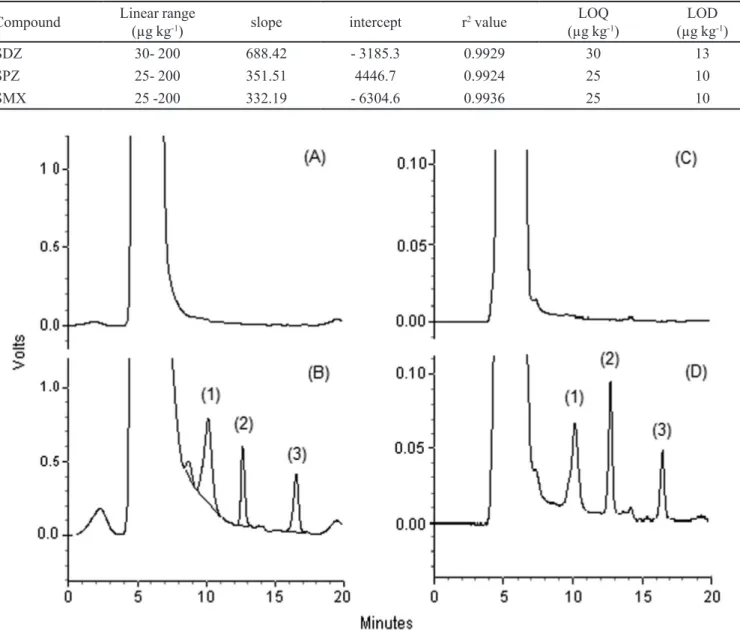
The matrix effect was also evaluated. Because the presence of matrix components can affect the analysis and the selectivity, the inluence must be studied. For this purpose, the concentrations were analyzed in pure solvent and in extracted blank chicken samples, and the slopes of the calibration curves were compared based on a t-test that revealed they were not statistically different (p-value higher than 5%). The selectivity was evaluated by the blank-sample analysis, and the chromatograms are shown in Figure 2.
The analytical method is apt and sensitive enough to carry out residue analysis for the SAs studied, as the LOD
TABLE II - Linear regression data for sulphadiazine (SDZ), sulfametoxypyridazine (SPZ) and sulphamethoxazole (SMX) limits
of detection (LOD) and quantiication (LOQ), in chicken breast samples analysed by QuEChERS-HPLC-DAD proposed method
Compound Linear range
(µg kg-1) slope intercept r
2 value LOQ
(µg kg-1)
LOD (µg kg-1)
SDZ 30- 200 688.42 - 3185.3 0.9929 30 13
SPZ 25- 200 351.51 4446.7 0.9924 25 10
SMX 25 -200 332.19 - 6304.6 0.9936 25 10
FIGURE 2 - Chromatograms of QuEChERS method: (A) blank chicken sample; (B) blank chicken sample fortiied at 100 µg kg-1.
Chromatograms of SPE method (C) blank chicken sample and (D) blank chicken sample fortiied at 100 µg kg-1. All analysis was
and LOQ values are ten and three times, respectively, low -er than the MRLs (European Commission, 2002; MAPA, 2009). Furthermore, if were added the LODs of the three analytes, the mean value is still below the MRLs, which enables the method to the analysis of the three analytes, even if they are found in the same sample, whereas the MRL for sulphonamides refers to the sum of residues of drugs of this group.
Tests of inter- and intra-assay precision produced relative standard deviations (RSD) acceptable (Table III) according to the European Community (European Com-mission, 2002), which recommends values below 15%, except for the LQ, which must be less than or equal to 20%. Accuracy can also be veriied in Table III. To evaluate the validity of the proposed method, the test was carried out at three levels, and the results can be considered satisfactory. According to the concept of the European Commission Decision 2002/657/EC (European Commission, 2002), the CCα (decision limit) and CCβ (detection capability) have been estimated in this case for permitted veterinary drug substances. The values are presented in Table III. With an MRL set at 100 µg kg-1, CCα and CCβ were always lower
than 115 µg kg-1.
Comparison of the proposed QuEChERS method and the SPE
To compare the results obtained with the QuECh -ERS method, the SPE method was optimized in the laboratory. The modified procedure was based on two procedures previously employed for the determination of SAs in buffalo meat (Biswas et al., 2007) and in honey (Martínez-Vidal et al., 2009). Several solvents were tested
for the conditioning, washing and elution steps. For an acceptable recovery, the sorbent was previously condi -tioned with methanol and ultrapure water and washed with ultrapure water. The analytes were then eluted by adding sequentially methanol, acetonitrile and 0.12% (v/v) of 25% of ammonia solution in methanol.
The linearity is demonstrated in Table IV, and the SPE procedure was sensitive enough to carry out the resi -due analysis for the SAs studied, as the LOD and LOQ values were lower than the MRLs (European Commission, 2002; MAPA, 2009).
Tests of repeatability, recovery and accuracy of the produced results, employing the SPE methodology, are acceptable according to the European Community
(Euro-TABLE III - Intraday and interday precision, accuracy, recovery, decision limit (CCα) and detection capability (CCβ) for sulphadiazine
(SDZ), sulfametoxypyridazine (SPZ) and sulphamethoxazole (SMX) in chicken breast samples analysed by
QuEChERS-HPLC-DAD proposed method
Parameter SDZ SPZ SMX
Intraday precision (RSD, %)
30 µg kg-1 3.56 9.03 10.90
100 µg kg-1 10.84 6.97 8.57
200 µg kg-1 8.56 14.09 1.90
Interday precision (RSD, %)
30 µg kg-1 9.65 2.50 10.19
100 µg kg-1 6.48 1.68 2.44
200 µg kg-1 1.53 4.07 2.07
Accuracy (bias, %) a (relative error, %)
30 µg kg-1 -8.57 (9.12) +11.48 (2.95) +11.87 (8.03)
100 µg kg-1 +2.08 (6.40) +6.24 (1.74) -5.59 (2.23)
200 µg kg-1 +7.86 (1.52) -4.55 (4.17) +9.46 (2.01)
Recovery (%)
30 µg kg-1 74.5 95.8 88.5
100 µg kg-1 94.2 87.5 75.2
200 µg kg-1 98.7 85.7 88.6
CCα (µg kg-1) 104.7 103.3 110.6
CCβ (µg kg-1) 108.4 105.7 114.8
pean Commission, 2002). Observing the Table V, for most of the compounds and concentrations assayed, recoveries are lower than 70 %. This is also another point to select QuEChERS procedure instead of SPE.
When the extraction methods were compared in terms of the initial amount of sample and inal concen -tration in the elution solvent, it can be noted that SPE provided a concentration approximately 60 times higher than the QuEChERS methodology, indicating that solid-phase extraction introduces low amounts of matrix in the chromatographic system and the effect of matrix can be minimized, with a better resolution between the SDZ peak and the interferents peaks (Figure 2). However, the procedure is tedious and time consuming (6 samples/ hour). Nevertheless, QuEChERS is a fast and inexpensive procedure, and the evaporation of the solvent permitted the concentration of the analytes in the extract with higher analytical frequency (12 samples/hour). Though the SPE method produced low values of detection and quantitation limits, by employing QuEChERS, the limits are satisfac-tory for the application of residue monitoring of SAs.
To evaluate the stability, freeze-thaw cycles and storage at room temperature for 8 h (bench-top stability), tests were performed, and the analytes remained stable in the samples. In the extracted samples, the analytes remained stable for 24 h in the equipment auto-sampler. A 20 µg mL-1 solution stored at -20ºC remained stable for
one month. The analytes were considered stable in the condition evaluated if the variation in the concentrations was less than 15% of initial time response.
To evaluate the applicability of the proposed QuEChERS method, six samples from different brands and supermarkets from Alfenas (Brazil) were analyzed (n=3/sample). The samples were also analyzed by the SPE methodology. In both methods, none of the samples showed contamination of the SAs studied at detectable levels.
CONCLUSIONS
A QuEChERS-HPLC-DAD method has been proposed for the simultaneous determination of sulpha TABLE V - Intraday precision, accuracy and recovery for sulphadiazine (SDZ), sulfametoxypyridazine (SPZ) and sulphamethoxazole
(SMX) in chicken breast samples extracted by SPE-HPLC-DAD
Parameter SDZ SPZ SMX
Intraday precision (RSD, %)
30 µg k-1 8.87 8.18 11.90
100 µg kg-1 5.50 1.50 14.51
200 µg kg-1 8.33 10.73 11.15
Accuracy (bias, %) a (relative error, %)
30 µg kg-1 -9.89 (7,55) +4.25 (8,23) +0.34 (12,37)
100 µg kg-1 +0.66 (5,32) -0.14 (1,50) +1.18 (14,65)
200 µg kg-1 +1.88 (8,24) +1.16 (10,74) +0.69 (11,18)
Recovery
30 µg kg-1 57.39 69.75 63.42
100 µg kg-1 69.60 73.07 66.46
200 µg kg-1 63.42 66.46 70.90
a Relative standard deviation is given in brackets (n=6/ each level)
TABLE IV - Linear regression data for sulphadiazine (SDZ), sulfametoxypyridazine (SPZ) and sulphamethoxazole (SMX) limits
of detection (LOD) and quantiication (LOQ), in chicken breast samples analysed by SPE-HPLC-DAD method
Compound Linear range
(µg kg-1) slope
Regression line LOQ
(µg kg-1)
LOD (µg kg-1)
intercept r2 value
SDZ 15-200 4146.5 618.08 0.9977 15 5
SPZ 15-200 169.22 563.14 0.9987 15 5
compounds: sulphadiazine, sulphametoxipiridazine and sulphamethoxazole. QuEchERS is inexpensive, fast and easy, and the extraction of the analytes of the matrix was successfully employed in chicken breast samples. In addi-tion, the method presented linearity, precision, selectivity and sensitivity. Therefore, the validated method is clearly useful for the practical residue monitoring of the drugs evaluated in chicken samples, as all the values were within the acceptable criteria used for food safety.
ACKNOWLEDGEMENTS
This research was supported by the Conselho Nacional de Desenvolvimento Cientíico e Tecnológico (CNPq)/Brazil, Capes/ Brazil and by Fundação de Am-paro à Pesquisa do Estado de Minas Gerais (FAPEMIG)/ Brazil (processes number CDS-APQ-4487-4.04/07 and CDS-PPM-00055-09).
REFERENCES
ANASTASSIADES, M.; LEHOTAY, S.J.; STAJNBAHER, D.; SCHENK, F.J. Fast and easy multiresidue method
employing acetonitrile extraction/partitioning and “dispersive solid-phase extraction” for the determination of
pesticides residues in produce. J. AOAC Int., v.86,
p.412-431, n.2,2003.
BEDOR, D.C.G; GONÇALVES, T.M.; FERREIRA, M.L.L.;
DE SOUSA, C.E.M.; MENEZES, A.L.; OLIVEIRA, E.J.; DE SANTANA, D.P. Simultaneous determination of sulfamethoxazole and trimethoprim in biological luids for high-throughput analysis: Comparison of HPLC with
ultraviolet and tandem mass spectrometric detection. J.
Chromatogr. B, v.863, n.1, p.46-54, 2008.
BISWAS, A.K.; RAO, G.S.; KONDAIAH, N.; ANJANEYULU, A.S.R.; MALIK, J.K. Simple multiresidue method for
monitoring of trimethoprim and sulphonamide residues in buffalo meat by high-performance liquid chromatography.
J. Agric. Food Chem., v.55, n.22, p.8845-8850, 2007.
BOGIALLI, S.; CURINI, R.; DI CORCIA, A.; NAZZARI, M.; POLCI, M.L. Rapid conirmatory assay for determining
12 sulfonamide antimicrobials in milk and eggs by matrix
solid-phase dispersion and liquid chromatography−mass
spectrometry. J. Agric. Food Chem., v.51,n.15,
p.4225-4232, 2003.
BOGIALLI, S.; DI CORCIA, A. Recent applications of liquid
chromatography-mass spectrometry to residue analysis
of antimicrobials in food of animal origin. Anal. Bioanal.
Chem., v.395, n.4, p.947-966, 2009.
CHIAOCHAN, C.; KOESUKWIWAT, U.; YUDTHAVORASIT, S.; LEEPIPATPIBOON, N. Eficient hydrophilic interaction
liquid chromatography-tandem mass spectrometry for the multiclass analysis of veterinary drugs in chicken muscle.
Anal. Chim. Acta, v.682,n.1-2,p.117-129, 2010.
CHICO, J.; RÚBIES, A.; CENTRICH, F.; COMPANYÓ,
R.; PRAT, M.D.; GRANADOS, M. High throughput multiclass method for antibiotic residue analysis by
liquid chromatography–tandem mass spectrometry. J.
Chromatogr. A, v.1213, n.2, p.189-199, 2008.
C H R I S T O D O U L O U , E . A . ; S A M A N I D O U , V. F. ; PAPADOYANNIS, I.N. Development and validation of
an HPLC conirmatory method for residue analysis of ten
quinolones in tissues of various food-producing animals, according to the European Union Decision 2002/657/EC.
J. Sep. Sci., v.30, n.16, p.2676-2686, 2007.
CHU, Q.; ZHANG. D.; WANG, J.; YE, J. Multi-residue
analysis of sulfonamides in animal tissues by capillary zone
electrophoresis with electrochemical detection. J. Food Agric., v.89, n.14, p.2498-2504, 2009.
COSTI, E.M.; SICILIA, M.D.; RUBIO, S. Multiresidue analysis of sulfonamides in meat by supramolecular solvent
microextraction, liquid chromatography and luorescence
detection and method validation according to the 2002/657/
EC decision. J. Chromatogr. A, v.1217, n.40, p.6250-6257,
2010.
EUROPEAN COMMISSION. Regulation 2002/657/EC, of 12th August. Implementing council directive 96/23/EC concerning the performance of analytical methods and the
interpretation of the results. Oficial Journal of European
Communities, L221/8-L221/36, 2002.
EUROPEAN COMMISSION. Regulation (EC) 470/2009 of the European Parliament and of the Council of 6 May 2009 laying
down Community procedures for the establishment of residue
limits of pharmacologically active substances in foodstuffs of animal origin, repealing Council Regulation (EEC) 2377/90
and amending Directive 2001/82/EC of the European
Parliament and of the Council and Regulation (EC) 726/2004
of the European Parliament and of the Council. Official
EUROPEAN COMMISSION. Commission Regulation (EU) 37/2010 of 22 December 2009 on pharmacologically active substances and their classification regarding maximum
residue limits in foodstuffs of animal origin. Oficial Journal
of European Communities, L15, p.1-72, 2009b.
FRENICH, A.G.; AGUILERA-LUIZ, M.M.; VIDAL, J.L.M.; ROMERO-GONZÁLEZ, R. Comparison of
several extraction techniques for multiclass analysis of veterinary drugs in eggs using ultra-high pressure liquid
chromatography-tandem mass spectrometry. Anal. Chim.
Acta, v.661, n.2, p.150-160, 2010.
GAMBA, V.; TERZANO, C.; FIORONI, L.; MORETTI, S.;
DUSI, G.; GALARINIC, R. Development and validation of a confirmatory method for the determination of
sulphonamides in milk by liquid chromatography with
diode array detection. Anal. Chim. Acta,v.637, n.1-2,
p18-23, 2009.
G A R C Í A - M AY O R , M . A . ; G A R C I N U Ñ O , R . M . ;
FERNÁNDEZ-HERNANDO, P.; DURAND-ALEGRÍA, J.S. Liquid chromatography-UV diode-array detection
method for multi-residue determination of macrolide antibiotics in sheep’s Milk. J. Chromatogr. A, v.1122, n.1-2,
p.76-83, 2006.
HALLER, M.Y.; MÜLLER, S.R.; MCARDELL, C.S.; ALDER,
A.C.; SUTER, M.J.-F. Quantification of veterinary
antibiotics (sulfonamides and trimethoprim) in animal
manure by liquid chromatography–mass spectrometry. J.
Chromatogr. A, v.952, n.1, p.111-120, 2002.
KISHIDA, K.; FURUSAWA, N. Matrix solid-phase dispersion
extraction and high- performance liquid chromatographic
determination of residual sulfonamides in chicken. J.
Chromatogr. A, v.937, n.1-2, p.49-55, 2001.
KNECHT, B.G.; STRASSER, A.; DIETRICH, R.;
MÄRTLBAUER, E.; NIESSNER, R.; WELLER, M.G. Automated microarray system for the simultaneous
detection of antibiotics in milk. Anal. Chem., v.76, n.3,
p.646-654, 2004.
KOESUKWIWAT, U.; JAYANTA, S.; LEEPIPATPIBOON, N.
Solid-phase extraction for multiresidue determination of sulfonamides, tetracyclines, and pyrimethamine in Bovine’s
milk. J. Chromatogr. A, v.1149, n.1, p.102-111, 2007.
KOWALSKI, P.; PLENIS, A.; OLĘDZKA, I.; KONIECZNA,
L. Optimization and validation of the micellar electrokinetic capillary chromatographic method for simultaneous determination of sulfonamide and amphenicol-type drugs
in poultry tissue. J. Pharm. Biomed. Anal., v.54, n.1,
p.160-167, 2011.
LAMAR, J.; PETZ, M. Development of a receptor-based
microplate assay for the detection of beta-lactam antibiotics
in different food matrices. Anal. Chim. Acta, v.586, n.1-2,
p.296-303, 2007.
LEHOTAY, S.J.; MASTOVSKA, K.; LIGHTFIELD, A.R.
Use of buffering and other means to improve results of problematic pesticides in a fast and easy method for residue
analysis of fruits and vegetables. J. AOAC Int., v.88, n.2,
p.615-629, 2005.
LU, K.H.; CHEN, C.Y.; LEE, M.R. Trace determination of sulfonamides residues in meat with a combination of
solid-phase microextraction and liquid chromatography-mass
spectrometry. Talanta, v.72, n.3, p.1082-1087, 2007.
MAMANI, M.C.V.; REYES, F.G.R.; RATH, S. Multiresidue determination of tetracyclines, sulphonamides and
chloramphenicol in bovine milk using HPLC-DAD. Food
Chem., v.117, n.3, p.545-552, 2009.
MAPA, Ministério da Agricultura, Pecuária e Abastecimento do Brasil. Instrução Normativa n.14, de 25 de maio de 2009 - Aprova o Programa para Controle de Resíduos e Contaminantes em Carnes (Bovina, Aves, Suína e Equina),
Leite, Mel, Ovos e Pescado. Diário Oficial da União,
28/05/2009, Seção 1, p.28, 2009.
MARTÍNEZ-VIDAL, J.L.; AGUILERA-LUIZ, M.M.; ROMERO-GONZÁLEZ, R.; GARRIDO-FRENICH,
A. Multiclass analysis of antibiotic residues in honey by ultraperformance liquid chromatography-tandem mass
spectrometry. J. Agric. Food Chem., v.57, n.5,
p.1760-1767, 2009.
PECORELLI, I.; BIBI, R.; FIORONI, L.; GALARINI, R.
Validation of a conirmatory method for the determination
of sulphonamides in muscle according to the European
Union regulation 2002/657/EC. J. Chromatogr. A, v.1032,
POSYNIAK, A.; ZMUDZKI, J.; MITROWSKA, K. Dispersive
solid-phase extraction for the determination of sulfonamides
in chicken muscle by liquid chromatography. J. Chromatogr.
A, v.1087,n.1-2, p.259-264, 2005.
PULIDO, M. V.; LÓPEZ, B. G.; REYES, J. F. G.; MARTOS, N. R.; DÍAZ, A. M. Multiclass detection and quantitation
of antibiotics and veterinary drugs in shrimps by fast liquid
chromatography time-of-light mass spectrometry. Talanta,
v.85, n.3, p.1419-1427, 2011.
SERGI, M.; GENTILI, A.; PERRET, D.; MARCHESE, S.;
MATERAZZI, S.; CURINI, R. MSPD extraction of sulphonamides from meat followed by LC tandem MS
determination. Chromatographia, v.65, n.11-12,
p.757-761, 2007.
SHERIDAN, R.; POLICASTRO, B.; THOMAS, S.; RICE, D. Analysis and occurrence of 14 sulfonamide antibacterials and chloramphenicol in honey by solid-phase extraction
followed by LC/MS/MS analysis. J. Agric. Food Chem.,
v.56, n.10, p.3509-3516, 2008.
SOTO-CHINCHILLA, J.J.; GARCÍA-CAMPAÑA, A.M.; GAMIZ-GRACIA, L. Analytical methods for multiresidue
determination of sulphonamides and trimethoprim in meat
and ground water samples by CE-MS and CE-MS/MS. Electrophoresis, v.28,n.22, p.4164-4172, 2007.
STUBBINGS, G.; BIGWOOD, T. The development and validation of a multiclass liquid chromatography tandem mass spectrometry (LC–MS/MS) procedure for the determination of veterinary drug residues in animal tissue using a QuEChERS (QUick, Easy, CHeap, Effective,
Rugged and Safe) approach. Anal. Chim. Acta, v.637,n.1
-2, p.68-78, 2009.
TSAI, W.; CHUANG, H.; CHEN, H.; WU, Y.; CHENG, S.; HUANG, T. Application of sugaring-out extraction for the determination of sulfonamides in honey by
high-performance liquid chromatography with fluorescence
detection. J. Chromatogr. A, v.1217,n.49, p.7812-7815,
2010.
U.S. DEPARTMENT OF AGRICULTURE, AGRICULTURAL RESEARCH SERVICE. 2009. USDA National Nutrient Database for Standard Reference, Release 22, Nutrient Data
Laboratory. Available at: http://www.ars.usda.gov/ba/bhnrc/
ndl. Accessed on: 16th dec. 2010.
US FDA - United States Food and Drug Administration.
Guidance for Industry. Validation of Chromatographic
Methods, 1994.
Received for publication on 15th August 2012