INTRODUCTION
Over the last years, the development of new products presenting suitable properties that fulill the requirements related to endodontic treatments (biocompatibility, improved sealing ability, dimensional stability, easiness for preparation and application, reduced setting time, and others) has been extensively investigated [1-4]. Mineral trioxide aggregate (MTA) is currently applied as root-end illing material but its use is limited due to the long setting time, medium compressive strength, poor handling characteristics, tooth and gum darkening and higher cost [5, 6]. For this reason, polycarboxylate binders and calcium aluminate cement based products have been designed and evaluated in order to overcome such drawbacks [2, 3, 7-9].
In order to design high quality endodontic products,
one of the main aspects to be explored is the rheological characteristics of the calcium aluminate cement pastes when in the presence of advanced dispersants or plasticizers (such as polycarboxylate ethers - PCE), which induces electrostatic and steric effects inhibiting the coagulation of particles and leading to lower water consumption and higher workability. In addition, depending on the chemical structure, PCE can either retard or accelerate the cement hydration process, giving an extended workability or resulting in a faster increase of the materials’ mechanical strength [4, 10].
According to Hommer et al. [10], the negative carboxylate groups of the polymeric macromolecule adhere onto the positively charged surface of the cement grain, leading to electrostatic and steric repulsion, the latter as a result of the side chains molecular structure. Hence, this electrosteric repulsion results in a suspension with less agglomerates and
Physical properties and hydration evolution of dispersant containing
calcium aluminate cement compositions for endodontic applications
(Propriedades físicas e evolução da hidratação de composições de cimento
de aluminato de cálcio contendo dispersante para aplicações endodônticas)
A. P. Luz, V. C. Pandolfelli
Departamento de Engenharia de Materiais, Universidade Federal de S. Carlos - UFSCar, Rod. Washington Luiz, km 235, C.P. 676, S. Carlos, SP 13565-905
[email protected] ou [email protected]
Abstract
The purpose of this study was to evaluate the physical properties and hydration evolution of calcium aluminate cement (CAC) compositions containing an advanced dispersant. The compressive strength, dimensional change, apparent porosity and quantitative X ray diffraction analysis (XRD) of the cement pastes were carried out over 1-15 days of curing (with the samples immersed in distilled water) at 37 ºC. The addition of a polymeric dispersant to the selected CAC (Secar 71) resulted in higher, but suitable
expansion of the cement samples, and improved uniaxial compressive strength reaching values in the range of 73-87 MPa after 15
days. Quantitative XRD results also showed that C3AH6 and Al(OH)3 were the main phases detected during the cement hydration
process, but CAH10 and C2AH8 were also found due to the higher water availability in the curing environment. According to the attained results, it could be concluded that the dispersant containing calcium aluminate cement compositions have the potential to be used as endodontic materials.
Keywords: calcium aluminate cement, compressive strength, dispersant, hydration.
Resumo
a cement paste with better lowability. Nevertheless, despite these promising rheological aspects, there is a lack of studies focused on the evaluation of the mechanical properties of dispersant containing CAC materials, especially regarding the formation of phases and their effect under conditions similar to those found in an endodontic treatment (37 ºC and in the presence of liquid luids).
Therefore, this work addresses the investigation of some physical properties (compressive strength, dimensional change and apparent porosity) and the hydrate phase evolution of calcium aluminate cement pastes containing a polymeric dispersant, aiming to shed more light on the performance of this alternative material. The cement samples were kept at 37 ºC and immersed in distilled water for 1 to 15 days of curing. Due to the complexity of the CAC hydration process, the authors chose to irstly evaluate the cement behavior in contact with distilled water in order to focus on the various phase transformations and avoid the delaying effect induced by some of the ions contained in the simulated body luid solutions [11].
MATERIALS AND METHODS
Plain Secar 71 calcium aluminate cement (S, Kerneos, France, Table I) and two additional compositions containing 0.2 (S-0.2D) and 0.6 wt.% (S-0.6D) of a polyethylene glycol based dispersant (Basf, Germany) were evaluated in this work. The cement pastes were mixed with 0.3 water/cement ratio (W/C), using a metal spatula in a glass beaker.
The CAC samples were evaluated based on the procedure standardized by ISO 9917-1 [12]. Cylindrical samples (diameter 11 mm and height 22 mm) were cast under vibration for 1 min and kept in a moisture-saturated environment (~100% RH) for 20 h at 37 ºC ± 1 ºC (Nova Ética equipment, model 403/D). After that, the samples were
demolded, immersed in distilled water and cured at 37 ºC ± 1 ºC. The uniaxial compressive strength of the materials was measured after 1, 3, 7 and 15 days of curing, using a Universal Testing Machine (MTS Systems 810, USA). The maximum load required to fracture each specimen was determined and the strength (MPa) was calculated according to the equation:
s = 4P
p D2 (A)
where P is the applied force (N) and D is the diameter (mm) of the specimens.
Dimensional change of the samples at 1, 3, 7 and 15 days of curing were evaluated according to the method prescribed by the ISO 6876:2001 [13] for dental root canal sealing materials. In addition, the apparent porosity of the CAC samples was measured by the Archimedes method (ASTM C380-00), using kerosene as the immersion liquid.
The cement samples attained after the compressive tests were ground and dried in the microwave for 6 min in order to halt the hydration process [14]. The collected materials were analyzed by X-ray diffraction technique (Bruker D8 Focus, Germany) and the Rietveld method (Topas 4.2 software, Bruker) was used to calculate the amount of the hydrate phases as a function of the curing time. Due to the lack of information in the literature concerning the symmetry and structure of the CAH10 and C2AH8 phases (where C = CaO, A = Al2O3 and H = H2O), a semi-quantitative evaluation of these hydrates (EVA software, Bruker) was carried out based on the calculation of the relative area of their more intense peaks.
RESULTS AND DISCUSSION
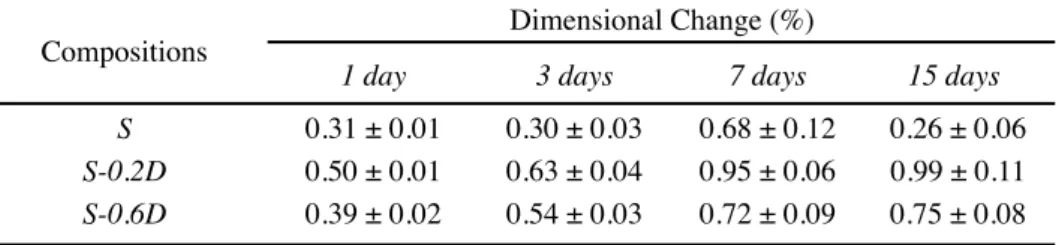
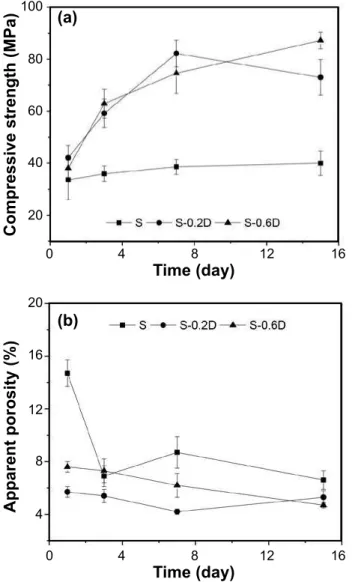
Table II and Fig. 1 present the physical properties of the cement specimens. Plain Secar 71 (S) and S-0.6D cements showed a signiicant lower dimensional change than S-0.2D. Moreover, the addition of 0.6 wt.% of dispersant resulted in a continuous increase of the mechanical strength values.
The hydration mechanism of calcium aluminate pastes is via dissolution-precipitation, where the anhydrous phases (CA and CA2) are dissolved and new compounds (CAH10, C2AH8, C3AH6 and/or AH3, as shown in Fig. 2) are precipitate out of the saturated solution [15]. The amount of Ca2+ and Al(OH)4- released in solution deine the hydrated phases generated. Furthermore, the hydrate growth induces Chemical composition Content (wt.%)
CaAl2O4 (or CA) 56
CaAl4O7 (or CA2) 40
Al2O3 2
Ca12Al14O33 (or C12A7) 2 Table I - Chemical composition of Secar 71.
[Tabela I - Composição química do cimento Secar 71.]
Table II - Dimensional change of the evaluated cements as a function of the curing time. [Table II - Variação dimensional dos cimentos avaliados em função do tempo de cura.]
Compositions
Dimensional Change (%)
1 day 3 days 7 days 15 days
S 0.31 ± 0.01 0.30 ± 0.03 0.68 ± 0.12 0.26 ± 0.06
S-0.2D 0.50 ± 0.01 0.63 ± 0.04 0.95 ± 0.06 0.99 ± 0.11
an interlocking effect and the formation of new bonds among these crystals, providing an increase of the cement mechanical strength [15-17].
Compressive behavior of the S cement showed slight changes over time and a signiicant increase of these values was observed in the range of 1-7 days for the S-0.2D and
S-0.6D samples, attesting that the presence of this polymeric additive affected the CAC properties. In general, the porosity results also decreased with the advance of the curing time (Fig. 1), which can be associated with the continuous hydrated phases formation and precipitation in the available pores.
The highest strength developed by the dispersant containing compositions (S-0.2D and S-0.6D) can be related to the eficient dispersion of their particles resulting in a well packed structure with signiicant lower porosity than that for the plain Secar 71 cement. In addition, this eletrosteric additive affected the dimensional stability of the evaluated samples, leading to the cement expansion up to about 1% (Table II). This is an important aspect to be considered, as the set expansion of a root-end illing material should decrease the open spaces between the canal walls and the root canal sealer (gaps) [8]. On the other hand, excessive expansion is undesirable as it may lead to cracks in the root.
Fig. 3 presents the evolution of the hydrate phase contents throughout the cement hydration at 37 ºC in the range of 1to15 days. The most important phases for the plain Secar 71 sample were C3AH6 and Al(OH)3 (27.2-39.3wt.% and 39.2 -52.8wt.%, respectively), however CAH10 and C2AH8 metastable hydrates were also found in higher amounts in the dispersant containing compositions. CA and CA2 phases were continuously consumed between 1-15 days (results not presented here), giving rise to hydrates with the advance of time.
The presence of C3AH6 and Al(OH)3 in all tested materials are in agreement with other investigations [15, 16], as for temperatures above 35 ºC the C3AH6 precipitation is predominant. Nevertheless, the formation of metastable hydrates (CAH10 and C2AH8) can take place due to the high water availability in the curing environment. The CAH10 and C2AH8 conversion to C3AH6 and Al(OH)3 is pointed out by many authors [4, 15, 18-20] as being responsible for spoiling some CAC properties, as these hydrates with lower density (1.72 and 1.95 g.cm-3) give rise to denser ones (2.42 and 2.52 g.cm-3), increasing the total porosity. Nevertheless, the continuous increase of the stable phases [C3AH6 and Al(OH)3] during the curing time offset the deleterious effect of CAH10 and C2AH8 transformation, resulting in high mechanical strength values after 15 days for the dispersant containing samples (Fig. 1). Due to the high content of the C3AH6 and Al(OH)3 hydrates in the evaluated materials (Fig. 3), one can infer that these components play a major role in the CAC mechanical behavior. Comparing the attained results with others in the literature [7, 21], S-0.2D and S-0.6D samples presented higher compressive strength (73.0-87.2 MPa after 15 days) at an earlier age than MTA and conventional Portland cements (50.6-86.02 MPa after 28 days). However, it must be highlighted that the continuous contact between CAC and water during the curing step of the samples might have affected the hydration kinetic of the evaluated materials, inducing a faster reaction and transformation of the anhydrous phases. Thus, in clinical applications when in contact with tissue luids, the evaluated cements are likely to Figure 1: Compressive strength and apparent porosity results of
Secar 71 samples kept in H2O at 37 ºC.
[Figura 1: Resultados de compressão uniaxial e porosidade aparente das amostras do cimento Secar 71 mantidas mergulhadas em H2O a 37 ºC.]
(a)
(b) 100
20 80
16 60
12 40
8 20
4 0
0
Time (day)
Time (day)
C
o
m
p
re
s
s
iv
e
s
tr
e
n
g
th
(MPa
)
A
p
p
a
re
n
t
p
o
ro
s
ity
(%
)
8
8 4
4
12
12
16
16
Figure 2: Representative equations for the hydrates generation reactions in calcium aluminate cements [14].
continue its hydration and gain strength, although the ions present can delay its kinetics [11].
CONCLUSIONS
The results of this study suggest that the dispersant containing calcium aluminate cement compositions have the potential to be used as endodontic materials. Higher compressive strength (73.0-87.2 MPa after 15 days), lower porosity levels and the main presence of C3AH6 and Al(OH)3 hydrates were observed for the CAC compositions containing dispersant. Although high compressive strength values are not critical for root-end illing materials as they do not bear any direct occlusal load, improvements in this property are welcomed and may, additionally, be useful to
expand the clinical applications of CAC based products. Given the low cost of calcium aluminate cement and good properties when compared with Portland cements and MTA, it is reasonable to consider it is a promising material for endodontic applications.
ACKOWLEDGMENTS
The authors are grateful to Conselho Nacional de Desenvolvimento Cientíico e Tecnológico (CNPq) for supporting this work and Kerneos Inc. (France) for supplying the cement.
REFERENCES
[1] F. G. Aguilar, L. F. R. Garcia, H. L. Rossetto, L. C. Pardini, F. C. P. Pires-de-Souza, “Radiopacity evaluation of calcium aluminate cement containing different radiopacifying agents”, J. Endod. 37 (2011) 67-71.
[2] H. Engqvist, J. E. Schultz-Walz, J. Loof, G. A. Botton, D. Mayer, M. W. Phaneuf, N. O. Ahnfelt, L. Hermansson, “Chemical and biological integration of a moudable bioactive ceramic material capable of forming apatite in vivo in teeth”, Biomaterials 25 (2004) 2781-2787.
[3] J. Loof, H. Engqvist, K. Linqvist, N. O. Ahnfelt, L Hermansoon, “Mechanical properties of a dental restorative material based on calcium aluminate”, J. Mater. Sci.: Mater. Med. 14 (2003) 1-5.
[4] A. P. Luz, V. C. Pandolfelli, “CaCO3 addition effect on the hydration and mechanical strength evolution of calcium aluminate cement for endodontic applications”, Ceram. Int. 38 (2012) 1417-1425.
[5] M. Torabinejad, T. F. Watson, T. R. Pitt Ford, “Sealing ability of a mineral trioxide aggregate when used as a root-end illing material”, J. Endod. 19 (1993) 591-595.
[6] C. C. Chen, C. C. Ho, C. H. D. Chen, S. J. Ding, “Physicochemical properties of calcium silicate cements for endodontic treatment”, J. Endod. 35 (2009) 1288-1291. [7] I. Islam, H. K. Chang, A. U. J. Yap, “Comparison of the physical and mechanical properties of MTA and Portland cement”, J. Endod. 32 (2006) 193-197.
[8] M. Jacobovitz, M. E. Vianna, V. C. Pandolfelli, I. R. Oliveira, H. L. Rossetto, B. P. F. A. Gomes, “Root canal illing with cements based on mineral aggregates: na in vitro analysis of bacterial microleakage”, Oral Surgery, Oral medicine, Oral Pathology, Oral Radiology Endodontology 108 (2009) 140-144.
[9] V. C. Pandolfelli, I. R. Oliveira, M. Jacobovitz, H. L. Rossetto, “Aluminous cement-based composition for application in endodontics and cementitious product obtained thereof”, Patent n. WO2009067774 (2009).
[10] H. Hommer, K. Wutz, “Recent developments in delocculants for castables”, in Proc. 9th Biennial Worldwide Cong. Refractories (2005) 1-6.
[11] A. P. Luz, N. Z. Borba, V. C. Pandolfelli, “Mechanical strength and hydrate products evolution of calcium aluminate cement for endodontic applications”, Cerâmica Figure 3: Evolution of the hydrate phase contents for the cement
samples kept immersed in water at 37 ºC. (S = Secar 71 and D =
dispersant). Average standard deviation was close to ± 1.0% for all
tested conditions.
[Figura 3: Evolução dos teores das fases hidratadas para as amostras de cimento mantidas em água a 37 ºC. (S = Secar 71 e D = dispersante). Desvio padrão médio para todas as condições avaliadas for de aproximadamente ± 1,0%].
(a)
(b) 45
60 40
55 35
50 25
40 45 20
20
15
35 0
0
Time (day)
Time (day)
C3
A
H6
(w
t%
)
A
l(O
H
)3
(w
t%
)
6
6 3
3
9
9
15
15 12
60, 354 (2014) 192-198 (in Portuguese).
[12] International Organization for Standardization, “Dental root canal sealing materials”, ISO 6789 (2001).
[13] International Organization for Standardization, “Dentistry water based cements: part 1 – powder/liquid acid-base cements”, Switzerland: ISO 9917-1 (2003) 1-22. [14] A. P. Luz, V. C. Pandolfelli, “Halting the calcium aluminate cement hydration process”, Ceram. Int. 37 (2011) 3789-3793.
[15] C. Parr, “Calcium aluminate cement – what happens when things go wrong?”, in Proc. of IRE Annual Conf., UK (2008) 1-11.
[16] I. R. Oliveira, V. C. Pandolfelli, “Castable matrix, additives and their role on hydraulic binder hydration”, Ceram. Int. 35 (2009) 1453-1460.
[17] J. E. Kopanda, G. Maczura, “Production processes, properties and applications for calcium aluminate cement”,
Aluminum Company of America, Pittsburg, PA 15212 (1987) 171-183.
[18] F. M. Lea, “The chemistry of cement and concrete”, 3rd Ed., London: Edward Arnold (1970) 177-186.
[19] C. Parr, F. Simonin, B. Touzo, C. Wohrmeyer, B. Valdelièvre, A. Namba, “The impact of calcium aluminate cement hydration upon the properties of refractory castables”, in Proc. TARJ Meeting, Ako, Japan (2004) 1-17. [20] I. R. Oliveira, V. C. Pandolfelli, “Does a tiny amount of dispersant make any change to refractory castable properties?”, Ceram. Int. 36 (2010) 79-85.
[21] Y. C. Hwang, D. H. Kim, I. N. H. Hwang, S. J. Song, Y. J. Park, J. T. Koh, H. H. Son, W. M. Oh, “Chemical constitution, physical properties, and biocompatibility of experimentally manufactured Portland cement”, J. Endod. 37 (2011) 58-62.