INTRODUCTION
The red ceramic industry is based mainly on the production of clayey ceramic materials for use in the civil construction such as bricks, ceramic blocks, rooing tiles and pipes [1]. Common clays are basically raw materials used for the manufacture of red ceramics. According with Dondi [2] the red ceramic processing is characterized by several manufacturing stages, including body preparation, shaping, drying and iring.
The main factors involved in the manufacturing process of red ceramics are the composition of raw materials and iring cycle (iring time and temperature). These factors fundamentally inluence quality and cost of the inal product. Slow-iring cycles are typically used for manufacture of red ceramic worldwide, which can reach up to 60 h (cold to cold), depending on the inal product [2]. It is important to emphasize that the iring process is irreversible, and is responsible for inal shape of the ceramic piece set in the stage of shaping of the clayey body. According with
Brindley [3] on iring the clay ceramic bodies undergo a complex series of physical-chemical reactions. It has been reported in the literature [4] that the main physical-chemical reactions of kaolinitic clays are: dehydroxylation of clay minerals, dehydration of hydroxides, phase transformations, and partial fusion with formation of a liquid phase at high temperature. The iring process of red ceramics, however, requires one high demand of energy.
Previous works have been devoted to the use of fast-iring technology for manufacture of several ceramic materials. Giuliano [5] reported on the use of fast-iring technology in the brick and tiles industries. It was demonstrated that the fast-iring technology presents high potential to optimize the iring process of ceramic materials for civil construction. The feasibility of fast-iring of pure alumina (Al2O3) has been investigated [6]. It was found that the fast-iring approach can be used to manufacture alumina within very short production times at low temperature. Fast ired alumina exhibits mechanical performance nearly comparable to those of conventionally sintered alumina.
Processing of red ceramic using a fast-iring cycle
(Processamento de cerâmica vermelha usando um ciclo de queima rápido)
G. T. Saleiro, J. N. F. HolandaGrupo de Materiais Cerâmicos/LAMAV-CCT, Universidade Estadual do Norte Fluminense Darcy Ribeiro Av. Alberto Lamego 2000, Campos dos Goytacazes, RJ, Brazil 28013-602
[email protected], [email protected]
Abstract
This work reports on the processing of red ceramic for civil construction using fast-iring cycles. The iring cycle is an important variable in the processing of red ceramic materials, which contributes to a high consumption of energy. The red ceramic pieces were prepared by industrial extrusion and ired at iring temperatures varying from 700 ºC to 1100 ºC using different iring cycles (slow-iring cycle - 1º C/min and fast-iring cycle - 10 ºC/min and 20 °C/min). The technological properties (linear shrinkage, water absorption, apparent porosity, apparent density, and lexural strength) as function of the iring temperature and iring cycle are investigated. The development of the microstructure was followed by SEM/SEI. The results showed that fast-iring red ceramics exhibits technological properties and microstructure comparable to conventionally ired red ceramics, resulting in great advantages in energy saving.
Keywords: red ceramic, fast-iring, iring cycle, processing, properties.
Resumo
Estetrabalho descreveo processamentodecerâmica vermelha paraconstrução civil usandociclosde queima rápido. Ociclo de queimaé uma variávelimportanteno processamentodemateriais de cerâmicavermelha, o qualcontribuiparaum alto consumo de energia. As peças de cerâmica vermelha foram preparadas por extrusão industrial e queimadas nas temperaturas de queima variando de 700 ºC a 1100 ºC utilizando diferentes ciclos de queima (ciclo de queima lento - 1 ºC/min e ciclos de queima rápidos -10ºC/mine 20ºC/min). As propriedadestecnológicas(retração linear, absorção de água,porosidade aparente, massa especíica aparenteetensão de rupturaà lexão) em funçãoda temperatura dequeimaeciclode queimasãoinvestigadas. Odesenvolvimento damicroestruturafoi avaliadoporSEM/SEI. Os resultadosmostraram que as peças decerâmicavermelha obtidas via processo de queima rápida exibiram propriedades tecnológicas e microestrutura comparáveis àquelas convencionalmente obtidas via queima lenta, resultando em grande vantagem na economia de energia.
The mechanical properties and microstructure of clay bricks obtained through slow traditional cycle (24 h cold to cold) and fast-iring cycles (3 - 5 h cold to cold) have been studied [7]. It was found that for clay bricks with equivalent water absorption, fast iring technique leads to higher lexural strength, lower apparent density, greater mean pore size, and improved frost resistance. The densiication process of PZT type ceramics in fast iring approach has been described [8]. The densiication behavior of PZT powder compacts was found to be inluenced by the iring cycle, in which a maximum density of 98.5 % was achieved for fast-ired compacts at 1350 ºC/20 min. It was found that all piezoelectric properties were improved by fast iring process compared to the conventional sintering. An important study [9] reported on the inluence of the iring conditions (2 ºC/min (slow cycle) and 13 ºC/min (fast cycle)) on the technological properties of calcareous and non-calcareous clays. It was found that the water absorption and porosity values resulted to be higher, while linear shrinkage and lexural strength lower in the fast-ired clays. In terms of pore size distribution two contrasting trends were observed for calcareous clays (larger pores in fast iring) and for non-calcareous clays (vice versa). In addition, the slow-ired calcareous clay samples present a larger amount of newly formed phases (plagioclase, clinopyroxene, melilite) if compared with the fast-ired ones. The comparative analysis of the technological properties of red wall tiles produced using a traditional slow-iring cycle (24 h cold to cold) and fast-iring cycle (1 h cold to cold) have been also described [10]. It was concluded that the use of a slow-iring cycle resulted in enhanced properties of the red wall tiles. The effect of porcelain and glaze iring cycles on the it of 3 types of all-ceramic crowns has been investigated [11]. It was found that porcelain iring cycle affected the marginal it of the all-ceramic crowns. However, the glaze iring cycle had no signiicant effect on it. Maciulaitis and Malaiskiene [12] reported on the feasibility to control quality of ceramics by changing the magnitudes of iring cycles. It was found a strong interdependence between the stages of iring cycles and structural parameters. In addition, it was also found that it is possible to select the iring cycles according to the desired structural parameters of a ceramic product. As can be observed, the fast-iring technology was successfully used for several ceramic materials. However, the validity of the fast-iring concept in the ield of red ceramic is still subject to restrictions and requires much research and development work.
In this work is done a systematic study on the use of fast-iring cycles in the manufacture of red ceramic for civil construction, with special emphasis on the processing and technological properties of the ired pieces.
MATERIALS AND METHODS
The red clay body was collected from a red ceramic plant located in South-Eastern Brazil (Campos-RJ). The industrial clayey body is composed of a mixture of 70 wt.% of plastic
clay and 30 wt.% of less plastic clay.
Mineralogical analysis of the red clay sample was done by X-ray diffraction (model XRD-700, Shimadzu), using monochromatic Cu-Ka radiation over non-oriented
specimens at a scanning speed of 1.5º (2q) per min.
The crystalline phases were identiied by comparing the intensities and positions of the Bragg peaks with those listed in the JCPDS-ICDD cards. The chemical composition of the clay sample was determined by X-ray luorescence (XRF). The loss on ignition (LOI) was determined according to
LOI = (Wd – Wc) / Wd x100 (A)
in which Wd is the weight of the dry sample at 110 ºC, and Wc is the weight of the calcined sample at 1000 ºC during 1 h. The particle size analysis of the clay sample was done according to NBR 7181-84 [13]. The real particle density was determined according to NBR 6508-84 [14]. The plasticity was determined by the Atterberg method according to the NBR 6459-84 [15] and NBR 7180-84 [16] standardized procedures.
Thermogravimetric analysis (TGA and DrTGA) of clay sample was done within the 25 - 1150 ºC temperature range using a heating rate of 10 ºC/min under air atmosphere.
The ceramic pieces in the form of bars measuring 90 mm x 35 mm x 15 mm were prepared by industrial extrusion and then dried at 110 ºC for 24 h. Firing step was carried out at soaking temperatures varying from 700 to 1100 ºC using different firing cycles (1 ºC/min, 10 ºC/min, and 20 ºC/min with 60 min soaking at the maximum temperature). For comparison, the iring cycle of 1 ºC/min was used as reference, because it corresponds to the traditional slow-iring cycle used in the red ceramic industry.
The following technological properties of the red ceramic pieces have been determined: linear shrinkage, water absorption, apparent porosity, apparent density, and lexural strength. Linear shrinkage values upon drying and iring were evaluated from the variation of the length of the rectangular bars. Water absorption was determined from weight differences between the as-ired and water saturated samples (immersed in boiling water for 2 h). The apparent porosities of the pieces were determined by weighing them irst dry in air, then heating them in boiling water for 2 h and inally, after cooling, weighing the now saturated pieces in both water and air. The apparent density was determined by the Archimedes method. The lexural strength (s) of the
ired specimens was determined by the three-point bending test (model 5582, Instron) at a loading rate of 0.5 mm/min according to
s = 3 PL / 2bd2 (B)
SSX-550, Shimadzu) via secondary electron images (SEI), at 15 kV, after gold coating.
RESULTS AND DISCUSSION
The irst step of this investigation aimed the characterization of the industrial red clay body used. This is very important in order to understand the effects of the iring cycles on the processing and technological properties of red ceramics.
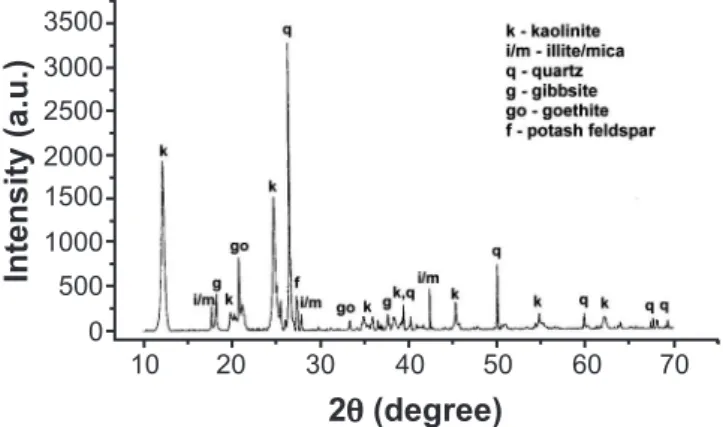
The XRD pattern of the clay sample is shown in Fig. 1. The red clay has diffraction peaks predominantly associated with kaolinite (Al2O3.2SiO2.2H2O). Apart from the kaolinite phase, gibbsite (Al2(OH)6), goethite (Fe2O3.H2O), quartz (SiO2), potash feldspar (KAlSi3O8), and illite/mica are detected by the XRD analysis.
Table I gives the chemical composition and loss on ignition of the red clay sample. The clay powder is composed mainly of SiO2 and Al2O3, which correspond to about 72.46 wt.%. This result conirms that the clay sample is mainly composed of kaolinite clay mineral. The silica (SiO2) is present in the structure of the clay minerals as kaolinite and illite/mica, structure of potash feldspar, as well as free quartz
particles. The alumina (Al2O3) does not occur in its free form in the clay powder, being bounded to the clay minerals and gibbsite, as observed in Fig. 1. The amount of lux materials (K2O, Na2O, CaO and MgO) is low, except Fe2O3. The high iron oxide content would be responsible for the reddish color of the red ceramic pieces after iring. The loss on ignition (LOI) is relatively high (11.03 %), and is associated with the presence of clay minerals, hydroxides and organic matter.
Table II gives the relevant physical characteristics of the clay sample. It was veriied that the clay sample presented reddish color, which is due to the high content of iron oxide (Table I). The real density obtained of 2.67 g/cm3 relects
its mineralogical analysis (Fig. 1), and is typical of clayey materials. The clay powder sample presented a wide range of particle sizes (1 to 500 mm), where the major size ranges
are clay (< 2 mm) with 31 %, silt (2 ≤ x < 63 mm) with 55 %,
and sand (> 63 mm) with 14%. When plotted in the Winkler
diagram [17], the red clay sample is placed inside of the characteristic ield for rooing tiles (ield B). The plasticity of the clay sample was evaluated by the Atterberg´s consistency limits [18]. The values of plasticity for the clay sample are within the acceptable range to industrial processing of red
ceramics. In terms of soil mechanics, the clay body sample may be classiied as belonging to the group of high plasticity inorganic clays [19].
The thermogravimetric (TGA and DrTGA) curves for the red clay sample is shown in Fig. 2. Three endothermic events are seen in the DrTGA curve, which are related mainly to the evolution of the physically adsorbed water, dehydration of hydroxides, and dehydroxylation of clay minerals. The endothermic events correspond to an intense process of mass transfer in the sample as observed in the TGA curve. The sample presented a total weight loss during heating around 16.50%. The thermogravimetry (TGA and DrTGA) of the sample conirms the kaolinitic nature of the red clay (dehydroxylation of kaolinite at 543.43 ºC) and presence of hydroxides as gibbsite and goethite (dehydration of hydroxides at 293.99 ºC).
The technological properties of the ceramic pieces were measured upon drying at 110 ºC (Table III). The linear shrinkage of the red ceramic pieces obtained by extrusion is of 4.53 %, which is within the optimal range Figure 1: Typical X-ray diffraction pattern of the red clay sample.
[Figura 1: Difratograma de raios X da amostra de argila vermelha.]
3500
2500
1500
500 3000
2000
1000
0 10
2q (degree)
30 60
20 40 50 70
Intensity (a.u.)
Table I - Chemical composition of the red clay used (wt. %). [Tabela I - Composição química da argila vermelha usada (% em peso).]
SiO2 Al2O3 Fe2O3 TiO2 CaO MgO K2O Na2O MnO LOI
40.31 32.15 10.83 1.49 0.32 0.78 2.37 0.62 0.10 11.03
LOI = loss on ignition
Characteristic Range
Color
Real density (g/cm3) Clay (%)
Silt (%) Sand (%) Liquid Limit (%) Plastic Limit (%) Plastic Index
Redish 2.67
31 55 14 65.2 27.5 37.7
to red ceramic processing [2]. The pieces presented apparent density of 1.62 g/cm3. In the dried state the pieces presented high lexural strength (3.34 MPa), which satisfy the recommended industrial limits.
The technological properties of the red ceramic pieces
obtained with different iring cycles between 700 ºC and 1100 ºC, are shown in Figs. 3-7. All technological properties showed the dependence on the iring temperature.
The linear shrinkage of the red ceramic pieces is shown in Fig. 3. This property is related to the degree of densiication during sintering, and is very important for the dimensional control of the inished red ceramic products. It can be observed that the shrinkage increases with the increase of the iring temperature. No signiicant change was found in linear shrinkage of the pieces (0.62 to 1.91 %) between 700 ºC and 900 ºC. The low shrinkage of the pieces observed in this temperature range is due the particles sintering be dominated by particle-to-particle contact mainly of metakaolinite particles. In this case, the sintering is dominated by solid state sintering mechanism [20]. Upon iring above 900 ºC, the shrinkage (2.49 to 9.65%) continued to increase sharply with iring temperature. This is due the formation of a liquid phase, which aids the densiication of the ceramic pieces, being viscous low the dominant sintering mechanism.
No signiicant differences can be recognized in the linear shrinkage of the red ceramic pieces (Fig. 3) ired under different iring cycles. However, the results show small but important differences. For iring temperatures below
900 ºC the linear shrinkage of the ceramic pieces tends to lightly increase for fast-iring cycles (10 ºC/min and 20 ºC/ min). This behavior can be attributed to the higher amount of amorphous phase in this temperature range. In fact, the red clay sample is rich in kaolinite (see Fig. 1), which is transformed for amorphous metakaolinite around 543.43 ºC (see Fig. 2). Above 900 ºC, however, the linear shrinkage tends to decrease for fast-iring cycles. This inding is likely related to the formation of new crystalline phases from metakaolinite such as 2:1 mullite or Si-containing g-Al2O3
(Souza et al., 2003). Vitriication should be in progress in this temperature range. These circumstances are naturally connected with the lesser time available for physical-chemical reactions in the fast-iring cycles.
The water absorption of the red ceramic pieces is shown in Fig. 4. The water absorption is related directly to microstructure, and determines the open porosity level of the Figure 2: Thermogravimetric and differential thermogravimetric
curves for the clay sample.
[Figura 2: Curvas termogravimétrica e derivativa termogra-vimétrica para a amostra de argila.]
100.00
TGA %
DrTGA mg/min
0.50
0.00
-0.50 90.00
80.00 0.00
Temperature (ºC)
500.00 1000.00
Linear shrinkage
(%)
Apparent density (g/cm3)
Flexural strength (MPa) 4.53 ± 0.45 1.62 ± 0.04 3.34 ± 0.74
Table III - Technological properties of the red ceramic pieces in the dried state at 110 ºC.
[Tabela III - Propriedades tecnológicas das peças de cerâmica vermelha secadas a 110 ºC.]
Figure 3: Linear shrinkage as a function of the iring cycle for all temperatures.
[Figura 3: Retração linear em função do ciclo de queima para todas as temperaturas.]
10
6
2 8
4
0 700
Temperature (ºC)
W
ater absorpion (%)
800 900 1000 1100
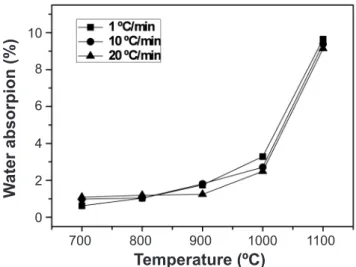
Figure 4: Water absorption as a function of the iring cycle for all temperatures.
[Figura 4: Absorção de água em função do ciclo de queima para todas as temperaturas.]
35
25
15 30
20
10
700
Temperature (ºC)
W
ater absorption (%)
ceramic pieces. The open porosity affects several properties, such as mechanical strength, thermal and acoustic insulation capacity, frost resistance and permeability. As expected, the water absorption decrease with the increase of the iring temperature independently of the iring cycle. Sintering of the ceramic pieces accelerates above 900 ºC as the glassy phase is formed. This phase penetrates the open pores, closing then and isolating neighboring pores. This explains the intense decrease of the water absorption in higher iring temperatures. On the other hand, no signiicant change was found in the water absorption of the red ceramic pieces ired under different iring cycles. This is in accordance with the apparent porosity values (Fig. 5). However, in a similar way to the shrinkage values, again, small differences can be observed. In general, the water absorption and apparent porosity values were observed to increase slightly for fast-iring cycles mainly for 20 ºC/min.
The apparent density of the ceramic pieces is shown in Fig. 6. It can be observed that the apparent density increases with the increase of the iring temperature, being more signiicant above 900 ºC independently of the iring cycle. This behavior can be attributed to the vitriication that helps to reduce the open porosity, resulting in denser red ceramic pieces. The apparent density of the pieces, as shown in Fig. 6, presented only slight differences with the iring cycles. Comparing the different iring cycles, the apparent density values resulted to be slightly lower in the fast-iring red ceramics.
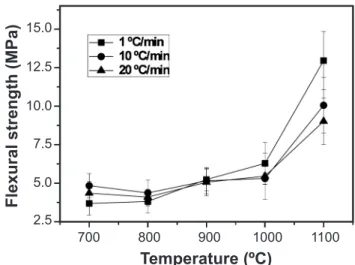
The lexural strength of the ired pieces as a function of iring temperature and iring cycle is shown in Fig. 7. The effect of the iring temperature was to increase the lexural strength of the pieces by means of densiication, and reached their maximum values at 1100 ºC. The correlation between lexural strength and physical properties (linear shrinkage, water absorption, apparent porosity and apparent density) of the red ceramic pieces is well established. In general, the lexural strength values resulted to be slightly lower in the fast-iring red ceramics. It can be also observed in Fig. 7 the effect of the iring cycle with respect to mechanical strength. For iring temperatures up to 1000 ºC, the lexural strength values resulted to be only slightly lower in the fast-iring red ceramics. At 1100 ºC, however, a tendency toward lower lexural strength in the fast-iring red ceramics is observed. This behavior is related to the formation of microcracks in the sintered matrix during cooling due to the phase transformation b-a of the quartz particles. Despite
this, all ceramic pieces ired at 1100 ºC met the requirements of mechanical strength for red ceramic predicted by the Brazilian standard speciication. This result is very important, because it demonstrates the possibility of great economy of energy during red ceramic processing with only small sacriice of the technological properties.
In order to enlighten the densiication behavior on iring, the fracture surface of the as-ired red ceramic pieces were examined (Fig. 8a - c). The micrographs show the evolution Figure 7: Flexural strength as a function of the iring cycle for all temperatures.
[Figura 7: Tensão de ruptura a lexão em função do ciclo de queima para todas as temperaturas.]
Figure 5: Apparent porosity as a function of the iring cycle for all temperatures.
[Figura 5: Porosidade aparente em função do ciclo de queima para todas as temperaturas.]
35 45
25 30 40 50
20
600 700
Temperature (ºC)
Apparent porosity (%)
800 900 1000 1100
Figure 6: Apparent density as a function of the iring cycle for all temperatures.
[Figura 6: Massa especíica aparente em função do ciclo de queima para todas as temperaturas.]
1.4 1.6 1.8 2.0 2.2
700
Temperature (ºC)
Apparent density (g/cm
3)
800 900 1000 1100
15.0
12.5
10.0
7.5
5.0
2.5 700
Temperature (ºC)
Flexural strength (MPa)
of the structure of the red ceramic ired at 1000 ºC with iring cycle. The SEM images of the fracture surface of all pieces reveal the agglomeration of clay particles of varying size and shape, microscopic pores and voids. This signiies that the slow-ired pieces had a microstructure similar to that of fast-iring ceramic pieces. This clearly shows that the use of fast-iring cycles in the red ceramic processing does not Figure 8: Microstructure of red ceramic ired at 1000 ºC at different iring cycles: (a) 1 ºC/min (slow-cycle); (b) 10 ºC/min; and (c) 20 ºC/min.
[Figura 8: Microestrutura de cerâmica vermelha queimada a 1000 ºC em diferentes ciclos de queima: (a) 1 ºC/min (ciclo de queima lento); (b) 10 ºC/min; e (c) 20 ºC/min.]
cause signiicant modiication on the texture and porosity of the ired pieces. These results are in accordance with the technological properties.
CONCLUSIONS
The experimental results showed clearly that the use of fast-iring cycles (shorter time) seems to be an important approach in the red ceramic processing, resulting in energy saving. The performance of the technological properties of the fast-iring red ceramic pieces between 700 and 1100 ºC is, in irst approximation, comparable to conventionally ired red ceramics, except the lexural strength at 1100 ºC. The use of fast-iring cycles does not cause signiicant modiication on the microstructure and porosity of the red ceramic pieces. In the context of the manufacture of red ceramic products, it is apparent from obtained results that the use of fast-iring technology is viable technically and economically. In addition, the fast-iring technology can be easily adapted to the red ceramic industrial processing.
ACKNOWLEDGMENTS
To CNPq, FAPERJ and CAPES for inancial support, and the São José Industry by the supply of the red clay body. REFERENCES
[1] P. S. Santos, Ciência e Tecnologia de Argilas, Vol. 1, 2a Ed., Edgard Blücher Ltda., S. Paulo, SP (1989).
[2] M. Dondi, Int. Ceram. J. (2003) 55-59. [3] G. W. Brindley, Cerâmica 42 (1978) 217-224.
[4] G. P. Souza, R. Sánchez, J. N. F. Holanda, J. Therm. Anal. Calorim. 73 (2003) 293-305.
[5] E. Giuliano, Ziegel. Int. 46 (1993) 168.
[6] D. E. García, J. Seidel, R. Janssen, N. Clanssen, J. Eur. Ceram. Soc. 15 (1995) 935-938.
[7] M. Dondi, M. Marsigli, I. Venturi, Brit. Ceram. Trans. 98 (1999) 12-18.
[8] C. Miclea, L. Tanasaiu, C. F. Miclea, L. Amarande, R. Iorgulescu, V. Tanasaiu, S. Moscu, J. Optoelec, Adv. Mater. 3 (2001) 83-87.
[9] M. I. Carretero, M. Dondi, B. Fabbri, M. Raimondo, Appl. Clay Sci. 20 (2002) 301-306.
[10] M. F. Pinto, S. J. G. Sousa, J. N. F. Holanda, Cerâmica 51, 319 (2005) 225-229.
[11] M.C. Balkaya, A. Cinar, S. Pamuk, J. Prost. Dent. 93 (2005) 346-355.
[12] R. Maciulaitis, J. Malaiskiene, Const. Build. Mater. 23 (2009) 226-232.
[13] NBR 7181-84, Soil: Granulometric Analysis, ABNT (1984).
[14] NBR 6508-84, Soil: Real Speciic Mass, ABNT (1984). [15] NBR 6459-84, Soil: Determination of the Liquid Limit, ABNT (1984).
[17] S. Pracidelli, F.G. Melchiades, Ceram. Ind. 2 (1997) 31-35.
[18] C. F. Gomes, Argilas - O Que São e Para Que Servem, Fundação Calouste Gulbenkian, Lisboa, Portugal (1988).
[19] H. P. Caputo, Mecânica dos Solos e Suas Aplicações Fundamentais, Livros Técnicos, Rio de Janeiro, RJ (1994). [20] F. A. C. Milheiro, M. N. Freire, A. G. P. Silva, J. N. F. Holanda, Ceram. Int. 31 (2005) 757-763.