Latest research showed increasingly growing in-terest on antioxidant potential of food products and its constituents infl uence on diet therapy [Anwar and Przybylski 2012, Filipiak-Florkiewicz et al. 2012, Ka-pusta-Duch et al. 2012]. Food components are proved to be important factors in body defense system activ-ity against reactive oxygen species (ROS), as normal cell aerobic respiration products [Lin and Tang 2007, Prior 2003, Stanner et al. 2004]. Research has provid-ed evidence of an inverse association between plant
constituents rich diet and chronic and degenerative diseases incidence, showing that high dietary intake of antioxidative compounds would help maintaining adequate antioxidant status and proper physiological functions of the body tissues [Kanazawa 2011].
In human diet vegetables and fruits are main sourc-es of dietary antioxidants, next to supplements, easily available for the consumer [Duda-Chodak et al. 2011, Gramza and Reguła 2007, Gramza-Michałowska and Człapka-Matyasik 2011, Prior et al. 2005, Pokorny
OXYGEN RADICAL ABSORBANCE CAPACITY OF SELECTED FOOD
PRODUCTS
*Anna Gramza-Michałowska
, Józef Korczak
Department of Food Service and Catering, Poznań University of Life Sciences Wojska Polskiego 31, 60-624 Poznań, Poland
ABSTRACT
Background. Recent epidemiological evidence on the growing role of food antioxidants in oxidative stress related diseases has led to a wide number of antioxidant potential evaluation assays. Main antioxidants in food are e.g. polyphenols of plant origin. Antioxidants consumption would be very promising future trend for human health and important factor in body defense system activity against reactive oxygen species (ROS), therefore in diseases prophylaxis. The aim of the present research was to evaluate the antiradical activity as ORACFL value of selected food and drinks.
Material and methods. In the present study, twenty four products were analysed for oxygen radical absorb-ance capacity evaluated according to the ORACFL peroxyl radical scavenging method.
Results. Highest ORACFL values were evaluated in strawberry, dried plum and cranberry fruits, carrot and red cabbage as vegetables, orange and pomegranate juices and red tea among drinks group. Results showed signifi cant differences between samples in selected product groups.
Conclusions. Research indicates that selected food products can be important peroxyl radical scavengers, and that is why information on food label, concerning the issue, would be useful for modern consumers.
Key words: antioxidant, oxygen radical absorbance capacity assay, ORACFL, fruits, vegetables, juices, tea, polyphenols, radicals
INTRODUCTION
2007]. Antioxidants are recognized as necessary food components, however there is no standard method for its activity quantifi cation [Frankel and Finley 2008, Perez-Jimenez et al. 2008]. There are many antioxi-dants in food products like vitamin E, polyphenols, carotenoids and thiol based compounds [Pellegrini et al. 2003, Scalbert et al. 2005]. According to antioxi-dants chemical diversity, interactions between com-ponents, their contribution to antioxidant activity and extraction methods it is very diffi cult to establish one proper method for antioxidant potential evaluation [Niki 2002]. Therefore, most popular method evaluat-ing antioxidant potential of food products is oxygen radical absorption capacity assay (ORAC) [Ou et al. 2001, Wu et al. 2004]. Mechanistically ORAC method is based on the hydrogen atom transfer (HAT) reaction between an oxidant and free radical [Ou et al. 2001]. ORAC method utilizes a radical initiator (AAPH) to generate peroxyl radical, which abstracts hydrogen atom from antioxidant, therefore inhibiting further re-actions. Modern, well-educated consumer needs not only basic composition information on the product’s index label, but also adequate information concerning its antioxidative potential [Stockham et al. 2011].
Present research aimed at the evaluation and com-parison of antiradical activity of selected fruits, veg-etables and drinks expressed as oxygen radical absor-bance capacity assay (ORACFL). The objective of the study was to provide useful information on antiradical potential of commercially available food products.
MATERIAL AND METHODS
Chemicals and reagents. Phosphate buffer (75 mmol, pH 7.4): Sodium phosphate monobasic dehy-drate, Potassium phosphate dibasic; Trolox (6-hydroxy--2,5,7,8-tetramethylchromane-2-carboxylic acid; Sig-ma-Aldrich), 2,2’-Azobis(2-methylpropionamidine) dihydrochloride (AAPH) were purchased from Sigma--Aldrich (Germany); Fluorescein sodium salt (Fluka). Samples. Vegetables and fruits were collected from various marketplaces and groceries in the Wiel-kopolska region in late summer. The examined sam-ples included fruits: strawberry, fresh and dried peach , fresh and dried cranberries, apples and dried plums; among vegetables: carrot, red cabbage, beetroot, black and red bean, tomato, potato, broccoli; drinks: apple,
orange, pomegranate and tomato juices, white, green, red and black teas.
Sample preparation. Lyophilized samples were accurately weighed and macerated with ethanol/wa-ter (80:20, v/v) solvent, then the mixture was shaken for 15 minutes on an orbital shaker at 40°C and cen-trifuged at 4500 rpm for 15 minutes. Collected su-pernatants were ready for the analysis, concentrated samples were diluted with 75 mmol potassium phos-phate buffer solution (pH 7.4). Prepared extracts were analysed on the same day, to minimize the product’s degradation.
that of sample. The area under the curve (AUC) was calculated as follows:
AUC = (5 + f5/f0 + f10/f0 + f15/f0 + f20/f0 + ... + f40/f0 + f45/f0) · 5
where:
f0 – initial fl uorescence before AAPH addition at time 0, f5, f10, ..., f45 – fl uorescence at time 5, 10, ..., 45 min-utes after addition of AAPH.
The relative oxygen radical absorbance capacity (ORACFL) value was calculated as follows: ORAC value = (AUC sample – AUC blank)/(AUC standard – AUC blank) · (molarity of Trolox/molarity of sample).
Results were expressed as μM of Trolox equiva-lents (TE) per 100 gram or 100 ml of tested product.
Statistical analysis. Results are expressed as mean values ± standard deviation of at least three independ-ent measuremindepend-ents. Mean values were compared by one-way analysis of variance (ANOVA) at signifi -cance level of p ≤ 0.05, using computer system Sta-tistica 9.0.
RESULTS AND DISCUSSION
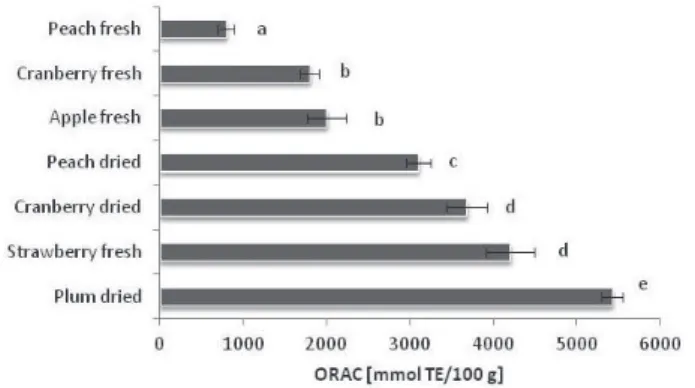
Oxygen Radical Absorbance Capacity Assay (ORACFL) of tested samples were found to be affected by the form used for the extraction procedure. The evaluation of antiradical activity was divided into three groups of products: fruits, vegetables and drinks. The results showed that among the examined fruits the high-est activity was evaluated for strawberries and dried fruits. Fresh fruits exhibited lower antiradical activity (Fig. 1). The fruits were ranked from highest to lowest potential as follows: plum dried > strawberry = cran-berry dried > peach dried > apple fresh = crancran-berry fresh > peach fresh. The antiradical activity of straw-berry was two times higher than fresh cranstraw-berry and almost fi ve times higher than of fresh peach. The re-sults showed that signifi cantly higher ORACFL values were evaluated in dark red colour fruits.
Second group of the examined products were vegetables, which were ranked from highest to low-est ORACFL values as follows: carrot = red cabbage > beetroot = black bean ≥ tomato = red bean > pota-toes > broccoli. The antiradical activity of carrot was nearly four times higher than broccoli and two times higher than that of potatoes (Fig. 2).
The evaluation of antiradical activity of commonly consumed drinks and juices showed high differences among the samples. The results showed that high-est activity of the examined drinks was evaluated for orange and pomegranate juices and red tea. Lowest activity was evaluated for herbal tea and apple juice (Fig. 3). Drinks were ranked from highest to lowest potential as follows: orange juice > red tea = pome-granate juice = white tea ≥ green tea = black tea = to-mato juice = apple juice > herbal tea.
ORAC value was successfully applied for a wide range of samples, especially to a complex nature sam-ples like food [Zulueta et al. 2009]. It is increasingly applied in the area of nutraceuticals, fi rst to establish the antioxidative activity of single ingredients, than Fig. 1. Rank order for common fruits ORACFL values: a-e – mean values with different letters differ statistically (p ≤ 0.05)
the formulation preparation impact and also in the con-sumer interest in products marketing [Stockham et al. 2011]. Wu et al. [2004] measured ORACFL values for acetone/water extract of strawberry at level of 35.41 (μmol TE/g). Higher ORACFL values were evaluated for dark coloured fruits like raspberry, blueberry and plum, lowest for cantaloupe and watermelon, which corresponds with present results. Other group were vegetables where highest potential was evaluated for broccoli (14.18 μmol TE/g), carrot (11.56 μmol TE/g) and potato (12.72 μmol TE/g), lowest for tomato (3.13 μmol TE/g). Ou et al. [2002] evaluated oxygen radical absorbance capacity for selected vegetables on the level of 60 (μmol TE/g) for carrot, 67 (μmol TE/g) for tomato and 126 (μmol TE/g) for broccoli, which are not in agreement with reported values in present research. Present evaluations showed ORACFL values nearly three times lower for carrot and tomato, and eighteen times lower than that of broccoli. Compari-son of present results with those of Stockham et al. [2011] showed similarities for peach, plum, black tea, tomato and apple juices. Also Ou et al. [2001] evalu-ated ORACFL for black tea on the level of 17 267.00 (μmol TE/liter), which corresponds with present re-sults (13 900 μmol TE/liter).
The results of Wu et al. [2004] and Liu [2003] pro-vided a number of factors, like season of sampling, storage, processing and cooking or additive and syn-ergistic activity combinations of phytochemicals, that signifi cantly impact the level of antioxidants in plants. Perez-Jimenez and Saura-Calixto [2006] concluded
that there is a need for ORAC assay unifi cation, which would allow placing comparable results on the food label. Summarizing, it should be noticed that, there are many factors introducing variations as a result of anti-oxidative activity of foods.
CONCLUSIONS
The application of oxygen radical absorbance capacity assay is regarded as the most adequate and popular method for fast and reliable food samples anti-radical activity evaluations. The method can be used as the fi rst step of antioxidant potential quantifi cation since consumers need a tool for right selection of new products, which consumption would benefi t body tis-sues oxidative stability enhancement.
REFERENCES
Anwar F., Przybylski R., 2012. Effect of solvents extraction on total phenolics and antioxidant activity of extracts from fl axseed (Linum usitatissimum L.). Acta Sci. Pol.,
Technol. Aliment. 11 (3), 293-301.
Duda-Chodak A., Tarko T., Tuszyński T., 2011. Antioxidant activity of apples – an impact of maturity stage and fruit part. Acta Sci. Pol., Technol. Aliment. 10 (4), 443-454. Filipiak-Florkiewicz A., Florkiewicz A., Cie lik E.,
Wal-czycka M., Kapusta-Duch J., Leszczyńska T., 2012.
In-fl uence of hydrothermal treatment on dietary fi ber and phenolic compounds content as well as antioxidative activity of legumes seeds. Acta Sci. Pol., Technol. Ali-ment. 11 (4), 355-362.
Frankel E.N., Finley J.W., 2008. How to standardize the multiplicity of methods to evaluate natural antioxidants. J. Agric. Food Chem. 56, 4901-4908.
Gramza A., Regula J., 2007. Use of tea extracts (Camellia sinensis) as polyphenols sources in human diet. Asia
Pac. J. Clin. Nutr. 16 (Suppl 1), 43-46.
Gramza-Michałowska A., Człapka-Matyasik M., 2011. Evaluation of the antiradical potential of fruit and veg-etable snacks. Acta Sci. Pol., Technol. Aliment. 10 (1), 61-72.
Kanazawa K., 2011. Bioavailability of non-nutrients for preventing lifestyle-related diseases. Trends Food Sci. Tchn. 22, 655-659.
Kapusta-Duch J., Leszczyńska T., Filipiak-Florkiewicz A., 2012. Comparison of total polyphenol contents and antioxidant activity in cruciferous vegetables grown in
diversifi ed ecological conditions. Acta Sci. Pol., Tech-nol. Aliment. 11 (4), 335-346.
Lin J., Tang C., 2007. Determination of total phenolic and
fl avonoid contents in selected fruits and vegetables, as well as their stimulatory effects on mouse splenocyte proliferation. Food Chem. 101, 140-147.
Liu R.H., 2003. Health benefi ts of fruit and vegetables are from additive and synergistic combinations of phyto-chemicals. Am. J. Clin. Nutr. 78, 517S-520S.
Niki E., 2002. Antioxidant activity: Are we measuring it correctly? Nutrition 18, 524-525.
Ou B., Hampsch-Woodill M., Prior R.L., 2001. Develop-ment and validation of an improved oxygen radical ab-sorbance capacity assay using fl uorescein as the fl uores-cent probe. J. Agric. Food Chem. 49, 4619-4926. Ou B., Huang D., Hampsch-Woodill M., Flanagan J.,
De-emer E., 2002. Analysis of antioxidantactivities of com-mon vegetables employing oxygen radical absorbance capacity (ORAC) and ferric reducing antioxidant power (FRAP) assays: a comparative study. J. Agric. Food Chem. 50, 3122-3128.
Pellegrini N., Serafi ni M., Colombi B., Del Rio D., Salva-tore S., Bianchi M., Brighenti F., 2003. Total antioxidant capacity of plant foods, beverages and oils consumed in Italy assessed by three different in vitro assays. J. Nutr. 133, 2812-2819.
Perez-Jimenez J., Arranz S., Tabernero M., Diaz-Rubio M.E., Serrano J., Goni I., Saura-Calixto F., 2008. Up-dated methodology to determine antioxidant capacity in plant foods, oils and beverages: extraction, measurement and expression of results. Food Res. Int. 41, 274-285.
Perez-Jimenez J., Saura-Calixto F., 2006. Effect of solvent and certain food constituents on different antioxidant ca-pacity assays. Food Res. Int. 39, 791-800.
Pokorny J., 2007. Are the natural antioxidants better – and safer – than synthetic antioxidants? Eur. J. Lipid Sci. Technol. 109, 629-642.
Prior R., 2003. Fruits and vegetables in the prevention of cellular oxidative damage. Am. J. Clin. Nutr. 78, 570S-578S.
Prior R., Wu X., Schaich K., 2005. Standardized methods for the determination of antioxidant capacity and phe-nolics in foods and dietary supplements. J. Agric. Food Chem. 53, 4290-4302.
Scalbert A., Johnson I.T., Saltmarsh M., 2005. Polyphe-nols: antioxidants and beyond. Am. J. Clin. Nutr. 81, 215S-217S.
Stanner S., Hughes J., Buttriss J., 2004. A review of the epi-demiological evidence for the antioxidant hypothesis. Public Health Nutr. 7, 407-422.
Stockham K., Paimin R., Orbell J.D., Adorno P., Buddha-dasa S., 2011. Modes of handling Oxygen Radical Ab-sorbance Capacity (ORAC) data and reporting values in product labelling. J. Food Comp. Anal. 24, 686-691. Wu X., Gu L., Holden J., Haytowitz D.B., Gebhardt S.E.,
Beecher G., Prior R.L., 2004. Development of a data-base for total antioxidant capacity in foods: a prelimi-nary study. J. Food. Comp. Anal. 17, 4107-422.
Zulueta A., Esteve M.J., Frigola A., 2009. ORAC and TEAC assays comparison to measure the antioxidant capacity of food products. Food Chem. 114, 310-316.
ZDOLNOŚĆ WIĄZANIA RODNIKÓW TLENOWYCH (ORAC) PRZEZ SKŁADNIKI WYBRANYCH PRODUKTÓW SPOŻYWCZYCH
STRESZCZENIE
Wstęp. Ostatnie badania epidemiologiczne wskazują na wzrastającą rolę przeciwutleniaczy z ywno ci w występowaniu chorób wynikających ze stresu oksydacyjnego oraz znaczne zwiększenie liczby metod oznaczania potencjału przeciwutleniającego tych składników. Główne przeciwutleniacze z ywno ci to związki pochodzenia ro linnego takie, jak polifenole. Spo ycie przeciwutleniaczy mo e obiecująco wpływać na układ ochronny organizmu przeciwko reaktywnym formom tlenu i być wykorzystane w profi laktyce cho-rób z tym związanych. Celem badań było okre lenie aktywno ci przeciwrodnikowej wyra onej jako ORACFL dla wybranych produktów spo ywczych.
Materiał i metody. Dwadzie cia cztery produkty spo ywcze poddano ekstrakcji, a następnie badaniom w kierunku zdolno ci zmiatania rodników tlenowych metodą ORACFL.
napar z czerwonej herbaty. Wyniki badań wskazują na istotne ró nice pomiędzy produktami w obrębie danej grupy asortymentowej.
Podsumowanie. Stwierdzono, e badane produkty spo ywcze mogą być dobrymi zmiataczami rodnika nad-tlenkowego a informacja na etykiecie produktu dotycząca potencjału przeciwutleniającego mo e być bod -cem do jego zakupu przez nowoczesnego konsumenta.
Słowa kluczowe: przeciwutleniacz, zdolnoć wiązania rodników tlenowych, ORACFL, owoce, warzywa, soki, herbata, polifenole, rodniki
Received – Przyjęto: 16.01.2013 Accepted for print – Zaakceptowano do druku: 1.03.2013 For citation – Do cytowania