Biofilm production and resistance profile of
Enterobacter
sp. strains isolated from pressure ulcers
in Petrolina, Pernambuco, Brazil
Produção de biofilme e perfil de resistência de cepas de
Enterobacter
sp. isoladas de úlcera
por pressão em Petrolina, Pernambuco, Brasil
Gleise G. Soares1; Joice F. Costa1; Flávia B. S. Melo1; Rachel Mola1; Tereza Cristina L. Balbino2
1. Universidade de Pernambuco (UPE), Campus Petrolina, Pernambuco, Brazil. 2. Centro de Pesquisas Aggeu Magalhães/Fundação Oswaldo Cruz (CPqAM/Fiocruz), Pernambuco, Brazil.
First submission on 04/02/16; last submission on 23/08/16; accepted for publication on 11/09/16; published on 20/10/16
ABSTRACT
Introduction: The Enterobacter genus is formed by lactose-fermenting bacteria. These microorganisms cause a wide range of hospital
infections such as pneumonia, urinary tract infections and wounds; and they are associated with the colonization of medical devices.
Objective: To deine the resistance proile and the bioilm production of Enterobacter sp. strains isolated from pressure ulcers. Materials and methods: A quantitative ield research (documentary) type laboratory study performed at a hospital in the municipality of Petrolina
(PE). Samples were collected from 30 wounds of internal medicine inpatients with stage II pressure ulcers, using the Z-technique with sterile swabs, from February to May 2014. Results: The most prevalent bacteria were Enterobacter sp. and Escherichia coli. All proved multiresistant to antibiotics. Most strains of Enterobacter sp. were classiied as moderate bioilm producer. Conclusion: The strains of
Enterobacter sp. showed high resistance to the antimicrobials used in clinical routine.
Key words:Enterobacter; bioilms; pressure ulcer; microbial drug resistance.
INTRODUCTION
The Enterobacteriaceae family is a heterogeneous group of
Gram-negative bacilli, whose natural habitat is the intestinal tract of human beings and animals. They are organisms considered facultative aerobes or aerobes that ferment a wide variety of carbohydrates, presenting a complex antigenic structure. They also produce several toxins and other virulence factors(1-3).
The Enterobacter genus is formed by lactose-fermenting bacteria; they have capsule, produce mucoid colonies and are motile. These microorganisms are associated with several nosocomial infections, such as pneumonia and urinary tract infections; with the colonization of wounds in general; and with the contamination of hospital devices (catheters, probes, and pacemakers)(4).
Most Enterobacter strains have chromosomic genes for beta-lactamase, AmpC, what makes them intrinsically resistant
to antimicrobial agents, such as ampicillin and irst- and second-generation cephalosporins. Some mutant strains may hyperproduce beta-lactamase, generating resistance to third-generation cephalosporins(1). According to Santos (2011)(5)
and Pirret (2014)(6), Enterobacter sp. is also responsible for the
colonization of pressure ulcers (PUs).
PU is a necrosis area resulting from tissue ischemia due to compression of bony prominences against a rigid surface over a given time period(7, 8). The most common sites of occurrence are
the sacral, trochanteric and ischial areas(4, 9). They are classiied
into four stages according to tissue involvement: stage I – intact skin with localized non-blanchable erythema; stage II – partial thickness loss of dermis with aspect of supericial ulcer and red pink wound bed, with no slough. They may also present as an intact or open/ruptured serum-illed blister; stage III – full thickness tissue loss. Subcutaneous adiposity may be visible, but there is no exposure of bone, tendon or muscle. Slough may be present, but does not obscure the depth of tissue loss, may
include undermining and tunneling; stage IV – full thickness tissue loss with bone, muscle or tendon exposure. There may be the presence of slough or eschar in some parts of the wound bed, frequently includes undermining and tunneling(10).
Considered an important problem of public health, this kind of skin wound directly affects patients’ recovery, at home and in hospital units, as well as it increases health service costs(11).
Because skin ulcers and ulcers of other tissues affect the skin and adjacent tissues, they may cause chronic secondary infection. These changes favor the multiplication of microorganisms at the lesion due to the exudative, serous, crust or hemorrhagic material present in its surface(9).
When present, these infections can be manifested by means of phlogistic signs, such as heat, erythema, purulent secretion and foul odor. Another factor that may indicate the presence of infection is the slow healing of the wound. The main involved microorganisms are Enterobacter sp., Staphylococcus sp. and Enterococcus faecalis(12).
The development of antimicrobial resistance is nowadays a growing problem worldwide and is intimately linked to infections by bacteria of the Enterobacteriaceae family. Resistance occurs in two ways: intrinsic, when it is part of the bacterial chromosome; and extrinsic, when the resistance genes are incorporated to it by other elements, such as the excessive, indiscriminate and disseminated use of antibiotic agents(13).
The resistance mechanism may be genetically inherited by new strains produced by intrinsically resistant bacteria, or they may present mobile elements inside, as integrons, transposons, and plasmids, which encode different factors blocking the action
of several drugs(1). Another factor that causes bacterial resistance
among Enterobacter sp. strains is bioilm production(14). Bioilm,
deined as complex microbial ecosystems embedded in an organic polymer matrix attached to a surface, contains particles of proteins, lipids, phospholipids, carbohydrates, minerals and vitamins that form a kind of crust, under which microorganisms continue to grow, forming a pure culture or an association of several species of microorganisms(15).
Therefore, the occurrence of microbial resistance by biofilm production in PU is a complication for the adequate treatment and the control of this bacterial product. Further studies about this theme should be conducted due to its scientific relevance. Thus, this research was aimed at defining the resistance profile and the biofilm production of Enterobacter sp. strains isolated from PUs at a university hospital in the city of Petrolina (PE),
Brazil.
MATERIALS AND METHODS
Study site, period and population
The research was conducted from February to May 2014, with samples from 30 PUs in 13 internal medicine inpatients of Hospital Universitário de Petrolina (HUP), situated in
the sertão of Pernambuco. This research was approved by the Ethics Research Committee, nº 19641513.1.0000.5207.
Sample collection and microbial identification
The biological samples from PUs were weekly collected by two researchers previously trained, which obeyed the following steps: PUs were lushed with 0.9% saline solution and the edges were dried with sterile gauze sponges. Exudate was collected with a sterile swab, using the Z-technique(16), and this material
was immediately transferred to test tubes containing sterile brain heart infusion (BHI) broth, being streaked onto their respective isolation media: blood agar, manitol salt agar (S. aureus), MacConkey agar, Teague agar (for Gram-negative bacilli). For identiication of Gram-negative bacteria, oxidative fermentation (OF) and oxidase tests were carried out. They underwent the tests of lactose fermentation, indole production, motility, citrate use, urea hydrolysis, sulphydric gas production, phenylalanine deaminase, lysine and ornithine decarboxylase and methyl red reaction. For non-fermenting Gram-negative bacilli the following were used: nitrate reduction, gluconate use, pigment production, lysine decarboxylase activity, indole production, acetamide and esculin hydrolysis. Microbiological identiication and the antibiotic susceptibility testing (AST) were performed at Laboratório de Análises Clinicas Especializadas de Petrolina (Lacesp).
Antibiotic susceptibility testing
An assay was developed that measures susceptibility/ resistance of a bacterium to one or more antimicrobial agents. The used medium was Mueller-Hinton, with antibiotic-impregnated diffusion disks. This analysis permitted to determine the spectrum of sensitivity/resistance to drugs, as well as the minimal inhibitory concentration (MIC) (Clinical and Laboratory Standards Institute [CLSI], former NCCLS).
Testing for biofilm production
FIGURE 2 − Resistance and antimicrobial susceptibility profiles of Enterobacter sp. isolated from PU exudate among internal medicine inpatients, Petrolina (PE)
Enterobacter sp. is intrinsically resistant to penicillin; hence it was not necessary to test this antimicrobial.
PU: pressure ulcer; R: resistant; S: sensitive; I: intermediate; Ceph: cephalosporins; Amino: aminoglycosides; Quin: quinolones; Fluor: fluoroquinolones; Ansa: ansamycins; Macro: macrolides; Amph: amphenicol; Nitro: nitrofurantoin; Tetra: tetracycline; Sulfo: sulfonamides. 100% 90% 80% 70% 60% 50% 40% 30% 20% 10% 0% Ceph
R S I R S I R S I R S I R S I R S I R S I R S I R S I R S I Amino Quin Fluor Ansa Macro Amph Nitro Tetra Sulfo
93% 93%
7% 7% 7% 7%
0% 0% 0% 0% 0% 0% 0% 0% 0% 0%
40% 53% 80% 80% 13% 47% 40%
13% 13% 20%
87%
100% 100% 100%
changes, at Centro de Pesquisas Aggeu Magalhães/Fundação Oswaldo Cruz (CPqAM/Fiocruz) in Recife, Pernambuco. The isolated microorganisms were seeded in BHI agar medium, incubated in an incubator at 37ºC for 24 h and later inoculated in cuvettes with 1 ml BHI broth, being well homogenized, to avoid clot formation. The cuvettes were calibrated according to the optical density (OD) between 00.8 and 1, using the spectrophotometer WPA UV 1101 Biotech Photometer at a wavelength of 600 nm. Next, 96-well U-bottom polystyrene plates were illed with 200 µl of diluted cultures. For sample testing and classiication according to bioilm production, the following controls were used as reference: negative control (non-bioilm producer) – sterile BHI broth; positive control (strong bioilm producer) – Staphylococcus aureus (ATCC 25923) strain. Plates were incubated at 37ºC during 24 h.
After incubation, the supernatant was delicately removed from the wells with a probe, and the precipitate was kept. Then, the wells were washed with 200 µl tryptone soya broth (TSB), and the plates were poured into Lysoform. Bacteria adhering to the well walls were ixed with 2% sodium acetate, and again poured into Lysoform after 3 minutes and stained with 0.1% crystal violet. Excess stain was removed with deionized water; and the plates were kept upside down until drying. The OD of adherent ilm was obtained by means of enzyme-linked immunosorbent assay (ELISA) reader, at the wavelength of 600 nm. The experiment was performed in triplicate. For interpretation of bioilm production, the average of the three wells was calculated, and the criterion proposed by Stepanovic (2000)(4) was adopted: non-adherent
(OD < 0.12), moderate producer (0.12 < OD < 0.24) and strong producer (OD > 0.24).
Results of ASTs and tests of biofilm quantification are presented as tables and graphs, and compared to related studies. Quantitative data were tabulated and analyzed in the light of descriptive statistics, by means of Microsoft Office Excel® 2010.
RESULTS
Among the 30 samples collected from PU exudate, bacteria
from the Enterobacteriaceae family were the most prevalent, as
observed in Figure 1.
Figure 2 shows the resistance and antimicrobial susceptibility proile of the 15 isolated strains of Enterobacter sp. Among them, four isolates proved resistant to all tested antibiotics. Aminoglycosides were the only group of antibiotics to which the isolates proved more susceptible.
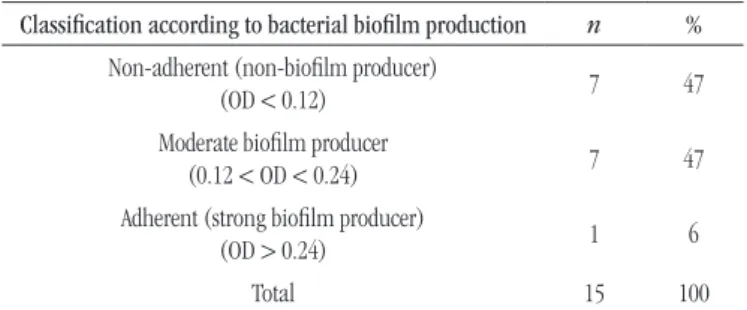
In relation to bioilm production, the 15 analyzed strains
of Enterobacter sp. were classiied as non-adherent, moderate producer, and strong producer; and their characterization can be
observed in the Table.
FIGURE 1 − Prevalence of microorganisms isolated from PU exudate among internal medicine inpatients, Petrolina (PE)
PU: pressure ulcer.
60% 50% 40% 30% 20% 10% 0% Prevalence Enterobacter sp. 50% 30% Escherichia coli 13% Citrobacter sp. 3% 3% Absence of bacterial growth Edwardsiella sp.
TABLE − Enterobacter sp. strains isolated from PU exudate among internal
medicine inpatients, Petrolina (PE) – classification according to biofilm production
Classification according to bacterial biofilm production n % Non-adherent (non-bioilm producer)
(OD < 0.12) 7 47
Moderate bioilm producer
(0.12 < OD < 0.24) 7 47
Adherent (strong bioilm producer)
(OD > 0.24) 1 6
Total 15 100
Source: CPqAM/Fiocruz.
DISCUSSION
In the current study there was predominance of bacteria
isolates of the Enterobacteriaceae family, especiallyEscherichia coli sp. and Enterobacter sp. Some studies show predominance of bacteria of the same family in samples of nosocomial infections, with predominance of Escherichiacoli sp., Enterobacter sp. and
Pseudomonas sp.(9, 13, 18). In the present study, among the PU
collected samples, predominance was observed of bacteria of the Gram-negative group, and all were multiresistant to the used antimicrobials. Braga (2011)(19) and Pirret (2011)(5) stated that
in chronic lesions such as PU, the presence of epidemiologically important microorganisms such as Gram-negative bacilli, is common. They can evolve to an infection or work as a reservoir of multiresistant microorganisms. Besides extrinsic and intrinsic factors that induce bacterial resistance, bioilm production is responsible for a large percentage of nosocomial infections(20).
Enterobacter sp. is frequently related to infections with the presence of bioilm(14).
The strains isolated in this study proved multiresistant to antimicrobials used in clinical routine, principally cefotaxime, chloramphenicol, cefalotin, cefalexin, and clarithromycin. At a research(19) conducted with isolates from culture of pulmonary
secretion present in the orotracheal tube (OTT), tracheostomy and central vascular catheter (CVC) tip cultures, a proile of resistance to cephalosporins similar to that of isolates of
Enterobacter sp. was observed, conirming the results described in this work.
Roca (2009)(21) conducted a study with Enterobacter sp.
in isolates from urinary infection, in which he observed 68.7% resistance to third-generation cephalosporins (ceftazidime and ceftriaxone). In the present study, there was greater prevalence of resistance to the same antimicrobials (ceftazidime 93%, and ceftriaxone 60%). Some mutant strains may hyperproduce beta-lactamase, conferring resistance to third-generation cephalosporins(1).
In the current research most strains (47%) of Enterobacter sp. revealed to be bioilm producers (adherent). In studies conducted
on isolates from orthopedic implants(22), Enterobacter sp. strains
proved to be bioilm producers, and then, resistant to gentamicin and octenidine hydrochloride. International publications display similar results, in which isolated subcultures of Enterobacter sp. produce bioilm of signiicant intensity(23), besides demonstrating
that the Enterobacter sp. capacity to form bioilm is correlated
with the messenger ribonucleic acid (mRNA) expression level of CSGA and CSGD genes. There is still the presence of curli imbriae that can play an important role in bioilm formation in
Enterobacter sp. strains(11, 24).
Although some researches demonstrate a bacterial behavior non-producer of bioilm (non-adherent), the infection sites (infectious environment) – tracheal aspirate(10) and urinary
tract(21, 25) – are important variables in the expression of
virulence factors, such as bioilm production. Thus, one may infer that such regions are manipulated with greater frequency than PUs.
Bacterial typing is a considerable analysis, because it is based on the idea that bacterial clonal lineages share properties that may be identiied and used to distinguish them from the non-similar ones. Strain typing was not performed in this irst moment, but it will be done in a future step, once the main objective of this work was to verify the relationship between bioilm production and the resistance proile of the analyzed
strains.
CONCLUSION
Enterobacter sp. strains showed high resistance proile to the antimicrobials used in clinical routine of the cited hospital. Moreover, most of them were classiied as moderate bioilm producers in the assessed PUs.
REFERENCES
1. Henriques A, Vasconcelos C, Cerca N. A importância dos bioilmes nas infeções nosocomiais – o estado da arte. Arquivos de Medicina. 2013; 7(1): 27-36.
2. Jawetz EA, Morse SA, Butel JS, Brooks GF, Karen CC, Timothy AM. Microbiologia médica. 25 ed. Rio de Janeiro: Guanabara Koogan; 2010. Cap. 15, p. 213.
3. Trabulsi LT, Alterthum F.; Microbiologia. 8 ed. Rio de Janeiro: Atheneu; 2008.
4. Stepanovic S, Vukovic D, Dakic I, Savic B, Svabic-Vlahovic M. A modiied microtiter-plate for quantiication of staphylococcal bioilm formation. J Microbiol Methods. 2000; 40(2): 175-9.
5. Pirret CCNS. Úlcera por pressão colonizada por Staphylococcus aureus resistente a meticilina: reservatório, fatores de risco e evolução para infecção local e bacteremia em um hospital de ensino de longa permanência [dissertation]. Uberlândia: Universidade Federal de Uberlândia, Programa de Pós-graduação em Ciências da Saúde; 2011. 6. Santos SLV. Bastonetes Gram-negativos em úlceras venosas e implicações para o atendimento de enfermagem na atenção primária. Rev Eletr Enf. 2014; 16(2): 370-7. Available at: http://dx.doi.org/10.5216/ ree.v16i2.24670.
7. Naher J, Shahidul AC, Abdullah AM, Nuruddin M, Wahhida S, Ruhul AK. A comparative study on the bioilm formation of Enterobacter agglomerans and Serretia rubideae in different environmental parameter under single culture condition. Open J Med Microbiol. 2014; 4: 70-6. 8. Bartoszewicz M, Rygiel A, Krzemiński M, Przondo-Mordarska A. Penetration of a selected antibiotic and antiseptic into a bioilm formed on orthopedic steel implants. Ortop Traumatol Rehabil. 2007; 9(3): 310-8. 9. Bomim EO, Cabral DB, Júnior LCL, Santos MFS, Cavalcante GM. Úlceras por pressão em pacientes com lesão medular traumática: subsídios na identiicação microbiológica. J Res Fundam Care Online 2014. Available at: www.seer.unirio.br/index.php/cuidadofundamental/ article/. [Access on: 10 June 2014].
RESUMO
Introdução: O gênero Enterobacter é formado por bactérias fermentadoras de lactose. Esse microrganismo causa largo espectro de infecções hospitalares, como pneumonia, infecções do trato urinário e feridas, além de associar-se à colonização de dispositivos hospitalares. Objetivo: Definir o perfil de resistência e a produção de biofilme de cepas de Enterobacter sp. isoladas de úlcera por pressão. Materiais e métodos: Estudo quantitativo, tipo pesquisa de campo (documental) laboratorial, realizado em um hospital do município de Petrolina (PE). Foram coletadas amostras de 30 feridas de pacientes internados na clínica médica, portadores de úlceras por pressão em estágio II, utilizando a técnica em “Z” com swab estéril no período de fevereiro a maio de 2014. Resultados:
As bactérias mais prevalentes foram Enterobacter sp. e Escherichia coli. Todas se mostraram multirresistentes aos antimicrobianos. As cepas de Enterobacter sp. em sua maioria foram classificadas como produtoras moderadas de biofilme. Conclusão: As cepas de Enterobacter sp. mostraram alto perfil de resistência aos antimicrobianos usados na rotina clínica.
Unitermos:Enterobacter; biofilmes; úlcera por pressão; resistência microbiana a medicamentos.
10. National Pressure Ulcer Advisory Panel (NPUAP), 2007. Available at: http://www.npuap.org. [Access on: 10 de June 2014].
11. Kim SM, Hee WL, Yeh WC, et al. Involvement of curli fimbriae in the biofilm formation of Enterobacter cloacae. J Microbiol. 2012; 50(Issue 1): 175-8.
12. Lucchetti G, Silva AJ, Ueda SMY, Perez MCD, Mimica LMJ. Infecções do trato urinário: análise da frequência e do peril de sensibilidade dos agentes causadores de infecções do trato urinário em pacientes com cateterização vesical crônica. J Bras Patol Med Lab. 2005; 41(6): 383-9. 13. Ferraiuoli GIA. Fatores de risco para infecção por enterobactérias resistentes às oximino-cefalosporinas em um hospital universitário do Rio de Janeiro [dissertation]. Rio de Janeiro: Universidade Federal do Rio de Janeiro, Faculdade de Medicina; 2005.
14. Wada A, Neto NT, Ferreira MC, et al. Úlceras por pressão. Rev Med. 2010; 89(34): 170-7.
15. Luz SR. Úlcera por pressão. Geriatria & Gerontologia. 2010; 4(1): 36-43. 16. Tabari L. Preparo do leito da ferida antes do tratamento cirúrgico da úlcera por pressão em indivíduos com lesão medular [dissertation]. Brasília, DF: Departamento de Enfermagem da Faculdade de Ciências da Saúde da UnB; 2014.
17. Christensen GD, Simpson WA, Younger JJ, et al. Adherence of coagulase negative Staphylococci to plastic tissue cultures: a quantitative model for the adherence of Staphylococci to medical devices. J Clin Microbiol. 1995; 22: 996-1006.
CORRESPONDING AUTHOR
Gleise Gomes Soares
Rio Grêmio, 15, casa; José e Maria; CEP: 56320-150; Petrolina-PE, Brasil; e-mail: [email protected]. 21. Roca DAL, Roca LML, Huamán EM. Padrão de suscetibilidade
antimicrobiana de Enterobacter ssp. isolada de infecções urinárias em pacientes ambulatoriais em um hospital da cidade de Lima, Peru. Perspectivas Médicas. 2009; 20(2).
22. Barros LM, Bento JNC, Caetano JA, et al. Prevalência de micro--organismo e sensibilidade antimicrobiana de infecções hospitalares em unidade de terapia intensiva de hospital público no Brasil. Rev Ciênc Farm Básica Apl. 2012; 33(3): 429-35.
23. Meireles MAOM. Uso de antimicrobianos e resistência bacteriana: aspectos socioeconômicos e comportamentais e seu impacto clínico e
ecológico [dissertation]. Belo Horizonte: Universidade Federal de Minas Gerais, Microbiologia do Instituto de Ciências Biológicas; 2008. 24. Zogaj X, Bokranz W, Nimtz M, Romling U. Production of cellulose and curli imbriae by members of the family Enterobacteriaceaeisolated from