Arq Bras Cardiol 2003; 80: 325-8.
Costa Jr. et al Acute myocardial infarction after myocardial revascularization
3 2 5 3 2 5
Hospital do Coração – ASS.
Mailing address: José Ribamar Costa Jr. – Hospital do Coração - Rua Desembargador Eliseu Guilherme, 123 - 04004-030 – São Paulo, SP – Brazil - E-mail: [email protected]
Arq Bras Cardiol, volume 80 (nº 3), 325-8, 2003
José Ribamar Costa Jr., Dinaldo C. Oliveira, Alexei DerBedrossian, Enilton T. Egito, Edson R. Romano, Marcos O. Barbosa, Ieda M. Liguori, Jorge Fahran, Luis C. B. Souza,
Adib D. Jatene, Leopoldo S. Piegas
São Paulo, SP - Brazil
Risk Factors for Acute Myocardial Infarction During the
Postoperative Period of Myocardial Revascularization
Original Article
Atherosclerotic coronary disease, in its chronic and acute presentation, is 1 of the 3 major causes of morbidity and mortality in the world 1,2.
It is estimated that thousands of people are injured or die due to atherosclerotic coronary disease, in addition to the cost of hospital care with this disease 1.
One treatment of choice for atherosclerotic coronary disease is myocardial revascularization, performed for the first time as an emergency in 1964 by Garret et al 3, but
actually recognized, disseminated, and enhanced with the studies of Favaloro et al 4,5 at the end of the 1960s.
We believe that in 2001 about 700 myocardial revascu-larization surgeries were performed all over the world 6.
Acute myocardial infarction in the postoperative period is one of the possible complications of myocardial revascularization, and its incidence, depending on the criteria adopted to define it, ranges from 4 to 8% 7-11. Acute
myocardial infarction in the postoperative period increases hospital stay and mortality, involving left ventricular func-tion significantly, contributing to a worse medium- and long-term prognosis of these patients 7,8,12,13.
This study was performed with the primary purpose of identifying predictor risk factors for acute myocardial infarc-tion in the postoperative period, and had the secondary purpose of assessing its incidence in the referred hospital and its influence on mortality and increased hospital stay.
Methods
From June 1995 to September 2000, 89 patients under-going myocardial revascularization at the Hospital do Cora-ção, Associação do Sanatório Sírio, experienced acute myo-cardial infarction in the postoperative period. We performed a retrospective case-control study paired according to the interval between the surgeries (± 6 months between myo-cardial revascularization of case and control groups), to age (± 5 years), sex, number and types of grafts [example: 1
Objective - To identify risk factors for acute myocar-dial infarction during the postoperative period after myo-cardial revascularization.
Methods - This was a case-control study paired for sex, age, number, type of graft used, coronary endarterec-tomy, type of myocardial protection, and use of extracorpo-real circulation. We assessed 178 patients (89 patients in each group) undergoing myocardial revascularization, and the following variables were considered: dyslipide-mia, systemic hypertension, smoking, diabetes mellitus, previous myocardial revascularization surgery, previous coronary angioplasty, and acute myocardial infarction.
Results - Baseline clinical characteristics did not differ in the groups, except for previous myocardial revas-cularization surgery, prevalent in the case group (34 patients vs. 12 patients; p = 0.0002). This was the only in-dependent predictor of risk for acute myocardial infar-ction in the postoperative period, based on a multivariate logistic regression analysis (p=0.0001). Mortality and the time of hospital stay of the case group were significantly higher (19.1% vs. 1.1%; p<0.001 and 15.7 days vs. 10.6 days; p<0.05 respectively) than those of the control.
Conclusion - Only previous myocardial revasculari-zation was an independent predictor of acute myocardial infarction in the postoperative period, based on multiva-riate logistic regression analysis.
3 2 6 3 2 6
Costa Jr. et al
Acute myocardial infarction after myocardial revascularization
Arq Bras Cardiol 2003; 80: 325-8.
Results
In the study period, 3,068 patients underwent myocar-dial revascularization, and 89 (2.9%) evolved to acute myo-cardial infarction in the postoperative period.
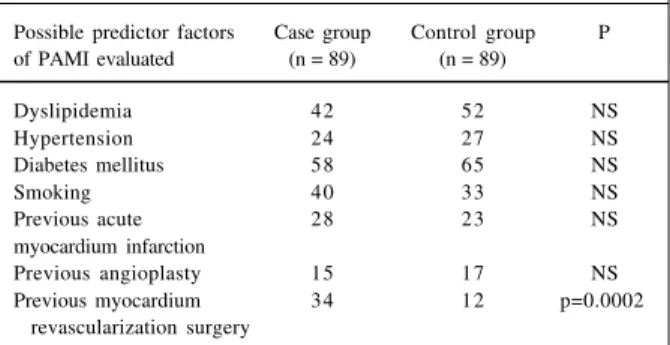
Table I shows the univariate analysis of the possible predictive factors of acute myocardial infarction in the postoperative period. In this group, previous myocardial revascularization was present more frequently (34 vs. 12; p=0.0002).
The mean time of hospital stay was higher in the cases of acute myocardial infarction in the postoperative period, when compared with that in to the control cases (15 vs. 10 days; p<0.05, fig. 1). Hospital mortality was also higher among patients who experienced acute myocardial infarc-tion in the postoperative period of myocardial revasculari-zation (19.1% vs. 1.1%; p<0.001, fig. 2).
Table II presents the results of the multivariate analy-sis according to the multiple logistic regression model. In the multivariate analysis of the possible predictors of acute myocardial infarction in the postoperative period, only previous myocardial revascularization surgery was a strong predictor (odds ratio 5.27; confidence interval from 2.35 to 11.82, p <0.0001).
patient who received 1 saphenous vein graft for the circum-flex artery and for right coronary arteries, and a left internal mammary artery for the anterior descending artery was paired with another patient who had also received a saphenous vein graft for the circumflex artery, a saphenous vein graft for the right coronary artery and left internal mammary anterior descending artery], to endarterectomy performance (example: one patient in whom endarterectomy was performed in the right coronary artery was paired with another in whom endarterectomy was performed in the right coronary artery), myocardial protection (blood cardioplegy and intermittent aortic cross clamping), and use of extracorporeal circulation. Acute myocardial infarction in the postoperative period of myocardial revascularization was determined to be when new Q waves occurred (greater than 30 ms and 0.1mV) in one or more eletrocardiographic derivations or when an elevation of the creatine kinase MB fraction acti-vity (CKMB) was more than 3 times above the standard value (10 international units), in the period between the surgical act and the 7th day of the postoperative period. Electrocardiography was routinely performed in the pre-operative period, when the patient arrived at the surgical ward, on the 1st postoperative day, and on the morning of the hospital discharge. CKMB was measured 6 and 12 hours after the end of surgery. When it was more than 3 times above the reference value, serial collection was started to obtain an enzymatic curve.
Possible predictive factors for acute myocardial infarc-tion in the postoperative period were smoking status, dysli-pidemia, systemic hypertension, diabetes mellitus, previous acute myocardial infarction, previous myocardial revas-cularization (performed between 3 and 10 years after the date of the last myocardial revascularization), or previous coronary angioplasties.
The statistical analysis was performed with the chi-square test and adjusting for confounding factors. To esti-mate relative risk, we used multivariate logistic regression model analysis (where the expert determined the inclusion of the variable to be analyzed in the model). Confidence interval was 95% and p was significant when < 0.05.
Information regarding the patients was obtained from the postoperative myocardial revascularization database of
the hospital. Fig. 1 – Hospital stay.
Fig. 2 – In-hospital mortality. Table I – Univariate analysis of the possible predictive factors of
acute myocardial infarction in the postoperative period
Possible predictor factors Case group Control group P of PAMI evaluated (n = 89) (n = 89)
Dyslipidemia 42 52 NS
Hypertension 24 27 NS
Diabetes mellitus 58 65 NS
Smoking 40 33 NS
Previous acute 28 23 NS
myocardium infarction
Previous angioplasty 15 17 NS
Arq Bras Cardiol 2003; 80: 325-8.
Costa Jr. et al Acute myocardial infarction after myocardial revascularization
3 2 7 3 2 7
Discussion
Acute myocardial infarction in the postoperative myo-cardial revascularization period is a complication that results in worse evolvement in a short- and long-term 14-18.
Several studies have reported measures that aim at decreasing the incidence of acute myocardial infarction in the postoperative period, in particular enhancement of myocardial protection techniques, enhancement of surgical technique (for example, use of arterial grafts, of circulatory support (especially intraaortic balloon), and pharmacolo-gical advances 19,20.
Several authors 10,18,21,22 have tried to identify risk
fac-tors for acute myocardial infarction in the postoperative period. It is accepted that left main coronary trunk lesion, 3-vessel coronary artery disease, ejection fraction lower than 30%, emergency surgery, acute myocardial infarction within less than a week, timing of the clamp release in aortic cross-clamping greater than 100 minutes, acute coronary syndrome without ST segment elevation, and previous surgical myocardial revascularization are factors that increase the risk of acute myocardial infarction in the postoperative period.
In this study, risk incidence and hospital mortality were more elevated in those patients with acute myocardial infarction in the postoperative period (19% vs. 1.1%; p<0.0001), which is in accordance with data from the literature 18,21-23.
Among the variables tested as possible risk factors, only the presence of previous myocardial revascularization was identified as an independent predictor of risk. We have pointed out that the mean time of previous infarction in our group of patients was 24 days, and risk factors for atheros-clerotic coronary disease tested (dyslipidemia, smoking, diabetes mellitus, and systemic hypertension) were not predictors of acute myocardial infarction in the postope-rative period of myocardial revascularization.
We also observed increased hospital stay in the case group in comparison with that of the control.
Based on these results, we concluded that acute myo-cardial infarction in the postoperative period after myocar-dial revascularization surgery results in greater hospital mortality; however, in this study it was a low-incidence complication, and the previous myocardial revascularization was the only predictor of risk.
References
1. WHO - MONICA Project: myocardial infarction and coronary deaths in the World Health Organization Monica Project: registration produces, events rates and case-fatality rates in 38 populations from 21 countries in four continents. Circulation 1994; 90: 583.
2. Maseri A. Ischemic Heart Disease. New York: Churchill Livingstone, 1995: 713p.
3. Garret HE, Dennis EW, Debakey ME. Aortocoronary bypass with saphenous vein graft: seven-year follow-up. JAMA 1973; 223: 792.
4. Favaloro RG. Saphenous vein autograft replacement of severe segmental coronary artery occlusion: operative technique. AnnThorac Surg 1968; 5: 334. 5. Johnson WD, Flemma RJ, Lepley LD, et al. Extended treatment of severe coronary
artery desease: a total surgical approach. Ann Surg 1969; 170: 460. 6. Stone G. In: Transcatheter Cardiovascular Therapeutics, 2001.
7. Namay DL, Zia MS, Dodge HT, Namay K. Effect of perioperative myocardial infarction on late survival in patients undergoing coronary artery bypass surgery. Circualation 1982; 65: 1066-71.
8. Chaintman BR, Alderman EL, Sheffield LT, et al. Use of survival analysis to determine the clinical significance of new Q waves after coronary artery bypass surgery. Circulation 1983; 67: 302-9.
9. Iyer VS, Russell WJ, Leppard P, et al. Mortality and myocardial infarction after coronary artery surgery. Med J Aust 1993; 159: 166-70.
10. Antman EM, Collins Jr JJ, Rizzo RJ. Current incidence and determinants of perioperative myocardial infarction in coronary artery surgery. Am Heart J 1996; 132: 572-8.
11. Serruys WP, Sousa JEMR, Jatene AD, et al. Comparison of coronary artery bypass surgery and stenting for the treatment of multivessel desease. N Engl J Med 2001; 344: 1117-24.
12. Myers WD, Davis K, Foster ED, et al. Surgical survival in the coronary artery surgery study registry. Ann Thorac Surg 1985; 40: 245-60.
13. Force T, Kemper AJ, Bloomfield P, et al. Non-Q wave perioperative myocardial infarction: assessment of the incidence and severity of regional dysfunction with quantitative two-dimensional echocardiography. Circulation 1985; 72: 781-9. 14. Guiteras VP, Pelletier LC, Hernandez MG, et al. Diagnostic criteria and prognosis of perioperative myocardial infarction following coronary bypass. J Thorac Cardiovasc Surg 1983; 86: 878-86.
15. Burton JR, FitzGibbon GM, Keon WJ, et al. Perioperative myocardial infarction complicating coronary bypass: Clinical and angiographic correlations and prognosis. J Thorac Cardiovasc Surg 1981; 82: 758-64.
16. Force T, Hibberd P, Weeks G, et al. Periopaerative myocardial infarction after coronary artery bypass surgery: Clinical significance and approach to risk stratification. Circulation 1990; 82: 903-12.
17. Stahle E, Bergstroom R, Holmberg L, et al. Risk factors for operative mortality and morbidity in patients undergoing coronary artery bypass surgery for stable angina pectoris. Eur Heart J 1991; 12: 162-8.
18. Svedjeholm R, Olin C, Dahlin LG. Perioperative Myocardial Infarction in Cardiac Surgery: Risk Factors and Consequences – A Case Control Study. Scan Cardiovasc J 2000; 34: 522-7.
19. Buckberg GD. Strategies and logic of cardioplegic delivery to prevent, avoid Table II – Multivariate analysis of risk factors for acute myocardial infarction in the postoperative period
Risk Factors Case Control Odds ratio IC of 95% P
Dyslipidemia 47.2% 58.4% 0.60 0.31 < OR < 1.13 0.11
Smoking 44.9% 37.1% 1.41 0.74 < OR < 2.66 0.29
Previous ATC 16.9% 18% 0.73 0.30 < OR < 1.74 0.47
Diabetes mellitus 34.8% 27% 1.95 0.97 < OR < 3.91 0.0598
SH 73% 69.7% 0.99 0.48 < OR < 2.02 0.98
Previous MAI 25.8% 31.5% 0.75 0.36 < OR < 1.52 0.42
3 2 8 3 2 8
Costa Jr. et al
Acute myocardial infarction after myocardial revascularization
Arq Bras Cardiol 2003; 80: 325-8.
and reverse ischemic and reperfusion damage. J Thorac Cardiovasc Surg 1987; 93: 127-39.
20. Ovrum E, Abdelnoor M, Forfang K. Effect of aortic cross-clamp time on myocardial infarction after coronary bypass surgery. Asian Cardiovasc Thorac Ann 1997; 5: 77-82.
21. Weintraub WS, Jones EL, King SP III, et al. Changing use of coronary
angioplasty and coronary bypass surgery in the treatment of chronic coronary artery disease. Am J Cardiol 1990; 65: 183-8.
22. Sanz G, Pomar LJ, Bosch X, et al. Predictors of Early Saphenous Vein Aortocoronary Bypass Graft Occlusion. Ann Thorac Surg 1993; 56: 1101-6. 23. Dargie HJ, Lip GYH, Metcalfe MJ. Factors Influencing coronary artery bypass