117 Radiol Bras. 2013 Mar/Abr;46(2):117–121
Magnetic resonance imaging in intersection syndrome
of the forearm: iconographic essay
*
Ressonância magnética na síndrome da interseção do antebraço: ensaio iconográfico
Bruno Beber Machado1, Claudio Marcio Amaral de Oliveira Lima2, Flávia Pegado Junqueira3,
Antônio Carlos Coutinho Junior2
Magnetic resonance imaging plays a relevant role in the assessment of patients with pain on the dorsal aspect of the distal forearm and wrist. Among the causes of pain, intersection syndrome is highlighted, corresponding to an inflammatory process affecting the tendons of the second compartment of the forearm extensor (extensor carpi radialis brevis and extensor carpi radialis longus), usually caused by direct trauma or repetitive activities requiring wrist flexion and extension. The present essay is aimed at illustrating the typical findings in intersection syndrome of the forearm and discuss the main differential diagnoses.
Keywords: Forearm; Intersection; Magnetic resonance imaging; Extensor compartment.
A ressonância magnética tem papel importante na avaliação de pacientes com dor na face dorsal do antebraço distal e do punho. Entre as causas de dor destaca-se a síndrome da interseção, um processo inflamatório dos tendões do segundo compartimento extensor do antebraço (extensor radial curto do carpo e extensor radial longo do carpo), ge-ralmente provocado por trauma local direto ou atividades repetitivas que exigem a flexão e extensão do punho. Nosso trabalho visa a ilustrar os achados típicos da síndrome da interseção do antebraço e discutir os principais diagnósticos diferenciais.
Unitermos: Antebraço; Interseção; Ressonância magnética; Compartimento extensor.
Abstract
Resumo
* Study developed at Clínica de Diagnóstico Por Imagem (CDPI)/MD.X, Rio de Janeiro, RJ, Brazil.
1. MD, Radiologist, Clínica Medimagem, Cachoeiro de Itape-mirim, ES, Brazil.
2. MDs, Radiologists, Clínica de Diagnóstico Por Imagem (CDPI)/MD.X, Rio de Janeiro, RJ, and Centro de Diagnóstico por Imagem Fátima Digittal, Nova Iguaçu, RJ, Brazil.
3. MD, Radiologist, Clínica de Diagnóstico Por Imagem (CDPI), Rio de Janeiro, RJ, Brazil.
Mailing Address: Dr. Claudio Marcio Amaral de Oliveira Lima. CDPI/MD.X Barra Medical Center. Avenida das Américas, 6205, Loja G e subsolo, Barra da Tijuca. Rio de Janeiro, RJ, Brasil, 22793-080. E-mail: [email protected] / antoniocoutinhojr @yahoo.com.br.
Received November 6, 2012. Accepted after revision Decem-ber 21, 2012.
Machado BB, Lima CMAO, Junqueira FP, Coutinho Junior AC. Magnetic resonance imaging in intersection syndrome of the forearm: iconographic essay. Radiol Bras. 2013 Mar/Abr;46(2):117–121.
sequences, as well as axial, coronal and sagittal DP with fat suppression before and after intravenous paramagnetic contrast injection (gadolinium, 0.1 mmol/kg of weight).
ANATOMY (Figures 1, 2 and 3)
The extensor carpi radialis longus (ECRL) and the extensor carpi radialis brevis (ECRB) muscles act synergically with the finger flexor muscles for wrist flexion. The first one covers the latter, and originates from the supracondylar crest of the humerus, but some fibers come from the common extensor tendon of the fore-arm. It ends at a flattened tendon which deeply follows the deep extensor muscles of the forearm, abductor pollicis longus muscle (APL) and the abductor pollicis brevis muscle (APB). The ECRB originates from the lateral epicondyle of the humerus, through a common tendon with the com-mon extensor muscle of the fingers and ends at a flattened tendon which follows the ECRL. It inserts into the dorsal surface It is clinically characterized by pain in
the dorsal aspect of the forearm and the wrist, and edema proximal to the Lister’s tubercle. A careful physical examination and appropriate clinical workup limit the hypotheses to a relatively small number of differential diagnoses, principally De Quervain’s tenosynovitis. Magnetic reso-nance imaging (MRI) is a fundamental tool for the diagnosis of such a common, but not frequently diagnosed syndrome(11–13).
The authors present, in the form of an iconographic essay, MRI findings and dis-cuss the most relevant differential diag-noses.
MRI PROTOCOLS
The images were acquired in a 1.5 T (Magnetom Avanto; Siemens Medical Sys-tems, Erlagen, Germany) and a 3 T (Mag-netom Trio; Siemens Medical Systems, Erlagen, Germany) apparatuses, with sur-face coils.
The following pulse sequences were utilized: axial and coronal T1-weighted
INTRODUCTION
Recently, the imaging evaluation of the musculoskeletal system has motivated a series of studies published in the Brazilian radiological literature(1–10).
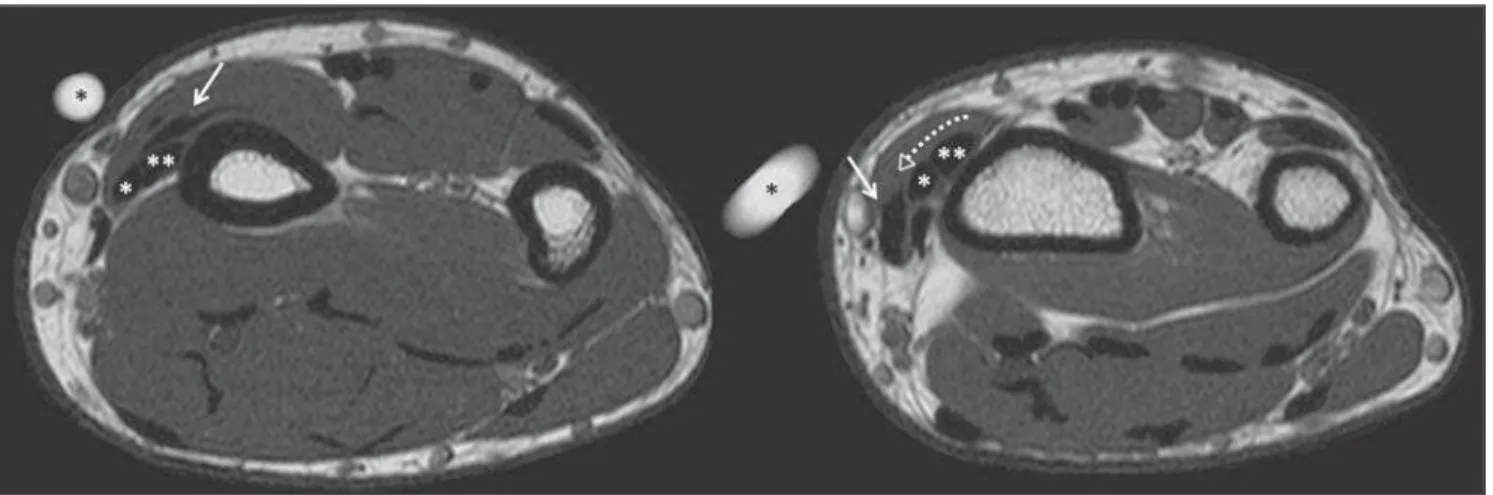
Figure 2. Axial, T1-weighted sequences at the level of the distal third of the forearm on the first intersection of the extensor tendons. Abductor pollicis longus and extensor pollicis brevis muscles (arrow) cross (dashed arrow) the extensor carpi radialis longus (white asterisk) and extensor carpi radialis brevis muscles (white double asterisk). Skin marker (black asterisk).
to the wrist, which runs in a lateral groove together with the APB tendon. The tendon generally unfolds into two components, one inserting into the radial aspect of the base of the first metacarpal bone, and the other into the trapezoid bone. The APB is medially and inferiorly located in relation to the APL and originates from the poste-rior surface of the radius. Its direction is similar to that of the APL and its tendon inserts into the dorsal surface of the proxi-mal phalanx of the hallux. In the lower third of the forearm, the APL and the APB become superficial, and then obliquely cross the tendons of the extensor carpi ra-dialis, cover the termination of the brachioradialis muscle and, while crossing the most lateral compartment of the exten-sor retinaculum in a single synovial sheath, superficially cross the radius styloid pro-cess and the radial artery(14).
DISCUSSION
ISF, a not often diagnosed cause of pain on the dorsal aspect of the wrist, is a non-infectious inflammatory process affecting the dorsal aspect of the forearm, about 4 to 8 cm proximal to the Lister’s tubercle(12,13). Also known as crepitating peritendinitis, cross syndrome, subcutaneous perimyosi-tis, bursitis of the abductor pollicis longus, oarsman’s wrist, bugaboo forearm, among others(11–16), this syndrome was described by Velpeau in 1841, however the term “in-tersection syndrome” was introduced by Dobyns et al. in 1978 and defined as an of the base of the second and third
metac-arpal bones. Such two tendons cross the same compartment of the extensor reti-naculum in a single synovial sheath and may unfold into two or three fascicles, or may join together or exchange muscle fas-cicles(14).
The abductor pollicis longus muscle (APL) and the abductor pollicis brevis muscle (APB) represent the principal deep
extensor muscles of the forearm involved in the ISF. The APL originates from the posterior surface of the ulnar diaphysis, below the anconeus, the interosseous mem-brane and the middle third of the posterior surface of the radius, and follows infero-laterally, becoming superficial at the distal segment of the forearm, and visible as an oblique relief. It ends in tendon which be-comes devoid of muscle fibers proximally
scribed in 1985 by Grundberg et al., sug-gested that the genesis of the process would be a stenosing tenosynovitis of second dor-sal compartment, with extension of the in-flammatory process to adjacent soft tis-sues(13,16).
Clinical manifestations include phlogis-tic signs on the dorsal aspect of the wrist, typically between 4–8 cm proximal to the Lister’s tubercle, with functional limitation and crepitation at wrist movements, present in more severe cases(11–13).
Ultrasonography and MRI are exten-sively applied methods, both in athletes or in non athletes, for evaluation of muscu-loskeletal lesions(17–19). In ISF, MRI is the main diagnostic method and the findings include peritendinous edema around the first and second extensor compartments, at the level of their intersection, with fluid surrounding the tendons and in their sheaths or between them, notably at the level of the intersection point (Figures 5 and 6). Additional findings include tendinosis, muscle and subcutaneous edema(11). The utilization of gadolinium is questionable, since T2-weighted sequences can easily identify the findings of intersec-tion syndrome; but, when utilized, the peritendinous enhancement is intense(11– 13,20)
. It is important to utilize skin markers, and the extent of the field of view (FOV) must proximally cover the area of intersec-tion(11–13,20). The axial plane is most appro-priate for diagnosis(12,13), however, a sagit-Figure 3. Proton density-weighted sequences with fat suppression in the oblique sagittal plane,
demon-strating the intersection (arrow) of the tendons of the first and second compartments.
inflammatory process of the tendons of the second extensor compartment of the fore-arm (ECRB and ECRL), generally caused by direct local trauma or activities that re-quire repeated flexion and extension of the wrist. Such activities may be sport activi-ties such as rowing, canoeing, racket games, weight lifting, ski and horse riding, or labor activities such as those of farmers, carpenters or secretaries(13). It is most
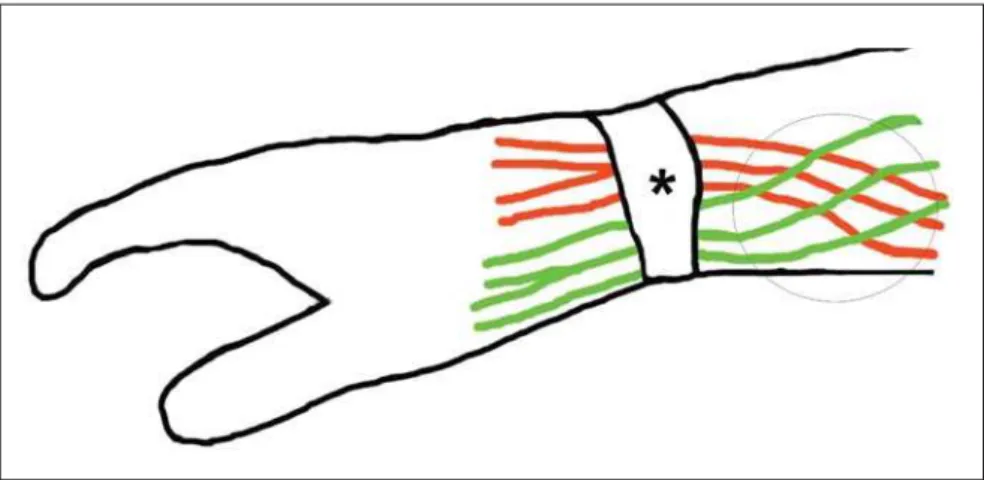
prevalent in young adults (mean age of 39.3 years) regardless of gender(12). The physio-pathology of this condition is uncertain, but two theories have been described. The first theory, proposed by Howard in 1937, re-ports that the friction between the muscle bundles of the APL and APB and the syn-ovial sheath of the second compartment would be responsible for the genesis of the disorder (Figure 4). The other theory,
de-Figure 4. Schematic drawing showing forearm anatomy, indicating the intersection point (circle) of the extensor radialis longus and extensor carpi radialis brevis (in orange) with the tendons of the abductor pollicis longus and extensor pollicis brevis (in green) muscles, and their pathways through the extensor retinaculum (asterisk).
Figure 7. Schematic drawing of the differential topognosis between intersection syndrome (A) and De Quervain’s tenosynovitis (B).
tal oblique plane oriented towards the ten-dinous intersection provides more details than the standard sagittal plane(12,13).
De Quervain’s tenosynovitis is the main differential diagnosis (Figure 7), corre-sponding to a stenosing tenosynovitis of the first extensor compartment, generally occurring several centimeters below the tendinous intersections. The Finkelstein’s test at physical examination is pathogno-monic of such a condition. The MRI find-ings described by Glajchen et al. include increased thickness of the tendon inside the first extensor compartment at the level of the radius distal extremity and increased signal intensity within the synovial sheath, indicating tenosynovitis. Subcutaneous edema is found in some patients(20).
Other hypotheses considered in the dif-ferential diagnosis include ligament lesions, tendinosis, tenosynovitis, cystic ganglions, soft tissue tumors, infection, Wartemberg’s syndrome (a sensitive neuropathy involv-ing the superficial branch of the radial nerve), cellulitis and muscle strain(11–13).
The treatment is initially conservative with non-steroid anti-inflammatory drugs.
Figure 6. Intersection syndrome of the forearm. Male, 55-year-old patient, swimmer, presenting pain and edema in the dorsal surface of the forearm. Proton density-weighted sequence with fat suppression in the axial plane shows marked edema of peri-tendinous soft tissues (arrows) as well as presence of fluid collec-tion (asterisks) in the interseccollec-tion point of the first and second ex-tensor compartment tendons.
Surgery for decompression of the intersec-tion area is only performed on those pa-tients who are refractory to conservative treatment(13,15).
CONCLUSION
not diagnostic. Radiologists must be atten-tive to some details during the scan and to the findings which characterize ISF.
REFERENCES
1. Chojniak R, Grigio HR, Bitencourt AGV, et al. Biópsia percutânea por agulha grossa de tumo-res de partes moles guiada por tomografia com-putadorizada: resultados e correlação com análise da peça cirúrgica. Radiol Bras. 2012;45:259–62. 2. Cotta AC, Melo RT, Castro RCR, et al. Dificul-dades diagnósticas no osteoma osteoide do coto-velo: estudo clínico, radiológico e histopatoló-gico. Radiol Bras. 2012;45:13–9.
3. Tavares Júnior WC, Faria FM, Figueiredo R, et al. Fadiga óssea: causa de dor em joelhos na os-teoartrite. Radiol Bras. 2012;45:273–8. 4. Moura MVT. Interposição de fragmento
perios-teal na fratura da placa epifisária femoral distal: estudo por ressonância magnética. Radiol Bras. 2012;45:184–6.
5. Ribeiro DS, Araújo Neto C, D’Almeida F, et al. Achados de imagem das alterações musculoes-queléticas associadas ao lúpus eritematoso sistê-mico. Radiol Bras. 2011;44:52–8.
6. Nunes RB, Amaral DT, Oliveira VS. Propedêu-tica radiológica do impacto femoroacetabular em
tempos de tomografia computadorizada e resso-nância magnética: o que o radiologista precisa saber. Radiol Bras. 2011;44:249–55.
7. Simão MN, Nogueira-Barbosa MH. Ressonância magnética na avaliação das variações anatômicas meniscais e da anatomia ligamentar perimenis-cal: potenciais causas de erro de interpretação. Radiol Bras. 2011;44:117–22.
8. Simão MN, Helms CA, Richardson WJ. Magnetic resonance imaging findings of disc-related epidu-ral cysts in nonsurgical and postoperative micro-discectomy patients. Radiol Bras. 2012;45:205– 9.
9. Jacob Jr C, Barbosa DM, Batista PR, et al. Fratura toracolombar do tipo explosão: o que o radiolo-gista deve conhecer. Radiol Bras. 2012;45:101– 4.
10. Grassi CG, Diniz FV, Garcia MRT, et al. Aspec-tos de imagem na tendinite calcária pré-vertebral. Radiol Bras. 2011;44:327–30.
11. Costa CR, Morrinson WB, Carrino JA. MRI fea-tures of intersection syndrome of the forearm. AJR Am J Roentgenol. 2003;181:1245–9. 12. Lee RP, Hatem SF, Recht MP. Extended MRI
find-ings of intersection syndrome. Skeletal Radiol. 2009;38:157–63.
13. de Lima JE, Kim HJ, Albertotti F, et al. Intersec-tion syndrome: MR imaging with anatomic
com-parison of the distal forearm. Skeletal Radiol. 2004;33:627–31.
14. Caetano MBF, Albertoni WM, Caetano EB. Es-tudo anatômico das inserções distais do tendão extensor longo do polegar. Acta Ortop Bras. 2004;12:118–24.
15. Hanlon DP, Luellen JR. Intersection syndrome: a case report and review of the literature. J Emerg Med. 1999;17:969–71.
16. Parellada AJ, Gopez AG, Morrison WB, et al. Dis-tal intersection tenosynovitis of the wrist: a lesser-known extensor tendinopathy with characteristic MR imaging features. Skeletal Radiol. 2007;36: 203–8.
17. Barbosa LH, Gil Coury HJC. A atividade do mé-dico ultra-sonografista apresenta riscos para o sistema músculo-esquelético? Radiol Bras. 2004; 37:187–91.
18. Silva HR, Simão MN, Elias Jr J, et al. Diagnóstico por imagem nas síndromes do estalido ou do res-salto. Radiol Bras. 2009;42:49–55.
19. Cunha GM, Marchiori E, Ribeiro EJ. Avaliação ultra-sonográfica da articulação do ombro em nadadores de nível competitivo. Radiol Bras. 2007;40:403–8.