ABSTRACT
Dental caries experience, oral health status and
treatment needs of dental patients with autism
Mohamed Abdullah JABER1
1- BDS, MSc, FDSRCS, FDSRCSE, PhD, Dental School, Ajman University of Science & Technology, (Al Jurf campus), Ajman, United Arab Emirates.
Corresponding address: Dr Mohamed Abdullah Jaber - Associate Professor/ Department of Surgical Sciences - College of Dentistry - Ajman University of Science & Technology (Al Jurf campus) - Ajman, P.O. Box 346 - United Arab Emirates - Phone: (+971) 67052222 ext: 6448 - Mobile (+971) 50 5178052 - Fax: (+971) 67056462 - e-mail: [email protected]
Received: July 16, 2009 - Modiication: September 29, 2009 - Accepted: February 16, 2010
O
bjectives: Autism is a lifelong neurodevelopmental disorder. The aims of this study were to investigate whether children with autism have higher caries prevalence, higher periodontal problems, or more treatment needs than children of a control group of non-autistic patients, and to provide baseline data to enable comparison and future planning of dental services to autistic children. Material and Methods: 61 patients with autism aged 6-16 years (45 males and 16 females) attending Dubai and Sharjah Autism Centers were selected for the study. The control group consisted of 61 non-autistic patients chosen from relatives or friends of autistic patients in an attempt to have matched age, sex and socioeconomic status. each patient received a complete oral and periodontal examination, assessment of caries prevalence, and caries severity. Other conditions assessed were dental plaque, gingivitis, restorations and treatment needs. Chi-square and Fisher's exact test of signiicance were used to compare groups. Results: The autism group had a male-to-female ratio of 2.8:1. Compared to controls, children with autism had signiicantly higher decayed, missing or illed teeth than unaffected patients and signiicantly needed more restorative dental treatment. The restorative index (RI) and Met Need Index (MNI) for the autistic children were 0.02 and 0.3, respectively. The majority of the autistic children either having poor 59.0% (36/61) or fair 37.8% (23/61) oral hygiene compared with healthy control subjects. Likewise, 97.0% (59/61) of the autistic children had gingivitis. Conclusions: Children with autism exhibited a higher caries prevalence, poor oral hygiene and extensive unmet needs for dental treatment than non-autistic healthy control group. Thus oral health program that emphasizes prevention should be considered of particular importance for children and young people with autism.Key words: Autism. Autistic disorder. Dental caries. Dental care for disabled. Dental care for children. Oral health.
INTRODUCTION
Autism or autistic disorder is a neurodevelopment disorder characterized by impaired social interaction, communication, and restricted and repetitive behavior. These signs all begin before a child is three years old1. Autism affects many parts of
the brain; how this occurs is not understood2. It
is a highly variable brain development disorder9
that irst appears during infancy or childhood,
and generally follows a steady course without remission30. Overt symptoms gradually begin
after the age of six months, become established
by age two or three years26, and tend to continue
through adulthood, although often in more muted form25. It is distinguished by a characteristic triad
of symptoms: impairments in social interaction; impairments in communication; and restricted interests and repetitive behavior. Other aspects, such as atypical eating, are also common but are not essential for diagnosis7.
The prevalence estimated to be 1-2 per 1,000 for autism and close to 6 per 1,000 for Autism Spectrum Disorder20, with about four times as many
males as females. The number of people known
the 1980s, partly due to changes in diagnostic practice, referral patterns, availability of services, age at diagnosis, and public awareness8, though
unidentiied environmental risk factors cannot be
ruled out27.
This complex developmental disability impairs communication, social, behavioral, and intellectual functioning. Some may express abnormal emotional and linguistic development, as well as visual and hearing impairment; others also have coexisting disabilities such as mental retardation or epilepsy, all these symptoms may complicate dental care for the affected children17. Children with autism
also commonly have damaging oral habits, such as
bruxism, tongue thrusting, picking at the gingiva,
and lip biting.
There are few studies describing oral health and dental needs of children with autism. These studies
reported no statistically signiicant differences in
the prevalence of caries, gingivitis and degree of oral hygiene in comparison with non-autistic individuals6,28 and some studies reported a lower
incidence of dental caries in autistic patients16,18.
Information on the patterns of development of the disease in the population is important because it acts as foundation for the planning of public oral health policies. Thus, the present study was carried out in an attempt to (1) describe the caries experience, treatment needs of autistic children aged 6-16 years in United Arab emirates (UAe), and (2) provide baseline data at national and regional level to enable comparison and future planning of dental services to the autistic children.
MATERIAL AND METhODS
Subjects’ Selection
Sixty-one autistic children (45 males and 16 females) attending autism centers of emirates of Dubai and Sharjah, United Arab emirates (UAe), were selected for the study. The centers offer an intensive rehabilitation program only for children diagnosed with autism. All the children had been previously examined and diagnosed medically as autistic patients according to the center’s medical records.
Consent for examining the children was obtained from the parents and respective head master.
The inclusion criteria involved were: Diagnosis of autism;
Consent;
Age between 6 and 16 years. exclusion criteria were:
Dental prophylaxes in the last 6 months;
Suffering from other diseases known to inluence
dental caries or the severity of periodontal disease such as Down’s syndrome and diabetes;
According to these criteria, 61 patients with autism were included in this study.
Control group selection
The healthy controls (61 subjects) who met the above-mentioned criteria were chosen from relatives or friends of autistic patients in an attempt to have matched age, sex, socioeconomic status and
general dental care background. All controls were medically it and none was undergoing antibiotic or antiinlammatory therapy or had undergone such
therapy in the previous 6 months.
Examination
Following a complete medical history, all subjects were examined by one examiner for oral hygiene status and dental caries while seated on a dental chair using dental mirror, explorer and a periodontal
probe with William’s markings. The examination of the soft and hard tissues was done under lash light
and regular room light. each child accompanied by his/her teacher was brought to the examination room and is seated on an adjustable chair. “Tell-Show-Feel and Do” technique was used with all the children. The dmft/DMFT index was used, with codes and criteria established by the WHO29
(1997). Met Need Index (MNI), an indication of treatment received by an individual is determined
using the ratio of the mean missing (M) plus illed (F) teeth to mean decayed, missing and illed
teeth (DMF) that is M+F/DMF. While Restorative
Index (RI) which relects the restorative care of
those who have suffered the disease is measured
by the ratio of illed (F) to illed plus decayed
teeth (F+D) percent that is F/F+D percent as
described by Jackson12 (1973). This methodology
was used systematically for all autistic and healthy control children examined. The gingival status was evaluated according to the gingival index of Loe and Silness15 (1963). Gingival status was recorded
as generalized or localized gingival inlammation
depending on the amount of gingival redness and bleeding during the examination. Oral hygiene was recorded as good, fair or poor according to
the Simpliied Oral Hygiene Index (SOHI)10. Before
examinations, intraobserver agreement for the
diagnosis of caries was checked: one in every 10
children was re-examined to test for intraexaminer
agreement. The kappa test was adopted on a tooth by tooth basis in order to check the intraexaminer
agreement in caries diagnosis, in agreement with the methodology described by Peres, et al.21 (2001).
Data Analysis
The data were summarized and described using relative frequencies and percentages for categorical variables (such as the presence of decayed teeth) and means for the interval scaled variables (such as the DMFT/dmft score). When the outcome variables were categorical, chi-squared and t-test was used to examine differences by gender, and age group
for statistical signiicance. Data were analyzed using
SPSS software, version 12·0 (SPSS Inc., Chicago,
IL, USA) for Windows. Statistical signiicance was set at P<0.05.
RESULTS
Prevalence
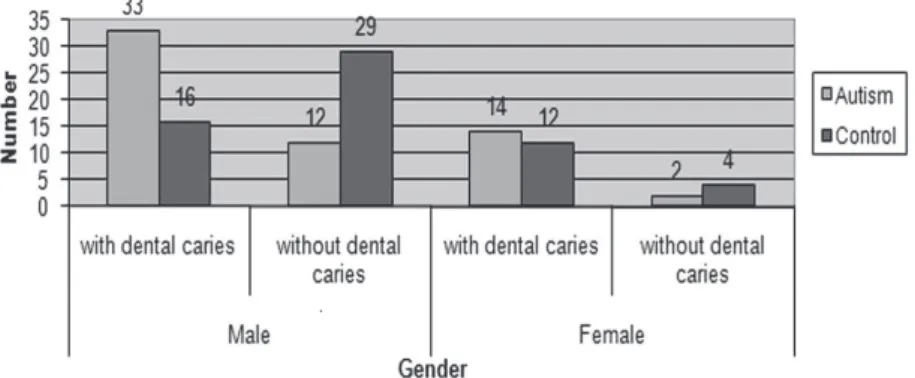
The study group comprised of 61 autistic children, 45 boys and 16 girls with a male-to-female ratio of 2.8:1 aged 6 to 16 years. The mean age of autism patients (8.45) years and healthy controls
(8.6 years) was very similar. Likewise,
male-to-female ratios of both groups were similar.
The overall prevalence of dental caries among autistic children was 77.0% (47/61) where as for the healthy controls was 46.0% (28/61) (Figure 1). The difference in the carious prevalence was
signiicant (p<0.05) between the two groups.
Mean DMFT/dmft values
For the children and adolescents with autism the values of the DMFT/dmft are presented in Table 1. The mean dmft of the autistic group was 0.80±0.2.0 while that of the controls was 0.30±0.3. The mean DMFT of the autistic group was 1.6+0.64 and 0.6+0.29 in the controls (p<0.05). There was also
no signiicant difference between male and female. The percentage of decayed, missing and illed teeth
increased with advancing age.
Met Need Index (MNI) and Restorative Index (RI) and treatment need
The mean DMFT/dmft for the 2 groups is presented (Table 2). The overall means DMFT/dmft for autistic patients was 2.4 and for healthy control was 0.9. The treatment received and restorative
care of those autistic children who have suffered the disease are presented in Table 2. The RI for autistic group was 0.02 and MNI was 0.09. For the control group the RI of 0.05 was found and MNI was 0.3 as 7 children had extraction done previously and 1 had amalgam restoration. As for the treatment need of the study population, the results showed that all of autistic children required oral prophylaxis, compared with 25 (41%) of controls. 47 (77.0%) autistic children and 28 (46.0%) controls also required restorative treatment (Table 3).
gingival status and oral hygiene condition
Oral hygiene and gingival status of the autistic children and healthy control subjects is shown in (Table 4). A total of 36 (59.0%) individuals in the control group had good oral hygiene, compared with 2 (3.3%) of the autism group. The majority of the autistic children either having poor 59.0% (36/61) or fair 37.8% (23/61) oral hygiene compared with healthy control subjects. As for the gingival status evaluation the results showed that 97.0% (59/61) of the autistic children had gingivitis which is generalized in 78.0% of the examined children or localized in 22.0% of the cases.
dmf DMFT
Group
Autistic patients 0.8±0.20 1.6±0.64
Control 0.3±0.3 0.6±0.29
p <0.05 <0.05
Gender
Autistic Female 0.65±1.4 0.50±0.49
Autistic Male 0.75±1.5 0.49±0.52
p >0.05 >0.05 Table 1- Mean decayed, missing and illed teeth (dmft/ DMFT) scores of the autism group and healthy control subjects. Data are presented as mean ± standard deviation
DISCUSSION
Autism, autistic disorder, childhood autism, or infantile autism are different terms given to the same condition2. The present study is the irst
attempt to systematically identify the problems of dental care for individuals who were diagnosed with autism in the UAe. Providing oral care to children with autism requires patience and a thorough understanding of the patient’s degree of mental disability. It was reported that better understanding of the effects of autism on the behavior of an affected individual helps the dental practitioner to deliver oral health care in an empathetic and appropriate manner5.
There are no specific genetic, medical, or
laboratory tests available to conirm the diagnosis
of autism and the comprehensive management of autism includes parental counseling, special education in a highly structured environment,
speech therapy, and social skills training, with
the ultimate goal of facilitating independence in activities of daily living and self-care. Children with autism have multiple medical and behavioral
problems, which make their dental treatment extremely dificult.
The studied group showed more males than
females, with a ratio of 2.8:1, this might relect
the higher prevalence of autism in males as it was reported in other studies14,18.
The overall prevalence of dental caries among the autistic children was 77.0%, the mean dmf, and DMF for all the autistic children and healthy control subjects was 2.4 and 0.9 respectively. This level of dental caries is considered low according
to the WHO classiication3. Comparing the results
of this study with the most recent dental survey conducted in the UAe11 involving groups of healthy
children with dmft of 10.2 conirmed the lower
caries prevalence in the autistic children in UAe.
These indings are in agreement with other regional
and international studies which reported lower
Age No D M F DMFT/dmft Mean DMFT/dmft RI MNI
Autism 47 105 8 3 116 2.4 0.02 0.09
Control 28 19 7 1 27 0.9 0.05 0.3
Total 75 124 15 4 143 1.9 0.03 0.13
Table 2- Mean decayed, missing and illed teeth (DMFT/dmft), Restorative Index (RI) and Met Need Index (MNI) for the two groups
(RI) Restorative Index=F/F+D (MNI) Met Need Index=M+F/DMF
Treatment needs Autistic patients Control Total
No % No % No %
Oral prophylaxis 61 100* 25 41.0 86 70.5
Restorations 47 77.0* 28 46.0 75 61.4
Extractions 3 5 - - 3 2.4
Endonontic treatment 7 11.4 - - 7 11.4 Table 3- Treatment needs of the of the autism group and healthy control subjects
*p<0.05 as compared to the control group
Table 4- Oral hygiene and gingival status of the 61 autistic patients and 61 healthy control subjects
Treatment needs Autistic patients Control Total
No % No % No %
Good oral hygiene 2 3.3* 36 59.0 38 31.1
Fair oral hygiene 23 38.0* 16 26.2 39 32.0
Poor oral hygiene 36 59.0* 9 14.8 45 37.0
Gingivitis 59 97.0 25 41.0 84 100
Generalized 46 78.0* 5 20.0 51 61.0
Localized 13 22.0* 20 80.0 33 39.0
caries prevalence in autistic children16,18. The higher
caries index value in permanent dentition compared with that of primary dentition is in accordance with previous studies18. However, in a recent study
from Brazil Bassoukou, Nicolau and Santos4 (2009)
reported that autistic individuals compared with non-autistic healthy controls, have neither a higher
salivary low rate nor a better buffer capacity of the
saliva and a similar dental caries experience was observed in both primary and permanent dentitions.
The percentage of decayed, missing and illed
teeth increased with advancing age. The increase attributed to the effects of time on the increased number of teeth susceptible to decay such as the second permanent molars, which erupt during adolescent period19. In general, children with autism
prefer soft and sweetened foods and they tend to pouch food inside the mouth instead of swallowing it due to poor tongue coordination, thereby increasing the susceptibility to caries14. Moreover, the risk for
dental caries can be expected to be higher in these
patients due to dificulties in brushing and lossing.
Non-institutionalized children with autism had caries rates that were similar to the rates in functionally independent peers in a study conducted by Shapira, et al.28 (1998). Rajic and Dzingalasevic24 (1989)
reported that a combined treatment, provided by
a dental team and a pedopsychiatric team working
together, resulted in a decreased prevalence of caries in a group of children with autism as compared to another group who did not receive any treatment. Addressing the high prevalence of dental caries among autistic children in UAe will require increased oral health promotion for parents and caregivers both at primary school age and at the preschool stage to enable them to implement effective preventive regimes for their children. Dental health education should include information/ guidance on reducing the frequency of sugary
foods and drinks in the diet, good oral hygiene, use of luoride toothpaste, and early attendance
at the dentist or dental nurse for advice and care. Improving access to dental care and encouraging
uptake of dental services should also form part of
any health promotion strategy for autistic children. In this study the majority of autistic children had poor oral hygiene, and almost all of them had gingivitis. These changes could be related to
irregular brushing habits because of the dificulties
the trainers and the parents encountered when they brushed the children’s teeth. It could also be due to
lack of the necessary manual dexterity of autistic
children, which result in inadequate tooth brushing.
Furthermore, the indings of this study relect poor dental awareness, a lack of dental education and deiciency in receiving oral hygiene instructions
from dental staff. Another possible explanation of the presence of generalized gingivitis might be
the side effects of medications used to control the manifestations of autism such as psychoactive drugs or anticonvulsants, with the most common drug classes being antidepressants, stimulants, and antipsychotics25. However, Pilebro and Bäckman23
(2005) in a prospective study which included clinical examinations and structured interviews produced a series of pictures that showed a structured method and technique of tooth brushing. The pictures were placed in the bathroom or wherever tooth brushing was performed. Fourteen children with autism aged between 5 and 13 years were involved, after 12 months, the amount of visible plaque was reduced. After 18 months, most parents found maintaining good oral hygiene easier than before the study and concluded that visual pedagogy is a useful tool in helping people with autism to improve their oral hygiene.
Met Need Index (MNI) and Restorative Index (RI) of the studied autistic children were low compared with healthy control subjects. Met Need Index (MNI), an indication of treatment received by an individual is determined using the ratio of
the mean missing (M) plus illed (F) teeth to mean decayed, missing and illed teeth (DMF) that is M+F/ DMF. While Restorative Index (RI) which relects
the restorative care of those who have suffered the
disease is measured by the ratio of illed (F) to illed
plus decayed teeth (F+D) percent that is F/F+D
percent as described by Jackson12 (1973). These
results indicate the provision of dental services to this unique group of patients with high prevalence of dental caries and more treatment need compared with non-autistic healthy patients. It is therefore mean that this group of autistic children needs a lot of restorative dental care, but many of them are not receiving such treatment, as only 9.5% of them received restorative treatment compared with 29.6% of non-autistic healthy patients. This may be due to the limited access to the dental services
for this group of children or due to the dificulties
in controlling those children18. Consequently, only
emergency treatment is sought when individual’s experience dental pain and lead to filling or extraction.
The person with autism generally presents a challenge to the dentist and dental care, while
behavior modiication techniques have value in
changing self-injurious behaviors, use of the reward system fails when the promised reward is no longer possible13.But adults with autism demonstrate
increased independence by developing skills
through a structured teaching22 or visual teaching23
model, such models can be used to introduce children with autism to dentistry.
efforts to establish personal contact with the dental staff. Furthermore, sedative techniques were ineffective because of atypical response patterns. Use of general anesthesia was the only solution to provide necessary dental care25. When dental needs
are great and attempts at behavior modiication are
unsuccessful, general anesthesia in the operating room creates a controlled environment where care
is delivered eficiently and effectively.
In conclusion, children with autism exhibited higher caries prevalence, poor oral hygiene and extensive unmet needs for dental treatment than non-autistic healthy control group.Thus an oral health program that emphasizes prevention is considered of particular importance for children and young people with autism.
ACKNOWLEDgEMENTS
We would like to thank Dubai and Sharjah Autism
Rehabilitation Center, children and their parents for
giving us access to conduct this study. We also like to acknowledge the help and contribution of the
doctors and other assisting staff.
REFERENCES
1- Amaral DG, Schumann CM, Nordahl CW. Neuroanatomy of autism. Trends Neurosci. 2008;31:137-45.
2- American Psychiatric Association. Pervasive developmental disorders. In:______. Diagnostic and statistical manual of mental disorders. Washington DC: American Psychiatric Association; 2000. p. 69-70.
3- Barmes De. Indicators for oral health and their implications for developing countries. Int Dent J. 1983;33:60-6.
4- Bassoukou IH, Nicolau J, Santos MT. Saliva low rate, buffer
capacity, and pH of autistic individuals. Clin Oral Investig. 2009;13:23-7.
5- Chew LC, King NM, O’Donnell D. Autism: the etiology, management and implications for treatment modalities from the dental perspective. Dent Update. 2006;33:70-2,74-6,78-80.
6- Fahlvik-Planefeldt C, Herrstrom P. Dental care of autistic children
within the nonspecialized Public Dental Service. Swed Dent J. 2001;25:113-8.
7- Filipek PA, Accardo PJ, Baranek GT, Cook EH Jr, Dawson G,
Gordon B, et al. The screening and diagnosis of autistic spectrum disorders. J Autism Dev Disord. 1999;29:439-84.
8- Fombonne e. epidemiology of pervasive developmental disorders. Pediatr Res. 2009;65:591-8.
9- Geschwind DH. Autism: many genes, common pathways? Cell. 2008;135:391-5.
10- Greene JC, Vermillion JR. The simpliied oral hygiene index.
J Am Dent Assoc. 1964;68:7-13.
11- Hashim R, Thomson WM, Ayers KM, Lewsey JD, Awad M. Dental caries experience and use of dental services among preschool children in Ajman, UAe. Int J Paediatr Dent. 2006;16:257-62.
12- Jackson D. Measuring restorative dental care in communities.
Br Dent J. 1973;134:385-8.
13- Johnson CD, Matt MK, Dennison D, Brown RS, Koh S. Preventing factitious gingival injury in an autistic patient. J Am Dent Assoc. 1996;127:244-7.
14- Klein U, Nowak AJ. Autistic disorder: a review for the pediatric
dentist. Pediatr Dent. 1998;20:312-7.
15- Loe H, Silness J. Periodontal disease in pregnancy. I. Prevalence and severity. Acta Odontol Scand. 1963;21:533-51. 16- Loo CY, Graham RM, Hughes CV. The caries experience and behavior of dental patients with autism spectrum disorder. J Am Dent Assoc. 2008;139:1518-24.
17- Medina AC, Sogbe R, Gómez-Rey AM, Mata M. Factitial oral lesions in an autistic paediatric patient. Int J Paediatr Dent. 2003;13:130-7.
18- Murshid eZ. Oral health status, dental needs habits and behavioral attitude towards dental treatment of a group of autistic children in Riyadh, Saudi Arabia. Saudi Dent J. 2005;17:132-9. 19- National Institute of Dental and Craniofacial Research. epidemiology and oral disease prevention program. Oral health of United State children, the national survey of dental caries in U.S. school children: 1986-1987. Bethesda: NIDCR; 1989. (NIH Publication No. 89-2247)
20- Newschaffer CJ, Croen LA, Daniels J, Giarelli e, Grether JK, Lewy Se, et al. The epidemiology of autism spectrum disorders. Annu Rev Public Health. 2007;28:235-58.
21- Peres MA, Traebert J, Marcenes W. Calibration of examiners for dental caries epidemiology studies. Cad Saúde Públ. 2001;17:153-9.
22- Persson B. Brief report: a longitudinal study of quality of life and independence among adult men with autism. J Autism Dev Disord. 2000;30:61-6.
23- Pilebro C, Bäckman B. Teaching oral hygiene to children with
autism. Int J Paediatr Dent. 2005;15:1-9.
24- Rajić A, Dzingalasević G. Autistic children and dental care.
Acta Stomatol Croat. 1989;23:175-83.
25- Rapin I, Tuchman RF. Autism: definition, neurobiology, screening, diagnosis. Pediatr Clin North Am. 2008;55:1129-46. 26- Rogers SJ. What are infant siblings teaching us about autism in infancy? Autism Res. 2009;2:125-37.
27- Rutter M. Incidence of autism spectrum disorders: changes over time and their meaning. Acta Paediatr. 2005;94:2-15. 28- Shapira J, Mann J, Tamari I, Mester R, Knobler H, Yoeli Y, et al. Oral health status and dental needs of an autistic population of children and young adults. Spec Care Dentist. 1989;9:38-41. 29- World Health Organization. Oral Health Surveys. Basic method.
4th ed. Geneva: WHO; 1997.
30- World Health Organization. Pervasive developmental disorders.
In: International Statistical Classiication of Diseases and Related