ORIGINAL ARTICLE
Prevalence of behavior problems and associated factors
in preschool children from the city of Salvador,
state of Bahia, Brazil
Letı´cia M. dos Santos,
1Fernanda C. Queiro´s,
2Maurı´cio L. Barreto,
1Darci N. dos Santos
11Instituto de Sau´de Coletiva, Universidade Federal da Bahia (UFBA), Salvador, BA, Brazil.2Instituto de Cieˆncias da Sau´de, UFBA,
Salvador, BA, Brazil.
Objective: To identify the prevalence of internalizing and externalizing behavior problems among preschoolers from the city of Salvador, state of Bahia, Brazil, and their associations with maternal mental health and family characteristics.
Methods:This was a cross-sectional study of 349 children aged 49 to 72 months, randomly selected from 20,000 households representing the range of socioeconomic and environmental conditions in Salvador. In 1999, we assessed sociodemographic variables and family environment characteristics. In 2001, we used the Child Behavior Checklist to measure and describe the frequencies of behavior problems. We conducted bivariate and multivariate analysis to estimate associations between family and maternal factors and prevalence of behavior problems.
Results:The overall prevalence of behavior problems was 23.5%. The prevalence of internalizing problems was 9.7%, and that of externalizing problems, 25.2%. Behavior problems were associated with several maternal mental health variables, namely: presence of at least one psychiatric diagnosis (odds radio [OR] 3.01, 95%CI 1.75-5.18), anxiety disorder (OR 2.06, 95%CI 1.20-3.46), affective disorder (OR 2.10, 95%CI 1.21-3.65), and mental health disorders due to use of psychoactive substances (OR 2.31, 95%CI 1.18-4.55).
Conclusion:The observed prevalence of child behavior problems fell within the range reported in previous studies. Maternal mental health is an important risk factor for behavior problems in preschool-aged children.
Keywords: Child psychiatry; epidemiology; families; mood disorders, unipolar; women
Introduction
Behavior problems in children are difficult to characterize, and the definitions for some of these problems, such as attention deficit hyperactivity disorder, are imprecise.1-3 Although conceptualization is challenging, most authors agree that behavior problems include deviation from social behavior1-3and manifestation of signs and
symp-toms that do not meet criteria for mental health disorders, but suggest a future risk to the child’s development.4
According to Achenbach & Edelbrock, behavior pro-blems can be grouped into two major categories: internalizing and externalizing behaviors.5The latter are
more common among boys and include negative behavior directed outward, such as frequent defiance, destruction of property, hyperactivity, anger, and impulsivity. Inter-nalizing behavior, on the other hand, is more common among girls and includes psychosomatic disorders, social withdrawal, anxiety, extreme wariness, and sadness.
Behavior problems are diagnosed when a child exhibits persistent and repetitive patterns that break social rules
and impair social interaction with others.2 Academic performance, feelings of inadequacy in daily situations, a tendency to develop physical symptoms, and excessive fear in ordinary situations also require investigation.3
A number of studies regarding the prevalence of childhood behavior problems have been conducted in several countries.6-13 A review of child psychopathology studies published in 20 countries identified an estimated prevalence of behavior problems ranging from 1 to 51%.12 The overall prevalence among preschool-aged children (age 1-6 years) was 10%, while another literature review reported a prevalence range of 9.5 to 14.2% for emotional/behavior problems among children under 5.14
In Brazil, studies on the prevalence of these conditions within the preschool age group are insufficient.
The diagnosis of behavior problems in early childhood is imprecise and varies significantly depending on instrument cutoff points.14-16 Therefore, any comparison of the prevalence of such problems is hindered by the use of varying methods and instruments.
One of the instruments most frequently utilized worldwide to diagnose behavior problems in children and youths is the Child Behavior Checklist (CBCL). An international study using the CBCL with children aged 17 to 60 months compared 19,850 children from 24 societies in developed and developing countries.17 Correspondence: Letı´cia Marques dos Santos, Rua Bası´lio da Gama,
s/n˚, Campus Universita´rio, Canela, 40110-040, Salvador, BA, Brazil. E-mail: [email protected]
Submitted Oct 23 2014, accepted Feb 28 2015.
Associac¸a˜o Brasileira de Psiquiatria
The authors reported the average prevalence of behavior problems to account for 33.3% of total problems within this age group.
Sociodemographic factors, such as low socioeconomic level, young maternal age, and low level of parental education, have been associated with a higher risk of developing internalizing, externalizing, and attention problems at age 5.16,18,19 The proximal environment of
a child – particularly the home environment, the main context of childhood development – also has a recognized influence on behavior problems. Family size and birth order, for instance, have been suggested as risk factors related to family background,16although the direction of associations is not completely clear. For instance, Lawson & Mace20 demonstrated a dual effect of family context in terms of birth order. They reported that having an older sibling may have a positive impact on a child’s mental health, while the presence of a younger sibling may have a negative impact. These findings suggest that there may be an unknown mechanism underlying the relationship between a child’s mental health and his/her birth order.
The roles of individual characteristics – particularly prematurity, gender, temperament, IQ, and race/ethnicity – on behavior problems have probably been more widely studied.16,18 There is strong evidence that maternal mental disorders increase the risk of a higher levels of behavior problems and/or development of psychopathol-ogy in the child.7,16,21A 2013 longitudinal Brazilian study highlighted the negative influence of maternal anxiety/ depression, measured when children were 6 to 13 years old, on child/adolescent mental health problems at ages 12 to 19.22
Child mental health problems are fairly common and may influence development in different areas, such as cognition, socialization, and learning.23-26 Numerous studies emphasize the severe long-term consequences of behavior problems as predictors of inadequate adjust-ment throughout the life course. These predictors cross into different domains, including delinquency, abuse of psychoactive substances, major depression, long-term unemployment, and difficulties in educating one’s own children.10,27-29
The need to obtain more precise information about child mental health has been identified in countries such as Brazil, where children do not receive adequate treatment.16,30Within this context, the goal of the present study was to identify the prevalence of internalizing and externalizing behavior problems in preschool children in the city of Salvador, state of Bahia, Brazil, and the association between these problems and maternal mental health.
Methods
Study design and population
The study reported herein involved a cross-sectional design integrating a longitudinal study, started in 1997, which investigated risk factors for child diarrhea in a sample of 1,153 children living within the urban area of the city of Salvador, Brazil. The study itself was conducted in
2001, with 349 children of both genders, between 49 and 72 months of age. Detailed information on the study design and methods is available elsewhere.31
Sampling procedure
The longitudinal study started in 1997 into which the present investigation is nested was designed to assess child development and diarrhea in a sample of 1,153 children randomly selected, by stratification proportional to the number of residents, from areas of the city of Salvador with and without basic sanitation. Detailed information on sampling and early cohort follow-up (1997-1998) is presented in Strina et al.31To study child development within this population, we selected a subsample of 510 children who were agedo42 months as of 1999. Of these, 365 children were located and constituted the sample for the present study.
In 2001, we located and assessed 350 children aged 4-6 years of age; complete data for all the covariates of interest were available for 349 of these subjects. This sample size was deemed adequate for estimation of the prevalence of behavior problems, assuminga= 0.05 and
a statistical power of 80%.
The majority of losses (61.5%) occurred due to cagiver refusal to continue participation in the study; all re-maining losses (38.5%) were due to a change of address during data collection. No statistically significant differ-ences were found between the 349 participants of the original sample and the 190 participants lost to follow-up in relation to weight-for-height (p = 0.65), proportion of mothers witho4 years of formal education (p = 0.72), or quality of the environment external to the household (p = 0.09).
Instruments
Child Behavior Checklist (CBCL)
This instrument was developed and standardized by Achenbach & Edelbrock at the University of Vermont in 1966 and updated in 1991 and 2001.32The CBCL is one of
the questionnaires most frequently used to assess behavior problems in a range of cultures, and is designed to be completed by parents or those who interact with the child at home.17,33 In Brazil, it has been used in epidemiologic studies and to measure treatment effects.16,34
are used to dichotomize the groups into normal and clinic.35Normative CBCL data suggest that scores above 67 indicate symptomatic patients with a clinical expression of behavior problems.36
The Home Observation for Measurement of the Environ-ment (HOME) Inventory
This instrument is widely used within different socio-cultural situations to assess the quality of the home environment during the first 3 years of life and its impact on cognitive and emotional development changes.37,38 The full scale takes approximately 60 minutes to complete. It must be applied in the child’s home or in another environment in which the child spends most of his/her time, with the child fully awake and in the presence of his/her main caregiver. The version used in this study was developed for children ages 0 to 3 years and comprises 45 dichotomous items, with responses based on observations and answers obtained in an interview with the mother or substitute caregiver.
HOME subscales for this age group correspond to six components or factors: 1) emotional and verbal maternal responsivity; 2) absence of punishment and restriction; 3) organization and regularity of the environment; 4) provision of appropriate play and learning material; 5) extent of maternal involvement with the child; and 6) opportunities for variety in daily stimulation. The total score ranged from 0 to 45 points, and the scores obtained for each subscale enable an assessment of the child’s environment. Higher scores denote better environments, and frequencies and percentiles derived from these scores are used to calculate the environmental risk for the child’s development. We created a dichotomous variable to represent the mother-child interaction using factors 1, 2, and 5. Scores for this new indicator ranged from 6 to 25 points. The variable was dichotomized using the 25th percentile as a cutoff point.
Composite International Development Interview (CIDI)
The CIDI was developed by the World Health Organization to assess mental health disorders in line with ICD-10 and DSM-IV. It has been validated for use in Brazil and includes 17 diagnostic areas for mental health disorders.39 The researchers who used the instrument were trained by the CIDI Training Center at Universidade Federal de Sa˜o Paulo - Escola Paulista de Medicina (UNIFESP-EPM). To represent maternal mental health, we used the most frequent disorders in our sample: disorders resulting from the abuse of psychoactive substances, anxiety disorders, and affective disorders. We also created a variable that represented the presence of at least one psychiatric diagnosis when the mother was diagnosed with at least one of the above-mentioned disorders.
Sociodemographic characteristics
In 2001, a pre-coded sociodemographic questionnaire was completed by the caregiver of each child as a means of assessing the family’s socioeconomic conditions.
Information was collected about the child (sex, age, preschool or day care center attendance), mother (age and educational attainment), and family (family income, paternal presence, number of children under 5 in the home, and housing density expressed as number of persons per room).
Data collection and processing
The data analyzed herein were collected between August and December 2001, except the HOME Inventory, which was applied in 1999. All children were assessed in their homes by a team consisting of two psychologists and four supervised students. Following codification, the data were entered into Epi Info 6, using the double-entry method, by separate researchers. The resulting databases were cleaned, corrected, converted, and imported into SPSS version 11.0 for further analysis.
Statistical analysis
Descriptive analyses were initially conducted to character-ize the sample through frequencies (for categorical vari-ables) and means and standard deviations (for continuous variable). We determined the non-adjusted prevalence of internalizing and externalizing problems and the total prevalence of behavior problems, and obtained a discrimi-nated profile for eight behavior problem scales: withdrawal, somatic complaints, anxious/depressed, social problems, thought problems, attention problems, delinquent behavior, and aggressive behavior.
We then used logistic regression to calculate odds ratios (ORs) and their respective 95% confidence inter-vals (95%CI) to determine the association between variables related to the child (sex, age, preschool/day care center attendance), to the family (family income, paternal presence, number of children under 5 in the home, housing density), and to the mother (educational attainment, age, mental health, and psychosocial stimula-tion – mother-child interacstimula-tion) and the prevalence of internalizing problems, externalizing problems, and total behavior problems among the preschoolers.
Finally, we included in the multivariate model only those variables that had demonstrated an association with p 4 0.20 in the previous step, to assess the influence
of maternal mental health on prevalence of behavior problems.
Ethical considerations
The Ethics Committee of the Hospital Universita´rio Professor Edgard Santos, Universidade Federal da Bahia, approved this study. The parents and guardians of all participants signed an informed consent form, which explained the aims of the study and provided assurances regarding the confidentiality of the information obtained.
Results
preschool (79.9%). We found a 23.5% overall prevalence of behavior problems, and specific prevalence figures of 9.7% for internalizing and 25.2% for externalizing problems. A range of 4.3 to 26.2% was observed in the prevalence of behavior problems according to the CBCL subscales, with the greatest prevalence found for delin-quent and aggressive behavior.
As also shown in Table 1, most families had an income of two or more times the minimum wage (62.7%) and were living in homes with more than one person per room (64.8%). The father was absent from 16% of families, while 35.5% had more than one child under 5 in the home and 26.1% had a low level of mother-child interaction, assessed by the HOME Inventory. Most mothers had at
Table 1Sociodemographic characteristics and prevalence of behavior problems as measured by the Child Behavior Checklist (n=349)
Variable n (%)
Child variables Sex
Male 191 (54.7)
Female 158 (45.3)
Age (years)
p4 113 (32.4)
5 or 6 236 (67.6)
Attends preschool/day care center
Yes 279 (79.9)
No 70 (20.1)
Child behavior problems Normal Clinical
Internalizing problems 315 (90.3) 34 (9.7)
Externalizing problems 261 (74.8) 88 (25.2)
Total behavior problems 267 (76.5) 82 (23.5)
Withdrawal 305 (87.4) 44 (12.6)
Somatic complaints 334 (95.7) 15 (4.3)
Anxiety/depression 320 (91.7) 29 (8.3)
Social problems 321 (92.0) 28 (8.0)
Thought problems 310 (88.8) 39 (11.2)
Attention problems 314 (90.0) 35 (10.0)
Delinquent behavior 263 (75.4) 86 (24.6)
Aggressive behavior 258 (73.9) 91 (26.2)
Family variables Father absent
No 293 (84.0)
Yes 56 (16.0)
Family income ( minimum wage)
p1 130 (37.3)
X2 219 (62.7)
Number of children under 5 in the home
p1 225 (64.5)
X2 124 (35.5)
Number of persons per room
p1 123 (35.2)
41 226 (64.8)
Psychosocial stimulation – mother-child interaction*
High 258 (73.9)
Low 91 (26.1)
Maternal variables Schooling
Illiterate to pre-primary level 92 (26.4)
Primary level 106 (30.3)
At least secondary level 151 (43.3)
Age (years)
p21 21 (6.0)
422 328 (94.0)
Maternal mental health Yes No
At least one psychiatric diagnosis 162 (46.4) 187 (53.6)
Anxiety disorder 119 (34.1) 230 (65.9)
Affective disorder 94 (26.9) 255 (73.1)
Mental health disorders due to psychoactive substance use 48 (13.7) 301 (86.3)
least primary level schooling (56.7%). Nearly half (46.4%) had at least one psychiatric diagnosis, with a 34.1% prevalence of anxiety disorders, 26.9% prevalence of affective disorders, and 13.7% prevalence of mental disorders due to use of psychoactive substances.
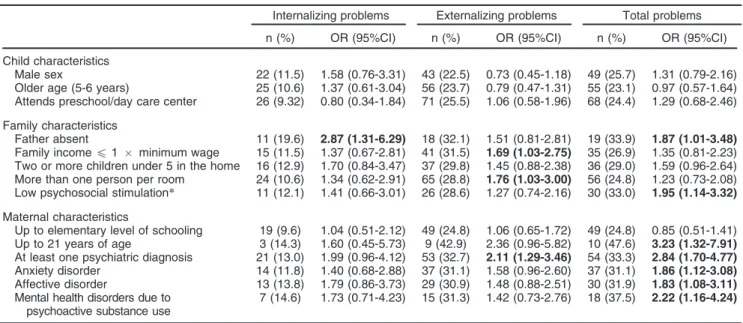
The bivariate analyses described in Table 2 revealed a distinct pattern of association between problem behavior and the risk factors of interest. At the individual level of child characteristics, no significant association was found between the studied variables and behavior problems, except for paternal absence, which was associated (OR 2.87, 95%CI 1.31-6.29) with internalizing problems. On the other hand, a greater likelihood of externalizing problems was found when the family earned only one minimum wage (OR 1.69, 95%CI 1.03-2.75), lived in a home with more than one person per room (OR 1.76, 95% CI 1.03-3.00), and when the mother had at least one psychiatric diagnosis (OR 2.11, 95%CI 1.29-3.46). Finally, all behavior problems were associated with paternal absence (OR 1.87, 95%CI 1.01-3.48), young maternal age (OR 3.23, 95%CI 1.32-7.91), low levels of mother-child interaction (OR 1.95, 95%CI 1.14-3.32), presence of at least one maternal psychiatric diagnosis (OR 2.84, 95%CI 1.70-4.77), and maternal anxiety
disorder (OR 1.86, 95%CI 1.12-3.08), affective disorder (OR 1.83, 95%CI 1.08-3.11), or mental disorder due to use of psychoactive substances (OR 2.22, 95%CI 1.16-4.24).
On multivariate analysis (Table 3), prevalence of any of the maternal mental health disorders assessed was associated with prevalence of behavior problems, adjusted for paternal absence, number of children under 5 in the home, maternal age, family income, number of persons per room, and level of mother-child interaction. The same multivariate model was used to test the association between maternal mental disorder and pre-valence of internalizing or externalizing problems in the child, and showed that presence of at least one psychiatric diagnosis or anxiety disorder was associated with externalizing behavior (OR 2.24, 95%CI 1.35-3.74 and OR 1.70, 95%CI 1.02-2.85, respectively). However, total behavior problems were associated not only with presence of at least one maternal psychiatric diagnosis (OR 3.02, 95%CI 1.75-5.20), but also with presence of anxiety disorder (OR 2.10, 95%CI 1.20-3.58), affective disorder (OR 2.10, 95%CI 1.22-3.58), or mental disorder due to use of psychoactive substances (OR 2.40, 95%CI 1.21-4.76).
Table 2 Prevalence and odds ratios of behavior problems in relation to associated risk factors
Internalizing problems Externalizing problems Total problems
n (%) OR (95%CI) n (%) OR (95%CI) n (%) OR (95%CI)
Child characteristics
Male sex 22 (11.5) 1.58 (0.76-3.31) 43 (22.5) 0.73 (0.45-1.18) 49 (25.7) 1.31 (0.79-2.16) Older age (5-6 years) 25 (10.6) 1.37 (0.61-3.04) 56 (23.7) 0.79 (0.47-1.31) 55 (23.1) 0.97 (0.57-1.64) Attends preschool/day care center 26 (9.32) 0.80 (0.34-1.84) 71 (25.5) 1.06 (0.58-1.96) 68 (24.4) 1.29 (0.68-2.46)
Family characteristics
Father absent 11 (19.6) 2.87 (1.31-6.29) 18 (32.1) 1.51 (0.81-2.81) 19 (33.9) 1.87 (1.01-3.48)
Family incomep1 minimum wage 15 (11.5) 1.37 (0.67-2.81) 41 (31.5) 1.69 (1.03-2.75) 35 (26.9) 1.35 (0.81-2.23) Two or more children under 5 in the home 16 (12.9) 1.70 (0.84-3.47) 37 (29.8) 1.45 (0.88-2.38) 36 (29.0) 1.59 (0.96-2.64) More than one person per room 24 (10.6) 1.34 (0.62-2.91) 65 (28.8) 1.76 (1.03-3.00) 56 (24.8) 1.23 (0.73-2.08) Low psychosocial stimulation* 11 (12.1) 1.41 (0.66-3.01) 26 (28.6) 1.27 (0.74-2.16) 30 (33.0) 1.95 (1.14-3.32)
Maternal characteristics
Up to elementary level of schooling 19 (9.6) 1.04 (0.51-2.12) 49 (24.8) 1.06 (0.65-1.72) 49 (24.8) 0.85 (0.51-1.41) Up to 21 years of age 3 (14.3) 1.60 (0.45-5.73) 9 (42.9) 2.36 (0.96-5.82) 10 (47.6) 3.23 (1.32-7.91)
At least one psychiatric diagnosis 21 (13.0) 1.99 (0.96-4.12) 53 (32.7) 2.11 (1.29-3.46) 54 (33.3) 2.84 (1.70-4.77)
Anxiety disorder 14 (11.8) 1.40 (0.68-2.88) 37 (31.1) 1.58 (0.96-2.60) 37 (31.1) 1.86 (1.12-3.08)
Affective disorder 13 (13.8) 1.79 (0.86-3.73) 29 (30.9) 1.48 (0.88-2.51) 30 (31.9) 1.83 (1.08-3.11)
Mental health disorders due to psychoactive substance use
7 (14.6) 1.73 (0.71-4.23) 15 (31.3) 1.42 (0.73-2.76) 18 (37.5) 2.22 (1.16-4.24)
95%CI = 95% confidence interval; OR = odds ratio. Results in bold indicate statistically significant associations.
*Psychosocial stimulation - mother-child interaction: a variable created according to factors 1 (maternal emotional and verbal responsivity), 2 (absence of punishment and restrictions), and 5 (maternal involvement with the child) from the HOME Observation for Measurement of the Environment Inventory.
Table 3 Adjusted odds ratios for behavior problems related to maternal mental health problems
Maternal mental health Internalizing problems Externalizing problems Total problems
At least one psychiatric diagnosis 2.13 (1.00-4.52) 2.24 (1.35-3.74) 3.02 (1.75-5.20)
Anxiety disorder 1.68 (0.79-3.58) 1.70 (1.02-2.85) 2.10 (1.23-3.58)
Affective disorder 1.87 (0.88-3.99) 1.66 (0.96-2.87) 2.11 (1.21-3.68)
Mental health disorders due to psychoactive substance use 1.94 (0.76-4.94) 1.39 (0.70-2.78) 2.40 (1.21-4.76)
Data presented as adjusted odds ratio (95% confidence interval). Analyses adjusted for absence of father, maternal age, income, number of persons per room, and mother-child interaction.
Discussion
This study shows that the presence of maternal mental disorders increases the likelihood of behavior problems among preschoolers, even after adjustment for important social and interaction factors. There is evidence that maternal mental health problems have a deleterious effect on child behavior, which may have significant repercussions on the acquisition of cognitive and social skills over both the short and long term.3,23-26,34 This finding is in line with other studies, which have demon-strated that maternal mental health is an important predictor of behavior problems in children.7,16,21
The prevalence of behavior problems found in this study (23.5%) falls within the range reported in other investigations conducted in developing countries (12 to 29%).9Regarding the prevalence found in Brazilian studies, the prevalence of our sample was lower than those described by Vitolo et al.13 in Taubate´ (35.2%) and by Feitosa et al.40 in Salvador. However, these two studies were carried out on children at a different stage of development (age 6 to 12 years).
International studies suggest a trend toward increased prevalence of behavior problems with advancing age. For instance, prevalence ranges from 3.6 to 24% in children aged 1 to 6 years, with an average of 10.2%, and from 1.4 to 30.7% in children aged 6 to 12 years, with an average of 13.2%.12
On bivariate analysis, low family income, absence of a father figure, young maternal age, problematic mother-child interaction, and high housing density increased the likelihood of child behavior problems in our sample.
Low socioeconomic status is one of the most frequently studied risk factors for behavior problems.41 Such a
context increases exposure to biological and psychoso-cial risks, which affect development through structural and functional changes to the brain and to the child’s behavior.21In the present study, children living in families with a household income of only one minimum wage were 1.7 times more likely to exhibit externalizing problems.
According to Bradley & Corwyn, there is substantial evidence that children with low socioeconomic status manifest symptoms of psychiatric disorders and malad-justed social functioning more frequently than children who live in better circumstances.41 However, it is likely that the relationship between socioeconomic status and behavior problems is mediated by aspects related to family dynamics and to the interactions experienced by the child; therefore, further studies are needed to examine this relationship.8,11,13
Poor environments with little psychosocial stimulation threaten the development of a child’s full potential, particularly during the first years of life.21,42We observed that children presenting problems in mother-child interac-tion were almost 1.9 times more likely to display behavior problems. Unlike distal risk factors, such as maternal schooling, this proximal risk factor can be modified through interventions, although few studies have been conducted in developing countries regarding the effect of psychosocial stimulation on child development.21,39
One of the limitations of this study was its sample size, which may not provide sufficient statistical power for
estimation of the associations between the different risk factors and prevalence of behavior problems. Another limitation is that data collection took place in 2001, using a now-outdated version of the instrument employed to measure child behavior problems. However, given the lack of studies on this topic, we consider our findings relevant to the field of child mental health in Brazil.
In conclusion, our findings suggest that maternal mental health problems have a deleterious effect on child behavior and that these effects may be avoided through the development of programs seeking to reduce the risk of behavior disorders in preschoolers, emphasizing the need for comprehensive care of the whole family, with particular attention to maternal mental health.
Disclosure
The authors report no conflicts of interest.
References
1 Bauermeister JJ, So CY, Jensen PS, Krispin O. El Din AS; Integrated Services Program Task Force. Development of adaptable and flexible treatment manuals for externalizing and internalizing disorders in children and adolescents. Rev Bras Psiquiatr. 2006;28:67-71. 2 Bordin IAS, Offord DR. Transtorno de conduta e comportamento
anti-social. Rev Bras Psiquiatr. 2000;22:S12-S15.
3 Grillo E, da Silva RJ. [Early manifestations of behavioral disorders in children and adolescents]. J Pediatr (Rio J). 2004;80:S21-7. 4 Institute of Medicine, Committee on the Prevention of Mental
Dis-orders and Substance Abuse Among Children, Youth, and Young Adults: Research Advances and Promising Interventions. Preventing mental, emotional, and behavioral disorders among young people: progress and possibilities. Washington: National Academies Press. 2009.
5 Achenbach TM, Edelbrock CS. The child behavior profile: II. Boys aged 12-16 and girls aged 6-11 and 12-16. J Consult Clin Psychol. 1979;47:223-33.
6 Matijasevich A, Murray E, Stein A, Anselmi L, Menezes AM, Santos IS, et al. Increase in child behavior problems among urban Brazilian 4-year olds: 1993 and 2004 Pelotas birth cohorts. J Child Psychol Psychiatry. 2014;55:1125-34.
7 Almeida-Filho N. Development and assessment of the QMPI: A Brazilian children’s behaviour questionnaire for completion by parents. Soc Psychiatry. 1981;16:205-11.
8 de Almeida-Filho N. Family variables and child mental disorders in a Third World urban area (Bahia, Brazil). Soc Psychiatry. 1984; 19:23-30.
9 Giel R, de Arango MV, Climent CE, Harding TW, Ibrahim HH, Ladrido-Ignacio L, et al. Childhood mental disorders in primary health care: Results of observations in four developing countries. A report from the WHO collaborative Study on Strategies for Extending Mental Health Care. Pediatrics. 1981;68:677-83.
10 Moren-Cross JL, Wright DR, LaGory M, Lanzi RG. Perceived neighborhood characteristics and problem behavior among dis-advantaged children. Child Psychiatry Hum Dev. 2005;36:273-94. 11 Poeta LS, Rosa Neto F. [Epidemiological study on symptoms of
attention deficit/hyperactivity disorder and behavior disorders in public schools of Florianopolis/SC using the EDAH]. Rev Bras Psi-quiatr. 2004;26:150-5.
12 Roberts RE, Attkisson CC, Rosenblatt A. Prevalence of psycho-pathology among children and adolescents. Am J Psychiatry. 1998;155:715-25.
13 Vitolo YL, Fleitlich-Bilyk B, Goodman R, Bordin IA. [Parental beliefs and child-rearing attitudes and mental health problems among schoolchildren]. Rev Saude Publica. 2005;39:716-24.
15 Campbell SB. Behavior problems in preschool children: a review of recent research. J Child Psychol Psychiatry. 1995;36:113-49. 16 Anselmi L, Piccinini CA, Barros FC, Lopes RS. Psychosocial
deter-minants of behaviour problems in Brazilian preschool children. J Child Psychol Psychiatry. 2004;45:779-88.
17 Rescorla LA, Achenbach TM, Ivanova MY, Harder VS, Otten L, Bilenberg N, et al. International comparisons of behavioral and emotional problems in preschool children: parents’ reports from 24 societies. J Clin Child Adolesc Psychol. 2011;40:456-67. 18 Huaqing Qi C, Kaiser AP. Behavior problems of preschool children
from low-income families: review of the literature. Topics Early Child Spec Educ. 2003;23:188-216.
19 Slopen N, Fitzmaurice G, Williams DR, Gilman SE. Poverty, food insecurity, and the behavior for childhood internalizing and externa-lizing disorders. J Am Acad Child Adolesc Psychiatry. 2010;49:444-52. 20 Lawson DW, Mace R. Siblings and childhood mental health: evidence
for a later-born advantage. Soc Sci Med. 2010;70:2061-9.
21 Walker SP, Wachs TD, Gardner JM, Lozoff B, Wasserman GA, Pollitt E, et al. Child development: risk factors for adverse out-comes in developing countries. Lancet. 2007;369:145-57. 22 Fatori D, Bordin IA, Curto BM, de Paula CS. Influence of
psychoso-cial risk factors on the trajectory of mental health problems from childhood to adolescence: a longitudinal study. BMC Psychiatry. 2013;13:31.
23 Zanoti-Jeronymo DV, Carvalho AM. Self-concept, academic perfor-mance and behavioral evaluation of the children of alcoholic parents. Rev Bras Psiquiatr. 2005;27:233-6.
24 Ferreira MCT, Marturano EM. Ambiente familiar e os problemas do comportamento apresentados por crianc¸as com baixo desempenho
escolar. Psicol Reflex Crit. 2002;15:35-44.
25 D’Avila-Bacarji KMG, Marturano EM, Elias LCS. Suporte parental: um estudo sobre crianc¸as com queixas escolares. Psicol Estud.
2005;10:107-15.
26 Stevanato IS, Loureiro SR, Linhares MBM, Marturano EM. Auto-conceito de crianc¸as com dificuldades de aprendizagem e problemas
de comportamento. Psicol Estud. 2003;8:67-76.
27 Pacheco J, Alvarenga P, Reppold C, Piccinini CA, Hutz CS. Est-abilidade do comportamento anti-social na transic¸a˜o da infaˆncia para
a adolesceˆncia: uma perspectiva desenvolvimentista. Psicol Reflex Crit. 2005;18:55-61.
28 Serra-Pinheiro MA, Schmitz M, Mattos P, Souza I. [Oppositional defiant disorder: a review of neurobiological and environmental cor-relates, comorbidities, treatment and prognosis]. Rev Bras Psiquiatr. 2004;26:273-6.
29 Guttmannova K, Szanyi JM, Cali PW. Internalizing and externalizing behaviour problem scores: cross-ethnic and longitudinal measurement
invariance of the behavior problem index. Educ Psychol Meas. 2008;68:676-94.
30 Gardner F, Shaw DS. Behavioral problems of infancy and preschool children (0-5). In:Rutter M, Bishop DVM, Pine DS, editors. Rutter’s child and adolescent psychiatry.5th ed.Malden: Blackwell Publishing; 2009. p.882-1248.
31 Strina A, Cairncross S, Barreto ML, Larrea C, Prado MS. Childhood diarrhea and observed hygiene behavior in Salvador, Brazil. Am J Epidemiol. 2003;157:1032-8.
32 Achenbach TM, Rescorla LA. Manual for the ASEBA school-age forms & profiles. Burlington: University of Vermont, Research Center for Children, Youth, & Families; 2001.
33 Njoroge WF, Bernhart KP. Assessment of behavioral disorders in preschool-aged children. Curr Psychiatry Rep. 2011;13:84-92. 34 Bordin IA, Rocha MM, Paula CS, Teixeira MC, Achenbach TM,
Rescorla LA, et al. Child behavior checklist (CBCL), youth self-report (YSR) and teacher’s report form (TRF): an overview of the develop-ment of the original and Brazilian versions. Cad Saude Publica. 2013;29:13-28.
35 Gray RF, Indurkhya A, McCormick MC. Prevalence, stability, and predictors of clinically significant behavior problems in low birth weight children at 3, 5, and 8 years of age. Pediatrics. 2004;114:736-43. 36 Fan RG, Portuguez MW, Nunes ML. Cognition, behavior and social
competence of preterm low birth weight children at school age. Clinics (Sa˜o Paulo). 2013;68:915-21.
37 Bradley RH, Corwyn RF, McAdoo HP, Coll CG. The home environ-ments of children in the United States part I: variations by age, eth-nicity, and poverty status. Child Dev. 2001;72:1844-67.
38 Zamberlan MAT, Biasoli-Alves ZMM. Detecc¸a˜o de nı´veis de riscos
psicossociais atrave´s do inventa´rio HOME em ambientes de popu-lac¸o˜es urbanas de baixa renda. In: Zamberlan MAT, Biasoli-Alves
ZMM, editors. Interac¸o˜es familiares: teoria, pesquisa e subsı´dios a`
intervenc¸a˜o. Londrina: Universidade Estadual de Londrina; 1997.
p. 143-61.
39 Santos SA, Lovisi G, Legay L, Abelha L. [Prevalence of mental disorders associated with suicide attempts treated at an emergency hospital in Rio de Janeiro, Brazil]. Cad Saude Publica. 2009;25:2064-74. 40 Feitosa CA, Santos DN, Barreto do Carmo MB, Santos LM,
Teles CA, Rodrigues LC, et al. Behavior problems and prevalence of asthma symptoms among Brazilian children. J Psychosom Res. 2011;71:160-5.
41 Bradley RH, Corwyn RF. Socioeconomic status and child develop-ment. Annu Rev Psychol. 2002;53:371-99.