- 684 - Literature Reviews
CLOTHING OF HEALTH CARE PROFESSIONAL AS POTENTIAL
RESERVOIRS OF MICRO-ORGANISMS: AN INTEGRATIVE REVIEW
Adriana Cristina de Oliveira1, Marlene das Dores Medeiros Silva2, Juliana Ladeira Garbaccio3
1 Ph.D. in Nursing. Adjunct Professor of the School of Nursing of the Federal University of Minas Gerais (UFMG). CNPq
researcher. Minas Gerais, Brazil. E-mail: [email protected]
2 MSc. in Nursing from the School of Nursing of UFMG. Minas Gerais, Brazil. E-mail: [email protected]
3 Doctoral studentof the Post-graduate Program of the School of Nursing of UFMG. Lecturer at the Pontiical Catholic University
of Minas Gerais. Minas Gerais, Brazil. E-mail: [email protected]
ABSTRACT: It has been aimed to determine, through an integrative review of the literature, reports about the occurrence of contamination by micro-organisms and isolation in their white coats, gowns, uniforms of the healthcare professionals, and the similarity to those related to Healthcare Associated Infections considering the proile of antimicrobial resistance. Articles were searched in the following databases MEDLINE, LILACS, and SCOPUS, published from 2000 to 2010. Nine articles were selected and analyzed. These studies considered and evidenced white coat, gown and uniform contamination. The analyzed studies there was the presence of mainly bacteria on pockets, cuff and waist area. As to the proile of sensitiveness the recuperation of Staphylococcus aureus meticiline resistant/MRSA, followed by Gram negative antimicrobial resistance. These were a similarity between the strains in the clothing of health workers and those related to the occurrence of infections. Thus, white coats, gowns, uniforms must be considered part of the dissemination chain of micro-organisms.
DESCRIPTORS: Cross infection. Clothing. Health personnel.
VESTUÁRIO DE PROFISSIONAIS DE SAÚDE COMO POTENCIAIS
RESERVATÓRIOS DE MICRORGANISMOS: UMA REVISÃO
INTEGRATIVA
RESUMO: Objetivou-se identiicar na literatura, artigos sobre a ocorrência de contaminação por microrganismos, em jalecos, aventais e uniformes dos proissionais de saúde, e a similaridade com aqueles associados às Infecções Relacionadas à Assistência à Saúde, considerando o peril de resistência aos antimicrobianos. Realizou-se busca por artigos nas seguintes bases de dados: MEDLINE, LILACS e SCOPUS, publicados entre 2000 e 2010. Foram selecionados nove artigos. Os estudos evidenciaram a contaminação dos jalecos, aventais e uniformes. Nos estudos analisados, veriicou-se a presença de bactérias, principalmente, nos bolsos, punhos e região abdominal. Quanto ao peril de sensibilidade, veriicou-se recuperação de Staphylococcus aureus meticilina resistente, seguidos dos Gram negativos resistentes aos antimicrobianos. Identiicou-se semelhança entre as cepas isoladas no vestuário dos proissionais de saúde e aquelas relacionadas à ocorrência de infecções. Assim, jalecos, aventais e uniformes devem ser considerados na cadeia de disseminação de microrganismos resistentes.
DESCRITORES: Infecção hospitalar. Vestuário. Pessoal de saúde.
VESTUARIO DE LOS PROFISSIONALES SALUD COMO POSIBLES
RESERVORIOS DE MICROORGANISMOS: UNA REVISIÓN
INTEGRADORA
RESUMEN: Se objetivó identiicar, por revisión integrativa de la literatura, artículos sobre la ocurrencia de contaminación por microorganismos en gabachas, delantales y uniformes de profesionales de salud, y su relación con las Infecciones presentadas al realizar el Cuidado de Salud, teniendo en cuenta el peril de resistencia a los antimicrobiano. Se realizó la búsqueda por artículos en los bancos de dados MEDLINE, LILACS y SCOPUS, publicados desde 2000 hasta 2010. Fueron seleccionados y analizados nueve artículos. Se destaco en los estudios la presencia de bacterias, principalmente en los bolsillos, los puños y en la región abdominal. Sobre el peril de sensibilidad se destacó la recuperación de Staphylococcus aureus meticilino resistente/MRSA, seguidos por Gram negativos resistentes a los antimicrobianos. Se identiicaron similitudes entre las cepas en el vestuario de los trabajadores de la salud y la aparición de infecciones. Por tanto las gabachas, delantales y uniformes de los profesionales en salud, deben ser considerados en la cadena de diseminación de microorganismos.
INTRODUCTION
Healthcare Associated Infections (HAIs) refer to those obtained during the provision of healthcare. They represent a major public health problem in both developed countries and devel-oping countries, because they increase the rates of morbidity and mortality, prolong the period of hospitalization, and increase hospital costs.1-2
Despite significant progress in infection control, there is an increase in the frequency and severity of cases of HAI, which may be favored by the spread of drug resistant microorganisms.3
The control of HAI and the spread of resis-tant bacteria constitute a challenge and a priority for the healthcare institutions, due to the reduced therapeutic options for the treatment of cases, the major complications related to the clinical care, and the social repercussions, such as decreased productivity and quality of life of the pacient.4-5
The major route of transmission of mi-croorganisms occurs between the hands of the healthcare professionals and patients.6-7 However, the possible participation of environmental fac-tors, such as surfaces, equipment and clothing (white coats, gowns and uniforms) used by the professionals, draws the attention of researchers, society, and the infection control agencies and associations.8
With the emergence of resistant bacteria, the focus of the dissemination of these infections turned to some fomites that had been forgotten. In this context, the clothing used in the quotidian of the healthcare professionals begins to be con-sidered a potential reservoir for the transmission of microorganisms involved in the occurrence of HAI, even if in small proportions.9-12
The spread of pathogens may occur in the hospital environment and also outside of this, i.e. in places in which the provision of direct care does not occur. The use by healthcare professionals, principally, of white coats outside the hospital environment has become common in areas close to the health institutions, on buses, in cafeterias and in other places.12 Given the importance of the subject, this study aimed to identify articles in the literature on the occurrence of contamination by microorganisms of white coats, gowns and uni-forms of healthcare professionals, and to highlight the similarity of these microorganisms with those related to Healthcare Associated Infections.
The methodological approach adopted was that of Evidence-Based Practice (EBP), which is
to organize the relevant information from the deinition of a problem. This contributes to im -proving the quality and safety of patient care and encourages healthcare professionals to seek scien-tiic knowledge already produced about the topic under investigation, providing the aggregation between the best available evidence, the clinical experience of the professional and the individual-ity of each patient assisted.13
METHODOLOGY
The recent EBP initiatives have increased the need to evaluate the production of all the literature review methods. In this study, the integrative literature review was selected, which is one of the evidence-based practice resources.13 The develop-ment of this integrative review took the following steps: 1st) identiication of the hypothesis, or the guiding question, for the development of the inte-grative review; 2nd) selection of the sample, from the establishment of the inclusion and exclusion criteria for the studies; 3rd) deinition of the infor -mation to be extracted from the studies selected/ categorization of the studies; 4th) evaluation of the studies included; 5th) discussion and interpretation of the results, and 6th) presentation of the review and synthesis of the knowledge.13 The evidence is classiied into seven levels: originating from I — a systematic review or meta-analysis of all the rel-evant randomized controlled clinical trials or from clinical guidelines based on systematic reviews of randomized controlled clinical trials; II — at least one well-designed randomized controlled trial; III — well designed clinical trials without randomiza -tion; IV — well designed cohort and case control studies; V — systematic reviews of descriptive and qualitative studies; VI — a single descriptive or qualitative study; and VII — the opinion of authorities and/or reports of expert committees.14
were used for the indexing of studies in databases, in order to facilitate access to the information. The following terms were deined for the search: a) in Portuguese: infecção hospitalar, pessoal de saúde and vestuário; b) in English: cross infection, health personnel and clothing; and c) in Spanish: infec-ción hospitalaria, personal de salud and vestuário. The inclusion criteria for the studies selected for this integrative review were: those published in Eng-lish, Spanish or Portuguese; primary articles which relect the recovery of microorganisms in white coats, gowns and uniforms of healthcare profes-sionals related to the occurrence of HAI and to bacterial resistance in healthcare institutions, with the application of laboratory (biochemical and/ or molecular) and statistical tests; and published between 2000 and 2010. It was chosen to consider works in this period because it is still a poorly studied subject, which is gradually attracting the attention of researchers. The exclusion criteria consisted of: articles repeated in the databases; articles of opinion; articles of relection; editorials; articles that did not directly address the theme of this review; and articles published outside the previously deined period.
In the MEDLINE database 100 references were found. Of these, 60 were not primary articles, 20 were articles of opinion or relection, ive were editorials, and nine had been published before the established period. Therefore, 94 were excluded. In searching SCOPUS, 35 articles were obtained, of which 33 were excluded due to duplication in MEDLINE, as well as four articles in LILACS. Overall, a sample of 140 studies was obtained, with 131 being excluded. The data obtained were tran-scribed for the instrument proposed and validated in a previous study,15 which considers the follow-ing items: identiication of the original article, methodology of the study, and evaluation of the methodological rigor, the intervention measures and the results obtained. Critical reading of the articles was performed, highlighting the following aspects: authors, year of publication, journal, type of study design, evidence level and aim(s).
RESULTS
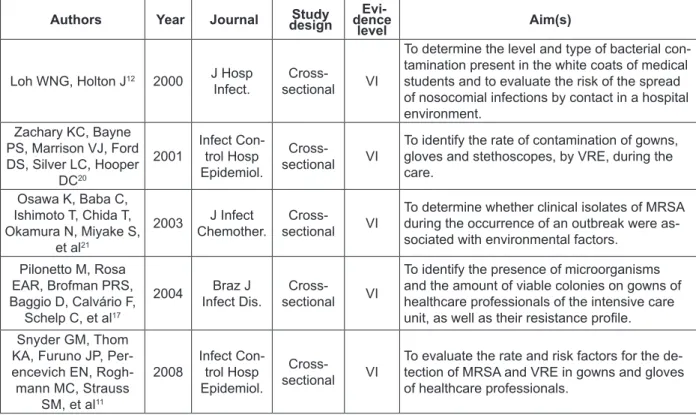
In this integrative review, the nine articles that met the previously established inclusion cri-teria were analyzed (Table 1).
Table 1 - Description of the studies included in the integrative review, showing the authors, year of publication, journal, type of study design, evidence level and aim(s)
Authors Year Journal designStudy dence
Evi-level Aim(s)
Loh WNG, Holton J12 2000 J Hosp
Infect.
Cross-sectional VI
To determine the level and type of bacterial con-tamination present in the white coats of medical students and to evaluate the risk of the spread of nosocomial infections by contact in a hospital environment.
Zachary KC, Bayne PS, Marrison VJ, Ford DS, Silver LC, Hooper
DC20
2001
Infect Con-trol Hosp Epidemiol.
Cross-sectional VI
To identify the rate of contamination of gowns, gloves and stethoscopes, by VRE, during the care.
Osawa K, Baba C, Ishimoto T, Chida T, Okamura N, Miyake S,
et al21
2003 J Infect Chemother.
Cross-sectional VI
To determine whether clinical isolates of MRSA during the occurrence of an outbreak were as-sociated with environmental factors.
Pilonetto M, Rosa EAR, Brofman PRS, Baggio D, Calvário F,
Schelp C, et al17
2004 Braz J Infect Dis.
Cross-sectional VI
To identify the presence of microorganisms and the amount of viable colonies on gowns of healthcare professionals of the intensive care
unit, as well as their resistance proile.
Snyder GM, Thom KA, Furuno JP, Per-encevich EN, Rogh-mann MC, Strauss
SM, et al11
2008
Infect Con-trol Hosp Epidemiol.
Cross-sectional VI
Authors Year Journal designStudy dence
Evi-level Aim(s)
Treakle AM, Thom KA, Furano JP, Strauss SM, Harris AD,
Per-encevich EN16
2009 Am J Infect Control.
Cross-sectional VI
To identify the prevalence of Staphylococcus au-reus, including MRSA and VRE in white coats of healthcare professionals, as well as the potential risk factors.
Gaspard P, Eschbach E, Gunther D, Gayet S, Bertrand X, Talon
D19
2009 J Hosp Infect.
Descrip-tive VI
To verify contamination by MRSA in the uniforms of healthcare professionals of geriatric clinics
and the inluence of personal protection equip -ment and of the continuing education programs in reducing contamination in the pockets.
Uneke CJ, Ijeoma
PA18 2010
World Health & Population.
Cross-sectional VI
To identify the proile of microbial contamination
of white coats used by physicians; to verify the relationship between the contamination of white coats and the practices of use and handling by the physicians; and to evaluate the susceptibility of the microbial isolates to antibiotics.
Morgan DJ, Stephen Y, Liang Y, Smith LC, Johnson K, Harris AD,
et al22
2010
Infect Con-trol Hosp Epidemiol.
Cross-sectional VI
To determine the incidence of transmission of multiresistant Acinetobacter baumannii and
Pseudomonas aeruginosa from patients to healthcare professionals during routine care.
Regarding the year of publication, the ma-jority of the studies occurred between 2000 and 2004 (4), followed by 2010 (2), 2009 (2) and 2008 (1). Regarding the origin of the journals, eight are International and one is Brazilian. In relation to the target populations of the studies, the follow-ing were identiied: multidisciplinary team – ive articles; nursing staff – one; physicians of differ -ent specialties – one; medical stud-ents – one, and physicians and nurses – one article. Of these, three were performed in the Intensive Care Units (ICU) of hospitals; ive in inpatient units; and one study in a geriatric clinic. Concerning the type of research design of the articles analyzed, one study was de-scriptive and eight cross-sectional. Thus, regarding the strength of evidence obtained in the articles, it was found that the nine studies were of level VI; i.e. not presenting strong evidence for clinical application. In addition, the cross-sectional type studies, which represent the majority of the articles analyzed, may present greater vulnerability to bias (mainly selection bias).
In seven articles, the rolling swab technique was used to collect the microbial samples from previously deined areas of the fabric of the white coats, gowns or uniforms of healthcare profession-als.11,16-19,21-22 Direct contact of the areas analyzed with the agar plates was used in two articles for obtaining the microbiological samples.12,19 The bacterial species were identiied by biochemical tests; and the antimicrobial susceptibility through the disc diffusion technique or by the identiication of the Minimum Inhibitory Concentration (MIC).
11-12,16-22 The pulsed ield gel electrophoresis (PFGE)
technique was used to verify the clonal relation-ship between the isolates, this being considered of broad application, as it enables the performance of genotyping and the comparison of similarity between microbial species.22-23
Of the microbial samples isolated from the white coats, gowns and uniforms of the health-care professionals, the following were identiied: Diphtheroids, Vancomycin Resistant Enterococcus (VRE), gram-negative bacteria (Acinetobacter bau-mannii, Klebsiela pneumoniae and Serratia rubidae) and methicillin-resistant Staphylococcus aureus (MRSA), which was most frequently isolated, including in outbreak situations. In the ICU a greater diversity of microorganisms resistant to penicillins, aminoglycosides and 1st, 2nd and 3rd generation cephalosporins were recovered.11-12,16-22 A higher level of contamination of clothing by VRE was observed during the care of patients with tracheostomy, gastrostomy, jejunostomy and ileos-tomy.11,20 In two studies the results of molecular tests conirmed the similarity between the strains of the patient and those recovered from the cloth-ing of the multiprofessional team.21-22
that, among the studies evaluated, the factors ‘fre-quency of washing and changing’, and ‘complexity of the care provided to the patient’ favored the contamination of the clothing.16-22 The use of white coats restricted to only areas of direct patient care was considered a important factor for lower levels of contamination of the coat (p<0.05), compared to coats used in non-care areas, such as cafeterias and libraries.18
DISCUSSION
Regarding the aims of this review – to identify evidence in the literature concerning the recovery of microorganisms from white coats, gowns and uniforms of healthcare profession-als; and to show the similarity of these with those related to HAI, considering the proile of antimicrobial resistance – it was observed in the articles that the clothing of healthcare workers can become contaminated with microorganisms of epidemiological relevance, contributing to the potential spread of pathogens between different patients and environments.
The results of the studies reviewed dem-onstrated the recovery of Staphylococcus aureus, Acinetobacter baumannii, Klebsiela pneumoniae, Pseu-domonas aureuginosa, MRSA and VRE from white coats, gowns and uniforms. It should be high-lighted that these constitute additional concerns for healthcare institutions worldwide, due to the high pathogenicity, the ease of cross transmission and the reduced proile of sensitivity to different antimicrobials.23
The relevance of the contamination of the clothing of healthcare professionals is evident, due to the fact that many of the microorganisms recovered are resistant to antimicrobial agents, and are thus capable of causing serious infections in hospitalized patients, as well as in the community. This leads to the need to provide aggressive treat-ment, sometimes with reduced therapeutic options, increasing the costs for the healthcare institutions, prolonging the hospital stay and increasing the per-sonal, social and family damage for the patient.24-25 The contamination of clothes may vary ac-cording to the type of hospitalization unit. It is higher in those that care for patients in critical health conditions, such as in the ICU, where nor-mally there is a greater possibility of direct contact between the professional and the patient, with risk factors for infection of the patient, and also large amounts of equipment, which helps to promote
greater environmental contamination.8,20
In this context of the discussion, the scarcity of studies with strong evidences for clinical appli-cation is highlighted. Furthermore, some studies indicate, through means of PFGE testing, the re-lationship between the similarity of the microbial samples recovered, especially from the white coats of healthcare professionals, and the epidemiologic proile of the bacteria causing outbreaks on the wards.19-20
To prevent the cross transmission of HAI be-tween patients and healthcare professionals is an indispensable issue for the safe care of the patient, which constitutes a great challenge. According to the Association for Professionals in Infection Control and Epidemiology (APIC), unsafe prac-tices and behavior that put the health, and even the lives, of patients and professionals at risk are unacceptable. Therefore, it is indispensable that healthcare professionals perform measures to control the spread of microorganisms.18,26
It appears, however, that the adherence of professionals to such measures is not taking place as required, citing as an example the use of the white coat outside the hospital environment, an increasingly common habit among healthcare professionals. Such behavior is repeated among students, who, without thinking critically, repro-duce the same behavior without analyzing the possible repercussions in the chain of dissemina-tion of microorganisms.27
In relation to the areas of recovery of patho-gens in the white coats, gowns and uniforms, the studies indicate the pockets, the cuffs and the waist region as those with greater contamination, due to the frequency of contact with the hands of the pro-fessionals when putting belongings in the pocket and when the waist and wrists come into contact with patients and the inanimate environment.11,20 The use of plastic and/or disposable aprons as protection for the clothes of the professional must be encouraged during the practices with greater risk of exposure to humidity and secretions.16
A point rarely discussed in the studies ana-lyzed, which can be directly related to the con-tamination and maintenance of microorganisms in the clothing, is the type of fabric and iber.In the fabrics composed of cotton ibers, pathogens may survive for longer periods in contrast to fabrics composed of synthetic ibers. This can be explained by the hydrophobicity of synthetic fabrics, which hinders the survival of pathogens.29-30
pos-sibility of reducing contamination of the clothing through the professionals cleaning their hands before and after patient care. The hands constitute the main route of the spread of microorganisms between patients and the clothing of the healthcare professionals. However, the procedure of the pro-fessionals in relation to hand hygiene is considered insuficient, with adherence values below 50% in various countries.6-7,12
Another issue associated with the contami-nation of the clothes of healthcare professionals is the frequency of changing and of laundering them and the use of the same white coat, gown or uniform while providing care to patients in dif-ferent clinical and epidemiological conditions.8,17 The white coats of medical students presented signiicant amounts of pathogens when consid -ered dirty by the students themselves, however, the laundering of the clothes still only occurred ocasionally.12
The restricted use of the white coat in pa-tient care units contributed to the reduction in the contamination of the coat. The use of this clothing in related areas as well presented higher contami-nation by microorganisms.19 Faced with the need to promote safe care for patients and healthcare professionals, the following recommendations should be considered regarding the handling and storage of clothing used in healthcare institutions: to provide enough coats, gowns and uniforms to the healthcare professionals, thus favoring an increased frequency of changing them; to recom-mend the washing of such clothing at least once a week, and to prohibit the use of white coats in non-care areas i.e. outside the inpatient units.12,16
Other recommendations should be observed, such as: to promote the involvement and partici-pation of the health institution managers in the compliance with the actions of preventing the spread of microorganisms, foreseeing the estab-lishment of the monitoring of the compliance with this measure; and to promote guidance regarding the cleaning of clothes and the adequation of the models, to facilitate hand washing.12,16,18
The clariication regarding the role of clothes in the dissemination of pathogens can contribute to a change in attitude and to improve the adher-ence of healthcare professionals to the measures of control of the spread of microorganisms, including those with proiles of antimicrobial multiresis -tance.
It was possible to detect gaps in the studies analyzed with regard to the occurrence of
infec-tions related to the contamination of the clothing of the healthcare professionals. This results in the need to promote studies with greater meth-odological rigor, such as studies with evidence levels I and II, i.e. meta-analysis and randomized controlled clinical trials, which are able to present recommendations for use in the clinical practice.
FINAL CONSIDERATIONS
In total, nine articles were analyzed, one being descriptive and eight being cross-sectional. Regarding the strength of evidence obtained in the articles, it was found that the nine studies were of level VI; i.e. not presenting strong evidence for clinical application.
Even faced with this limitation and the small number of studies on the contamination of the clothing of healthcare professionals, there was agreement among them regarding the recovery of microorganisms, including strains resistant to antimicrobial agents, from the clothing of the healthcare professionals. In two studies, a similar-ity was observed between strains found in patients and in the occurrence of an outbreak and those isolated from white coats and gowns.
Considering the studies analyzed in this inte-grative review, it is suggested to revise and imple-ment measures to guide healthcare professionals in care related to the storage and washing of clothes and their availability in suficient numbers, favoring an increased frequency of changing and conscien-tization regarding their use in patient care areas.
Even though the contamination of clothes, especially of white coats, can seem obvious, the analysis and the registration of the presence of multiresistant bacteria can constitute a clear strat-egy concerning the importance of the role of each person in combating the dissemination of bacterial resistance.
In relation to EBP, the importance of devel-oping new studies with strong levels of evidence in relation to the contamination of white coats, gowns and uniforms is emphasized, which could possibly contribute to the prevention and control of HAIs.
REFERENCES
1. Chen YY, Chou YC, Chou P. Impact of nosocomial infection on cost of illness and length of stay in intensive care units. Infect Control Hosp Epidemiol. 2005 Mar; 26(3):281-7.
2. Organização Mundial de Saúde. World alliance for
health care. First global patient safety challenge clean care is safer care. Geneva: OMS; 2009. 3. Siegel JD, Rhinehart E, Jackson M, Chiarello L. The
Healthcare Infection Control Practices Advisory Com-mittee (HICPAC). Management of multidrug-resistant organisms in healthcare settings, 2006. Atlanta (US): Centers for Disease Control and Prevention; 2006. 4. Siegel JD, Rhinehart E, Jackson M, Chiarello L. The
Healthcare Infection Control Practices Advisory Committee (HICPAC). Guideline for isolation precautions: preventing transmission of infectious agents in healthcare settings, 2007. Atlanta (US): Centers for Disease Control and Prevention; 2007. 5. Tenover F. Mecanisms of antimicrobial resistence
in bacteria. Am J Infect Control. 2006 Jun; 34(Suppl 1):3-10.
6. Scheithauer S, Oberröhrmann A, Haefner H, Kopp R, Schürholz T, Schwanz T, et al. Compliance with hand hygiene in patients with meticillin-resistant staphylococcus aureus and extended-spectrum B-lactamase-producing enterobacteria. J Hosp Infect. 2010 Dec; 76(4):320-3.
7. Pittet D, Allegranzi B, Boyce J. The World health organization guidelines on hand hygiene in health care and their consensus recommendations. Am J Infect Control. 2009 Jul; 30(7):611-22.
8. Boyce J. M. Environmental contamination makes an important contribution to hospital infection. J Hosp Infect. 2007 Jun; 65(Suppl 2):50-4.
9. Lankford MG, Collins S, Youngberg L, Rooney DM, Warren JR, Noskin GA. Assement of materials commnly utilized in health care: Implications for bacterial suviral an transmission. Am J Infection Control. 2006 Jun; 34(5):258-63.
10. Saloojee H, Steenhoff A. The health professional’s role in preventing nosocomial infections. Postgrad Med J. 2001 Jan; 77(903):16-9.
11. Snyder GM, Thom KA, Furuno JP, Perencevich EN, Roghmann MC, Strauss SM, et al. Detection of methicillin-reistant Staphylococcus aureus and vancomycin-resistentant enterococci on the gowns and gloves of healthcare workes. Infect Control Hosp Epidemiol. 2008 Jul; 29(7):583-89.
12. Loh WNG, Holton J. Bacterial lora on the white
coats of medical students. J Hosp Infect. 2000 May; 45(1):65-8.
13. Mendes KDS, Silveira RCCP, Galvão CM. Revisão
integrativa: método de pesquisa para incorporação de evidências na saúde e na enfermagem. Texto Contexto Enferm. 2008 Out-Dez; 17(4):758-64.
14. Ursi ES, Galvão CM. Prevenção de lesões de pele no
perioperatório: revisão integrativa da literatura. Rev Latino-am Enfermagem 2006 Jan-Fev; 14(1):124-31. 15. Melnyk BM, Fineout-Overholt E. Making the case
for evidence-based practice. In: Melnyk BM, Fineout-Overholt E. Evidence-based practice in nursing &
healthcare. A guide to best practice. Philadelphia (US): Lippincot Williams & Wilkins; 2005.
16. Treakle AM, Thom KA, Furano JP, Strauss SM, Harris AD, Perencevich EN. Bacterial contamination of health care workers’ white coats. Am J Infect Control. 2009 Mar; 37(2):101-5.
17. Pilonetto M, Rosa EAR, Brofman PRS, Baggio D, Calvário F, Schelp C, et al. Hospital gowns as a vehicle for bacterial dissemination in an intensive care unit. Braz J Infect Dis. 2004 Jun; 8(3):206-10. 18. Uneke CJ, Ijeoma PA. The potencial for
nosoco-mial infection transmission by white coat used by physicians in Nigeria: implications for improved patient-safety initiatives. World Health Popul. 2010; 11(3):44-54.
19. Gaspard P, Eschbach E, Gunther D, Gayet S, Bertrand X, Talon D. Meticillin-resistant Staphyococcus aureus contamination of healthcare workers’ uniforms in long-term care facilites. J Hosp Infect. 2009 Feb; 71(2):170-5.
20. Zachary KC, Bayne PS, Marrison VJ, Ford DS,
Silver LC, Hooper DC. Contamination of gowns, gloves, and stethoscopes with vancomycin resistant enterococci. Infect Control Hosp Epidemiol. 2001 Set; 22(1):560-4.
21. Osawa K, Baba C, Ishimoto T, Chida T, Okamura N, Miyake S, et al. Signiicance of methicillinresistant Staphylococcus aureus (MRSA) survey in a university teaching hospital. J Infect Chemother. 2003 Jun; 9(2):172-7.
22. Morgan DJ, Stephen Y, Liang Y, Smith LC, Johnson K, Harris AD, et al. Frequent multidrug-resistant Acinetobacter baumannii contamination of gloves, gowns, and hands of healthcare workers. Infect Control Hosp Epidemiol. 2010 Jul; 31(7):716-21. 23. Rice LB. Editorial commentary. Federal funding for
the study of antimicrobial resistance in nosocomial pathogens: No ESKAPE. J Infect Dis. 2008 Apr; 197(8):1079-81.
24. Rice LB, Ohio C. Antimicrobial resistence in gram-positive bacteria. Am J Infect Control. 2006 Jun; 34 (2 suppl):13-7.
25. Huang YT, Husueh PH. Antimicrobial drug resistance in TaiwanInt. J Antimicrob Agents. 2008 Nov; 32 (3 suppl):174-8.
26. Warye KL. Murphy DM. AJIC presidents’message - Targeting zero health careassociated infections. Am J Infect Control. 2008 Dec; 36(10):683-4.
27. Oliveira AC, Damasceno QS, Ribero SMCP.
Infecções relacionadas à assistência em saúde: desaios para prevenção e controle. Rev Min Enferm. 2009 Jul-Set; 13(3):445-50.
Staphylococcus aureus as a model. J Appl Microbiol. 2001 Jun; 90 (6):962-70.
29. Takashima M, Shirai F, Sageshima M, Iketa N, Okamoto Y, Dohi Y. Distinctive bactéria-binding property of cloth materials. Am J Infect Control. 2004 Feb; 32(1):27-30.
30. Rossi D, Devienne KF, Raddi MSG. Influência
de fluídos biológicos na sobrevivência de Staphylococcus aureus sobre diferentes supericies secas. Rev Ciênc Farm Básica Aplicada. 2008; 29(2):209-12.
Correspondence: Marlene das Dores Medeiros Silva Avenida JK, 220, ap. 302
35500-155 – Santa Clara, Divinópolis, MG, Brazil E-mail: [email protected]