Literature Reviews 843
-CONVERGENT-ASSISTENTIAL RESEARCH: AN INTEGRATIVE REVIEW
OF SCIENTIFIC NURSING PRODUCTION
1Flávia Lamberti Pivoto2, Wilson Danilo Lunardi Filho3, Silvana Sidney Costa Santos4, Valéria Lerch Lunardi5
1 Study elaborated in the Qualitative Research in Nursing/Health Discipline in the Doctorate in Nursing Course at the Federal
University of Rio Grande (FURG).
2 Doctorate student on the Post-Graduate Nursing Program of the FURG. Nurse at the Porto Alegre Teaching Hospital. Porto Alegre, Rio Grande do Sul, Brazil. E-mail: [email protected]
3 Ph.D. in Nursing. Associate Professor III of the FURG College of Nursing. Rio Grande, Rio Grande do Sul, Brazil. E-mail: [email protected]
4 Ph.D. in Nursing. Adjunct Professor IV of the FURG College of Nursing. Rio Grande, Rio Grande do Sul, Brazil. E-mail: [email protected]
5 Ph.D. in Nursing. Associate Professor III of the FURG College of Nursing. Rio Grande, Rio Grande do Sul, Brazil. E-mail: [email protected]
ABSTRACT: The aim was to analyze scientiic nursing production, published between 2005 and 2010, which used the
convergent-assistential methodology. It is an integrative review to respond to the question of the suitability of its methodological design in the studies which stated that they used it. Seven Brazilian nursing periodicals were consulted from November to December 2010. Based on reading of the abstracts of the publications which responded to the stipulated period, 19 articles were selected and submitted to thorough evaluation, with exploratory reading of the complete texts and illing out of a data collection instrument, followed by analytical reading with textual and thematic analysis, and interpretive analysis of the data. The research’s characterization is depicted through the showing of methodological designs, thematic designs, contexts, participants, insertion of the researcher in the assistential context, and relevant contributions and aspects indicated in the different studies. A growing use of this methodology was identiied, and the need for greater attention to its speciic characteristics, in the description of its methodological procedures, and in the research’s contributions is inferred. DESCRIPTORS: Nursing. Qualitative research. Nursing research.
PESQUISA CONVERGENTE-ASSISTENCIAL: REVISÃO INTEGRATIVA
DE PRODUÇÕES CIENTÍFICAS DA ENFERMAGEM
RESUMO: Objetivou-se analisar produções cientíicas da enfermagem, publicadas no período de 2005 a 2010, que utilizaram a
metodologia convergente-assistencial. Trata-se de revisão integrativa para responder à questão da adequabilidade ao seu desenho metodológico, nos estudos que airmam tê-lo utilizado. Consultaram-se sete periódicos brasileiros de enfermagem, de novembro a dezembro de 2010. A partir da leitura dos resumos das publicações que respondiam ao período estipulado, foram selecionados 19 artigos, submetidos à avaliação criteriosa, com leitura exploratória dos textos completos e preenchimento de instrumento de coleta de dados, seguidos de leitura analítica com análise textual, temática e interpretativa dos dados. Retrata-se a caracterização da pesquisa com exposição de desenhos metodológicos, temáticas, contextos, participantes, inserção do pesquisador no contexto assistencial, contribuições e aspectos relevantes apontados nos diferentes estudos. Identiicou-se crescente utilização dessa metodologia e infere-se a necessidade de maior atenção às suas especiicidades e na descrição dos procedimentos metodológicos e contribuições da pesquisa. DESCRITORES: Enfermagem. Pesquisa qualitativa. Pesquisa em enfermagem.
METODOLOGÍA CONVERGENTE-ASISTENCIAL: UNA REVISIÓN
INTEGRATIVA DE LA PRODUCCIÓN CIENTÍFICA DE ENFERMERÍA
RESUMEN: El objetivo fue analizar producciones cientíicas de enfermería publicadas en el periodo 2005 y 2010 que utilizó el método
convergente-asistencial. Es una revisión integrativa para responder a la cuestión de la adecuación del diseño metodológico en los estudios que lo han utilizado. Se consultó siete periódicos brasileños, de noviembre a diciembre 2010. De la lectura de los resúmenes de las publicaciones que han respondido al plazo, 19 artículos fueron seleccionados, sometidos a una cuidadosa evaluación, con la lectura exploratoria de los textos completos y lectura analítica con el análisis de los datos. Representa a la caracterización de la investigación con la exposición de diseños metodológicos, temas, contextos, participantes, inserción del investigador en el cuidado, contribuciones y aspectos relevantes mencionados. Se identiicó un creciente uso de esta metodología y se iniere la necesidad de una mayor atención a sus especiicidades y la descripción de los procedimientos metodológicos y contribuciones de la investigación.
INTRODUCTION
The convergent-assistential methodology is a mode of qualitative research, essentially character-ized by the convergence between research, assis-tance and the participation of the subjects involved in the practice, concomitantly with the process of the construction of knowledge. It proposes relec -tion and the produc-tion of knowledge for guiding practice through theorization and investigation of phenomenon emerging from the assistance, in the context where it occurs.1-2
The convergent-assistential investigation follows the phases of conception, instrumentation, examination, analysis and interpretation. In the conception phase, one proceeds to establish the area of interest which, detailed in its theoretical and practical aspects, and considering the interest of the professionals involved, results in the theme of the research, based on which the guiding ques-tion and the objectives are established, and the the-oretical support, the introduction and the rationale for the study are elaborated. In the instrumentation phase, one adopts the methodological decisions referent to the research space, the participants, and the methods of collecting and analyzing the data. In the next phase, of examination, the strategies for obtaining the data are adopted and established, be-ing followed by the phase of analysis. The process is inalized with the phase of interpretation, in the summarizing processes, with subjective analysis of the associations and variations of the data; of theorization, conferring theoretical grounding to the interpretation of the information reported in the summary; and of transference, attributing meaning to the results, with explanation of how they affect the assistance.1
The research’s questions and information are the result of experiences had in the practice context and the results are aimed at solving prob-lems and introducing innovations and improve-ments into the study locale itself. The research ield is the context of development of assistential activities, where the problem was identiied and for which the changes are desired. In addition to this, the researcher must, necessarily, be part of the practice context, even if temporarily, during the research.The subjects are those involved in the context, both of the research and the assis-tential practice, valuing the representativity of the participants, who contribute actively, sug-gesting, criticising and validating the results. The collection and analysis of the data must be
concomitant with the practice; speciic techniques are not stipulated, bringing together different methods, as long as the information obtained in the assistential practice is recognized as data from the research.1-2
The convergent-assistential methodology makes it possible to relect and improve profes -sional practice, conferring scientificity on the assistance and reducing the dichotomous belief between theory and practice. This investigatory mode is being adopted by nurses, in research which seeks to make explicit the convergence be-tween theory and professional practice, aimed at improvements and the introduction of innovations in nursing’s assistential practice. For implemen-tation of this type of research, peculiarities and relevant aspects need to be taken into account.
In the light of the above, and basing the con-ditions of its use, the present study sought to an-swer the following research question: what is the suitability to the convergent-assistential research design of the studies published in the period 2005 to 2010 which stated that they used this design? To this end, the aim was to analyze scientific nursing production, published in the period 2005 to 2010, which used the convergent-assistential methodology.
METHOD
This is an integrative review, a method which makes it possible to investigate an issue through summarizing research undertaken so as to obtain new conclusions and a better un-derstanding of the phenomenon studied. The operationalization of this review took place during the stages of delimitation of the issue and the research question; deinition of the inclusion criteria for the scientiic productions; the seek -ing of the studies; analysis of the abstracts with selection of the studies; thorough evaluation of, and making notes on, the studies selected; and analysis of the data.3-4
Latino-Americana de Enfermagem, Texto & Contexto Enfermagem, Acta Paulista de Enfermagem, Revista Brasileira de Enfermagem, Revista da Escola de Enfer-magem da USP and Revista de Enfermagem da UERJ, from the months of November and December 2010. For the selection of the studies, the abstracts from all the publications in the above-mentioned journals in the stipulated period were read, with the identiication of the articles which used the convergent-assistential methodology for the de-velopment of the research.
These articles were submitted to thorough evaluation, through exploratory reading of the complete texts, with illing out of the data col -lection instrument, constituted of the following items: numerical identiication, bibliographic reference, year of publication, theme of the research, context of the research; participants, type of insertion of the researcher in the assis-tential context, data collection technique, data analysis technique, and relevant contributions/ aspects of the convergent-assistential research as a scientiic investigation methodology. Finally, the authors proceeded to the qualitative analysis of the data, through analytical reading,5 with textual analysis, based on thorough reading and obtaining of a wider vision of the data; thematic analysis, for clariications regarding the issue; and interpretive analysis, with the problemati-zation of the data.
PRESENTATION OF THE RESULTS
Based on the results of the bibliographic survey and considering the inclusion criteria, 19 scientiic articles were selected. The data of the research carried out is presented below, consti-tuted of the issues and methodological designs adopted in the different studies in which the convergent-assistential methodology was utilized, and the points raised from this methodology’s contributions.
Of the productions analyzed, one was pub-lished in 2005; four, in 2006; frequency repeated in 2009; two, in 2007; three, in 2008; and ive, in 2010. The Revista Brasileira de Enfermagem and Texto & Contexto Enfermagem were the scientiic journals
with the largest number of studies which utilized this research methodology, in a total of six articles each, followed by the Revista Latino-Americana de Enfermagem, with four publications, in the period of six years. See table 1 for the topics of the stud-ies analyzed.
Table 1 - Distribution of scientiic productions according to the topic addressed. Rio
Grande-RS, 2011
Topic Frequency
Health of the older adult 4
Women’s health 4
Children’s health 2
Neonatology 1
Patients with chronic illnesses 4
Patients who were victims of violence in
trafic 1
Process of nursing work 3
Total 19
For 15 of the studies, the context of devel-opment was the hospital; for ive of these, sup -port groups for chronically-ill patients from the institutions; and a further two studies, besides the hospital setting, completed the production of data in the participants’ homes. Four studies were undertaken in Primary Health Care Centers.
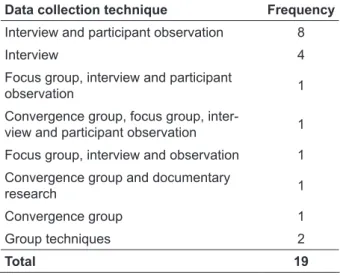
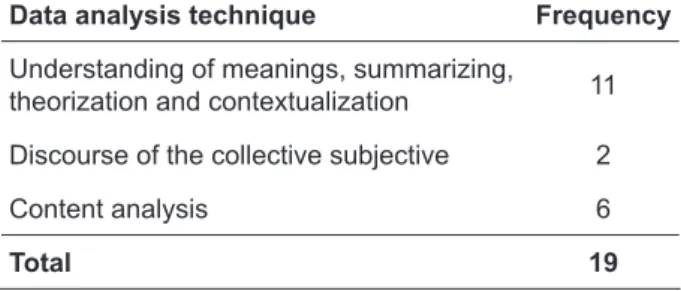
The majority of the participants in the studies analyzed were hospitalized patients in inpatient units or belonged to health institutions’ support groups. In ive of these studies, family members were included in the group of participants. Only three studies were undertaken with health profes-sionals from the study contexts. The data collection techniques utilized in the studies are presented in table 2, and the analysis techniques in table 3.
Table 2 - Distribution of scientiic productions according to the data collection technique. Rio Grande-RS, 2011
Data collection technique Frequency
Interview and participant observation 8
Interview 4
Focus group, interview and participant
observation 1
Convergence group, focus group,
inter-view and participant observation 1
Focus group, interview and observation 1
Convergence group and documentary
research 1
Convergence group 1
Group techniques 2
Table 3 - Distribution of scientiic productions according to data analysis technique. Rio Grande-RS, 2011
Data analysis technique Frequency
Understanding of meanings, summarizing,
theorization and contextualization 11
Discourse of the collective subjective 2
Content analysis 6
Total 19
Regarding the insertion of the researcher in the assistential context, in 10 of the studies analyzed, the researcher was inserted, carrying out care activities in the research context. In the others, it was not possible to identify the type of insertion originated.
Regarding the relevant contributions and aspects of the utilization of the convergent-as-sistential methodology for the development and carrying out of the research, indicated by the authors of the scientiic productions analyzed, in seven of them it was not possible to identify any consideration referent to the methodology adopt-ed or association between the methodological design and the contributions resulting from the research. In the others, points were made about the methodology.
DISCUSSION OF THE RESULTS
Based on the data raised in this research, it was possible to identify a smaller number of publi-cations which adopted the convergent-assistential methodology in 2005. Since then, studies which utilize it have been published continuously in the Brazilian journals consulted, with a greater incidence in 2010, which relects a growing utili -zation of this methodology in nursing research, demonstrating acceptance and recognition of this approach. On the other hand, it leads to discus-sion of how this proposal is being presented and developed, such that possible weak points in the investigations made may be indicated, making clariication of the same possible through their investigative designs.
The convergent-assistential research modal-ity has its core in an initiative from the Federal University of Santa Catarina’s Post-Graduate Nursing Program, which instigated Master’s
students to produce knowledge related to phe-nomena of their professional practice, resulting in studies with speciic methodological trajectories and which were dificult to categorize using al -ready-described methods. Such characterization, of linkage between research and care in the works undertaken, led to commitment to construct a new methodological approach which would respond to such singularity, with the publication of the irst edition of the speciic work of this methodology in 1999, and its second edition in 2004, with an increase in the dissemination and utilization of the method in nursing research.2 The editorial relation-ship between this Post-Graduate Program and the journal Texto & Contexto Enfermagem may be a pos-sible reason for this periodical being one of those which had the highest number of publications of studies which adopted the convergent-assistential methodology.
As may be seen in table 1, regarding the topics of the studies analyzed which utilized this methodology, whose aim was to articulate the nursing assistance and the production of scien-tiic knowledge, all of the productions address professional care practices, with only the groups researched and the contexts covered differing, with prevalence in these studies of the hospital context. In this way, this investigatory modali-ty can be utilized in studies which address the distinct groups of nursing care, in the different contexts of development of professional activities and in the varying areas in which nursing is pres-ent, whether care, managempres-ent, teaching or short university-based courses.
Thus, in the convergent-assistential method-ology, the ield of research is the space of develop -ment of professional activities where the problem was identiied, and in which the locale and the relationships are inherent to the study, and the de-velopment of and relection on the practical activi -ties produce the research questions and provide the information. Therefore, the aim of this type of research needs to include the resolution of practi-cal problems or introduce innovations.1 It can be translated into a type of study which allies research and professional practice, making it possible to at-tribute practical applicability to the research, and theoretical foundations to the practice.
the research,1 with the investigation possibly being compromised, should this engagement not be ef-fective. This is because, if the purpose is to resolve assistential problems or produce changes which impact on practice, such aspirations depend on subjective changes in those involved, and the best way for this situation to occur is their involvement in the constructive process.
The most utilized data collection strategy was that which allied the techniques of partici-pant observation and interview, indicated in the literature as a base for the convergent-assistential methodology and as a privileged method, as “the descriptive record of observation, the highlights of the individual interview, the intertwining of the accounts, salient points and behaviors of the social actors in the physical environment”1:98 make possible the revealing of the phenomenon investigated.
Other studies allied or adopted, separately, the techniques of participant observation and in-terview, group techniques, such as focus groups and convergence groups, which does not in-validate them, as, as previously highlighted, this methodology does not stipulate methods for data collection and analysis, it being possible to unite more than one method.1
For data analysis, the strategy adopted by the majority of the studies was that proposed by the literature which convergent-assistential meth-odology is based on, which indicates four generic processes of qualitative analysis, which should occur simultaneously with the data collection: apprehension, summarization, theorization, and transference.1 The other two techniques utilized were discourse of the collective subject and con-tent analysis.
Regarding the insertion of the researcher in the assistential context, in the majority of studies analyzed, the researcher was inserted, carrying out professional activities in the context of the research. The researcher’s involvement as a carer and researcher in the professional activities of the locale where the scientiic investigation was carried out is one of the peculiarities of the conver-gent-assistential methodology which lacks rigor in its thorough application, as his or her cumulative involvement as a researcher in the assistential work, alongside those who conventionally prac-tise the assistance in that locale’s daily routine, is fundamental to the development of the process of construction of the research, such that the data
emerging from the assistential practice may be recognized and that there may be possibilities for genuine involvement of the participants in the research to take place.
Therefore, the contact with the assistential context of the development of the research needs to precede and originate the research question. The researcher cannot arrive in the research context with the research problem ready; this needs to emerge from the practice.
In nine of the studies, it was not possible to identify how the researchers were inserted in the research scenarios and the core of the research problem. In one of these studies, on weaving to-gether considerations about the utilization of the convergent-assistential methodology, which were fairly relevant, such as the fact of making possible the joint construction of problems, the authors comment that this methodology made possible “the contact with the ield of action of the nurses working in the clinics”.6:182
In this way, attention is necessary to the spe-ciic characteristics of this type of research and to the presentation of the methodological procedures adopted for its development. The consideration of the characteristics of the convergent-assistential modality needs to be clear in the description of the study, including the emergence of the research question in the practice context, the insertion of the researcher in the assistential activities, the active involvement of the participants, the intended changes and those achieved through the study, and the contributions of the methodology adopted.
However, some studies seem not to exhibit the comprehension of the real pretensions of this type of research,2 in ceasing to adopt or, some-times, to describe the criteria of implementation of this methodology. This observation shows the relevance of discussing the utilization of this in-vestigatory modality, as presented in this study. The points made referent to the relevant contributions and aspects of the utilization of the convergent-assistential methodology include that of being “relevant and appropriate for a work which sought, based on professional practice, to collectively develop the scientiicity of ‘doing’ in nursing”.7:669
construc-tion of improvements and innovaconstruc-tions in the professional ield,9 to accompany the resolution of problems identified and addressed in the research,10-11 and to improve the dialogic interac-tion and exchange of informainterac-tion and guidance between the researchers/health professionals and the participants/patients.12-15
In all the publications analyzed, the authors did not make comments referent to negative as-pects of the methodology, neither did they indicate weaknesses of the option, regarding the suitability for the research problem or the methodological development. However, it was possible to observe weaknesses in the description and adoption of the methodological procedures and in the pre-sentation of the research’s contributions. These are questions which need to be described well, such that one can direct greater scientiicity of the convergent-assistential research.
FINAL CONSIDERATIONS
Based on this integrative review of the sci-entiic publications of Brazilian nursing which ad -opted the convergent-assistential methodology, it was possible to identify what has been developed under this nomenclatura, as well as the different issues researched and points made referent to the methodology in question. It should be noted that the methodological choice, on falling on this research method, requires an adaptation to the research problem and the available resources. However, once a methodology like this has been adopted, consideration and attendance to its char-acteristics are necessary, as well as the description of the corresponding conducts.
In the speciic case of convergent-assistential methodology, it seems there is a certain dificulty in comprehension of, and different interpretations of, the rules of developing this methodology; in the same way that there seems not to be a more homogenized understanding of the real meaning of the immersion in the study’s context, based on assistential practice. And, further, of this modal-ity’s intentions, which makes it possible to high-light the primary function of the research: to result in improvements to the space and subjects of the study, as well as to highlight the relevance of par-ticipation and joint construction of improvement, delineation and greater visibility and valorization of the profession, through production of knowl-edge emerging from the nursing care practices.
Regarding the method of integrative review adopted in the present study, it is worth empha-sizing that it satisied this research’s initial inten -tions, also making possible the linking of data for greater recognition of the distinct methodological procedures in the light of convergent-assistential research. In addition to this, this research has an interface which is instructive and disseminates knowledge referent to the question researched, and which can serve as a source of information for authors who wish to work with, or know a little more about, the research design termed by its authors as ‘convergent-assistential research’, dealt with here in the interests of wider clariication of this methodology.
REFERENCES
1. Trentini M, Paim L. Pesquisa em enfermagem: uma modalidade convergente-assistencial. Florianópolis (SC): Editora da UFSC; 1999.
2. Trentini M, Beltrame V. A pesquisa convergente-assistencial (PCA) levada ao real campo de ação da enfermagem. Rev Cogitare Enferm. 2006 Mai-Ago; 11(2):156-60.
3. Whittemore R, Knal K. The integrative review: updated methodology. J Adv Nurs. 2005; 52(5):546-53.
4. Menezes KDS, Silveira RCCP, Galvão CM. Revisão integrativa: método de pesquisa para a incorporação de evidências na saúde e na enfermagem. Texto Contexto Enferm. 2008 Out-Dez; 17(4):758-64. 5. Severino AJ. Metodologia do trabalho cientíico. São
Paulo (SP): Cortez; 2002.
6. Willig MH, Lenardt MH, Trentini M. Gerenciamento e cuidado em unidades de hemodiálise. Rev Bras Enferm. 2006 Mar-Abr; 59(2):177-82.
7. Pivoto FL, Lunardi Filho WD, Santos SSCS, Almeida MA, Silveira RS. Diagnósticos de enfermagem em pacientes no período pós-operatório de cirurgias cardíacas. Acta Paul Enferm. 2010 Set-Out; 23(5):665-70.
8. Dias DG, Santana MG, Santos E. Percebendo o ser humano diabético frente ao cuidado humanizado. Rev Bras Enferm. 2006 Mar-Abr; 59(2):168-71. 9. Acker JIBV, Cartana MHF. Construção da
participação comunitária para a prevenção de acidentes domésticos infantis. Rev Bras Enferm. 2009 Jan-Fev; 62(1):64-70.
10. Zorzi NT, Bonilha ALL. Práticas utilizadas pelas puérperas nos problemas mamários. Rev Bras Enferm. 2006 Jul-Ago; 59(4):521-6.
ajuda mútua grupal para pessoas com Parkinson e suas famílias. Texto Contexto Enferm. 2010 Jan-Mar; 19(1):93-103.
12. Trindade WR, Ferreira MA. Grupo feminino de cuidado: estratégia de pesquisa-cuidado à mulher. Rev Bras Enferm. 2009 Mai-Jun; 62(3):374-80. 13. Trindade WR, Ferreira MA. Sexualidade feminina:
questões do cotidiano das mulheres. Texto Contexto Enferm. 2008 Jul-Set; 17(3):417-26.
14. Teixeira MLO, Ferreira MA. Uma tecnologia de processo aplicada ao acompanhante do idoso hospitalizado para sua inclusão participativa nos cuidados diários. Texto Contexto Enferm. 2009 Jul-Set; 18(3):409-17.
15. Teixeira MLO, Ferreira MA. Cuidado compartilhado: uma perspectiva de cuidar do idoso fundamentada na educação em saúde. Texto Contexto Enferm. 2009 Out-Dez; 18(4):750-8.
Correspondence:Flávia Lamberti Pivoto Avenida Ipiranga, 3377, ap. 1108
90610-001 – Santana, Porto Alegre, RS, Brasil E-mail: [email protected]